
Article by John Eaton from the NOSSA, general meeting held 23rd Sept ‘25, Published in the NOSSA Journal Volume 49 No 10
(Video of the complete talk is here)
I put together this NOSSA presentation as I thought it would be interesting to understand how orchid distribution is related to geology and evolution. My background is in the oil and gas industry, having studied geology at Flinders University. I am the current President of the Field Geology Club of South Australia. I am also interested in evolution, particularly of marine molluscs. I am the President of the Malacological Society of S.A., member of the Flinders University Paleontology Society and a volunteer in the South Australian Museum in the marine invertebrates department. So I have a good understanding of geology, and a reasonable understanding of evolution, but I had no knowledge of how these two topics relate to orchids. With this in mind, I started my research in ‘A Complete Guide to Native Orchids of Australia’ by David L. Jones, 3rd Edition – Revised, 30 July 2024. This book referred to (Givnish et al.2016) and stated that:
• Orchidaceae originated 80 – 120 million years ago (mya).
• Originated in Australia 112 mya then migrated to South America via Antarctica.
To further research this topic I had to seek out the scientific literature as there is limited information in general orchid books. My first reference was: ‘Terrestrial Orchids Speciation across the Earth Driven by Global Cooling’, Jamie B. Thompsona,1 , Katie E. Davisb, Harry O. Dodda , Matthew A. Willsa, and Nicholas K. Priesta, Edited by Nils Stenseth, University of Oslo, Oslo, Norway; received February 7, 2021; accepted June 3, 2023.
Charles Darwin proposed that orchids adapted gradually through natural selection to attract different pollinators. It is now known that evolution is not a gradual process but can occur very rapidly at times.
In this study, the analysis of DNA of 1,475 orchidoid taxa produced a phylogeny chart against the geological time scale. It found that global cooling has been responsible for the rapid speciation across Orchidoideae in the last 5 million years.
The study stated that it is not clear how global cooling drives evolution and diversification. A possible explanation is that Milankovitch (orbital) cycles change the exposure to annual solar energy in predictable ways. The relatively short-term oscillations in global temperature occurring during longer- term trends of global cooling.
It was the geologist Reg Sprigg who first noticed the relationship between Milankovitch cycles and the series of ancient barrier shorelines now preserved as sand dunes in the South East of South Australia. The modern Australian coastline has only existed in its present general form since the sea surface attained its current level about 7000 years ago. 22,000 ago, at the height of the Last Glacial Maximum, most of the continental shelf was exposed as dry land. There would have been a larger area of potential habitat for orchids. The global expansion of grasslands which peaked 4 to 8 mya could also have contributed to more recent orchidoid speciation by creating new habitats.
The next paper I looked at was: ‘Tracing the origin and evolution of the orchid family through genes and trees’, release date 22 February 2024. This study presented a new Orchidaceae phylogeny based on DNA sequencing data, covering all 5 subfamilies, 17/22 tribes, 40/49 subtribes, 285/736 genera,1921 of the 29,524 accepted species (7%).
This study’s conclusions were:
• Orchidaceae evolution commenced 120 +/- 6Ma (Early Cretaceous).
• Ancestral area estimations revealed that the most recent common ancestor of extant orchids originated in Laurasia ~83 Myr ago (+/-10 Ma). This result contradicts the Neotropical-Australian estimation of Givnish et al. (2016).
• Highest current diversification (speciation) rate of orchids is Southern Central America (not Southeast Asia).

The next paper I researched was: ‘Evolutionary Relationships and Range Evolution of Greenhood Orchids (Subtribe Pterostylidinae): Insights’ From Plastid Phylogenomics.
Australia’s high rate of endemic species is due to geographic isolation. 110 mya Australia/Antarctica separated from Gondwana. 55 to 35 mya Australia separated from Antarctica.
The study’s conclusions were:
• Divergence between Pterostylidinae and the remainder of the tribe occurred in the early Oligocene, 32 mya
• Divergence of all major lineages occurred during the Miocene, 15 mya.
• Accompanied by increased aridification and seasonality of the Australian continent.
• Resulted in strong vegetational changes from rainforest to more open sclerophyllous vegetation.
• Greenhood orchids evolved mainly within their ancestral range in eastern Australia, and then moved to South West Australia.
• Modern distributions of greenhood orchids in other Australasian regions, such as New Zealand and New Caledonia, are of a more recent origin, resulting from long-distance travel of tiny dust-like seeds over the Pacific Ocean.
On the question of orchid relationship to geology, it is known that orchids are found on a wide range of geological substrates. They include igneous, metaphoric, and sedimentary rock substrates, which in turn influences the soil profile.
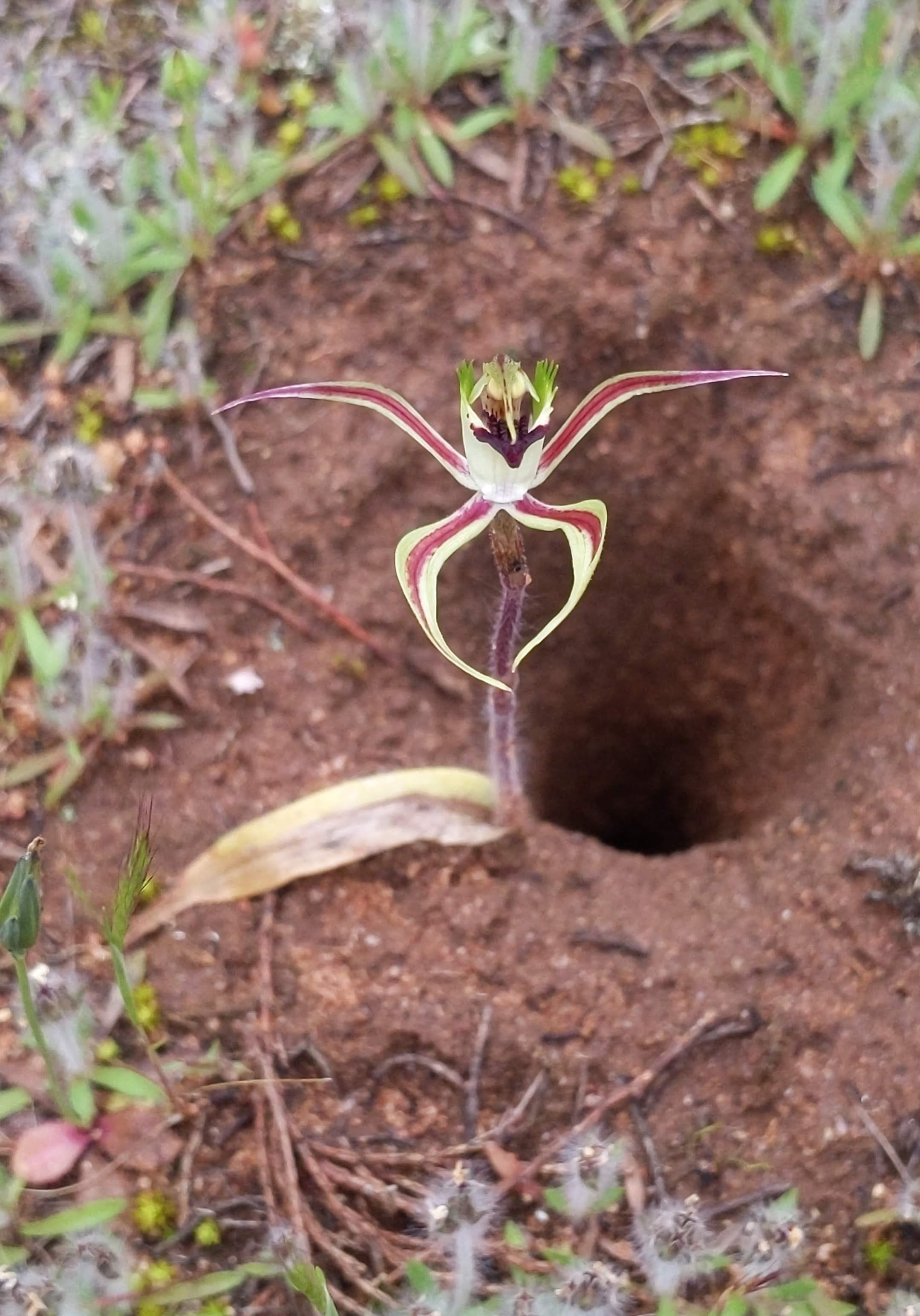
Looking closely at orchids’ relationship to soil type in the field can be illuminating as to the harsh conditions orchids can thrive in. Large areas of South Australian have soils that are very nutrient poor with a high sand and/or calcareous content. This is often the case on Yorke Peninsula and in the South East of S.A.
Orchids can also become geographically isolated by geological processes as is the case in the Grampians, Victoria.
So in conclusion:
• Orchids have been around since the Early Cretaceous (120 mya).
• Orchid evolution has not been linear – most orchid species originated over the past 5 million years.
• Southern Central America has the highest current diversification (speciation) rate of orchids.
• The initial diversification of orchids occurred in Laurasia (now North America in the Late Cretaceous (83 mya).
• Global distribution is primarily controlled by temperature and rainfall.
• Local distribution is also controlled by the physical, chemical, and biological properties of soil (which is functionally of rock type / geology).
• Local distribution is also controlled by geography, (which is function of rock type / geology).

 NOSSA
NOSSA 