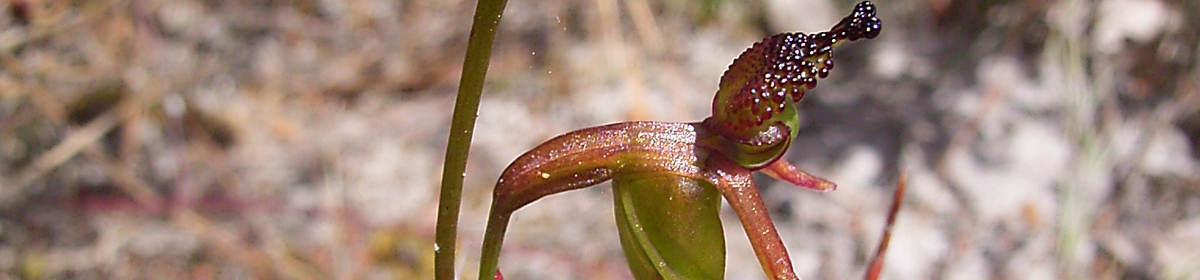
April 2014 Winning Photo

Thelymitra crinita

With a common name of Queen Orchid, Thelymitra crinita is aptly named, for the flower has a quiet regal air of elegance and delicacy that would appeal to many people. Lorraine Badger who took this photograph was one of those people.

T crinita is a common Western Australian orchid that can be found from Perth around to Albany with a disjunct area near Esperance. Back in 1839, it was one of 60 orchids named by John Lindley in ‘Appendix to the first twenty-three volumes of Edwards’s Botanical Register together with A Sketch of the Vegetation of the Swan River Colony’ page xlix. Though the register is written in English the species description is in Latin, here reproduced for all those Latin buffs –

(214)  helymitra crinita; folio radicali oblongo apiculato glabro, raceme cylindraceo, floribus purpureis, cuculli laciniis lateralibus barbatis unguiculatis intermediâ fornicatâ emarginatâ dorso glanduloso-villosâ

On a recent visit to the South Australian State Herbarium, Michelle Waycott, Chief Botanist, explained that there is a strict botanical standard for describing a species. You may  be pleased to  know  that  at  the  18th  International  Botanical Congress in Melbourne, Australia in July 2011, it was determined  that  from  the  1st January  2012  it  was  no longer mandatory for descriptions to be in Latin only. English can now be used.

March 2014 Winning Picture

03 PM Arachnorchis c

Taken at the same site as February’s winning photograph – Ramsay Conservation Park on Yorke Peninsula, the winning photograph was of an Arcahnorchis sp. by Pauline Meyers.

A positive identification was not possible due to a number of factors making firm identification difficult.  Most likely it is a hybrid of the Green-combed group of spider orchids and though not positively identified there are some things that can be observed.  The Green-combed group according to Gary Backhouse consists of three sub-groups, A dilatata (largest sub-group), A concinna and A integra, but David Jones has them as three separate gorups.

Some features of this group are

  • One of two flowers
  • Flowers mainly green or greenish and red
  • Labellum
    • Hinged and mobile
    • Maroon apex
    • Green comb-like teeth on the margins (edges)
  • Tepals (petals and sepals)
    • Green to greenish with red stripes
    • Brown to yellow clubs at the tips

From the photograph it can be seen that all the green-comb features are visible except for the clubs,  The dorsal sepal is obviously thickened but it is not as clear for the other two sepals.  This could be due to the angle of the photograph.

Another observation to note is that it is a freshly opened flower as suggested by the elongated appearance of the labellum.  As the flower ages the labellum curls further under itself.  It is important to remember that an old flower and a young flower of the same species could be mistaken as two different species.

In South Australia, species belonging to the green-comb groups are

  • A dilatata sub-group consisting of
    • A aurulenta, A clavula, A dilatata, A interanea, A macroclavia, A necrophylla,  A parva,
      A phaeoclavia, A septuosa, A stricta, A tensa, A tentaculata, A verrucosa, A villosissima
  • A concinna sub-group consisting of
    • A toxochila, A conferta
  • A integra sub-group consisting of none in South Australia

To iterate from last month – Orchids are an interesting group concerning identification.  Some are extremely easy to identify but others not so.

References:

Backhouse,  G.  (2011).  Spider-orchids  –    the  Genus Caladenia and its Relatives in Australia on CD Rom.
Jones, D. L. (2006). A Complete Guide to Native Orchids of  Australia  including  the  Island  Territories,  (2nd  ed.).  Frenchs Forest, N.S.W., Reed New Holland.
R.J.Bates.  (2011).  South  Australia’s  Native  Orchids (DVD) [Electronic Version]

Thank you to Thelma Bridle for reviewing the article.


2014 February Winning Picture

 02  85PM Arachnorchis brumalis x conferta

This month’s winner photographed by Pauline Meyers was a spider hybrid identified by Bob Bates as Arachnorchis brumalis x A conferta.

Orchids are an interesting group concerning identification.  Some are extremely easy to identify but others specifically the sun orchids, but also the spider orchids, can be difficult to identify partly due to the ease with which they are able to hybridise.

A frequent hybrid occurrence across Australia (see map for Arachnorchis distribution) is the pairing of the green comb spider orchids of the A dilatata complex with the white spider orchid of the A patersonii complex as seen in this picture.  A brumalis belongs to the A patersonii complex and A conferta to the green comb orchid.

Hybrids will be variable but obviously they will have characteristics of both parents.  By looking at the two parents it can be seen that this picture of Pauline’s contains features of both.  From the A conferta parent, the inherited features are the wide labellum of the green comb, thickened calli and the red on the segments whilst the long thin segments, glandular tips (osmophores) long and thin, not clubbed are from the A conferta.

I would like to thank Bob Bates for his helpful comments with writing this article and also Colin for his helpful website www.RetiredAussie.com with its many images of both A conferta and A brumalis which enabled me to view both species at the same time making it much easier to see the characteristics of both parents within the hybrid

ARACHNORCHIS Distribution Map sm

Reference for the map.

Australian Orchid Genera: an information and identification system
Electronic series: ABRS Identification Series
Publishers: Australian Biological Resources Study/CSIRO Publishing
Year: 2006
Authors: D.L.Jones, T.Hopley, S.M.Duffy, K.J.Richards, M.A.Clements, X.Zhang
ISBN-10: 0 643 09336 2
ISBN-13: 978 0 643 09336 2
Although originally from the disk quoted above, the map was accessed from this site
https://www.anbg.gov.au/cpbr/cd-keys/orchidkey/html/genera/ARACHNORCHIS_map.htm