
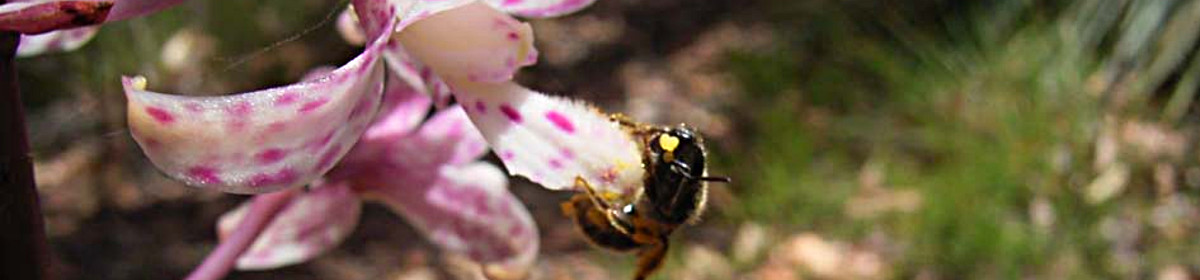
The theme for the November Photograph Competition will be Orchids and Insects (spiders and other similar small critters will be honorary insects). The April Journal of the Native Orchid Society of South Australia Vol 38 No3 had an article on how to photograph pollinators which is reprinted here below along with some pictures of orchid pollinators.
For most of us trying to photograph a pollinator is a hit or miss event.
Back in 2007 when Robert and I were still fairly new members, Bob Bates suggested we visit Talisker to photograph Dipodium – “and while you are there, photograph a bee pollinator” and “It has to be this weekend, or you will miss it” – from me “What is a bee pollinator?” So on a hot January day, the family spent the morning at Talisker. Robert busily photographing every Dipodium he saw. By early afternoon, the children were hot and tired but Robert wanted another half an hour. After more than a hundred photographs and in that last half hour Robert spotted a bee on one of the flowers only to have it disappear when it heard the shutter sound of the camera. Fortunately when we looked at the picture it showed the pollinia of the D. pardalinum on the head of a native bee – we had our bee pollinator!

The lesson we learnt from that day was to turn the shutter sound off.
Talking to Rudie Kuiter and reading his book Orchid Pollinators of Victoria 2nd edition 2013, the other factors contributing to our success were:
- a hot day,
- flowers in the sun
- after lunch
This is when the bee pollinator is most likely to be active, see page 110. Although, Rudie’s book is a compilation of his observations for specific Victorian species, there are many clues to help us successfully photograph pollinators; of which follows (direct quotes from his book are in quotation marks):
- His most important point is observation.
- “Working out how and when to catch the insects in the act of pollination is a question of finding the right flowers and figuring out about the insect’s likely visiting times. To observe the action means watching the plants for many hours and have some idea when the creatures are flying.” (Page 110)
- “Temperature and air movement play a major role in the pollination processes. On windy days the pollinator is usually not active, whilst temperatures effect (sic) the flying ability of the insects and controls the scent produced by the orchids.” (Page 110)
- Cryptostylis
- His notes infer searching before 10 am. (Page 2)
- Thynniid Wasps
- Most species become active when temperatures rise above 16⁰ C. Look for freshly opened flowers or visible pollinia. Check either the day before or in the morning. Several cool days preceding a warm day are more likely to aid success. (Page 10)
- Green combed spider orchid
- The best time seems to be a short period of not more than 30 minutes in the early morning between 10 and 11 am. In summer, the temperature can be a few degrees higher than the 16⁰ C of spring before the wasps are active. Also see note above for wasps. (Page 17)
- Mictotis sp
- “pollinators are rarely seen or photographed ….” (Page 54)
- Acianthus
- As temperature rises, the labellum develops a glossy surface which attracts the pollinator. Whilst still warm after dark, the pollinator remains active, suggesting at nocturnal pollination. See also Page 59. (Page 110)
- Cyrtostylis
- “The fungus gnats were usually seen during late mornings when temperatures rose above 11⁰ C.” (Page 64)
- Gastrodia
- “The smell becomes strongest above about 25⁰ C.” (Page 76)
- Calochilus
- “seems the wasp is only seen on the orchids when temperatures reach about 27⁰ or more.” (Page 79)
- Thelymitra
- “I watched a large number of Thelymitra peniculata on a very hot day in early November. It was coolish early in the morning and warming quickly. Flowers were still closed at 10 am, and by 11 am most were open. As a flower was about to open, one could wait for a small bee to arrive. It seemed every flower was visited within a few minutes.” (Page 80)
- Dipodium spp
- “One has to be very patient to wait for bees on these flowers. I’ve found a very hot day was best to see bees showing an interest.” (Page 84)
- Pterostylis nutans
- Pollinators are seen in the early afternoon when mid-day temperatures are 12⁰ C or more and the flowers are in the sun. (Page 94)
- Pollinators are attracted to the fresh flowers and pollination takes place within half an hour of insects flying. Once inside the flower it may take 6 – 12 minutes before they are ready to leave. (Page 110)
- Spiranthes australis
- Requires temperatures of about 29⁰ C but need to be photographed from a distance as pollinators may be easily disturbed. (Page 106)
- When looking for pollinators and wanting to get close, insect repellents should not be used and also strong perfumes may be a problem as most insects are touchy to approach.
In summary, the most likely time to photograph pollinators is when they are most active, when:
- There is a warm day following a few cooler days.
- Day time temperature has risen (relative to the season), ie late morning to early afternoon but there are exceptions.
- Flowers are freshly opened.
- Flowers are in sun, not shade.
- There is no wind.
Photographing pollinators takes planning, observation and patience but it is well worth the effort.
Rudie Kuiter’s book is available for loan from the NOSSA library.
Special thanks to Rudie for taking the time to read through and respond to this article.
Thank you to Rudie for allowing us to use two of his photographs showing pollinators.
NB The genus Genoplesium has also been known as Corunastylis.


Billiat Conservation Park
Photo: Rob Bates


 NOSSA
NOSSA 