A very popular orchid grown in culture in South Australia is the epiphytic/lithophytic Dendrobium speciosum. It is a showy species with a heady perfume.
Dendrobium speciosum (Rock Lily, Rock Orchid) in culture
This species ranges along the eastern seaboard from Queensland just peeking into Victoria. There are nine variations each with its own unique distribution.
But not only is it popular in South Australia, it is popular throughout the country. The whole of the 2006 September issue of the Orchadian was devoted to a single article on D. speciosum. The March 2016 Orchadian has three articles plus references to D. speciosum in other articles.
And then there is Gerry Walsh who is so passionate about this species that he has a comprehensive website – The Rock Lily Man – devoted to it. Explore and enjoy his website.
Attempting to divide a large Dendrobium taberi (Dendrobium speciosum var. hillii or Thelychiton tarberi) for the first time can be daunting but with a little instruction and guidance it is not quite as hard as it seems. If left, these plants just get bigger and bigger ……
… and if you would like to see a magnificent one that’s in flower, click here.
Here is my first time attempt at dividing a Dendrobium tarberi.
First the pot was allowed to dry out a bit – no watering in the days before.
A drier plant is easier to divide.
All the necessary equipment was assembled before starting
Assembled equipment including Snail repellent, Bleach for cleaning pots & equipment, wettable sulphur for putting on the fresh cuts
All equipment to be used was disinfected.
For though tough, the plants will be placed under stress making them vulnerable to the risk of infection.
The pots were washed in bleach as per instructions on the container, including the wearing of gloves.
The plant was removed from the pot by
by giving the pot some good knocks with a mallet. This loosened the plant and made it easier to remove without damaging the pot
and then it was given a good shake to remove the loose potting mix
Next the plant was examined for areas of natural cleavage which were then pulled apart.
This is the place to start dividing the plant.
The plant was still quite big so then tried using a mallet to try and loosen the plant and find more natural cleavages but wasn’t successful
The whole plant was picked up and dropped from chest height several times
This finally caused the plant to split
As the plant started separating two techniques were employed
These plants are tough – no need to use kid gloves
An axe and mallet were used to lever the larger divisions
Smaller divisions were twisted by hand
Throughout the process old roots were pulled off or cut away
Old roots are soft, spongy and dirty looking
New roots were white and firm to touch – see photograph above
Once the initial canes were divided they were examined for further division This decision can be a case of personal preference.
In the picture below this section could have been split in half but it was decided to leave as one piece
Next the split canes were well dusted with wettable sulphur
To make this easier the sulphur was put into a stocking and used like a powder puff
Before commencing the potting on, many of the dried white sheathes on the canes were removed
This can be a source of stagnant water collection resulting in rotting or infection
Finally it came to potting on. A mixture of two types of orchid potting mix was used – Orchid Mix with fertilizer and Orchid mix with 8 – 18 mm bark
The reason was that the mixture needs to be open to allow air movement. Normal potting mix would be too compact. Dendrobium are epiphytes not terrestrials but they can be grown in pots.
The canes were placed upright in the pot and the mix placed around.
As these are heavy plants, stakes were used to secure the canes upright
Each plant was then labelled
An important process so as to not get them confused with other plants – many can look similar
The name and date were written on lollypop stick
Finally the pots were given a light fertilizer, less than a teaspoon, and watering, then sprayed with Escar-go, a copper spray a snail and slug repellent.
Other grower may do things a little different from what is describe here but this is the method that was shown to us.
Lesson – breaking up is easy to do even if it is hard work, but worthwhile hard work.
The finished product – lots of lovely new plants!
PS – It did take three of us to do the one pot and so I would like to thank Jan and Sandra for their help.
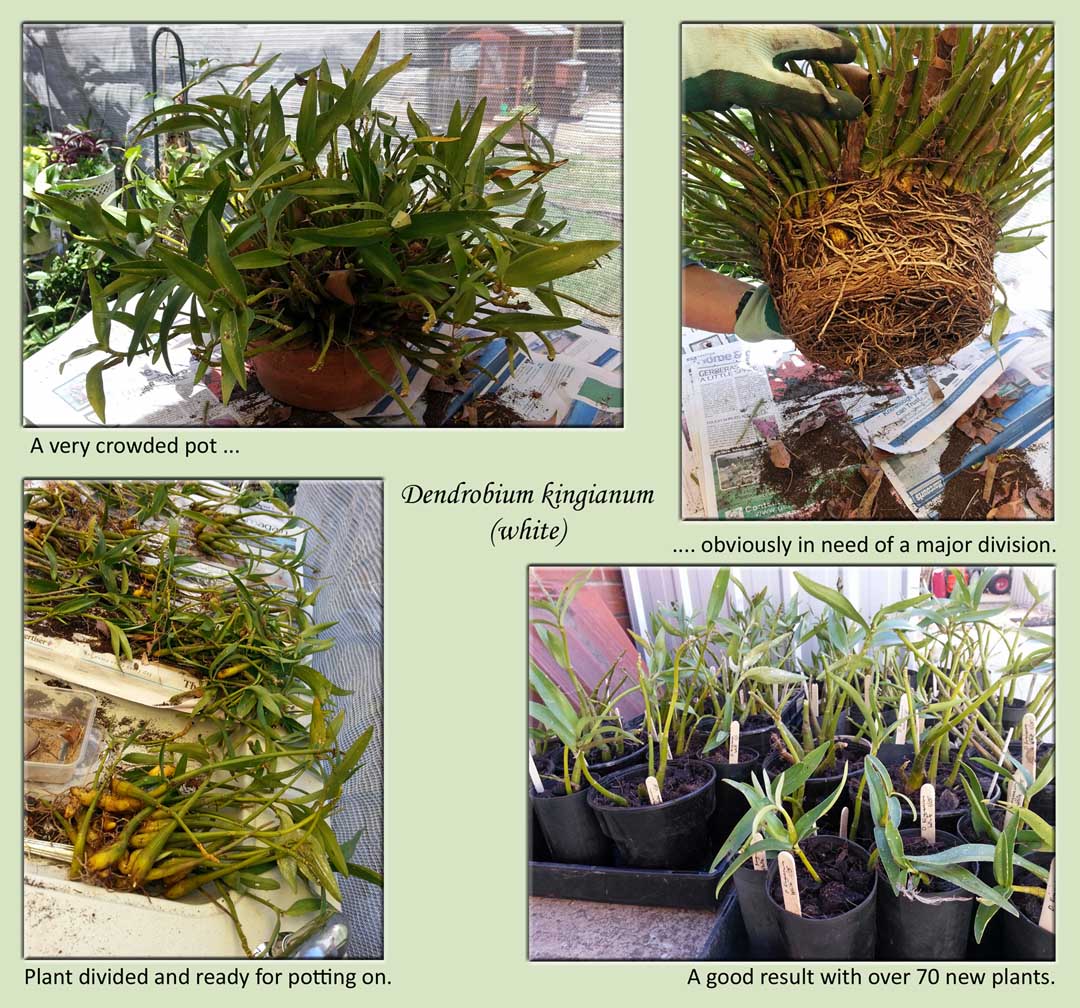
PPS – Encouraged by how easy it was to do, the following week two of us divided two other Dendrobium – D. speciosum and D. kingianum (white) but we only took pictures of the D. kingianum and to see what it will look like when it flowers, click here.



 NOSSA
NOSSA 