
Hans Herman Behr (1818 – 1904)
A physician, botanist, entomologist, lepidopterist, poet, writer, humourist and linguist.
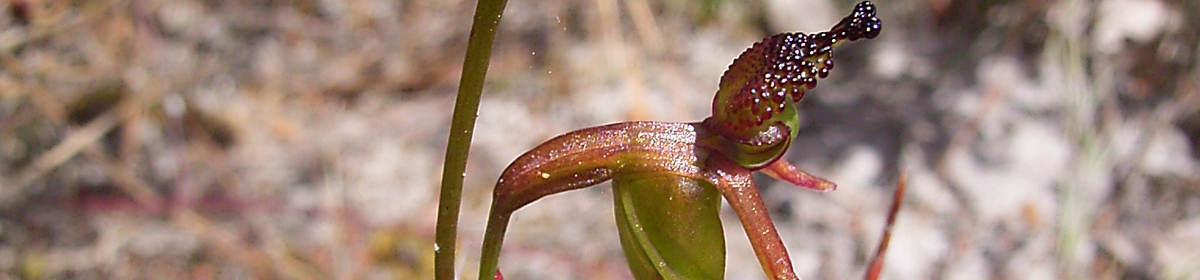
Orchid species: Arachnorhis behrii Synonym: Caladenia behrii
Hans Herman Behr (1818 – 1904)
A physician, botanist, entomologist, lepidopterist, poet, writer, humourist and linguist.
Orchid species: Arachnorhis behrii Synonym: Caladenia behrii

A photograph of a yellow sun orchid is July’s winning photograph and was taken by John Badger.
It is not difficult to identify a yellow sun orchid because amongst all of the Australian Thelymitras there are only two true yellow sun orchids. These are Thelymitra antennifera and the less common and very different, smaller T. flexuosa.
T. antennifera has a distinctive column with two reddish brown appendages resembling rabbit’s ears henc the connom name of Rabbit Ears Sun Orchid. Another common name Lemon Sun Orchid refers to the faint but recognisable lemon scent produced by the flower but as to why it should ever have been singled out from the other sun orchids to be called Women’s Caps1, I cannot tell.
Prior to flowering, the leaf distinguishes this sun orchid from others. Though having a red base like some of the other sun orchid, it is thin and rounded ie filiform and terete. Further, the closed buds are dark pink with lemon yellow margins of the sepals.
It should be noted that both T. carnea and T. rubra can on rare occasions produce a pale yellow variety but they will have all the features of their respective species. Also a T antennifera hybrid, T. x macmillanii, can on occasions produce yellow flowers.
References
Actually there is more than one.
Frequently NOSSA receives a request to identify an orchid in someone’s garden. Often, instead of an orchid (but occasionally there are orchids), it is the Ariasrum vulgare (common name Friar’s Cowl Lily or Cobra Lily).
Native to Asia and Europe, notably the Mediterranean and introduced to Australia, it is often mistaken for one of the flowers of the Pterostylis (Greenhood Orchids) or Diplodium (Shell Orchids). Some have called it a Blackhood orchid others Snake Orchid. It’s resemblance to the Greenhoods and Shell Orchids is superficial as they have none of the orchid features. The dark purple hooded part is not the flower; it is a spathe (bract). The flowers are minute hidden on deep down on the “tongue”.
The hood of the orchids is the combination of a deeply concave dorsal sepal interlocking with the lateral petals; and the fusing of the two lateral sepals. Tucked away within the hood is the labellum (a modified petal) and the column (the reproductive organs of the flower). The leaves of Ariasrum are quite large and distinctly different from any of the Greenhood orchids.


If you want to see the Helmet Orchids, now it the time of year to find them. My understanding is that the time from leaf mergence to capsule is about six weeks. In the past week I’ve seen Corysanthes diemenica (Veined Helmet Orchid) both in the north and the south of the Adelaide Hills. Corysanthes incurva ( Slaty Helmet Orchid) appears slightly later, end July early August, and will now be in bud. Look for them amongst the leaf litter.


Pauline Meyer’s winning photograph is a whole plant picture of Western Australia’s flamboyant Queen of Sheba Orchid. It was taken at Eneabba, north of Perth and identified by a local as Thelymitra variegata but in consulting the books it would appear that it is the Northern Queen of Sheba, T. pulcherrima. There are three species known as Queen of Sheba orchids in Western Australia – T. varigata, T. pulcherrima and T. speciosa.
T. variegata was originally named in 1839 by John Lindley but under the genus Macdonaldia. In 1865 Ferdinand Mueller moved it to Thelymitra, later people began to separate it out to three different species* but it wasn’t until 2009 that Jeff Jeanes describeds T. pulcherrima and T. speciosa as distinct species from T. variegata.
All three species have a single thin spiral leaf and showy multi-coloured flowers.
T. pulcherrima and T. speciosa differ from T. variegata in the following points.
| Thelymitra pulcherrima | Theylmitra speciosa | Thelymitra variegata | |
| Northern Queen of Sheba | Eastern Queen of Sheba | Southern Queen of Sheba | |
| Distribution | North of Perth between Lancelin and Dongara | Between the Stirling Range and Condingup | Between Perth & Albany with disjunct populations near Hyden |
| Flowering | late June – early September | late June – September | August to September |
| Flower numbers | 1 to 5 | 1 to 2 | 1 to 5 |
| Flower height | 150 – 350 | 100 – 200 mm | 100 – 350 mm |
| Flower size | 25 – – 35mm | 30 – 50 mm | 30 – 50 mm |
| Sepals | Yellow, red, purple and mauve | Yellow, red, purple and mauve | Deep pink purple blotched |
| Petals | Pink or purple and mauve | Pink or purple and mauve | Deep pink or purple and darker purple blotched |
For the last couple of years, NOSSA has been conducting spring tours at the Mt Lofty Botanic Gardens, South Australia, showcasing our beautiful native orchids to visitors far and wide. They have come from not only Adelaide but from interstate as well as overseas from such countries as America, Germany, England and many others. If you are planning to be in Adelaide during spring, then consider joining one of our walks, but for those who cannot attend here is a video for you. So watch and enjoy …….
Richard Sanders Rogers (1862 – 1942)
An Adelaide physician, doctor-soldier and forensic pathologist who described 82 new orchid species (66 from Australia).
Orchids
Diplodium rogersii (= Pterostylis rogersii) or Curled Tongue Shell Orchid
Prasophyllum rogersii or Marsh Leek Orchid

