Orchid Blogs

South Australian Terrestrial Orchid Culture Notes Part Four of Four Parts

Re-establishing Orchids

Replanting in bushland should be restricted to orchid species that grow or once grew in the local area. No hybrids please.

If planting out in the garden or bush, choose a location with good air movement and winter sun and a thin layer of surface mulch. Slashed native ground cover is good. Native terrestrial orchids cannot stand competition from weeds, grasses, slugs and snails and scratching blackbirds (all introduced pests). They will rot away in dense weeds or dense understory plants. If in a frost prone area they may need overhead protection from a shrub or trees. For plants in growth, dig out a hole a little bigger than the tube. Knock out the tube and insert the contents into the hole and backfill with as little disturbance as possible. Dormant tubers can be planted in a furrow, 50mm or more deep, and backfilled just like planting beans. Water in. The colony forming species will spread out and form patches of plants over a period of several years.

Orchid seed is like fine dust and can be mixed with fine dry sand to help spread it over a large area. Broadcast using a pepper-shaker over a suitable site. Results are dependent on the season and whether fungi are present. This method is slow to show results as flowers may not be seen for 5 to 10 years after seed is sown. More seedlings germinate if there are mother plants already growing.

Pot of Arachnorchis argocalla

A pot of Arachnorchis argocalla, 40 cm tall (Fungi Dependent)

To learn more about re-establishing orchids in the bush, visit the Vale Park Our Patch website to see the work being done by Heather Whiting and her team.

South Australian Terrestrial Orchid Culture Notes Part Three of Four Parts

Maintenance throughout the year

Summer

  • During summer, very lightly water surface of pots weekly to prevent tuber desiccation especially if dormant seedlings are in the pot.
  • Divide overcrowded pots in summer. Tip out and break into slices like cutting a cake. Stand a slice in a new pot & fill spaces with fresh mix. Take care to keep the surface layer at the surface of the new pot.
  • Add fresh leaf litter to surface layer in January to February to March.
  • If surface moss gets too thick, peel it off and discard in summer.

Autumn

  • Start heavier watering of pots weekly from mid March.
  • Mix seed with fine dry sand and sprinkle on mother pots in April.
  • Water as required in autumn, winter & spring so that pots never dry out during the growing season yet are not soggy wet.
  • Leaves appear from Anzac Day to June.

Winter

  • Look for flower buds down inside the largest leaves from mid July onwards.
  • Look for new seedling leaves from August to October.

Spring

  • Enjoy and photograph flowers September to November.
  • Hand-pollinate flowers in September – October. Flowers collapse within days of fertilisation.
  • Collect seed pods as they turn brown just before they split open in November – December.
  • Dry & store seed over summer in paper envelopes kept indoors.
  • Allow pots to slowly dry out in mid – late November to induce dormancy and ripen tubers. Plants die down completely in summer to underground tubers.

For further information on growing fungus – dependent orchids refer to:

  • Orchids Australia’ February 2006, P58, or ‘The Orchadian’ Vol 15, Number 3, March 2006, P100.

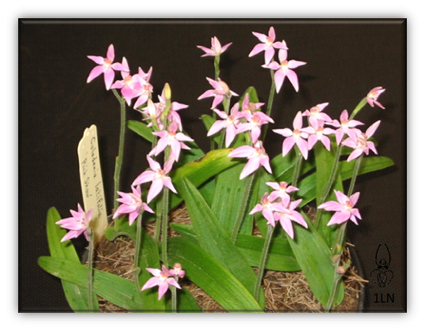
Pot of Caladenia latifolia cultivated by Les Nesbitt

Caladenia latifolia cultivated by LN (Fast Multipler)

South Australian Terrestrial Orchid Culture Notes Part Two of Four Parts


Terrestrial Orchid Cultural Groups

Terrestrial orchids can be placed into one of three groups that have similar cultural requirements.

  • Fast multipliers with an annual increase rate greater than 1.5
  • Slow multipliers with an annual increase rate less than 1.5
  • Fungus dependent orchids survival rate less than 1

Fast multipliers (FM):

Fast multipliers are the easiest deciduous terrestrials to grow and potfuls are regularly seen at orchid meetings and shows. They multiply rapidly by forming 2 – 4 tubers per plant each year. They will take some fertiliser and grow better if repotted annually. It is usually not commercially viable to grow seed of these in flask. They will grow well in premium potting mix from your local hardware store with some sand added. This group contains many genera including Acianthus, Chiloglottis, Corybas, Cyrtostylis, Diplodium, Leptoceras, Microtis, Pterostylis and some species from Caladenia, Diuris and Thelymitra.

Slow multipliers (SM):

Slow multipliers are not so easy because there is less room for error. Some very showy Diuris, Pterostylis and Thelymitra fall within this group. A few have a near zero increase rate and will fade away unless additional plants can be produced to make up for occasional losses from predators and disease. They are more expensive because they have to be raised from seed in flasks. Flowering plants are hand pollinated and the seed collected just before the pods split open and the dust-like seed blows away. The pull-off-the-tuber method can be used with some Diuris and Pterostylis species to double plant numbers annually. Do not fertilise these except when repotting. Those with large tubers such as Thelymitra nuda and Diuris behrii should be the first to be repotted in November – December.


Fungus dependent orchids (FD):

Some of Australia’s most fascinating orchids rely on a symbiotic fungal association to obtain nutrients from the soil as these orchids have virtually no roots. The majority of Australia’s terrestrial orchids are in this group and many are rare plants as they seldom multiply. We talk about survival rates for these orchids that are normally less than one. Propagation is from seed. They have a reputation for being difficult to grow in pots. However some species have been kept alive in pots for nearly 30 years. Never use fertiliser because it can kill the fungi. They should be repotted only when the tubers reach or come out of the bottom of the pot or seedlings get too crowded. A new thin layer of leaf litter is added to the surface each summer to feed the fungi which is active near the surface. Flowers are hand pollinated to get seed. Seed is sprinkled on the pots each autumn and with good culture, seedlings will appear in spring around mother plants.

Since the fungus cannot be seen with the naked eye, the health of the leaves is used to indicate that the fungal relationship with the orchid is working. If seed is sown in autumn, by springtime, when mature orchids flower, there may be a new crop of tiny seedling leaves around the base of the large mother plants. The appearance of new seedling leaves around mother plants each spring confirms that the fungal relationship is healthy. Seedlings take 3 – 5 years to reach flowering size.


Important Rules

  • Use a mix that is at least 50% sand. The bottom of the pot can be pure sand.
  • Never use fertilisers (fertilisers can kill fungi).
  • Feed the fungus by adding new leaf litter on top of the old litter layer each summer. Chopped up sheoak needles or gum leaf stalks/nuts are recommended.
  • Do not repot unless absolutely necessary (eg the tubers come out the bottom of the pot, overcrowding, disease).


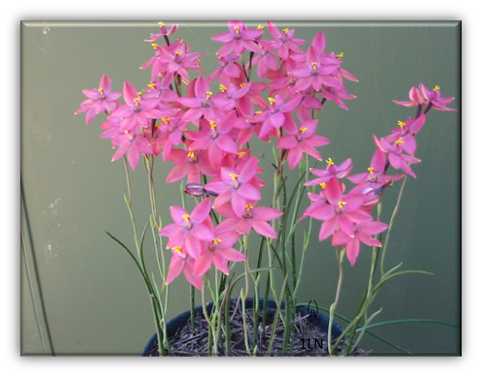
Pots of Thelymitra nuda cultivated by Les Nesbitt

Thelymitra nuda cultivated by Les Nesbitt (Slow Multipler)


South Australian Terrestrial Orchid Culture Notes Part One of Four Parts

Les Nesbitt is a founding member of the Native Orchid Society of South Australia and is our most experienced terrestrial orchid grower.  The following four posts on growing are from his notes and pictures .


Introduction

Australian terrestrial orchids have been grown in pots in Adelaide for more than 50 years. Nowadays with a wider range of species and hybrids available there are an estimated 300 cultivars successfully growing here. When the cultivation of the fungus dependent terrestrials is fully understood this number will increase dramatically.

Australian ground orchids are cool climate plants that follow an annual growth cycle comprising 6 – 8 months as growing plants under cool (5 – 20°C max, 0 – 14°C min) moist conditions and 4 – 6 months as dormant tubers in hot dry (18 – 40°C max, 12 – 30°C min) conditions. All species like good air movement and will not thrive in a stuffy humid atmosphere especially if temperatures are high.

Growing Area

In South Australia, terrestrials are grown in shadehouses with 50% cloth on the roof and sides. This lets the rain soak the pots and flush out salts from tapwater use. Some growers add a second layer of 50% shadecloth in summer to lower pot temperatures.

It is very important that winter sun and breezes reach your plants so place the shadehouse away from the winter shadows of buildings and evergreen trees. A shadecloth cover or evergreen tree to the southwest and overhead will give protection from frost, hail and storms. Light frosts of -2°C do not worry the majority of species. Galvanised mesh benching about 750mm high will deter slugs and snails and is a convenient height for observing the pots. Watering with rainwater is better than Adelaide tap water. Fungi and orchids do not like salt.

Light

Some species prefer heavy shade, others full sunlight, but most will adapt to a wide range of light intensity. If the leaves and stems are weak and limp or if the rosettes are drawn up to the light, then the shading is too dense and the amount of light should be increased. The spring flowering species like higher light intensities at flowering time and flowers may have pale colours under dull conditions.

Watering

The soil should be kept moist at all times during active growth by watering gently if there is no rain. Hand watering is especially necessary in spring as soil in pots dries out more rapidly than in the garden. Watering must be done slowly so that the mat of needles on the surface of the pot is not disturbed. If pots are allowed to dry out during the growing season, the plants may go dormant prematurely.

Pests and diseases

Slugs and snails love these plants and must be kept under control. Raising the pots off the ground on galvanised steel benching is very effective in controlling these pests. Thrips, aphids, red spider and caterpillars may cause damage. Blackbirds can scratch out small orchids. Various rots can destroy plants. Orchids showing virus like symptoms should be burnt or dumped.

Fertilising

Be very careful with fertilisers because some terrestrials are easily burnt or even killed by overuse. Diuris and Pterostylis are very hardy and will benefit from weak applications of foliar feed in the early growth stages.

Repotting

The new tubers are produced in winter – spring. The fast multiplying types form several tubers per plant each year. Sometime in October – November, the leaves go yellow and then brown and dry, as the days get longer, hotter and drier in late spring. After the leaves have turned yellow, let the pot dry out completely to dry up the old roots and tubers otherwise they may turn into a soggy mouldy mess and rot may destroy the adjacent new tubers.

The pots can be knocked out and the tubers examined in summer without harm, in fact we find at the Nursery that the best results are obtained if the tubers are repotted in half fresh soil mix each year. Our soil mix is 40% loam, 50% sand and 10% organic matter with a little blood and bone fertiliser added. A 5 mm sieve is a useful tool for separating tubers from soil. Replant the dormant tubers with the tops 20 mm deep. Cover the soil surface with a mulch of sheoak needles, chopped to 20 – 50 mm lengths, to prevent soil erosion & aerate under the leaves. Repotting is normally done in November, December, January and February in South Australia. Ideal pot sizes are 125 – 150 mm standard plastic pots.

Keep the pots shaded and allow the pots to dry out between light watering until mid February when they should be set out in their growing positions and watered a little more often. The tubers of some species will rot if kept wet during the dormant period, others will produce plants prematurely which are then attacked by pests such as thrip and red spider and fungal diseases in the warm weather. Each tuber sends up a shoot to the surface in autumn and leaves grow rapidly in late autumn – early winter as temperatures fall and the rains set in. Pterostylis are usually the first to appear in March followed by Diuris and Thelymitra in April, Caladenia in May and Corybas in June – July.

Sun loving species like Diuris, Microtis and Thelymitra prefer a brighter location for good growth. Corybas like the shadiest corner in winter.


Pot of Thelymitra Kay Nesbitt Cultivar copy

Thelymitra ‘Kay Nesbitt’ cultivar (Fast Multiplier)


March 2014 Winning Picture

03 PM Arachnorchis c

Taken at the same site as February’s winning photograph – Ramsay Conservation Park on Yorke Peninsula, the winning photograph was of an Arcahnorchis sp. by Pauline Meyers.

A positive identification was not possible due to a number of factors making firm identification difficult.  Most likely it is a hybrid of the Green-combed group of spider orchids and though not positively identified there are some things that can be observed.  The Green-combed group according to Gary Backhouse consists of three sub-groups, A dilatata (largest sub-group), A concinna and A integra, but David Jones has them as three separate gorups.

Some features of this group are

  • One of two flowers
  • Flowers mainly green or greenish and red
  • Labellum
    • Hinged and mobile
    • Maroon apex
    • Green comb-like teeth on the margins (edges)
  • Tepals (petals and sepals)
    • Green to greenish with red stripes
    • Brown to yellow clubs at the tips

From the photograph it can be seen that all the green-comb features are visible except for the clubs,  The dorsal sepal is obviously thickened but it is not as clear for the other two sepals.  This could be due to the angle of the photograph.

Another observation to note is that it is a freshly opened flower as suggested by the elongated appearance of the labellum.  As the flower ages the labellum curls further under itself.  It is important to remember that an old flower and a young flower of the same species could be mistaken as two different species.

In South Australia, species belonging to the green-comb groups are

  • A dilatata sub-group consisting of
    • A aurulenta, A clavula, A dilatata, A interanea, A macroclavia, A necrophylla,  A parva,
      A phaeoclavia, A septuosa, A stricta, A tensa, A tentaculata, A verrucosa, A villosissima
  • A concinna sub-group consisting of
    • A toxochila, A conferta
  • A integra sub-group consisting of none in South Australia

To iterate from last month – Orchids are an interesting group concerning identification.  Some are extremely easy to identify but others not so.

References:

Backhouse,  G.  (2011).  Spider-orchids  –    the  Genus Caladenia and its Relatives in Australia on CD Rom.
Jones, D. L. (2006). A Complete Guide to Native Orchids of  Australia  including  the  Island  Territories,  (2nd  ed.).  Frenchs Forest, N.S.W., Reed New Holland.
R.J.Bates.  (2011).  South  Australia’s  Native  Orchids (DVD) [Electronic Version]

Thank you to Thelma Bridle for reviewing the article.


Orchid Walks at Mt Lofty Botanic Gardens

For the last couple of years, NOSSA has been conducting spring tours at the Mt Lofty Botanic Gardens, South Australia, showcasing our beautiful native orchids to visitors far and wide.  They have come from not only Adelaide but from interstate as well as overseas from such countries as America, Germany, England and many others.  If you are planning to be in Adelaide during spring, then consider joining one of our walks, but for those who cannot attend here is a video for you.  So watch and enjoy …….


Orchids and Fire

Bushfires are a part of the Australian landscape.  The effect upon people and animals can be devastating but what of their effect upon orchids?  In 2012, Mike Duncan published a report Response of Orchids to Bushfire, Black Saturday 2009 for the Victorian Department of Sustainability and Environment.

Page one is a good summary of the effects experience by the orchids in Victoria:

This project addresses general community concerns about the response of orchids to the 2009 bushfires, by documenting the range of orchid responses encountered across all fire affected areas.  The information presented in the report is the result of data synthesis and direct field observations from a variety of sources, collected during the two years since the fires.
The response of orchids to the February 2009 bushfires was diverse, spanning the spectrum from being killed by fire, to being totally dependent upon the fire to flower.  In this report, the spectrum of responses that were encountered have been divided into five broad categories.

1. Fire Killed Species
Populations of epiphytes (e.g. Sarcochilus australis) and terrestrials with shallow tubers (e.g. Thynninorchis huntianus) were killed by the intense fire front.  In some cases, these species are likely to recolonise by seed from nearby unburnt areas, but in other cases, these species may require conservation intervention to assist in their recovery.

2. Fire Sensitive Species
Species such as Pterostylis alveata and Corunastylis despectans appear to have been sensitive to the bushfire, showing a large reduction in emergence over the following two years.  Populations of these species are likely to recover naturally over a number of years.

3. Fire Neutral Species
The response of the winter and spring flowering Pterostylis species were generally fire neutral, with their flowering rates neither increasing nor decreasing in the two years since the bushfire.

4. Fire Stimulated Species
The flowering of many Caladenia, Diuris, Prasophyllum and Thelymitra species was strongly stimulated by the 2009 bushfire, creating spectacular patches of massed flowering in the fire-blackened landscape.  Similarly, many smaller genera (e.g. Pheladenia and Glossodia) also showed a strong increase in flowering in response to the bushfire, sometimes producing clumps of more than 20 flowering plants.

5. Fire Dependent Species
There are four species (Burnettia cuneata, Pyrorchis nigricans, Leptoceras menziesii and Prasophyllum australe) that are dependent upon fire to flower.  These species are able to survive for extended periods without flowering.  Stimulated by the occurrence of the 2009 bushfire, these four species flowered en masse during spring 2009 (and to a lesser extent in spring 2010); the first time most of these plants have flowered since each site was last burnt.
Four nationally threatened orchid species (Caladenia concolor, C. orientalis, C. tessellata, and Pterostylis chlorogramma) occur within the area affected by the 2009 bushfire.  These species are part of an ongoing monitoring program, and the collected data offers an opportunity to quantify the post-fire flowering response of these species.  The data showed that grazing had negatively impacted seed production in each species since the 2009 bushfire.  It would also seem reasonable to assume that similarly high levels of grazing have occurred to other orchid species during this period.  A reduction in seed production is an important concern to any orchid species, but it is of particular concern to fire sensitive species, as it will lengthen the recovery time for these populations.  A reduction in seed production represents a lost opportunity for species that are fire stimulated or fire dependent, in terms of achieving recruitment to a population.  Fire-affected populations of these species will require careful management to ensure that seed production is not compromised into the future.

To see the full report, click here .………

2014 February Winning Picture

 02  85PM Arachnorchis brumalis x conferta

This month’s winner photographed by Pauline Meyers was a spider hybrid identified by Bob Bates as Arachnorchis brumalis x A conferta.

Orchids are an interesting group concerning identification.  Some are extremely easy to identify but others specifically the sun orchids, but also the spider orchids, can be difficult to identify partly due to the ease with which they are able to hybridise.

A frequent hybrid occurrence across Australia (see map for Arachnorchis distribution) is the pairing of the green comb spider orchids of the A dilatata complex with the white spider orchid of the A patersonii complex as seen in this picture.  A brumalis belongs to the A patersonii complex and A conferta to the green comb orchid.

Hybrids will be variable but obviously they will have characteristics of both parents.  By looking at the two parents it can be seen that this picture of Pauline’s contains features of both.  From the A conferta parent, the inherited features are the wide labellum of the green comb, thickened calli and the red on the segments whilst the long thin segments, glandular tips (osmophores) long and thin, not clubbed are from the A conferta.

I would like to thank Bob Bates for his helpful comments with writing this article and also Colin for his helpful website www.RetiredAussie.com with its many images of both A conferta and A brumalis which enabled me to view both species at the same time making it much easier to see the characteristics of both parents within the hybrid

ARACHNORCHIS Distribution Map sm

Reference for the map.

Australian Orchid Genera: an information and identification system
Electronic series: ABRS Identification Series
Publishers: Australian Biological Resources Study/CSIRO Publishing
Year: 2006
Authors: D.L.Jones, T.Hopley, S.M.Duffy, K.J.Richards, M.A.Clements, X.Zhang
ISBN-10: 0 643 09336 2
ISBN-13: 978 0 643 09336 2
Although originally from the disk quoted above, the map was accessed from this site
https://www.anbg.gov.au/cpbr/cd-keys/orchidkey/html/genera/ARACHNORCHIS_map.htm

Winning Picture for November 2013 Paracaleana Minor Section

The winner for Part two of November’s competition, Paracaleana minor (Little Duck Orchid) was David Manglesdorf.

In  South  Australia,  though  much  smaller  than  its  big brother  –  Caleana  major,  it  still  suffers  from  similar problems  ie  lack  of  pollinator,  vulnerable  status, extremely limited distribution within the Southern Lofty region.   The  Little  Duck  is widespread  in  the  east extending  from  Queensland  down  around  into  the South  East,  as  well  as  across  to  Tasmania,  plus  one other distant location.

One  of  the  differences  between  the  two  species  is that the minor  is  able  to  set  seeds  without  insect pollination occurring.  Could this possibly help provide an explanation for its other location?

There  is  one  colony  near  the  very  popular  tourist resort  of  Rotorua,  New  Zealand  where  it  is  called Sullivania minor,  (Paracaleana minor  is  recognised  as a synonym).  According to Graeme Jane it has been there ‘over a very long period’.  The speculation is that it  ‘could  have  arrived  during  one  of  those  periodic severe  bushfire  seasons  in  eastern  Australia  when
smoke, ash and apparently orchid seed and insects are carried high into the atmosphere and brought eastwards in  the  jet  stream  in  a  few  hours.   More  likely  though (since it has occurred nowhere else), it arrived in soil on the shoes of a visitor to the thermal wonderland.’

Just  some  food  for  thought  as  to  how  plants  may spread  around  the  world  –  but  it  still  doesn’t  take away  from  the  fact  that  it  is  also  another  one  that cannot  be  cultivated  and  needs  to  protected  where it naturally  grows  if  we  are  to  continue  to   enjoy  this species.

References:
Department Of Environment And Heritage. 2008.
Paracaleana minor: Small Duck-orchid.  Adelaide and Mount Lofty Ranges South Australia: Threatened Species Profile, May 2008.

Jane, G. 2006. Caladenia alata at Rainbow Mountain -Dispelling a Myth. [online]  Available at: http://www.nativeorchids.co.nz/Journals/98/page17.htm  [Accessed: 7 Feb 2014].

An Orchid You Can’t Buy or Grow

Question

I like the Flying Duck orchid.  It is truly a beautiful plant.  Where can I buy one?

Answer

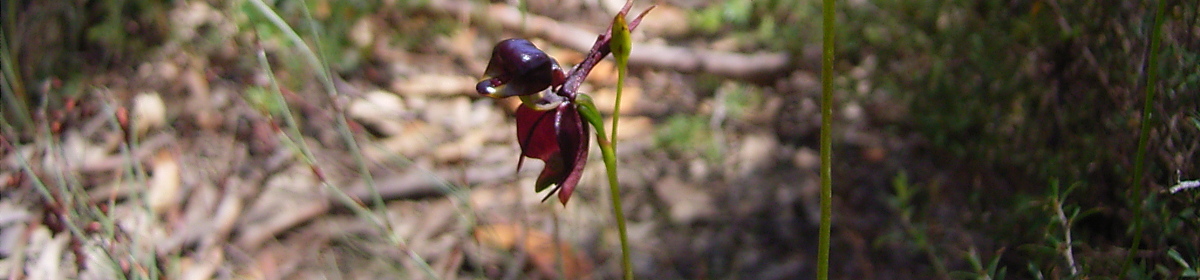
The Flying Duck orchid or Caleana major is an unusual and unique flower.  Unfortunately, despite many attempts, no one has been able to cultivate it, so there is no supplier able to sell it.

It is a protected plant and it is illegal to remove it from the bush.  See the November Photo Competition 2013 for more details