SWAMPED WITH Sth Oz ORCHIDS

In 2017, Mark Bachmann of Glenelg Nature Trust spoke at NOSSA on The Hydrological Restoration of Glenshera Swamp, Stipiturus Conservation Park. See the article of his talk here. On 2025, Ben Taylor also from Glenelg Nature Trust gave a talk with an update of the restoration work at Stipiturus. See Ben’s talk here. These talks were both encouraging but it begs the question of what is happening to orchids in the swamps? Of which the first question is – what orchids are there?

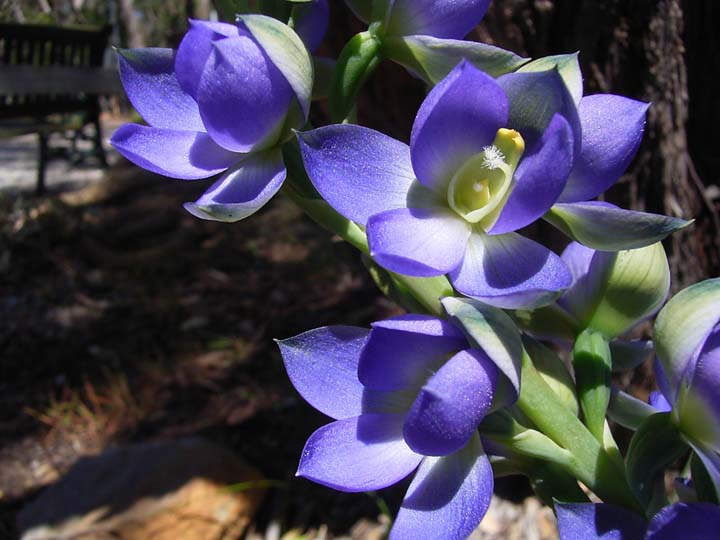
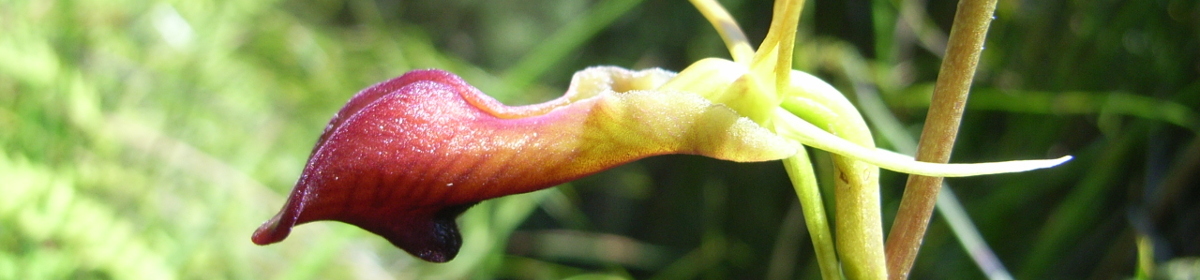
Thelymitra cyanea

In the blog on Mark’s talk, three swamp orchids were mentioned in the article but there are many more swamp species, as Bob Bates points out in the quote below from South Australian Native Orchids 2011 indicates.

In general, the orchid flora of bog, swamp, marsh or morass will be highly specific and although there is less than 0.1% of the state which could be termed swampy, some 20% of our orchid species are confined to such wet habitat. Put simply: all of the orchids of swamps are highly threatened as the swamps are either much sought after for grazing and cultivation or they are drained, as in hundreds of square kilometres of the South East.

Some 20 different classes of swamp can be recognised and some orchids are confined to just one microhabitat in these. For example, the tiney swamp helmet orchid Anzbas aff. fordhamii has only ever been seen on the mossy edges of small mounds in peat bogs! The genus Hydrorchis only frequents the sedgy edges of winter wet waterholes. It is something of a paradox that our driest state should have one of the world’s few aquatic orchids!

Some of the types of swamps Bob mentions in his disc are hanging bogs (perched on the sides of hills), sphagnum bogs, peat swamps, limestone swamps, sand swamps, tea-tree swamps, etc. So it is not surprising that the types of orchids associated with these habitats are also quite varied.

20% or one fifth seems a high figure for wetlands but depending upon the taxonomic classification it is feasible. A perusal through both Bates 2011 and June Niejalke’s 2022 Native Orchids of South Australia yields an interesting list of about 49 swamp associated species out of about 300 species.

Cryptostylis subulata (Moose Orchid)
GENUSIN SWAMPSMARGINS (but not in)
Caladenia
C. congesta
C. dilatata
C. riparia
C. venusta
C. vulgaris
CalochilusC. paludosusC. robertsonii
C. herbaceous
CorybasC. fordhamiiC. aff. diemenicus
(syn Corysanthes arcana)
CryptostylisC. subulata
DiurisD. inundata
EriochilusE. paludosus
GenoplesiumG. nudum
MicrotisM. atrata
M. oblonga
M. orbicularis
M. rara
M. arenaria
M. parviflora
PrasophyllumP. murfetiiP. austale
P. frenchii
PterostylisP. falcata
P. lustra
P. tenuissima
P. uliginosa
P. melagramma
P. nutans
SpiranthesS. alticola
S. elytra
ThelymitraT. aristata
T. circumsepta
T. cynea

T. holmesii
T. hygrophila
T. lucida
T. abrupta
T. antennifera
T. cyanapicta
T. flexuosa
T. ixiodies
T. x merraniae
T. mucida
T. orientalis
T. pauciflora
T. peniculata
T. polychroma
T. rubricaulis

As can be seen most genera are represented in the swamp/margins list. Although two noticeable exceptions not represented were from the dryland Pterostylis segregate genera Hymenochilus and Oligochaetochilus.
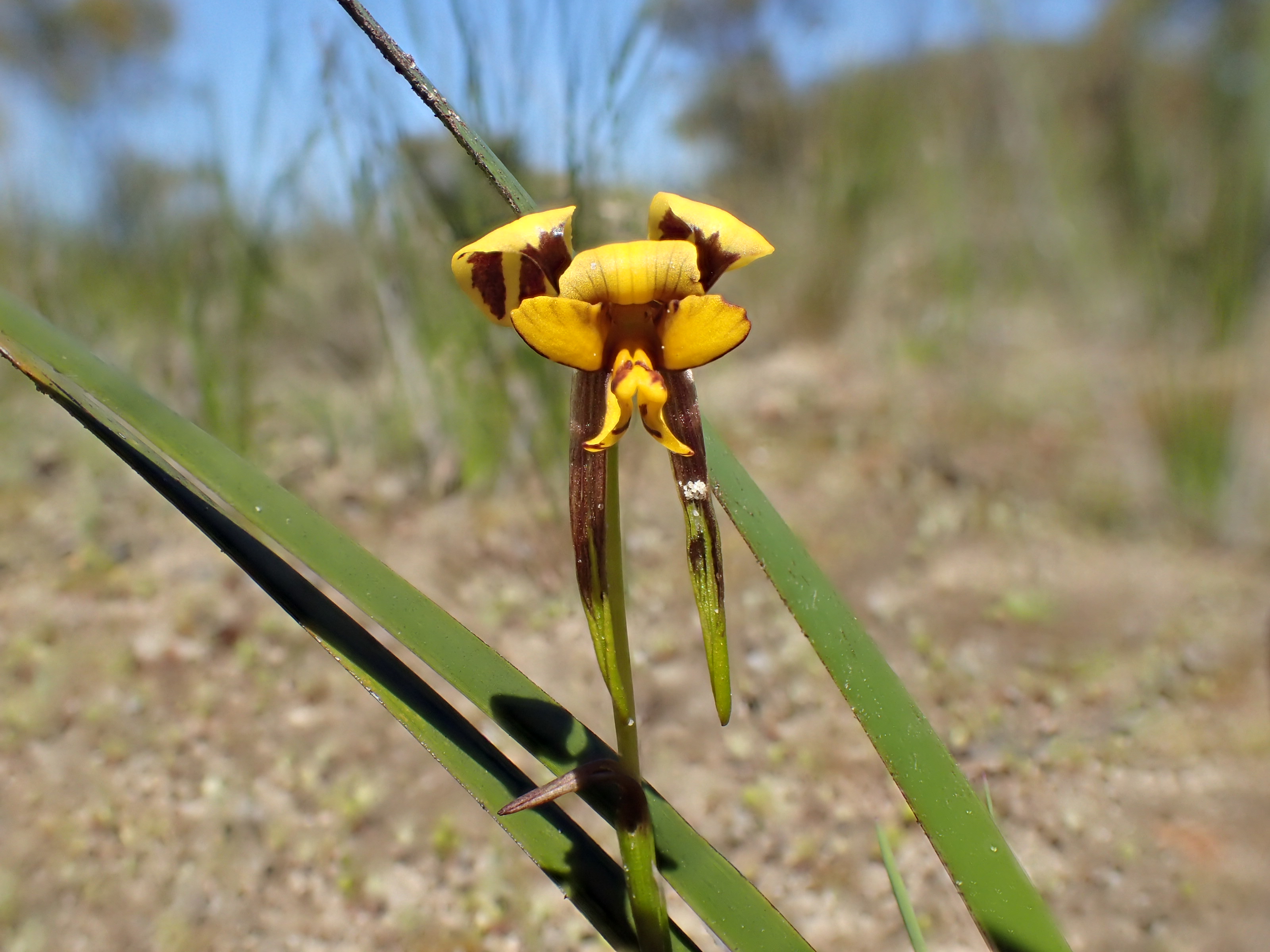
Diuris palastris

As a curiosity, it should be noted that one species Diuris palustris whose Latin name palustre suggests it should be swamp dwelling, is in South Australia not found in our swamps but instead is associated with grassland, heath and mallee. In contrast, in the eastern states, it is found in swampy depressions. This is in contrast with some South Australian swamp orchids, such Cryptostylis subulata, which in the eastern states, are found in low open forests. As is the case for Thelymitra cyanea, found on heathy hillside in Tasmania.
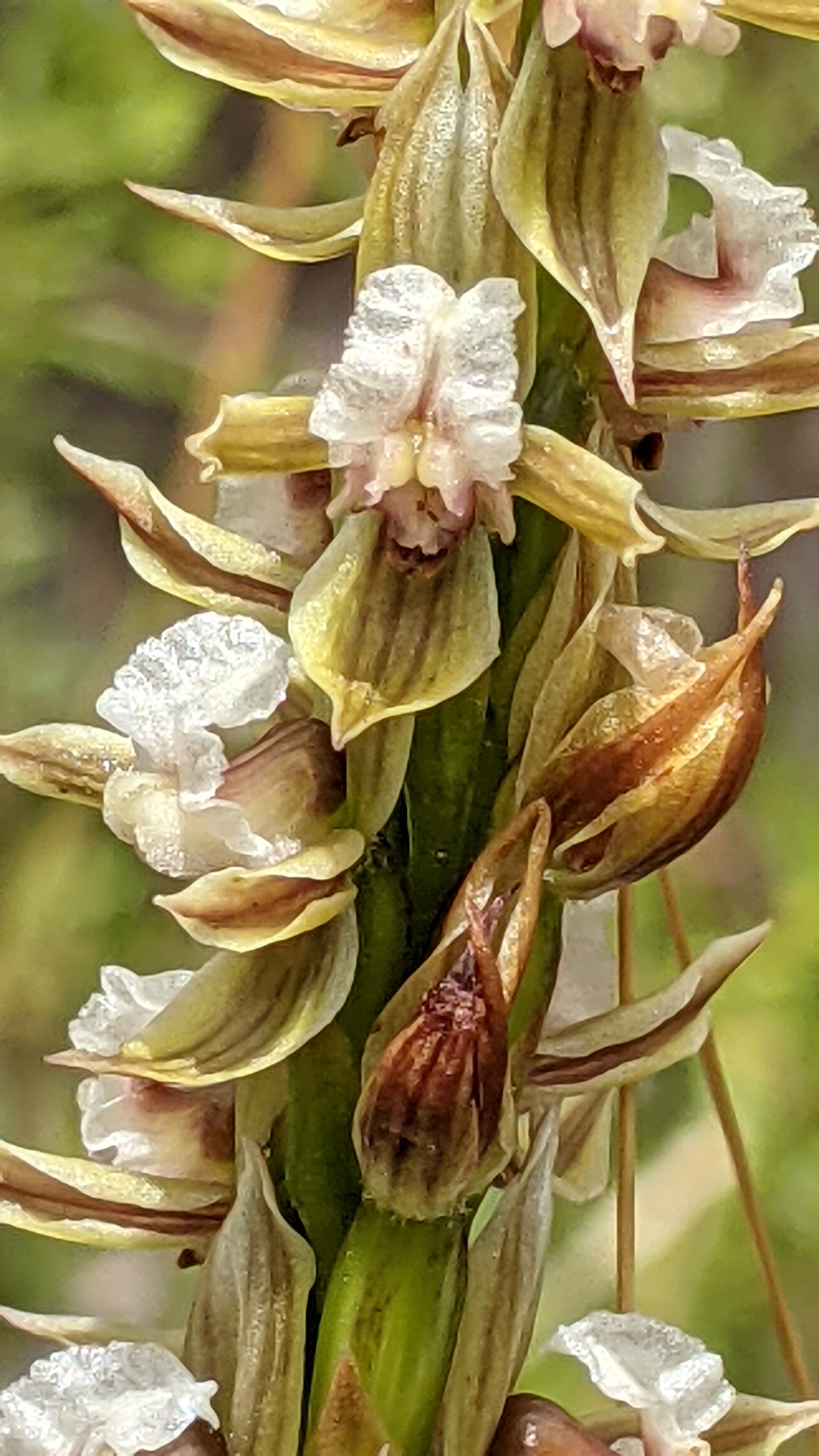
Prasophyllum australe - Kuitpo, January 2021
Prasophyllum australe – Kuitpo, January 2021

Swamps are significant for many different reasons. But considering that we are loosing so many of our orchid species, loosing swamps means loosing a significant number of our orchids. It is therefore encouraging to see the work of Glenelg Nature Trust in restoring swamps. Will it benefit our orchids? We hope so.
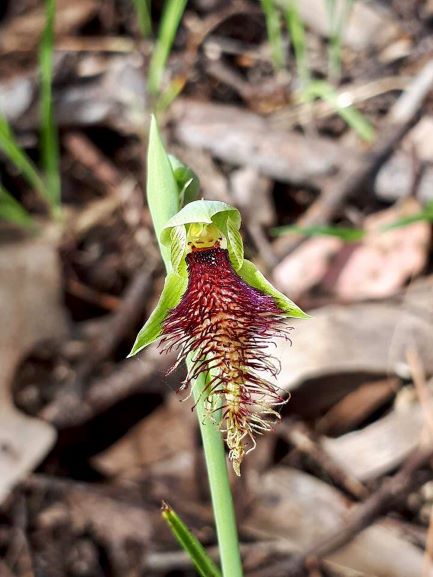
Calochilus robertsonii

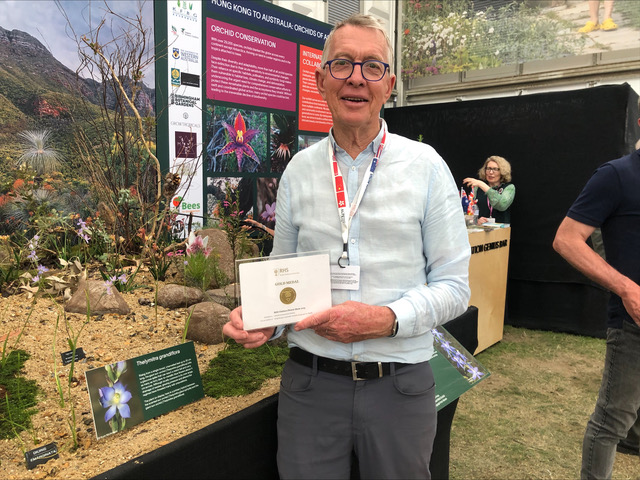
From Humble Potato to South Aussie Grand  Orchids: Gold at Chelsea

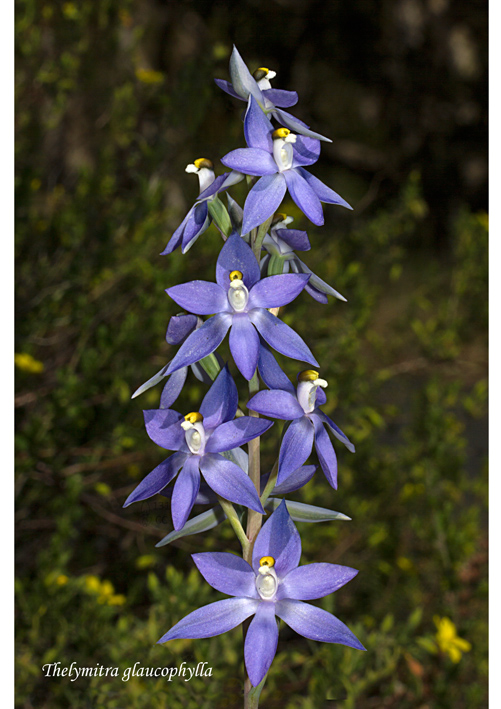
So the news is out – Aussie orchid (as part of a display with South east Asia and the Pacific) wins Gold Medal for conservation at the 2025 Chelsea Flower Show and according to Professor Kingsley Dixon this is the equivalent to winning Gold at the Olympics. One orchid was a hybrid, Thelymitra glaucaphylla x grandiflora.

Professor Kingsley Dixon (Image from Australian Orchid Foundation)

The Chelsea Flower Show is a prestigious event managed by the Royal Horticulture Society (RHS) who’s beginnings start with the presentation of a potato at a 1805 meeting. Over time, various exhibitions were developed with the Flower Show Fete first held at Cheswick in 1827 and moving to Chelsea Hospital in 1913  where it became known as the Chelsea Flower Show. The show was popular with exhibitors but only half of the applicants were accepted that first year. But in that group, McBean Orchids (Britain’s oldest orchid nursery) was one of the fortunate exhibitors and so orchids have always been present at the Show, though they were generally not terrestrial orchids.

Image from Australian Orchid Foundation

To win such an award, the team needed to put together a meticulously curated display to meet the RHS stringent standards; even a wrong font can result in disqualification. But there were other barriers to be overcome. Australian terrestrial orchids are not easy to grow. They require skill and attention to detail. Not many people are able to grow this exquisite orchid. In fact less than 10% of our orchid species are in cultivation. So this was quite an achievement in itself.

Thelymitra grandiflora (Photographer Robert Lawrence)

Over 90% of Australian orchids are unique to Australia with about half considered threatened;  and so though T glaucophylla does not have a rating, it is still under threat being uncommon. T grandiflora is rated rare. Both are endemic to similar limited areas in South Australia. That is the Southern Mt Lofty Ranges and the Southern Flinders Ranges. Both are under threat from habitat loss, weed invasion, grazing, trampling, etc.  So in-situ conservation is important if these, as well as other orchids, are to survive. 

Working toward conservation of Australian orchids is a major pillar of NOSSA and it was encouraging that two of South Australian endemics played a part in this display. Congratulations for the immense effort that Kinsley Dixon and his collaborators have put into bringing orchid conservation awareness to the Chelsea Flower Show and to the world.

Thelymitra glaucophylla Photographer Claire Chesson

References

History of Chelsea Flower Show
https://www.rhs.org.uk/digital-collections/making-chelsea

McBean Nursery
https://www.mcbeansorchids.com/about-us/

Niejalke June, Native Orchids of South Australia 2022

ABC Aussie Orchid Turns Heads at London’s Prestigious Chelsea Flower Show
https://www.abc.net.au/news/2025-05-23/charles-and-camilla-view-aussie-orchid-at-chelsea-flower-show/105326104

Thelymitra – Atlas of Living Australia
https://bie.ala.org.au/species/https://id.biodiversity.org.au/taxon/apni/51414292#

https://bie.ala.org.au/species/https://id.biodiversity.org.au/taxon/apni/51631246#overview

https://bie.ala.org.au/species/https://id.biodiversity.org.au/taxon/apni/51414288

List of orchids in the display

https://www.bhg.com.au/garden/garden-tours/australian-orchid-at-chelsea-flower-show/

https://www.instagram.com/p/DJ6hGOnINCm/?img_index=1


Links Accessed on 24 May 2025

2021 May Talk – Orchids & Ecological Restoration

Robert Lawrence, NOSSA vice-President, was the speaker at the May 25th meeting. He spoke on his work in Native Vegetation Restoration projects in South Australia. Throughout his years of work, Robert monitored the orchids using them as a tool to assess the effectiveness of weed control.

In this talk, he shares the lessons learnt and conclusions he has drawn as a result. He concludes that orchids can be used as a Key Performance Indicator of the success of native restoration work. He cites Heather Whiting – the understorey drives the ecosystem in successful restoration.

So onto the video …

Orchid Code of Ethics or How I can conserve our native orchids

So many of us are interested in preserving our native flora and fauna, and for NOSSA it is the native orchids. But many of us may not be aware of how we can play a significant role in minimising our impact upon the environment so that they are still around for our children and grandchildren

The following video is a brief overview of two documents that NOSSA has produced. They are guidelines to help individuals know how they can minimalize their impact on the environment and so assist in the conservation of our beautiful and unique native orchids.

Below are the links to the documents referred to in the video:

Code of Ethics – Sensitive Sites 2 page
Code of Ethics – Sensitive Sites 3 page
Code of Ethics – Photography

Ethical Nature Photography in Tasmania

Australian Orchids: Their Role in Human Lives

In July, NOSSA resumed face to face meetings but with an innovation. We introduced Zoom meeting as part of our face to face meeting. We are hoping that this will allow more members to become involve with the meetings.

Our first speaker, Greg Steenbeeke, spoke to the meeting from Sydney; and we had another member joining in from Victoria. Greg kindly allowed us to record his talk which is available for all to hear.

Australian Orchids: Their Role in Human Lives
Speaker: Greg Steenbeeke

Anyone wanting to join our General Meeting, please contact the treasurer via email – nossa.treasurer@gmail.com

NOSSA: The Doco

Last year, UniSA second year media students were required to produce a short documentary about a local organised. Three of their students, Vanessa Rossi, Tayla Elliot and Emma Sullivan, chose to produce a video about the work of the Native Orchid Society of South Australia. And for this we thank them. It was interesting working with them and they learnt a few things about our bush gems – namely that they are not big and showy!

Some adjustment needed to be made to the original video, but it is now available for viewing

It’s Arrived, the Wild Orchid Watch App …

The process may have taken awhile, (for some longer than than the two years collaboration with the University of Adelaide,) but finally the Wild Orchid Watch app is now available for all Australians to use.

Glossodia major

So why orchids…

  • Orchids are iconic and somewhat mysterious plants that are highly valued by sections of our society.
  • They are sensitive to environmental change most of which puts the survival of populations at risk of being lost permanently.
  • Orchids tend to be indicators of ecosystem health.
    • They are dependent on other parts of the ecosystem such as fungi within the soil and particular insect pollinators .
    • These insects are also dependent on a functioning ecosystem for their survival.

Thus, when orchids are conserved other parts of the ecosystem are also conserved resulting in broader benefits to the ecosystem as a whole.

Diplodium sp Adelaide Hills

So, why an app …

  • traditional methods of data collection for orchids are inadequate because of their
    • differences in emergence with seasons
    • short flowering, sometimes non-flowering, seasons
  • allows the collection of a wealth of knowledge known to orchid enthusiasts
  • this method of collecting data enables researchers to gain a better understanding of
    • the conservation status and trend of orchids
    • the value of orchids as indicators of environmental change
    • the phenology (life cycle), distribution and abundance of orchids

The WOW app allows citizens scientists to provide important data for researchers.

Bonus Benefit of the App – Identification

Probably one of the most frustrating things for the novice is not knowing what is the species of orchid that they have found. With this app it is not necessary to be familiar with all the orchid species.

The WOW app uses the iNaturalist platform where there is a whole community ready to assist with identification.

One can be an orchid citizen scientist without a detailed knowledge of orchids.

So, hop over to the WOW website to find more information, instructions and download the app.

Orthoceras stricta

Caged For A Reason

Sadly many of our orchids are under threat of extinction.

Fortunately, conservationists and researchers are putting in a lot of effort in an attempt to save them. Part of this work consists of caging and tagging individual plants.

Most people do the right thing and do not disturb the cages/tags. Unfortunately some, hopefully mainly through lack of knowledge, do move them. Sadly, too many of them are being moved. Sometimes they are re-positioned but not always.

There are a good reasons for the individual plants to be tagged/caged. And there are good reasons for not moving either the tags or the cages.

Tags

Tags are usually numbered. These numbered tags are reference locations from which the distance and bearing of plants are measured. If the pin is moved the record for that individual plant is invalidated. Position of pins are used to determine if plants reappear in succeeding years.

Replacing the pins can also result in inadvertently spearing, and thus destroying, the tubers.

Cages

Cages are used to protect individual plants from grazing. Moving cages, even if returned, can result in damage to the plant, as well as damage to any emerging juvenile plants.

NOSSA & Conservation

One of the main activities of NOSSA is conservation. Many of our members assist in the work of monitoring, caging and tagging of plants. They know of the time and effort required for this work. They know why it is important not to move tags or cages, not even for taking photographs.

But we are aware that there are those who do not know and so would ask that others pass this message onto friends who may be unaware of the significance of cages/tags.

So simply put, “Cages & tags are not to be moved under any circumstances”.

Good News, They’re Back …

With the lack of rains, it doesn’t look good for the start of the 2019 South Australian orchid season but there is a good news story.

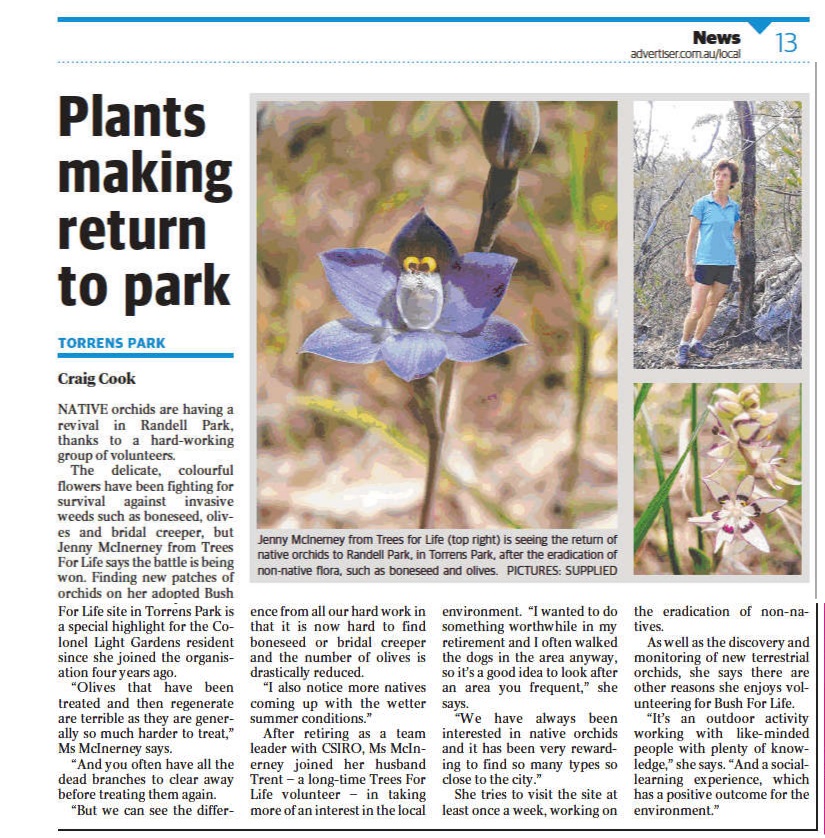
In the February 13, 2019 edition of the Hills Valley Weekly there was an encouraging article of the work of Bush For Life. Part of Trees For Life, this program with the aid of trained volunteers spend numerous hours weeding specific bush sites with the hope that they give our native plants a chance to survive. Yes it requires commitment and dedication but what joy there is when volunteers start seeing plants returning.

Orchids are often the first to disappear from a site when weeds enter and in many instances do not return. For them to return the conditions have to be just right with both the mycorrhizal fungi and the pollinators present. The more orchid species the better the site.

So well done to Jenny McInernay and Trees For Life for their work and commitment.Plants Return to Park

The blue orchid featured in the article is a spring flowering sun orchid; it appears to be Thelymitra inflata, common names Blue Star Sun Orchid or Adelaide Hills Plum Orchid. The other flower is not an orchid. It is a Wurmbea, common name Early Nancy.

2018 February Winning Photograph

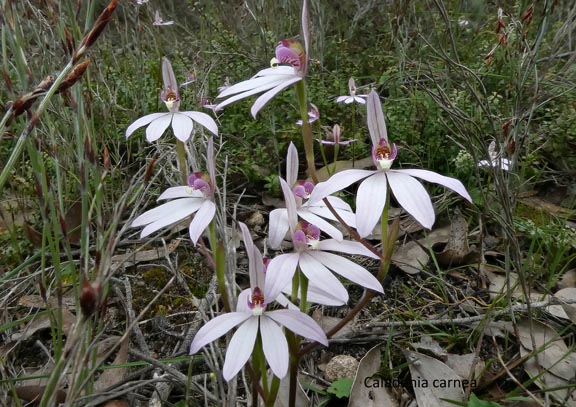
1802 sm RP Caladenia carnea

A small but varied number of entries for our first competition of the year. Andrew Primer entered a lovely picture Thelymitra azurea from Eyre Peninsula; Thelma Bridle entered Calochilus cupreus one of South Australia’s endangered orchids; John Fennell’s close up of Caladenia prolata and Rob Pauley’s mass flowering of Caladenia carnea.

The winner was Rob Pauley’s C. carnea a wide spread orchid which ranges from across the Eyre Peninsula through to the South East as well as occurring in the Eastern States and Tasmania. Although considered common both nationally and at a state level, there are regions within its range where it is considered to be Near Threatened, Rare and even Vulnerable. Also, despite being common, the Seedbank notes that there are areas of probable decline: Fleurieu (KAN02), Mt Lofty Ranges (FLB01), Eyre Mallee (EYB05), Wimmera (MDD05) and Southern Yorke (EYB01). It is a reminder that not only the rarest species but also that common species can be in decline.

The situation is complicated by taxonomic issues; C. carnea is not only a highly variable species but also a complex of several similar species plus many undescribed species which continues to challenge botanists.

References:

http://saseedbank.com.au/species_information.php?rid=815 accessed 8 March 2018

Backhouse, G., et al, (2016) Bush Gems: A Guide to the Wild Orchids of Victoria, Australia, Electronic version.

Bates, R. J., ed. (2011). South Australian Native Orchids. Electronic version. NOSSA