By way of introduction, Muelleria is the Royal Botanic Gardens of Melbourne official research journal and has been published since 1955.
Though a technical article there is much to be gleaned for the ordinary reader, for instance the article contains a good description of the commonly used terms for describing the column for example stigma, trichomes, anther, post anther lobe, etc. This is helpful to know as the column structure is often the main feature of the plant used to identify the individual species. Naturally the key features of the T. nuda complex are covered comprehensively, as well as a brief discussion of the taxonomic history.
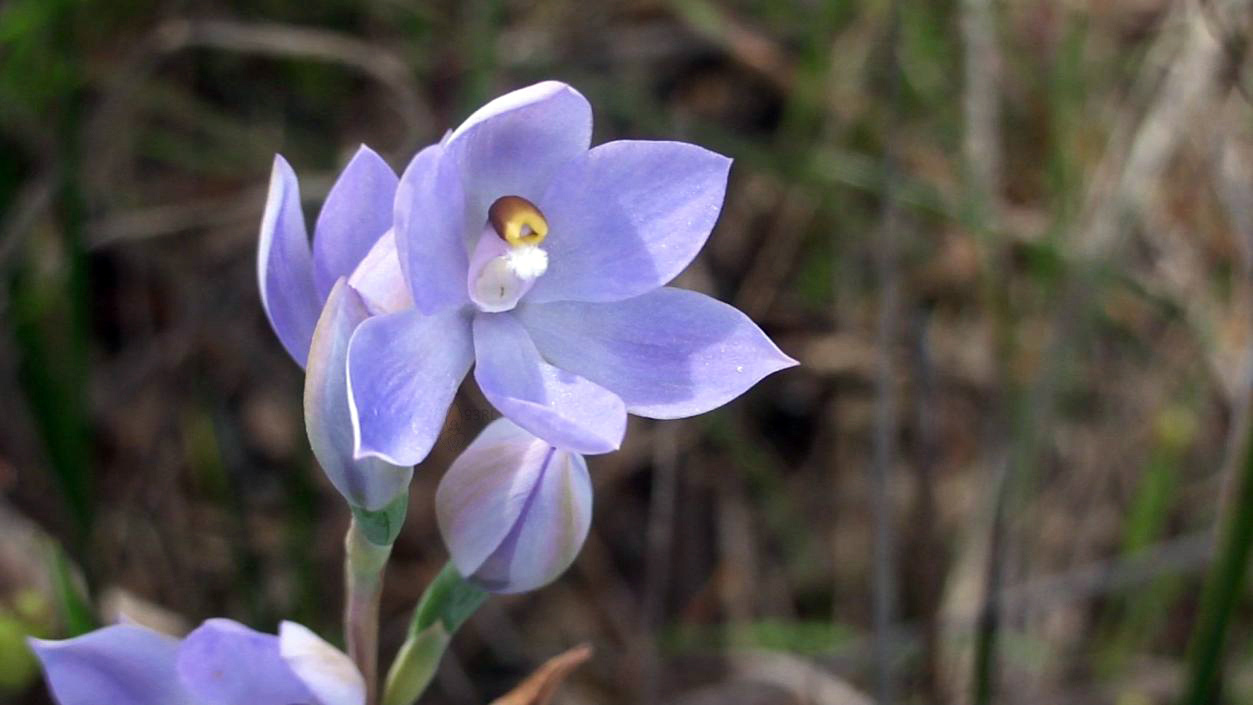
Another helpful section is the dichotomous key for all fifteen species described in the article. Of the fifteen species four are found in South Australia and are pictured below. But to discover more read the article ……
Thelymitra nudaThelymitra megcalyptraThelymitra glaucophylla photographed by Robert BatesThelymitra alcockiae
In the NOSSA Constitution (2007) the aims of NOSSA “are to promote and engage in activities for the promotion and furtherance of :
the culture, propagation, conservation, knowledge and scientific study of the native orchids of southern Australia and the Australasian region;
the preservation of orchids as a species and their preservation within their native habitat.”
The article following is about one of the ongoing conservation activities with which NOSSA members were and are currently involved. Quoted verbatim from SA Veg on the Edge, Vol 7, No. 1, 2007
Recovery Plan for 12 Threatened Orchids in the Lofty Block Region released
Since 1998, the Lofty Block Threatened Orchid Recovery Project (LBTORP) has been implementing recovery actions for threatened orchids in the Lofty Block region of SA. In late 2006, a draft recovery plan was completed for the following twelve species:
C. behrii(Pink-lipped Spider-orchid) – ENDANGERED (EPBC Act)
C. gladiolata(Bayonet Spider-orchid) – ENDANGERED (EPBC Act)
C. sp. ‘Brentwood’ (Ghost Spider-orchid) – Nominated as CRITICALLY ENDANGERED (EPBC Act)
C. macroclavia(Large-club Spider-orchid) – ENDANGERED (EPBC Act)
C. rigida(White Spider-orchid) – EPBC Act – ENDANGERED (EPBC Act)
C. woolcockiorum(Woolcock’s Spider-orchid) – VULNERABLE (EPBC Act)
C. xantholeuca(Flinders Ranges Spider-orchid) – ENDANGERED (EPBC Act)
Pterostylis bryophila(Hindmarsh Valley Greenhood) – CRITICALLY ENDANGERED (EPBC Act)
P. cucullata(Leafy Greenhood) – VULNERABLE (EPBC Act)
P. despectans(Lowly Greenhood) – ENDANGERED (EPBC Act)
P. sp. ‘Halbury’ (Halbury Greenhood) – ENDANGERED (EPBC Act)
The recovery plan describes each of these twelve species in detail including their morphology, distribution, population size, habitat, and ecology. Importantly, it also outlines the threats to each species and prescribes recovery objectives, targets, and actions for the next five years.
Determine population size and trends
Determine current extent of occurrence and number of sub-populations
Mitigate threats to sub-populations.
Recovery actions will be implemented for each of the twelve species in accordance with the recovery plan over the next five years by the LBTORP. Community involvement is recognised as a key factor in the successful delivery of on-ground recovery actions.
Fact sheets and a webpage that provide up to date information on the program were recently completed … Joe Quarmby, Lofty Block Threatened Orchid Recovery Project Officer , SA DEH
(NB Joe Quramby now is theThreatened Flora Ecologist Natural Resources, Adelaide & Mount Lofty Ranges Partnerships and Stewardship and DEH is now Department of Environment, Water and Natural Resources, 2014)
The article may be seven years old but it is a good overview of some of the conservation work that NOSSA members have done with Joe Quarmby.
October is Orchid Month with the greatest number of species flowering throughout South Australia; so it is worth considering the role of orchids in the Australian bushland. Hence this week’s blog is an article written by Belinda Newman, Western Australia.
Orchids: The Canary in the Coal Mine was published in the Friends of Kings Park magazine For Plants and People, Issue 70 p 22-24, 2010. The article is both a good introduction to, and summary of, her 2009 thesis Orchids as Indicators of Ecosystem Health in Urban Bushland Fragments
Orchids: The Canary in the Coal Mine
Belinda Newman – Research Scientist BGPA
What could orchids and canaries possibly have in common?
Before occupational health and safety and ventilation systems were commonplace in the mining industry, a caged canary would be bought down to the coal seam by the miners. Canaries are particularly sensitive to methane and carbon dioxide which made them excellent indicators for the build-up of dangerous gases. A singing canary meant everything was fine, a dead canary spelt trouble and an immediate evacuation.
Although orchids can’t sing, they do possess a number of traits that make them sensitive ecological indicators. The relationships that orchids have with their surroundings form part of a complex ecological web. Orchids have specific relationships with mycorrhizal fungi, which they require both for germination of their dust-like seed and ongoing growth of plants in adulthood. These fungi in turn rely on the appropriate soil moisture content and carbon sources. Above ground, the majority of terrestrial orchids in the south west of Western Australia rely on pollinators for successful seed set. For some orchids this plant-pollinator relationship has become so highly evolved that removal of the pollinator would spell the end of the orchid. The pollinators also have specific requirements for habitat, appropriate food sources and nesting sites. These above and below ground links to the ecosystem make orchids particularly sensitive to disturbances and changes in their surroundings.
The potential for orchids to be used as indicators of ecosystem health formed the basis of a study between Kings Park and Botanic Gardens and Murdoch University. The coal seam was eleven urban reserves of varying condition on the Swan Coastal Plain. The canaries were seven orchids common to Perth’s urban bushlands; the Carousel spider (Caladenia arenicola), Cowslip orchid (Caladenia flava), Pink Fairy orchid (Caladenia laitfolia), Pansy orchid (Diuris magnifica), Dark Banded Greenhood (Pteryostylis sanguinea), Purple Enamel Orchid (Elythranthera brunonis) and the Mignonette orchid (Microtis media). Before it was possible to see which orchids made the best canaries, it was important to determine the health of each of the bushland sites. A number of environmental variables were chosen that best reflected the health of the ecosystems. Extensive surveys and analysis of species composition, plant functional groups against these environmental variables revealed a range of site conditions from close to pristine to highly degraded. This provided the backdrop against which to determine the effectiveness of orchids as indicators through the measured responses of the orchid species.
Firstly orchid presence and abundance was measured across sites to determine if particular orchid species showed a preference for particular site conditions. Diuris magnifica and Microtis media showed strong correlations and were most abundant in poor condition sites and Pteryostylis sanguinea showed strong correlations to sites in good condition. While the abundance and presence of orchids appeared to correlate with site condition, we wanted to know what other aspects of the orchid we could measure as a means of judging the health of an ecosystem.
Successful seed set in plants reflects a healthy ecosystem and the reproductive success of the seven orchid species was investigated to determine the effects of declining site condition on seed set. Pollination trials were set up to measure natural and artificial pollination events across all sites. Widespread depression in pollination across all species and sites was found to be occurring, rendering seed set a poor measure of ecosystem health.
Investigations into the below-ground links orchids have with the ecosystem were undertaken by determining the presence and abundance of orchid mycorrhizal for the seven orchid study species across all sites. Mycorrhizal distribution was found to be patchy within urban reserves and also revealed unoccupied niches capable of supporting orchid germination. A greater abundance of Microtis media mycorrhizal at sites of poor condition supported earlier correlations of plant abundance at sites of poor condition. The higher abundance of mycorrhizal symbionts for Caladenia arenicola at sites of very good condition also suggests its potential as an indicator species.
The study also looked at seedling growth in urban reserves. This was the first time that biomass allocation in orchids has been investigated in light of ecosystem health. In poor condition sites, Diuris magnifica and Caladenia arenicola increased growth effort to the above ground leaf. In sites of very good condition, these two species increased growth to the tuber to take advantage of being able to store starch as a result of both fungal and photosynthetic activity taking place. Most importantly this shows a measurable change over a short period time. Although it is effort intensive, planting orchid seedlings of a standardised size into the field may provide a useful and rapid measure of ecosystem health, much like caged canaries were used in the past.
This research into using orchids as an indicator species is the first of its kind and suggests that orchids can be used as an indicator of ecosystem health. Future research will need to focus on the thresholds of the species identified as potential indicators in this study. What aspect of the orchid’s ecology will give clear and repeatable data linked to ecosystem health? Following the canary analogy, how long can orchids hold their breath? Future studies would need to focus on testing these thresholds. The results of this study suggest that orchid presence and abundance, orchid growth and orchid symbionts can be used as indicators of ecosystem health, although work needs to be undertaken to refine the understanding of their response to specific disturbances. This study provides a baseline for investigating the utility of orchids as indicators of ecosystem health in highly fragmented systems. Perhaps orchids and canaries have more in common than first thought.
This week, a local radio station introduced a segment with the phrase “our rarest sun orchid” and that it was called Thelymitra irregularis or Spotted Pink Sun Orchid. However it certainly is not our rarest sun orchid.
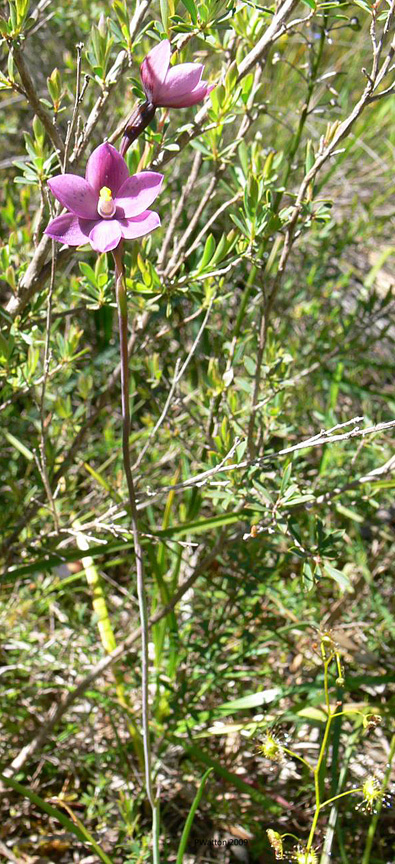
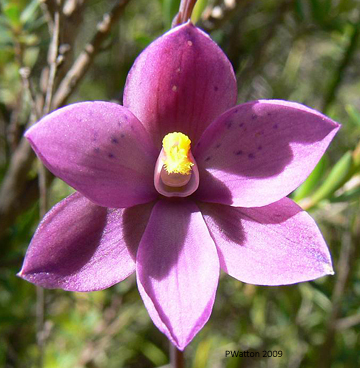
Thelymitra x irregularis, Peter Watton, 2009
True, it is not common, but that is partly because it is a hybrid and, correctly speaking, the name should be written as Thelymitra x irregularis (the “x” indicates that it is a hybrid).
For a hybrid to occur, the two parent species need to grow in close proximity, the flowers need to open at the same time that the pollinator is visiting flowers, either to collect or to deposit the pollen and, in the case of self pollinating species, before the individual flower has pollinated itself.
The majority of hybrids are sterile, but occasionally some are fertile. When hybrids occur the majority will only last a few years before disappearing although sometimes colonies are formed which may last for decades. Hence, it is not usual to name hybrids, but the more common and recurring ones have been named formally. T. x irregularis is one of them.
Several species of Thelymitra have been proposed as parent species of Thelymitra x irregularis. Jeanes & Backhouse (2006) give T. ixioides and T. carnea as parents; Weber & Entwisle (1996) and Jones (2006) suggest T. ixioides and T. carnea and/or T. rubra; Bates & Weber (1990) state that in South Australia the parents are T. ixioides and T. rubra, but T. ixioides and T. carnea in the Eastern states; in contrast, Bates (2011) states that in South Australia it is a hybrid between T. juncifolia and T. rubra. However, without detailed genetic studies or breeding experiments these all remain suggestions.
Due to the transient nature of hybrids and the conditions needed to produce them, the named hybrids are not common, but since the 1890s specimens of Thelymitra x irregularis have been collected in every decade, which suggest that this hybrid readily occurs. The 71 specimens held in the Australian herbaria have been collected from four states – which gives a good indication of the distribution but not necessarily the frequency of occurrence. See Australia’s Virtual Herbarium (AVH) for details. The AVH lists 12 herbarium records for South Australia with specimens collected from the Adelaide Hills, the Barossa Valley, Kangaroo Island and near Naracoorte.
This Thelymitra x irregularis or Pink Spotted Sun Orchid was photographed by Peter Watton in 2009 near Macclesfield, South Australia
The botanical name “irregularis” refers to the description of the column. With many sun orchids, it is often necessary to observe the column to distinguish one species from another. In this instance the top of the column is irregularly toothed. Retired Aussie has some very good photographs with one in particular showing the column detail.
Thanks to Juergan Kellermann, State Herbarium of South Australia for his help with this post.
References
Bates (2011). South Australia’s Native Orchids. DVD-ROM
Bates & Weber (1990). Orchids of South Australia.
Jeanes & Backhouse. Wild Orchids of Victoria, Australia
Jones (2006), Native Orchids of Australia, 2nd edn.
The first orchids scientifically named in the Pacific were species in the genus Thelymitra J.R.Forst. & G.Forst., a taxon raised and coined by the Forsters — the irascible Johann Reinhold Forster (1729–1798), and his son Georg Forster (1754–1794), who was 18 years old when they left on Cook’s second voyage of 1772 to 1775. The Forsters collected Thelymitra longifolia in the South Island of New Zealand in 1772 and published the name of the species in 1776. The Forsters described and named nine new species in what they termed the “Class of Orches” in the South Pacific. Georg Forster graduated in medicine in Vilna (now Vilnius, Lithuania) in 1784. Species of Thelymitra, which are known as the Sun Orchids, are found mainly in the south-west of Western Australia.
It should be noted that Thelymitra are found both in the east, central and the west of southern Australia.
To learn a little more about some of the orchids Professor John Pearn has mentioned, click on the links
Part 3
Early orchidology in the Asia–Pacific region
The fleshy pseudobulbs (thickened stems that serve as storage organs) of orchids have been eaten and used medicinally by Indigenous Australians for thousands of years. The first Australian orchids brought to the attention of Western science were three species of Dendrobium (D. discolor Lindley [described by John Lindley]; D. canaliculatum R.Br. [described by Robert Brown]; and D. rigidum R.Br. [described by Robert Brown]) that were collected by Joseph Banks and Daniel Solander at the Endeavour River between 17 June and 3 August 1770. Solander had trained in medicine and botany under Linnaeus in Uppsala (Sweden) and, after 1759, in London (England). One of the plant species named after him is the Australian orchid Orthoceras solandri (also known as Orthoceras strictum).
In continuing this series of Professor John Pearn, links have been provided for the genera or species mentioned. In this group most of them are from limited locations in Queensland.
Orchids named after medical professionals
Sixteen doctors who practised medicine and/or botany in Australia have their names recorded in the scientific names of 24 indigenous orchids of Australia. In addition, one separate species (Thelymitra flexuosa, also known as Thelymitra smithiana) and five genera of indigenous Australian orchids record the names of European doctors, pharmacologist–pharmacists or herbalists. The five genera are Burnettia Lindl. (described by John Lindley in 1840), a monospecific genus; Cadetia Gaud. (described by Charles Gaudichaud-Beaupré in 1829); Goodyera R.Br. (described by Robert Brown in 1813); Robiquetia Gaud. (described by Charles Gaudichaud-Beaupré in 1829); and Vrydagzynea Blume (described by Carl Ludwig Blume in 1858).
The Lizard Orchid, Burnettia cuneata, blooms in eastern Australia and Tasmania; it commemorates Gilbert Thomas Burnett (1800–1835), surgeon and foundation professor of botany at King’s College London.
In the genus Cadetia(delicate white orchids), four species are named after the apothecary of the French imperial court, Charles-Louis Cadet de Gassicourt (1769–1821) — C. collinsii, C. maideniana, C. taylori and C. wariana. They commemorate his life and works as an apothecary, soldier, scholar, writer, scientist and researcher.
The genus Goodyerais named after the 17th century herbalist John Goodyer (1592–1664).
Robiquetiacommemorates Pierre Jean Robiquet (1780–1840), a French pharmacist, organic chemist, professor and foundation member of the Académie royale de Médecine (1820). He was the first to describe an amino acid (asparagine) (1806), and he characterised caffeine (1821) and discovered codeine (1832).
One species out of the 40 species of the Tonsil Orchids, Vrydagzynea grayi, grows in Australia. A rare orchid of the Daintree rainforest in north Queensland, it commemorates Theodore Daniel Vrydag Zynen (fl. 1850), a Dutch pharmacologist and contemporary of one of the most famous doctor–orchidologists, Karl Ludwig Blume (1796–1862). The Twisted Sun Orchid, Thelymitra flexuosa, commemorates the Norwich physician and friend of Joseph Banks, Sir James Edward Smith (1759–1828). When he was 25 years old, Smith took the decisive action to buy the great Linnean collection of plants, which were in danger of being lost to science following the death of Linnaeus’s son in 1783. Smith bought them when they were offered for sale in 1784. In conjunction with the bishop of Carlisle, he founded the Linnaean Society of London and was its first president. In 1798, he raised the new genus, Diuris, which is one of the first taxa of Pacific orchids to be described. The Lilly Pilly, Syzygium smithii, is another of his six botanical memorials.
Back in 2013, Professor John H Pearn, Emeritus, School of Medicine, University of Queensland wrote a five page article about medical doctors who were Australian orchidologists. This was published in the Medical Journal of Australia. My intention is to post direct quote extracts from his article.
First …..
Thank you, John Pearn for giving permission to post
Now to begin …….., at the beginning….. of course …………
Orchidaceae is the largest family of flowering plants. Orchids grow in habitats ranging from subalpine niches to the tropics, and they produce some of the most beautiful, varied and intriguing flowers. Of the more than 1300 genera and 33 000 species, more than 1300 named taxa of orchids, in 193 genera, grow in Australia.
The word “orchid” is from the Greek word orchis (meaning testicle), which reflects the appearance of the root tubers in some species. According to the “doctrine of signatures” – a 16th century herbalist philosophy which states that herbs resembling body parts can be used to treat those body parts – orchids were used continuously from preliterate times as aphrodisiacs and as medicaments to restore virility. Theophrastus (c. 372–288 BC) wrote about the medicinal value of orchids, as did Paracelsus (1491–1541) and Carl Linnaeus (1707–1778), the father of modern botanical taxonomy. As a child, Linnaeus recorded details of his personally collected orchid specimens in his notebook, in which he wrote “Orchis from testiculus, through which its effects should occur”.
Orchid extracts such as vanilla (from Vanilla planifolia) and salep (from Orchis mascula and Orchis militaria) are used commercially in ice-cream, confectionery and medicinal flavouring agents. Crawley root preparations (from Corallorhiza odontorhiza) are used in folk medicine for their diaphoretic and antipyretic properties. In Australia, orchid preparations have been and continue to be used by Indigenous healers to treat diarrhoea and skin infections. Lieutenant (not yet Captain) James Cook used powdered orchid root as part of his method for preserving the health of his crew.
The physical manifestations of orchids, such as their flowers and the medicines and flavourings derived from them, are ephemeral. But the scientific names of orchids endure, and many perpetuate the lives and works of those who have contributed to medicine since the time of Aristotle. Here, I describe indigenous orchids of Australia whose scientific names commemorate doctors who worked in Australia, encapsulating a library of Australian medical history. These orchids comprise a monumentum aere perennius (monument more lasting than bronze) — a phrase coined by Horace in Book III of his Odes when referring to his own literary work.
John Lindley (1799 – 1865), who named Thelymitra crinita, mentioned in a previous post, was one of the world’s earliest orchidologists and has been described as the Father of Modern Orchidology (Pridgeon, p.1). Having no formal university education, his career began under Sir Joseph Banks as assistant-librarian. He eventually rose to Professor of Botany, University College, London, amongst his many other numerous official duties and public activities. It was the result of Lindley’s work and involvement with a group of other likeminded men that Kew Garden was saved from destruction and Corn Tax was repealed at the time of the great Irish potato famine.
Although orchids were not his only area of interest they were his passion and the common name ‘orchid’ was introduced by him in 1845. Lindley became involved with the naming of orchids at a time when the western world was discovering the wealth of the orchid world and his subsequent work on orchids was prodigious. He personally examined and named thousands of species specimens, with one author stating that Lindley named over 6,000 orchid species, establishing over 120 genera. Notably he wrote three major orchid works Genera and Species of Orchidaceous Plants (1830 – 1840), Sertum orchidaceum (1838), and Folia orchidacea (1852-1855). He also wrote for the general public and one delightfully readable textbook was Ladies’ Botany or A Familiar Introduction to the Study of the Natural System of Botany Volume I and II (1834–1837).
Though not referring specifically to South Australia, he lamented “that there are still, however, many species from the East and North Coast (of Australia), with which he has no acquaintance” [sic]. As far as I can determine none of our endemic orchids were named by him.
Lindley, J. (1839). Appendix to the first twenty-three volumes of Edwards’s botanical register : consisting of a complete alphabetical and systematical index of names, synomymes and matter, adjusted to the present state of systematical botany, together with a sketch of the vegetation of the Swan River colony (http://www.biodiversitylibrary.org/item/29179#page/59/mode/1up). London: James Ridgway.
Pridgeon, A. (2005). Blue Plaque for John Lindley’s Home [Electronic Version]. Orchid Research Newsletter 46, 1. Retrieved 8 May 2014, from http://www.kew.org/herbarium/orchid/orn46.pdf
Replanting in bushland should be restricted to orchid species that grow or once grew in the local area. Nohybrids please.
If planting out in the garden or bush, choose a location with good air movement and winter sun and a thin layer of surface mulch. Slashed native ground cover is good. Native terrestrial orchids cannot stand competition from weeds, grasses, slugs and snails and scratching blackbirds (all introduced pests). They will rot away in dense weeds or dense understory plants. If in a frost prone area they may need overhead protection from a shrub or trees. For plants in growth, dig out a hole a little bigger than the tube. Knock out the tube and insert the contents into the hole and backfill with as little disturbance as possible. Dormant tubers can be planted in a furrow, 50mm or more deep, and backfilled just like planting beans. Water in. The colony forming species will spread out and form patches of plants over a period of several years.
Orchid seed is like fine dust and can be mixed with fine dry sand to help spread it over a large area. Broadcast using a pepper-shaker over a suitable site. Results are dependent on the season and whether fungi are present. This method is slow to show results as flowers may not be seen for 5 to 10 years after seed is sown. More seedlings germinate if there are mother plants already growing.
A pot of Arachnorchis argocalla, 40 cm tall (Fungi Dependent)
To learn more about re-establishing orchids in the bush, visit the Vale Park Our Patch website to see the work being done by Heather Whiting and her team.





 NOSSA
NOSSA 