If you want to see the Helmet Orchids, now it the time of year to find them. My understanding is that the time from leaf mergence to capsule is about six weeks. In the past week I’ve seen Corysanthes diemenica (Veined Helmet Orchid) both in the north and the south of the Adelaide Hills. Corysanthes incurva ( Slaty Helmet Orchid) appears slightly later, end July early August, and will now be in bud. Look for them amongst the leaf litter.
Confucius was an admirer of orchids and in this quote he captures the quality of the epiphytes in this eloquent translation*:
The orchid grows where others cannot enduring the hardships of hunger and thirst, and is loosely tied to the things that support it. And, even with all the difficulty of its life, the orchid graces the world with beautiful colour and rare fragrance. This is like the life of the true gentleman, who sets himself to learn self-discipline, and whose character shines no matter where he is or what he experiences.
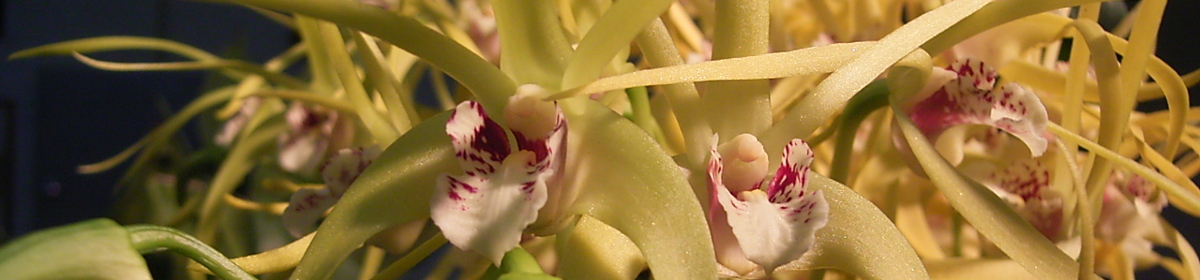
Though he never saw an Australian epiphytic orchid, the description holds true as can be seen in these three pictures from among the many species found on the eastern seaboard.
Ever since the Western world discovered the orchid in the 18th and 19th century there have been enthusiasts wanting to grow them but though an orchid may produce millions of seeds, for they are minuscule, only a relatively small number germinate. The seeds do not have any stored food and are dependent upon fungi for germination. This made it difficult for early orchid growers who relied on obtaining specimens from the wild – a most unsustainable practice!
Yet today cultivation of orchids is flourishing. It is not dependent upon removing specimens from the bush. In Australia it is illegal.
Today the orchid enthusiast can grow orchids from seeds at home. The technique, invitro embryo germination, is popularly known as flasking. It involves growing the seeds in a sterile agar medium to which the most significant ingredient was the addition of sugar.
At the time it was developed by Professor Lewis Knudson (1884 – 1958) of Cornell University in 1922 this method was revolutionary.
Reference:
Rasmussen J, April – June 1986, “Contact Dermatitis from Orchids” Clinics in Dermatology Volume 4 Number 2
Below are some examples of terrestrial orchids grown from seeds in flasks.
In almost a word – every continent except the Antarctica.
Orchids are amazing, we expect to find them in the tropics but they can be found anywhere from the cold climes of Alaska to the semi-arid edge of the Australian deserts.
An Interactive Key to Australian Orchid Genera has an excellent chapter on habitats of Australian orchids.
15 habitats are listed with a list of the type of orchid likely to be found there. The vast majority of Australian terrestrial orchids are found in either lowland (less than 500 metres altitude), in coastal regions or in open forest/woodland. There are none in the Red Centre.



 NOSSA
NOSSA 