One of the orchids currently flowering is Nemacianthus caudatus (syn Acianthus caudatus). The common name is Mayfly orchid. Robert Lawrence’s post in OrchidNotes gives an interesting background to the resemblance of the flower both to the Mayfly’s three tails and its mass swarming.
The Mayfly Orchid is a small orchid with very dark reddish brown flowers with long, hair-like sepals. It flowers from late July to August. One might question what sort of insect was behind the naming of this orchid, which does not even flower in May. Mayflies are an insect with which many of us are not acquainted.
Close view of a typical flowering Mayfly Orchid
One source attributed the naming or the orchid being similar to the long legs of a Mayfly. However, a quick search in the Internet revealed that Mayflies have fairly short legs, as in the image below:
It turns out that it is the appendages on the end of the abdomen that the sepals of the Mayfly Orchid resemble. Mayflies usually have three tails (two cerci, one middle filament), although the middle tail is rarely reduced or absent. …
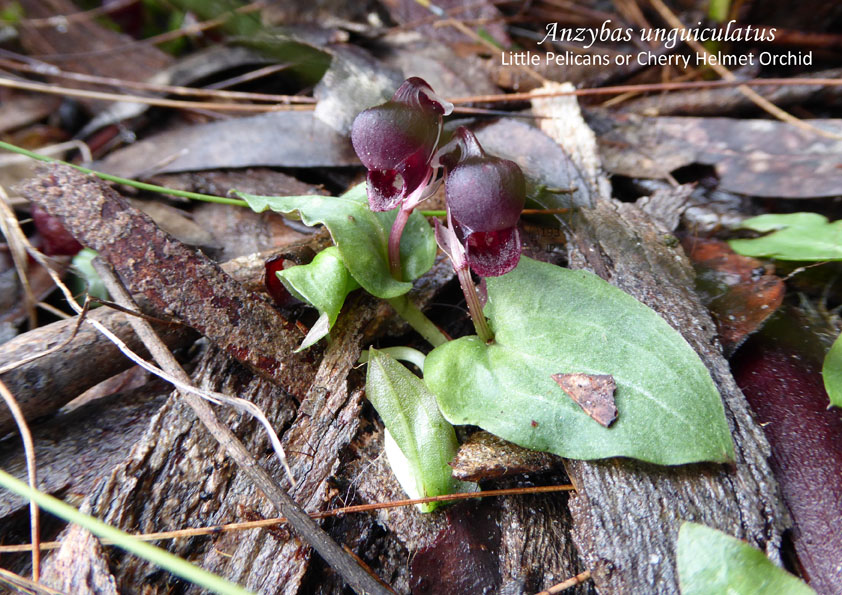
Anzybas unguiculatas (common name Little Pelican or Cherry Helmet Orchid) was the main focus for this month’s competition with three photographs of this diminutive flower.
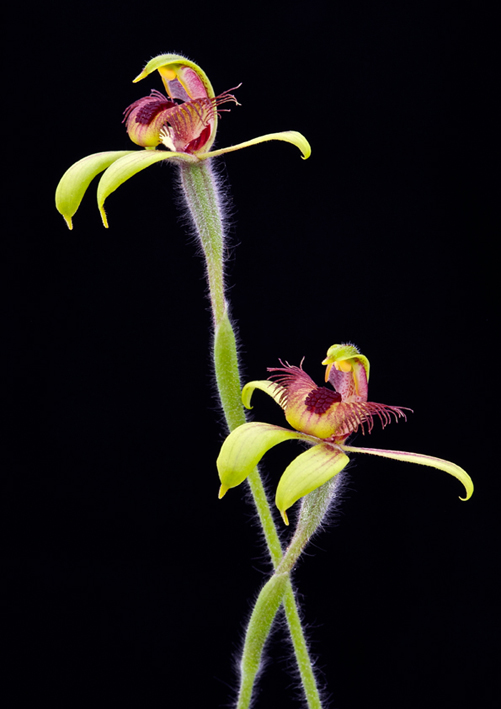
The other photographs were Ed Lowrey’s close-up of a triggered Urochilus sanguineus labellum, John Badger’s first Diuris palustris sighting for this year and Pauline Meyer’s mass flowering of Leptoceras menziesii post fire. Of the Anzybas, Jenny Pauley entered two and Lorraine Badger one. Jenny Pauley’s photograph of two flowers was the outstanding winner.
Originally named Corysanthes unguiculata (1810), then Corybas unguiculatus (1871), the genus name was changed in 2002 to Anzybas in recognition of its distribution both in Australia in New Zealand. Since 1945 it had been recognised that the New Zealand species Corybas cheesemanii was a synonym for Corybas unguiculatas although the juvenile plant can have two leaves unlike the Australian species which is single leafed.
An interesting feature of this flower is the prominent white ears at the rear of the helmet (not clearly seen in this photograph) which are part of the labellum.
These plants are small. The gum leaves and twigs give an idea of size but the engagement ring shows it very clearly. Note also the prominent ‘white ears’ of the labellum.
An unusual aspect of this photograph is that the colour of the underside of one of the leaves. It lacks the characteristic distinguishing feature of the purple underside of the leaves. According to orchid growers, the light affects the leaf colour. Heavy shade produces green leaves. It is possible that the heavy leaf litter where this plant was growing provided enough deep shade to cause the colour loss.
Bates (1990) states that it (has) not proved amenable to cultivation, but it has, on rare occasions, been benched at NOSSA meetings with the most recent occurrence was in July 2010 but it remains a very difficult plant to cultivate. The electronic version Vol 34 No 7 has a photograph of the plant just visible within the moss.
It is not always easy to photograph this species as not only is it rare with limited numbers but there are very few sites where it can be found. Added to that is that the window of opportunity is short in South Australia with a flowering time from June to August compared with those interstate which can range from May to October.
There has always been an interest in Australian orchids. Over the years there have been many photographs of orchids. This stereographic postcard from 1928 is a study in beauty –
This postcard is held by the State Library of Victoria.
Although the distribution covers the Southern Lofty, Kangaroo Island and the South East regions of South Australia, it has become increasingly rare due to loss of habitat which consists of leaf litter on damp soils. As a result, there are very limited localities where they can now be found.
It is one of our earliest helmets to flower which is from June to July.
Rupp, HMR and Hatch, ED (1945) Relation of the Orchid Flora of Australia to that of New Zealand in Proceeding of the Linnean Society of New South Wales Vol 70 1945, pages 53 – 61
Part One – Attracting Pollinators looked at pollination strategy, but the fourth aim of the paper was to establish that Corunastylis littoralis reproduced by xenogamy or geitonogamy and that the species was not autogamous or apomictic, that is, pollinated, self pollinating or non pollinating plants.
Xenogamy or geitonogamy that is vector mediated pollination or out-crossing is when fertilization occurs by the transfer of pollen from one flower to another flower usually by the means of insect.
Autogamy or self-pollinating is when the flower is pollinated by its own pollen.
Apoximis is when reproduction occurs without pollination, that is, vegetative reproduction.
As explained in the paper, there are visual clues for determining which process is used by the plant.
Xenogmay
Autogamy
Apoximis
Pollinia removal and pollen deposition
Pollinia not removed
Lacks pollen or it is tightly bound
Pollinia weakly attached to the viscidium
If pollinia present, then unable to be removed
Not all the ovaries are fertilized
All the ovaries are fertilized and have viable seeds
Swelling of the ovaries can occur whilst in bud
Perfumed
Likely to have no perfume
Attracts insects
Flowers short lived
More detailed information was gained by dissecting the flower.
The following article titled Moving Lablellums written by Helen Lawrence is reproduced from the NOSSA Journal Volume 36 (1) February 2012
Labellums are fascinating. Well I think they are fascinating, especially the ones that move.
Bunochilus viriosus with the labellum down
Why do these labellum move? You may have observed that the orchids which have labellums often have “hoods” and inside these “hoods” are the pollen. It is quite simple, the pollinator lands on the labellum, triggers it and is held captive by the labellum. As it struggles to free itself it pollinates the orchid. Clever, isn’t it?
Bunochilus viriosus with the labellum up
So that these labellums can capture the insect they need to be sensitive. Consequently they can easily be “set off.” This can happen with of a gust of wind, or if the plant is in a pot, the labellum may trigger if the plant is moved/knocked.
It is easy to see these labellums as they move up into their “triggered position.” They move reasonably quickly, so the insect does not have time to respond.
However, how does the labellum return to its “normal” position? Does it slowly return to the position, or does it happen in a sudden movement in the same manner as when it is triggered?
One day when I was travelling in the car with a Pterostylis curta (Blunt Greenhood), I observed something very interesting. When I looked at the flower, the labellum was up, but then when I looked at it a minute or two later, the labellum was down. The labellum had to move quickly. However was it the bumps in the road which caused it to move? I had to find out.
I devised an experiment to satisfy my curiosity, and find out what these fascinating labellums actually do.
First I had to find an orchid with a labellum that could be triggered. I ended up using an Oligochaetochhilus bisetus (Two-bristle Greenhood).
Oligochaetochilus arenicola
Second I had found a good camera that could take high definition video. I placed it on a “tripod” (a pile of books).
So I had set up my apparatus, set the camera rolling, triggered the labellum, and left the room.
So what happened?
For the first six minutes after I had triggered the flowers nothing happened. There was no movement that I could see.
In the next five minutes, the labellums of the two flowers slowly moved downwards until they were half way down.
After twelve minutes of the flower being triggered, the labellum returned rapidly to its original position. This final stage of the labellum moving lasted for less than five seconds, and appeared to move at the same speed as when it was triggered.
So it looks like the labellum returns to it normal position first moving slowly and then in a rapid final movement which returns the labellum to its original position.
Urochilus sanguineus
If I thought it would be that simple, I was mistaken.
As I briefly looked through the fifty minute video I took, I came upon something that made no sense to me.
A minute after the labellum had returned to its resting position, one of the labellums suddenly returned to its “triggered” position. What’s more, there was nothing in the room to trigger the labellum: no wind, no insects, and no people. So what triggered the flower?
I do not know. Six minutes after the labellum was triggered it returned to its original position, and then two minutes later the other flower’s labellum moved into the triggered position. The first flower was triggered again for no apparent reason at all, four minutes after the second flower was triggered and still remained up.
Once the labellums returned to their original position, there was no more movement.
Maybe triggering the labellum causes a chain reaction. Maybe the labellums periodically “trigger themselves.” Well, I can’t give you any answers, all I can tell you is that it looks like this is an example of how we barely know anything about these wild gems. They are beautiful but bizarre and of course fascinating!
After 7 minutes, just before the labellum movedAfter 12 minutes, labellum about to fallAfter 13 minutes, labellum in original position
As a 50 minute video is a bit long to watch, Helen has produced a four minute video, so watch and enjoy the music!
Australia has some of the most varied, if not the most varied, terrestrial orchids. This variety is reflected in the words used in their commons names – spiders, hoods, moose, cowslip, mosquito, comb, fingers, fairies, bearded, ant, bird, frog, helmet, midge, shell, donkey, bulldogs, parsons, bunnies, daddy long-legs, hare, rabbit, onion, leek, gremlin, duck. This list is from words used for describing just the South Australian orchids. The other states particularly Western Australia have even more common descriptive names!
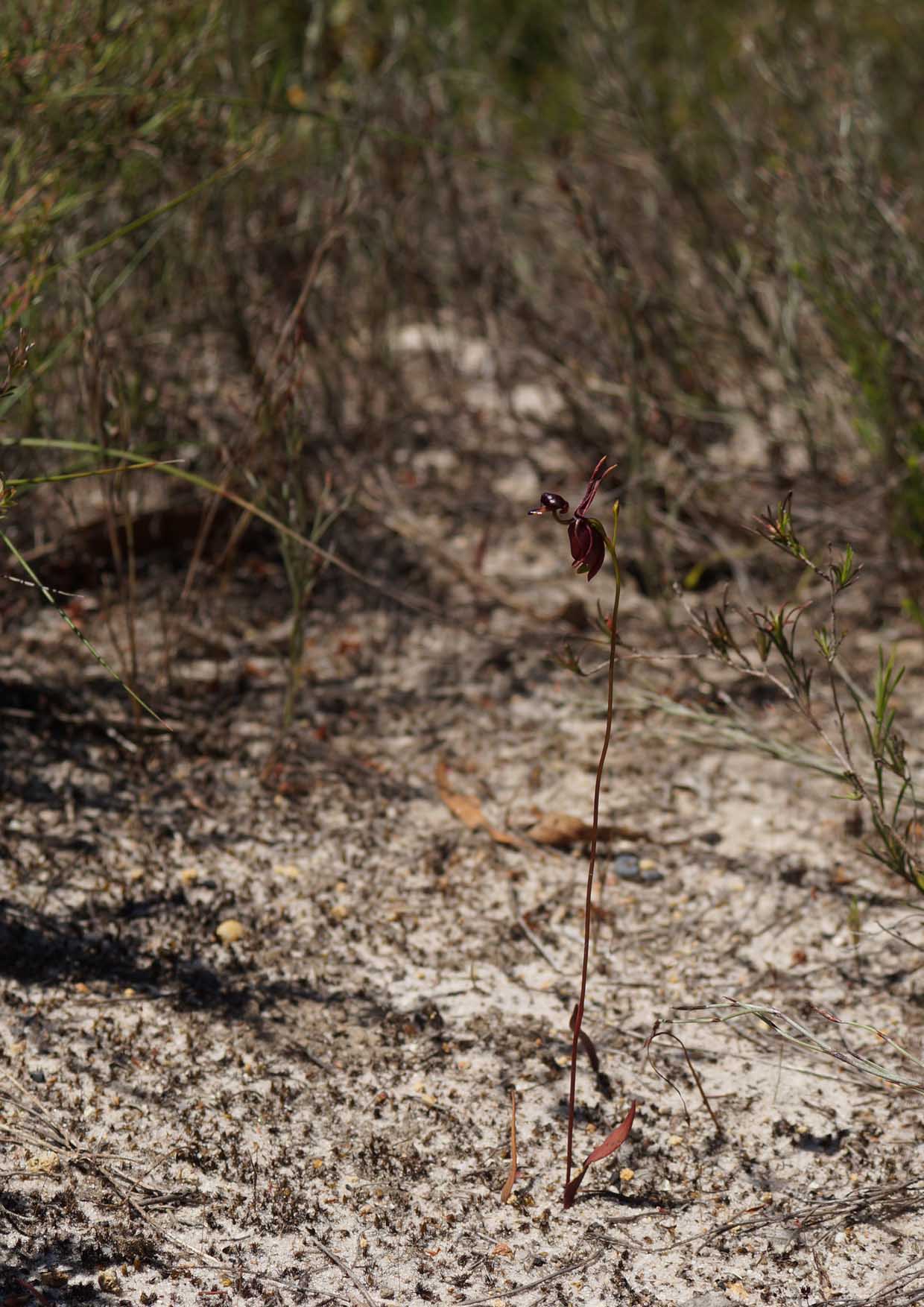
With such a variety is there a favourite one? From the searches and questions that come to this site, it would have to be the Flying Duck Orchid. This orchid never fails to amaze people with its resemblance to a duck in full flight.
It was no surprise than to discover that the winner for the Australian Orchid Foundation 2014 Essay titled Our Favourite Orchid featured the Flying Duck Orchid.
And just a reminder, it is only ever found in the wild. No-one has ever been able to grow one and it cannot be bought or sold! But so that we can all enjoy them, here is a short video clip …..
Ducks in full flightTo get an idea of the size of this superb orchid, bring this image up to A4 paper size
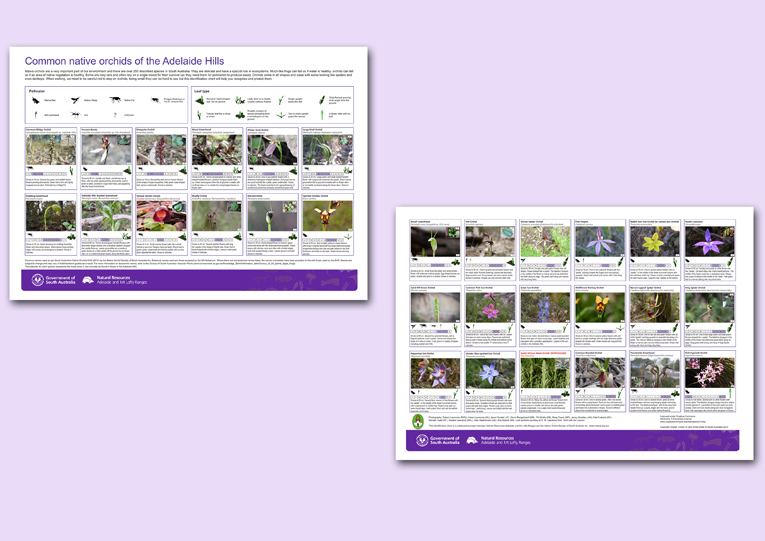
Over the years, Natural Resources Adelaide and Mount Lofty Ranges (NRM) have been involved with providing educational resources for schools and the community. One resource has been A3 Identification Charts.
This week has seen the release of another identification chart – Common Orchids of the Adelaide Hills. Produced in collaboration with the Native Orchid Society of SA, it was launched at our general meeting on April 28.
These charts are available free from the NRM website. To get a copy of the poster, click on the image below and scroll down to Identification Charts. Whilst there have a look at some of their other posters.
PS the chart looks good on a smart phone which makes it convenient for out in the field.
On the eve of the 100th anniversary of ANZAC Day, this week’s post is taken from the NOSSA Journal April 2015 Vol. 39 No. 3. The article is by Lorraine Badger.
William Hugh Murdoch, Anzac Veteran 17 September, 1885 – 24 July 1989
William Hugh Murdoch, known as Bill, was born at Poowong in Victoria’s Gippsland*. Later in life he became an orchid grower, eventually becoming co-founder of the Australian Native Orchid Society (ANOS), after sending out letters in 1962, suggesting the formation of a Society, to fellow Native Orchid Growers.
However, it is not for that reason alone, that we remember him in this journal. This month is the hundred year anniversary of the first battle of our new country, at Gallipoli. Following several weeks training in Egypt, William landed at ANZAC Cove with the 17th battalion on 16 August**, just four months after the initial landing. The battalion was mainly responsible for the defence of Quinn’s Post***.
Conditions on the Dardanelles peninsular ‘defy description.’ Water was scarce. Food rations were limited to mainly bully beef and hard tack biscuits. ‘The terrain and close fighting did not allow for the dead to be buried. Flies and other vermin flourished in the heat, which caused epidemic sickness’****. Under these conditions William, amongst dozens of men, contracted Enteric Fever, better known as Typhoid Fever, just three months after his arrival. He was sent by hospital ship, SS Nevasa (sic), to Alexandria back in Egypt before being sent to the Australian hospital in Helios on the outskirts of Cairo and then the Enteric Convalescent Camp in Port Said.
On 21 January 1916 he was declared fit to travel and was repatriated to Australia for three months of rehabilitation, leaving Pt Said on the Suez, via the MAT Commonwealth. Almost nine months later he returned to join his battalion, first disembarking in England. Four days before Christmas Day in 1916, he left the UK to join his battalion which had returned to Etaples, France following a spell in a quieter sector of the front in Belgium following the battalion’s first major battle at Pozières between 25 July and 5 August. In their new location they manned the front through a very bleak winter and William was again needed hospitalisation on several occasions for frostbite, diarrhoea, being wounded in action and finally Trench Fever a few weeks prior to armistice in 1918. He embarked for Australia in March 1916 reaching Australia in May where he was discharged.
Again when WWII commenced William re-joined the Army and was involved in training and later as ‘Voyage Only Officer’.
Bill Murdoch Trophy Bill is also remembered by ANOS through the Australia wide, Bill Murdoch Trophy for Champion Australian Native Orchid Species of the Year. It is not often that a South Australian wins this prestigious award but Kris Kopicki has become the latest recipient for his winning entry, Caladenia discoidea, in the NOSSA 2014 Spring Show.
Caladenia discoidea (Bee Orchid or Dancing Orchid). This picture was taken of the 2014 winning plant in 2013. Congratulations Kris for growing a winner!
References
*Birthdate gleaned from: http://www.irabutlertrophy.org/WRMurdoch.htm However, on his enlistment papers of 2 February 1915 it states that he was aged 19 years and 4 months – which would suggest he was born about October 1895.
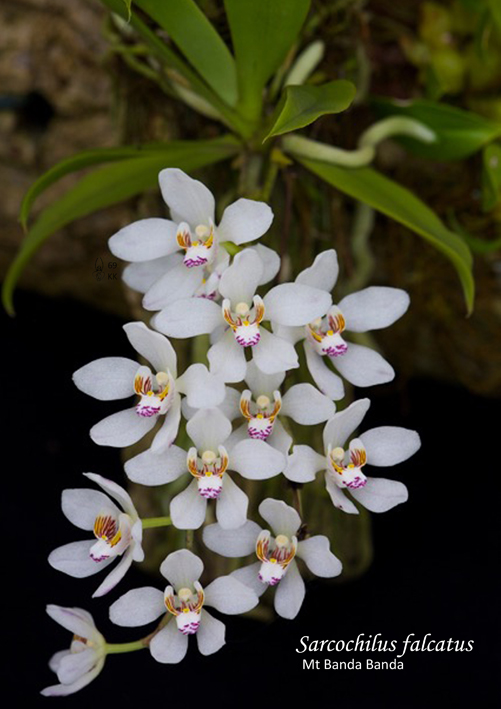
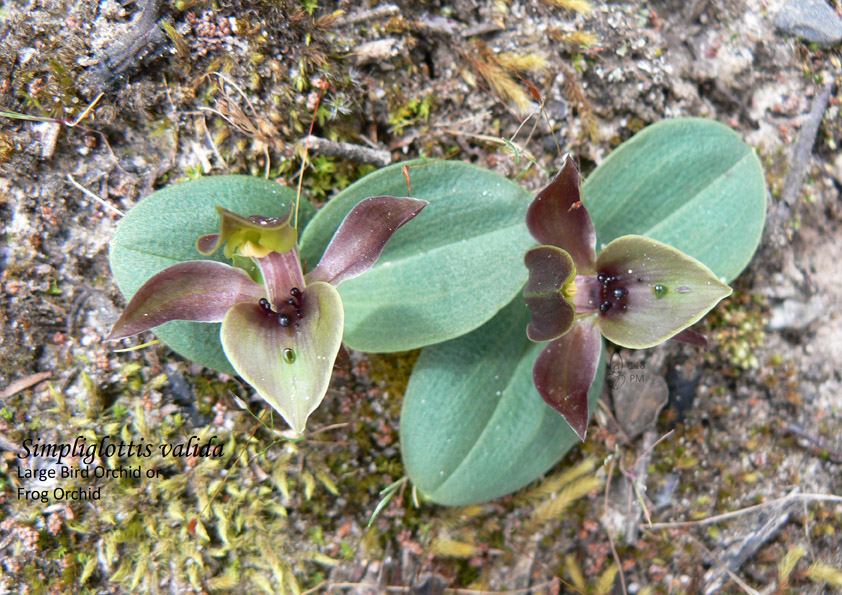
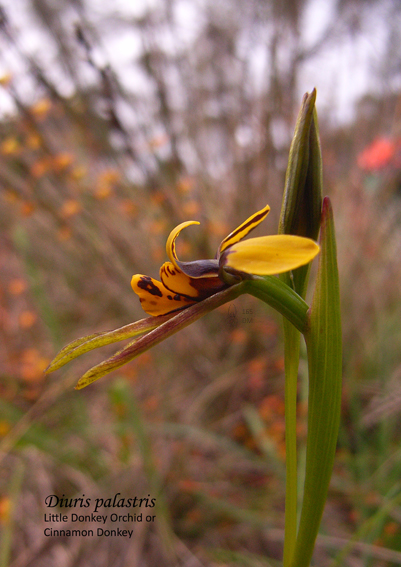
Three winners; three very different orchids but that is typical of Australian Orchids, there is no one species that you can point to and say that is a typical orchid as illustrated by the the winners which were Sarchochilus falcatus (Kris Kopicki), Diuris palustris (David Mangelsdorf) and Simpliglottis valida synonym Chiloglottis valida (Pauline Meyers).
Sarchochilus falcatus (common name Orange Blossom Orchid) is an epiphyte. The cultivated plant in this photo originated from the Blue Mountains just north of Macquarie. Epiphytic/lithophytic orchids are found across northern Western Australia through the Top End and from a narrow band down the east coast to Tasmania; that is in all States except South Australia. About a quarter of Australian orchids are epiphytes and despite the widespread distribution, 90% of epiphytic orchids are found primarily in the rainforests of northeastern Queensland.
S. valida (common name Large Bird Orchid or Frog Orchid) and D. palustris (common name Little Donkey Orchid or Cinnamon Donkey Orchid) are terrestrial, the larger of the two orchid groups. Terrestrials are mainly found across the southern part of the continent with some occurring in the north and tropics. Their optimal habitat is the various types of sclerophyll forests found in Australia.
There is some distribution overlap but the two groups mainly occupy different habitats.
Concerning the habitat of the two terrestrials, S. valida ranges from tall moist closed forest to shaded places of drier open forests to sphagnum bogs and in the mature pine plantations of the South East. Whereas D. palustris occurs in wet and swampy habitats in the Eastern states (hence it is named from the Latin palustre meaning swampy), in South Australia it is not so. Instead it is found in open terrain of grassland, grassy woodland, mallee and shrubland.
Some Odd Facts:
S. valida is a small ground hugging plant the scape (flowering stalk) of which elongates to 10cm or more after pollination. Click on this video link to see these plants ‘talking’. In New Zealand it is described as a vagrant having been introduced from Australia.
Sarchochilus falcatus is the most common and widely distributed species of this genus in Australia. Occassionally it is lithophytic (grows on rocks). Though it had been rated Endangered and downgraded to Vulnerable in 2005, it is still under major threat from illegal collecting, trampling, water pollution, weeds and fire. New Zealand has epiphytes and the common name for them is Perching Orchids.
D. palustris is uncommon in South Australia and Tasmania; and rare in Victoria. D. palustris was one of the subjects painted by Adelaide colonial artist and cartoonist Margaret Cochrane Scott in 1890s who had an affinity for native orchids.
References:
All internet references accessed on 31st March 2015
South Australia has some very interesting and unique orchids but it is not always possible see them either because one cannot get out to see them or the season has been poor with inadequate rain at the right time. So, one of NOSSA’s member has produced a video. It starts in autumn and goes through to summer.
An important first lesson to learn when out orchid hunting is to watch where you put your feet. In this video the Orchid Hunter explains the how and why for watching where you step.

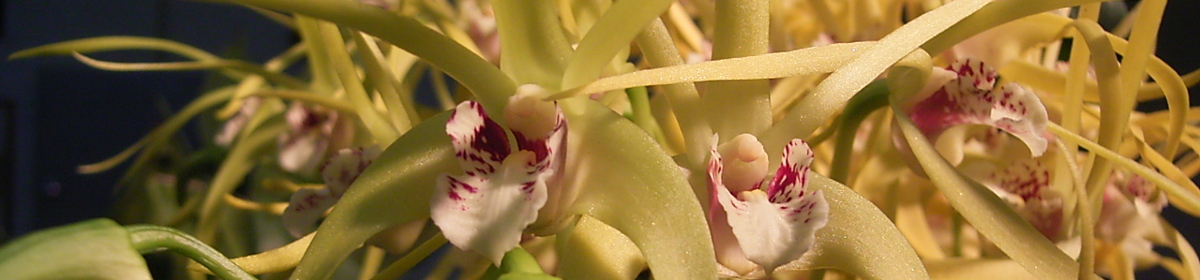

 Close view of a typical flowering Mayfly Orchid
 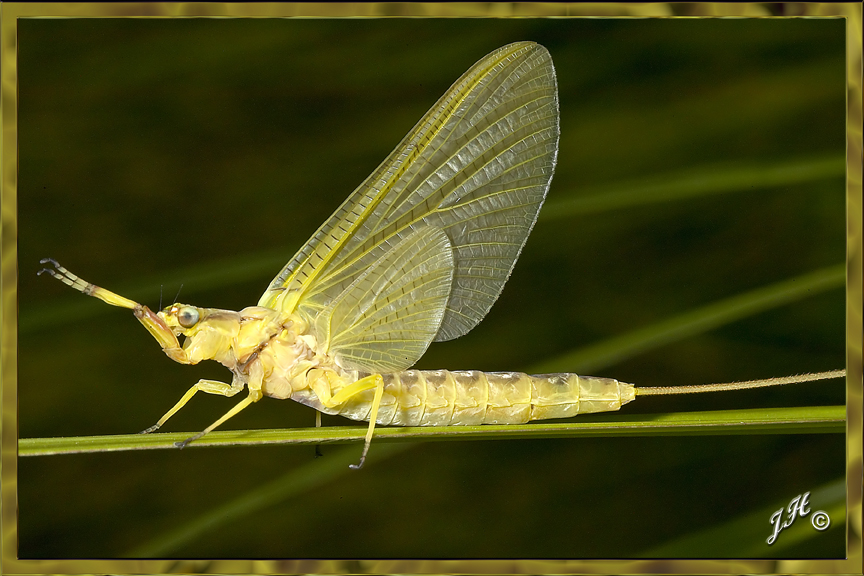 Mayflies have relatively short legs … Source: http://www.empirepestcontrol.co.uk/wp-content/uploads/ephemerella_subvaria.jpg