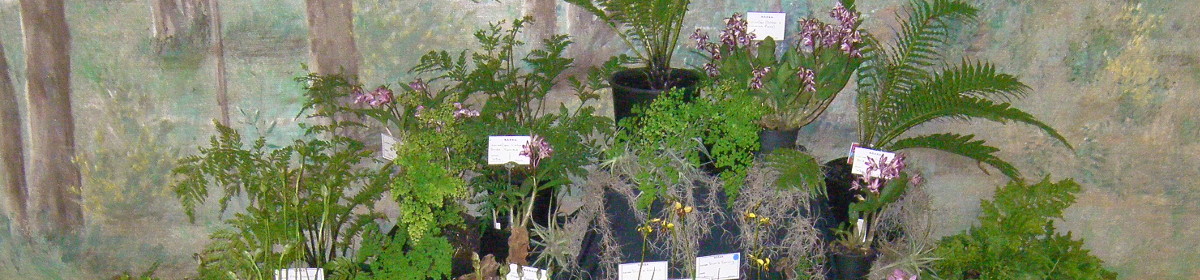
Caladenia haemantha is no more ….

Orchid taxonomy can take some interesting turns. This has just happened to Caladenia haemantha. Based upon the examination of the type specimens collected for C haemantha and C formosa, authors Andrew McDougall & Timothy Hammer have just published an article reinstating C haemantha as C formosa.

Soon after C formosa was described and named in 1991 by GW Carr, David L Jones came along and described and named C haemantha; but in 1993, Mark Clements took a look and listed it as a synonymy of C formosa, where is stayed for many years until 2021 when Jones reinstated it as C haemantha.

But, through the beauty of science, along comes Andrew and Tim to have a closer look at the two type specimens. Meticulously they counted the details and duly documented their findings. Their conclusion – C haemantha is a synonym of C formosa.

To read more of the detail in Swainsona, click on the image below –
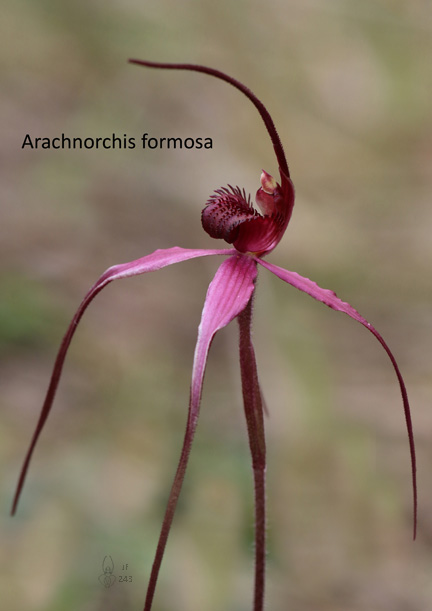
March 2018 Winning Photograph

1803 A4 sm JF Arachnorchis formosa

Four very different species were entered this month. Ricky Egel’s autumn flowering Coryunastylis fuscoviridis (see February Journal for name usage), Rosalie Lawrence’s winter flowering Diplodium bryophilum and John Fennell’s spring flowering Stegostyla cucullata and Arachnorchis formosa.

It was no surprise that John’s A. formosa (syn. Caladenia formosa) was the winning photograph. Words such as stunning, spectacular, wonderful and attractive are used in the description of this rare orchid and is reflected in its common names – Scarlet Spider Orchid, Elegant Red Spider Orchid, Elegant Spider Orchid and Blood-red Spider Orchid. It is truly a stunning red flower with its drooping petals and sepals (tepals).

A. formosa is part of the large patersonii alliance which is characterised by white to reddish flowers with (mainly) drooping tepals ending in long, slender (sometimes thickened) sparsely to densely glandular (hairy) tails, labellum with short to long marginal teeth. The features that separate A. formosa from others in the complex are the large (~60 mm across) deep red flowers with long (~80mm) tapering, drooping tepals. Similar species to A. formosa is the smaller once common but now extremely rare Caladenia ‘Fleurieu Peninsula’ In Victoria there are some other similar species.

A. formosa is confined mainly to the South East and into south western Victoria.

References:

Backhouse, G., (2011). Spider-orchids – the Genus Caladenia and its Relatives in Australia, Melbourne, Electronic version.

Backhouse, G., et al, (2016). Bush Gems: A Guide to the Wild Orchids of Victoria, Australia, Electronic version.

Bates, R. J., ed. (2011). South Australian Native Orchids. Electronic version. NOSSA