
This week’s blog is an extract from Volume 30 No 10 November 2006. In this article of Len Field he gives not only cultural notes but also some interesting background including an orchid link with the infamous Captain Bligh.
Dockrillia linguiformis (Sw) 1800 Brieger
Len Field
Common names Thumbnail orchid, Tongue orchid, and in North Queensland the Tick
orchid.
The name linguiforme is from the Latin lingu(a) as in linguiforme (a tongue). It was also claimed for many years that this was the orchid that Olaf Peter Swartz the German botanist founded the genus Dendrobium in 1800, but this was wrong, although this was the first orchid seen by white man when they landed at the rocks area in Sydney cove, Port Jackson. It was introduced into England by Rear Admiral Bligh of Bounty fame.
Other names it has been called are
Dendrobium linguiforme var. linguiforme Swartze 1800
Callista linguiforme (Swartze) Rev. Kuntze 1891
Dendrobium linguiforme (Swartze) var. huntianum Rupp 1942
There was another variety named from this species called var. huntianum by Rupp in 1942, which was named after T.E. Hunt and is a June or July flower and found near Ipswitch (sic) in Queensland, but as it reverts to type form it never reached true variety status and was considered just a variation of the type form.
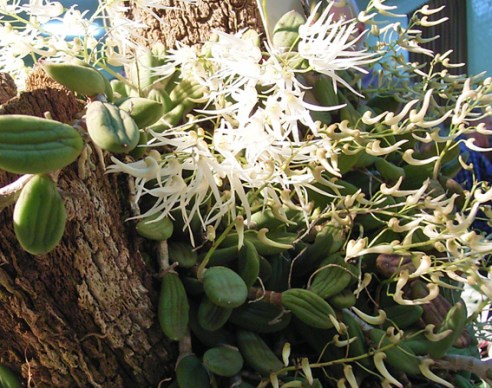
This orchid has a huge range of habitat which stretches from almost the Victorian border up to North Queensland and West to the Great Dividing Range. It is very common throughout this area and equally happy as an epiphyte or a lithophyte but where as a epiphyte it likes swamp oaks (Casuarina glauca), river oaks (Casuarina cunninghamiana), in fact it will grow on most trees that will hold there bark including the tea trees (Leptospermum species). I have seen this orchid hundreds of kilometres inland from the coast still forming large mats on the rock faces, while in its more prolific growing areas these mats will cover huge areas of the rocks where it can survive and grow in extreme exposed conditions that would kill other orchids. In the dry times the leaves which are very thick, tough and numerous will shrivel and can last up to six months without water. This is a feature of a lot of Australian Dendrobium and Dockrillia
Flowering is from August to October with blooms that are long lasting, up to two weeks with one raceme per leaf.
Culture. If grown on slabs which is the usual way it should be hung up high and if grown in pots a very coarse open mix. In nature it likes plenty of sunlight although at times it will grow in shade. Whichever way it is grown it should have good light, humidity and air movement.


 NOSSA
NOSSA 