Established in 1976, the Australian Orchid Foundation (AOF) was formed to protect and propagate orchids; support and conduct orchid research; to educate and encourage orchid study and related sciences.
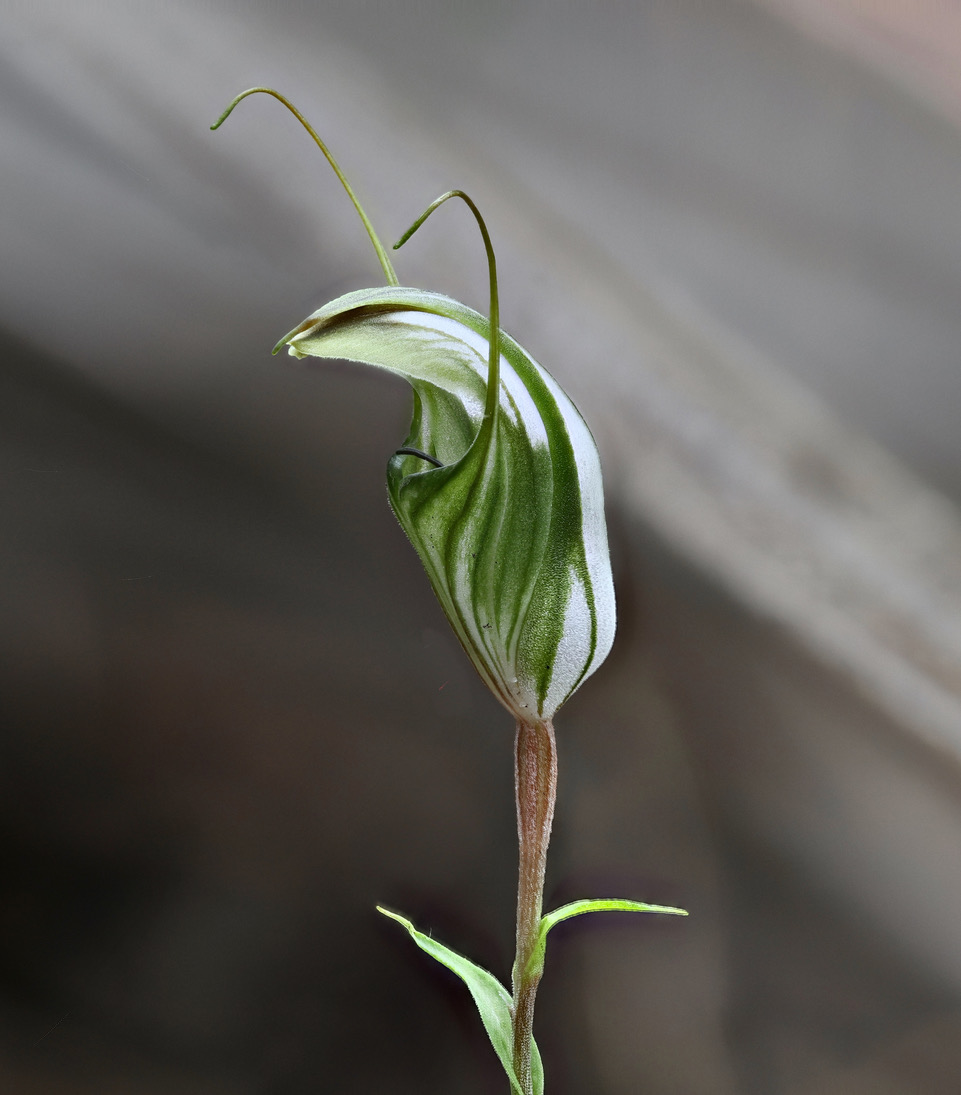
Diplodium aff alatum sp Hills – Scott Conservation Park-12/6/21 Now D clivoum
In keeping with their aim of research and education, the AOF has published various volumes of the Australian Orchid Research wherein, amongst other things, new orchid species are described. Over the years, beginning in 1989, six volumes have been produced.
Now Volume 7: More New Taxa of Australasian Orchidaceae, is available from their website.
For South Australians, this is as significant volume with the publishing of 52 species, many of which we have been waiting for many years to have described.
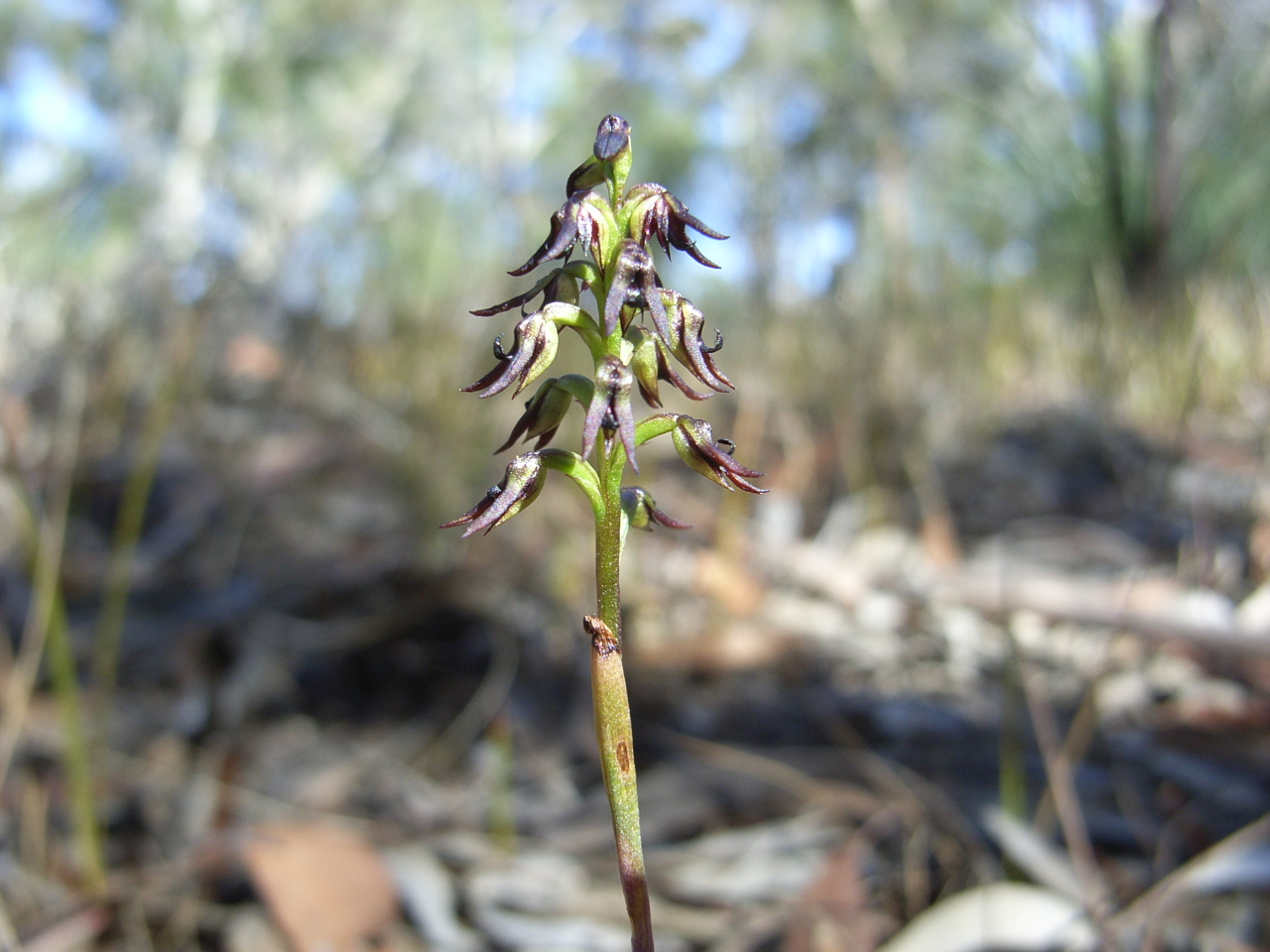
Previously Corunastylis sp Adelaide Hills, now C occidua Photographer: Robert Lawrence
As many of them have appeared in Native Orchids of South Australia: A Field Guide, the author, June Niejalke, for her own cross-referencing she has attempted as best as possible to map the names and page number of both volumes. This was based upon the Illustration section of the description as found in Volume 7.
As there is no index, she has kindly made this available for other orchid enthusiasts.
Ten years ago, the then NOSSA secretary, Cathy Houston, wrote an article reflecting upon orchid name changes. Since then there have been more name changes. The issues she raised then are still pertinent today. Whilst we continue to learn more about our orchids, name changes are going to happen.
NOSSA Journal Volume 31 No 2 March 2007
HAVE OUR ORCHIDS CHANGED? Cathy Houston (Secretary)
This month the Native Orchid Society of South Australia celebrates its thirtieth “birthday”. A review of the first five years of the Society’s Newsletters/Journals (yes, they were newsletters in the earliest days) reveals some interesting points. By 1979 “A total of 110 species [of orchids] and 14 varieties” were accepted. The following are some interesting aspects about the knowledge of, and what was then current thinking about, our orchids at that time. It must be remembered that no comprehensive book on South Australian orchids existed in those days, especially not any field guides. The most useful “tools” the members had to work with were Blacks Flora of South Australia and W.H. Nicholls “Orchids of Australia”. In 1979 “A Checklist of Orchidaceae on South Australia” by J.Z. Weber: Changes introduced in the new ‘Black’s Flora” by R. Bates, appeared as a full issue of the Native Orchid Society of South Australia Journal.
Today we sometimes struggle to grasp all the fine differences when orchid species, or species groups, are split, but spare a thought for those wanting to identify with what they have seen in the field back in about 1979. An article by R. Bates describes the “Variations within the species Caladenia dilatata R.Br. in South Australia”. “There are, at present, two recognised varieties” viz. C. dilatata var. dilatata and C. dilatata var. concinna. Within these two varieties are further more divisions into distinct sub-varieties or races! At that time there were six distinct forms recognised; how much easier today, now that they are named as species. These would now include C. tentaculata, C. verrucosa, C. stricta, C. toxochila and C. conferta.
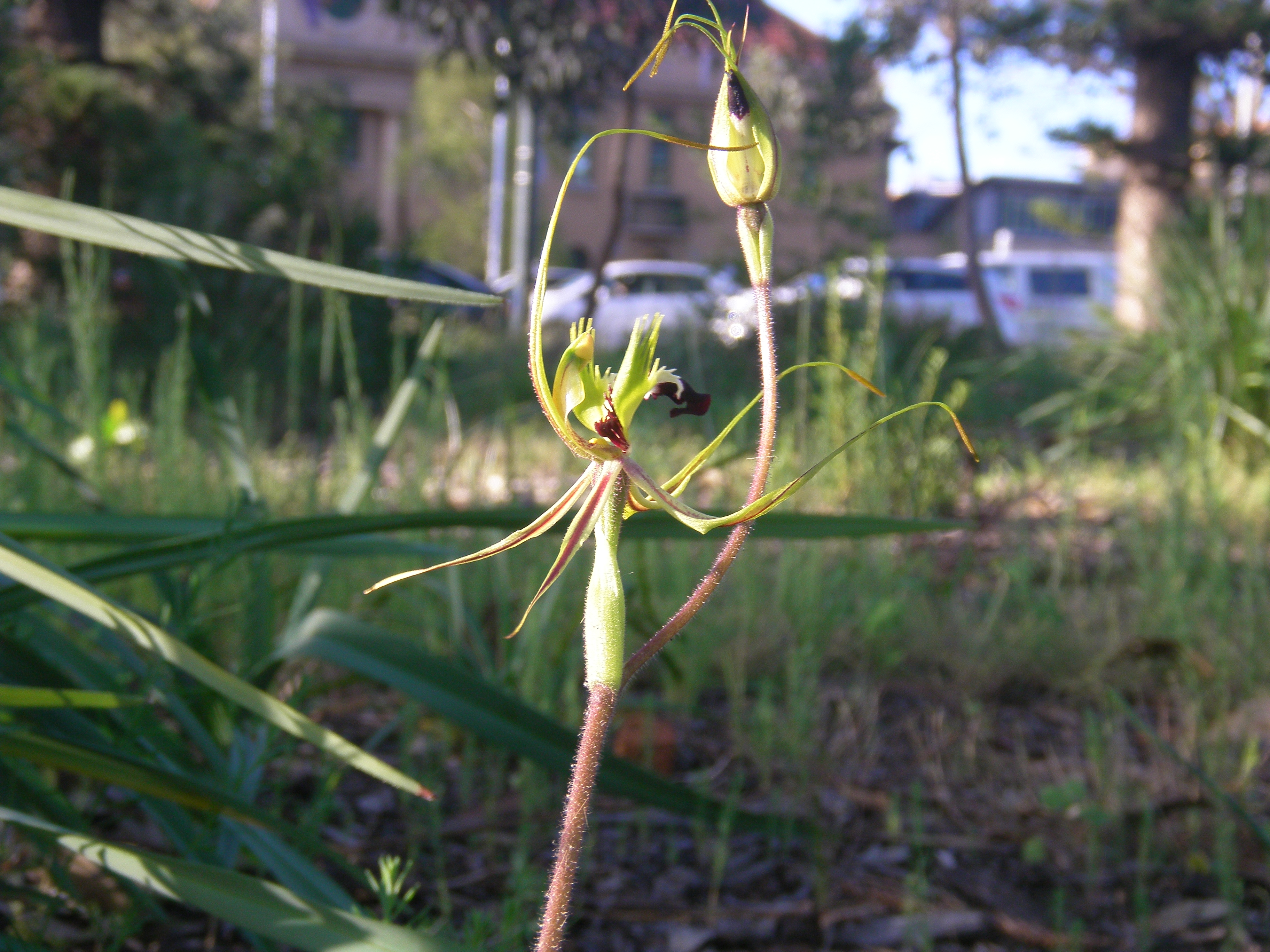
Arachnorchis tentaculata (King spider Orchid) syn Caladenia tentaculata
Recognition of what could be species has long been apparent. Take for example the article written in 1980 about two forms of Pterostylis nana, viz. what we commonly refer to as the ‘Hills’ form and the ‘Mallee’ form. This article documents the obvious morphological differences and illustrates this with line drawings and a map showing distributions of the two. Electronic Orchids of S.A. currently recognises five possible species of P. nana for South Australia. These are probably all un-named, since David Jones, in “Native Orchids of Australia”, does not recognise true P. nana in our state. Similarly, an article written in 1981 discusses the P. alata – scabra – robusta complex. The author recognises there are “at least four species of this group in South Australia”. This is the first time the authors acknowledge they should be elevated to species, not just accepted as varieties or forms. At that time P. robusta was treated at varietal level, viz. P. scabra var. robusta or P. alata var. robusta. Ultimately most of these have been elevated to species level (P. dolichochila, P. erythroconcha, P. robusta, and P. striata).
It was noted that in 1978 David Jones and Ray Nash were currently working on Pterostylis. Further to that Les Nesbitt notes that of the sixty or so Pterostylis in Australia, South Australia has twenty-two species. One wonders what the count is now. It is well known that David Jones is currently/still working on the Pterostylis group, with more species being recognised regularly.
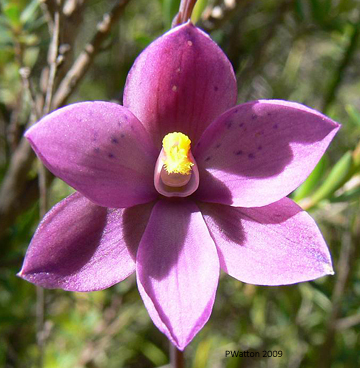
Thelymitra x irregularis or Pink Spotted Sun Orchid was photographed in 2009 near Macclesfield
In a series of articles produced about “Our rarest orchids” in 1977 we find the comment “Very few of our orchids are thought to be extinct… . “One wonders what that number would be considered to be today. The same article talks about the demise of Pterostylis cucullata and the possibility that it may no longer exist in the wild. Certainly this is one of our highly endangered species for which recovery actions are being undertaken these days. [N.O.S.S.A. members have an opportunity to assist with this work starting on April 14th – see diary dates.] In 1977 there was excitement when, following a field trip to Belair National Park one member returned the following day and “the elusive Pterostylis cucullata” was seen “growing in association with P. curta”. In 1981, following a discussion and review of endangered orchids in South Australia, R. Bates writes “There are a number of endangered species in S.A. which have not yet been named. It is not unlikely that some of these will become extinct before they are even described properly.” With such a large number of as yet undescribed orchids in our state, let us hope this does not happen.
Naturally occurring hybrids and the naming of such, has been debated regularly within botanical circles. In 1978 this insight is shown by Ray Nash who “guided us to a nearby patch of Thelymitramacmillanii,…… Ray’s view is that this will probably turn out to be a hybrid, possibly between antennifera (which it closely resembles) and rubra or luteocilium.” In 1980 T. decora [T. x truncata] was featured as one of South Australia’s rarest orchids. It was thought to be of hybrid origin and three forms were recognised then. The probable parents were T. ixioides x T. longifolia, T. ixioides x T. pauciflora, and T. ixioides x T. mucida. Today with the naming of many species within the T. pauciflora complex, it is now being recognised that there are even more combinations producing similar type flowers, e.g. T. juncifolia, which gives rise to the spotted features, x T. brevifolia.
Name changes always raise controversy. A brief explanation giving some insight into this complex area can be picked up when an author is expanding on the front cover illustration of Corybas. “In fact, they should never have been called Corybas in the first place. They were discovered by Robert Brown during the Flinders Expedition (1801 – 1805), and illustrated by the Austrian Ferdinand Bauer, another of the members of the expedition. Brown called them Corysanthes from the Greek “korys” (a helmet) and “anthos” (a flower), and they were known for many years by that name. However, in this instance, justice was never truly done, because the decision was made to call them Corybas, the name previously allotted by R.A. Salisbury in 1805, on the strength of seeing Bauer’s illustrations.” More recent times have seen that injustice righted with the name reverting to Corysanthes, something brought about through the work of David Jones. Similarly, the latest naming of Corunastylis tepperi follows this, The International Code of Botanical Nomenclature, a name that was recognised by R. Bates in an article written in 1981! However, Bates concludes that P. tepperi and P. nigricans are synonymous, so the latter prevails, but “further work needs to be done”! He is also the author of an article depicting some name changes in 1980. If our readers are confused by “new” names, then just think what it was like for those in 1980 when, among others, Caladenia carnea, and all its five varieties, is changed to C. catenata, with all its varieties, two of which are C.catenata var. gigantea and C. catenata var. minor. Two others were elevated to C. pusilla and C. alba.
Corysanthes diemenica (Veined Helmet Orchid)
At one time our esteemed orchidologist was asked to comment on a list of name changes being proposed for the revision of Black’s Flora of S.A. “My first reaction was to state that everyone would be happiest if no changes were made”! However, in fairness to that gentleman, it must be said that by the time he had worked through a lengthy consultation with botanists covering much of Australasia, a revision of type specimens and other material and associated literature, he was clearly of the opinion that the changes were warranted.
Have our orchids changed? Maybe, but what has really changed is our knowledge and understanding of these unique plants. Based on that knowledge, opinions, attitudes and ideas have changed. Thirty years ago it was not “policy to differentiate between the numerous forms of C. patersonii in this State …” Today we have numerous named species in this complex, without actually any Caladenia patersonii as such.
The final word must come from Peter Hornsby when he said “The ultimate aim should be for the reader to know which plant is being discussed, rather than whether or not the title is absolutely correct.”
References:
Native Orchid Society of South Australia Journal.
1. 1977 Vol. 1 #5
2. Vol. 1 #9
3. 1978 Vol. 2 #2
4. Vol. 2 #6
5. Vol. 2 #7
6. 1979 Vol. 3 #1
7. Vol. 3 #6
8. Vol. 3 #9
10. 1980 Vol. 4. #3
11. Vol. 4 #4
12. Vol. 4 #6
13. Vol. 4 #7
14. 1981 Vol. 5 #1
15. Vol. 5 #3
16. Vol. 5 #4
17. Vol. 5 #6
Black J.M. 1978. Flora of South Australia, Part 1, Third Edition. Handbooks Committee, South Australia.
Jones David L. 2006. A Complete Guide to Native Orchids of Australia, Including the Island Territories. Reed New Holland, Australia.
Nicholls, W. H. 1969. Orchids of Australia; The Complete Edition. Thomas Nelson, Australia.
Orchid names are contentious. The reasons appear to be complex but whatever the reasons the situation exists whereby some orchidologists are naming species that may or may not be accepted by others. The result is that there are publications using different names for the same species. And of course, in the midst of it all, are those names that have been accepted for previous species with phrase names or manuscript names.
Whatever the name, it is helpful then to be able to match them up. Last week’s blog covered South Australian names but in the same week Andrew Brown published on the Western Australian Native Orchid Conservation Study Group Facebook an updated list of WA orchids whereby he has linked them with significant WA Orchid field guide books.
Andrew has kindly given permission for this list to be published. Other lists are also included and these are available on the NOSSA’s Orchid eBook page.
It is worth reading Andrew’s introduction in ALIGNMENT of WESTERN AUSTRALIAN DIURIS AND PTEROSTYLIS NAMES.
The object of this exercise is to align the phrase names in these three publications with names published in recent taxonomic papers. Please note that most, but not all, currently recognized (described and undescribed) Western Australian Diuris and Pterostylis are included. There are other taxa that may be considered worthy of recognition but have not been included at this time as we feel further research is required.
In the case of phrase names, these are added and removed for taxa as new information comes to hand and should not be thought of as the final view. Rather, these should be thought of as current thinking that may change in the future. Taxa are only formally recognized as being distinct once their scientific names are published. Even then, later thinking may result in further changes.
Given that phrase names are a work in progress, some may think that we should not be promoting their use and that they should not be included in popular books. However, I think it is worthwhile putting them out to the wider audience so that their distinctiveness can be debated. Having a large group of people looking for (and at) these taxa provides us with a great deal of information and opinion based on firsthand experience in the field, that we may not otherwise have obtained. Then, if and when the taxon is formally described, it will be done on a much more informed basis.
As I am sure you are aware, the naming plants is an evolving process and there will be further changes as new information comes to light.
For the novice or beginner, orchid names can be a bit overwhelming. To add to their confusion, the more knowledgeable people tend to use abbreviated terms often switching between common and botanical names & their synonyms.
This week’s post will be a brief introduction to the most common names used for the South Australian orchids and how they relate to each other. It will not be comprehensive and it will not be a detailed discussion of orchid nomenclature but hopefully it might help the novice learn some of the names in current use.
In the past attempts have been made to split some genera. Not everyone has agreed with the splits but there are many who find it more convenient to use the alternate genus when working in the field. This tends to be the case with the larger genera such as Caladenia, Corybas and Pterostylis. Unfortunately, this has contributed to the confusion.
The names in this list are compiled from South Australia’s Native Orchids 2011 DVD. Even with this list the use of the names varies quite a bit with some being used rarely. Rather than considering each individual species, the list is centred around the genus name.
GENUS
ALTERNATE
GENUS NAME
or
SYNONYM
COMMON NAME
Acianthus
Acianthus
Acianthus
Mosquito
Acianthus
Nemacianthus
Mayfly
Caladenia
Caladenia
Caladenia
Pink Fairy
Caladenia
Arachnorchis
Spider
Caladenia
Jonesiopsis
Daddy Longlegs
Wispy Spider
Caladenia
Petalochilus
Pink Fingers
Caladenia
Pheladenia
Bluebeard
Blue Fairy
Caladenia
Stegostyla
Gremlin
Caleana
Caleana
Caleana
Duck
Caleana
Paracaleana
Little Duck
Calochilus
Bearded
Beardies
Chiloglottis
Chiloglottis
Chiloglottis
Bird
Chiloglottis
Myrmechila
Ant
Chiloglottis
Simpliglottis
Frog
Corybas
Corybas
Corybas
Helmet
Corybas
Corysanthes
Helmet
Corybas
Anyzbas
Pelican
Genoplesium
Corunastylis
Midge
Cryptostylis
Tongue
Moose
Cyrtostylis
Gnat
Dipodium
Hyacinth
Diuris
Donkey
Eriochilus
Parson’s Bands
Autumn Bunnies
Gastrodia
Potato
Cinnamon Bells
Glossodia
Purple Cockatoo
Waxlip
Leporella
Fringed Hare
Leptoceras
Rabbit Ears
Hare Orchid
Microtis
Microtis
Microtis
Onion
Microtis
Hydrorchis
Mignonette
Microtis
Microtidium
Yellow Onion
Orthoceras
Horned
Crucifix
Prasophyllum
Leek
Pterostylis
Pterostylis
Pterostylis
Greenhood
Pterostylis
Bunochilus
Banded Greenhood
Pterostylis
Diplodium
Shell
Pterostylis
Hymenochilus
Tiny Shell
Pterostylis
Linguella
Little Greenhoods
Nana
Pterostylis
Oligochaetochilus
Rufoushoods
Pterostylis
Plumatochilos
Bearded Greenhood
Pterostylis
Speculantha
Tiny Greenhood
Pterostylis
Taurantha
Cobra Greenhood
Pterostylis
Urochilus
Maroonbanded Greenhood
Sanguinea
Blood Greenhood
Pyrorchis
Fire
Undertaker
Spiranthes
Ladies Tresses
Spiral
Thelymitra
Sun Orchid
A detailed list of SA orchid species names and their synonyms can be found here .
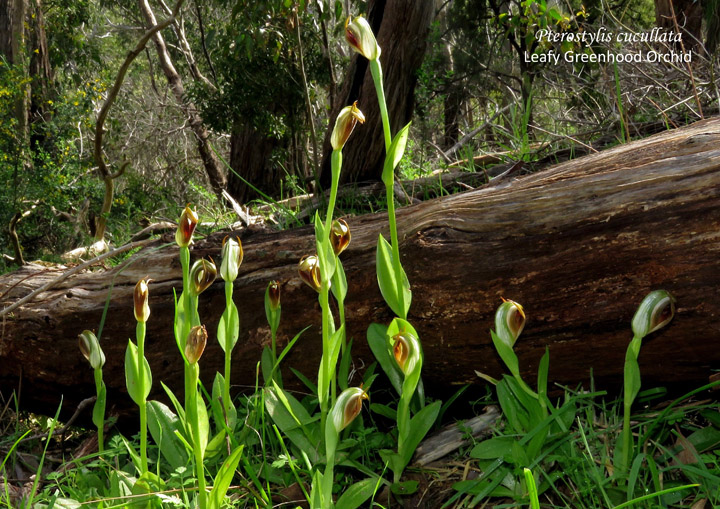
The following are all Pterostylis but not all of them are Greenhoods. This first image is a Pterostylis Greenhood.
Pterostylis cucullata
This one is a Shell Orchid or alternately Diplodium
Diplodium dolichochilum
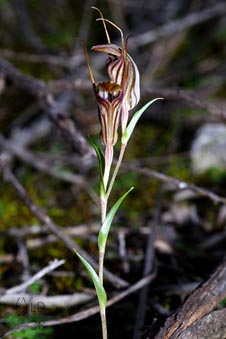
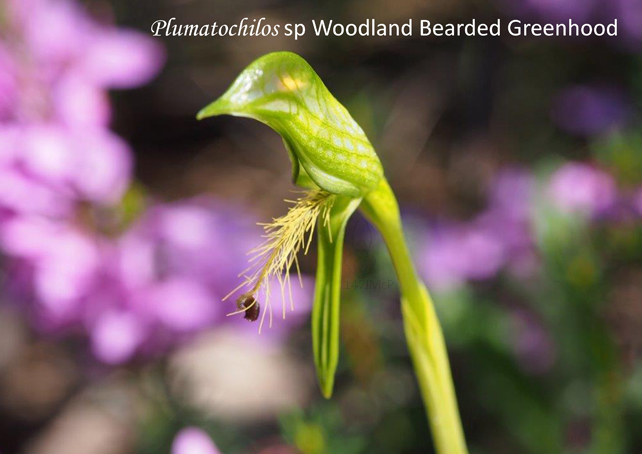
Whilst this Pterostylis is a Bearded Greenhood or Plumatochilos
Plumatichilos sp Woodland Bearded Greenhood
The final Pterostylis example is a Rufoushood, or Oligochaetochilus
Typical of the Rufoushood this Oligochaetochilus arenicola shows the sencesing leaves, pendent petals and hairs on the labellum. Photographer: H Lawrence
So they could all be referred to Pterostylis or any of the other possible names whether the common name or a synonym.
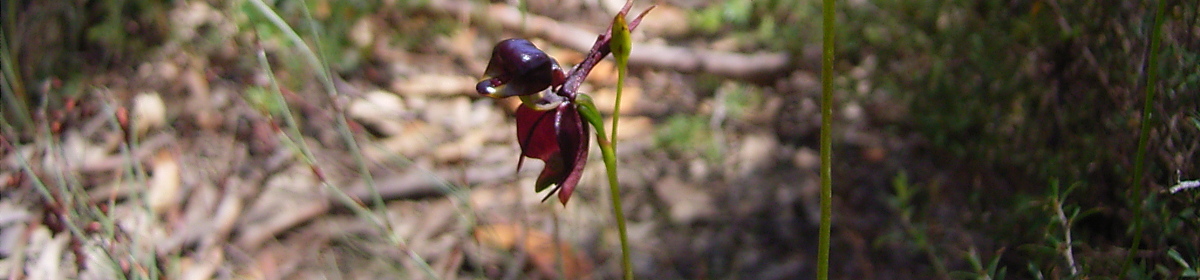
In Part One, Leo Davis’ first article centred on the Large Flying Duck, this second part is about the lesser known Little Duck.
TAKING A DIFFERENT PERSPECTIVE 2 (The Small Flying Duck Orchid)
There are at least three speceis of flying duck orchids in SA, one in genus Caleana and two others having been moved from there to genus Paracaleana.
My favourite, of the two duck orchids that most of us see, is the small duck orchid (Paracaleana minor). It is actually rarer than the more popular species, can bear six or more flowers on a spike, and has a more delicate and quirky charm, to my eye.
As with the large flying duck the usual angle of photographing the smaller species is to emphasise the ‘flying’ nature. But again there is other detail to see and to be illustrated from other view-points.
The accompanying image of the little duck flower, viewed from the front, shows variations on the same structures shown previously in the large duck orchid. Down at the bottom of the flower is the sticky stigma (♀ part), not white this time, and immediately below is the triangular yellow pollinium packet (♂ part). Again both structures sit in the bowl shaped column.
Paracalean minor (Little Flying Duck Orchid)
Note the three part symmetry of the pollinium, with a distinctive Mercedes Benz logo (or Mitsubishi if your budget only stretches that far) to tease us.
The location of the female (♀) and male (♂) organs, adjacent to each other, fused to form a column, is one of the main distinguishing characteristic features of the orchid family.
As an afterword let me remind you that the little duck (like the larger, collected in Sydney in 1803) started out as Caleana minor but was moved to a new genus, leaving the large duck as the only member of its genus. Rules of nomenclature mean that the small duck had to keep its specific name (minor), hence we now have Paracaleana minor but there is no, and never will be, Paracaleana major. But Caleana minor still appears in publications and some folks may still use that name.
Some of you choose to use different scientific names to some that others use. Recently some of us bought a propagation pack that Les Nesbitt produced, to grow the maroon banded greenhood (Pterostylis sanguinea.) In the unlikely event that my pack produces seedlings I will label them Urochilus sanguineus. And we can both justify our choice. And then, of course, some taxonomist could move the little duck back to its original genus one day.
Then, of course, there is the added complication that David Jones (Native Orchids of Australia Including the Island Territories. 2006, p148) calls the species Sullivania minor!




 NOSSA
NOSSA 