
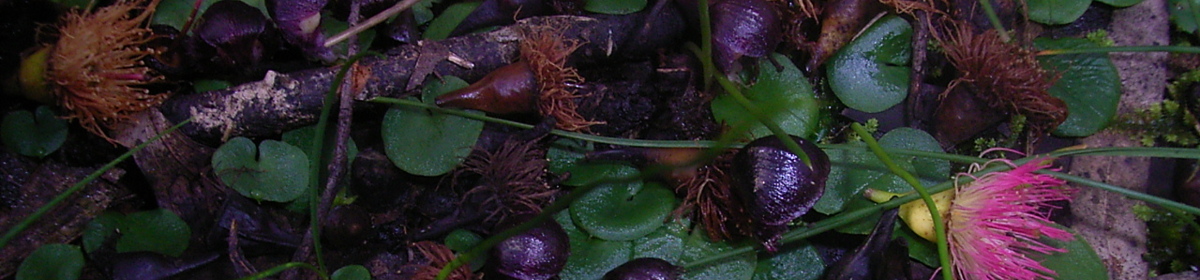
Recently, Jodie Hamilton (ABC reporter) wrote a good orchid article highlighting the importance of and threats to orchids. Click on the link to read her article – Orchid enthusiasts call for greater protection for native species facing habitat threats When she emailed me with some orchid questions (28 November 2025), I gave a comprehensive answer from which she was able to take what she needed for her article.

As there is additional information in my answer, I thought others might be interested in my reply. Here it is –
“Hi Jodie,
As to numbers, the answer to some of your questions depends upon who you ask. So the figures will vary. Orchid taxonomy is being reviewed with several researchers looking into South Australian orchids and in coming years we will see the numbers change. But regardless of the detail, it can be confidently said that over half of South Australian orchids are threatened. Threats are clearance & development, weeds, herbicide, overgrazing, isolated “island” population (orchids need room to spread).
So having said that, looking at the Atlas of Australia (ALA), there are 4,470 observations of 141 species of orchids in EP collected between 1850 and 2025. Since 2015, iNaturalist, a citizen science project, 117 observers have collected over 1,200 of those ALA observations. iNaturalist is significant because in recent years individuals are adding observations exponentially to the database, a thing we have not been able to do in the past. The more people that get involved with iNaturalist, the more data we will have and be able to have a better understanding of not only orchids, but all our other species.
My numbers are more aligned to the herbarium numbers. Approximately 12 species are endemic to EP (~162 species for the whole of SA).*
As to why orchids are important, the following information is taken from a talk I gave earlier this year – Orchids are bio-indicators of the health of the bushland. Because they have great visual appeal, we notice them and when aware of them we are able to use their presence to determine what is happening.
- They have a low tolerance for change/disruption whereas other plants will show stress signs later, making them an early indicator of what’s happening.
- Pollinated orchids indicate pollinator presence i.e. insects as many orchids do not provide food for the pollinators.
- They have a strong reliance upon mycorrhizal fungi from germination and with some species through the whole of their life cycle.
- The significance of the fungi is that they contribute to the soil health, are involved in nutrient recycling and contribute to plant growth.
This makes orchids a potential flagship for conservation work. I’ve attached a pdf of the talk.
Fun Fact you might like.
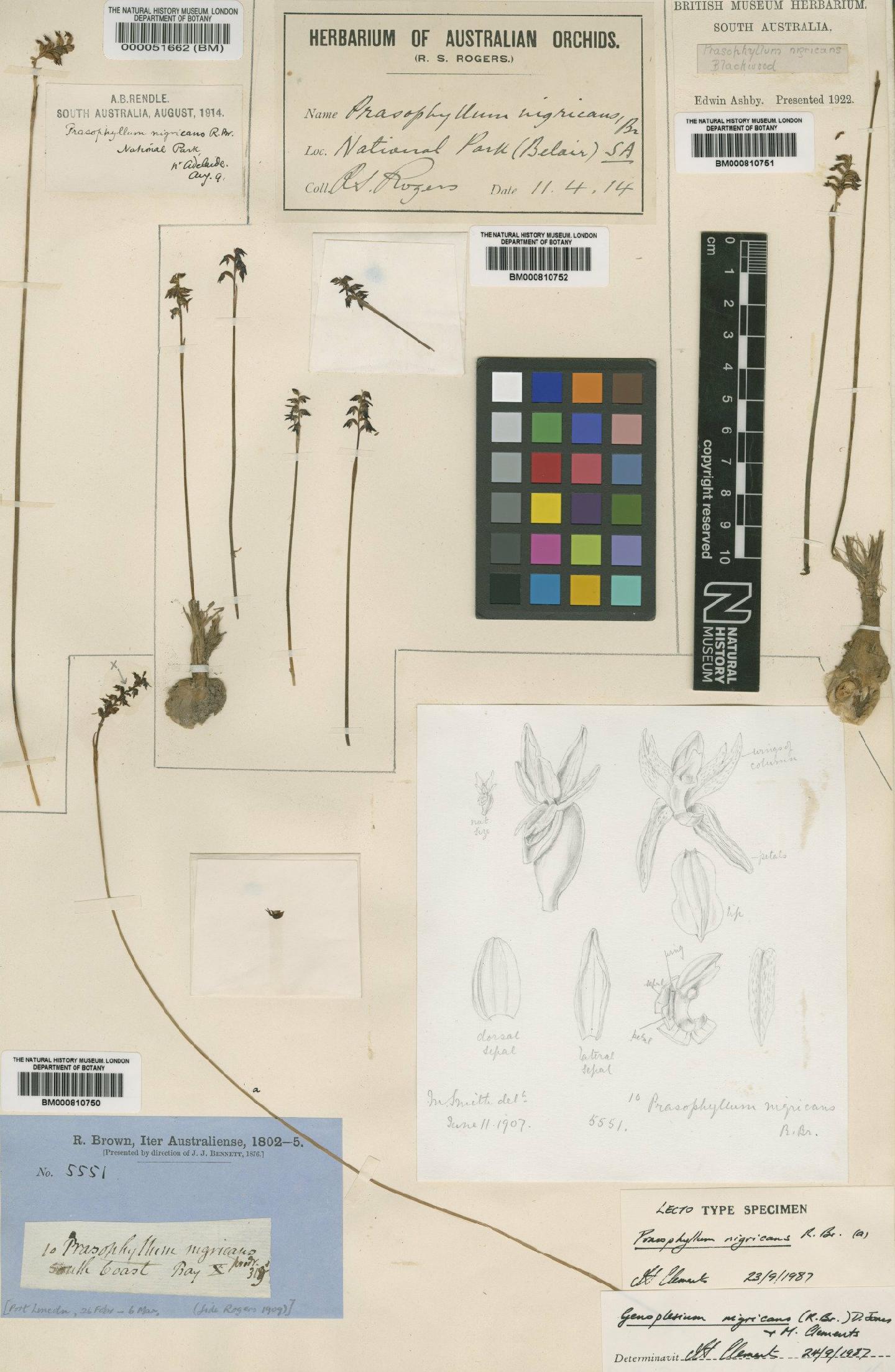
The first orchid found in South Australia was March 3,1802 by Robert Brown, botanist on the Investigator with Matthew Flinders. This was at Port Lincoln. Initially it was called Prasophyllum nigricans but today is known as Genoplesium nigricans. I find it amazing that he managed to find such a small sticklike orchid which often gets overlooked in our modern species lists.
June Nieljalke would also be able to help you.”

In giving Jodie the fun fact about the first orchid found (or rather I should say first documented), I went down a bit of a rabbit warren on the ‘net as I couldn’t find my original research material for a 2019 talk and wanted to double check the accuracy of my information.
So, I typed into Google “when was the first orchid found in south australia” only for it to give a wrong answer. I do appreciate that the Google AI gives references (other ChatBots such as Co-Pilot do not). This is important as it pointed me to an article I’d written about Caladenia cardiochila which was a few decades after settlement and therefore unlikely to be correct as other orchids would have been found before that.

As a tool, AI does not do research, let alone original research. It does not understand concepts but recognises individual words and word patterns. The words it picked was “first”, “orchids” “found” and “south australia”. All four words were in the article but the concept was about when Caladenia cardiochila was first described but it was not the first orchid found in South Australia which is what the question was about.
As AI did not have a summary, it meant I needed to do some research, potentially looking for original material. This took me to the Internet Archive, the Biodiversity Heritage Library (a very useful source as it contains a lot of original source material), Digital Herbariums, etc from which I was able through deduction to come to the answer of “when was the first orchid found in south australia”
Now when you type in the same question, Google hopefully will give the correct answer.
References
Lectotype
Natural History Museum (2014). Specimens (from Collection specimens) [Data set resource]. Natural History Museum. https://data.nhm.ac.uk/dataset/collection-specimens/resource/05ff2255-c38a-40c9-b657-4ccb55ab2feb
https://data.environment.sa.gov.au/Content/publications/JABG21P004_Barker.pdf
Appendix 2 page 34/35 Plant Collections by the British from South Australian waters in 1802. This reference gave the dates and locations of where the Investigator was as well as the specimens collected
https://archive.org/details/mobot31753003393979/page/318/mode/2up page 319 Latin description of Prasophyllum nigricans
Disentangling the history of the Robert Brown specimens at RBGE – Botanics Stories some background history on Robert Brown and his collection
Personal correspondence Jurgen Kellermann, South Australian Herbarium
*My figures for the endemic species numbers came from a spreadsheet, I’d initially complied years ago based upon 2011 Native Orchids of South Australia and updated.
 NOSSA
NOSSA 