June 2014 Winning Photograph


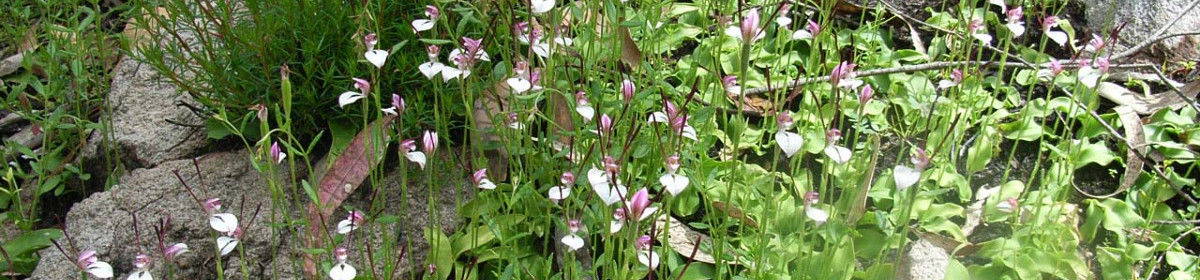
06 DM A leptochila sm
Arachnorchis leptochila spp. leptochila (syn. Caladenia leptochila)

There were many more entries than usual this month but the winner was a photograph by David Mangelsdorf.

Looking back over the last three winners, a royal theme emerges.  In April it was the elegant Queen Orchid, in May the flamboyant Queen of Sheba and this month it is the dignified Queen Spider Orchid (a statelier name than the more usual common name of Narrow Lipped Spider Orchid).

The botanical name for this species is Arachnorchis leptochila spp letptochila (syn. Caladenia leptochila).  An endemic species of South Australia, it is mainly found in the Mount Lofty Ranges where it favours leached stony soils.  Flowering in spring, it is easily recognised by the upswept segments and narrow labellum.

Usually these orchids are characterised by dark clubs which can be seen even in bud, but in this picture they are light coloured.  This could be due to variation with the species, as occasionally pale coloured flowers have been found.  Interestingly in doing an image search on the web I found none with light coloured clubs.


The Great Orchid Pretender

Actually there is more than one.

Frequently NOSSA receives a request to identify an orchid in someone’s garden.  Often, instead of an orchid (but occasionally there are orchids), it is the Ariasrum vulgare (common name Friar’s Cowl Lily or Cobra Lily).

Native to Asia and Europe, notably the Mediterranean and introduced to Australia, it is often mistaken for one of the flowers of the Pterostylis (Greenhood Orchids) or Diplodium (Shell Orchids).  Some have called it a Blackhood orchid others Snake Orchid.  It’s resemblance to the Greenhoods and Shell Orchids is superficial as they have none of the orchid features.  The dark purple hooded part is not the flower; it is a spathe (bract).  The flowers are minute hidden on deep down on the “tongue”.

The hood of the orchids is the combination of a deeply concave dorsal sepal interlocking with the lateral petals; and the fusing of the two lateral sepals.  Tucked away within the hood is the labellum (a modified petal) and the column (the reproductive organs of the flower).  The leaves of Ariasrum are quite large and distinctly different from any of the Greenhood orchids.

Friar's Cowl Lily 93RL
Arisarum vulgare amidst its large leaves
Pterostylis pedunculata 92RL
Pterostylis pedunculata (Maroonhood Orchid)
Diplodium robustum 92RL
Back view of a Diplodium robustum showing the dorsal sepal and two lateral petals that make up the hood of the flower


Diplodium robustum labellum and column 96HL
Looking into the Diplodium robustum – the labellum is the brown tip just visible at the front of the flower and the column is the brown white and yellow structure at the back
Pterostylis curta Labellum and column 92RL
Peering into the hood of a Pterostylis curta, the labellum is toward the front and the white and yellow structure to the back is the column
Friar's Cowl Lily open bract 93RL
The bract of the Arisarum vulgare has been split open to reveal the knobs which are the flowers. The flowers are so small a hand lens or microscope is needed to see them.


The time has arrived

If  you want to see the Helmet Orchids, now it the time of year to find them.  My understanding is that the time from leaf mergence to capsule is about six weeks.  In the past week I’ve seen Corysanthes diemenica (Veined Helmet Orchid) both in the north and the south of the Adelaide Hills.  Corysanthes incurva ( Slaty Helmet Orchid) appears slightly later, end July early August, and will now be in bud.  Look for them amongst the leaf litter.


Corysanthes diemenica (Veined Helmet Orchid)


Confucius’ thoughts on Orchids

Confucius was an admirer of orchids and in this quote he captures the quality of the epiphytes in this eloquent translation*:

The orchid grows where others cannot enduring the hardships of hunger and thirst, and is loosely tied to the things that support it.  And, even with all the difficulty of its life, the orchid graces the world with beautiful colour and rare fragrance.  This is like the life of the true gentleman, who sets himself to learn self-discipline, and whose character shines no matter where he is or what he experiences.

Though he never saw an Australian epiphytic orchid, the description holds true as can be seen in these three pictures from among the many species found on the eastern seaboard.

Sarcochilus falcatus
Sarcochilus falcatus (Orange Blossom Orchid)
Dendrobium speciosum
Dendrobium speciosum (Sydney Rock Orchid)
Dockrilla linguiformis
Dockrilla linguiformis (Tongue Orchid)


*From The Fragrance of the Unread Poem by Jonathon Steffan http://www.jonathansteffen.com/the-fragrance-of-the-unread-poem/ Accessed 10:04pm 30th June 2014


Australian Orchids and the Doctors they Commemorate Part 4 of 20

Continuing Professor John Pearn’s article

Part 4

The first orchids scientifically named in the Pacific were species in the genus Thelymitra J.R.Forst. & G.Forst., a taxon raised and coined by the Forsters — the irascible Johann Reinhold Forster (1729–1798), and his son Georg Forster (1754–1794), who was 18 years old when they left on Cook’s second voyage of 1772 to 1775. The Forsters collected Thelymitra longifolia in the South Island of New Zealand in 1772 and published the name of the species in 1776. The Forsters described and named nine new species in what they termed the “Class of Orches” in the South Pacific. Georg Forster graduated in medicine in Vilna (now Vilnius, Lithuania) in 1784. Species of Thelymitra, which are known as the Sun Orchids, are found mainly in the south-west of Western Australia.

It should be noted that Thelymitra are found both in the east, central and the west of southern Australia.

Australian Orchids and the Doctors they Commemorate Part 3 of 20

To learn a little more about some of the orchids Professor John Pearn has mentioned, click on the links

Part 3

Early orchidology in the Asia–Pacific region

The fleshy pseudobulbs (thickened stems that serve as storage organs) of orchids have been eaten and used medicinally by Indigenous Australians for thousands of years. The first Australian orchids brought to the attention of Western science were three species of Dendrobium (D. discolor Lindley [described by John Lindley]; D. canaliculatum R.Br. [described by Robert Brown]; and D. rigidum R.Br. [described by Robert Brown]) that were collected by Joseph Banks and Daniel Solander at the Endeavour River between 17 June and 3 August 1770. Solander had trained in medicine and botany under Linnaeus in Uppsala (Sweden) and, after 1759, in London (England). One of the plant species named after him is the Australian orchid Orthoceras solandri (also known as Orthoceras strictum).

May 2014 Winning Photo

05 PM T pulchemirra sm

Pauline Meyer’s winning photograph is a whole plant picture of Western Australia’s flamboyant Queen of Sheba Orchid.  It was taken at Eneabba, north of Perth and identified by a local as Thelymitra variegata but in consulting the books it would appear that it is the Northern Queen of Sheba, T. pulcherrima.  There are three species known as Queen of Sheba orchids in Western Australia – T. varigata, T. pulcherrima and T. speciosa.

T. variegata was originally named in 1839 by John Lindley but under the genus Macdonaldia.  In 1865 Ferdinand Mueller moved it to Thelymitra, later people began to separate it out to three different species* but it wasn’t until 2009 that Jeff Jeanes describeds T. pulcherrima and T. speciosa as distinct species from T. variegata.

All three species have a single thin spiral leaf and showy multi-coloured flowers.

T. pulcherrima and T. speciosa differ from T. variegata in the following points.

  • T. speciosa, begins flowering earlier, is a slightly shorter plant with fewer flowers (one, more rarely two) and although the flowers are a similar size to T. variegata they are even more colourful and the petals and sepals are distinctly different colours.
  • T pucherrima is similar in height to T. variegata but has smaller flowers with yellow, red, purple mauve sepals and pink purple mauve petals.  It too begins flowering earlier than T. variegata.
They all have distinct separate locations as reflected in the common names – Southern Queen of Sheba (T. variegata), Eastern Queen of Sheba (T. speciosa) and Northern Queen of Sheba (T. pulcherrima).  For some good images go to Retired Aussies or the Chookman
 
Finally there is one other species that is similar to these three and it is called Cleopatra’s Needle, T. apiculata.
 
  Thelymitra pulcherrima Theylmitra speciosa Thelymitra variegata
  Northern Queen of Sheba Eastern Queen of Sheba Southern Queen of Sheba
Distribution North of Perth between Lancelin and Dongara Between the Stirling Range and Condingup Between Perth & Albany with disjunct populations near Hyden
Flowering late June – early September late June – September August to September
Flower numbers 1 to 5 1 to 2 1 to 5
Flower height 150 – 350 100 – 200 mm 100 – 350 mm
Flower size 25 – – 35mm 30 – 50 mm 30 – 50 mm
Sepals Yellow, red, purple and mauve Yellow, red, purple and mauve Deep pink purple blotched
Petals Pink or purple and mauve Pink or purple and mauve Deep pink or purple and darker purple blotched
 
References:
Field Guide to the Orchids of Western Australia 2013, pages 425 & 427
I would like to thank Andrew Brown, co-author, for his help with this article.
 
* The name T. puchemirra is mentioned in the Western Australian Native Orchid Study and Conservation Group 2008 field trip report

Australian Orchids and the Doctors they Commemorate Part 2 of 20

In continuing this series of Professor John Pearn, links have been provided for the genera or species mentioned.  In this group most of them are from limited locations in Queensland.

Orchids named after medical professionals

Sixteen doctors who practised medicine and/or botany in Australia have their names recorded in the scientific names of 24 indigenous orchids of Australia. In addition, one separate species (Thelymitra flexuosa, also known as Thelymitra smithiana) and five genera of indigenous Australian orchids record the names of European doctors, pharmacologist–pharmacists or herbalists. The five genera are Burnettia Lindl. (described by John Lindley in 1840), a monospecific genus; Cadetia Gaud. (described by Charles Gaudichaud-Beaupré in 1829); Goodyera R.Br. (described by Robert Brown in 1813); Robiquetia Gaud. (described by Charles Gaudichaud-Beaupré in 1829); and Vrydagzynea Blume (described by Carl Ludwig Blume in 1858).

The Lizard Orchid, Burnettia cuneata, blooms in eastern Australia and Tasmania; it commemorates Gilbert Thomas Burnett (1800–1835), surgeon and foundation professor of botany at King’s College London.

In the genus Cadetia (delicate white orchids), four species are named after the apothecary of the French imperial court, Charles-Louis Cadet de Gassicourt (1769–1821) — C. collinsii, C. maideniana, C. taylori and C. wariana. They commemorate his life and works as an apothecary, soldier, scholar, writer, scientist and researcher.

The genus Goodyera is named after the 17th century herbalist John Goodyer (1592–1664).

Robiquetia commemorates Pierre Jean Robiquet (1780–1840), a French pharmacist, organic chemist, professor and foundation member of the Académie royale de Médecine (1820). He was the first to describe an amino acid (asparagine) (1806), and he characterised caffeine (1821) and discovered codeine (1832).

One species out of the 40 species of the Tonsil Orchids, Vrydagzynea grayi, grows in Australia. A rare orchid of the Daintree rainforest in north Queensland, it commemorates Theodore Daniel Vrydag Zynen (fl. 1850), a Dutch pharmacologist and contemporary of one of the most famous doctor–orchidologists, Karl Ludwig Blume (1796–1862). The Twisted Sun Orchid, Thelymitra flexuosa, commemorates the Norwich physician and friend of Joseph Banks, Sir James Edward Smith (1759–1828). When he was 25 years old, Smith took the decisive action to buy the great Linnean collection of plants, which were in danger of being lost to science following the death of Linnaeus’s son in 1783. Smith bought them when they were offered for sale in 1784. In conjunction with the bishop of Carlisle, he founded the Linnaean Society of London and was its first president. In 1798, he raised the new genus, Diuris, which is one of the first taxa of Pacific orchids to be described. The Lilly Pilly, Syzygium smithii, is another of his six botanical memorials.

A Revolution of a Sweet Kind

Ever since the Western world discovered the orchid in the 18th and 19th century there have been enthusiasts wanting to grow them but though an orchid may produce millions of seeds, for they are minuscule, only a relatively small number germinate.  The seeds do not have any stored food and are dependent upon fungi for germination.  This made it difficult for early orchid growers who relied on obtaining specimens from the wild – a most unsustainable practice!

Yet today cultivation of orchids is flourishing.  It is not dependent upon removing specimens from the bush.  In Australia it is illegal.

Today the orchid enthusiast can grow orchids from seeds at home.  The technique, invitro embryo germination, is popularly known as flasking.  It involves growing the seeds in a sterile agar medium to which the most significant ingredient was the addition of sugar.

At the time it was developed by Professor Lewis Knudson (1884 – 1958) of Cornell University in 1922 this method was revolutionary.


Reference:

Rasmussen J, April – June 1986, “Contact Dermatitis from Orchids” Clinics in Dermatology Volume 4 Number 2

Below are some examples of terrestrial orchids grown from seeds in flasks.

Flasking Terrestrial Orchid Seeds (3)  Flasking Terrestrial Orchid Seeds (2)  Flasking Terrestrial Orchid Seeds (1)

Photographs kindly supplied by Les Nesbitt.


Australian Orchids and the Doctors they Commemorate Part 1 of 20

Back in 2013, Professor John H Pearn, Emeritus, School of Medicine, University of Queensland wrote a five page article about medical doctors who were Australian orchidologists.  This was published in the Medical Journal of Australia.  My intention is to post direct quote extracts from his article.

First …..

Thank you, John Pearn for giving permission to post

Now to begin …….., at the beginning….. of course …………

Orchidaceae is the largest family of flowering plants. Orchids grow in habitats ranging from subalpine niches to the tropics, and they produce some of the most beautiful, varied and intriguing flowers. Of the more than 1300 genera and 33 000 species, more than 1300 named taxa of orchids, in 193 genera, grow in Australia.

The word “orchid” is from the Greek word orchis  (meaning testicle), which reflects the appearance of the  root tubers in some species. According to the “doctrine of signatures” –  a 16th century herbalist philosophy  which states that herbs resembling body parts can be used to treat those body parts – orchids were used continuously from preliterate times as aphrodisiacs and as medicaments to restore virility. Theophrastus (c. 372–288 BC) wrote about the medicinal value of orchids, as did Paracelsus (1491–1541) and Carl Linnaeus (1707–1778), the father of modern botanical taxonomy.  As a child, Linnaeus recorded details of his personally collected orchid specimens in his notebook, in which he wrote “Orchis from testiculus, through which its effects should occur”.

Orchid extracts such as vanilla (from Vanilla planifolia) and salep (from Orchis mascula and Orchis militaria) are used commercially in ice-cream, confectionery and medicinal flavouring agents. Crawley root preparations (from Corallorhiza odontorhiza) are used in folk medicine for their diaphoretic and antipyretic properties. In Australia, orchid preparations have been and continue to be used by Indigenous healers to treat diarrhoea and skin infections. Lieutenant (not yet Captain) James Cook used powdered orchid root as part of his method for preserving the health of his crew.

The physical manifestations of orchids, such as their flowers and the medicines and flavourings derived from them, are ephemeral. But the scientific names of orchids endure, and many perpetuate the lives and works of those who have contributed to medicine since the time of Aristotle. Here, I describe indigenous orchids of Australia whose scientific names commemorate doctors who worked in Australia, encapsulating a library of Australian medical history. These orchids comprise a monumentum aere perennius (monument more lasting than bronze) — a phrase coined by Horace in Book III of his Odes when referring to his own literary work.

To be continued ……………