Australian orchids are special but Australian orchids have been disappearing from our landscape. Throughout the country individuals and groups are attempting various conservation methods to help save our orchids. One such group is Dr Nouska Reiter and her team from Orchid Conservation Program, and arm of the Australian Network for Plant Conservation Inc
Dr Nouska Reiter is seeking to raise money for a conservation laboratory to cultivate threatened orchids for reintroduction into the bushland. She has a month left; so for details about the project and on how to help, go to Help save South East Australia’s unique and threatened orchids!
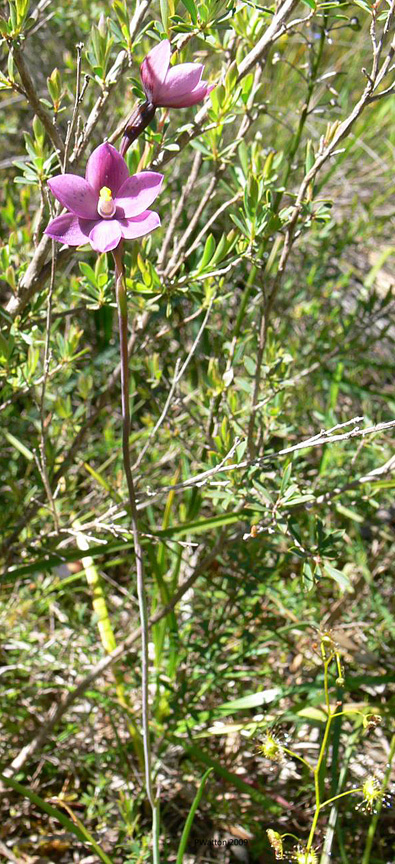
This week, a local radio station introduced a segment with the phrase “our rarest sun orchid” and that it was called Thelymitra irregularis or Spotted Pink Sun Orchid. However it certainly is not our rarest sun orchid.
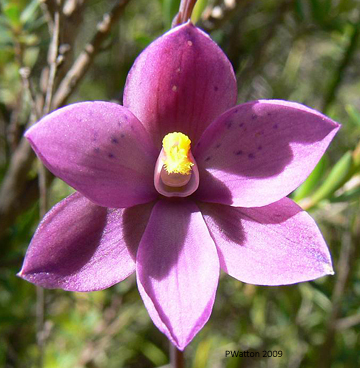
Thelymitra x irregularis, Peter Watton, 2009
True, it is not common, but that is partly because it is a hybrid and, correctly speaking, the name should be written as Thelymitra x irregularis (the “x” indicates that it is a hybrid).
For a hybrid to occur, the two parent species need to grow in close proximity, the flowers need to open at the same time that the pollinator is visiting flowers, either to collect or to deposit the pollen and, in the case of self pollinating species, before the individual flower has pollinated itself.
The majority of hybrids are sterile, but occasionally some are fertile. When hybrids occur the majority will only last a few years before disappearing although sometimes colonies are formed which may last for decades. Hence, it is not usual to name hybrids, but the more common and recurring ones have been named formally. T. x irregularis is one of them.
Several species of Thelymitra have been proposed as parent species of Thelymitra x irregularis. Jeanes & Backhouse (2006) give T. ixioides and T. carnea as parents; Weber & Entwisle (1996) and Jones (2006) suggest T. ixioides and T. carnea and/or T. rubra; Bates & Weber (1990) state that in South Australia the parents are T. ixioides and T. rubra, but T. ixioides and T. carnea in the Eastern states; in contrast, Bates (2011) states that in South Australia it is a hybrid between T. juncifolia and T. rubra. However, without detailed genetic studies or breeding experiments these all remain suggestions.
Due to the transient nature of hybrids and the conditions needed to produce them, the named hybrids are not common, but since the 1890s specimens of Thelymitra x irregularis have been collected in every decade, which suggest that this hybrid readily occurs. The 71 specimens held in the Australian herbaria have been collected from four states – which gives a good indication of the distribution but not necessarily the frequency of occurrence. See Australia’s Virtual Herbarium (AVH) for details. The AVH lists 12 herbarium records for South Australia with specimens collected from the Adelaide Hills, the Barossa Valley, Kangaroo Island and near Naracoorte.
This Thelymitra x irregularis or Pink Spotted Sun Orchid was photographed by Peter Watton in 2009 near Macclesfield, South Australia
The botanical name “irregularis” refers to the description of the column. With many sun orchids, it is often necessary to observe the column to distinguish one species from another. In this instance the top of the column is irregularly toothed. Retired Aussie has some very good photographs with one in particular showing the column detail.
Thanks to Juergan Kellermann, State Herbarium of South Australia for his help with this post.
References
Bates (2011). South Australia’s Native Orchids. DVD-ROM
Bates & Weber (1990). Orchids of South Australia.
Jeanes & Backhouse. Wild Orchids of Victoria, Australia
Jones (2006), Native Orchids of Australia, 2nd edn.
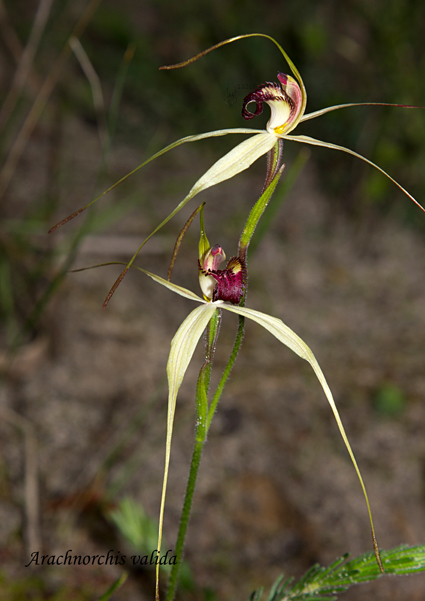
Claire Chesson’s Arachnorchis valida (common name Robust Spider Orchid) was the winning photograph for August.
The name Arachnorchis valida was not validated until 2002; synonym Caladenia valida. Previously it had been included under Caladenia huegelii (a Western Australian species) and Caladenia reticulata.
A. valida grows in sandy or sand over red clay soil, in sheltered clearings within heathy woodland or mallee but within a very restricted and disjunct distribution on Fleurieu Peninsula and Kangaroo Island in South Australia; and Otway Plain, Victoria. Rated Endangered in South Australia, it is not listed nationally.
Although A. valida shares some similar features with A. reticulata (ie 1 to 2 flowers, clubbed sepals, calli on the labellum) it also has quite distinctive features (see chart below) that help to differentiate between the two as they can sometimes be found growing together.
Comparison of A. valida and A. reticulata
Features
A. valida
A. reticulata
Pollinating wasp
Phymatothynnus pygidialis
Phymatothynnus victor
Leaf
Felted Leaf – dense, short hairsSemi erect
Very long silky hairs; purplish at the baseErect
Flower Stem
Taller – 40 cm, hairy
30 cm, green & purplish red with long silky hairs
Flower Size
Though variable, larger – 7 cm
5 cm
Flower
Greenish when first opened fading to white or cream as the flower matures
Red-brown
Perianth
Stiffly spreading – broad based sepals; backswept petalsNo stripes
An important first lesson to learn when out orchid hunting is to watch where you put your feet. In this video the Orchid Hunter explains the how and why for watching where you step.
“So fair, so sweet withal so sensitive, Would that the little flowers were born to live, Conscious of half the pleasure which they give”
I found this quote of Samuel Taylor Coleridge in A Collection of Australian Wildflower Illustrations by Patricia Weare 1984. The only text for the painting’s section were for identification but at the end of the Orchid section there was this one poem. It was appropriately placed as one could easily substitute the word orchids for flowers.
“So fair, so sweet withal so sensitive, Would that the little orchids were born to live, Conscious of half the pleasure which they give”
The exquisite paintings of Patricia Weare combined with this quote do homage to these dainty plants of our Australian bush. It is a reminder that though at times it can be seen as harsh, there is in these jewels a hidden delicateness and gentleness of the bushland.
Petite point work showcasing the delicacy of our South Australian Orchids; worked by Lorraine Badger; Design by Jan Woodman from her book ‘Australian Wildflowers for Embroiderers’
Some native terrestrial orchids only flower in the season after a bushfire. They are stimulated by the hot gases given off during the fire. One of those gases is ethylene. Bananas are shipped down from Queensland to the southern states of Australia as green bananas to stop fruit fly outbreaks. On arrival they are put in sealed rooms and exposed to ethylene gas. The bananas ripen a few days later. Traces of ethylene remain in the banana skin. Overripe fruit also emits ethylene gas. Orchid flowers do not last long if ethylene is present in a closed glasshouse.
We know that dormant tubers exposed to ethylene often flower the next season. The best example is the Hare orchid Leptoceras menziesii. In summer I put dormant tubers in a small dish in a plastic bag with a banana skin and seal the bag with a rubber band. The skin may go mouldy so should not touch the tubers. I leave the bag inside my shed for about 2 weeks then remove the tubers and pot them up. The exposed plants make leaves almost twice as large as normal tuber leaves. This procedure should not be carried out with the same plants the following year as they may get exhausted and die out. I have found results with other shy flowering species are not so reliable. Maybe they need a stronger does of ethylene.
A photograph of a yellow sun orchid is July’s winning photograph and was taken by John Badger.
It is not difficult to identify a yellow sun orchid because amongst all of the Australian Thelymitras there are only two true yellow sun orchids. These are Thelymitra antennifera and the less common and very different, smaller T. flexuosa.
T. antennifera has a distinctive column with two reddish brown appendages resembling rabbit’s ears henc the connom name of Rabbit Ears Sun Orchid. Another common name Lemon Sun Orchid refers to the faint but recognisable lemon scent produced by the flower but as to why it should ever have been singled out from the other sun orchids to be called Women’s Caps1, I cannot tell.
Prior to flowering, the leaf distinguishes this sun orchid from others. Though having a red base like some of the other sun orchid, it is thin and rounded ie filiform and terete. Further, the closed buds are dark pink with lemon yellow margins of the sepals.
It should be noted that both T. carnea and T. rubra can on rare occasions produce a pale yellow variety but they will have all the features of their respective species. Also a T antennifera hybrid, T. x macmillanii, can on occasions produce yellow flowers.
References
R. Bates (2011) South Australia’s Native Orchids DVD
David L. Jones (2006) A Complete Guide to Native Orchids of Australia
A medical student who abandoned his medical career just before graduation; he emigrated to Sydney, where he practised as a solicitor, cofounded the Linnean Society of New South Wales, and was appointed honorary secretary of the Australian Library in Bent Street.