Hans Herman Behr (1818 – 1904)
A physician, botanist, entomologist, lepidopterist, poet, writer, humourist and linguist.
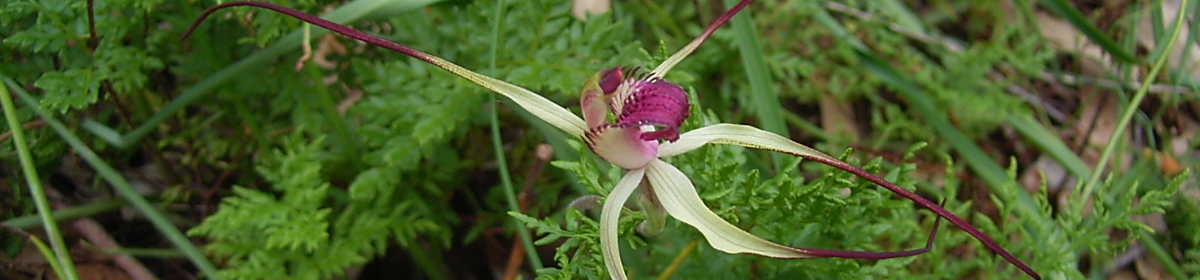
Orchid species: Arachnorhis behrii Synonym: Caladenia behrii
Hans Herman Behr (1818 – 1904)
A physician, botanist, entomologist, lepidopterist, poet, writer, humourist and linguist.
Orchid species: Arachnorhis behrii Synonym: Caladenia behrii
Some native terrestrial orchids only flower in the season after a bushfire. They are stimulated by the hot gases given off during the fire. One of those gases is ethylene. Bananas are shipped down from Queensland to the southern states of Australia as green bananas to stop fruit fly outbreaks. On arrival they are put in sealed rooms and exposed to ethylene gas. The bananas ripen a few days later. Traces of ethylene remain in the banana skin. Overripe fruit also emits ethylene gas. Orchid flowers do not last long if ethylene is present in a closed glasshouse.
We know that dormant tubers exposed to ethylene often flower the next season. The best example is the Hare orchid Leptoceras menziesii. In summer I put dormant tubers in a small dish in a plastic bag with a banana skin and seal the bag with a rubber band. The skin may go mouldy so should not touch the tubers. I leave the bag inside my shed for about 2 weeks then remove the tubers and pot them up. The exposed plants make leaves almost twice as large as normal tuber leaves. This procedure should not be carried out with the same plants the following year as they may get exhausted and die out. I have found results with other shy flowering species are not so reliable. Maybe they need a stronger does of ethylene.
Article by Les Nesbit
NOSSA Journal
A photograph of a yellow sun orchid is July’s winning photograph and was taken by John Badger.
It is not difficult to identify a yellow sun orchid because amongst all of the Australian Thelymitras there are only two true yellow sun orchids. These are Thelymitra antennifera and the less common and very different, smaller T. flexuosa.
T. antennifera has a distinctive column with two reddish brown appendages resembling rabbit’s ears henc the connom name of Rabbit Ears Sun Orchid. Another common name Lemon Sun Orchid refers to the faint but recognisable lemon scent produced by the flower but as to why it should ever have been singled out from the other sun orchids to be called Women’s Caps1, I cannot tell.
Prior to flowering, the leaf distinguishes this sun orchid from others. Though having a red base like some of the other sun orchid, it is thin and rounded ie filiform and terete. Further, the closed buds are dark pink with lemon yellow margins of the sepals.
It should be noted that both T. carnea and T. rubra can on rare occasions produce a pale yellow variety but they will have all the features of their respective species. Also a T antennifera hybrid, T. x macmillanii, can on occasions produce yellow flowers.
References
Edwin Daintrey (1814-1887)
A medical student who abandoned his medical career just before graduation; he emigrated to Sydney, where he practised as a solicitor, cofounded the Linnean Society of New South Wales, and was appointed honorary secretary of the Australian Library in Bent Street.
Orchid species: Pterostylis daintreana
Robert Brown (1773 -1858)
A Scottish-born and Edinburgh-trained surgeon, doctor-soldier, and the father of Australian botany; he was awarded the Copley Medal in 1839, then the world’s highest accolade in science.
Orchid species: Elythranthera brunonis (= Glossodia brunonis)
Archibald Menzies (1754 – 1842)
A British navy surgeon who circumnavigated the globe from west to east with Captain George Vancouver, in the tumultuous voyage of 1791 to 1974, explored extensively in south-west Western Australia, and was later president of the Linnean Society of London; his name is recorded in the names of banksias (including the firewood Banksia [Banksia menziesii]), orchids and mosses of the King George Sound hinterland which record his service to Australian botany.
Orchid species: Leptoceras menziesii (=Caladenia menziesii)
This orchid is the emblem of Native Orchid Society of South Australia
Having looked at the background, Professor Pearn documents the individual doctors and orchids. In the original paper the doctors were listed alphabetically but these posts will be in chronological order based upon the doctor’s year of birth.
Daniel Solander (1733 – 1782)
A medical student in Sweden and London, and botanist-librarian on the Endeavour voyage to Austalia (1769 – 1771); his name is commemorated in the names of Australian species of Aciacia, Banksia and Geraniums.
Orchid species: Orthoceras strictum (= Orthoceras solandri)
The type specimen is from New Zealand.

There were many more entries than usual this month but the winner was a photograph by David Mangelsdorf.
Looking back over the last three winners, a royal theme emerges. In April it was the elegant Queen Orchid, in May the flamboyant Queen of Sheba and this month it is the dignified Queen Spider Orchid (a statelier name than the more usual common name of Narrow Lipped Spider Orchid).
The botanical name for this species is Arachnorchis leptochila spp letptochila (syn. Caladenia leptochila). An endemic species of South Australia, it is mainly found in the Mount Lofty Ranges where it favours leached stony soils. Flowering in spring, it is easily recognised by the upswept segments and narrow labellum.
Usually these orchids are characterised by dark clubs which can be seen even in bud, but in this picture they are light coloured. This could be due to variation with the species, as occasionally pale coloured flowers have been found. Interestingly in doing an image search on the web I found none with light coloured clubs.
Actually there is more than one.
Frequently NOSSA receives a request to identify an orchid in someone’s garden. Often, instead of an orchid (but occasionally there are orchids), it is the Ariasrum vulgare (common name Friar’s Cowl Lily or Cobra Lily).
Native to Asia and Europe, notably the Mediterranean and introduced to Australia, it is often mistaken for one of the flowers of the Pterostylis (Greenhood Orchids) or Diplodium (Shell Orchids). Some have called it a Blackhood orchid others Snake Orchid. It’s resemblance to the Greenhoods and Shell Orchids is superficial as they have none of the orchid features. The dark purple hooded part is not the flower; it is a spathe (bract). The flowers are minute hidden on deep down on the “tongue”.
The hood of the orchids is the combination of a deeply concave dorsal sepal interlocking with the lateral petals; and the fusing of the two lateral sepals. Tucked away within the hood is the labellum (a modified petal) and the column (the reproductive organs of the flower). The leaves of Ariasrum are quite large and distinctly different from any of the Greenhood orchids.


If you want to see the Helmet Orchids, now it the time of year to find them. My understanding is that the time from leaf mergence to capsule is about six weeks. In the past week I’ve seen Corysanthes diemenica (Veined Helmet Orchid) both in the north and the south of the Adelaide Hills. Corysanthes incurva ( Slaty Helmet Orchid) appears slightly later, end July early August, and will now be in bud. Look for them amongst the leaf litter.
