This week’s blog is an extract from Volume 30 No 10 November 2006. In this article of Len Field he gives not only cultural notes but also some interesting background including an orchid link with the infamous Captain Bligh.
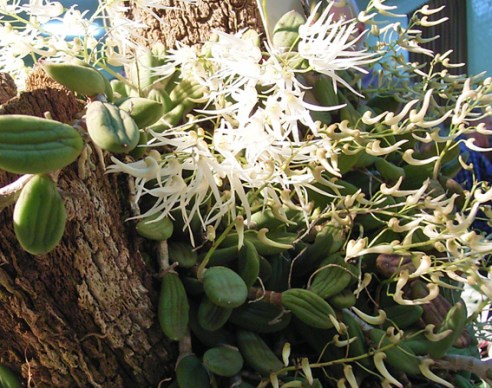
Dockrillia linguiformis (Sw) 1800 Brieger
Dockrilla linguiformis
Len Field Common names Thumbnail orchid, Tongue orchid, and in North Queensland the Tick
orchid.
The name linguiforme is from the Latin lingu(a) as in linguiforme (a tongue). It was also claimed for many years that this was the orchid that Olaf Peter Swartz the German botanist founded the genus Dendrobiumin 1800, but this was wrong, although this was the first orchid seen by white man when they landed at the rocks area in Sydney cove, Port Jackson. It was introduced into England by Rear Admiral Bligh of Bounty fame.
Other names it has been called are Dendrobium linguiforme var. linguiforme Swartze 1800 Callista linguiforme (Swartze) Rev. Kuntze 1891 Dendrobium linguiforme (Swartze) var. huntianum Rupp 1942
There was another variety named from this species called var. huntianum by Rupp in 1942, which was named after T.E. Hunt and is a June or July flower and found near Ipswitch (sic) in Queensland, but as it reverts to type form it never reached true variety status and was considered just a variation of the type form.
This orchid has a huge range of habitat which stretches from almost the Victorian border up to North Queensland and West to the Great Dividing Range. It is very common throughout this area and equally happy as an epiphyte or a lithophyte but where as a epiphyte it likes swamp oaks (Casuarina glauca), river oaks (Casuarina cunninghamiana), in fact it will grow on most trees that will hold there bark including the tea trees (Leptospermum species). I have seen this orchid hundreds of kilometres inland from the coast still forming large mats on the rock faces, while in its more prolific growing areas these mats will cover huge areas of the rocks where it can survive and grow in extreme exposed conditions that would kill other orchids. In the dry times the leaves which are very thick, tough and numerous will shrivel and can last up to six months without water. This is a feature of a lot of Australian Dendrobium and Dockrillia Flowering is from August to October with blooms that are long lasting, up to two weeks with one raceme per leaf. Culture. If grown on slabs which is the usual way it should be hung up high and if grown in pots a very coarse open mix. In nature it likes plenty of sunlight although at times it will grow in shade. Whichever way it is grown it should have good light, humidity and air movement.
Epiphytic orchids grow on trees or rocks (lithophytic), where they are dependent on their host for support but not for food.
CULTIVATION
The majority of Australian epiphytic orchids can be easily grown in cultivation. Most can be grown in Adelaide if the correct cultural requirements are provided. These include controlled glasshouse conditions, shadehouse conditions and, in some instances, in the garden. Only a few species are able to tolerate the cold winter months in Adelaide without extra protection, and all need protection from frost.
CONTAINERS AND MOUNTS
Plants can be grown in pots or mounted on an appropriate substrate. Pots may be either plastic or terracotta. Terracotta pots are porous and dry out more quickly than plastic. If terracotta pots are used, their drainage holes may need to be enlarged to give very good drainage. Plants should be potted into the smallest pot, which comfortably accommodates the base of the plant.
Plants may be mounted on materials such as compressed or natural cork slabs, branches of rough barked trees, black weathered tree fern slabs and pieces of weathered hardwood. Brown tree fern slabs contain substances, which are toxic to orchid roots and are not suitable. Those species that have a pendulous habit e.g. Dendrobium teretifolium should only be mounted.
POTTING MIX
Most potted orchids require a mixture made up of bark chips (fir or pine), to which may be added charcoal, gravel or polystyrene chips, in which to grow. Bark used should be aged and preferably purchased as graded hammer-milled bark, not shredded bark. Fresh pine bark contains compounds, which are toxic to orchids. Before use fresh pine bark should be soaked in water changed regularly, to remove toxins. This may take 3 weeks. If in doubt as to the freshness of the bark, treat as above to be sure.
Depending on the size of your plant, bark may vary from 5-7mm up to 20mm in diameter, and sieved if necessary to remove fine particles and dust. Other substances such as scoria, leaf mould and coarse grit may also be added according to the requirements of the particular species involved. Whatever the substrate, be it a slab or potting mix, the essential thing with all epiphytic orchids is to always provide good drainage for the plant’s root system. This ensures no, or minimal, root rot of plants.
Repotting is necessary when the potting mix breaks down resulting in poor drainage, the medium goes stale or when the plant over grows its container. The best time to repot is during the spring, after flowering, when the plant starts to actively grow again. Try to repot every 2-3 years.
Potting on: If the plant has overgrown its container and the mix has not deteriorated, it can be potted on into the next sized pot with minimal disturbance to the root system.
GROWING ENVIRONS, HOUSING
Garden Culture
Several species may be grown outside in Adelaide, provided they are given a position sheltered from frosts and hot drying winds. They should receive daily supplementary watering during the summer. They may be tied on to trees with rough non-deciduous bark or grown on rocks. Microclimates can be created in areas of the garden using screens for protection and other plants to help maintain a humid atmosphere.
Bush house, Shadehouse
These structures are built to give protection from frosts, strong winds and sun and to provide extra humidity for plants. They may be covered with shadecloth or tea-tree and should have a solid south wall. They provide protection, but still allow for good air circulation around the plants. A water impervious roof, e.g. fibreglass or polycarbonate sheets, will protect plants and flowers from excess water in the winter.
Unheated glasshouse
An unheated glasshouse gives more protection to the plants, achieving higher temperatures during winter days, and better humidity. It may be made from glass or other materials such as fibreglass or polycarbonate sheets. Additional shading with shadecloth or paint is necessary from October to March-April. Adequate ventilation must be provided, by using ventilators under the benches to let in fresh air, and roof ventilators to let out hot air. Alternatively, air circulation can be achieved using fans. All orchids love fresh air.
WATERING
All plants need to be watered frequently from October to April, during the growing period. Most species require watering once a day or twice a day if the weather is particularly hot or drying. Ensure that plants dry out between waterings. During winter, watering once a week should be sufficient for plants in a glass house environment, although plants which are mounted may be misted (a very fine spray) more frequently. Water early in the morning of winter days to ensure that the leaves of the plants have dried off by night. Water lodging in leaf axils in cold, comparatively still conditions, renders that area liable to fungal attack. Humidity may be maintained by watering the floor and under the benches, particularly in summer.
Rainwater, if available, is preferable to mains water, which can. In some cases, increase in salinity to a level, which is harmful to good plant growth.
FERTILISING
To promote healthy growth of all epiphytic orchids, a supplement of half strength liquid fertiliser every two weeks may be used during the growing season of the plant, i.e. November to April. Mature potted plants can be sparingly fertilised with slow release pellets. Too much fertiliser will lead to a salt build up (especially in charcoal), which will harm the plants.
PESTS
Pests will become a problem in any shadehouse or glasshouse if the grower does not keep a watchful eye out for them. The shadehouse or glasshouse should be kept free from weeds, decaying organic matter and rubbish, as these are the places where pests feed and accumulate. Overcrowding of plants will also encourage pests to thrive.
Pests can be easily removed by squashing if they are in small enough numbers. A pest strip hung in the glasshouse successfully controls many pests. Unfortunately the environment of a glasshouse, which suits orchid culture, also provides a suitable environment for the spread of pests. Poisonous chemical sprays should only be used after non-toxic preparations have been unsuccessfully used. These chemicals also destroy the natural predators of insect pests, upsetting the natural balance.
Caution should be used when handling chemical sprays as many are very toxic to the user as well as the pests. The manufacturer’s directions and warning labels should be read carefully and recommended strength adhered to strictly.
DISEASES
Australian epiphytic orchids are generally disease free. Fungal infections may occur, susceptible areas being new growths, especially in young plants. These can be kept to a minimum by maintaining good air movement and avoiding water remaining in leaf axils for too long. Broad spectrum fungicides are suitable to control severe infections.
PLANT CARE
Removal of any dead leaves, pseudobulbs, etc, not only enhances the aesthetics of the plants, but also lessens the chance of further deterioration. These areas are also the places where pests may accumulate or diseases harbour.
The following article is from Vol. 32 No 7 August 2008 Journal of the Native Orchid Society of South Australia Inc.
Dendrobium speciosum
Native Orchids. The Epiphytes: August. Steve Howard
Movement of our natives towards flowering is often rapid. How often do we look at our plants thinking that they will never be out in time then take a look the week after and they have doubled in size. Dendrobium speciosum is a classic example of this. One minute the plant is covered in acorn like flower buds then a week later there are bunches of flowering buds everywhere. There is the temptation to force them on but I would leave that until the last two weeks prior to show before making that call. Then we have the Sarcochilus. These can stay in bud for months and not do a thing then suddenly they are away.
On the epiphyte side we should have a heap of buds everywhere on the flowering plants. They key is to keep these under cover and away from rain and also slugs and snails that have a nasty habit of chomping into them. Rain exaggerates fungal problems that will rot out a flower spike overnight. Also avoid temperature extremes, especially once the buds start showing on a lengthening spike. Bud drop occurs quickly and the loss of even one bud will sway the judge’s decision. Even and strong light now becomes important especially for those epiphytes with Den. speciosum and Den. kingianum in the background. The reason is we need to create strong upright racemes to support the flowers. No point having the spikes hanging over the side of the plant and then have the flowers doing the same. Some species do have this trait and as such do not make very good parents if this trait is passed on in hybridisation. I like my flowers to look at me and cannot see the point in lying on the ground and looking up at the plants on the bench. Strong light will assist this spike development as does the potassium and potash in the fertiliser. This is also a reason we tend to avoid high nitrogen feeds in our feeding programme. Even light is also important in order that the flowers will be evenly distributed around the pot as opposed to all facing the one way. Hanging flowering plants is one way we can get this even light.
Now is also a good time to clean up our plants before flowering. Remove husks over the canes, remove dead leafless canes and trim and clean the leaves. It is easier to do this now whilst the spikes are on the small side. Also give the pots a scrub too. All of these tips will help make things a little easier when it comes time to prepare the plants before show. Also make sure you have some fresh topping for the pots. It’s these little things that helps improve the presentation of our plants.
Only remove leafless canes if you think they have completed their flowering potential as many will flower for years after losing leaves or if the cane affects the appearance of the plant. If the forward growths are struggling under no circumstance remove the leafless cane unless it is absolutely dead as the struggling plant would be relying on stored nutrients in this cane to survive. I would then concentrate on why is the plant in the state in the first place.
Dendrobium bigibbum
Even though we are two months away from re potting and dividing our plants it is now time to take stock of what plants will be potted on, divided or sold off on the trading table. That way we can arrange pots, mix etc in preparation. The other thing I am looking at now is where am I going to move my plants this year. Last years heat exposed many plants that are susceptible to heat and with the probability that this will happen more frequently in the future there is the need to move these prone plants from where they are at present. Leave them where they are and the same thing will happen again. There will also be the need that these tender plants be removed from the collection and the emphasis placed on more hardy species and hybrids.
Watering will be dependent on the hybrids you grow and where the parents originate from. Most of the hot/cold type have the tropical hard cane types in the breeding eg Den. bigibbum and these require dry winters so we need to take this into account here. I do not dry them out completely but then again don’t water them frequently either. I aim for slightly moist at all times to keep the roots in good condition. The others with Den. speciosum, kingianum, falcorostrum all come from cooler climates that receive winter rains and as such can handle being damp over winter. Avoid over wetness as this will be to the detriment of the plants. These plants require a short dry period after flowering to mimic the same dry spring period experienced in the areas where most of them come from. I find that with our reduced rainfall of late, nature provides my plants with enough water apart from the mounted plants that get the odd mist or squirt. Any watering should be confined to the warmer part of the day after lunch. Early morning squirts with water from a hose that has been sitting on a frozen ground all night will not do your plants any favours. Feeding during these cooler months is infrequent and if you miss them for a month or more will not cause too many issues. Plants under cover get watered every couple of weeks and these are usually the hot colds.
You will have a few late season new growths reaching full size. Keep an eye on these as they are very prone to rot when water sits in the axils of the new growths. If you notice a growth go reddish or yellow it is a good bet that it has rotted. You can cut the growth off below the infection and treat with a fungicide. I then dry the plant out as a precaution and take a mental note. This plant will always be prone to attack.
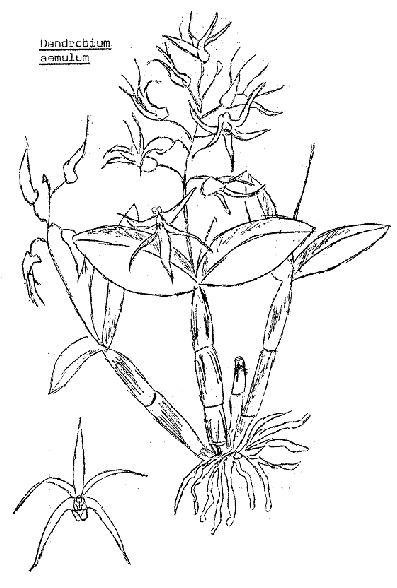
My plant of the month is Den. aemulum, the feather orchid. This compact growing epiphyte comes from central NSW (New South Wales) to Qld (Queensland) and comes in 2 forms. The iron bark form strangely enough grows on the iron bark tree, a heavily permanent barked member of the eucalyptus family. It has small cylindrical psuedobulbs that grow in a radial pattern topped with two small and rather thick leaves. Small white clusters of flowers that go pink as they age are borne apically over several seasons from the one cane. The other form commonly seen is the brush box form. This is the long caned variety and the two are found in similar areas. These are not often seen in collections and have the habit of slowly fading away in cultivation unless their requirements of light, a suitable host and conditions are met. I have several plants on different hosts and the results are mixed. The best plant grows east on a slab of hardwood in a rather protected spot and is the brush box form. The iron bark forms appear to struggle on mounts of Callistemon and paperbark. Maybe it is the acidic gummy excretions from the bark of the ironbark that are missing. These plants have not been used in hybridisation very much as they do not have the traits that hybridists are looking for. Nevertheless I find them a very attractive flower when grown into a specimen plant and they will always have a place in my collection. They are not easy to obtain and generally restricted to those that have permits to collect them from the wild.
Next month is September and with it the warming weather and a profusion of flowers. We will look at a few tips to help with the presentation of show flowers but also look back at those that did not flower well or flower at all and see where we can improve and what went wrong.
A very popular orchid grown in culture in South Australia is the epiphytic/lithophytic Dendrobium speciosum. It is a showy species with a heady perfume.
Dendrobium speciosum (Rock Lily, Rock Orchid) in culture
This species ranges along the eastern seaboard from Queensland just peeking into Victoria. There are nine variations each with its own unique distribution.
But not only is it popular in South Australia, it is popular throughout the country. The whole of the 2006 September issue of the Orchadian was devoted to a single article on D. speciosum. The March 2016 Orchadian has three articles plus references to D. speciosum in other articles.
And then there is Gerry Walsh who is so passionate about this species that he has a comprehensive website – The Rock Lily Man – devoted to it. Explore and enjoy his website.
In 1983, Ron Robjohns, NOSSA’s first treasurer, wrote a comprehensive series of articles about growing epiphytes in South Australia. Thirty years on Ron’s information for growing is still helpful and applicable for today. Any updates or extra information are in black text.
NATIVE ORCHID SOCIETY OF SOUTH AUSTRALIA JOURNAL Volume 7, No. 11, December, 1983
GROWING EPIPHYTIC ORCHIDS IN SOUTH AUSTRALIA – R.T. Robjohns
Cymbidium canaliculatum
A most interesting orchid, also one of the few epiphytes to grow in Western Australia. It is credited with a southern limit of near Forbes in New South Wales, extending northwards to Cape Yorke Peninsula in northern Queensland and westwards across the Northern Territory to the northern areas of Western Australia. Although sometimes found in the near coastal areas of the eastern states it is primarily a plant of the open forests of the drier inland areas. In some of its habitats there is less than a 55 cm rainfall, summer temperatures of over 38⁰ C with a very low humidity and winter temperatures dropping to below freezing. While not exclusively, it is usually found growing in hollow branches or trunks of trees where its roots penetrate the decomposed wood and often grow to considerable length. No doubt the fact that the roots are protected from the heat enables it to survive and even thrive under such harsh conditions.
It frequently grows to form large clumps of crowded pseudobulbs having two to six leaves which are thick, rigid and channelled and are from 10 to 50 cm long and 2 to 4 cm wide. The racemes are up to 50 cm long and can be erect or pendulous with up to 60 extremely variable flowers about 2-3 cm across.
The colours range from green, brown, purple, dull red or a combination of those colours and may be either with or without spotting, the labellum, however, is usually white with red markings.
I find that C. canaliculatum responds reasonably well to cultivation and have grown and flowered it in plastic planters filled with a mix of charcoal, pine bark and rotted hardwood, also in hollow logs filled with the same mixture. Propagation from backbulbs has been with limited success and it looks like about a six year project from planting to flowering.
An established plant can take full sun and will withstand our winter frosts without detriment. Fertilising has been with the occasional dose of liquid fertiliser. When purchasing from a nursery I would suggest medium to small plants as although large clumps may look attractive they usually have had the root system almost completely removed – an operation to which they do not take kindly.
Les adds that Cym. canaliculatum should be kept dry from Anzac Day (25th April) to September when the flower spikes appear.
In 1983, Ron Robjohns, NOSSA’s first treasurer, wrote a comprehensive series of articles about growing epiphytes in South Australia. Thirty years on Ron’s information for growing is still helpful and applicable for today. Any updates or extra information are in black text.
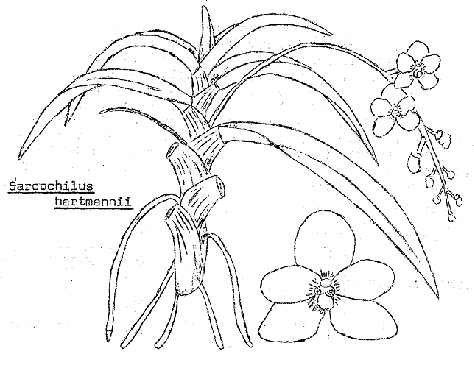
NATIVE ORCHID SOCIETY OF SOUTH AUSTRALIA JOURNAL Volume 7, No. 10, November, 1983 GROWING EPIPHYTIC ORCHIDS IN SOUTH AUSTRALIA – R.T. Robjohns Sarcochilus hartmanii (Hartman’s Sarcochilus) This has a range from the Hastings River in north-eastern New South Wales to the McPherson Ranges in southern Queensland, although some authorities extend this to the Atherton Tablelands in northern Queensland. S. hartmanii is lithophytic and is normally found growing on rocks, sometimes forming large masses but usually in small clumps, however, it occasionally grows on trees. It varies in its habitat from bright sunny positions on cliff faces, above 600 metres, to shady seepages. It must be remembered, however, that this is an area of high summer rainfall and in late summer and autumn has considerable cloud cover with accompanying high humidity.
The leaves, 4 to 9 per stem, from 10 to 20cm long, 1 to 2cm across, are thick, fleshy, deeply channelled and slightly twisted at the base.
Racemes are 6 to 25cm long with 5 to 25 flowers usually sparse at first then crowded towards the apex. The flowers are 2 to 3cm in diameter and have petals and sepals of glistening pure white with deep maroon or crimson spots near the base, though sometimes all white.
The flowering period is September to November.
In 1979 a clone of Sarcochilus hartmanii “Kerrie” was awarded AM/AOC. It was a large plant with 16 spikes and approximately 320 flowers measuring 31mm across the petals.
It adapts well to cultivation and is not difficult to grow, doing well in a shadehouse with 60-70% shade and a good air circulation. I have it growing and flowering in a plastic pot in a bark, charcoal* and polystyrene foam mix and would suggest underpotting rather than overpotting. Good drainage is essential. Other growers recommend shallow baskets or rafts about 8 mm of stag-horn fern fibre as this allows the plant to spread more naturally. It likes to be kept moist (not wet), prefers a humid atmosphere and does not object to regular year-round (½ strength) doses of foliar fertiliser.
In 1983, Ron Robjohns, NOSSA’s first treasurer, wrote a comprehensive series of articles about growing epiphytes in South Australia. Thirty years on Ron’s information for growing is still helpful and applicable for today. Any updates or extra information are in black text.
NATIVE ORCHID SOCIETY OF SOUTH AUSTRALIA JOURNAL
Volume 7, No. 9, October, 1983
GROWING EPIPHYTIC ORCHIDS IN SOUTH AUSTRALIA – R.T. Robjohns
Dendrobium aemulum (Iron Bark Orchid)
There are several growth forms of this orchid due probably to the wide variety of habitats, the flowers of all forms being similar. It has a range from the Clyde River in south eastern New South Wales to the Atherton Tablelands in Queensland
Those growing in the rainforests of New South Wales and Queensland have straight stems up to 20 cm long with 2-4 shining dark green leaves. On the edge of the rainforests in northern New South Wales and southern Queensland in the dense brush forest, the principal hosts are the trunks of “Brush Box” trees where it has stems up to 30 cm long which tend to radiate from a central point. It also has 2-4 dark green leaves. In the open forest areas its hosts are the “Iron Bark” eucalyptus trees, it has shorter (up to 7 cm), stouter (up to) 1 cm), and more crowded stems, sometimes growing into large mats and having 2-4 yellowish green leaves. On the Atherton Tablelands at an altitude of around 750 metres and with callitris trees as its favoured host, it has very slender stems of about 0.3 cm with usually only two dark green leaves.
The flowering period is August/September. One to three slender racemes (5-10 cm long) occur terminally from between the leaves or at nodes along the stem, each raceme bearing 3-20 cm diameter. The flowers are usually pure white (sometimes pale cream) with purple markings on the labellum, the whole raceme turning deep pink before withering.
This is another of our natives which to date does not appear to have attracted much attention from the hybridisers. “Emmy” aemulum x kingianum seems to be the only registered cross.
I find D. aemulum is an easily cultivated and highly rewarding plant that flowers freely with masses of feathery flowers. It grows well mounted on hardwood slabs, cork or on a paperbark branch under 50% shadecloth. Mine get about 65% shade in mid-summer and receive an occasional spray of weak foliar fertiliser during the growing period.
In 1983, Ron Robjohns, NOSSA’s first treasurer, wrote a comprehensive series of articles about growing epiphytes in South Australia. Thirty years on Ron’s information for growing is still helpful and applicable for today. Any updates or extra information are in black text.
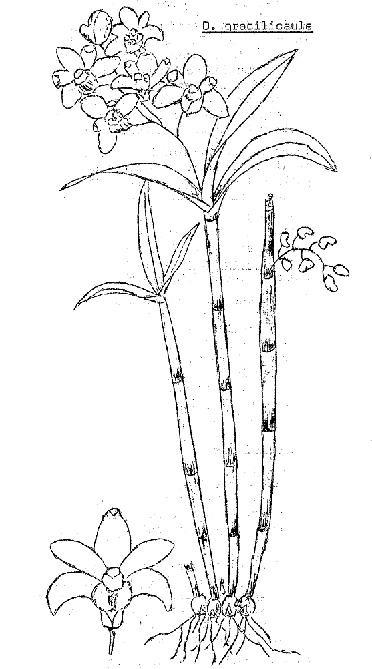
NATIVE ORCHID SOCIETY OF SOUTH AUSTRALIA JOURNAL Volume 7, No. 8, September, 1983 GROWING EPIPHYTIC ORCHIDS IN SOUTH AUSTRALIA – R.T. Robjohns Dendrobium gracilicaule D. gracilicaule is found from Kiama in eastern New South Wales to the Bloomfield River in the south east of Cape York Peninsula in Queensland. It has one of the widest ranges of habitat of any of our epiphytic orchids, growing in the light coastal scrubs, the dense rainforests and, in the tropical areas, on the tablelands. With such a variation in altitude (from near sea-level to about 1200 metres) it follows that there is a wide variety of hosts, even occasionally growing as a lithophyte on rocks. The stems are long, thin and cylindrical, ½ to 1 cm thick, and from 20 to 60 cm in length with 3 to 6 ovate to lanceolate, terminal leaves, 5 to 13 cm long and of rather thin, leathery texture. The racemes are short (5 to 12 cm) and bear 5 to 14 small, cup-shaped flowers of a dull or light yellow colour having the outer sepals lightly to heavily blotched or spotted with a brown or red-brown. Occasionally they are found a brighter yellow and without blotching. The flowering season is from July to September. D. gracilicaule must surely be one of the hardiest and easily cultivated of our Australian epiphytic orchid species as it is adaptable to almost any conditions. I have it growing and flowering on hardwood slabs, paperbark limbs and in a pot, but I think it is better if mounted. It receives 50% – 60% shade and occasional foliar fertiliser. I protect it from frost but the cold does not affect it. It does not flower from first year stems but will flower from mature stems for several years, even after they are leafless. Although most racemes are terminal or near, I have had racemes occurring from nodes halfway along a leafless canes. There are two natural hybrids, i.e. D. x suffusum and D. x gracillimum. D. x gracillimum is a natural hybrid between D. gracilicaule and D. speciosum in which the features of D. gracilicaule are dominant in the flower while in D. x suffusum, the natural hybrid between D. gracilicaule and D. kingianum, D. kingianum is the dominant parent. D. gracilicaule has not attracted professional hybridists, probably because the flowers are not as outstanding as many of our other epiphytes, only two crosses appear to be registered: D. Susan (D. gracilicaule x D. falcorostrum) and D. Shan Leaney (D. gracilicaule x D. gracillimum).
In 1983, Ron Robjohns, NOSSA’s first treasurer, wrote a comprehensive series of articles about growing epiphytes in South Australia. Thirty years on Ron’s information for growing is still helpful and applicable for today. Any updates or extra information are in black text.
NATIVE ORCHID SOCIETY OF SOUTH AUSTRALIA JOURNAL
Volume 7, No. 7, August, 1983
GROWING EPIPHYTIC ORCHIDS IN SOUTH AUSTRALIA – R.T. Robjohns
Dendrobium pugioniforme (Dagger Orchid)
This is an epiphyte frequently growing into large pendulous masses on the branches or trunks of trees, mainly in the rain forest areas from Mt. Dromedary on the south coast of New South Wales northwards to the Bunyah Mountains in south eastern Queensland. The stems are slender, wiry and branching, often quite long and usually tangled. Thin creeping roots develop freely from nodes at the branches.
The distinguishing feature of the numerous shiny, thick flat, ovate to lanceolate leaves is the sharply pointed tip.
The flowers are usually single but sometimes 2 or 3 per inflorescence and are 2 to 2½ cm in diameter. The petals and sepals are light green, the labellum pale with bright red or purple markings. The flowering season is September to November.
It is a reasonably hardy plant which will respond to cultivation on quite a variety of hosts. I have had success using Melaleuca, and find that it responds to a position having plenty of shade and moisture, particularly during our summer. Although in the wild it will tolerate cold conditions, (being found from near sea level to around 1300 metres), it will require shelter from our winter frosts
Most authorities designate it an epiphyte, however, in “The Orchadian” Vol. 4, No. 2, p. 24 (1972) D.L. Jones reports having found a bleached and tough looking plant growing on Alum Mountain with its roots amongst leaf litter in a crevice. Again in “The Orchadian” Vol. 7, No. 7, p. 164 (1983) G. Walsh describes ‘inter alia‘ lithophytic forms of D. pugioniforme growing in the Illawarra District of New South Wales.
In view of this it could possibly be grown in a pot, but as it grows quite readily on a slab I have felt it pointless to possibly waste a plant just to grow it in a pot. Fertilise in the growing season with foliar fertiliser at half the recommended strength.
Two naturally occurring hybrids of D. pugioniforme have been recorded – D. pugioniforme x D. tenuissimum and D. pugioniforme x D. beckleri but they are relatively rare (Ford, “The Orchadian”, Vol, 3, No. 7, p.88: Dockerill, Aust. Indig. Orch. Vol. 1, pp 370-371) and as yet it has not yet attracted the hybridists as there does not appear to be any registered crossings.
In 1983, Ron Robjohns, NOSSA’s first treasurer, wrote a comprehensive series of articles about growing epiphytes in South Australia. Thirty years on Ron’s information for growing is still helpful and applicable for today. Any updates or extra information are in black text.
NATIVE ORCHID SOCIETY OF SOUTH AUSTRALIA JOURNAL
Volume 7, No. 6, July, 1983
GROWING EPIPHYTIC ORCHIDS IN SOUTH AUSTRALIA – R.T. Robjohns
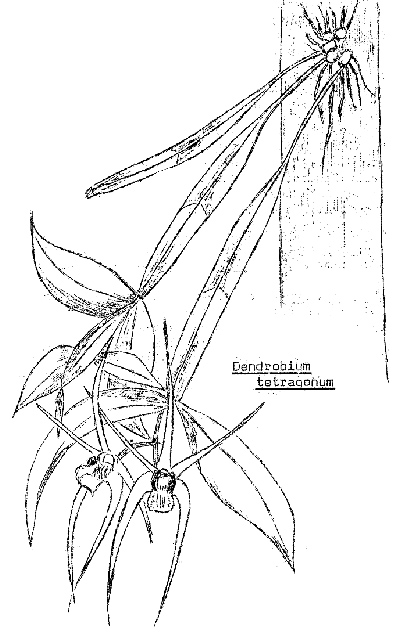
Dendrobium tetragonum (Tree Spider Orchid)
A variable epiphytic species growing mainly in rainforest areas from Illawarra in New South Wales to the Endeavour River in Queensland. A favourite haunt is on trees overhanging water, often in deep shade. It has a variety of hosts (including Myrtles, Eugenias, Water Gums and occasionally Melaleuca) on which it grows into small clumps. Altitude is of little concern as it is found from near sea level to approximately 1000 metres.
The stems, which are semi-pendulous and from 6 to 45 cm long, arise from a prostrate and branching rhizome They are round, thin and wiry at the base but thickening to become rectangular (hence the name tetragonum – derived from the Greek “tetra” meaning “four-sided”), then tapering slightly before the leaves. There are from 2 to 5 leaves up to 8 cm long at the end of the stems. They are deep green in colour and often with crinkled or wavy margins.
The racemes appear from between the leaves but are short and have from 1 to 5 flowers which are widely spreading and spidery in appearance. The colour is greenish/yellow with irregular and variable brown, red and purple markings. In size the flowers are from 4 to 9 cm from the top of the dorsal sepal to the tip of the lateral sepal and they have quite a pronounced fragrance.
The var giganteum is the tropical species and ranges from the Fitzroy to the Endeavour Rivers. The flowers are usually larger, but not always, and have a slightly different colour pattern.
The plant does not lend itself readily to pot culture and should be mounted. I have it growing on Melaleuca and cork slabs, but best results have been with one mounted on a hardwood slab.
I find that it needs little more than 50% shade plus humidity and, of course, plenty of air movement. Protect from frosts. Fertilise in the growing period with foliar fertiliser at half recommended strength. A number of interesting hybrids have been produced using D. tetragonum as one of the parents. They mostly flower well and have reasonably large flowers.




 NOSSA
NOSSA 