2014 November Photograph Competition Part 2

Part Two of the November competition consisted of photographs of insects on orchids. There was quite a range of insects but the winner was a draw between Cyrtostylis robusta (Winter Gnat Orchid) with an ant and Pterostylis curta (Blunt Greenhood) with a midge fly; both taken by Doug Castle.

With today’s technology it is not only easier to take crisp images but fine details can be seen particularly when enlarging the image. Hence when the pictures are enlarged it is possible to see hairs on the ant and feathered antennae on the midge fly.

With identifying orchids, it is often the detail that is important. Both of these orchids are distinctive and can be readily identified but it is good to examine why this is the case.

Pterostylis curta (Blunt Greenhood)

With the greenhood, there is enough detail to see that the dorsal sepal and lateral petals have united to form a galea, ie hood, and that the lateral sepals are semi-fused and erect resulting in lateral orifices (side gap) between the two structures. These are some of the features that separate Pterostylis* from the other greenhoods such as Diplodium, Speculantha and Taurantha. This becomes apparent when browsing through the greenhood photographs, pages 286 to 339, in Jones “A Complete Guide to Native Orchids of Australia”. Having established that the plant is a Pterostylis, the twisted labellum is diagnostic of a P. curta as it is the only one that is described with a twisted labellum. Although not all the identifying features are present, enough information is available in this picture for identification.

In contrast the photograph of the Cyrtostylis robusta only has sufficient data to confidently identify it as a Cyrtostylis species, having a distinctive labellum that is larger than the lateral sepals and petals. In South Australia there are only two species and according to Bates (2011), the distinguishing features between the two

Cyrtostylis robusta (Winter Gnat Orchid)

appear to be the leaf, the bud and the labellum. In this picture, the angle of the image does not give a clear view of the labellum (it could possibly be damaged) and of course there is no bud or leaf. It is possible that the pale edges of the dorsal sepal may give a clue to species identification as C. reniformis has mainly darker buds than C. robusta. Obviously Doug was able to identify it from his observations of the other features not present in this photograph.

In summary, one image is not always sufficient for identification. As was discussed on the night, to confirm identification, orchids should always be photographed from more than one angle, including pictures of other parts of the plant.

*In South Australia, Pterostylis foliata is a possible exception as it has no obvious lateral orifice.

References

Jones, D.L., T. Hopley, S.M. Duffy, K.J. Richards, M.A. Clements & X. Zhang (2006) Australian orchid genera. An information and identification system. CSIRO Publishing: Collingwood, Vic.

Bates, R.J. (2011) South Australia’s Native Orchids. DVD-ROM. Native Orchid Society of South Australia Inc.: Adelaide.

Jones, D.L. (2006) A complete guide to native orchids of Australia, including the island territories. New Holland Publishers: Sydney.

Those Blue Orchids Again …

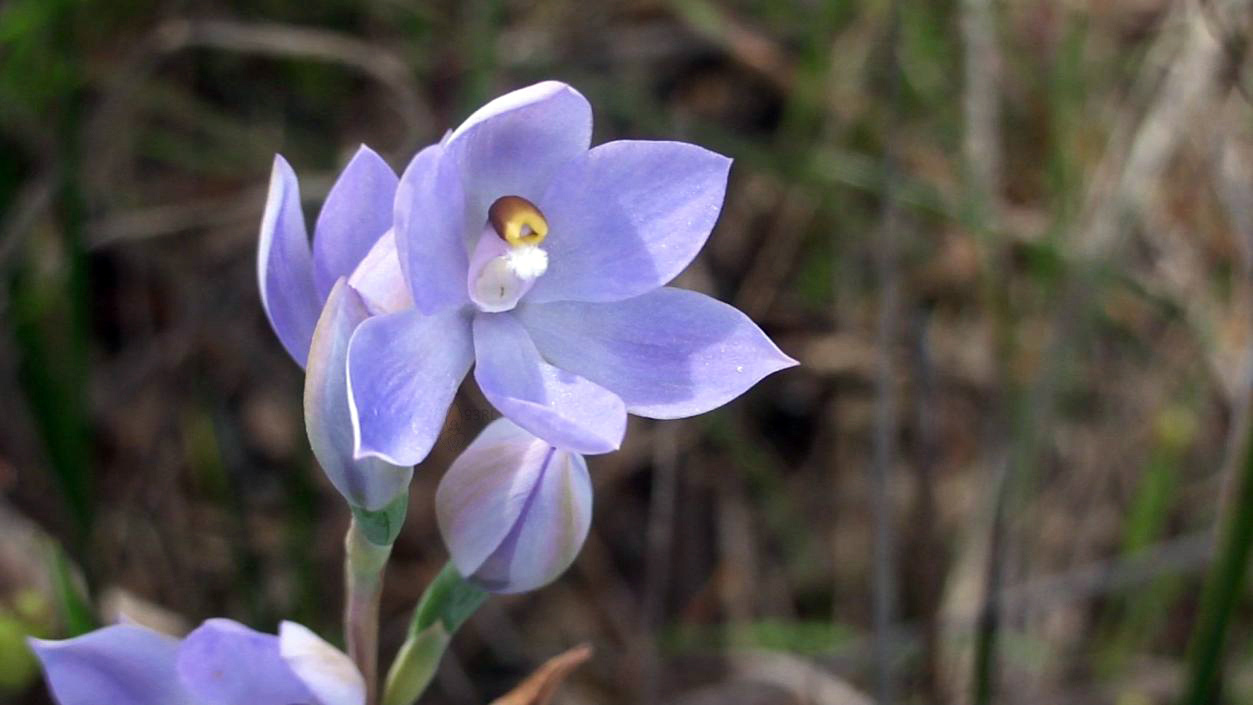
Volume 31, 2013 of the Muelleria contains an orchid article by Jeffery A Jeanes. The title may be long – An overview of the Thelymitra nuda (Orchidaceae) complex in Australia including the description of six new species – but the subject is of interest to all of us who want to know our sun orchids, many of which are not always easy to identify.

By way of introduction, Muelleria is the Royal Botanic Gardens of Melbourne official research journal and has been published since 1955.

Though a technical article there is much to be gleaned for the ordinary reader, for instance the article contains a good description of the commonly used terms for describing the column for example stigma, trichomes, anther, post anther lobe, etc. This is helpful to know as the column structure is often the main feature of the plant used to identify the individual species. Naturally the key features of the T. nuda complex are covered comprehensively, as well as a brief discussion of the taxonomic history.

Another helpful section is the dichotomous key for all fifteen species described in the article. Of the fifteen species four are found in South Australia and are pictured below.  But to discover more read the article ……

Thelymitra nuda
Thelymitra nuda
T megcalyptra130927
Thelymitra megcalyptra
Thelymitra glaucophylla photographed by Robert Bates
Thelymitra alcockiae

Another Summer Orchid

Just on Christmas, NOSSA received an enquiry from Tim in the South East about an orchid he had photographed.  He knew about Dipodium roseum but in 20 years he had not seen one like this one.

From the photograph that he’d sent, it was obvious that it was a Gastrodia.  In South Australia there are three species ranging in size from the smaller G. vescula (Limp Potato Orchid) through to G. sesamoides (Cinnamon Bells or Common Potato Orchid) to the larger G. procera (Tall Potato Orchid).  Whilst G. vescula and G. procera are limited in South Australia to the South East, G. sesamoides is also found in the Southern Lofty and Kangaroo Island regions.

Tim’s orchid was G. procera.  The features that set it apart from the other two were the time of year – late December whereas both G. sesamoides and G. procera would have finished flowering (and for 2014 most orchids finished flowering earlier than usual); the spike was crowded and the plant was upright but G. sesamoides has a bent or droopy spike when in bud and G. vescula is small with very few flowers.

Though Tim considered the photographs to not be very good, he’d photographed the necessary features to help with identification. Another feature seen in his picture is the warty appearance of the plant compared with the photograph of the G. sesamoides.

Gastrodia procera or Tall Potato Orchid
Gastrodia procera (Tall Potato Orchid) Note the upright spike and the ‘wartiness’
Gastrodia sesamoides (Cinnamon Bells or Common Potato Orchid)


Although it is has no conservation rating federally and may even be considered secure in the Eastern States, in South Australia it is rated endangered, so well done to Tim for spotting it!

 It was possible to identify this orchid from the information found in South Australia’s Native Orchids, an electronic book produced and sold by the Native Orchid Society of South Australia.  Identification was confirmed by one of our most knowledgeable members.

‘Tis the Season … for Dipodium

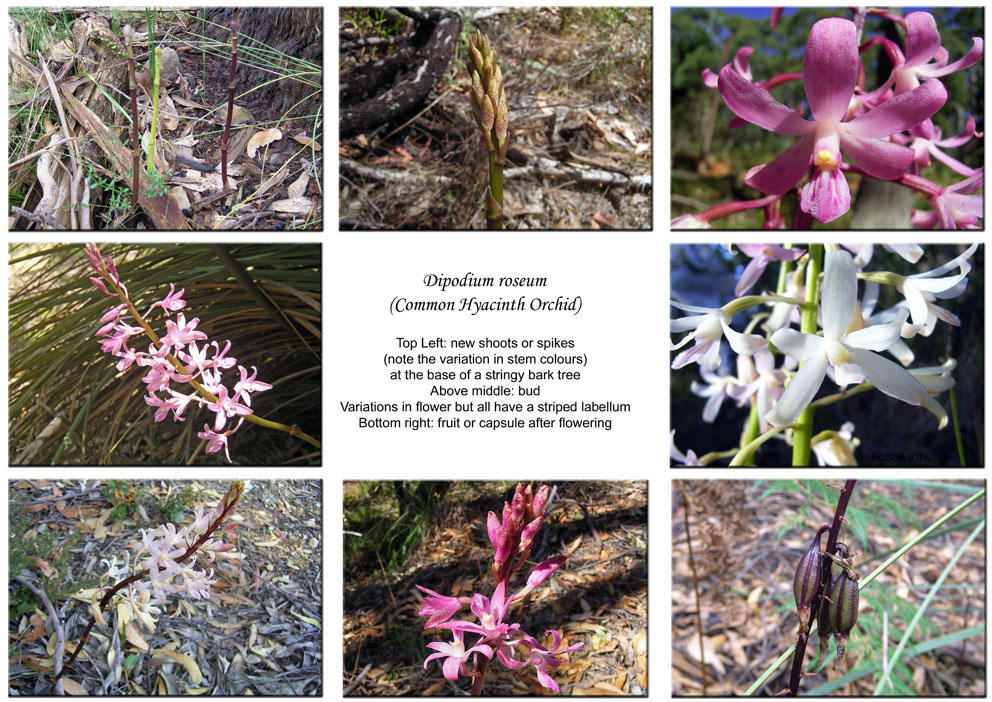
For many with Christmas and New Year holidays it is a busy time but not so with the orchids here in the Adelaide region.  The vast majority of orchids have finished flowering for the year except for a few including one of our most showy orchids, the Hyacinth Orchids (Dipodium species).  Of the four species found in South Australia, two are found in Adelaide Hills –  D. roseum or Common Hyacinth Orchid and D. pardalinum or Small-spotted Hyacinth Orchid and these will be flowering across the whole of the summer period.

Both of these Dipodium species are leafless plants that are dependent upon mycorrhizal fungi associated with stringy bark trees, either Eucalyptus obliqua or E. baxteri.  This growth requirement makes it impossible to grow in cultivation.  (Stringy bark trees can’t be grown in pots!)  The emerging stem and buds resemble an asparagus shoot.  The stems can range from a light green through to a deep dark red.  At this stage it is difficult to tell the two species apart although if there are yellowing tips on white buds it may be a clue that the plant could be D. pardalinum.

Once in flower D. roseum has a surprising range of variation  from carmine (a lightly purplish deep red) through to pink to white, with suffused rather than clearly defined spots.  On paler or white flowers these blotches may appear pale mauve-pink rather than candy-pink.   It always has a distinctive striped labellum.

Dipodium roseum composite

This feature sets it apart from D. pardalinum which has a clearly spotted labellum and in contrast to D. roseum, the flowers lack variation of colour but are consistently white with small well-defined candy spots.  (There are other Dipodium species with larger spots.)

Note the yellow staining on the bud and no stripes on the labellum

And the final word, D. roseum is common but D. pardalinum is rated vulnerable in South Australia.


Reference: South Australia’s Native Orchids Bates 2011

Spotted Pink Sun Orchid – Beautiful, but Only a Hybrid

This week, a local radio station introduced a segment with the phrase “our rarest sun orchid” and that it was called Thelymitra irregularis or Spotted Pink Sun Orchid.  However it certainly is not our rarest sun orchid.

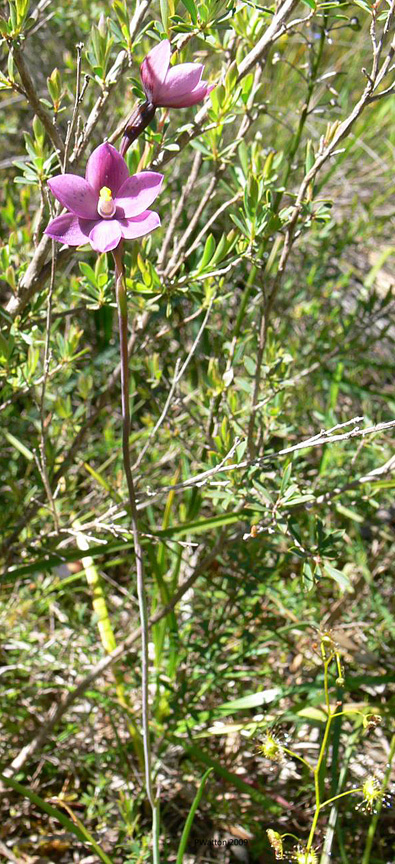
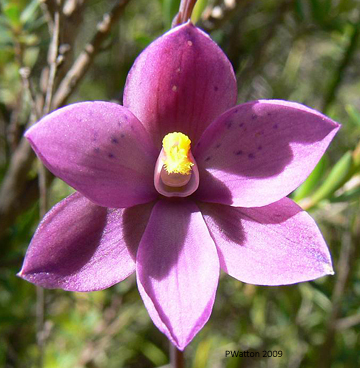
Thelymitra x irregularis is typically a hybrid pink spotted sun orchid
Thelymitra x irregularis,  Peter Watton, 2009

True, it is not common, but that is partly because it is a hybrid and, correctly speaking, the name should be written as Thelymitra x irregularis (the “x” indicates that it is a hybrid).

For a hybrid to occur, the two parent species need to grow in close proximity, the flowers need to open at the same time that the pollinator is visiting flowers, either to collect or to deposit the pollen and, in the case of self pollinating species, before the individual flower has pollinated itself.

The majority of hybrids are sterile, but occasionally some are fertile.  When hybrids occur the majority will only last a few years before disappearing although sometimes colonies are formed which may last for decades.  Hence, it is not usual to name hybrids, but the more common and recurring ones have been named formally.  T. x irregularis is one of them.

Several species of Thelymitra have been proposed as parent species of Thelymitra x irregularis.  Jeanes & Backhouse (2006) give T. ixioides and T. carnea as parents; Weber & Entwisle (1996) and Jones (2006) suggest T. ixioides and T. carnea and/or T. rubra; Bates & Weber (1990) state that in South Australia the parents are T. ixioides and T. rubra, but T. ixioides and T. carnea in the Eastern states; in contrast, Bates (2011) states that in South Australia it is a hybrid between T. juncifolia and T. rubra.  However, without detailed genetic studies or breeding experiments these all remain suggestions.

Due to the transient nature of hybrids and the conditions needed to produce them, the named hybrids are not common, but since the 1890s specimens of Thelymitra x irregularis have been collected in every decade, which suggest that this hybrid readily occurs.  The 71 specimens held in the Australian herbaria have been collected from four states – which gives a good indication of the distribution but not necessarily the frequency of occurrence.  See Australia’s Virtual Herbarium (AVH) for details.  The AVH lists 12 herbarium records for South Australia with specimens collected from the Adelaide Hills, the Barossa Valley, Kangaroo Island and near Naracoorte.

Thelymitra x irregularis
This Thelymitra x irregularis or Pink Spotted Sun Orchid was photographed by Peter Watton in 2009 near Macclesfield, South Australia

The botanical name “irregularis” refers to the description of the column.  With many sun orchids, it is often necessary to observe the column to distinguish one species from another.  In this instance the top of the column is irregularly toothed.  Retired Aussie has some very good photographs with one in particular showing the column detail.


Thanks to Juergan Kellermann, State Herbarium of South Australia for his help with this post.

References

Bates (2011). South Australia’s Native Orchids. DVD-ROM

Bates & Weber (1990). Orchids of South Australia.

Jeanes & Backhouse. Wild Orchids of Victoria, Australia

Jones (2006), Native Orchids of Australia, 2nd edn.

Weber & Entwisle (1996). Thelymitra. In: Flora of Victoria, Vol 3.

Australia’s Virtual Herbarium accessed 24th September 2014


August 2014 Winning Photograph

08 sm CC Caladenia valida

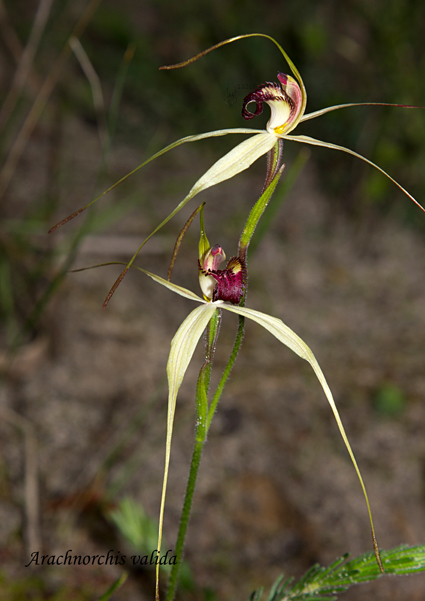
Claire Chesson’s Arachnorchis valida (common name Robust Spider Orchid) was the winning photograph for August.

The name Arachnorchis valida was not validated until 2002; synonym Caladenia valida. Previously it had been included under Caladenia huegelii (a Western Australian species) and Caladenia reticulata.

A. valida grows in sandy or sand over red clay soil, in sheltered clearings within heathy woodland or mallee but within a very restricted and disjunct distribution on Fleurieu Peninsula and Kangaroo Island in South Australia; and Otway Plain, Victoria. Rated Endangered in South Australia, it is not listed nationally.

Although A. valida shares some similar features with A. reticulata (ie 1 to 2 flowers, clubbed sepals, calli on the labellum) it also has quite distinctive features (see chart below) that help to differentiate between the two as they can sometimes be found growing together.

Comparison of A. valida and A. reticulata

Features

A. valida

A. reticulata

Pollinating wasp Phymatothynnus pygidialis Phymatothynnus victor
Leaf Felted Leaf – dense, short hairsSemi erect Very long silky hairs; purplish at the baseErect
Flower Stem Taller – 40 cm, hairy 30 cm, green & purplish red with long silky hairs
Flower Size Though variable, larger – 7 cm 5 cm
Flower Greenish when first opened fading to white or cream as the flower matures Red-brown
Perianth Stiffly spreading – broad based sepals; backswept petalsNo stripes Dorsal sepal erect; perianth spreading downwardRed stripes
Labellum Can be red but without veining Red with veining


NB: November Picture Competition Theme – Orchids and Insects

See the 2014 April Journal for hints of photographing orchid pollinators.

References:

http://www.rbg.vic.gov.au/dbpages/dev/vicflora/index.php/viclist/name/4677 accessed 4th September 2014

Threatened Species Profile Fact Sheet Caladenia valida Department for Environment and Heritage, South Australia

International Plant Name Index – http://www.ipni.org/

Personal communications with Claire Chesson

South Australia’s Native Orchids DVD 2011 Bates

Spider-orchids the Genus Caladenia and it Relatives in Australia CD 2011 Gary Backhouse


July 2014 Winning Photograph

07 JB T antennifera sm

A photograph of a  yellow sun orchid is July’s winning photograph and was taken by John Badger.

It is not difficult to identify a yellow sun orchid because amongst all of the Australian Thelymitras there are only two true yellow sun orchids.  These are Thelymitra antennifera and the less common and very different, smaller T. flexuosa.

T. antennifera has a distinctive column with two reddish brown appendages resembling rabbit’s ears henc the connom name of Rabbit Ears Sun Orchid.  Another common name Lemon Sun Orchid refers to the faint but recognisable lemon scent produced by the flower but as to why it should ever have been singled out from the other sun orchids to be called Women’s Caps1, I cannot tell.

Prior to flowering, the leaf distinguishes this sun orchid from others.  Though having a red base like some of the other sun orchid, it is thin and rounded ie filiform and terete.  Further, the closed buds are dark pink with lemon yellow margins of the sepals.

It should be noted that both T. carnea and T. rubra can on rare occasions produce a pale yellow variety but they will have all the features of their respective species.  Also a T antennifera hybrid, T. x macmillanii, can on occasions produce yellow flowers.

References

  •  R. Bates (2011) South Australia’s Native Orchids DVD
  • David L. Jones (2006) A Complete Guide to Native Orchids of Australia
  • 1The Australian Zoologist 1945 – 1951 Vol II Issued by the Royal Zoological Society of  NSW http://biodiversitylibrary.org/page/39059910#page/7/mode/1up accessed 1st August 2014

Australian Orchids and the Doctors they Commemorate Part 6 of 20

Archibald Menzies (1754 – 1842)

A British navy surgeon who circumnavigated the globe from west to east with Captain George Vancouver, in the tumultuous voyage of 1791 to 1974, explored extensively in south-west Western Australia, and was later president of the Linnean Society of London; his name is recorded in the names of banksias (including the firewood Banksia [Banksia menziesii]), orchids and mosses of the King George Sound hinterland which record his service to Australian botany.

Orchid species: Leptoceras menziesii (=Caladenia menziesii)


This orchid is the emblem of Native Orchid Society of South Australia

Australian Orchids and the Doctors they Commemorate Part 5 of 20

Having looked at the background, Professor Pearn documents the individual doctors and orchids.  In the original paper the doctors were listed alphabetically but these posts will be in chronological order based upon the doctor’s year of birth.

Daniel Solander (1733 – 1782)

A medical student in Sweden and London, and botanist-librarian on the Endeavour voyage to Austalia (1769 – 1771); his name is commemorated in the names of Australian species of Aciacia, Banksia and Geraniums.

Orchid species: Orthoceras strictum (= Orthoceras solandri)

The type specimen is from New Zealand.


June 2014 Winning Photograph


06 DM A leptochila sm
Arachnorchis leptochila spp. leptochila (syn. Caladenia leptochila)

There were many more entries than usual this month but the winner was a photograph by David Mangelsdorf.

Looking back over the last three winners, a royal theme emerges.  In April it was the elegant Queen Orchid, in May the flamboyant Queen of Sheba and this month it is the dignified Queen Spider Orchid (a statelier name than the more usual common name of Narrow Lipped Spider Orchid).

The botanical name for this species is Arachnorchis leptochila spp letptochila (syn. Caladenia leptochila).  An endemic species of South Australia, it is mainly found in the Mount Lofty Ranges where it favours leached stony soils.  Flowering in spring, it is easily recognised by the upswept segments and narrow labellum.

Usually these orchids are characterised by dark clubs which can be seen even in bud, but in this picture they are light coloured.  This could be due to variation with the species, as occasionally pale coloured flowers have been found.  Interestingly in doing an image search on the web I found none with light coloured clubs.