Growing Dendrobium tetragonum in Adelaide 1983 and Now

In 1983, Ron Robjohns, NOSSA’s first treasurer, wrote a comprehensive series of articles about growing epiphytes in South Australia. Thirty years on Ron’s information for growing is still helpful and applicable for today. Any updates or extra information are in black text.

NATIVE ORCHID SOCIETY OF SOUTH AUSTRALIA JOURNAL

Volume 7, No. 6, July, 1983

GROWING EPIPHYTIC ORCHIDS IN SOUTH AUSTRALIA – R.T. Robjohns

Dendrobium tetragonum (Tree Spider Orchid)

A variable epiphytic species growing mainly in rainforest areas from Illawarra in New South Wales to the Endeavour River in Queensland. A favourite haunt is on trees overhanging water, often in deep shade. It has a variety of hosts (including Myrtles, Eugenias, Water Gums and occasionally Melaleuca) on which it grows into small clumps. Altitude is of little concern as it is found from near sea level to approximately 1000 metres.

The stems, which are semi-pendulous and from 6 to 45 cm long, arise from a prostrate and branching rhizome They are round, thin and wiry at the base but thickening to become rectangular (hence the name tetragonum – derived from the Greek “tetra” meaning “four-sided”), then tapering slightly before the leaves. There are from 2 to 5 leaves up to 8 cm long at the end of the stems. They are deep green in colour and often with crinkled or wavy margins.

The racemes appear from between the leaves but are short and have from 1 to 5 flowers which are widely spreading and spidery in appearance. The colour is greenish/yellow with irregular and variable brown, red and purple markings. In size the flowers are from 4 to 9 cm from the top of the dorsal sepal to the tip of the lateral sepal and they have quite a pronounced fragrance.

The var giganteum is the tropical species and ranges from the Fitzroy to the Endeavour Rivers. The flowers are usually larger, but not always, and have a slightly different colour pattern.

The plant does not lend itself readily to pot culture and should be mounted. I have it growing on Melaleuca and cork slabs, but best results have been with one mounted on a hardwood slab.

I find that it needs little more than 50% shade plus humidity and, of course, plenty of air movement. Protect from frosts. Fertilise in the growing period with foliar fertiliser at half recommended strength. A number of interesting hybrids have been produced using D. tetragonum as one of the parents. They mostly flower well and have reasonably large flowers.
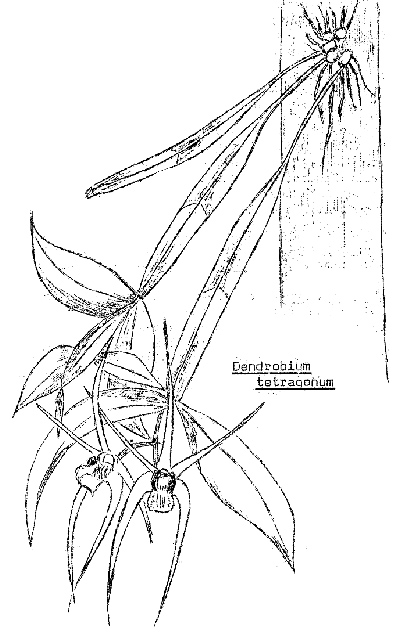
Dendrobium tetragonum

Growing Dendrobium falcorostrum in Adelaide 1983 and Now

In 1983, Ron Robjohns, NOSSA’s first treasurer, wrote a comprehensive series of articles about growing epiphytes in South Australia. Thirty years on Ron’s information for growing is still helpful and applicable for today. Any updates or extra information are in black text.

NATIVE ORCHID SOCIETY OF SOUTH AUSTRALIA JOURNAL

Volume 7, No. 5, June, 1983

GROWING EPIPHYTIC ORCHIDS IN SOUTH AUSTRALIA – R.T. Robjohns

Dendrobium falcorostrum (Beech Orchid)

This is one of the most attractive of the New South Wales epiphytic orchids, the common name being derived from the fact that it is only found in the forests of the Antarctic Beech, which occur in the highlands, extending from the Barrington Tops in New South Wales northwards to the McPherson Ranges in southern Queensland. However, within those forests it does occasionally grow on other than beech trees.

Due to the clearing of those forests it is fast becoming an “endangered species”.

It is a plant of the highlands and is rarely found below 900 metres, consequently it will tolerate cold conditions, however, it requires protection from frosts and needs to be grown where there is plenty of air movement.

There are from two to six light green lanceolate leaves at the top of the stem which is from 12 to 50 cm high and the mature stems are ribbed. The flowers number from four to 20 in the raceme and are intensely fragrant during the warmer part of the day. They are from 3 to 5 cm in diameter.

Flower spikes are terminal and some stems will flower for two or three years.

They are a glistening pure white to cream with the exception of the labellum which is streaked with purple. The common name is derived from the labellum, which is short and broad, bearing a fanciful resemblance to a falcon’s beak. The flowering season is from August to October.

It can be grown using either slab or pot culture using a mixture of aged pine bark, scoria* and charcoal* in a plastic pot and grown under 50% shadecloth.

Fertilise lightly during the growing season using foliar fertilisers at half the recommended strength.

Propagation is usually by division. 

*NB Charcoal is no longer used and scoria can get cold and wet in winter.

Dendrobium falcorostrum

Growing Dendrobium linguiforme in Adelaide 1983 and Now

In 1983, Ron Robjohns, NOSSA’s first treasurer, wrote a comprehensive series of articles about growing epiphytes in South Australia. Thirty years on Ron’s information for growing is still helpful and applicable for today. Any updates or extra information are in black text.

NATIVE ORCHID SOCIETY OF SOUTH AUSTRALIA JOURNAL

Volume 7, No. 4, May, 1983

GROWING EPIPHYTES IN SOUTH AUSTRALIA – R.T. Robjohns

Dendrobium linguiforme (Tongue Orchid)

The plant is epiphytic or lithophytic, forming large masses on trees or rocks. Its range is from the extreme south-east of New South Wales to at least the Burdekin River in Queensland. It grows from sea-level to altitudes of around 1000 metres, but is confined mainly to the coastal areas, although it has been found up to 250 kilometres inland. The inland plants have smaller, tougher leaves than those of the coastal areas, due no doubt to the harsher conditions under which they exist. It is not confined to a specific host but is found on quite a large variety of trees.

The rhizomes are prostrate and branching with thick, tough ovate leaves, 3 to 4 cm long having distinctive longitudinal furrows on top.

The racemes, up to 15 cm long, grow from just below the base of the leaf and bears from six to 20 flowers. The flowers are usually white or cream with a number of faint purple markings on the labellum.

The flowering time is usually August-September here but earlier in the tropical areas.

It does not lend itself to pot culture but is very hardy and with a little care will grow freely on cork or hardwood slabs. I have had good success using pieces of Melaleuca on which it readily establishes itself. It receives approximately 75% shade. It should be protected from our frosts and can be fertilised using foliar fertilisers at half the recommended strength.

This is the variety of the species on which the genus Dendrobium was founded. It was first described by O. Swartz.

There are three varieties of this species, the best known of which is var. nugentii, which is a tropical form from about the Burdekin River north to Bloomfield River in the south-east of Cape York Peninsula.

This form has broader, thicker leaves which are more rounded at the apex and in addition to the longitudinal furrows it often has transverse furrows. The flowers of this form are slightly smaller and age quicker.

Dendrobium linguiforme

Why use a mulch on your potted terrestrial orchids?

Here in South Australia, it is very common to see a covering of She Oak needles (Allocasuarina sp.) on pots of terrestrial orchids.  According to Les Nesbitt, NOSSA founding member and experienced terrestrial orchid grower, there are four reasons for this

  • It keeps the leaves up off the soil.
    • Provides good air circulation
    • Helps prevent leaf rot.
  • It provides nutrients to the fungi
    • This is very important for the fungi dependent orchids.
  • It stops pitting into the soil when it rains.
    • This is most likely to occur when pots are under the drip line of a shade-cloth.
    • Pitting exposes the root system.
  • It allows the leaves to readily come through because of its small diameters.
    • Other mulches, such as gum leaves, smother seedlings.

She Oak needles are the choice of mulch because it is

  • Long lasting and takes more than year to break down
    • which means that it lasts the whole growing season.
  • Does not become mushy or spongy
    • unlike pine needles and grass cuttings which breakdown more quickly into a wet soggy mass and contribute to leaf rot.

It should be noted that it is necessary to replace this mulch yearly.

These two pots were in the same area under the shadecloth.  Notice the damage to the pot without the mulch.
These two pots were in the same area under the shadecloth. Notice the rain damage to the pot without the mulch.

Growing Dendrobium kingianum in Adelaide 1983 and Now

In 1983, Ron Robjohns, NOSSA’s first treasurer, wrote a comprehensive series of articles about growing epiphytes in South Australia. Thirty years on Ron’s information for growing is still helpful and applicable for today. Any updates or extra information are in black text.

NATIVE ORCHID SOCIETY OF SOUTH AUSTRALIA JOURNAL Volume 7, No. 3, April, 1983

GROWING EPIPHYTIC ORCHIDS IN SOUTH AUSTRALIA – R.T. Robjohns

Dendrobium kingianum (Pink Rock Lily)

This is possibly the best known and most variable of our native epiphytic orchids. Its range is along the coastal strip from the Hunter River in New South Wales to Rockhampton in Queensland. While it is principally a lithophyte and found growing in large mats on exposed rock faces, it is also found in shady gullies and on trees.

It has three to six lanceolate leaves up to 13 cm long on stems varying from slender stems, pseudo bulbous only at the base, to short stout pseudo-bulbous stems. The pseudobulbs are usually 8 to 10 cm long with some up to 30 cm in length; the colour varying from pale green to dark reddish green. One to three racemes of up to twelve flowers, often fragrant, are borne from the top of the pseudobulbs, the colour, while commonly pink, varies from white to purple. They are up to 25 mm in diameter having the labellum usually spotted and blotched with mauve. The flowering season is August to November.

It can be grown on slabs or trees (e.g. Jacaranda or Melaleuca) but locally, best results are obtained from pot culture – rafts or hanging baskets, using an open mix. Some growers use a commercial cymbidium mixture.

I have had good results by lining wire baskets with a thick layer of live spagnum moss and filling them with small pieces of seasoned pine bark and charcoal. I find that the plant not only grows up but also out of the sides of the basket.

Some shade is required in our summer I have had success using 50% shadecloth. Protection from our winter frosts is also necessary. Fertilise lightly in the growing season using commercial fertilisers at half strength.

Being hardy it is well suited to cultivation and hybridisation. D. x delicatum is a natural hybrid of D. speciosum and D. kingianum, also D. x suffusum is a natural hybrid of D. gracilicaule and D. kingianum.

A number of man-made hybrids are available. Some of the best known are D. Bardo Rose (D. kingianum x D. falcorostrum). D. Ella Victoria Leaney (D. kingianum x D. tetragonum), all of which respond well to pot culture and flower freely.*

Propagation is either by division or cultivation of “keikies”.

Drawing of Dendrobium kingianum

*The number of hybrids has increased since 1983.

2015 April Winning Photograph: Calochilus cupreus

04 sm HL Calochilus cupreusDespite having five very different but high quality photographs, Helen Lawrence’s photograph of Calochilus cupreus (Aldinga Bearded Orchid) was the clear winner with the vast majority of votes.

In South Australia it is considered endemic and endangered. Researching it was interesting. For instance, there is no mention of it in Jones extensive book (2006) yet it was named by R S Rogers in 1918 with a description appearing in Black’s Flora of South Australia (1922 edition), including a drawing by Rosa Fiveash. Between then and now there was a shift. In the Third edition of Black’s (1978) C. cupreus is absent but C. campestris present. In Bates and Weber 1990 the authors describe C. campetris (C. cupreus). Currently, the eflora of South Australia (the electronic version of 1986 Flora of South Australia) considers it a synonym of C. campestris. This is reflected in the Census.

It would appear that as C. campestris was studied and its variations documented (e.g. article by Jones 1976 Orchadian 5:83) the distinction with C. cupreus was lost. Clements and Jones (2006) state “Calochilus cupreus R.S.Rogers = Calochilus campestris” which means that they are not using C. cupreus. But in Jones’ book an anomaly occurs – he does not include South Australia in the distribution of C. campestris and as result Bates, from 2008, states that it is not recognized as occurring in South Australia.

Though C. cupreus disappeared from the literature the name still continued to be discussed amongst orchid enthusiasts. So when in 1995 NOSSA members found a distinctively different colony at Aldinga they identified it as Rogers’ C. cupreus.

Below is a chart, based upon Dr Rogers’ description, of some of the differences that made him consider C. cupreus a separate species:

C. cupreus C. campestris C. robertsonii
Shorter leaf

Rather rigid or fleshy erect triangular section

Longer leaf

Crescentic section

Longer leaf

Crescentic section

Base of labellum oblong glabrous (without hairs) with several raised longitudinal line Base of labellum round thickened, smooth no raised longitudinal lines Whole of labellum hirsute (hairy)
8 – 15 flowers About 8 flowers maximum About 8 flowers maximum

It will be interesting to watch what happens.

References

Bates personal communications

Bates & Weber (1990) Orchids of South Australia

Bates (2011) NOSSA South Australia’s Native Orchids

Bates (2005 to present) Orchids of South Australia CDs various editions

Clements and Jones An Australian Orchid Name Index (27/4/2006)

https://www.anbg.gov.au/cpbr/cd-keys/orchidkey/html/AustralianOrchidNameIndex.pdf

Jones (2006) A Complete Guide to Native Orchids of Australia

NOSSA Journal Vol 25 No 10 November 2001

Rogers R S Transactions of the Royal Society of South Australia V42 (1918) Pages 24, 25

http://www.biodiversitylibrary.org/item/113409#page/40/mode/1up

Growing Epiphytic Orchids in Adelaide 1983 and Now

In 1983, Ron Robjohns, NOSSA’s first treasurer, wrote a comprehensive series of articles about growing epiphytes in South Australia. Thirty years on Ron’s information for growing is still helpful and applicable for today. Any updates or extra information are in black text.

NATIVE ORCHID SOCIETY OF SOUTH AUSTRALIA JOURNAL

Volume 7, No. 3, April, 1983

GROWING EPIPHYTIC ORCHIDS IN SOUTH AUSTRALIA – R.T. Robjohns

Epiphytes usually grow where there is plenty of air movement, ample light but also shade and to achieve this they are frequently found well above the ground storey in the forest from where, should they be dislodged from their host and fall to the forest floor they wither and die. With most plants the roots grow downwards, however, with epiphytes in their natural habitat, the roots may grow up, down or around their host, that is, in any direction in search of suitable conditions.

As a novice grower I urge you to learn all you can about the natural habitat of the plant and its principal host, bearing in mind that in accounts of plants that grow on rock faces, often they are growing with their roots in crevices into which any moisture drains and maybe in an accumulation of leaf litter. Frequently the rocks on which the lithophytic orchids grow are sandstone – a rock which can absorb moisture and consequently keeps cool longer than most other rocks. “In an exposed situation” should not be construed as being in full sun all of the time: usually they receive some shade.

With the possible exception of Cymbidium canaliculatum few epiphytes grow at their best in full sun in nature. Full sun in the hot dry South Australian summer will usually burn off the plants or at the best cause severe yellowing and loss of leaves. It is to be noted that this State has no native epiphytic orchids.

Most Australian epiphytic orchids grow in the coastal belt of northern New South Wales and Queensland where the average rainfall in their DRY season is much the same as the Adelaide winter or WET season with which it coincides, consequently advice that plants require to dry out during the winter should not be taken to the extreme and the plants left without water.

The three principal requirements of epiphytes are a free air circulation, a semi-shaded position and free drainage.

In South Australia epiphytes are grown in two ways, the most popular being pot culture and the other slab culture.

For pot culture the medium must be a free draining one and a mixture of “aged” pinebark, scoria and charcoal is quite effective.

Note 2015 – Today the potting media used is composted pine bark.  Charcoal is not used and scoria can get cold and wet in winter.

In choosing material for slab culture consider the conditions under which you intend to grow the plants. For humid conditions cork is ideal while tree fern, which holds moisture longer, is good for dry conditions, although any of our native trees with papery or corky bark is suitable. Perhaps you would wish to attach the plants directly to trees in your garden, for this purpose try Jacaranda, Melaleuca or trees with a similar bark.

Watering is important, slab culture requires more watering than pot culture and in summer water orchids on slabs at least every second day and every-day during a hot spell. Water according to the weather and watch for signs of stress – in wintertime the rain is usually sufficient.

Fertilising is best done using half of the recommended strength of commercial proprietary fertilisers.

As a last general recommendation – beware of frosts. Last year (1982) the frosts in some areas of Adelaide caused severe losses amongst plants of epiphytic native orchids. Large tubs of D*. speciosum, whose thick leathery leaves I mistakenly thought frost resistant, were reduced to a mass of leafless canes; even baskets of D. kingianum hanging three feet below the 50% shadecloth had all of the leaves burnt off. These were but two of the varieties which suffered, so be warned and ensure that your plants are protected from frosts.

*D. = Dendrobium

Dendrobium speciosum
Dendrobium speciosum in culture


Creating a Mosquito-free Micro Climate for Epiphytes

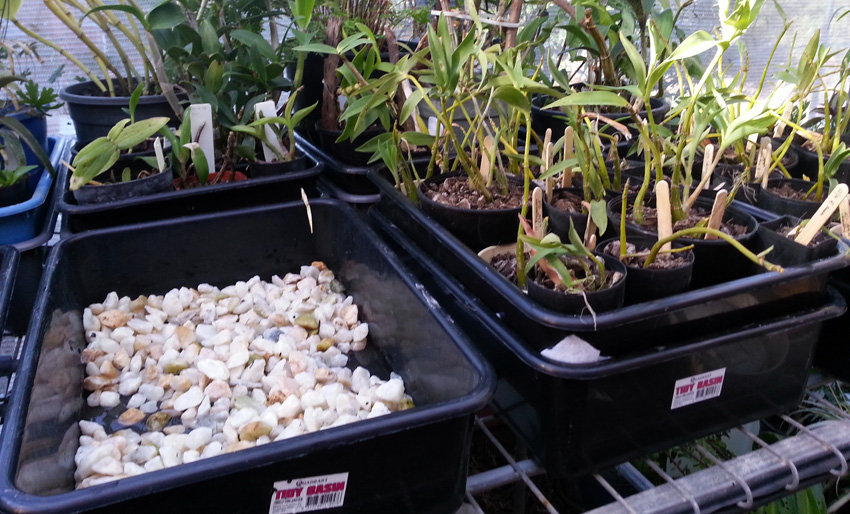
Adelaide in summer is very dry and hot with very little humidity or rain.  Since January 2015 there has been over 60 days without any significant rainfall.  This presents a problem for growing Australian epiphytes which come mainly from the eastern seaboard with its increased humidity and summer rain.  Therefore to grow ephiphytes in Adelaide, it becomes necessary to attempt to replicate these conditions through creating a micro climate with increased humidity.  To achieve this many growers will stand the pots on gravel in water-filled trays but this presents a problem.  Mosquitoes love it and rapidly breed up to the annoyance of us all.

The following system stops mosquitoes from breeding plus prevents pots getting water logged in Adelaide’s winter, particularly when the pots are not under a solid roof but shadecloth (in this instance, 50% shadecloth).

  • Equipment
    • 10 Black trays – these were inexpensive trays from Cheap as Chips
    • Black irrigation tubing
    • 10 Grommets
    • 11 ‘T’ junctions and 2 angle junctions
    • Tap
    • Sealant
    • Gravel
    • Builders Landscape Fabric
  • Preparing the trays
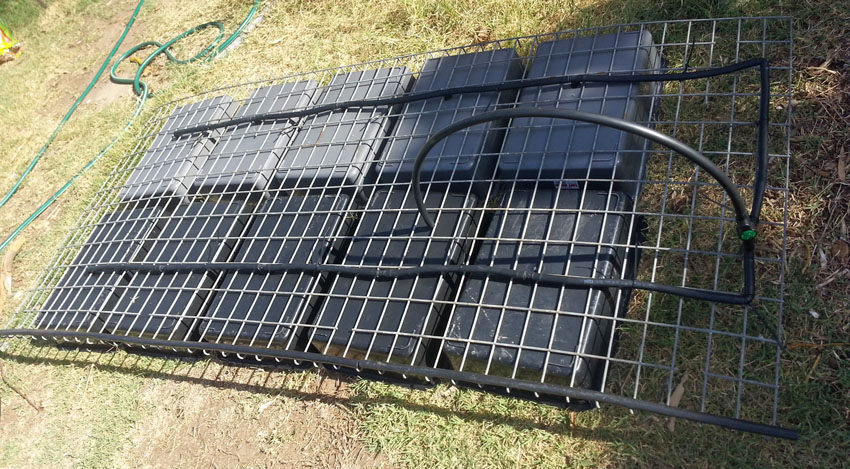
    • One hole was drilled in each of the trays.  A grommet was placed in each hole and using ‘T’ and corner junctions the trays were joined with poly tubing including a tap.

      The trays connected.  To give stability the trays and hose were connected to the table top.
      The trays connected. To give stability the trays and hose were connected to the table top with the hose running under the table top. This allows free drainage as it stops the hose from being squashed.
  • Checking the system for leaks
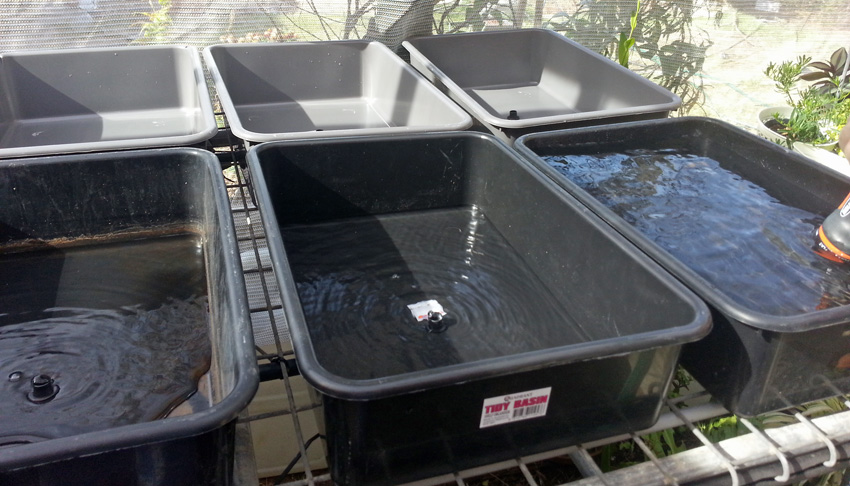
    • The next step was to check that the water flowed into all the trays and that there were no leaks.

      Filling all the trays from one tray.
      Filling all the trays from one tray.
    • There were leaks and these were sealed with an aquarium sealant.
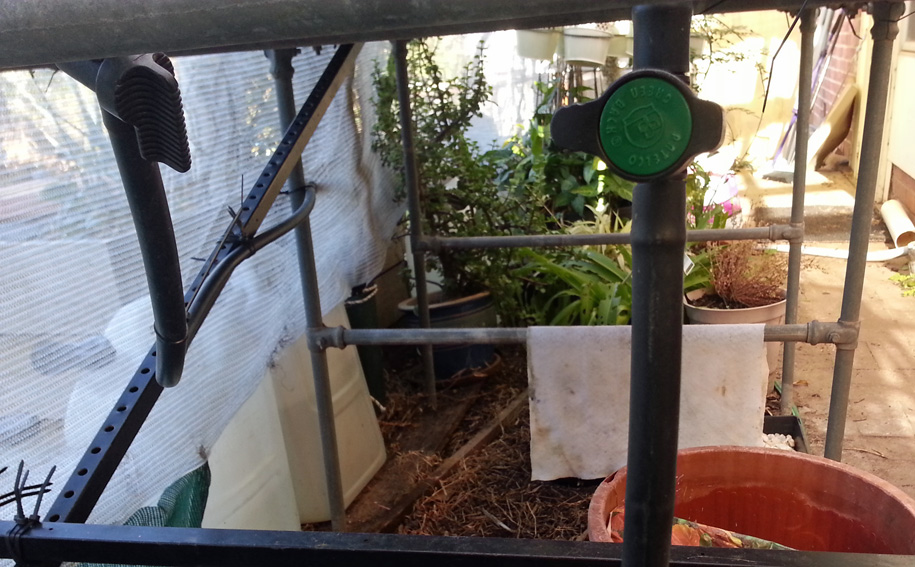
    • A hose with a tap was directed toward a raised garden bed on the other side of the shadecloth.

      Checking for leaks & the drainage system
      Tubing leading to the raised garden bed
  • Preparing the inner tray
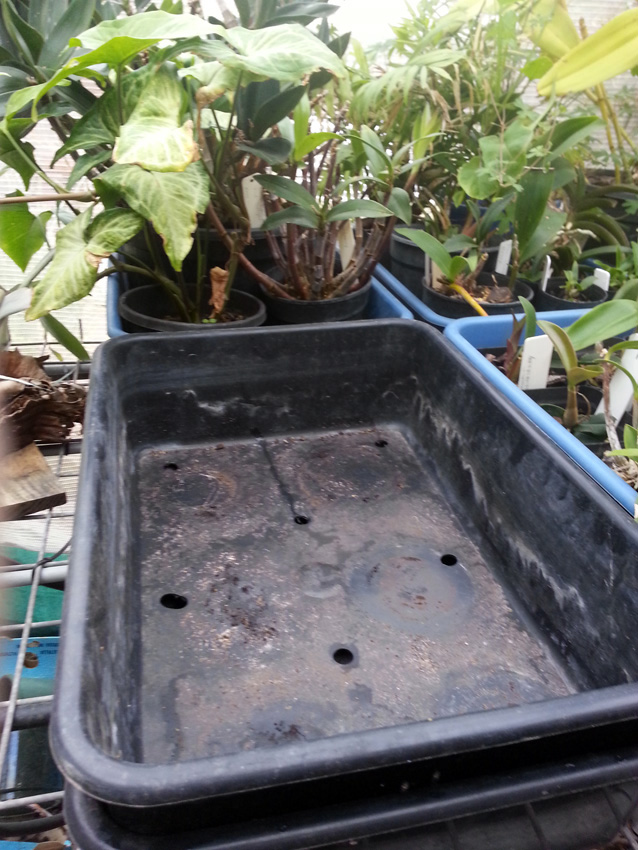
    • The system requires a second tray.  Drainage holes were drilled in the trays.

      Inner (upper) trays with holes to allow the water to come up into the pots.
      Inner trays with holes to allow the water to come up into the pots.
    • Gravel was placed in the outer (lower) tray.

      Gravel to support the inner trays
      Gravel to support the inner trays
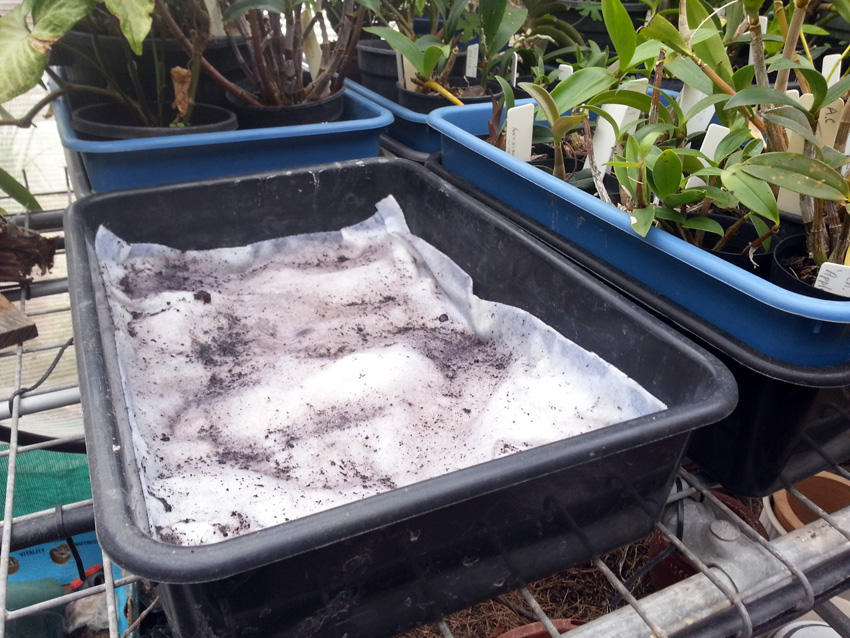
    • The reason was two-fold.  One was to make it easier to remove the inner tray with the pots insitu and the other was to hold the builder’s landscape fabric nearer the inner tray.  The purpose of the fabric is to keep the tubing clear of debris.

      Layer of cloth to stop debris entering the drainage pipes
      Layer of cloth to stop debris entering the drainage pipes
  • The finished system
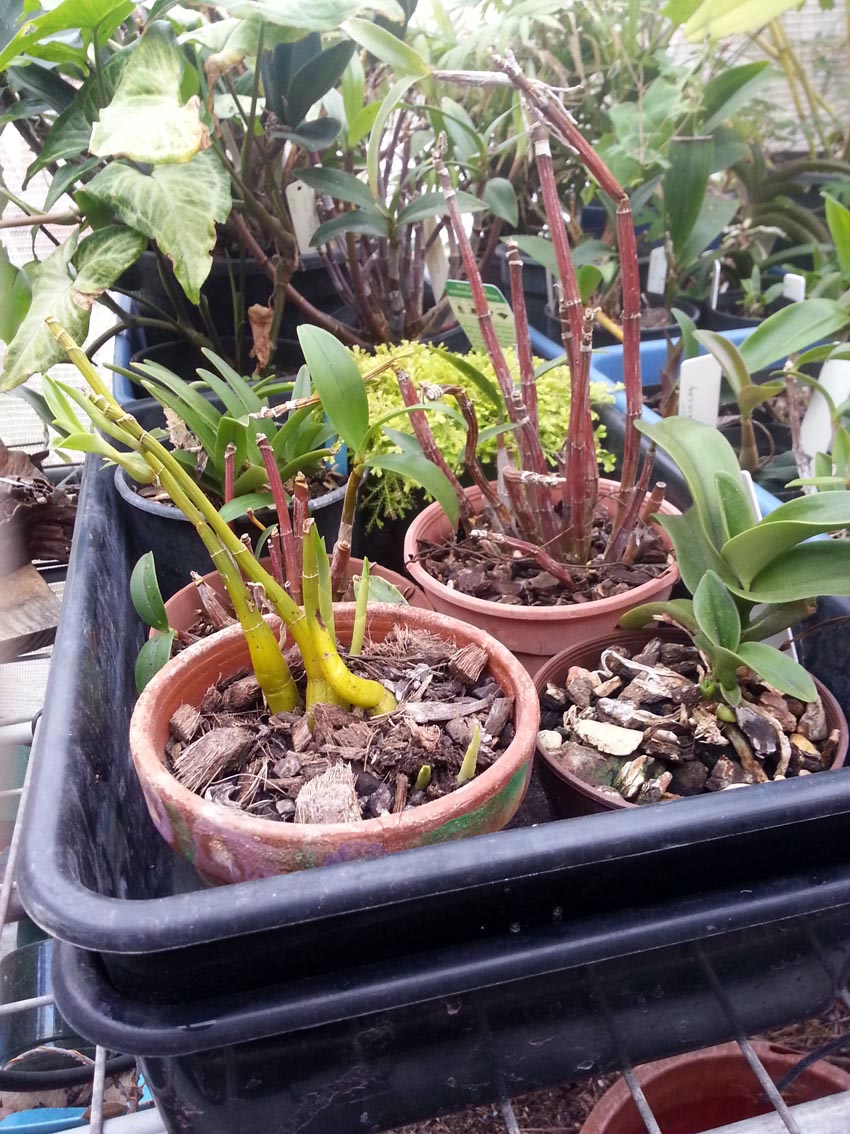
    • Pots in place and ready to enjoy the new growth of those numerous plants that were divided previously – see the post Breaking up is ….. easy to do.

      The front pot originally consisted of just the pseudobulbs without leaves of Dendrobium kingianum.  After a few weeks in this system, new growth.
      The front pot originally consisted of just the pseudobulbs of Dendrobium kingianum. There were no leaves. After a few weeks in this system, new growth has appeared.
  • Using the system
    • Depending upon the conditions, the mosquito breeding cycle can be as short as four days from egg-laying to the larva emerging as a adult.  As a result, the water is fully drained every four days or less.  This regular drainage of water means that there is no stagnant water left lying around for any prolonged length of time.
    • The trays are allowed dry for a couple of days (less in a heat wave) before refilling again and the pots sit in a small amount of water.
    • By following this watering cycle there are no mosquitoes.
    • The shallow layer of water around the pots provides the necessary humidity.
    • In winter the taps are left open the whole time to prevent the plants from becoming water-logged.

NB This system is not suitable for the terrestrial orchids.


Three Key Starting Points for Successfully Growing Australian Orchids

There is a lot of information on growing orchids so much so that it can become overwhelming.  As a novice, I’ve put together my observations which can be summed up in three key points.

One – Find a Mentor

The best and first thing to do is to join a local orchid club, such as the Native Orchid Society of South Australia (NOSSA), and find a mentor within the group.  There are many books but nothing substitutes for that personal interaction with an experienced grower who will know both the plant and the adaptions needed for the local conditions.  At the monthly meetings, NOSSA has a Grower’s forum where various aspects of growing orchids are discussed and questions answered.  It is well worth attending.

Two – Have an Equipment Kit

There are some things that are essential and it is good to have a basic kit to get started.  Later, more equipment can be added as one’s skill develops in growing orchids.  The necessary items would include:

  • Secateurs
  • Labels – these can be proper plant labels from a garden store or wooden lollipop sticks, so long as they are waterproof.
  • Pen – indelible ink pen or pencil (there are pencils that can write on plastic) as it is pointless having a labelled plant with the details washed off.
    • it may be necessary to use both current name and synonyms on the label eg Corybas/Corysanthes
  • Wettable Sulphur – necessary for guarding against diseases and is available from garden centres but Tomato Dust can be a good substitute although it is half the strength.
  • Sterilizing equipment
    • Good nursery hygiene techniques are important
    • Dilute bleach, tri-sodium phosphate (and possibly a small blow torch for metal tools)
    • newspaper
      • a different sheet for each orchid when dividing will help prevent transference of any disease, etc (don’t forget handwashing)
  • For Epiphytes
    • Ties and Stakes
  • For Terrestrials
    • Sieve for recovering tubers
    • Sheoak or pine needles for putting on top of the pots to stop soil and fungi splashing up on the undersize of the leaves
  • Pots – do not need to be fancy but the pot size will depend upon the species
    • Diuris prefer deeper pots; Corysanthes prefer wider, shallower pots whilst Pterostylis doesn’t seem to mind either

Three – Work within the Plant’s Growing Condition

This will require time, research, experiment and going back to the experienced growers.  Each one of us eventually needs to find what is the best setup for our individual location but some general guidelines would be:

  • Start with plants that are suitable for your current climatic conditions.  Obviously putting a tropical Dendrobium bigibbum under the patio in temperate Adelaide is not going to be successful.  For the terrestrials it is better to start with Pterostylis curta or a Microtis than a fungi dependent Arachnorchis tentaculata.
  • Research the plant you want to grow and then create the micro-climate necessary for the flourishing of the plant.  This will entail separating the orchids, don’t put shade lovers such as Corysanthes with those requiring brighter light eg the Thelymitra genus.
Dendrobium speciosum
Potted Epiphyte – Dendrobium speciosum
Thelymitra plants in pots
Potted Terrestrials – Thelymitra (Sun Orchids)

Orchid Walks at Mt Lofty Botanic Gardens

For the last couple of years, NOSSA has been conducting spring tours at the Mt Lofty Botanic Gardens, South Australia, showcasing our beautiful native orchids to visitors far and wide.  They have come from not only Adelaide but from interstate as well as overseas from such countries as America, Germany, England and many others.  If you are planning to be in Adelaide during spring, then consider joining one of our walks, but for those who cannot attend here is a video for you.  So watch and enjoy …….