The following article by Les Nesbitt was published in May 2017 Native Orchid Society of South Australia Journal Volume 41 No 4. The article relates to Australian Native Orchids.
Suggested potting mixes for potted native terrestrial orchids have changed greatly over the years as some ingredients such as peat moss have become too expensive or difficult to obtain. Basic requirements are that the mix should be free draining yet retain moisture and should have an organic component that breaks down slowly and does not go mushy in winter. Most species are not too fussy and will grow in a variety of mixes.
Those tubers that desiccate in summer do better in a heavy mix that contains clay. Examples are Diurus behrii, D. punctata and Pterostylis nutans.
Tubers that rot easily in wet soil in Spring prefer an open coarse sandy mix. An example is Thelymitra antennifera.
A dry mix containing a higher proportion of sand is usually recommended for Caladenia and Glossodia species grown in pots. In contrast these orchids grow in clay soil on my property in the Adelaide Hills but there excess water can run off. In pots, excess water has to drain through the potting mix.
An organic component is vital to feed orchid fungi.
Some Basic Ingredients:
Washed sand with rounded particles. (Not sharp sand as this sets hard in summer.)
Soil (sandy loam, clay based loam, mountain soil)
Native seedling mix (Bark based – sieve to remove splinters)
Native potting mix (can be sieve* to remove larger particles)
Chopped and sieved* gum leaves
Perlite or isolite (but will make tubers harder to identify at repotting time)
Composted leaf mould & buzzer chips (but needs to be gathered now for use next summer)
Cauarina (She-oak) needles chopped for surface mulch
Some Suggested Potting Mixes
ANOS-Vic dry mix – 2 parts coarse sand, 1 part coastal sandy loam, 1 part composted buzzer chips, 1 part leaf mould
100% native potting mix. (Works for drought resistant tubers, viz. Pterostylis curta & P. pedunculata)
Native potting mix (sieved*) and isolite
Native potting mix and sand
Les Nesbitt’s current mix of 50% sand, 20% hills soil, 25% seedling potting mix (sieved), and 5% chopped & sieved* string bark gum leaves.
Orchid names are contentious. The reasons appear to be complex but whatever the reasons the situation exists whereby some orchidologists are naming species that may or may not be accepted by others. The result is that there are publications using different names for the same species. And of course, in the midst of it all, are those names that have been accepted for previous species with phrase names or manuscript names.
Whatever the name, it is helpful then to be able to match them up. Last week’s blog covered South Australian names but in the same week Andrew Brown published on the Western Australian Native Orchid Conservation Study Group Facebook an updated list of WA orchids whereby he has linked them with significant WA Orchid field guide books.
Andrew has kindly given permission for this list to be published. Other lists are also included and these are available on the NOSSA’s Orchid eBook page.
It is worth reading Andrew’s introduction in ALIGNMENT of WESTERN AUSTRALIAN DIURIS AND PTEROSTYLIS NAMES.
The object of this exercise is to align the phrase names in these three publications with names published in recent taxonomic papers. Please note that most, but not all, currently recognized (described and undescribed) Western Australian Diuris and Pterostylis are included. There are other taxa that may be considered worthy of recognition but have not been included at this time as we feel further research is required.
In the case of phrase names, these are added and removed for taxa as new information comes to hand and should not be thought of as the final view. Rather, these should be thought of as current thinking that may change in the future. Taxa are only formally recognized as being distinct once their scientific names are published. Even then, later thinking may result in further changes.
Given that phrase names are a work in progress, some may think that we should not be promoting their use and that they should not be included in popular books. However, I think it is worthwhile putting them out to the wider audience so that their distinctiveness can be debated. Having a large group of people looking for (and at) these taxa provides us with a great deal of information and opinion based on firsthand experience in the field, that we may not otherwise have obtained. Then, if and when the taxon is formally described, it will be done on a much more informed basis.
As I am sure you are aware, the naming plants is an evolving process and there will be further changes as new information comes to light.
For the final meeting of the year we chose the best of the 2016 monthly winners of the picture competition.
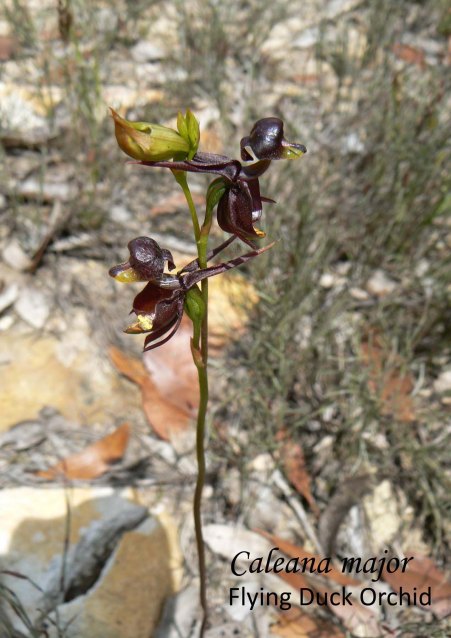
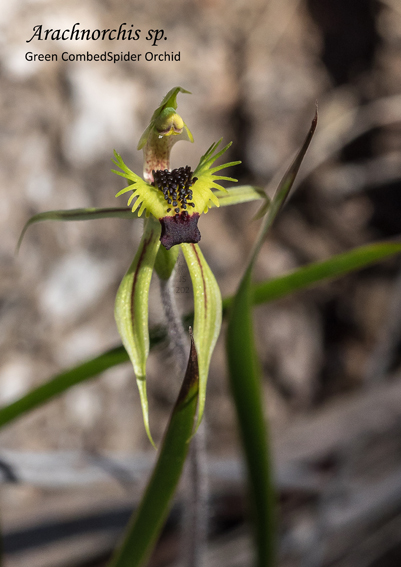
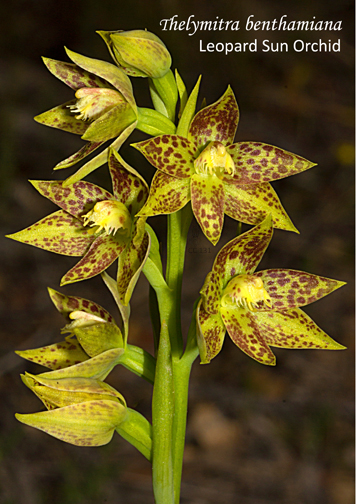
Here in Australia we are fortunate to have such a variety of orchids. They may not be as big and showy as some of the overseas orchids but the diversity of shapes fires the imagination as reflected in this year’s monthly winners, when put together. The common names of the winners – spider, leopard, flying duck, cowslip, zebra, helmet, bluebeard and greenhood – reinforce this theme of diversity.
Patterns and colours contribute to the variety of our orchids. Australian orchid colours run the gamut of the rainbow and more, with Australia being home to most of the naturally occurring blue orchids in the world. This colour fascinates and allures people around the world so much so that nurseries will dye a white orchid blue because it will sell. There is even a website devoted to the colour called, not surprisingly, Blue Orchid and the popular band master Glenn Miller wrote a song titled Blue Orchids (1944).
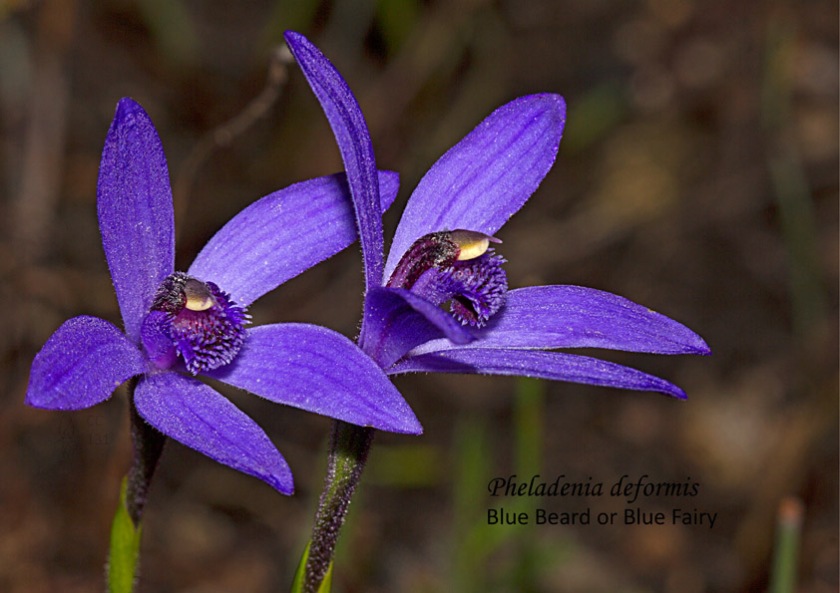
Could this be why the very clear winner for the year was Claire Chesson’s Pheladenia deformis common name Bluebeard or Blue Fairy?
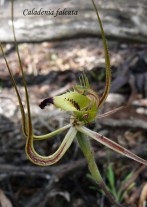
Pauline Myer’s Caladenia falcata and Caladenia carinsiana;
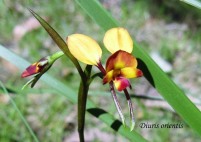
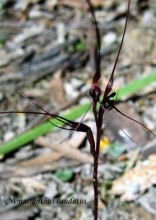
Margaret Lee’s Diuris orientis and Nemacianthus caudatus;
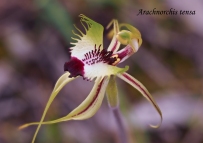
Judy Sara’s Arachnorchis tensa;
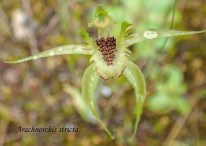
Greg Sara’s Arachnorchis stricta which had an unusual green coloured flower;
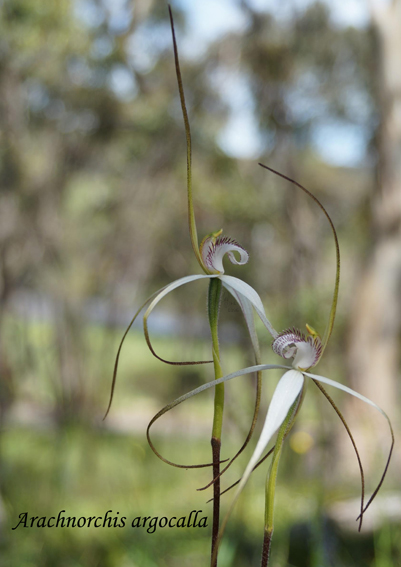
and Helen Lawrence’s Arachnorchis argocalla.
Helen’s picture of the nationally endangered A. argocalla was the outstanding winner. Now known as the White Beauty Spider Orchid^, it was featured last year as a winner with Pauline Meyer’s June 2015 entry*.
This is one of our largest spider orchids. For size, beauty and delicacy it rivals the Western Australian Caladenia longicauda ssp. eminens (White Stark Spider Orchid) and A. venusta, syn. Caladenia venusta (Graceful Spider Orchid) from Victoria and the South East.
It shares many similarities with these two species in that they are reasonably good size white flowers with a stiffly hinged labellum that has long, thin teeth and the segments have threadlike tips without clubs. It is separated both geographically and in the type of habitat from these two species. A. argocalla is a plant of the inland hills and valleys.
Though primarily a white flower and part of the A. patersonii complex, A. argocalla has red colouring in the labellum which according to Backhouse may possibly indicate genetic introgression (that is long term mixing of the gene pool) with either the A. reticulata or A. leptochila complexes. Certainly, the colour of the labellum was quite variable ranging from white through to a deep red.
^Previously known as Common White Spider Orchid because of its abundance but now only known to a limited number of locations.
*NOSSA Journal, July 2015
Reference:
Department of the Environment (2016). Caladenia argocalla in Species Profile and Threats Database, Department of the Environment, Canberra. Available from: http://www.environment.gov.au/sprat. Accessed Thu, 3 Nov 2016 16:31:39 +1100
This week’s blog, Part One of Two Parts, is quoted directly from the introductory chapter (Pages 2&3) Orchid Pollinators of Victoria 4th Edition, 2016, Rudie Kuiter. Over the years of photographing orchids and their pollinators, Rudie and his team have been discovering much of the hidden world of orchid pollinators. In this first section he highlights the fallacy of the “one orchid-one pollinator” as well as touching briefly on the vast difference between the insects and their role in the ecosystem.
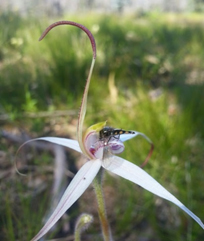
Amongst flowering plants, orchids have evolved in their own special reproductive ways. Their pollen is massed as waxy packages, pollinia, unlike like (sic) other flowers that produce masses of fine pollen grains that mostly go astray. The pollinia are relatively heavy and the usually small creatures need to be strong fliers for cross pollination (see image below). Orchids evolved with amazing strategies to attract specific carriers in order to transfer pollen between flowers of their species only, and in this way eliminating the need to produce great quantities. Various insects, many moths, bees and even birds have been documented as pollinators of orchids around the world (v.d. Cingel, 2001). A number of uniquely different examples of orchids attracting insects for their pollination evolved in Australia, especially in the more temperate southern zones originating from Gondwana times. With very few exceptions the Victorian orchids are terrestrial, ground-dwellers, that rely on small insects such as fungus-gnats, native bees, wasps, ants and many attract only the males by sexual deception. In the case no pollinators visits, many species may self-pollinate as a back up.
When taking an interest in orchids it seems difficult enough to identify some species. Usually one looks and admires the amazing flowers that may resemble an insect and can be difficult to recognise as a flower at first. An insect on a flower may be thought of something that spoils a picture – until taking an interest in the visitor!
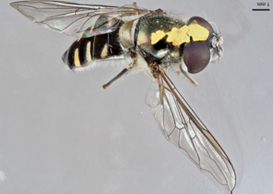
Hoverfly on Caladenia rigida (syn Arachnorchis rigida)
I first learned about the orchid pollinators in Orchids of South Australia by Bates & Weber, 1990, an excellent book by today’s standard, but few were seen over the years by just being there at the right time when photographing orchids. During preparation of the book on Caladenia spider-orchids, certain issues developed from questionable statements made in scientific papers about wasp-pollinators. Of particular concern was about the one-to-one relationship – how only one wasp-species would be involved with only one spider-orchid species – and suggesting populations that were thought to represent the same species comprised different taxa if not pollinated by the same wasp-species. A very different story emerged when monitoring the local spider-orchid populations to find the answers and it became clear that there was much more to it. A site in Wonthaggi with a very large colony of Caladenia dilatata proved to be perfect for this study and also to photograph pollinators as it produces flowers for about four months. It was found that a local wasp-pollinator species typically flies for a little over one month, thus this need to be investigated further. Scientific publications on wasp-pollinators were generally based on short-term experiments, and usually employing baiting methods – moving flowers and often taking them to different sites. Responses included unnatural behaviour or attracting sibling wasps at a non-local site. It is certainly true that a particular flower may attract only one species of wasp a t a locality and a certain time in the season, but this reflects a very small part of the picture. It can be different in the long-term, at certain localities or with a season.
The main study site was in coastal dunes, where in a very large population of Caladenia dilatata produced flowers for over four months from September, and under favourable Summer-conditions into January. At least three congeneric (belonging to the same genus) thynniid wasps species were involved in this population. The flying times were up to about 6 weeks for each wasp species, that were separated or slightly overlapping. The flowering times in other populations of C. dilatata in Wonthaggi and Wilsons Promontory were usually about one month in each, and at the corresponding times to the study site the wasps visiting were the same species. A close sibling C. parva in the Wonthaggi heathland habitats and early flowering C. dilatata were pollinated by the same species, but the later flowering C. tentaculata by a thynniid wasp of the different genus.
Hoverfly with pollinia
Whilst a flower may attract only one wasp species, the kairomones (chemical omitted by the orchid to attract a pollinator) of a species may vary between flowers within in a population or when allopatric (growing in different geographical regions), just like colour or morphology. Variations maybe in relation to locality, weather conditions, or ground chemistry and available pollinator. Pollinators may evolve over time, but adaptions usually require many seasons and this would vary with location. The observations made over several seasons suggest that more than one congeneric insect is involved in pollination depending on local or seasonal conditions, especially after a long drought. Chiloglottis gunnii populations in Langwarrin were checked for pollinators since a decade-long drought and no action was seen for many seasons. When wasps finally made an appearance they comprised different taxa of Neozeleboria the first season, but only one became the common and principal pollinator the following seasons. Thynniid wasps are very localised as females lack wings and rely on the males to carry them around during copulation and to provide food. It limits their travelling and their homing range may comprise just a few hundred metres. Thynniid wasp are very vulnerable in small reserves isolated by land-clearing, and certain species have gone locally extinct due to conducting burns. Insects form a crucial and fundamental part of an ecosystem, but their importance is never considered in the planned burning, showing a complete lack of understanding by people in charge. So little is known of ecosystem’s foundations, but controlled burning continues – ruining precious habitats. Orchid species failing to produce seed pods is an indication that pollinators were absent, probably gone locally extinct. Orchid species that have a sexual association with thynniid wasp pollinators are localised and usually have geographically variable flowers. The situation is different with Cryptostylis spp. And their pollinating male wasp Lissopimpla excelsa, as females are a strong flyers. The flowers of Cryptostylis are geographically uniform in each species and the wasp is widespread. Both sexes are very distinctive in colour that show no variation. They are active over Spring and Summer and are great travellers.
This week’s post is taken from the IUCN SSC Orchid Specialist Group Facebook post concerning Resolution decided upon at the final session of the International Orchid Conservation Congress Conference, held in May 2016 at the Kadoorie Farm & Botanic Garden, Hong Kong
It was posted by Michael Fay of Royal Botanic Gardens, Kew. He is also the Chair of the IUCN SSC Orchid Specialist Group. According to their website, “The Orchid Specialist Group is a global network of experts who volunteer their time and expertise to build a scientific and practical foundation for the conservation of orchids (Orchidaceae).”
(A list of the meanings of acronyms appears at the end of this post.)
Michael’s post follows
Here are the Resolutions from the final session of IOCC VI in Hong Kong:
Orchids are a flagship plant group with a high profile in human culture. They are known from all vegetated continents on earth but their occurrence reflects patterns in the global distribution of biodiversity and their intricate ecological associations, particularly with pollinators and mycorrhizal fungi, reflect sensitive ecosystem processes. Accordingly, orchids are indicators of ecosystem and climate health. Many orchids and their associated biota have been exposed to a variety of threats as a direct consequence of human-driven global change, with almost half of the ca. 27,000 known species now potentially at risk of extinction. Delegates of the IOCC support all efforts to research and mitigate these threats and secure environments on which orchids depend, and are committed to achieving meaningful conservation by recommending that:
The creation of orchid enhanced habitats is a priority for ecological restoration.
Enhanced in situ orchid protection requires the creation of orchid reserves. These will benefit a wide array of other species and biological communities and can be financed through various public and private sources.
The international and domestic wild plant trade is widely recognised by governments and civil society as a major threat to the persistence of many orchid species, and that its curtailment requires concerted government action and enforcement.
The propagation and cultivation of threatened orchids by small and local orchid enterprises should be supported for the sustainable production of orchids used in horticulture, medicine and food.
Orchid cultivation should be licensed and audited by government or other government-approved body through a national (or international) accreditation scheme that specifies adequate safeguards to ensure best practice. Propagated orchids should be traceable and distinguishable from wild orchids so as to minimise the risk of laundering wild plants.
National, regional and international networks should be established and strengthened for promoting in situ and ex situ orchid conservation.
The next generation of orchid taxonomists, ecologists and conservationists is nurtured through improved training, education, publicity and awareness-raising programmes.
Paracaleana minor (Little Duck Orchid) Photo: David Manglesdorf
Members shall strengthen the work of OSG by:
Facilitating and conducting national and global Red Listing of orchids, and contributing to the Sampled Red List Index (SRLI);
Monitoring and reporting on the illegal trade in orchids to national enforcement agencies and to TRAFFIC;
Reviving Orchid Conservation International as a vehicle for web-based education and channelling funding to orchid conservation programmes, along the lines of Birdlife International;
Embracing social media and other web-based interactive tools as dynamic and effective means of stimulating communication, raising awareness and building networks;
Using citizen science as an effective means of motivating individuals and amateur groups to record orchid occurrence (e.g. OrchidMap, iNaturalist) and help scale-up the collection of verifiable data;
Establishing and maintaining a global database of orchid reintroductions (including both successes and failures) and ex situ orchid collections that can be accessed and updated by members and which is linked to the IUCN Reintroduction Specialist Group;
Creating new sub-groups focusing on trade and molecular identification, to reflect important cross-cutting themes and challenges.
Thanks to Stephan Gale and Phil Cribb for producing the final version of these.
Calochilus cupreus (Bearded Orchid) Photo: Helen Lawrence
IOCC VI refers to the International Orchid Conservation Congress Conference was held in May 2016 at the Kadoorie Farm & Botanic Garden, Hong Kong
IUCN: International Union for Conservation of Nature
OSG: Orchid Specialist Groups
SSC: Species Survival Commission
TRAFFIC: Trade Records Analysis of Flora and Fauna in Commerce
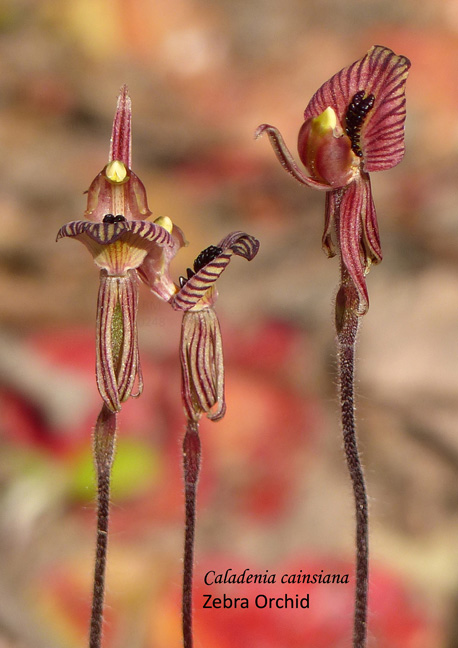
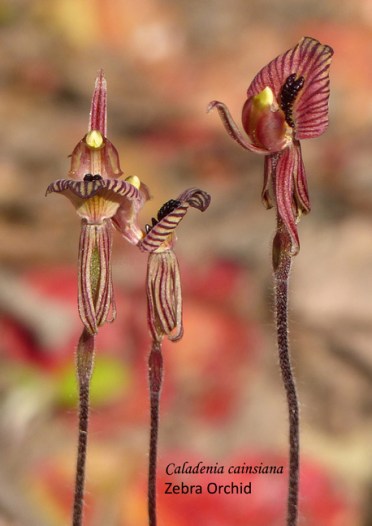
It is always good to see other members submitting images for the competition. This month Rob Soergel entered Urochilus sanguineus growing with Bunochilus viriosus and Ros Miller a Caladenia cairnsiana. Others were Rob and Jenny Pauley’s mass flowering of short Urochilus sanguineus, Pauline Meyers’ Arachnorchis cardiochila hybrid (possibly with A. strigosa) and Lorraine Badger’s Diuris corymbosa.
The winning picture taken by Ros Miller C. cairnsiana (Zebra Orchid) is one of Western Australia’s unique and interesting orchids. It was first collected by Baron Von Mueller (Victorian Government Botanist 1857–1873) from the Stirling Ranges and subsequently named in 1869 after the Rev Adam Cairns a Melbourne Presbyterian minister who promoted “various philanthropic studies”. In the 2000’s various synonyms were applied to the name, most notably Jonesiopsis cairnsiana (2003).
Many of the distinctive features of this species are readily seen in Ros’ picture – the non-clubbed, equidimensional short lateral sepals and petals which are hard pressed up against the ovary; the smooth, upswept labellum. What is not seen is the leaf which is erect large pale green with the bottom third usually irregularly blotched with red-purple.
Flowering from August to November, occasionally in clumps, these orchids are distributed over an extensive geographic area from Lancelin approximately 130 km north east of Perth, to Israelite Bay near Esperance some 775 km south east. They grow in a range of habitats from forests, woodlands, to mallee heathlands.
Interestingly for such a widespread and colourful flower, they are often missed being seen as they are ‘small and hard to see’.
References
Brown, A., et al,(2013) Field Guide to the Orchids of Western Australia. Perth, WA: Simon Neville Publications
This is the last of the three terrestrial fact sheets in Culture Notes that NOSSA has produced on growing terrestrial orchids. All three facts sheets can be downloaded – Click on the following for Fungi Dependent, Slow Multipliers and Fast Multipliers.
Arachnorchis tentaculata, common name King Spider Orchid or Large Green Comb Spider Orchid
Some 3/4 of Southern Australian terrestrial orchids are fungus dependent throughout their life cycle. Orchids that are fungus dependent have very specific cultural requirements. The fungus must be grown in the pot with the orchid. Sometimes a third entity such as a shrub or tree is involved in the fungal relationship.
A minimum disturbance culture is used.
Limited numbers are available each year. Other fungus dependent species are rarely available. Those in cultivation have mostly come from rescue digs in the past. NOSSA has started a seed kit project to help overcome this vacuum.
GROWTH HABIT: Australian ground orchids follow an annual growth cycle comprising 6 – 8 months as growing plants under cool (5 – 20°C max, 0 – 14°C min) moist conditions and 4 – 6 months as dormant tubers in hot dry (18 – 42°C max, 12 – 30°C min) conditions. The new tuber is produced in winter – spring. Each tuber sends up a shoot to the surface in Autumn and leaves grow rapidly in late Autumn/early Winter as temperatures fall and the rains set in. Sometime in October/November the leaves go yellow and then brown and dry as the days get longer, hotter and drier in late Spring.
LIGHT/SHADE: In Adelaide they thrive in a shadehouse of 50% shadecloth. Some species prefer heavy shade, others full sunlight, but most will adapt to a wide range of light intensity.
If the leaves and stems are weak and limp or if the leaf rosettes are drawn up to the light then the shading is too dense and the amount of light should be increased. FDs are mostly spring flowering and like higher light intensities at flowering time. flowers may have pale colours if placed in heavy shade, even temporarily, when buds are just starting to open.
In very cold areas an unheated glasshouse may be required for frost protection although light frosts do not worry the majority of species.
AIR MOVEMENT/HUMIDITY: All species like good air movement and will not thrive in a stuffy humid atmosphere especially if temperatures are high.
POLLINATION/SEED COLLECTION: FDs seldom multiply so must be propagated from seed.
Flowers on the strongest plants of the same species growing in pots are cross pollenated by hand to set seed pods. The flowers collapse in a day of so and pods ripen in 4-8 weeks. Pods are collected as they change colour from green to brown, which happens quickly on a hot day in October/November. Tea bags can be tied over the pods to catch the dust like seed if frequent visits to site are not possible.
Pods are stored dry in paper envelopes indoors over summer. Seed can be sprinkled on mother pots or scattered on bush sites.
SEEDLING CARE: Seedlings can be raised by sowing seed around potted mother plants.
At Easter time, just before the rainy season begins, the dust-like seed is mixed with fine sand in a pepper shaker (minimizes seed loss) and sprinkled on top of the pots and watered in. Germination occurs in Autumn/Winter as that is when the fungi are most active. Tiny leaves appear from July to October. The seedlings form miniscule tubers on droppers about 1 – 2cm below the surface. Seedlings take up to five years to reach flowering and are best left undisturbed until larger.
WATERING: The soil should be kept moist at all times during active growth by watering gently if there is no rain. Hand watering is especially necessary in spring as soil in pots dries out more rapidly than in the garden. Watering must be done slowly so that the mat of needles on the surface of the pot is not disturbed. Slugs and snails love these plants and must be kept under control. Raising the pots off the ground on galvanised steel benching is very effective in controlling these pests.
After the leaves have turned yellow, let the pot dry out completely to dry up the old roots and tubers otherwise they may turn into a soggy mouldy mess and rot may destroy the adjacent new tubers.
REPOTTING: The plants are not repotted but left in the same pot year after year.
SUMMER CARE: Keep the pots shaded and allow the pots to dry out between light waterings until mid-February when they should be set out in their growing positions and watered a little more often. The tubers of some species will rot if kept wet during the dormant period, others will produce plants prematurely which are then attacked by pests such as thrip and red spider and fungal diseases in the warm weather.
A thin layer of new leaf litter is placed on top of the existing leaf litter each summer to feed the fungus. Chopped gum leaves or sheoak needles are suitable.
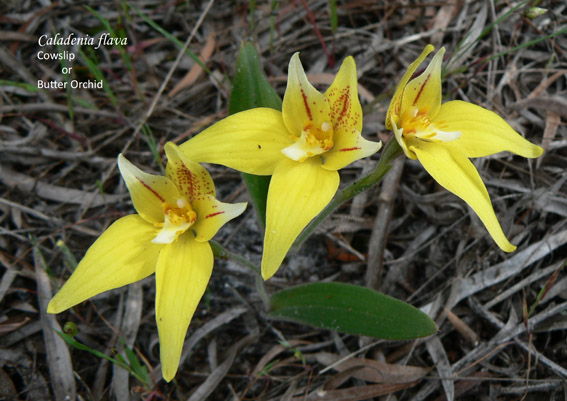
There were four entries this month with two from Western Australia Pauline Meyers’s Caladenia flava and Ros Miller’s Caladenia longicauda sbsp. eminens; one local Greg Sara’s Pheladenia deformis; and one from the Australian Capital Territory, Lorraine Badger’s Cyanicula caerulea. The winner was the Caladenia flava.
If I was to think of an orchid that represents Western Australia it would be hard to choose between the Queen of Sheba and this one.
With its long flowering season (July to December) it is Western Australia’s most common and widespread species; being found in the south west triangle of the state from Kalbarii to Israelite Bay; in habitat as variable as the coastal heathlands through to inland rocky outcrops; from forests to swamp margins. Being so prevalent, it is not surprising that it was amongst one of the first Western Australian orchids collected in September to October, 1791 by the ship-surgeon and naturalist, Archibald Menzies. It was subsequently named in 1810 by Scottish botanist Robert Brown.
C. flava is one of the five species belonging to the subgenus Elevatae. The other four being C. marginata, C. nana, C. reptans (all WA endemics) and C. latifolia which is widespread across southern Australia. All five species have the same characteristic feature of the calli joined together on a raised plate near the base of the labellum. C. flava is distinctively and predominately yellow whereas the others are pink or white.
C. flava has two pollinators, native bees which are lured deceitfully to the non-existent nectar and scarab beetles (Neophyllotocus sp.). As they share the same pollinators, C. flava often hybridizes with C. reptans and C. latifolia, producing very colourful offspring.
Observations have led orchidologists to divide C. flava into 3 subspecies. These differences are based upon floral morphology. but curiously they each have their own separate distribution.
References:
Brown A, et al, 2013 Field Guide to the Orchids of Western Australia
Hopper, SD & Brown, AP 2001b Contributions to Western Australian Orchidology: 2, New taxa and circumscriptions in Caladenia (Spider, Fairy and Dragon Orchids of Western Australia), Nuytsia 14:27–314.
QUESTION: Are there more than one species called Hare Orchid? This one [Leporella fimbriata] looks different from Leptoceras…? Why are they in different genera?
ANSWER:
Originally they were described the genus Caladenia but as the knowledge information increased other genera were created. Thus Leporellafimbriata was put into Eriochilus, as Eriochilusfimbriatus (1882), then Leptocerasfimbriata and finally into its own genus Leporella (A S George 1971). Caladeniamenziesii became Leptoceras menziesii.
This does not answer the why of the question which is about classification but Jones (2006) is helpful when he says:
“Plant classification systems rely on interpreting and measuring the features in one group of plants and comparing these with another group, either seeking difference or similarities. Studies in orchids are usually biased heavily towards features of floral morphology but recent studies have revealed the importance of vegetative features in the roots, stems and leaves. The most successful classification system is one that is balanced and based on a wide range of vegetative and floral features.” To add to this list is the molecular studies being done on orchids.
This means the authors advocating change need to clearly show why a name change and/or a new species is warranted.
For instance, Fitzgerald gives the following reason for not including Leporella fimbriata in the Caladenia genus
“Leaves much more frequently observed than flowers. It is with great reluctance I depart from the naming in ‘Flora Australiensis’ [author Bentham, 1863 – 1878], but I cannot concur with the inclusion of this with Caladenia, and have place it in Lindleys’ Leptoceras for the following reasons: Leaf or leaves not those of Caladenia. In Caladenia I have never seen more than one leaf, always thin and usually hairy; in this plant leaf thick, hard and shining, occasionally two. In Caladenia tubers are generally numerous, in L. fimbriata I have only observed one. The labellum, is without the characteristic glans and is not of the form obtaining in Caladenia, the stigma is very different in form being triangular and deep sunk, the upper parts overhanging, not oval and shallow; and the flowers have the peculiarity of drying and continuing in a state hardly to be distinguished from the fresh flowers long after the seed has been shed. It approaches C. menziesii only (so far as I can see) in having erect linear-clavate petals, in which C. menziesii is itself peculiar, L. firmbriata seems to come near to Eriochilus than to Caladenia but differs from it again” Quoted from Emily Pelloe Western Australian Orchids 1930
Concerning Leptoceras menziesii, Bates & Weber have made the following statement:
“True Caladenias have hairy scapes and hairy leaves. (C. menziesii now believed to belong to a separate genus is glabrous)”.
Even though they are not Caladenia, why not have them in the same genus for both have glabous (without hairs) leaves, more leaves than flowers, erect spathulate (spoon shaped) glandular petals, colony forming, similar distribution.
Leporella fimbriata – note the absence of leaves and the dry sandy conditions [Photo: R Lawrence]Leptoceras menziesii – note the abundance of leaves [Photo: R Lawrence]There are similarities. In fact, Bates (2011) calls them sister genera but despite the similarities there are enough differences to recognise them at genus level at present including “different flowering times, different mycorrhizal fungi associations and different pollination” some of which are detailed in the chart below.
Feature
Leptoceras
Leporella
Pollination Strategy
Strategy unknown
Native Bee
Strategy pseudocopulation
Winged male ants (Myrmecia urens)
Myrmecophyte – lives in mutualistic association with colony of ants
Labellum
Curved white with red stripes
Has calli
Wider than longer, purple and green
Has no calli
Flowering Time
Spring (September to November)
Autumn (March to May)
Habitat
Shaded sites – moist gullies; scrub, heath, woodland and foret
Open sites – acid sands, light scrub, stringybark
Leaf Emergence
Leaves emerge before flowering
Leaves emerge after flowering
Leptoceras menziesii (Hare Orchid or Rabbit Ears Orchid) after a fire, [Photo: R Lawrence]








 NOSSA
NOSSA 