
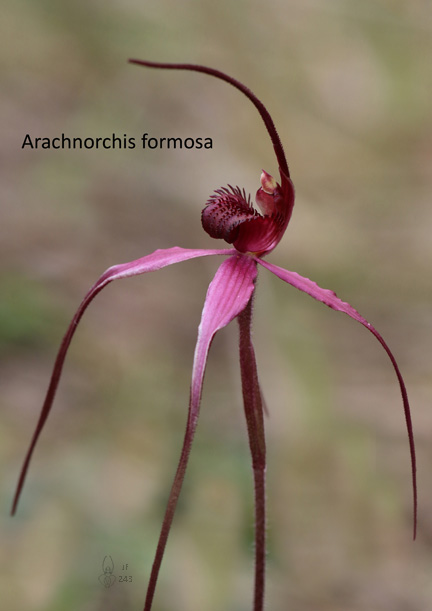
Shane Grave’s winning photograph for April was the spring flowering Caladenia plicata which is endemic to the South West of Western Australia.
Caladenia is a very large genus with over 330 species, 39 of these currently unnamed. In addition, there are 58 named subspecies and varieties. Caladenia plicata would belong under the subgenus Calonema or the segregate genus Arachnorchis which, although not generally recognised by State herbaria is commonly accepted by many amateur enthusiasts. Yet even this subdivision is still large with 192 species. As a result, some authors have created further groups/complexes, for example C. dilatata complex, C. longicauda complex, etc. However, according to Andrew Brown, C. plicata doesn’t seem to fit neatly into any of these categories, although David Jones does include it within the clubbed spider orchids.
Various authors consistently refer to the labellum as being unusual. In Fitzgerald’s formal description (1882) he states that the labellum tip is “recurved so as to become plicate and touch the under surface of the disc”. Plicate means to fold. The labellum tip of many other Arachnorchis species are known to curl under but none fold under in the way that this species does. The sharp fold with the spreading horizontal fringed margins (edges) combined with a central band of tall dense calli (wart-like structures) gives a distinctive shape reminiscence of a crab, hence the common name Crab Lipped Spider Orchid. The effect of this is best seen from a front, rather than a side, view.
The very mobile labellum is sufficient to identify this species, but it is also possible to identify when in bud “due to the prominent short osmophores (clubs) on the sepals”. The sepals narrow halfway along to form thick brown clubs and when the flower is open both the lateral sepals and petals are downswept. This is clearly seen in Shane’s photograph.
Finally, for those interested in pollination, it is pollinated by an undescribed male thynnine wasp of the genus Zeleboria. This has been captured on video https://ars.els-cdn.com/content/image/1-s2.0-S0960982217306310-mmc6.mp4
Thank you to Andrew Brown for assisting me with this article.
References:
Brown A, et al, Field Guide to the Orchids of Western Australia 2013
Brown A, personal communication
Caladenia accessed 24 May 2019
https://en.wikipedia.org/wiki/Caladenia
Caladenia plicata Wikipedia accessed 24 May 2019
https://en.wikipedia.org/wiki/Caladenia_plicata
Haiyang Xu et al Complex Sexual Deception in an Orchid Is Achieved by Co-opting Two Independent Biosynthetic Pathways for Pollinator Attraction 2017
https://www.sciencedirect.com/science/article/pii/S0960982217306310
Jones DL, A Complete Guide to Native Orchids of Australia including the Island Territories 2006
Jones DL, et al, Australian Orchid Genera CD-ROM 2008 CSIRO accessed 24 May 2019
https://www.anbg.gov.au/cpbr/cd-keys/orchidkey/html/genera/Arachnorchis.htm
Pelloe, EH, West Australian Orchids 1930
http://gutenberg.net.au/ebooks04/0400681h.html#page50
Orchids of South-West Australia website
http://chookman.id.au/wp_orchids/?page_id=2424


 NOSSA
NOSSA 