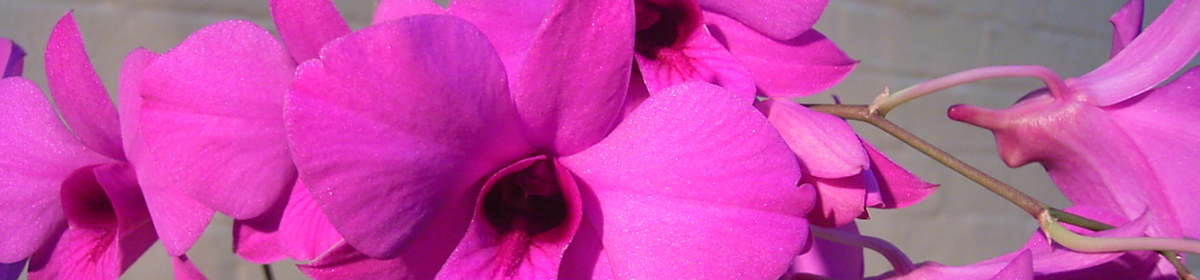
Why can’t I buy that pretty blue orchid? . . . or Purchasing Aussie terrestrial Orchids on the International Market

When noticed, Australian orchids capture people’s imagination and many want to be able to grow them.  As a result we often receive request for where to purchase them, particularly from overseas.  For people overseas we are unable to help them.  Recently I came across some comments from Philip Shin and he has kindly written about his experience with trying to purchase orchids from Australia.  I trust that his experience will help our overseas people understand some of the issues involved.

So let’s hear what he has to say …..


It has been brought to my attention that there have been many requests from international buyers who wish to purchase Native Australian Terrestrial Orchids from Australia. To give you all a basic idea of who I am and why I’m writing this brief article, I will tell you a few things about me.

Firstly, I am an orchid hobbyist just like you all. I live in the United States of America. My love for orchids stemmed from repeated failures of growing bromeliads, (which I eventually learned how to grow), after which my parents had suggested I try growing orchids instead, as they might be easier to cultivate. I took them up on it and for the most part, when it came to many of the more commonly available orchid hybrids, they were right. After a few tries, I managed to not only grow some orchids, but I also was able to bloom them as well! From here, my appreciation for the hobby grew to include species orchids. Then I learned about terrestrial orchids and how people were attempting to cultivate them in their gardens/greenhouses, and that lead to me wanting to grow them too.

Some of the terrestrial orchids that caught my eyes were those pretty little blue flowered orchids in the genus Thelymitra. I was always told that there were “no such things as orchids that were true blue”, but seeing photos of them contradicted that notion, and thus I was intrigued. Then, I started hearing about how some people were attempting to grow them. I thought to myself, “I must have some!” And that was when reality hit hard.

You see, I eventually learned that acquiring Thelymitras through legal channels was quite an endeavour here in America. I had to acquire a permit through our APHIS/USDA (Animal and Plant Health Inspection Service/ United States Department of Agriculture) to import plants from other countries, (specifically, Australia and Europe in the case of Thelymitras and a few other Native Australian Terrestrial Orchids). Of course, there was also paying for the CITES (Convention on International Trade in Endangered Species) permit and phytosanitary certificate in order to have them make it through our US Customs. The difficult part wasn’t necessarily with the USDA permit, but rather paying for the CITES permit and phytosanitary certificate. When Australia was open for export, the fees for CITES permits and phytosanitary certificates were rather high in price, running at about $250 USD per shipment. But shortly after making two orders to be shipped out from Australia, the exportation laws had changed radically! During this time, CITES and phytosanitary paperwork now cost somewhere in the order of $1,000 USD. It was now clear that Australia was no longer in the business of exporting goods from small companies. Which then brings us to the next option, Europe…

Europe had somehow also managed to get a hold of Native Australian Terrestrial Orchids much earlier than America did, but they were still not very prevalent in the hobby.

It then bears the question, “if Native Australian Terrestrial Orchids are already on the market, why aren’t they more prevalent or more popular?” The answer to this question would be, although people have attempted to grow these orchids, they are not necessarily the easiest orchids to grow long term. Some may be easier than others, but they are still a novelty in the hobby, partially because of this. The difficulty lies in that they are plants that have a tight symbiotic relationship with fungi. I’m not sure whether or not the orchids started to develop smaller and smaller root systems because of the symbiosis, but these orchids do tend to have rather negligible amount of roots. This often makes it difficult to cultivate these orchids, because once the roots get damaged for any reason, they pretty much die. Hence, why these orchids are not more prevalent in numbers despite the demand.

In short, this article is an explanation of the difficulties of obtaining Native Australian Terrestrial Orchids. And this is also some insight on how it is trying to obtain these plants here in America. For anyone coming across this article, I appreciate the time and effort it took for you to read through an American hobbyist’s perspective on Native Australian Terrestrial Orchids. Thank you.


Philip Shin

Pots of Thelymitra nuda cultivated by Les Nesbitt
Pots of Thelymitra nuda cultivated by Les Nesbitt in South Australia

Just as a postscript, Philip mentioned that he could grow Diuris or Donkey Orchid “but that it takes quite a bit of trial and error before you can see anything that resembles success.”


Spotted Pink Sun Orchid – Beautiful, but Only a Hybrid

This week, a local radio station introduced a segment with the phrase “our rarest sun orchid” and that it was called Thelymitra irregularis or Spotted Pink Sun Orchid.  However it certainly is not our rarest sun orchid.

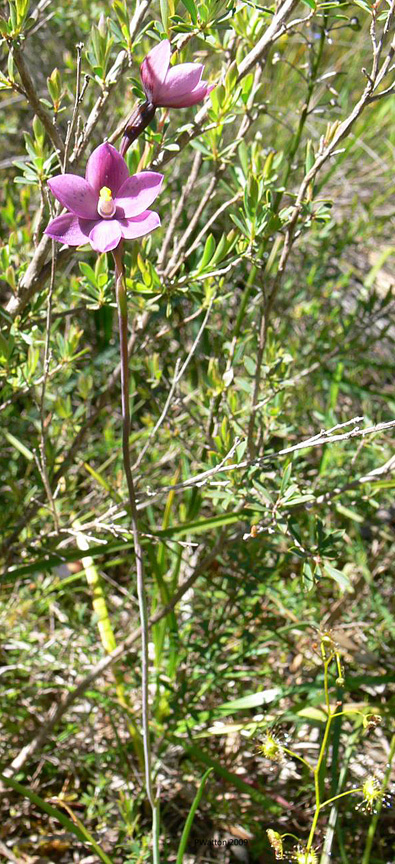
Thelymitra x irregularis is typically a hybrid pink spotted sun orchid
Thelymitra x irregularis,  Peter Watton, 2009

True, it is not common, but that is partly because it is a hybrid and, correctly speaking, the name should be written as Thelymitra x irregularis (the “x” indicates that it is a hybrid).

For a hybrid to occur, the two parent species need to grow in close proximity, the flowers need to open at the same time that the pollinator is visiting flowers, either to collect or to deposit the pollen and, in the case of self pollinating species, before the individual flower has pollinated itself.

The majority of hybrids are sterile, but occasionally some are fertile.  When hybrids occur the majority will only last a few years before disappearing although sometimes colonies are formed which may last for decades.  Hence, it is not usual to name hybrids, but the more common and recurring ones have been named formally.  T. x irregularis is one of them.

Several species of Thelymitra have been proposed as parent species of Thelymitra x irregularis.  Jeanes & Backhouse (2006) give T. ixioides and T. carnea as parents; Weber & Entwisle (1996) and Jones (2006) suggest T. ixioides and T. carnea and/or T. rubra; Bates & Weber (1990) state that in South Australia the parents are T. ixioides and T. rubra, but T. ixioides and T. carnea in the Eastern states; in contrast, Bates (2011) states that in South Australia it is a hybrid between T. juncifolia and T. rubra.  However, without detailed genetic studies or breeding experiments these all remain suggestions.

Due to the transient nature of hybrids and the conditions needed to produce them, the named hybrids are not common, but since the 1890s specimens of Thelymitra x irregularis have been collected in every decade, which suggest that this hybrid readily occurs.  The 71 specimens held in the Australian herbaria have been collected from four states – which gives a good indication of the distribution but not necessarily the frequency of occurrence.  See Australia’s Virtual Herbarium (AVH) for details.  The AVH lists 12 herbarium records for South Australia with specimens collected from the Adelaide Hills, the Barossa Valley, Kangaroo Island and near Naracoorte.

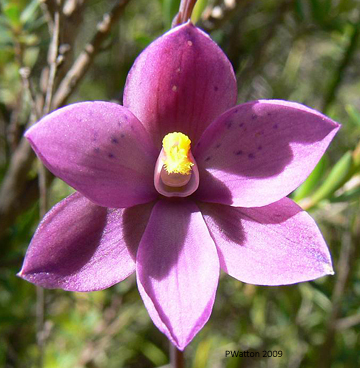
Thelymitra x irregularis
This Thelymitra x irregularis or Pink Spotted Sun Orchid was photographed by Peter Watton in 2009 near Macclesfield, South Australia

The botanical name “irregularis” refers to the description of the column.  With many sun orchids, it is often necessary to observe the column to distinguish one species from another.  In this instance the top of the column is irregularly toothed.  Retired Aussie has some very good photographs with one in particular showing the column detail.


Thanks to Juergan Kellermann, State Herbarium of South Australia for his help with this post.

References

Bates (2011). South Australia’s Native Orchids. DVD-ROM

Bates & Weber (1990). Orchids of South Australia.

Jeanes & Backhouse. Wild Orchids of Victoria, Australia

Jones (2006), Native Orchids of Australia, 2nd edn.

Weber & Entwisle (1996). Thelymitra. In: Flora of Victoria, Vol 3.

Australia’s Virtual Herbarium accessed 24th September 2014


August 2014 Winning Photograph

08 sm CC Caladenia valida

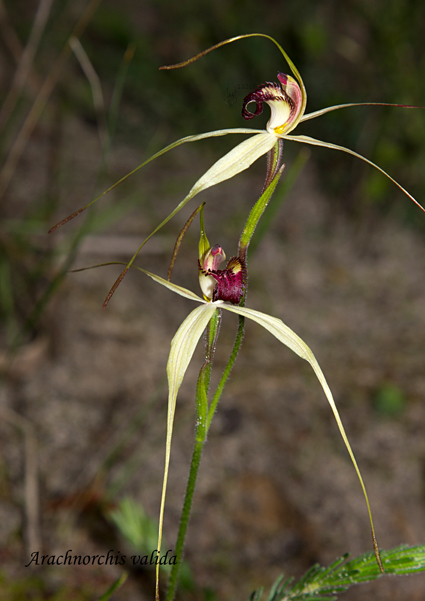
Claire Chesson’s Arachnorchis valida (common name Robust Spider Orchid) was the winning photograph for August.

The name Arachnorchis valida was not validated until 2002; synonym Caladenia valida. Previously it had been included under Caladenia huegelii (a Western Australian species) and Caladenia reticulata.

A. valida grows in sandy or sand over red clay soil, in sheltered clearings within heathy woodland or mallee but within a very restricted and disjunct distribution on Fleurieu Peninsula and Kangaroo Island in South Australia; and Otway Plain, Victoria. Rated Endangered in South Australia, it is not listed nationally.

Although A. valida shares some similar features with A. reticulata (ie 1 to 2 flowers, clubbed sepals, calli on the labellum) it also has quite distinctive features (see chart below) that help to differentiate between the two as they can sometimes be found growing together.

Comparison of A. valida and A. reticulata

Features

A. valida

A. reticulata

Pollinating wasp Phymatothynnus pygidialis Phymatothynnus victor
Leaf Felted Leaf – dense, short hairsSemi erect Very long silky hairs; purplish at the baseErect
Flower Stem Taller – 40 cm, hairy 30 cm, green & purplish red with long silky hairs
Flower Size Though variable, larger – 7 cm 5 cm
Flower Greenish when first opened fading to white or cream as the flower matures Red-brown
Perianth Stiffly spreading – broad based sepals; backswept petalsNo stripes Dorsal sepal erect; perianth spreading downwardRed stripes
Labellum Can be red but without veining Red with veining


NB: November Picture Competition Theme – Orchids and Insects

See the 2014 April Journal for hints of photographing orchid pollinators.

References:

http://www.rbg.vic.gov.au/dbpages/dev/vicflora/index.php/viclist/name/4677 accessed 4th September 2014

Threatened Species Profile Fact Sheet Caladenia valida Department for Environment and Heritage, South Australia

International Plant Name Index – http://www.ipni.org/

Personal communications with Claire Chesson

South Australia’s Native Orchids DVD 2011 Bates

Spider-orchids the Genus Caladenia and it Relatives in Australia CD 2011 Gary Backhouse