When I first joined NOSSA many years ago, I was very much interested in the conservation side of Australian orchids. But over the years I have come to appreciate the growers and their orchid knowledge.
This was quite evident when Dr Heinrich Beyrle, a long time researcher, gave his talk to the October 2025 NOSSA general meeting on orchid mycorrhizal and growing terrestrial orchids. As I listened to his explanation of how the mycorrhiza interacts with the orchid and saw the hybrids that he created, I saw glimpses of how this information relates to conservation.
So one of the things was to consider when out in the field, is the question: am I looking at a variation, a second generation hybrid or a new species?
Growers have the advantage of being able to observe a plant throughout the whole of its life cycle as well as the variations that occur in the same plant or population over several season, a thing that is not so easily observed by those of us visiting several different sites in one season and maybe not being able to get back to them in the next season.
I highly recommend Dr Heinrich’s talk “Orchid Mycorrhizal: From a Gardener’s Perspective” on the NOSSA Youtube channel.
I put together this NOSSA presentation as I thought it would be interesting to understand how orchid distribution is related to geology and evolution. My background is in the oil and gas industry, having studied geology at Flinders University. I am the current President of the Field Geology Club of South Australia. I am also interested in evolution, particularly of marine molluscs. I am the President of the Malacological Society of S.A., member of the Flinders University Paleontology Society and a volunteer in the South Australian Museum in the marine invertebrates department. So I have a good understanding of geology, and a reasonable understanding of evolution, but I had no knowledge of how these two topics relate to orchids. With this in mind, I started my research in ‘A Complete Guide to Native Orchids of Australia’ by David L. Jones, 3rd Edition – Revised, 30 July 2024. This book referred to (Givnish et al.2016) and stated that: • Orchidaceae originated 80 – 120 million years ago (mya). • Originated in Australia 112 mya then migrated to South America via Antarctica.
To further research this topic I had to seek out the scientific literature as there is limited information in general orchid books. My first reference was: ‘Terrestrial Orchids Speciation across the Earth Driven by Global Cooling’, Jamie B. Thompsona,1 , Katie E. Davisb, Harry O. Dodda , Matthew A. Willsa, and Nicholas K. Priesta, Edited by Nils Stenseth, University of Oslo, Oslo, Norway; received February 7, 2021; accepted June 3, 2023.
Charles Darwin proposed that orchids adapted gradually through natural selection to attract different pollinators. It is now known that evolution is not a gradual process but can occur very rapidly at times.
In this study, the analysis of DNA of 1,475 orchidoid taxa produced a phylogeny chart against the geological time scale. It found that global cooling has been responsible for the rapid speciation across Orchidoideae in the last 5 million years.
The study stated that it is not clear how global cooling drives evolution and diversification. A possible explanation is that Milankovitch (orbital) cycles change the exposure to annual solar energy in predictable ways. The relatively short-term oscillations in global temperature occurring during longer- term trends of global cooling.
It was the geologist Reg Sprigg who first noticed the relationship between Milankovitch cycles and the series of ancient barrier shorelines now preserved as sand dunes in the South East of South Australia. The modern Australian coastline has only existed in its present general form since the sea surface attained its current level about 7000 years ago. 22,000 ago, at the height of the Last Glacial Maximum, most of the continental shelf was exposed as dry land. There would have been a larger area of potential habitat for orchids. The global expansion of grasslands which peaked 4 to 8 mya could also have contributed to more recent orchidoid speciation by creating new habitats.
The next paper I looked at was: ‘Tracing the origin and evolution of the orchid family through genes and trees’, release date 22 February 2024. This study presented a new Orchidaceae phylogeny based on DNA sequencing data, covering all 5 subfamilies, 17/22 tribes, 40/49 subtribes, 285/736 genera,1921 of the 29,524 accepted species (7%).
This study’s conclusions were: • Orchidaceae evolution commenced 120 +/- 6Ma (Early Cretaceous). • Ancestral area estimations revealed that the most recent common ancestor of extant orchids originated in Laurasia ~83 Myr ago (+/-10 Ma). This result contradicts the Neotropical-Australian estimation of Givnish et al. (2016). • Highest current diversification (speciation) rate of orchids is Southern Central America (not Southeast Asia).
Leaves of Pyrorchis nigricans (L) with Leporella fimbriata (R)
The next paper I researched was: ‘Evolutionary Relationships and Range Evolution of Greenhood Orchids (Subtribe Pterostylidinae): Insights’ From Plastid Phylogenomics.
Australia’s high rate of endemic species is due to geographic isolation. 110 mya Australia/Antarctica separated from Gondwana. 55 to 35 mya Australia separated from Antarctica.
The study’s conclusions were: • Divergence between Pterostylidinae and the remainder of the tribe occurred in the early Oligocene, 32 mya • Divergence of all major lineages occurred during the Miocene, 15 mya. • Accompanied by increased aridification and seasonality of the Australian continent. • Resulted in strong vegetational changes from rainforest to more open sclerophyllous vegetation. • Greenhood orchids evolved mainly within their ancestral range in eastern Australia, and then moved to South West Australia. • Modern distributions of greenhood orchids in other Australasian regions, such as New Zealand and New Caledonia, are of a more recent origin, resulting from long-distance travel of tiny dust-like seeds over the Pacific Ocean.
On the question of orchid relationship to geology, it is known that orchids are found on a wide range of geological substrates. They include igneous, metaphoric, and sedimentary rock substrates, which in turn influences the soil profile.
3. Caladenia sticta
Looking closely at orchids’ relationship to soil type in the field can be illuminating as to the harsh conditions orchids can thrive in. Large areas of South Australian have soils that are very nutrient poor with a high sand and/or calcareous content. This is often the case on Yorke Peninsula and in the South East of S.A.
Orchids can also become geographically isolated by geological processes as is the case in the Grampians, Victoria.
So in conclusion: • Orchids have been around since the Early Cretaceous (120 mya). • Orchid evolution has not been linear – most orchid species originated over the past 5 million years. • Southern Central America has the highest current diversification (speciation) rate of orchids. • The initial diversification of orchids occurred in Laurasia (now North America in the Late Cretaceous (83 mya). • Global distribution is primarily controlled by temperature and rainfall. • Local distribution is also controlled by the physical, chemical, and biological properties of soil (which is functionally of rock type / geology). • Local distribution is also controlled by geography, (which is function of rock type / geology).
As one of the principle founders of NOSSA back in 1977, Les has worked tirelessly and continuously with cultivation and conservation of our native orchids. It was a delight to see Les’ work recognized earlier this year for his work with the next generation of orchid growers and conservations.
Along with all the others, we too at NOSSA add our congratulations.
Congratulations Les Nesbitt! A true legend and mentor, Les has been awarded Volunteer of the Year 2025 by Catholic Education SA! Since 2014, Les has generously volunteered at Kildare College, inspiring students through hands-on workshops in native orchid ecology and conservation. His work led to the creation of a full tissue culture lab and multiple student wins at the Royal Adelaide Show! Beyond the classroom, Les’s impact includes groundbreaking conservation work with the Native Orchid Society of SA and the development of a germination kit for endangered orchids. Thank you, Les, for your dedication, passion, and for cultivating the next generation of environmental stewards.
Reshared from Gawler Districts Orchid Club Inc. Facebook page
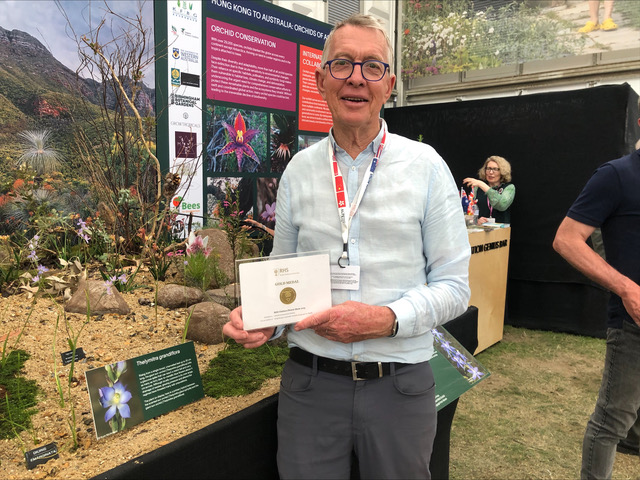
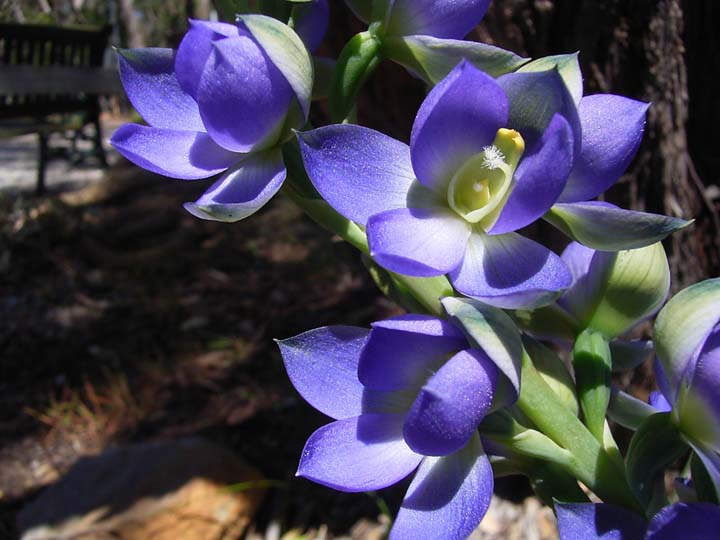
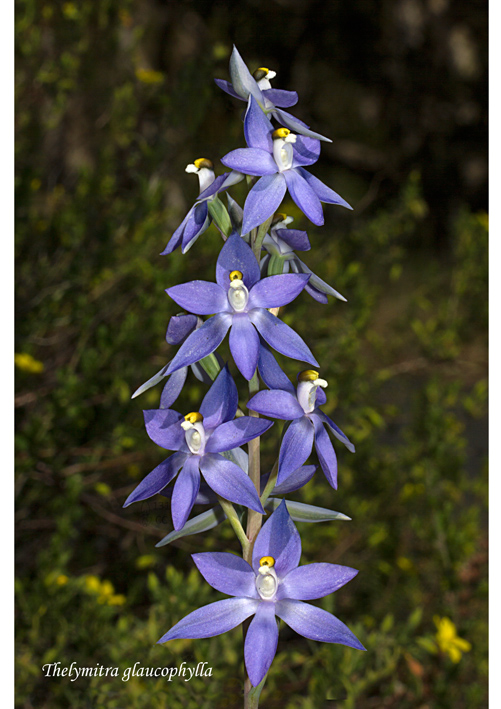
So the news is out – Aussie orchid (as part of a display with South east Asia and the Pacific) wins Gold Medal for conservation at the 2025 Chelsea Flower Show and according to Professor Kingsley Dixon this is the equivalent to winning Gold at the Olympics. One orchid was a hybrid, Thelymitra glaucaphylla x grandiflora.
Professor Kingsley Dixon (Image from Australian Orchid Foundation)
The Chelsea Flower Show is a prestigious event managed by the Royal Horticulture Society (RHS) who’s beginnings start with the presentation of a potato at a 1805 meeting. Over time, various exhibitions were developed with the Flower Show Fete first held at Cheswick in 1827 and moving to Chelsea Hospital in 1913 where it became known as the Chelsea Flower Show. The show was popular with exhibitors but only half of the applicants were accepted that first year. But in that group, McBean Orchids (Britain’s oldest orchid nursery) was one of the fortunate exhibitors and so orchids have always been present at the Show, though they were generally not terrestrial orchids.
Image from Australian Orchid Foundation
To win such an award, the team needed to put together a meticulously curated display to meet the RHS stringent standards; even a wrong font can result in disqualification. But there were other barriers to be overcome. Australian terrestrial orchids are not easy to grow. They require skill and attention to detail. Not many people are able to grow this exquisite orchid. In fact less than 10% of our orchid species are in cultivation. So this was quite an achievement in itself.
Thelymitra grandiflora (Photographer Robert Lawrence)
Over 90% of Australian orchids are unique to Australia with about half considered threatened; and so though T glaucophylla does not have a rating, it is still under threat being uncommon. T grandiflora is rated rare. Both are endemic to similar limited areas in South Australia. That is the Southern Mt Lofty Ranges and the Southern Flinders Ranges. Both are under threat from habitat loss, weed invasion, grazing, trampling, etc. So in-situ conservation is important if these, as well as other orchids, are to survive.
Working toward conservation of Australian orchids is a major pillar of NOSSA and it was encouraging that two of South Australian endemics played a part in this display. Congratulations for the immense effort that Kinsley Dixon and his collaborators have put into bringing orchid conservation awareness to the Chelsea Flower Show and to the world.
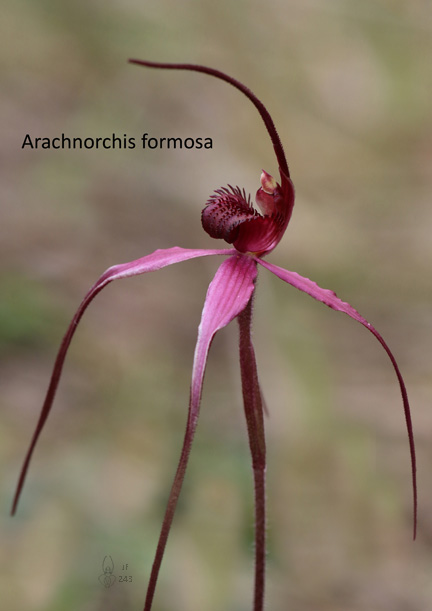
Orchid taxonomy can take some interesting turns. This has just happened to Caladenia haemantha. Based upon the examination of the type specimens collected for C haemantha and C formosa, authors Andrew McDougall & Timothy Hammer have just published an article reinstating C haemantha as C formosa.
Soon after C formosa was described and named in 1991 by GW Carr, David L Jones came along and described and named C haemantha; but in 1993, Mark Clements took a look and listed it as a synonymy of C formosa, where is stayed for many years until 2021 when Jones reinstated it as C haemantha.
But, through the beauty of science, along comes Andrew and Tim to have a closer look at the two type specimens. Meticulously they counted the details and duly documented their findings. Their conclusion – C haemantha is a synonym of C formosa.
To read more of the detail in Swainsona, click on the image below –
From time to time, NOSSA receives overseas requests from individuals wanting to purchase some of our beautiful orchids. Unfortunately, NOSSA does not sell overseas due to the various legal and administrative issues involved. For internationals wanting to buy Australian orchids, go to OrchidWire which is a directory ‘connecting a world of orchids’. On their site is a list of orchid vendors.
Live orchid plants coming into or leaving Australia must be accompanied by an Australian wildlife trade permit.
Permit rules apply, unless the live orchid plants meet permit exemption criteria listed on the back of this card.
This means you need to get a wildlife trade permit before you move your orchids—whether you intend to carry the orchids with you or you plan to send them by post or freight.
Without a permit, you may be breaking the law. You could be liable for significant penalties including seizure of the orchids and fines.
Apply for a wildlife trade permit from the Department of the Environment and Energy at: International wildlife trade
All permit applications are processed as quickly as possible. The timeframe for assessing permit applications varies based on the volume of applications received. Please allow up to 40 business days for your permit application to be processed.
10 Diuris behrii
Permit exemption criteria
Under Australian law, Australian wildlife trade permits are not required for the following:
Orchid seeds, spores and pollen
Orchid seedling or tissue cultures/flasks
Cut flowers of artificially-propagated orchids
Artificially-propagated hybrids of Cymbidium, Dendrobium, Phalaenopsis and Vanda species if they meet all of the following criteria:
All specimens must:
be recognisable as artificially propagated
be healthy with no signs of damage
look uniform in size and shape.
When shipped in a flowering state:
each plant must have at least one fully open flower
plants must be professionally processed for retail sale—i.e. labelled with printed labels or packaging indicating the name of the hybrid and the country of final processing.
When shipped in a non-flowering state:
each container* must have 20 or more plants of the same hybrid type (e.g. V. Kru Chon ‘Dark Knight’)
each shipment must include an invoice or other document that clearly states the number of plants of each hybrid in the shipment.
* ‘Container’ includes cartons, boxes, crates or individual shelves of CC-Containers (Container Centralen or Danish Trolley).
For the June Native Orchid Society of South Australia’s meeting we were privelaged to have June Niejalke speak to our members about how to use photostacking when photographing our beautiful orchids.
Photographing our exquisite orchids is a challenge due to their size and the need to use macro. Sharp focus seems to elude many of us and for many years, we have admired her sharp images that has enabled us to see the hidden details of these tiny bush gems.
It was a pleasure to listen to her share her photographic methods. I hope you too find this video as helpful as those who were at the meeting found it.
The Native Orchid Society is involved in many different activities, one of them being to assist researchers. In 2020, Covid 19 struck bringing many university projects to a halt. But in South Australia, NOSSA members were able to help PhD candidate Alex Thomsen, University of New South Wales, set up her project titled Impacts of Changing Fire Seasons on Orchids. The following video is her brief presentation of her planned research that she gave to the general membership at the September meeting.
The following two articles are from the December 2019 NOSSA Journal. Written by Les Nesbitt, they cover the months of December and January.
Terrestrial Culture – December
A few late orchids such as Diuris drummondii may still have green leaves and flowers so will need watering every couple of days. Most terrestrials will have died down by now on the Adelaide Plain. Watering consists of a quick squirt with the hose once a week to moisten the top 1 cm to prevent tubers shrivelling. A small terrestrial collection of pots can be moved to a cooler place out of direct sun under a bench or to the south side of the house. A large collection must stay on the benches so extra shadecloth is added for the summer.
Repotting is in full swing now. Keep a stock of the required materials on hand including sand, soil, native potting mix, clay, blood & bone, chopped sheoak needles, smashed and sieved gum leaves pots labels, shadecloth squares for crocking, pencils to write on plastic, sieve and bowl, watering can & shadehouse benching. A system for washing and sterilizing pots before reuse is essential to control disease and virus.
Pots dry out quickly in hot windy weather. Water a day or two before repotting so that the potting mix is just moist. If too dry dust will be a problem and tubers can be damaged by hard lumps of mix. Too wet and the mix sticks to the tubers and clogs the sieve. The ideal is a mix that is easy to work when separating wet pots take tubers from mix. It helps to move some pots under cover in case of rain. Wet pots take several days to dry out which can hold up repotting. Alternatively, a sheet of plastic over the pots when rain is forecast will shed the water but remember to weigh it down with bricks or it will blow away.
Pick out the tubers and put them in a kitchen sieve sitting in a container of water. Use a jet of water to wash the tubers clean and spread them on a towel to dry. Discard any tubers that are soft or have turned black. If the tubers are healthy, firm and a pale colour the mix can be reused. Colony type tubers should have at least doubled in number since last year. Add half fresh mix to the old mix and add a big pinch of blood & bone fertilizer. Should the old mix be dark in colour, or the tubers not be healthy looking then throw out the old mix and pot up in new mix.
Select the pot size, place a shadecloth square in the pot to retain the mix when it dries out. Fill the pot with mix to about 2cm from the top. Select the largest tubers for a show pot and push them into the mix with the shoot on top. The small tubers can be potted in another pot to grow bigger next year. Cover the tubers with more mix and almost fill the pot. Firm the mix down with your hand or use the bottom of an empty pot. Cover the surface with chopped sheoak needles. Write out a label with the name of the orchid and the provenance, if known. On the back of the label note the number of tubers and the date planted. Water the pot gently so as to not disturb the needles. This helps settle the soil around the tubers and makes subsequent watering easier. Put the finished pots back in the shadehouse to await the next growing season.
Send off your tuber bank order before Christmas or you might miss out on your choices. The tuber bank is a great way to increase your terrestrial collection.*
*Tubers are sold only to financial members
Terrestrial Culture – January
Start watering the blue tag pots in January. Pots of orchids from the East Coast of Australia where it rains in Summer are given a blue tag as the culture is different compared to local terrestrial orchids. This early shooting group includes most cauline greenhoods, Pterostylis baptistii and Corybas hispidus. Local South Australian tubers can be kept completely dry until at least mid-February if pots are shaded.
When your tuber bank order arrives, pot up the tubers straight away. Plant each species in a separate 125mm or 150mm pot. Don’t forget to record the provenance name (if known) on the label and in your recording system. The provenance is the location of the original collection. Provenance is important because in 10 years the orchid will possibly be extinct in that area as suburbia expands or weeds take over the habitat.
Summer watering is important. Too little and tubers may dry up. Too much and they may rot or come up early before the heat of summer is over when they will be attacked by thrip and aphids. A light sprinkle on top of the pots once a week works OK.
Try to finish repotting this month. If left until February there is more chance of breaking off the new shoots which can be well developed by late February.
Though a bit behind time, but for completeness, Les Nesbitt’s culture notes for November 2019 from the November 2019 NOSSA Journal are reproduced below.
After the first week in November, pots dry quickly and it is hard to keep pots moist. Water green leaves, let the others dry off as plants die down. Late species in flower this month are Diuris drummondii, rufa group Pterosylis & Microtis. Seed pods ripen quickly now, so check every couple of days.
Repotting can start at month’s end although Dec – Jan is the ideal time if there are only a few pots needing to be done. Repot orchids with large tubers first as they are more prone to rotting if there is prolonged hot wet weather this month. We usually get at least one thunderstorm before Xmas. Until the old tuber has completely dried up it can go mouldy and infect the new tuber alongside. This especially applies to the slow multipliers such as Diuris and Thelymitra that have large tubers.
Gather potting mix materials and pots ready for the summer activities as this growing season comes to an end.
TYPES OF POTTING MIXES
Terrestrial growers all have their favourite mix that works for them. Some recipes are:
~ Half premium native potting mix and half sand. ~ Sand, buzzer chips, mountain soil (see ANOS cultivation booklet). ~ 50% sand, 20% Hills soil, 30% organic matter ( seed & cutting mix, native potting mix, smashed gum leaves). ~ Eco terrestrial mix (fine composted pine bark) and perlite.
Some species require adjustments to the mix for optiumum results. Caladenia like more sand, Diuris & Pt nutans 30% clay, Acianthus pusillus more organic matter. The mix must be free draining in Winter yet retain moisture in Autumn and Spring. Most growers reuse some of the old mix, (up to 50%) to which new ingredients are added at repotting time. The reason for this is to carry over any fungus in the old mix. Add a little blood & bone fertilizer and native slow release pellets. Most of the orchids in cultivation prefer a slightly acid soil mix.
Locate a source of Casuarina trees in your area and collect the fallen needles. These trees grow all over Adelaide. Chop the needles into lengths of 1 – 5 cms and store in a dry place.
POTS
The ideal size pots for terrestrials seem to be 125mm & 150mm standard pots that are about 150mm deep. Smaller diameter pots dry out quickly and it is difficult to keep the mix moist in Spring. Shallow clay pans can be used for specimen show pots.
November is a good month to flask seed of Diuris for planting out next autumn. Terrestrial seed can be sown in flasks at any time of year but some months are better than others to match tuber development in flask with optimal deflasking in April.









 NOSSA
NOSSA 