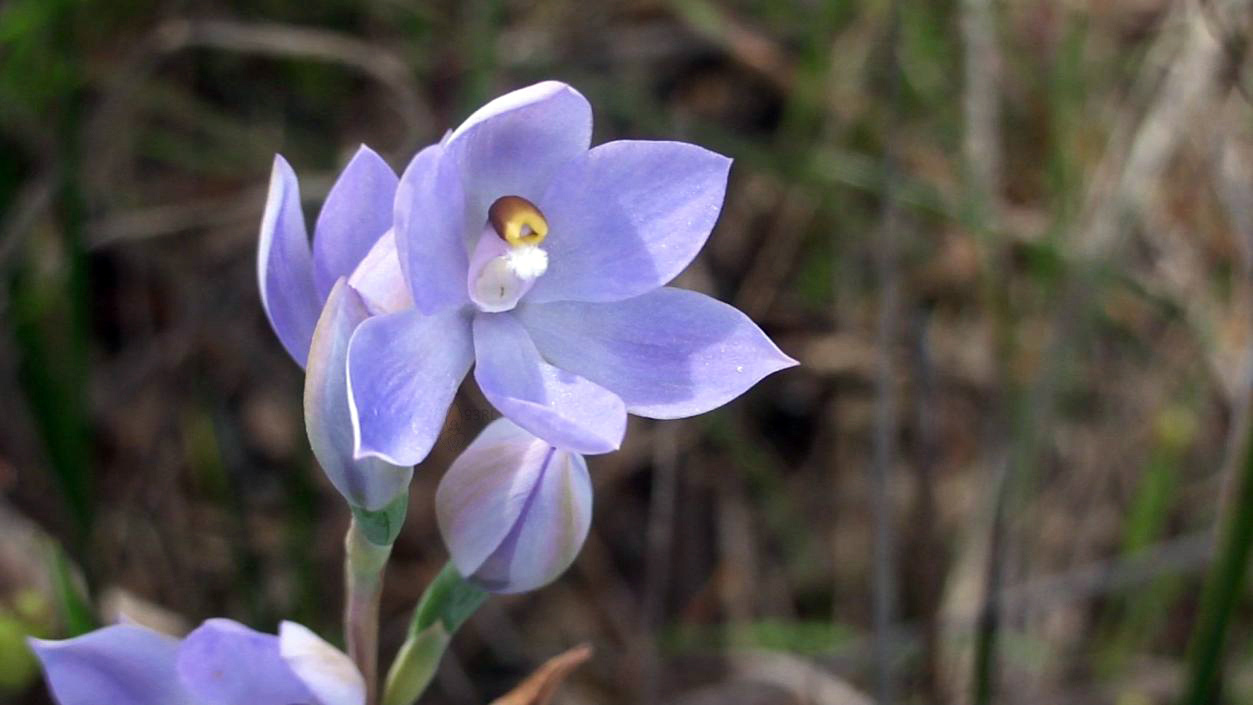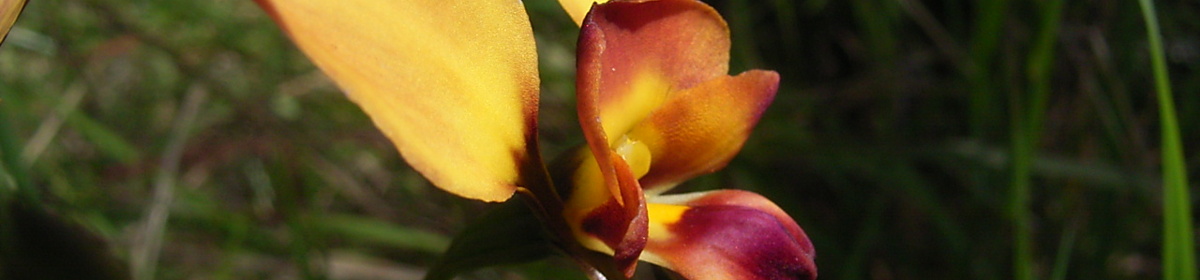
From Humble Potato to South Aussie Grand  Orchids: Gold at Chelsea

So the news is out – Aussie orchid (as part of a display with South east Asia and the Pacific) wins Gold Medal for conservation at the 2025 Chelsea Flower Show and according to Professor Kingsley Dixon this is the equivalent to winning Gold at the Olympics. One orchid was a hybrid, Thelymitra glaucaphylla x grandiflora.
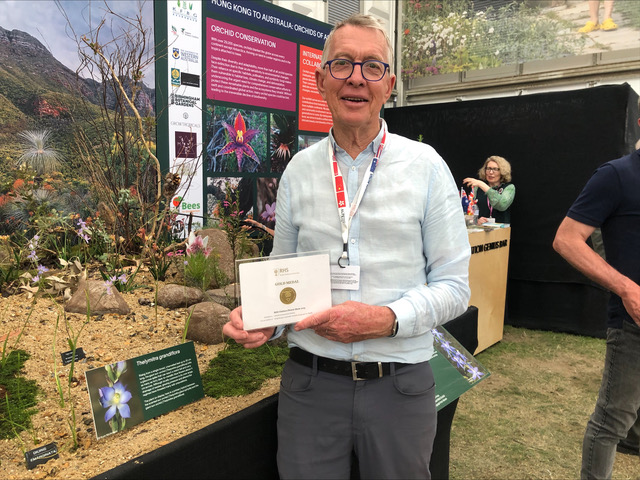
Professor Kingsley Dixon (Image from Australian Orchid Foundation)

The Chelsea Flower Show is a prestigious event managed by the Royal Horticulture Society (RHS) who’s beginnings start with the presentation of a potato at a 1805 meeting. Over time, various exhibitions were developed with the Flower Show Fete first held at Cheswick in 1827 and moving to Chelsea Hospital in 1913  where it became known as the Chelsea Flower Show. The show was popular with exhibitors but only half of the applicants were accepted that first year. But in that group, McBean Orchids (Britain’s oldest orchid nursery) was one of the fortunate exhibitors and so orchids have always been present at the Show, though they were generally not terrestrial orchids.

Image from Australian Orchid Foundation

To win such an award, the team needed to put together a meticulously curated display to meet the RHS stringent standards; even a wrong font can result in disqualification. But there were other barriers to be overcome. Australian terrestrial orchids are not easy to grow. They require skill and attention to detail. Not many people are able to grow this exquisite orchid. In fact less than 10% of our orchid species are in cultivation. So this was quite an achievement in itself.
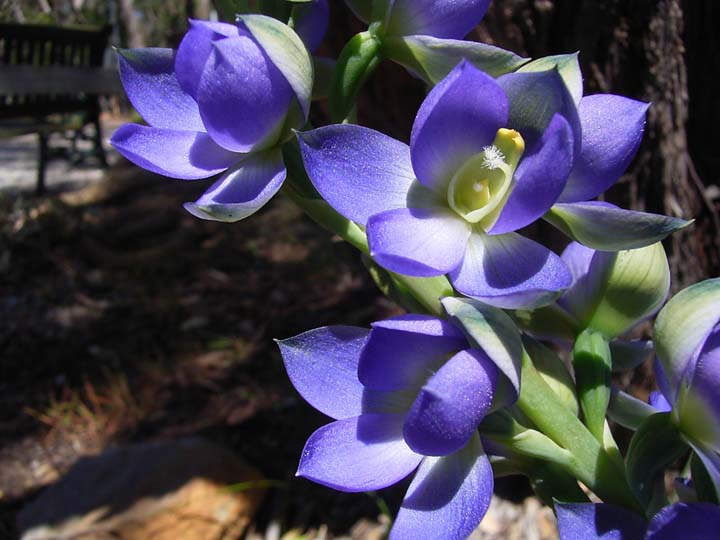
Thelymitra grandiflora (Photographer Robert Lawrence)

Over 90% of Australian orchids are unique to Australia with about half considered threatened;  and so though T glaucophylla does not have a rating, it is still under threat being uncommon. T grandiflora is rated rare. Both are endemic to similar limited areas in South Australia. That is the Southern Mt Lofty Ranges and the Southern Flinders Ranges. Both are under threat from habitat loss, weed invasion, grazing, trampling, etc.  So in-situ conservation is important if these, as well as other orchids, are to survive. 

Working toward conservation of Australian orchids is a major pillar of NOSSA and it was encouraging that two of South Australian endemics played a part in this display. Congratulations for the immense effort that Kinsley Dixon and his collaborators have put into bringing orchid conservation awareness to the Chelsea Flower Show and to the world.
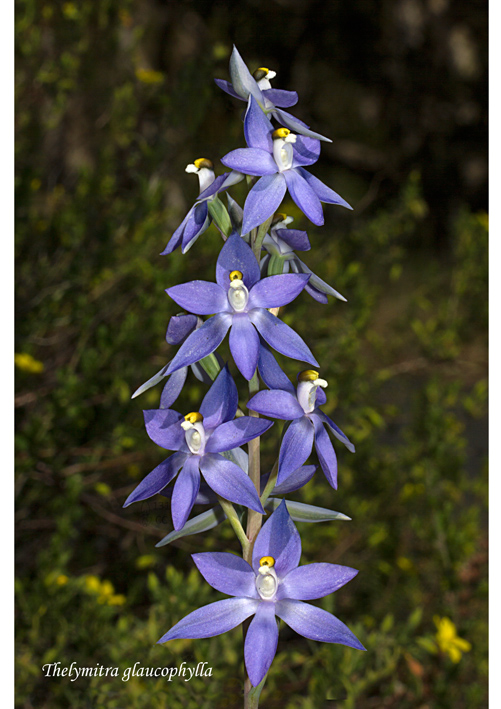
Thelymitra glaucophylla Photographer Claire Chesson

References

History of Chelsea Flower Show
https://www.rhs.org.uk/digital-collections/making-chelsea

McBean Nursery
https://www.mcbeansorchids.com/about-us/

Niejalke June, Native Orchids of South Australia 2022

ABC Aussie Orchid Turns Heads at London’s Prestigious Chelsea Flower Show
https://www.abc.net.au/news/2025-05-23/charles-and-camilla-view-aussie-orchid-at-chelsea-flower-show/105326104

Thelymitra – Atlas of Living Australia
https://bie.ala.org.au/species/https://id.biodiversity.org.au/taxon/apni/51414292#

https://bie.ala.org.au/species/https://id.biodiversity.org.au/taxon/apni/51631246#overview

https://bie.ala.org.au/species/https://id.biodiversity.org.au/taxon/apni/51414288

List of orchids in the display

https://www.bhg.com.au/garden/garden-tours/australian-orchid-at-chelsea-flower-show/

https://www.instagram.com/p/DJ6hGOnINCm/?img_index=1


Links Accessed on 24 May 2025

Thelymitra Column Features Part Two

This article is a completion of the Thelymitra Column article which appeared in the NOSSA Journal, Volume 42 No 8 September 2018. Click here for Part One.

The first part looked at the features and terms used by botanists to describe various parts of the column, a major identification feature of the sun orchids.

And as previously stated we cannot physically dissect an individual flower, but we can make use of photographs to spot the various features.

The diagram below is that of T. nuda (based on the taxonomy of 1984) column whilst the photographs are that of T. glaucophylla column (as T. glaucophylla is one of the T. nuda complex). The column of these two are similar.


2015 February Winning Photograph

02 CC Thelymitra glaucophylla sm

The number of photographs may have been few but the quality was present. The clear winner was Claire Chesson’s Thelymitra glaucophylla (Glaucous Leaf Sun Orchid). Flowering from October to December, this endemic grassy woodland species of the ranges was only published in 2013 by Jeff Jeanes in the Mulleria 31:3 – 30 (2013) but it had been recognized much earlier by Bob Bates and has appeared with this name in his electronic Orchids of South Australia since 2005. It belongs to the T. nuda complex, of which there are 15 species, six of them having only been published in 2013. This complex is characterised by having large scented blue multiple flowers that open freely.

Not seen in this picture is the leaf and though the leaf is highly variable – 10-50cm long, 8-20mm wide, erect and short, long and flaccid, Jeanes mentions that T. glaucophylla “can be identified with a high degree of confidence from the mature leaves alone” (Page 4 Vol 31, 2013 Mulleria). The main features of the leaf are grey-green glaucous ie white bloom and is often senescent (withered) at anthesis (full flowered). Of the T. nuda complex, T. megcalyptra is the most similar but its leaf is never glaucous and has a red base, as well as an earlier flowering time and habitat of plains and rock outcrops.

For more details on the other orchids in the T. nuda group see the post titled Those Blue Orchids Again … posted 30th January 2015 with the link to Jeanes article in the Muelleria

Those Blue Orchids Again …

Volume 31, 2013 of the Muelleria contains an orchid article by Jeffery A Jeanes. The title may be long – An overview of the Thelymitra nuda (Orchidaceae) complex in Australia including the description of six new species – but the subject is of interest to all of us who want to know our sun orchids, many of which are not always easy to identify.

By way of introduction, Muelleria is the Royal Botanic Gardens of Melbourne official research journal and has been published since 1955.

Though a technical article there is much to be gleaned for the ordinary reader, for instance the article contains a good description of the commonly used terms for describing the column for example stigma, trichomes, anther, post anther lobe, etc. This is helpful to know as the column structure is often the main feature of the plant used to identify the individual species. Naturally the key features of the T. nuda complex are covered comprehensively, as well as a brief discussion of the taxonomic history.

Another helpful section is the dichotomous key for all fifteen species described in the article. Of the fifteen species four are found in South Australia and are pictured below.  But to discover more read the article ……

Thelymitra nuda
Thelymitra nuda

T megcalyptra130927
Thelymitra megcalyptra

Thelymitra glaucophylla photographed by Robert Bates

Thelymitra alcockiae