Here in South Australia, it is very common to see a covering of She Oak needles (Allocasuarina sp.) on pots of terrestrial orchids. According to Les Nesbitt, NOSSA founding member and experienced terrestrial orchid grower, there are four reasons for this
It keeps the leaves up off the soil.
Provides good air circulation
Helps prevent leaf rot.
It provides nutrients to the fungi
This is very important for the fungi dependent orchids.
It stops pitting into the soil when it rains.
This is most likely to occur when pots are under the drip line of a shade-cloth.
Pitting exposes the root system.
It allows the leaves to readily come through because of its small diameters.
Other mulches, such as gum leaves, smother seedlings.
She Oak needles are the choice of mulch because it is
Long lasting and takes more than year to break down
which means that it lasts the whole growing season.
Does not become mushy or spongy
unlike pine needles and grass cuttings which breakdown more quickly into a wet soggy mass and contribute to leaf rot.
It should be noted that it is necessary to replace this mulch yearly.
These two pots were in the same area under the shadecloth. Notice the rain damage to the pot without the mulch.
Western Australia produces a lovely array of orchids and so it is not surprising to find in NOSSA photograph competitions that when a Western Australian species is entered it can often be the winner. This month was no different with Pauline Myers beautiful picture of a mass of Diuris hazeliae which was kindly identified by Andrew Brown.
This species has only recently been named in 2013 and as a result finding information was a challenge. Obviously there was no information in Jones Native Orchids of Australia (2006); and surprisingly the definitive Field guide to the Orchids of Western Australia (2013) A Brown et al did not appear to have any information.
But
the Western Australian Herbarium’s FloraBase (Western Australian Flora), has a map of distribution which is roughly a diagonal line from east of Geraldton to the north of Esperance. It is not listed as threatened.
Distribution of Diuris hazeliae. Map taken from the Western Australian Flora Base
the Western Australian Herbarium lists the species as one of 59 new taxa added to their plant census in 2014.
from the Atlas of Living Australia it can be deduced that the flowering time is mainly August and September and is likely to be found in various types of shrublands margins including Eucalypt and mallee woodlands and appears to be mainly associated with rocky or granite outcrops.
and the National Species List APNI/APC yields the information that it was named after Hazel King, plant collector and conservationist with a special interest in orchids and was previously known by the phrase name Diuris ‘northern granite’ with a common name of Rosy-cheeked Donkey Orchid. It was found in a granite outcrop on her property Tampu (north of Beacon).
Fortunately Andrew Brown was able to help with extra information. It is listed in his book (page 212) but under the phrase name Diuris sp. Eastern Wheatbelt (Yellow Granite Donkey Orchid). Diuris sp. Northern Granite was found to be the same species and so the use of that name was discontinued but it does remain a synonym for Diuris hazeliae.
The following description is information updated from his book “Field Guide to the Orchids of Western Australia”
Diuris hazeliae D.L. Jones & C.J. French (yellow granite donkey orchid)
Flowering: August to September.
Description:
A common, inland donkey orchid 100 to 300 mm high with two to three basal leaves 50 to 150 mm long by 5 to 10 mm wide and up to seven predominantly yellow, brown marked flowers 20 to 40 mm across. Flowers are characterised by their broad petals, very broad dorsal sepal, narrow, reflexed, usually crossed lateral sepals and tri-lobed labellum with broad, spreading lateral lobes and a broad, flattened to convex mid lobe.
Distributionand habitat:
Found between Mullewa, Salmon Gums and Balladonia, growing in shallow soil pockets on granite outcrops and along drainage lines below rocky breakaways.
Notes:
Named in 2013 from specimens collected at Tampu, north of Beacon in September 1997. The species often forms very large colonies on granite outcrops.
Distinctive features:
Inland granite and breakaway habitat.
Very broad dorsal sepal.
Diuris hazeliae is part of the Diuris corymbosa complex of which, in 2013, there were only 10 of the 26 Western Australian species formally named. This situation has now changed with 14 now formally named. As a final word, Diuris orientis is South Australia’s only member of this complex.
This week’s post is taking a brief look at a paper by Noushka Reiter, Mark Clements and Kate Vlcek which appeared in Muelleria, Volume 31: 69 – 76, 2013.
Titled “An examination of Pterostylis xerophila (Orchidaceae) and the confirmation of P. lingua as a new species in Victoria” this paper seeks to ascertain whether the records collected are correctly identified, that there are differences between them both in morphology and associated vegetation.
Both P. xerophila and P. lingua are found in South Australia where they are known, respectively, by the synonyms Oligochaetochilus xerophilus and O. linguus. In fact the type specimen for O. xerophilus is from South Australia.
In the introduction, the authors give a detailed description of Oligochaetochilus otherwise known as the ‘rufa group’ which differs from Pterostylis, in the strict sense, in several features. Some of the main features of this group are:
Basal rosette of overlapping stemless leaves
Leaves senesced, withered and died, by flowering
Erect multi-flowered
Flowers
Lateral sepals
hang down
basal half joined
tips become long and threadlike
Labellum
is very mobile
has obvious long white hairs and often short hairs as well
Typical of the rufus hood, this Oligochaetochilus arenicola shows the sencesing leaves, pendent petals and hairs on the labellum. Photographer: H Lawrence
Later in the articles, the differences between the two species are discussed. There is much of interest concerning the two species but one outcome of the research was to establish that P. lingua (O. linguus) had been incorrectly identified in the records and by correcting the names of the specimens the authors were able to confirm that it did occur in Victoria.
To find the answer to the authors other questions, read the paper
And for those that need a glossary of the terminology used, click here
For images of P. xerophila (O. xerophilus) click here
In 1983, Ron Robjohns, NOSSA’s first treasurer, wrote a comprehensive series of articles about growing epiphytes in South Australia. Thirty years on Ron’s information for growing is still helpful and applicable for today. Any updates or extra information are in black text.
NATIVE ORCHID SOCIETY OF SOUTH AUSTRALIA JOURNAL Volume 7, No. 3, April, 1983
GROWING EPIPHYTIC ORCHIDS IN SOUTH AUSTRALIA – R.T. Robjohns
Dendrobium kingianum (Pink Rock Lily)
This is possibly the best known and most variable of our native epiphytic orchids. Its range is along the coastal strip from the Hunter River in New South Wales to Rockhampton in Queensland. While it is principally a lithophyte and found growing in large mats on exposed rock faces, it is also found in shady gullies and on trees.
It has three to six lanceolate leaves up to 13 cm long on stems varying from slender stems, pseudo bulbous only at the base, to short stout pseudo-bulbous stems. The pseudobulbs are usually 8 to 10 cm long with some up to 30 cm in length; the colour varying from pale green to dark reddish green. One to three racemes of up to twelve flowers, often fragrant, are borne from the top of the pseudobulbs, the colour, while commonly pink, varies from white to purple. They are up to 25 mm in diameter having the labellum usually spotted and blotched with mauve. The flowering season is August to November.
It can be grown on slabs or trees (e.g. Jacaranda or Melaleuca) but locally, best results are obtained from pot culture – rafts or hanging baskets, using an open mix. Some growers use a commercial cymbidium mixture.
I have had good results by lining wire baskets with a thick layer of live spagnum moss and filling them with small pieces of seasoned pine bark and charcoal. I find that the plant not only grows up but also out of the sides of the basket.
Some shade is required in our summer I have had success using 50% shadecloth. Protection from our winter frosts is also necessary. Fertilise lightly in the growing season using commercial fertilisers at half strength.
Being hardy it is well suited to cultivation and hybridisation. D. x delicatum is a natural hybrid of D. speciosum and D. kingianum, also D. x suffusum is a natural hybrid of D. gracilicaule and D. kingianum.
A number of man-made hybrids are available. Some of the best known are D. Bardo Rose (D. kingianum x D. falcorostrum). D. Ella Victoria Leaney (D. kingianum x D. tetragonum), all of which respond well to pot culture and flower freely.*
Propagation is either by division or cultivation of “keikies”.
Australia has some of the most varied, if not the most varied, terrestrial orchids. This variety is reflected in the words used in their commons names – spiders, hoods, moose, cowslip, mosquito, comb, fingers, fairies, bearded, ant, bird, frog, helmet, midge, shell, donkey, bulldogs, parsons, bunnies, daddy long-legs, hare, rabbit, onion, leek, gremlin, duck. This list is from words used for describing just the South Australian orchids. The other states particularly Western Australia have even more common descriptive names!
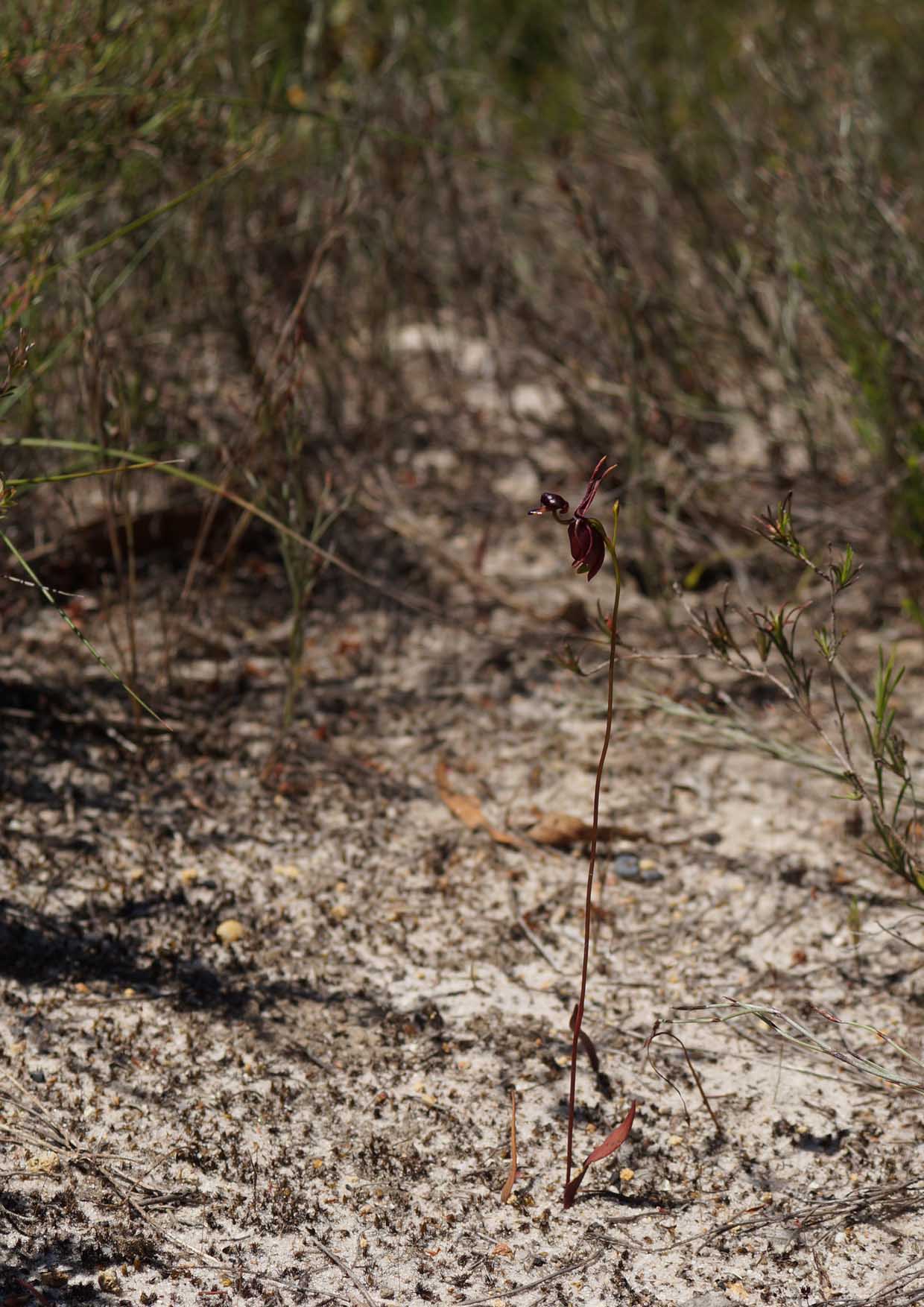
With such a variety is there a favourite one? From the searches and questions that come to this site, it would have to be the Flying Duck Orchid. This orchid never fails to amaze people with its resemblance to a duck in full flight.
It was no surprise than to discover that the winner for the Australian Orchid Foundation 2014 Essay titled Our Favourite Orchid featured the Flying Duck Orchid.
And just a reminder, it is only ever found in the wild. No-one has ever been able to grow one and it cannot be bought or sold! But so that we can all enjoy them, here is a short video clip …..
Ducks in full flightTo get an idea of the size of this superb orchid, bring this image up to A4 paper size
Despite having five very different but high quality photographs, Helen Lawrence’s photograph of Calochilus cupreus (Aldinga Bearded Orchid) was the clear winner with the vast majority of votes.
In South Australia it is considered endemic and endangered. Researching it was interesting. For instance, there is no mention of it in Jones extensive book (2006) yet it was named by R S Rogers in 1918 with a description appearing in Black’s Flora of South Australia (1922 edition), including a drawing by Rosa Fiveash. Between then and now there was a shift. In the Third edition of Black’s (1978) C. cupreus is absent but C. campestris present. In Bates and Weber 1990 the authors describe C. campetris (C. cupreus). Currently, the eflora of South Australia (the electronic version of 1986 Flora of South Australia) considers it a synonym of C. campestris. This is reflected in the Census.
It would appear that as C. campestris was studied and its variations documented (e.g. article by Jones 1976 Orchadian 5:83) the distinction with C. cupreus was lost. Clements and Jones (2006) state “Calochilus cupreus R.S.Rogers = Calochilus campestris” which means that they are not using C. cupreus. But in Jones’ book an anomaly occurs – he does not include South Australia in the distribution of C. campestris and as result Bates, from 2008, states that it is not recognized as occurring in South Australia.
Though C. cupreus disappeared from the literature the name still continued to be discussed amongst orchid enthusiasts. So when in 1995 NOSSA members found a distinctively different colony at Aldinga they identified it as Rogers’ C. cupreus.
Below is a chart, based upon Dr Rogers’ description, of some of the differences that made him consider C. cupreus a separate species:
C. cupreus
C. campestris
C. robertsonii
Shorter leaf
Rather rigid or fleshy erect triangular section
Longer leaf
Crescentic section
Longer leaf
Crescentic section
Base of labellum oblong glabrous (without hairs) with several raised longitudinal line
Base of labellum round thickened, smooth no raised longitudinal lines
In 1983, Ron Robjohns, NOSSA’s first treasurer, wrote a comprehensive series of articles about growing epiphytes in South Australia. Thirty years on Ron’s information for growing is still helpful and applicable for today. Any updates or extra information are in black text.
NATIVE ORCHID SOCIETY OF SOUTH AUSTRALIA JOURNAL
Volume 7, No. 3, April, 1983
GROWING EPIPHYTIC ORCHIDS IN SOUTH AUSTRALIA – R.T. Robjohns
Epiphytes usually grow where there is plenty of air movement, ample light but also shade and to achieve this they are frequently found well above the ground storey in the forest from where, should they be dislodged from their host and fall to the forest floor they wither and die. With most plants the roots grow downwards, however, with epiphytes in their natural habitat, the roots may grow up, down or around their host, that is, in any direction in search of suitable conditions.
As a novice grower I urge you to learn all you can about the natural habitat of the plant and its principal host, bearing in mind that in accounts of plants that grow on rock faces, often they are growing with their roots in crevices into which any moisture drains and maybe in an accumulation of leaf litter. Frequently the rocks on which the lithophytic orchids grow are sandstone – a rock which can absorb moisture and consequently keeps cool longer than most other rocks. “In an exposed situation” should not be construed as being in full sun all of the time: usually they receive some shade.
With the possible exception of Cymbidium canaliculatum few epiphytes grow at their best in full sun in nature. Full sun in the hot dry South Australian summer will usually burn off the plants or at the best cause severe yellowing and loss of leaves. It is to be noted that this State has no native epiphytic orchids.
Most Australian epiphytic orchids grow in the coastal belt of northern New South Wales and Queensland where the average rainfall in their DRY season is much the same as the Adelaide winter or WET season with which it coincides, consequently advice that plants require to dry out during the winter should not be taken to the extreme and the plants left without water.
The three principal requirements of epiphytes are a free air circulation, a semi-shaded position and free drainage.
In South Australia epiphytes are grown in two ways, the most popular being pot culture and the other slab culture.
For pot culture the medium must be a free draining one and a mixture of “aged” pinebark, scoria and charcoal is quite effective.
Note 2015 – Today the potting media used is composted pine bark. Charcoal is not used and scoria can get cold and wet in winter.
In choosing material for slab culture consider the conditions under which you intend to grow the plants. For humid conditions cork is ideal while tree fern, which holds moisture longer, is good for dry conditions, although any of our native trees with papery or corky bark is suitable. Perhaps you would wish to attach the plants directly to trees in your garden, for this purpose try Jacaranda, Melaleuca or trees with a similar bark.
Watering is important, slab culture requires more watering than pot culture and in summer water orchids on slabs at least every second day and every-day during a hot spell. Water according to the weather and watch for signs of stress – in wintertime the rain is usually sufficient.
Fertilising is best done using half of the recommended strength of commercial proprietary fertilisers.
As a last general recommendation – beware of frosts. Last year (1982) the frosts in some areas of Adelaide caused severe losses amongst plants of epiphytic native orchids. Large tubs of D*. speciosum, whose thick leathery leaves I mistakenly thought frost resistant, were reduced to a mass of leafless canes; even baskets of D. kingianum hanging three feet below the 50% shadecloth had all of the leaves burnt off. These were but two of the varieties which suffered, so be warned and ensure that your plants are protected from frosts.
This series ends with Dr John Pearn’s summary below.
Enduring memorials
Scientific names of living things will be used as long as scientists find it useful to do so. Names change as taxonomists revise plant groupings and there is a proposal to dispense with scientific names, in favour of an alternative system called the PhyloCode.
In the past, the doctrine of signatures linked the forms of plants with their supposed therapeutic uses. But the world of binomial nomenclature (which Linnaeus introduced in 1753), allows for the most fitting memorials in medicine and botany. In the scientific names of Australian orchids, the lives of many doctors and botanists endure.
Though this series has been divided into 20 parts, it does not cover the whole of his original article which can be viewed here and downloaded as a pdf.
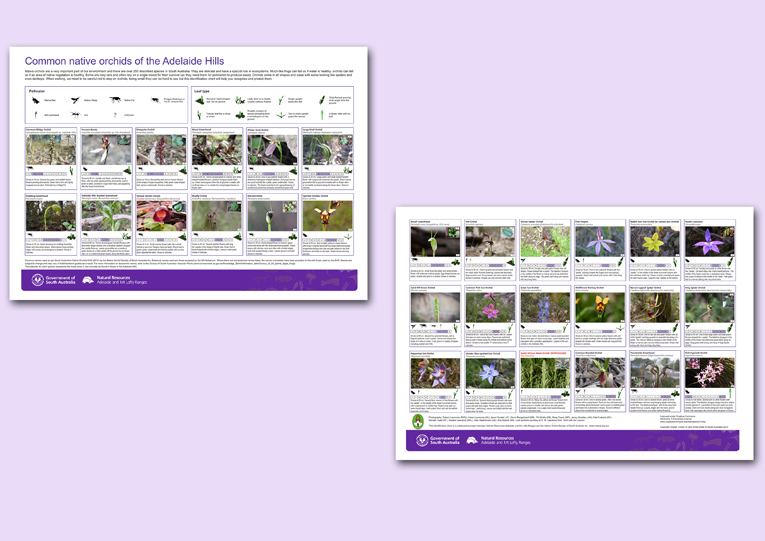
Over the years, Natural Resources Adelaide and Mount Lofty Ranges (NRM) have been involved with providing educational resources for schools and the community. One resource has been A3 Identification Charts.
This week has seen the release of another identification chart – Common Orchids of the Adelaide Hills. Produced in collaboration with the Native Orchid Society of SA, it was launched at our general meeting on April 28.
These charts are available free from the NRM website. To get a copy of the poster, click on the image below and scroll down to Identification Charts. Whilst there have a look at some of their other posters.
PS the chart looks good on a smart phone which makes it convenient for out in the field.
On the eve of the 100th anniversary of ANZAC Day, this week’s post is taken from the NOSSA Journal April 2015 Vol. 39 No. 3. The article is by Lorraine Badger.
William Hugh Murdoch, Anzac Veteran 17 September, 1885 – 24 July 1989
William Hugh Murdoch, known as Bill, was born at Poowong in Victoria’s Gippsland*. Later in life he became an orchid grower, eventually becoming co-founder of the Australian Native Orchid Society (ANOS), after sending out letters in 1962, suggesting the formation of a Society, to fellow Native Orchid Growers.
However, it is not for that reason alone, that we remember him in this journal. This month is the hundred year anniversary of the first battle of our new country, at Gallipoli. Following several weeks training in Egypt, William landed at ANZAC Cove with the 17th battalion on 16 August**, just four months after the initial landing. The battalion was mainly responsible for the defence of Quinn’s Post***.
Conditions on the Dardanelles peninsular ‘defy description.’ Water was scarce. Food rations were limited to mainly bully beef and hard tack biscuits. ‘The terrain and close fighting did not allow for the dead to be buried. Flies and other vermin flourished in the heat, which caused epidemic sickness’****. Under these conditions William, amongst dozens of men, contracted Enteric Fever, better known as Typhoid Fever, just three months after his arrival. He was sent by hospital ship, SS Nevasa (sic), to Alexandria back in Egypt before being sent to the Australian hospital in Helios on the outskirts of Cairo and then the Enteric Convalescent Camp in Port Said.
On 21 January 1916 he was declared fit to travel and was repatriated to Australia for three months of rehabilitation, leaving Pt Said on the Suez, via the MAT Commonwealth. Almost nine months later he returned to join his battalion, first disembarking in England. Four days before Christmas Day in 1916, he left the UK to join his battalion which had returned to Etaples, France following a spell in a quieter sector of the front in Belgium following the battalion’s first major battle at Pozières between 25 July and 5 August. In their new location they manned the front through a very bleak winter and William was again needed hospitalisation on several occasions for frostbite, diarrhoea, being wounded in action and finally Trench Fever a few weeks prior to armistice in 1918. He embarked for Australia in March 1916 reaching Australia in May where he was discharged.
Again when WWII commenced William re-joined the Army and was involved in training and later as ‘Voyage Only Officer’.
Bill Murdoch Trophy Bill is also remembered by ANOS through the Australia wide, Bill Murdoch Trophy for Champion Australian Native Orchid Species of the Year. It is not often that a South Australian wins this prestigious award but Kris Kopicki has become the latest recipient for his winning entry, Caladenia discoidea, in the NOSSA 2014 Spring Show.
Caladenia discoidea (Bee Orchid or Dancing Orchid). This picture was taken of the 2014 winning plant in 2013. Congratulations Kris for growing a winner!
References
*Birthdate gleaned from: http://www.irabutlertrophy.org/WRMurdoch.htm However, on his enlistment papers of 2 February 1915 it states that he was aged 19 years and 4 months – which would suggest he was born about October 1895.





 NOSSA
NOSSA 