The Native Orchid Society of SA has been involved with the Threatened Orchid Project which is attempting to propagate some of our most threatened orchids. There has been some success such as Thelymitra epicaptoides (Metallic Sun Orchids) but others are proving elusive. Marc Freestone, from the Orchid Conservation Project, Royal Botanic Gardens Victoria, is a PhD student who is researching one such difficult to grow orchid genus, the Prasophyllum.
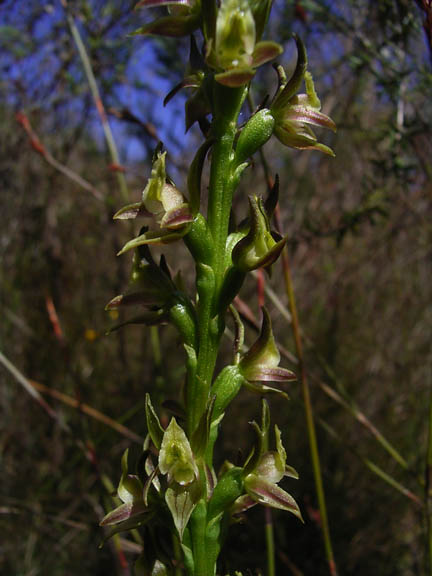
Prasophyllum murfettii (Denzel’s Leek Orchid)
To assist with his research Marc has the sent the following request.
CAN ANYONE GROW LEEK ORCHIDS?
South Australia has about 40 species and Victoria about 74 species of the native Leek Orchids, Prasophyllum. Some are on the brink of extinction.
A major problem hampering efforts to prevent our Leek Orchids from going extinct is that they have proven next to impossible to grow in cultivation. They have proved extremely difficult, usually not germinating at all, or germinating but then dying soon after. Occasionally some success has been had (particularly with symbiotic germination) but successful germination trials to our knowledge have so far proved un-repeatable. Working out how to grow Prasophyllum is critical for the survival of many species at risk of extinction across southern Australia.
To try and change this, I will be studying Prasophyllum and their relationships with symbiotic mycorrhizal fungi.
But I need your help!
I am wanting to hear from as many people as possible who
have tried (either successfully or unsuccessfully) to grow Leek Orchids or the closely related Midge Orchids (Corunastylis).
have observed Leek Orchids (or Midge Orchids) recruiting from seed in the wild.
If you can help, or know of anyone who might be worth talking to, please contact me at: marc.freestone@rbg.vic.gov.au or 0428 304 299.
(Funding and support for this project: Australian National University, Federal Government National Environmental Science Programme, Royal Botanic Gardens Victoria, University of Tasmania).
I would encourage people to contact Marc with whatever information that you have, no matter how insignificant you may think it is. Every little bit helps including unsuccessful attempts.
His eventual aim is to be able to work out how to grow them reliably from seed in cultivation.
Recently, 10th February 2016, Anita Marquart, PhD student, Adelaide University spoke at the Field Naturalists Society of South Australia. She is a recipient of the Society’s Lirabenda Endowment Fund Research Grant. At the meeting she gave a summary of her research – Orchids, Insects and Fire: Investigating the impacts of prescribe burning on orchid pollinators in Southern Australia. Though she has not finished collating the data she has kindly supplied a summary of her talk with her preliminary findings.
It is always encouraging to see research on our native orchids. They are the Barometer of the Bush, so the more we can discover about them, hopefully the more we will better understand how to manage our native bushland.
Orchids, Insects and Fire: Investigating the impacts of prescribed burning on orchid pollinators in Southern Australia
Anita Marquart, Renate Faast, José M. Facelli, Andrew Austin
School of Earth and Environmental Sciences,
The University of Adelaide, Adelaide 5005 Australia
PhD Project
Summary
Fire is an important ecological factor in Australian ecosystems. Orchids that depend on specific pollinators may be more susceptible to disturbance than more generalist species. Therefore, declines or changes in pollinator communities due to prescribed burns and wild fires could lead to reduced pollination success and consequently declines in orchid populations. The project combines traditional plant and insect ecology with advanced molecular techniques to identify orchid pollinators and assess their response to prescribed burns and wild fires. Insect relevant habitat characteristics (such as floral abundance, vegetation height, presence of logs, litter and standing litter) were assessed and trapping surveys of potential orchid pollinators were conducted in spring, before and after prescribed burns. The effect of both spring burns and autumn burns is being investigated.
Study sites are located in the Adelaide hills with always one burn and one adjacent control site respectively in Kersbrook Native Forest, Millbrook Reservoir, Para Wirra Recreation Park and South Para Reservoir. Some parts of the study sites in Kersbrook and Millbrook were affected by the Sampson Flat Bushfire. Affected sites are used to compare the effects on orchid pollinators after prescribed burns in contrast to wild fires.
Potential orchid pollinators are being identified using DNA barcoding with the mitochondrial cytochrome oxidase I (COI) gene. Sequencing results will be compared with existing databanks and confirmed using morphological identification. As the data accumulates it will build up a reference library of COI barcodes for the species found in the surveys.
The outcome of this research project might help to advise the optimal management of orchid species under fire-managed regimes in the Mount Lofty region of South Australia, as well as more generally in south eastern Australia.
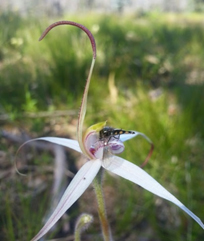
A hoverfly, Melangyna collatus on Arachnorchis rigida syn Caldenia rigida (Rigid White Spider Orchid)
Orchids and their pollinators
Native bees, thyninne wasps and Syrphid flies are known orchid pollinators of South Australian orchid species. Orchids of main interest for this study were Caladenia rigida, Caladenia behrii, Caladenia tentaculata and Glossodia major. Caladenia tentaculata and C. behrii are sexually deceptive orchids and are known to be pollinated by thynnine wasps (Bates 2011). In contrast, C. rigida is food advertising and uses a broad range of bee and fly species, such as native bees and hoverflies (Faast et al. 2009). Glossodia major is a generalist in its pollination strategy and is using small native bees of several genera (Bates 2011, personal observations).
Preliminary findings
Syrphid flies were successfully separated into different species using DNA barcoding methods. Results show that we have two dominating species on our field sites in the Adelaide hills. Both species, Melangyna collatus and Symosyrphus grandicornis are common native Australian species. Both species were caught with orchid pollinia attached and were observed on Caladenia rigida flowers.
First findings suggest that hoverflies don’t seem to be much affected by prescribed burns or bushfires. Syrphid fly numbers vary greatly between the years of sampling, but we did not find a significant impact of prescribed burning or the Samson Flat bushfire.
Statistical analyses for the data on syrphids, native bees and thynnine wasps are currently underway.
Preliminary findings suggest that a range of pollinators are still present on field sites after prescribed burns and even after bushfires. Nevertheless, some specific species might be more sensitive to fires and might have disappeared from the study sites. For example, orchids relying on one species of wasp could be more affected by changes in the abundance of their pollinator after fire, than orchids that are pollinated by a number of different insects.
We will have to analyse our results in more detail to look into the specific species composition for the insect families, especially for native bees and thynnines, rather than looking at overall abundance.
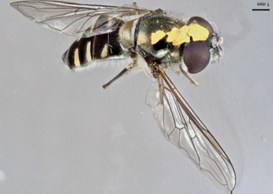
Hoverfly, Melangyna collatus with orchid pollinia attached
References:
Faast R, Farrington L, Facelli JM, Austin AD (2009). Bees and white spiders: unravelling the pollination syndrome of Caladenia rigida (Orchidaceae). Australian Journal of Botany57, 315–325.
Bates, R. J. (2011). South Australia’s Native Orchids. Native Orchid Society of South Australia.
This week there was a workshop South Lofty Block Orchid Recovery Project with representatives from Adelaide and Mt Lofty Ranges Natural Resource Management, SA Water, Forestry SA, Park Rangers, Threatened Plant Action Group and NOSSA. Many issues were discussed. One issue briefly discussed was the development of unofficial bike and walking tracks in parks and the negative impact that this would have on rare and endangered orchids.
This issue is not unique to Australia, the American Orchid Society whose mantra is Education, Conservation and Research published in their journal Orchid February 2008 a summary article titled Watch Your Step: Possible Consequences of Walking off the Trail. The authors are Maryilyn H.S. Light and Michael Mcconaill and the original paper can be found in the Lankesteriana 7:294 – 298 Click on the titles to read the articles.
The researchers studied the effects of visiting a site once a day and standing in the same spot for 10 minutes ie the effects of trampling. Their research suggested that there are possible longer term consequences as they found that the effects of compaction was still observable 18 months later. This does not seem like much but it was sufficient for them to offer some advice such as
stay on the tracks,
don’t walk on the side as even walking on the side of the track can result in unintended damage as the track is widened,
when one person walks off the track others are likely to follow
think carefully of the consequences before walking off the track
where possible step on rocks, not soil
The research was carried out in Canada and though there are differences between the two countries, there are so many similarities it is worth our while to take note of their advice.
Possibly there is scope for research here in South Australia but in the meantime their summary sentence says it all – Until we know what is happening beneath our feet, we should really watch our step
Fortunately our orchids like the edges of paths and so the are easy to spot. But at the same time, trampling on the edge of the paths means that the orchids can be destroyed and so be lost forever.
Part One – Attracting Pollinators looked at pollination strategy, but the fourth aim of the paper was to establish that Corunastylis littoralis reproduced by xenogamy or geitonogamy and that the species was not autogamous or apomictic, that is, pollinated, self pollinating or non pollinating plants.
Xenogamy or geitonogamy that is vector mediated pollination or out-crossing is when fertilization occurs by the transfer of pollen from one flower to another flower usually by the means of insect.
Autogamy or self-pollinating is when the flower is pollinated by its own pollen.
Apoximis is when reproduction occurs without pollination, that is, vegetative reproduction.
As explained in the paper, there are visual clues for determining which process is used by the plant.
Xenogmay
Autogamy
Apoximis
Pollinia removal and pollen deposition
Pollinia not removed
Lacks pollen or it is tightly bound
Pollinia weakly attached to the viscidium
If pollinia present, then unable to be removed
Not all the ovaries are fertilized
All the ovaries are fertilized and have viable seeds
Swelling of the ovaries can occur whilst in bud
Perfumed
Likely to have no perfume
Attracts insects
Flowers short lived
More detailed information was gained by dissecting the flower.
Because of their details, research papers can contain some very interesting facts of interest to a wide range of readers. This paper was no different. The aim of the paper was to identify the pollinator(s), how the attractant worked, confirm that C. littoralis was not autogamous (self-fertilizing) or apomictic (reproduction without pollination) and to assess the requirements & long-term viability of the pollinator.
The following summary notes have been drawn from both the research paper and the consultancy report. Note that Corunastylis littoralis is a synonym of Genoplesium littorale.
One of the interesting issues discussed was the different types of pollination strategies employed by orchids. It is commonly accepted that about one third of orchids use deceptive practices to attract a pollinator whereby they promise but don’t deliver. Some of these strategies are quite unusual. It would appear that there are at least four strategies now known. In order of frequency they are
Food mimicry
Sexual mimicry
Brood-site mimicry
Prey/carrion mimicry
The first two are well known to many orchid lovers. The orchid promises food such as nectar but does not produce any nectar or it has the appearance and even odour of the female insect pollinator so that it fools the male. The lesser known deception is brood-site mimicry where the female insect pollinator is tricked into laying the eggs on the flower but there is no chance for survival of the off-spring. Finally the most uncommon and unusual deception of prey or carrion mimicry, known as kleptomyiophily.
This method was discussed in detail in the report and made for fascinating reading although it was helpful to have a dictionary on hand.
Some insects are kleptoparasitic that is they feed on the haemolymph (roughly similar to blood) but from freshly killed insects. The researchers established that the pollinator for C. littoralis was not Drosophilidae (vinegar fly) but were instead from the families Chloropidae and Milichiidae known kleptoparasitic flies.
It has been observed that the pollinators swarm around the Corunastylis. This is a known behavioural pattern of kleptoparasitic flies that are attracted to the prey of other predators such as spiders, robber flies and other predatory insects.
It was noted that the pollinators were dominated by females. This precludes sexual deception and suggests that the females may require the haemolymph, which is protein rich, for egg maturation. It was also noted that C littoralis is a nectar producing orchid. It was considered that the nectar contained properties that mimic haemolymph.
Based upon these observations it was hypothesized that prey mimicry pollination syndrome was the best fit for the Corunastylis. Though this syndrome has been observed in orchids in the northern hemisphere, this would be the first time that this has been demonstrated as a possibility for Australian orchids.
Photo: Colin Bower
Part two will consider the fourth aim of the paper which was to determine the method of reproduction.
Thank you to Colin Bower for checking this post and for allowing the use of his photographs.
This week’s post is taking a brief look at a paper by Noushka Reiter, Mark Clements and Kate Vlcek which appeared in Muelleria, Volume 31: 69 – 76, 2013.
Titled “An examination of Pterostylis xerophila (Orchidaceae) and the confirmation of P. lingua as a new species in Victoria” this paper seeks to ascertain whether the records collected are correctly identified, that there are differences between them both in morphology and associated vegetation.
Both P. xerophila and P. lingua are found in South Australia where they are known, respectively, by the synonyms Oligochaetochilus xerophilus and O. linguus. In fact the type specimen for O. xerophilus is from South Australia.
In the introduction, the authors give a detailed description of Oligochaetochilus otherwise known as the ‘rufa group’ which differs from Pterostylis, in the strict sense, in several features. Some of the main features of this group are:
Basal rosette of overlapping stemless leaves
Leaves senesced, withered and died, by flowering
Erect multi-flowered
Flowers
Lateral sepals
hang down
basal half joined
tips become long and threadlike
Labellum
is very mobile
has obvious long white hairs and often short hairs as well
Typical of the rufus hood, this Oligochaetochilus arenicola shows the sencesing leaves, pendent petals and hairs on the labellum. Photographer: H Lawrence
Later in the articles, the differences between the two species are discussed. There is much of interest concerning the two species but one outcome of the research was to establish that P. lingua (O. linguus) had been incorrectly identified in the records and by correcting the names of the specimens the authors were able to confirm that it did occur in Victoria.
To find the answer to the authors other questions, read the paper
And for those that need a glossary of the terminology used, click here
For images of P. xerophila (O. xerophilus) click here
This series ends with Dr John Pearn’s summary below.
Enduring memorials
Scientific names of living things will be used as long as scientists find it useful to do so. Names change as taxonomists revise plant groupings and there is a proposal to dispense with scientific names, in favour of an alternative system called the PhyloCode.
In the past, the doctrine of signatures linked the forms of plants with their supposed therapeutic uses. But the world of binomial nomenclature (which Linnaeus introduced in 1753), allows for the most fitting memorials in medicine and botany. In the scientific names of Australian orchids, the lives of many doctors and botanists endure.
Though this series has been divided into 20 parts, it does not cover the whole of his original article which can be viewed here and downloaded as a pdf.
Since orchids, and Australian orchids in particular, first came to the attention of the western world in the 1800s researchers have been fascinated by the so many different aspects of the orchid’s morphology and life cycle. One area of interest has been that of how orchids are pollinated. The mechanism of pollination has not always been clear as the orchids seem to use different and complex methods. From time to time various papers have been published of observations by researchers.
The ‘question and answer’ style of the paper helps with ease of reading and is worthwhile perusing, even for the lay person. The accompanying VIDEO is also of interest.
The essence of the paper was to establish whether sexual deception was used to facilitate pollination. The species researched was Pterostylis sanguinea (syn. Urochilus sanguineus) and the researchers confirmed that this did happen. Their research showed that the attraction for the insect came only from the labellum which exuded an alluring chemical. P. sanguinea has a mobile hinged labellum which is a feature of other sexually deceptive orchids such Paracaleana,Caleana,Arachnorchis.
Pterostylis sanguinea syn. Urochilus sanguineus with the untriggered labellumPterostylis sanginea syn. Urochilus sangineus with a side view of the labellum
By way of introduction, Muelleria is the Royal Botanic Gardens of Melbourne official research journal and has been published since 1955.
Though a technical article there is much to be gleaned for the ordinary reader, for instance the article contains a good description of the commonly used terms for describing the column for example stigma, trichomes, anther, post anther lobe, etc. This is helpful to know as the column structure is often the main feature of the plant used to identify the individual species. Naturally the key features of the T. nuda complex are covered comprehensively, as well as a brief discussion of the taxonomic history.
Another helpful section is the dichotomous key for all fifteen species described in the article. Of the fifteen species four are found in South Australia and are pictured below. But to discover more read the article ……
Thelymitra nudaThelymitra megcalyptraThelymitra glaucophylla photographed by Robert BatesThelymitra alcockiae
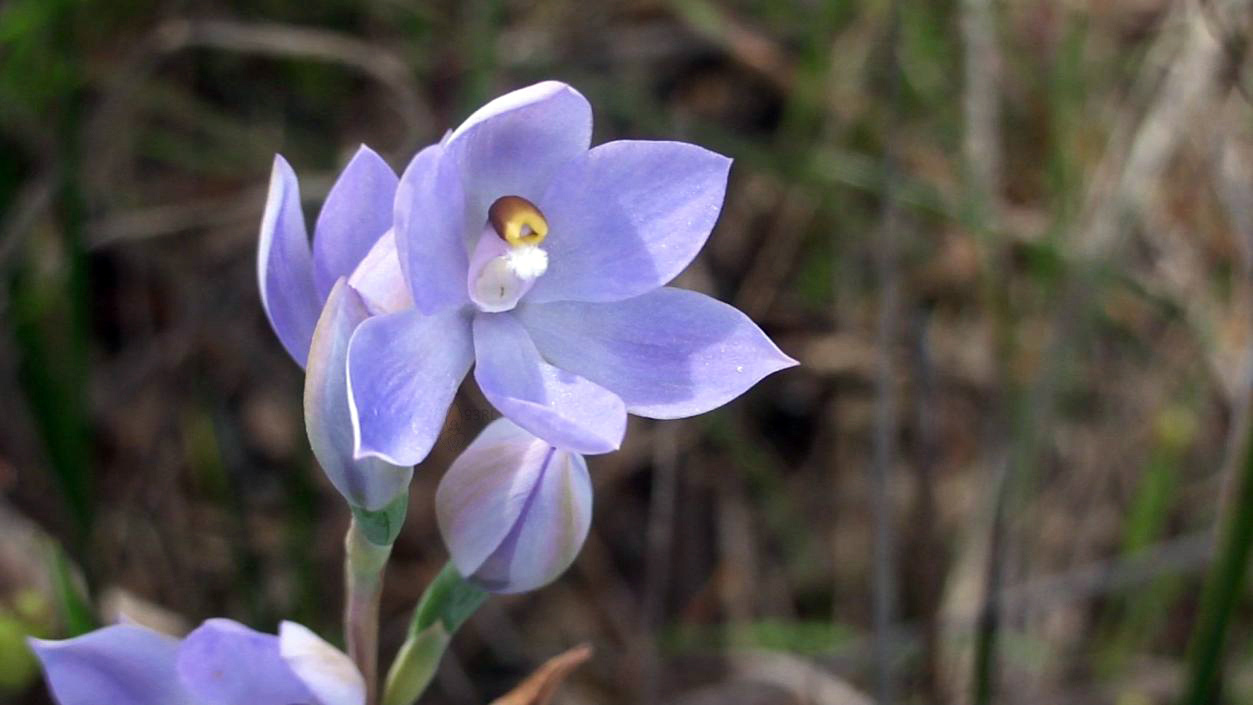
The winning picture was a single flower of Thelymitra epipactoides (Metallic Sun Orchid) taken by Rosalie Lawrence. This picture was cropped from a photograph taken on a mobile phone. Phones have come a long way since the days of Alexander Graham Bell!
T. epipactoides is a special orchid both in its beautiful colourings and that it is one of our rarest orchids. This endangered species has been well studied in an effort to prevent its demise with the result that there is an abundance of information about it. Recently, with the knowledge gained, Dr Nouska Reiter of the Australian Network for Plant Conservation (ANPC) and her team have managed to cultivate 3,000 plants with the plan to re-introduce them back into the bush in the Wimmera area.
Following are some interesting points from two good sources, which are the
(2)……can remain dormant as a tuber in the soil for up to nine years ……….
(But once a plant has flowered)
(2)…….Plants can produce flowers from their second year of growth onwards for up to four consecutive years, but no more. Individual plants can remain dormant for up to two years then grow to produce flowers, but if dormant for four years or more, plants generally do not reappear. …..
(2)…… Detailed monitoring suggests that mature plants only live for about 10 years before dying (Cropper 1993). ……..
(2)……..flowers open when the relative humidity is lower than 52%, air temperature is above 15 °C, and there are clear skies ………….
(2)……..Flowers remain for up to four weeks but wither a week after pollination ……
(2)……. fungus is required to initiate successful seed germination (Calder et al. 1989) and seeds cannot survive more than two weeks without associating with the fungus ………
Plant Information
(1)…….Flower colour is highly variable, brown, copper, blue and green being the main colour groups which are determined by the proportion of red, blue and green epidermal cells, some of which are reflective giving a metallic appearance. …….
(2)….The leaf is loosely sheathing ………
(2)…Mature non-flowering plants have slightly narrower leaves to 51 cm long and not sheathing …
(1)………Flower colour is highly variable, brown, copper, blue and green being the main colour groups which are determined by the proportion of red, blue and green epidermal cells, some of which are reflective giving a metallic appearance. ………
Topography:
(2)…. is undulating plains, crests of hills, gentle slopes of low broad ridges and at the bottom of broad, shallow swales (Obst 2005). It grows in sandy soils over a clay subsoil, with these soils having a tendency to become waterlogged in winter and spring, and drying out in summer and autumn ……
(2)…..This species is a post-disturbance coloniser, utilising early successional stages after disturbance events such as human activities, fire, animal activities such as scratching of the soil, or associated vegetation disturbance. ……
(2)……..requires open sites for flowering and seedling recruitment (Calder et al. 1989). ………
Population Size
(1)……Population estimates vary from about 1050 plants in Australia (DEH 2006), to less than 3,000 plants (Coats et al 2002). More recent assessments suggest the population could be less than 1500 plants in the wild …….
(2)……In the Murray Darling Basin and South East Regions of South Australia there were ten populations of the Metallic Sun-orchid recorded in 2004 by Obst ……..
Reminder – November theme is Orchids and Insects (Spiders and other such critters are honorary insects)





 NOSSA
NOSSA 