Culture of Fungi Dependent (FD) Terrestrials

This is the last of the three terrestrial fact sheets in Culture Notes that NOSSA has produced on growing terrestrial orchids.  All three facts sheets can be downloaded – Click on the following for Fungi Dependent, Slow Multipliers and Fast Multipliers.

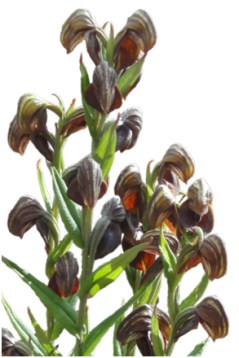
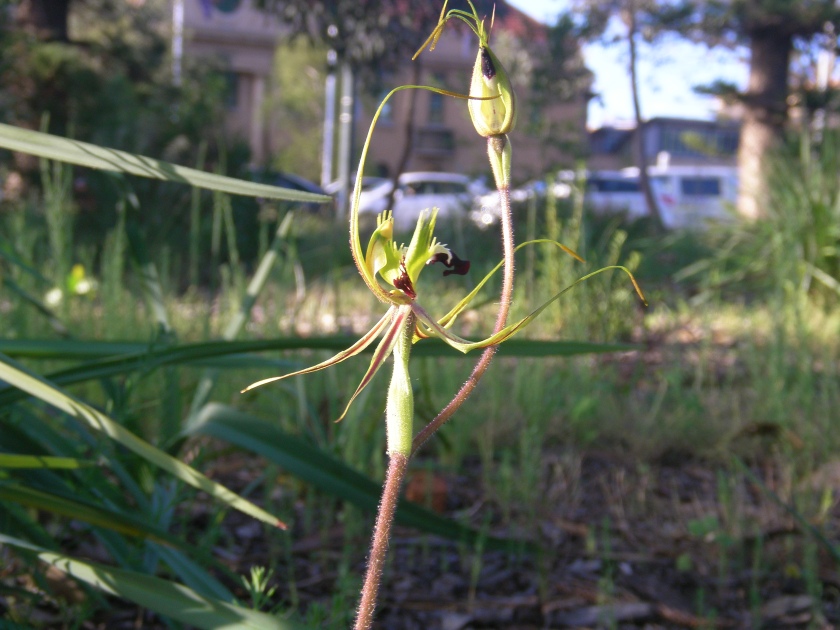
Orchid 1 Arachnorchis tentaculata
Arachnorchis tentaculata, common name King Spider Orchid or Large Green Comb Spider Orchid

FLAGBEARER SPECIES: Caladenia tentaculata (synonym Arachnorchis tentaculata)

Some 3/4 of Southern Australian terrestrial orchids are fungus dependent throughout their life cycle. Orchids that are fungus dependent have very specific cultural requirements. The fungus must be grown in the pot with the orchid. Sometimes a third entity such as a shrub or tree is involved in the fungal relationship.

A minimum disturbance culture is used.

Limited numbers are available each year. Other fungus dependent species are rarely available. Those in cultivation have mostly come from rescue digs in the past. NOSSA has started a seed kit project to help overcome this vacuum.

GROWTH HABIT: Australian ground orchids follow an annual growth cycle comprising 6 – 8 months as growing plants under cool (5 – 20°C max, 0 – 14°C min) moist conditions and 4 – 6 months as dormant tubers in hot dry (18 – 42°C max, 12 – 30°C min) conditions. The new tuber is produced in winter – spring. Each tuber sends up a shoot to the surface in Autumn and leaves grow rapidly in late Autumn/early Winter as temperatures fall and the rains set in. Sometime in October/November the leaves go yellow and then brown and dry as the days get longer, hotter and drier in late Spring.

LIGHT/SHADE: In Adelaide they thrive in a shadehouse of 50% shadecloth. Some species prefer heavy shade, others full sunlight, but most will adapt to a wide range of light intensity.

If the leaves and stems are weak and limp or if the leaf rosettes are drawn up to the light then the shading is too dense and the amount of light should be increased. FDs are mostly spring flowering and like higher light intensities at flowering time. flowers may have pale colours if placed in heavy shade, even temporarily, when buds are just starting to open.

In very cold areas an unheated glasshouse may be required for frost protection although light frosts do not worry the majority of species.

AIR MOVEMENT/HUMIDITY: All species like good air movement and will not thrive in a stuffy humid atmosphere especially if temperatures are high.

POLLINATION/SEED COLLECTION: FDs seldom multiply so must be propagated from seed.

Flowers on the strongest plants of the same species growing in pots are cross pollenated by hand to set seed pods. The flowers collapse in a day of so and pods ripen in 4-8 weeks. Pods are collected as they change colour from green to brown, which happens quickly on a hot day in October/November. Tea bags can be tied over the pods to catch the dust like seed if frequent visits to site are not possible.

Pods are stored dry in paper envelopes indoors over summer. Seed can be sprinkled on mother pots or scattered on bush sites.

SEEDLING CARE: Seedlings can be raised by sowing seed around potted mother plants.

At Easter time, just before the rainy season begins, the dust-like seed is mixed with fine sand in a pepper shaker (minimizes seed loss) and sprinkled on top of the pots and watered in. Germination occurs in Autumn/Winter as that is when the fungi are most active. Tiny leaves appear from July to October. The seedlings form miniscule tubers on droppers about 1 – 2cm below the surface. Seedlings take up to five years to reach flowering and are best left undisturbed until larger.

WATERING: The soil should be kept moist at all times during active growth by watering gently if there is no rain. Hand watering is especially necessary in spring as soil in pots dries out more rapidly than in the garden. Watering must be done slowly so that the mat of needles on the surface of the pot is not disturbed. Slugs and snails love these plants and must be kept under control. Raising the pots off the ground on galvanised steel benching is very effective in controlling these pests.

After the leaves have turned yellow, let the pot dry out completely to dry up the old roots and tubers otherwise they may turn into a soggy mouldy mess and rot may destroy the adjacent new tubers.

REPOTTING: The plants are not repotted but left in the same pot year after year.

SUMMER CARE: Keep the pots shaded and allow the pots to dry out between light waterings until mid-February when they should be set out in their growing positions and watered a little more often. The tubers of some species will rot if kept wet during the dormant period, others will produce plants prematurely which are then attacked by pests such as thrip and red spider and fungal diseases in the warm weather.

A thin layer of new leaf litter is placed on top of the existing leaf litter each summer to feed the fungus.  Chopped gum leaves or sheoak needles are suitable.

FERTILIZING: NO FERTILISER

OTHER CULTURE NOTES:

March 2016 Winning Photograph

1603 sm JS Arachnorchis sp

We frequently receive entries from Western Australia but this month our entries were from both the west and the east. Allen Jennings entered a Calanthe triplicata (Christmas Orchid) from New South Wales. Pauline Meyer’s was from the west, (Western) Flying Duck Orchid, Paracaleana nigrita. The other entries were South Australian, Jenny Pauley’s recently photographed Leporella fimbriata (Fringed Hare Orchid), Greg Sara’s Thelymitra rubra (Common Pink Sun Orchid) and Judy Sara’s Plumatochilos sp. (Bearded Orchid) and Arachnorchis sp. (Spider Orchid).

The winning photograph was Judy’s Spider Orchid. Obviously it was one of the Green Comb Spider Orchids – A. dilatata complex. Of this group there are about a dozen possibilities. Knowing the location, Mt Boothby, helped to narrow the options with the most likely candidate being Arachnorchis stricta but it wasn’t convincing. It would appear that the tips of the sepals may have been chewed off when in bud.

A distinguishing feature of this species is that there are no clubs or osmophores on the sepals. Other species of this complex have clubs. Another feature is that the dorsal sepal is bent over the column unlike many other green combs which have an erect dorsal sepal. The features that caused doubt were lateral sepals looking droopy instead of being characteristically stiffly held out but dry conditions could cause this. The other was that the labellum did not strictly fit the description of A. stricta but then again it is a variable species.

The conclusion was a possible hybrid but there is no information on the likely parents or that is an atypical A. stricta that may have been damaged in bud.

This is an example of the difficulties that can occur when attempting to identify a plant from one photograph.

Reference:

Personal communications Thelma Bridle (NOSSA Conservation Officer)

Personal communications Bob Bates

Bates, R. J., ed. (2011). South Australian Native Orchids. Electronic version, 2011. NOSSA

Rules of entry:

The subject matter must have something to do with Australian orchids.  Any format is acceptable including Photo shopped images, artwork, etc

How to enter:

Email nossa.enquiries@gmail.com – jpg as large as you are able to send it, preferably A4 ratio for printing

Post: PO Box 565, Unley, 5061

Bring in to the meeting

It’s Not Extinct at Ferris-McDonald After All

Leo Davis is an enthusiast about the natural world and shares his knowledge through different journals.  He is a keen observer and meticulous in his record keeping.  He is also very knowledgeable about orchids.  The following is one such article of Leo’s.

GOOD NEWS FROM FERRIES-McDONALD CONSERVATION PARK
Leo Davis

I was aware of the Star Spider Orchid from Bates who lists the species as ‘3E, critically endangered in South Australia, nationally rare’ (pp. 242–243). I knew that in the past it had been found at Monarto and Hartley and discussions with members of the Native Orchid Society of SA (NOSSA) suggested that it had been seen at Ferries-McDonald Conservation Park, but was now possibly extinct there. My searches over five years had all failed.
On August 2, 2014, I ran into, then strangers, Len Stephens and his grandson Rickey Egel, in Monarto C.P. They had just come from Ferries-McDonald C.P., about 8 km further south. Rickey, who has a very good eye for spotting orchids, showed me an image, in his camera, of ‘the common spider orchid’. From my hurried glimpse I knew immediately it was far from ‘common’ and told him so. I headed straight for Ferries-McDonald C.P. for the first of many fruitless searches.  On August 14, 2015 Rickey and Len showed me a few Star Spider Orchids in flower at Ferries-McDonald C.P. Because I was to lead the Botany Group of the FNSSA on an outing to Ferries-McDonald C.P. on September 5, I had been visiting the park almost weekly and so was able to spend many hours looking for the orchid. It is difficult to spot, being quite small. This year’s plants, perhaps not typical given the very dry June, are between 8 and 20 cm high with flowers only about 35 x 30 mm.
Plants were only found in Broombush (Melaleuca uncinata) associations. As soon as Eucalyptus species were present the orchid was no longer found.
Any survey, especially by a single person, will produce a lower count than the actual population. Leaves of non-flowering or beheaded (the fate of so many spider orchid flowers) plants will not be recognised, some flowers will not be spotted and some plants will flower before or after surveys, with some areas surveyed on different days. Between August 14 and September 5, 2015 just 18 flowering plants (Fig. 1) were positively identified (about the same number of likely leaves and buds, adjacent to these, were noted) over a narrow area of approximately 3,000 m2. The area searched was very much greater than this. Small as this tally is, it establishes a significant population other than the only other South Australian one that I know.  That is on the private property of farmer […], at Hartley. With his kind permission I have counted over 100 flowering plants there during five visits from July 28 (buds only) to August 30 (Fig. 2). The actual population will be larger because I did not cover all of that location. My observations suggest the populations I know to be around 150 to 200 plants with other occurrences probably existing around Monarto and Hartley.
Why have I avoided the scientific name? Many of you will follow the Electronic Flora of South Australia which lists the Star Spider Orchid as Caladenia stellata, as does Backhouse (pp. 456–457). I prefer to follow Jones (p. 76) (who does not recognise the species occurring in SA) and Bates (p. 242) (who says it does occur in SA), both of whom call it Arachnorchis stellata. Backhouse points out that the nearest other occurrence, the major one, is in central southern New South Wales, south of Rankin Springs, several hundred kilometres away, and that the plants there differ from our populations in having smaller flowers. He suggests that we are looking at a separate undescribed species, Caladenia sp. ‘Murray mallee’ (p. 484), but that it might indeed be co-specific with the Rock Star Orchid (sic), Caladenia saxatilis, which is similar and occurs further north, in the northern Mt Lofty and the southern Flinders Ranges. Bates told me in conversation, that he disagrees with Backhouse and believes the local plants are the same as those in NSW and distinct from A. saxatilis, which grows in soils of different pH (acidity).


Good News from Ferries-McDonald-1 38LD
Fig 1: Arachnorchis stellata, Ferries-McDonald CP,  August 22, 2015.  Photo: Leo Davis

Good News from Ferries-McDonald-2 38LD
Fig 2: Arachnorchis stellata Hartly, South Australia, August 5, 2015.  Photo: Leo Davis

BIBLIOGRAPHY:

Backhouse, G. (2011). Spider-orchids – the genus Caladenia and its relatives in Australia. DVD/pdf, Backhouse, Melbourne.
Bates, R.J. (2011). South Australia’s Native Orchids, DVD, NOSSA, Adelaide.
eFlora SA. Electronic Flora of South Australia; last updated August 22, 2015.
Jones, D.L. (2006). A complete guide to native orchids of Australia including the island territories. Reed New Holland, Sydney.


Used by permission, extract from The South Australian Naturalist Vol. 89 No 2 July-December 2015.

Are there any orchids growing in the desert?

Think of deserts and the image is that of a bleak barren landscape with little to see but this is not so.  The conditions are harsh but there is a myriad, though not an abundance, of hardy fauna and flora if one but looks closely.

But concerning orchids – No orchids have been found in true deserts…..  They also appear to be absent from the arid mountains of the far north-west, or at least no-one has ever found orchids there.

Orchids need moisture and so they do not grow on unstable soils such as dry sand-hills, gibber plains or the many saline areas of the far north but on the desert fringes there are micro-climates where the moisture, humidity and soil structure is  just right (to quote Goldilocks) for orchids.  This micro-climate is created by [s]hrubland  [which] is … [an] … important dryland orchid habitat. Besides providing shade and shelter for the orchids, shrubs like the many species of wattles, Acacia and hop-bush Dodonea drop fine leaves which help to hold the soil together and slowly break down into humus rich with nutrient and water storing capability. These shrublands usually form in soils too dry or shallow for trees. Orchids of course have no need for deep soils as they are shallow rooted. 

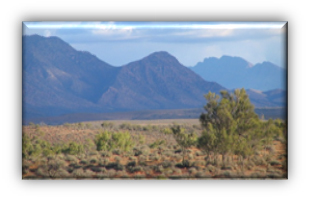
Robert Bates Semi-arid Shrubland.jpg
Semi-arid Shrublands, Flinders Ranges

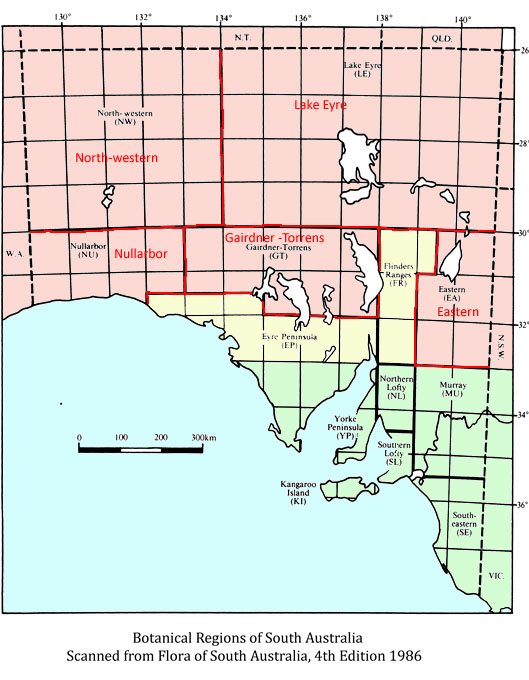
Of the five desert botanical regions, the Eastern region contains the most number of species with over a dozen species.

Botanical Regions Map
Colour added to indicate the desert regions (in red)

Orchids of the Eastern Region – this region is from the east of the Flinders Ranges to the New South Wales border and includes the Olary Spur and Lake Frome.

Arachnorchis toxochila – Dry Land Spider Orchid or Bow Lip Spider Orchid.
Corunastylis tepperi – Mallee Midge Orchid
Diplodium robustum – Common green shell-orchid.
Hymenochilus pagophilus – Mountain Shell-orchid
Microtis eremaea – Desert onion orchid
Microtis frutetorum – Common woodland onion orchid.
Oligochaetochilus bisetus species complex, Rusty rufous-hoods

Oligochaetochilus sp. Blue-bush Plain – Blue Bush rufous-hood (O. bisetus complex)

Oligochaetochilus sp. Outback – Outback rufous-hood (O. bisetus complex)

Oligochaetochilus cobarensis – Little desert rufous-hood
Oligochaetochilus sp. Crossed Sepals Bibliando rufous-hood. (O. hamatus complex)
Oligochaetochilus sp. Bimbowrie Bimbowrie Rufoushood (O boormanii complex)
Oligochaetochilus linguus – Swept-back Rufoushood

Oligochaetochilus sp. Old Boolcoomatta Large-lip rufous-hood (O. linguus complex)

Oligochaetochilus sp. Quartz – Quartz hill rufous-hood (O. linguus complex)

Oligochaetochilus sp. Slender desert – Slender Desert rufous-hood (O excelusus complex)
Undescribed not within any other Oligochaetochilus complex

Oligochaetochilus sp. Canegrass – Desert Sand-hill Orchid.

Oligochaetochilus sp. Oratan Rock – Diminutive rufous-hood

Oligochaetochilus sp. ‘Mt Victoria Uranium Mine’ – Uranium rufous-hood

Prasophyllum odoratum – Scented Leek-orchid

Prasophyllum sp. Desert Desert Leek-orchid (P. odoratum complex)

The Gairdner-Torrens region includes, besides the salt lakes it is named after, the Gawler Ranges and the southern part of the Great Victoria Desert.  Though not as many species as the Eastern region, it contains some different species including a Sun Orchid.

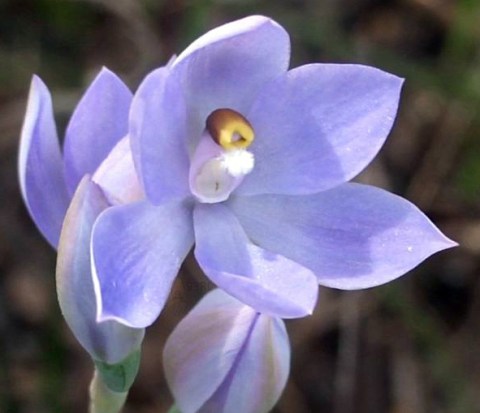
Thelymitra megcalyptra
Arachnorchis interanea – Inland Green-comb Spider Orchid
Arachnorchis toxochila – Dry Land Spider Orchid or Bow Lip Spider Orchid.
Hymenochilus pagophilus – Mountain Shell-orchid
Hymenochilus pisinnus – Tiny Shell-orchid
Jonesiopsis capillata – Pale Wispy Spider Orchid
Linguella sp. Hills nana – White haired little-greenhood.
Microtis eremaea – Desert onion orchid
Oligochaetochilus ovatus – Ovate Lip Rufoushood
Oligochaetochilus xerophilus – Desert rufous-hood
Prasophyllum sp. Desert Desert Leek-orchid (P. odoratum complex)
Thelymitra megcalyptra – Scented or Dryland Sun Orchid

Third of this group is the Nullabor region.  Consisting of flat treeless limestone plains, this area, surprisingly, has two species both of which have been found close to the coast.

Urochilus sanguineus – Maroon banded greenhood
Corunastylis sp. Intermediate – Halbury Midge Orchid (C. rufa complex)
Urochilus sanguineus

The final two regions Lake Eyre and North-Western contain the vast expanses of desert of the far north of South Australia.  Definitely not a place to find orchids yet one specimen has been collected from each of these two regions.

Oligochaetochilus sp. Everard Range (L. Scott 173), Mimili Orchid (possibly O. woollsii complex) from North-Western Region.

Oligochaetochilus sp. Gammon Range (O excelusus complex) from the Lake Eyre region.

It is unusual to find orchids in the desert because they only grow when there have been good winter rains which isn’t very often.  But nevertheless, here in South Australia we have over 20 possible species – an astonishingly high number for such a harsh area!

Reference:

Bates R J ed, South Australia’s Native Orchids, 2011 Native Orchid Society of South Australia

Map adapted from Flora of South Australia, Fourth Edition, 1986


Orchids, Insects and Fire

Recently, 10th February 2016, Anita Marquart, PhD student, Adelaide University spoke at the Field Naturalists Society of South Australia. She is a recipient of the Society’s Lirabenda Endowment Fund Research Grant.   At the meeting she gave a summary of her research – Orchids, Insects and Fire: Investigating the impacts of prescribe burning on orchid pollinators in Southern Australia. Though she has not finished collating the data she has kindly supplied a summary of her talk with her preliminary findings.

It is always encouraging to see research on our native orchids. They are the Barometer of the Bush, so the more we can discover about them, hopefully the more we will better understand how to manage our native bushland.


Orchids, Insects and Fire: Investigating the impacts of prescribed burning on orchid pollinators in Southern Australia

Anita Marquart, Renate Faast, José M. Facelli, Andrew Austin

School of Earth and Environmental Sciences,

The University of Adelaide, Adelaide 5005 Australia

PhD Project

Summary

Fire is an important ecological factor in Australian ecosystems. Orchids that depend on specific pollinators may be more susceptible to disturbance than more generalist species. Therefore, declines or changes in pollinator communities due to prescribed burns and wild fires could lead to reduced pollination success and consequently declines in orchid populations. The project combines traditional plant and insect ecology with advanced molecular techniques to identify orchid pollinators and assess their response to prescribed burns and wild fires. Insect relevant habitat characteristics (such as floral abundance, vegetation height, presence of logs, litter and standing litter) were assessed and trapping surveys of potential orchid pollinators were conducted in spring, before and after prescribed burns. The effect of both spring burns and autumn burns is being investigated.

Study sites are located in the Adelaide hills with always one burn and one adjacent control site respectively in Kersbrook Native Forest, Millbrook Reservoir, Para Wirra Recreation Park and South Para Reservoir. Some parts of the study sites in Kersbrook and Millbrook were affected by the Sampson Flat Bushfire. Affected sites are used to compare the effects on orchid pollinators after prescribed burns in contrast to wild fires.

Potential orchid pollinators are being identified using DNA barcoding with the mitochondrial cytochrome oxidase I (COI) gene. Sequencing results will be compared with existing databanks and confirmed using morphological identification. As the data accumulates it will build up a reference library of COI barcodes for the species found in the surveys.

The outcome of this research project might help to advise the optimal management of orchid species under fire-managed regimes in the Mount Lofty region of South Australia, as well as more generally in south eastern Australia.

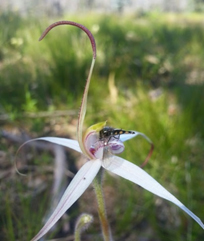
160219 Anita Marquart Melangyna collatus on Caladenia rigida
A hoverfly, Melangyna collatus on Arachnorchis rigida syn Caldenia rigida (Rigid White Spider Orchid)


Orchids and their pollinators

Native bees, thyninne wasps and Syrphid flies are known orchid pollinators of South Australian orchid species. Orchids of main interest for this study were Caladenia rigida, Caladenia behrii, Caladenia tentaculata and Glossodia major. Caladenia tentaculata and C. behrii are sexually deceptive orchids and are known to be pollinated by thynnine wasps (Bates 2011). In contrast, C. rigida is food advertising and uses a broad range of bee and fly species, such as native bees and hoverflies (Faast et al. 2009). Glossodia major is a generalist in its pollination strategy and is using small native bees of several genera (Bates 2011, personal observations).

Preliminary findings

Syrphid flies were successfully separated into different species using DNA barcoding methods. Results show that we have two dominating species on our field sites in the Adelaide hills. Both species, Melangyna collatus and Symosyrphus grandicornis are common native Australian species. Both species were caught with orchid pollinia attached and were observed on Caladenia rigida flowers.

First findings suggest that hoverflies don’t seem to be much affected by prescribed burns or bushfires. Syrphid fly numbers vary greatly between the years of sampling, but we did not find a significant impact of prescribed burning or the Samson Flat bushfire.

Statistical analyses for the data on syrphids, native bees and thynnine wasps are currently underway.

Preliminary findings suggest that a range of pollinators are still present on field sites after prescribed burns and even after bushfires. Nevertheless, some specific species might be more sensitive to fires and might have disappeared from the study sites. For example, orchids relying on one species of wasp could be more affected by changes in the abundance of their pollinator after fire, than orchids that are pollinated by a number of different insects.

We will have to analyse our results in more detail to look into the specific species composition for the insect families, especially for native bees and thynnines, rather than looking at overall abundance.

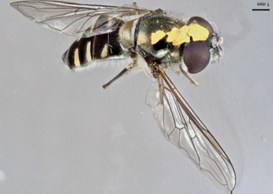
160219 Anita Marquart Melangyna collatus with pollinia
Hoverfly, Melangyna collatus with orchid pollinia attached

References:

Faast R, Farrington L, Facelli JM, Austin AD (2009). Bees and white spiders: unravelling the pollination syndrome of Caladenia rigida (Orchidaceae). Australian Journal of Botany 57, 315–325.

Bates, R. J. (2011). South Australia’s Native Orchids. Native Orchid Society of South Australia.

Do Any Orchids Grow Near The Sea?

Orchids are found in a wide range of habitats.  One such habitat is the littoral zone or more simply the seaside.  The following information is taken from the NOSSA’s CD/DVD South Australia’s Native Orchids 2011.

The Littoral Zone

Many orchid species have a linear distribution following the coastline. Here on the leeward side of sandhills the air is usually moist and mild, few frosts occur so close to the sea and sea-fogs in winter will cause water to drip into the sand which easily soaks up both the moisture and the extra nutrients provided by sea-spray. Some of the best known coastal orchids include the gnats Cyrtostylis robusta, pink fairies Caladenia latifolia, coast onion-orchids, Microtis arenaria and coastal helmet orchids Corysanthes expansa as well as C. despectans. All of these are colony forming species, mostly because the windblown sand would soon cover ‘single plant’ species which start to appear after the second line of dunes.

Coastal species can be a few kilometres from the sea but there are several that grow either at the high tide mark, within sight or sound of the sea or in coastal dunes. Apart from the ones already mentioned above, the following are some others that can potentially be found within sight and sound of the sea.

  • Acianthus pusillus (Mosquito Orchid)
  • Arachnorchis cardiochila (Thick Lipped Spider Orchid)
  • Arachnorchis fragrantissima (Scented Spider Orchid)
  • Arachnorchis fuliginosa (Coastal Spider Orchid)
  • Arachnorchis sp Brown Bayonets (Port Lincoln Spider Orchid)
  • Bunochilus flavovirens (Coastal Banded Greenhood)
  • Bunochilus littoralis (Lake Saint Clair Banded Greenhood)
  • Caladenia sp Selfing Coastal Dunes (Little Dune Fingers)
  • Corunastylis nigricans (Port Lincoln Midge Orchid)
  • Diuris orientis (Wallflower Orchid or Bulldogs)

    Diuris orientis
    Diuris orientis (Wallflower Orchid)
  • Diplodium erythroconchum (Red shell Orchid)
  • Glossodia major (Waxlip or Purple Cockatoo Orchid)
  • Leptoceras menziesii (Hare Orchid, Rabbit Ears)

    Leptoceras menziesii (Rabbit Ears Orchid)
    Leptoceras menziesii (Rabbit Ears Orchid) after a fire
  • Prasophyllum elatum (Tall Leek Orchid)
  • Prasophyllum litorale (Vivid Leek Orchid)
  • Prasophyllum sp Late Coastal Dunes
  • Pterostylis cucullata (Leafy Greenhood)
  • Pterostylis curta (Blunt Greenhood)Pterostylis curta Labellum and column 92RL
  • Thelymitra antennifera (Rabbit Ears; Lemon Sun Orchid)07 JB T antennifera sm

Unfortunately, where there has been settlement, it is now unusual to find these species so close to the sea.

November 2015 Winning Photograph

November’s theme was hybrids. Orchids, more than any other plant family, are likely to produce natural hybrids. Even though the overall occurrence of natural hybridisation in orchids is low, it occurs often enough to make some species identification challenging.

Hybrids mainly occur between species of the same genera such as Jenny Pauley’s Arachnorchis brumalis x A. conferta

11sm JP Arachnorchis brumalis x conferta
Arachnorchis brumalis x A. conferta

but, less commonly, it can occur between genera as seen with Pauline Meyer’s Caladenia latifolia x A. brumalis

11 sm PM C latifolia X A brumalis
Caladenia latifolia x Arachnorchis brumalis

and her Western Australian photograph of Caladenia x enigma; a hybrid between C. falcata and Drakonorchis barbarossa.

11sm PM Caladenia x enigma
Caladenia x enigma


Jones (2006) states that “Natural hybrids are more common in some genera, such as Arachnorchis, Caladenia and Diuris, than in others.” To this list could be added Thelymitra as seen with both of the winning pictures T. x truncata and T. x irregularis. Interestingly with these two hybrids, the parents are not always the same; the parents for T. irregularis could be T. ixiodies or T. juncifolia with either T. carnea or T. rubra.

11 sm RAL Thelymitra x irregularis.jpg
Thelymitra
x irregularis

A similar situation occurs with T. truncata with the parents consisting of T. juncifolia and any member of the T. pauciflora (including T. albiflora, T. arenaria, T. bracteata, T. brevifolia, T. cyanapicata, T. pauciflora) or of the T. nuda complex.

11 sm RWL Thelymitra x truncata
Thelymitra
x truncata

The conditions necessary for hybridisation are that the parents must grow in the same area, have overlapping flowering time and share the pollinator. Brown et al (2103) make the additional observation – Hybrids are more common between wasp and bee-pollinated species than between two wasp-pollinated species or two bee-pollinated species.   … However, rare hybrids between species using the same pollination strategies, do occasionally occur …

Obviously hybridisation is more likely to occur when there is an abundance of the parent species. This situation can occur when there is mass flowering following fires or good seasonal rains. Site disturbances either through natural causes or clearing can result in increased incidence of hybridisation.

Hybrids are often infertile and will only last for the life of the individual plant but some have the ability to reproduce vegetatively and, provided the conditions remain favourable, may persist for several years.

One situation that can occur is hybrid swarm. When these occur they can make orchid identification challenging. Hybrids share the characteristic of both parents and by careful observation this can be deduced but swarms introduce an added complexity because the hybrid can backcross with either of the parents or cross fertilise with themselves. The result is a wide range of variation which makes orchid identification difficult.

Finally, some orchids will not hybridise even though the conditions are right. This could be due to specific pollinator or possibly chemical or genetic barriers.

References:

Brown et al (2013) Field Guide to the Orchids of Western Australia, Floreat, WA, Simon Nevill Publications

Jeans, Jeffrey & Backhouse, Gary (2006) Wild Orchids of Victoria, Seaford Vic, Aquatic Photographics

Jones, David (1988) Native Orchids of Australia, Frenchs Forest, NSW, Reed Books

Jones, David (2006) A Complete Guide to Native Orchids of Australia including the Islands and Territories, Frenchs Forest, NSW, Reed New Holland

Introduction to Australian Orchidaceae CD-ROM

https://www.anbg.gov.au/cpbr/cd-keys/orchidkey/html/intro-c_hybrid.html   accessed 7th December 2015

Bates, Robert (2011) South Australia’s Native Orchids NOSSA DVD Adelaide

Spotted Pink Sun Orchid – Beautiful, but Only a Hybrid

https://nossa.org.au/2014/09/26/thelymitra-x-irregularis-beautiful-but-only-a-hybrid/ accessed 7th December 2015


From the Journals: A Tale of Two Cities – London & Burnside

The following article written by Robert and Rosalie Lawrence is from the Volume 37 No 9 October 2013 Journal of the Native Orchid Society of South Australia

Orchids and the concrete jungle that makes up a city don’t seem together, particularly the terrestrial orchids. Yet in the heart of one of the world’s most well known capital cities such an orchid was found. On the 19th July 2013, the Telegraph reported that botanists from the Natural History Museum had found in the middle of London a white helleborine orchid (Cephalanthera damasonium) which had not been seen in that region since 1900. It was found in the Queen’s backyard, Buckingham Palace. Despite the building, demolishing, rebuilding, bombing and rebuilding that has been going on for the last 400 years, here is an orchid which has survived to surprise the botanist. (For details see Long Lost orchid found in Buckingham Palace Garden)

It is always heartening to hear good news about orchids but here in Adelaide we have our own encouraging story. Settlement in Adelaide is not as long as in London by a long shot but in our own short time we have managed to clear and cover some very good land with concrete and bitumen. The result has been that much of our native flora has been lost with many of our orchid species being the first to disappear.

In recent years effort has been made to bring back the bush with revegetation projects. This work has not tended to involve the orchids, the work of Heather Whiting and her team of volunteers at Vale Park being an exception. Consequently, any orchids found on such sites tend to be the more robust species principally Pterostylis pedunculata, Microtis sp. and in some cases Linguella sp.

Finding anything else will always be special; but that is what has happened at site where a Shell petrol station stood for decades on the corner of Portrush and Greenhill Roads. After the demolition of the service station the site was an area of bare clay for about a decade. Then in 2003, work began on restoring native vegetation incorporating a mini wetland in an area of 2,000 square metres that was given the name Linden “Bush Garden”. Indigenous flora was sourced from the local region and the site has been kept meticulously weed-free by dedicated workers.

Originally 60 local species were planted with several other species arriving by themselves. Among the latter group are five species of orchids. These include a Microtis species and Pterostylis pedunculata, but the other three are more surprizing – Arachnorchis tentaculata, a small blue-flowered Thelymitra species and a Caladenia (syn Petalochilus) species. How they came to be there is a mystery. The long term viability of them will depend upon the continued maintenance of this unique site.

The City of Burnside should be congratulated both for its foresight and initiative as well as its ongoing support of this project.

Orchid 1 Arachnorchis tentaculata
Natural regeneration at Linden Gardens includes three plants of Arachnorchis tentaculata (King spider Orchid) that are understood to have flowered for the first time this year (2013). The buildings of the council chambers can be seen in the background.


September 2015 Winning Photograph

09 sm PM A ferruginea possible
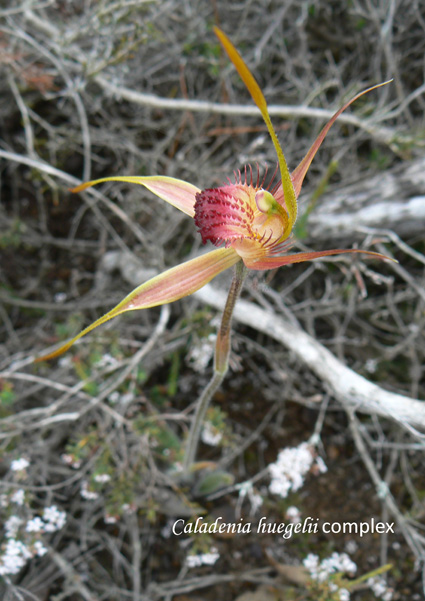
Caladenia huegelii complex
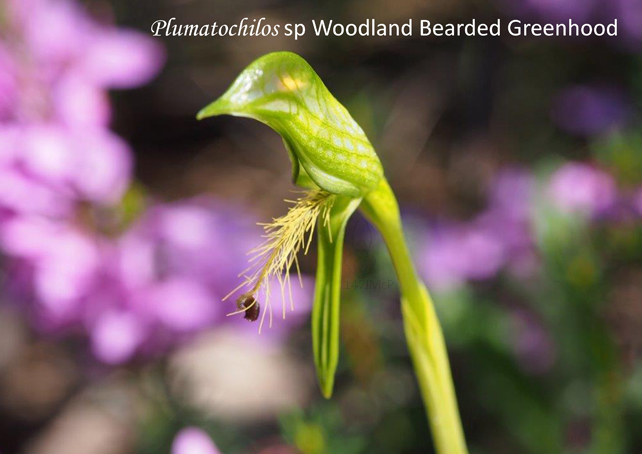
Plumatichlos sp Woodland Bearded Greenhood

Five photos were entered for the September competition and there was a draw, Pauline Meyers’ flower of a plant from the Caladenia hueguelii complex from Western Australia and Jill McPherson’s Plumatichilos sp. Woodland Bearded Greenhood from Scott Creek Conservation Park. The other three by Chris Davey were photographed on Yorke Peninsula (see Letter to the Editor in this September Journal).
As winners they showcase the great diversity that are found in our Australian terrestrial orchids.

Plumatichilos belongs to the greenhoods but the features that set it apart from the other greenhoods are the long thin bristled labellum, the galea pinched in the middle resulting in two openings and the rosette of leaves growing a short way up the stem. Nationally there are thought to be several species but only a small handful have been named. In South Australia, there may be a few distinct species but currently they are usually identified with a phrase name such as Plumatichilos sp Woodland Bearded Greenhood.

Mainly flowering in spring the flowers of the Caladenia huegelii complex are characterised by the thickened clubs on the three sepals, petals shorter than the long sepals, fringed (either short or long) labellum with four or more rows of calli. All of these features can be seen in Pauline’s photograph but the leaf is not so easily seen which should be long, hairy and curve inward. In all there are said to be twenty two species within this complex of which twenty are named.

References:
Brown et al (2013) Field Guide to the Orchids of Western Australia, Floreat, WA Simon Nevill Publications.
Jones, David L (2006) A complete Guide to Native Orchids of Australia, Frenchs Forest, NSW: Reed New Holland
Jeans, Jeffrey & Gary Backhouse (2006) Wild Orchids of Victoria, Seaford Vic: Aquatic Photographics.
Bates, R. J. (2011) South Australia’s Native Orchids NOSSA DVD, Adelaide

2015 August Winning Photograph

08 RP Arachnorchis cardiochila smOf the five entries this month, three were spider orchids and the winner was from this group. It was Rob Pauley’s Arachnorchis cardiochila (syn Caladenia cardiochila), Heart Lip Spider Orchid which can be found across South Australia and into western Victoria. At one time a specimen was found on Flinders Island, Tasmania but as it was collected in 1947 it is considered extinct in that region.

This lovely flower is quite variable in colour and form.

The heart shape labellum is a distinctive feature of this spider orchid, so it is not surprising that this is reflected in the name. Cardio means heart and chila lip.

What probably is surprising is that the traditional heart shape symbol has come full circle. It had a botanical origin. According to cardiologist Professor Armin Dietz the symbol was originally a stylized vine/ivy leaf as evidenced from paintings on goblets from the 3rd millennium. In the Middle Ages, doctors and anatomists used the shape to represent the heart. As at that time Latin and Greek were both the international languages of scholars, including doctors, the word associated with the symbol was the Greek word kardia (ie cardio) meaning heart. Consequently, by the time Ralph Tate names this species in 1887, the shape has become intrinsically linked with the heart and so it must have appeared to him as an obvious descriptive name.

There are several field guides which give a detailed description of the species including South Australia’s Native Orchids DVD-ROM which is available for sale from NOSSA.


References:

http://www.heartsymbol.com/english/index.html accessed 28th August 2015

The texts published on this website are taken from his book “Ewige Herzen – Kleine Kulturgeschichte der Herzbestattungen” (“Eternal Hearts – a short cultural history of heart burials”), published 1998 in MMV Medien und Medizin Verlag, Munich. (English translation by Pauline Liesenfeld.)

http://data.rbg.vic.gov.au/vicflora/flora/taxon/bca2495d-3325-4c1b-b2c3-782566fb6bce accessed 28th August 2015

http://dpipwe.tas.gov.au/Documents/Caladenia-cardiochila-listing-statement.pdf acessed 28th August 2015