From Humble Potato to South Aussie Grand  Orchids: Gold at Chelsea

So the news is out – Aussie orchid (as part of a display with South east Asia and the Pacific) wins Gold Medal for conservation at the 2025 Chelsea Flower Show and according to Professor Kingsley Dixon this is the equivalent to winning Gold at the Olympics. One orchid was a hybrid, Thelymitra glaucaphylla x grandiflora.
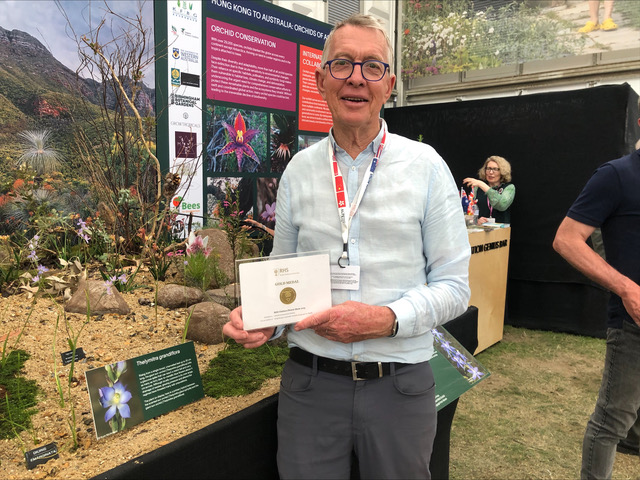
Professor Kingsley Dixon (Image from Australian Orchid Foundation)

The Chelsea Flower Show is a prestigious event managed by the Royal Horticulture Society (RHS) who’s beginnings start with the presentation of a potato at a 1805 meeting. Over time, various exhibitions were developed with the Flower Show Fete first held at Cheswick in 1827 and moving to Chelsea Hospital in 1913  where it became known as the Chelsea Flower Show. The show was popular with exhibitors but only half of the applicants were accepted that first year. But in that group, McBean Orchids (Britain’s oldest orchid nursery) was one of the fortunate exhibitors and so orchids have always been present at the Show, though they were generally not terrestrial orchids.

Image from Australian Orchid Foundation

To win such an award, the team needed to put together a meticulously curated display to meet the RHS stringent standards; even a wrong font can result in disqualification. But there were other barriers to be overcome. Australian terrestrial orchids are not easy to grow. They require skill and attention to detail. Not many people are able to grow this exquisite orchid. In fact less than 10% of our orchid species are in cultivation. So this was quite an achievement in itself.
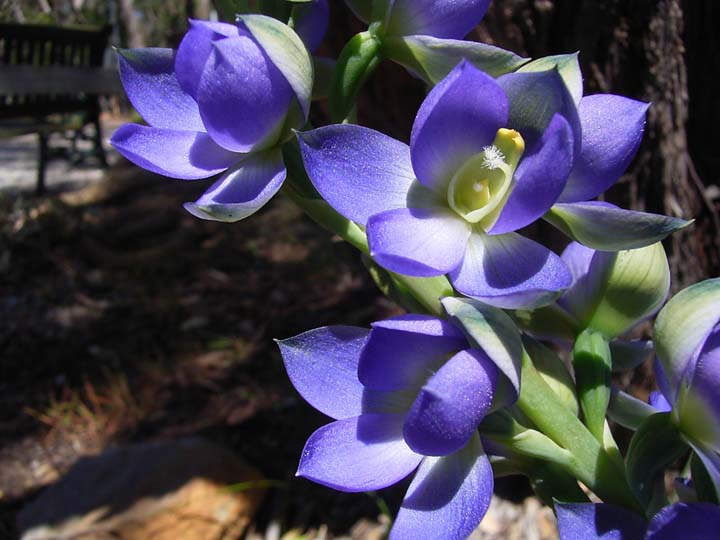
Thelymitra grandiflora (Photographer Robert Lawrence)

Over 90% of Australian orchids are unique to Australia with about half considered threatened;  and so though T glaucophylla does not have a rating, it is still under threat being uncommon. T grandiflora is rated rare. Both are endemic to similar limited areas in South Australia. That is the Southern Mt Lofty Ranges and the Southern Flinders Ranges. Both are under threat from habitat loss, weed invasion, grazing, trampling, etc.  So in-situ conservation is important if these, as well as other orchids, are to survive. 

Working toward conservation of Australian orchids is a major pillar of NOSSA and it was encouraging that two of South Australian endemics played a part in this display. Congratulations for the immense effort that Kinsley Dixon and his collaborators have put into bringing orchid conservation awareness to the Chelsea Flower Show and to the world.
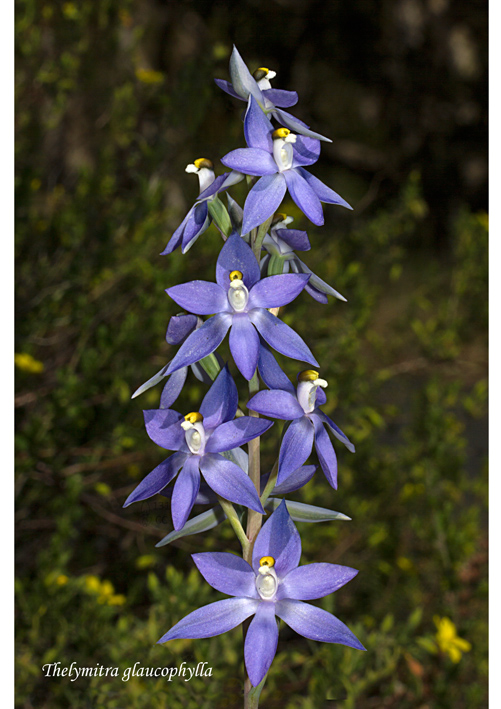
Thelymitra glaucophylla Photographer Claire Chesson

References

History of Chelsea Flower Show
https://www.rhs.org.uk/digital-collections/making-chelsea

McBean Nursery
https://www.mcbeansorchids.com/about-us/

Niejalke June, Native Orchids of South Australia 2022

ABC Aussie Orchid Turns Heads at London’s Prestigious Chelsea Flower Show
https://www.abc.net.au/news/2025-05-23/charles-and-camilla-view-aussie-orchid-at-chelsea-flower-show/105326104

Thelymitra – Atlas of Living Australia
https://bie.ala.org.au/species/https://id.biodiversity.org.au/taxon/apni/51414292#

https://bie.ala.org.au/species/https://id.biodiversity.org.au/taxon/apni/51631246#overview

https://bie.ala.org.au/species/https://id.biodiversity.org.au/taxon/apni/51414288

List of orchids in the display

https://www.bhg.com.au/garden/garden-tours/australian-orchid-at-chelsea-flower-show/

https://www.instagram.com/p/DJ6hGOnINCm/?img_index=1


Links Accessed on 24 May 2025

Blue – it just ain’t natural

2017 June Winning Picture: Blue & White Orchids

1706 sm RWL Thelymitra grandiflora 10

This month’s theme for the photo competition was blue and white. White flowers can occur as a result of lack of colour such as Rosalie Lawrence’s Caladenia latifolia (Pink Fairies) which is normally pink. White orchids can also occur naturally such as the Arachnorchis argocalla (White Beauty Spider Orchid) and Arachnorchis intuta (Ghost Spider Orchid) both photographed by John Fennel, or as a dominant colour such as Lorraine Badger’s Eriochilus collinius (syn Eriochilus sp Hills Woodland).

Of the blue orchids, both Ricky Egel and John Badger entered pictures of Thelymitra x truncata (Blue Spotted Hybrid Sun Orchid) whilst Robert Lawrence entered a Thelymitra grandiflora (Giant Sun Orchid) which was the outstanding winning picture.

Blue in the floral world is unusual colour in the floral world for it is not a naturally occurring colour. In fact, “[t}he key ingredient for making blue flowers are the red anthocyanin pigments. Less than 10 percent of the 280,000 species of flowering plants produce blue flowers.” (Lee, 2010 as cited in Oder 2014).

Whilst blue orchids occur outside of Australia, their “colour cannot rival” … “the intensely blue flowers” … “especially [are] unique in the orchid world” … “of their Australian counterparts. The sun orchids (Thelymitra) in particular are famous for their sky blue flowers.” (Ronse 2008: 103)

Based upon Jones 2006 tome, the following genera have true blue orchid species – Cyanicula (9 species), Pheladenia (1 species), Epiblema (1 species) and the largest group Thelymitra (about 65 out of potentially 118 species) plus one hybrid, XGlossodenia tutelata. Of the epiphytes, blue is almost non-existent except for three which Jones lists that rarely might be bluish and they are Vappodes bigibba, V. lithocola and V. phalaenopsis*.

With such rarity, is it any wonder then that the Chinese attached special significance to it as a plant that could cure lung disease and the Aztecs saw it as a symbol of strength.

*Names used as they appear in Jones 2006 tome

Reference

Jones, D. L., A Complete Guide to Native Orchids of Australia Including the Island Territories. Reed New Holland

Lee, David (2010), Nature’s Palette: The Science of Plant Color< Chicago, University of Chicago Press

Oder, T, The Science of Blue Flowers https://www.mnn.com/your-home/organic-farming-gardening/stories/the-science-of-blue-flowers accessed 6 July 2017

Pretty Zesty All About Blue Orchids http://www.prettyzesty.com/2012/11/all-about-blue-orchids.html accessed 6 July 2017

Why can’t I buy that pretty blue orchid? . . . or Purchasing Aussie terrestrial Orchids on the International Market

When noticed, Australian orchids capture people’s imagination and many want to be able to grow them.  As a result we often receive request for where to purchase them, particularly from overseas.  For people overseas we are unable to help them.  Recently I came across some comments from Philip Shin and he has kindly written about his experience with trying to purchase orchids from Australia.  I trust that his experience will help our overseas people understand some of the issues involved.

So let’s hear what he has to say …..


It has been brought to my attention that there have been many requests from international buyers who wish to purchase Native Australian Terrestrial Orchids from Australia. To give you all a basic idea of who I am and why I’m writing this brief article, I will tell you a few things about me.

Firstly, I am an orchid hobbyist just like you all. I live in the United States of America. My love for orchids stemmed from repeated failures of growing bromeliads, (which I eventually learned how to grow), after which my parents had suggested I try growing orchids instead, as they might be easier to cultivate. I took them up on it and for the most part, when it came to many of the more commonly available orchid hybrids, they were right. After a few tries, I managed to not only grow some orchids, but I also was able to bloom them as well! From here, my appreciation for the hobby grew to include species orchids. Then I learned about terrestrial orchids and how people were attempting to cultivate them in their gardens/greenhouses, and that lead to me wanting to grow them too.

Some of the terrestrial orchids that caught my eyes were those pretty little blue flowered orchids in the genus Thelymitra. I was always told that there were “no such things as orchids that were true blue”, but seeing photos of them contradicted that notion, and thus I was intrigued. Then, I started hearing about how some people were attempting to grow them. I thought to myself, “I must have some!” And that was when reality hit hard.

You see, I eventually learned that acquiring Thelymitras through legal channels was quite an endeavour here in America. I had to acquire a permit through our APHIS/USDA (Animal and Plant Health Inspection Service/ United States Department of Agriculture) to import plants from other countries, (specifically, Australia and Europe in the case of Thelymitras and a few other Native Australian Terrestrial Orchids). Of course, there was also paying for the CITES (Convention on International Trade in Endangered Species) permit and phytosanitary certificate in order to have them make it through our US Customs. The difficult part wasn’t necessarily with the USDA permit, but rather paying for the CITES permit and phytosanitary certificate. When Australia was open for export, the fees for CITES permits and phytosanitary certificates were rather high in price, running at about $250 USD per shipment. But shortly after making two orders to be shipped out from Australia, the exportation laws had changed radically! During this time, CITES and phytosanitary paperwork now cost somewhere in the order of $1,000 USD. It was now clear that Australia was no longer in the business of exporting goods from small companies. Which then brings us to the next option, Europe…

Europe had somehow also managed to get a hold of Native Australian Terrestrial Orchids much earlier than America did, but they were still not very prevalent in the hobby.

It then bears the question, “if Native Australian Terrestrial Orchids are already on the market, why aren’t they more prevalent or more popular?” The answer to this question would be, although people have attempted to grow these orchids, they are not necessarily the easiest orchids to grow long term. Some may be easier than others, but they are still a novelty in the hobby, partially because of this. The difficulty lies in that they are plants that have a tight symbiotic relationship with fungi. I’m not sure whether or not the orchids started to develop smaller and smaller root systems because of the symbiosis, but these orchids do tend to have rather negligible amount of roots. This often makes it difficult to cultivate these orchids, because once the roots get damaged for any reason, they pretty much die. Hence, why these orchids are not more prevalent in numbers despite the demand.

In short, this article is an explanation of the difficulties of obtaining Native Australian Terrestrial Orchids. And this is also some insight on how it is trying to obtain these plants here in America. For anyone coming across this article, I appreciate the time and effort it took for you to read through an American hobbyist’s perspective on Native Australian Terrestrial Orchids. Thank you.


Philip Shin

Pots of Thelymitra nuda cultivated by Les Nesbitt
Pots of Thelymitra nuda cultivated by Les Nesbitt in South Australia

Just as a postscript, Philip mentioned that he could grow Diuris or Donkey Orchid “but that it takes quite a bit of trial and error before you can see anything that resembles success.”