An Examination of Two Rufoushoods

This week’s post is taking a brief look at a paper by Noushka Reiter, Mark Clements and Kate Vlcek which appeared in Muelleria, Volume 31: 69 – 76, 2013.

Titled “An examination of Pterostylis xerophila (Orchidaceae) and the confirmation of P. lingua as a new species in Victoria” this paper seeks to ascertain whether the records collected are correctly identified, that there are differences between them both in morphology and associated vegetation.

Both P. xerophila and P. lingua are found in South Australia where they are known, respectively, by the synonyms Oligochaetochilus xerophilus and O. linguus. In fact the type specimen for O. xerophilus is from South Australia.

In the introduction, the authors give a detailed description of Oligochaetochilus otherwise known as the ‘rufa group’ which differs from Pterostylis, in the strict sense, in several features. Some of the main features of this group are:

  • Basal rosette of overlapping stemless leaves
  • Leaves senesced, withered and died, by flowering
  • Erect multi-flowered
  • Flowers
    • Lateral sepals
      • hang down
      • basal half joined
      • tips become long and threadlike
    • Labellum
      • is very mobile
      • has obvious long white hairs and often short hairs as well
Typical of the rufus hood this Oligochaetochilus arenicola shows the sencesing leaves, pendent petals and hairs on the labellum. Photographer: H Lawrence
Typical of the rufus hood, this Oligochaetochilus arenicola shows the sencesing leaves, pendent petals and hairs on the labellum.
Photographer: H Lawrence

Later in the articles, the differences between the two species are discussed. There is much of interest concerning the two species but one outcome of the research was to establish that P. lingua (O. linguus) had been incorrectly identified in the records and by correcting the names of the specimens the authors were able to confirm that it did occur in Victoria.

To find the answer to the authors other questions, read the paper

And for those that need a glossary of the terminology used, click here

For images of P. xerophila (O. xerophilus) click here

For images of P. lingua (O. linguus) click here

2015 April Winning Photograph: Calochilus cupreus

04 sm HL Calochilus cupreusDespite having five very different but high quality photographs, Helen Lawrence’s photograph of Calochilus cupreus (Aldinga Bearded Orchid) was the clear winner with the vast majority of votes.

In South Australia it is considered endemic and endangered. Researching it was interesting. For instance, there is no mention of it in Jones extensive book (2006) yet it was named by R S Rogers in 1918 with a description appearing in Black’s Flora of South Australia (1922 edition), including a drawing by Rosa Fiveash. Between then and now there was a shift. In the Third edition of Black’s (1978) C. cupreus is absent but C. campestris present. In Bates and Weber 1990 the authors describe C. campetris (C. cupreus). Currently, the eflora of South Australia (the electronic version of 1986 Flora of South Australia) considers it a synonym of C. campestris. This is reflected in the Census.

It would appear that as C. campestris was studied and its variations documented (e.g. article by Jones 1976 Orchadian 5:83) the distinction with C. cupreus was lost. Clements and Jones (2006) state “Calochilus cupreus R.S.Rogers = Calochilus campestris” which means that they are not using C. cupreus. But in Jones’ book an anomaly occurs – he does not include South Australia in the distribution of C. campestris and as result Bates, from 2008, states that it is not recognized as occurring in South Australia.

Though C. cupreus disappeared from the literature the name still continued to be discussed amongst orchid enthusiasts. So when in 1995 NOSSA members found a distinctively different colony at Aldinga they identified it as Rogers’ C. cupreus.

Below is a chart, based upon Dr Rogers’ description, of some of the differences that made him consider C. cupreus a separate species:

C. cupreus C. campestris C. robertsonii
Shorter leaf

Rather rigid or fleshy erect triangular section

Longer leaf

Crescentic section

Longer leaf

Crescentic section

Base of labellum oblong glabrous (without hairs) with several raised longitudinal line Base of labellum round thickened, smooth no raised longitudinal lines Whole of labellum hirsute (hairy)
8 – 15 flowers About 8 flowers maximum About 8 flowers maximum

It will be interesting to watch what happens.

References

Bates personal communications

Bates & Weber (1990) Orchids of South Australia

Bates (2011) NOSSA South Australia’s Native Orchids

Bates (2005 to present) Orchids of South Australia CDs various editions

Clements and Jones An Australian Orchid Name Index (27/4/2006)

https://www.anbg.gov.au/cpbr/cd-keys/orchidkey/html/AustralianOrchidNameIndex.pdf

Jones (2006) A Complete Guide to Native Orchids of Australia

NOSSA Journal Vol 25 No 10 November 2001

Rogers R S Transactions of the Royal Society of South Australia V42 (1918) Pages 24, 25

http://www.biodiversitylibrary.org/item/113409#page/40/mode/1up

Native Orchid Identification Poster Launched

Over the years, Natural Resources Adelaide and Mount Lofty Ranges (NRM) have been involved with providing educational resources for schools and the community.  One resource has been A3 Identification Charts.

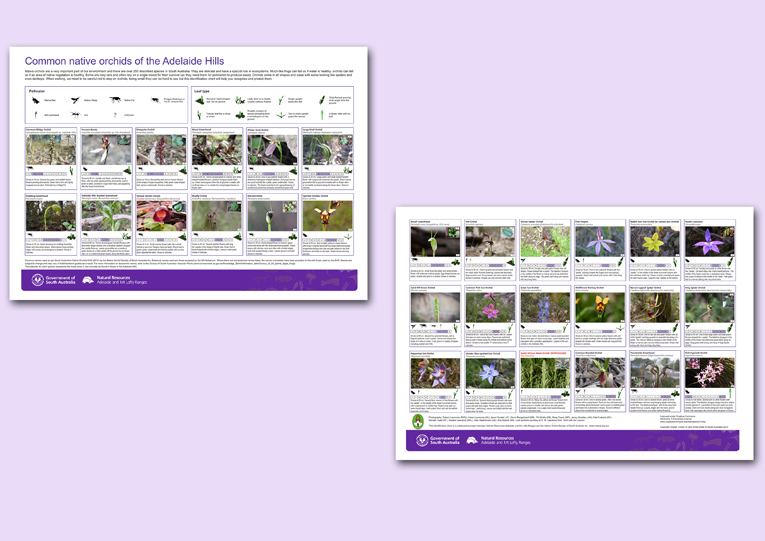
This week has seen the release of  another identification chart – Common Orchids of the Adelaide Hills.  Produced in collaboration with the Native Orchid Society of SA, it was launched at our general meeting on April 28.

These charts are available free from the NRM website.  To get a copy of the poster, click on the image below and scroll down to Identification Charts.  Whilst there have a look at some of their other posters.

NRM & NOSSA Orchid PosterPS the chart looks good on a smart phone which makes it convenient for out in the field.


2015 February Winning Photograph

02 CC Thelymitra glaucophylla sm

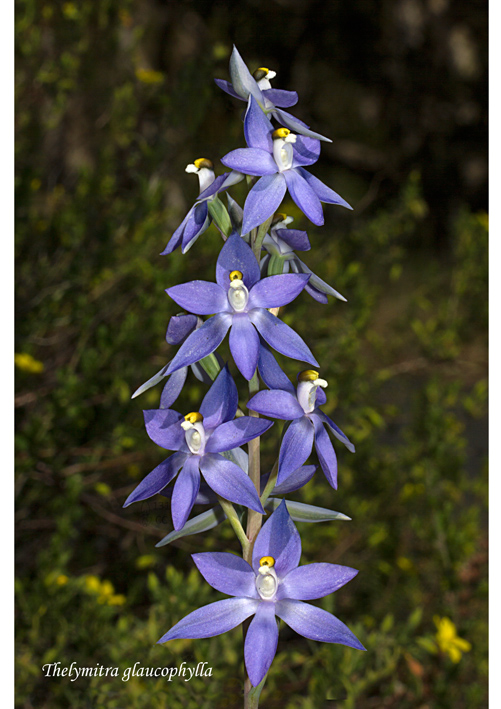
The number of photographs may have been few but the quality was present. The clear winner was Claire Chesson’s Thelymitra glaucophylla (Glaucous Leaf Sun Orchid). Flowering from October to December, this endemic grassy woodland species of the ranges was only published in 2013 by Jeff Jeanes in the Mulleria 31:3 – 30 (2013) but it had been recognized much earlier by Bob Bates and has appeared with this name in his electronic Orchids of South Australia since 2005. It belongs to the T. nuda complex, of which there are 15 species, six of them having only been published in 2013. This complex is characterised by having large scented blue multiple flowers that open freely.

Not seen in this picture is the leaf and though the leaf is highly variable – 10-50cm long, 8-20mm wide, erect and short, long and flaccid, Jeanes mentions that T. glaucophylla “can be identified with a high degree of confidence from the mature leaves alone” (Page 4 Vol 31, 2013 Mulleria). The main features of the leaf are grey-green glaucous ie white bloom and is often senescent (withered) at anthesis (full flowered). Of the T. nuda complex, T. megcalyptra is the most similar but its leaf is never glaucous and has a red base, as well as an earlier flowering time and habitat of plains and rock outcrops.

For more details on the other orchids in the T. nuda group see the post titled Those Blue Orchids Again … posted 30th January 2015 with the link to Jeanes article in the Muelleria

2014 November Photograph Competition Part 2

Part Two of the November competition consisted of photographs of insects on orchids. There was quite a range of insects but the winner was a draw between Cyrtostylis robusta (Winter Gnat Orchid) with an ant and Pterostylis curta (Blunt Greenhood) with a midge fly; both taken by Doug Castle.

With today’s technology it is not only easier to take crisp images but fine details can be seen particularly when enlarging the image. Hence when the pictures are enlarged it is possible to see hairs on the ant and feathered antennae on the midge fly.

With identifying orchids, it is often the detail that is important. Both of these orchids are distinctive and can be readily identified but it is good to examine why this is the case.

Pterostylis curta (Blunt Greenhood)

With the greenhood, there is enough detail to see that the dorsal sepal and lateral petals have united to form a galea, ie hood, and that the lateral sepals are semi-fused and erect resulting in lateral orifices (side gap) between the two structures. These are some of the features that separate Pterostylis* from the other greenhoods such as Diplodium, Speculantha and Taurantha. This becomes apparent when browsing through the greenhood photographs, pages 286 to 339, in Jones “A Complete Guide to Native Orchids of Australia”. Having established that the plant is a Pterostylis, the twisted labellum is diagnostic of a P. curta as it is the only one that is described with a twisted labellum. Although not all the identifying features are present, enough information is available in this picture for identification.

In contrast the photograph of the Cyrtostylis robusta only has sufficient data to confidently identify it as a Cyrtostylis species, having a distinctive labellum that is larger than the lateral sepals and petals. In South Australia there are only two species and according to Bates (2011), the distinguishing features between the two

Cyrtostylis robusta (Winter Gnat Orchid)

appear to be the leaf, the bud and the labellum. In this picture, the angle of the image does not give a clear view of the labellum (it could possibly be damaged) and of course there is no bud or leaf. It is possible that the pale edges of the dorsal sepal may give a clue to species identification as C. reniformis has mainly darker buds than C. robusta. Obviously Doug was able to identify it from his observations of the other features not present in this photograph.

In summary, one image is not always sufficient for identification. As was discussed on the night, to confirm identification, orchids should always be photographed from more than one angle, including pictures of other parts of the plant.

*In South Australia, Pterostylis foliata is a possible exception as it has no obvious lateral orifice.

References

Jones, D.L., T. Hopley, S.M. Duffy, K.J. Richards, M.A. Clements & X. Zhang (2006) Australian orchid genera. An information and identification system. CSIRO Publishing: Collingwood, Vic.

Bates, R.J. (2011) South Australia’s Native Orchids. DVD-ROM. Native Orchid Society of South Australia Inc.: Adelaide.

Jones, D.L. (2006) A complete guide to native orchids of Australia, including the island territories. New Holland Publishers: Sydney.

Another Summer Orchid

Just on Christmas, NOSSA received an enquiry from Tim in the South East about an orchid he had photographed.  He knew about Dipodium roseum but in 20 years he had not seen one like this one.

From the photograph that he’d sent, it was obvious that it was a Gastrodia.  In South Australia there are three species ranging in size from the smaller G. vescula (Limp Potato Orchid) through to G. sesamoides (Cinnamon Bells or Common Potato Orchid) to the larger G. procera (Tall Potato Orchid).  Whilst G. vescula and G. procera are limited in South Australia to the South East, G. sesamoides is also found in the Southern Lofty and Kangaroo Island regions.

Tim’s orchid was G. procera.  The features that set it apart from the other two were the time of year – late December whereas both G. sesamoides and G. procera would have finished flowering (and for 2014 most orchids finished flowering earlier than usual); the spike was crowded and the plant was upright but G. sesamoides has a bent or droopy spike when in bud and G. vescula is small with very few flowers.

Though Tim considered the photographs to not be very good, he’d photographed the necessary features to help with identification. Another feature seen in his picture is the warty appearance of the plant compared with the photograph of the G. sesamoides.

Gastrodia procera or Tall Potato Orchid
Gastrodia procera (Tall Potato Orchid) Note the upright spike and the ‘wartiness’
Gastrodia sesamoides (Cinnamon Bells or Common Potato Orchid)


Although it is has no conservation rating federally and may even be considered secure in the Eastern States, in South Australia it is rated endangered, so well done to Tim for spotting it!

 It was possible to identify this orchid from the information found in South Australia’s Native Orchids, an electronic book produced and sold by the Native Orchid Society of South Australia.  Identification was confirmed by one of our most knowledgeable members.

2014 September Winning Photograph

The winning picture was a single flower of Thelymitra epipactoides (Metallic Sun Orchid) taken by Rosalie Lawrence. This picture was cropped from a photograph taken on a mobile phone. Phones have come a long way since the days of Alexander Graham Bell!

Thelymitral epipactoides or Metallic Sun Orchid

T. epipactoides is a special orchid both in its beautiful colourings and that it is one of our rarest orchids. This endangered species has been well studied in an effort to prevent its demise with the result that there is an abundance of information about it. Recently, with the knowledge gained, Dr Nouska Reiter of the Australian Network for Plant Conservation (ANPC) and her team have managed to cultivate 3,000 plants with the plan to re-introduce them back into the bush in the Wimmera area.

Following are some interesting points from two good sources, which are the

  1. Biodiversity Information Resources Data page  (quotes in blue)
  2. Species Profile and Threats Database page  (quotes in brown)


Life Cycle

  • (2)……can remain dormant as a tuber in the soil for up to nine years ……….

(But once a plant has flowered)

  • (2)…….Plants can produce flowers from their second year of growth onwards for up to four consecutive years, but no more. Individual plants can remain dormant for up to two years then grow to produce flowers, but if dormant for four years or more, plants generally do not reappear. …..
  • (2)…… Detailed monitoring suggests that mature plants only live for about 10 years before dying (Cropper 1993). ……..
  • (2)……..flowers open when the relative humidity is lower than 52%, air temperature is above 15 °C, and there are clear skies ………….
  • (2)……..Flowers remain for up to four weeks but wither a week after pollination ……
  • (2)……. fungus is required to initiate successful seed germination (Calder et al. 1989) and seeds cannot survive more than two weeks without associating with the fungus ………

Plant Information

  • (1)…….Flower colour is highly variable, brown, copper, blue and green being the main colour groups which are determined by the proportion of red, blue and green epidermal cells, some of which are reflective giving a metallic appearance. …….
  • (2)….The leaf is loosely sheathing ………
  • (2)…Mature non-flowering plants have slightly narrower leaves to 51 cm long and not sheathing …
  • (1)………Flower colour is highly variable, brown, copper, blue and green being the main colour groups which are determined by the proportion of red, blue and green epidermal cells, some of which are reflective giving a metallic appearance. ………

Topography:

  • (2)…. is undulating plains, crests of hills, gentle slopes of low broad ridges and at the bottom of broad, shallow swales (Obst 2005). It grows in sandy soils over a clay subsoil, with these soils having a tendency to become waterlogged in winter and spring, and drying out in summer and autumn ……
  • (2)…..This species is a post-disturbance coloniser, utilising early successional stages after disturbance events such as human activities, fire, animal activities such as scratching of the soil, or associated vegetation disturbance. ……
  • (2)……..requires open sites for flowering and seedling recruitment (Calder et al. 1989). ………

Population Size

  • (1)……Population estimates vary from about 1050 plants in Australia (DEH 2006), to less than 3,000 plants (Coats et al 2002). More recent assessments suggest the population could be less than 1500 plants in the wild …….
  • (2)……In the Murray Darling Basin and South East Regions of South Australia there were ten populations of the Metallic Sun-orchid recorded in 2004 by Obst ……..


Reminder – November theme is Orchids and Insects (Spiders and other such critters are honorary insects)

Australian Orchids and the Doctors they Commemorate Part 6 of 20

Archibald Menzies (1754 – 1842)

A British navy surgeon who circumnavigated the globe from west to east with Captain George Vancouver, in the tumultuous voyage of 1791 to 1974, explored extensively in south-west Western Australia, and was later president of the Linnean Society of London; his name is recorded in the names of banksias (including the firewood Banksia [Banksia menziesii]), orchids and mosses of the King George Sound hinterland which record his service to Australian botany.

Orchid species: Leptoceras menziesii (=Caladenia menziesii)


This orchid is the emblem of Native Orchid Society of South Australia

Australian Orchids and the Doctors they Commemorate Part 5 of 20

Having looked at the background, Professor Pearn documents the individual doctors and orchids.  In the original paper the doctors were listed alphabetically but these posts will be in chronological order based upon the doctor’s year of birth.

Daniel Solander (1733 – 1782)

A medical student in Sweden and London, and botanist-librarian on the Endeavour voyage to Austalia (1769 – 1771); his name is commemorated in the names of Australian species of Aciacia, Banksia and Geraniums.

Orchid species: Orthoceras strictum (= Orthoceras solandri)

The type specimen is from New Zealand.


May 2014 Winning Photo

05 PM T pulchemirra sm

Pauline Meyer’s winning photograph is a whole plant picture of Western Australia’s flamboyant Queen of Sheba Orchid.  It was taken at Eneabba, north of Perth and identified by a local as Thelymitra variegata but in consulting the books it would appear that it is the Northern Queen of Sheba, T. pulcherrima.  There are three species known as Queen of Sheba orchids in Western Australia – T. varigata, T. pulcherrima and T. speciosa.

T. variegata was originally named in 1839 by John Lindley but under the genus Macdonaldia.  In 1865 Ferdinand Mueller moved it to Thelymitra, later people began to separate it out to three different species* but it wasn’t until 2009 that Jeff Jeanes describeds T. pulcherrima and T. speciosa as distinct species from T. variegata.

All three species have a single thin spiral leaf and showy multi-coloured flowers.

T. pulcherrima and T. speciosa differ from T. variegata in the following points.

  • T. speciosa, begins flowering earlier, is a slightly shorter plant with fewer flowers (one, more rarely two) and although the flowers are a similar size to T. variegata they are even more colourful and the petals and sepals are distinctly different colours.
  • T pucherrima is similar in height to T. variegata but has smaller flowers with yellow, red, purple mauve sepals and pink purple mauve petals.  It too begins flowering earlier than T. variegata.
They all have distinct separate locations as reflected in the common names – Southern Queen of Sheba (T. variegata), Eastern Queen of Sheba (T. speciosa) and Northern Queen of Sheba (T. pulcherrima).  For some good images go to Retired Aussies or the Chookman
 
Finally there is one other species that is similar to these three and it is called Cleopatra’s Needle, T. apiculata.
 
  Thelymitra pulcherrima Theylmitra speciosa Thelymitra variegata
  Northern Queen of Sheba Eastern Queen of Sheba Southern Queen of Sheba
Distribution North of Perth between Lancelin and Dongara Between the Stirling Range and Condingup Between Perth & Albany with disjunct populations near Hyden
Flowering late June – early September late June – September August to September
Flower numbers 1 to 5 1 to 2 1 to 5
Flower height 150 – 350 100 – 200 mm 100 – 350 mm
Flower size 25 – – 35mm 30 – 50 mm 30 – 50 mm
Sepals Yellow, red, purple and mauve Yellow, red, purple and mauve Deep pink purple blotched
Petals Pink or purple and mauve Pink or purple and mauve Deep pink or purple and darker purple blotched
 
References:
Field Guide to the Orchids of Western Australia 2013, pages 425 & 427
I would like to thank Andrew Brown, co-author, for his help with this article.
 
* The name T. puchemirra is mentioned in the Western Australian Native Orchid Study and Conservation Group 2008 field trip report