Pauline Myer’s Caladenia falcata and Caladenia carinsiana;
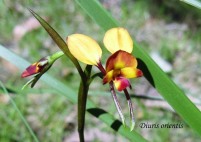
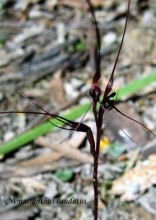
Margaret Lee’s Diuris orientis and Nemacianthus caudatus;
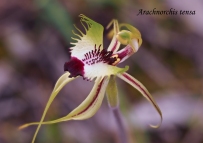
Judy Sara’s Arachnorchis tensa;
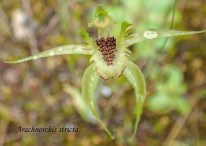
Greg Sara’s Arachnorchis stricta which had an unusual green coloured flower;
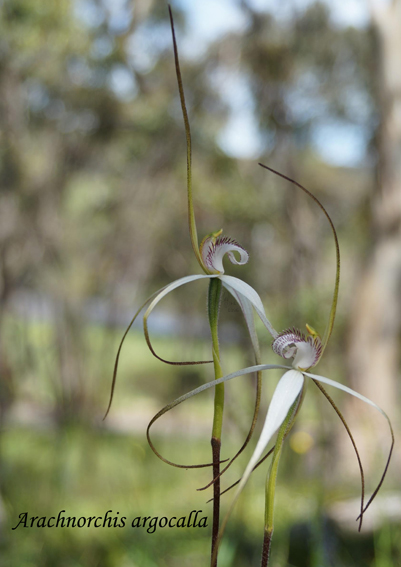
and Helen Lawrence’s Arachnorchis argocalla.
Helen’s picture of the nationally endangered A. argocalla was the outstanding winner. Now known as the White Beauty Spider Orchid^, it was featured last year as a winner with Pauline Meyer’s June 2015 entry*.
This is one of our largest spider orchids. For size, beauty and delicacy it rivals the Western Australian Caladenia longicauda ssp. eminens (White Stark Spider Orchid) and A. venusta, syn. Caladenia venusta (Graceful Spider Orchid) from Victoria and the South East.
It shares many similarities with these two species in that they are reasonably good size white flowers with a stiffly hinged labellum that has long, thin teeth and the segments have threadlike tips without clubs. It is separated both geographically and in the type of habitat from these two species. A. argocalla is a plant of the inland hills and valleys.
Though primarily a white flower and part of the A. patersonii complex, A. argocalla has red colouring in the labellum which according to Backhouse may possibly indicate genetic introgression (that is long term mixing of the gene pool) with either the A. reticulata or A. leptochila complexes. Certainly, the colour of the labellum was quite variable ranging from white through to a deep red.
^Previously known as Common White Spider Orchid because of its abundance but now only known to a limited number of locations.
*NOSSA Journal, July 2015
Reference:
Department of the Environment (2016). Caladenia argocalla in Species Profile and Threats Database, Department of the Environment, Canberra. Available from: http://www.environment.gov.au/sprat. Accessed Thu, 3 Nov 2016 16:31:39 +1100
Mad dogs and Englishmen are not the only ones to go out in the midday sun. For orchidologists to see Sun Orchids flowering, then it is out into the midday sun on a hot day because that is when they open. There is no point going much before 11am and by 2pm most are closing and no point going out on a cool or windy day.
But for those who don’t want to go out (or cannot get out) into the midday sun, here is a video to be viewed in the cool of the shade.
This video features the Leopard Sun Orchid (Thelymitra benthamiana) an uncommon Sun Orchid in South Australia. Unlike many sun orchids which requires a view of the flower to confirm identification, this one can be identified by the leaf alone. At the beginning of the video take note of its distinctive leaf.
Continuing last week’s blog, here is the completion of Rudie Kuiter’s Introducion, Orchid Pollinators of Victoria. In this section he discusses some factors of hybridisation and the value of regular observation by local people interested in orchids.
Lissopimpla excelsa is the pollinator of all members of Cryptostylis, but hybrids are not known, even when sympatric, thus a molecular mechanism is in place that prevents cross-fertilisation. Hybrids in other orchid genera do occur and these usually are amongst closely related species. Several congeneric orchids attract the same male pollinator species, thus would be emitting the same kairomones, the scent that is a mimic of the female’s sex-pheromones, but normally these orchids are allopatric or have different habitat preferences. The land clearing, frequent fires, changes of watercourses, gold-diggings are amongst many unnatural human habitat interference of recent times. Historically in undisturbed natural habitats sibling orchid species that attracted the same male insect were not sympatric, not flowering at the same time or were in close vicinity to each other. In disturbed sites the situation has changed, as closely related species may have become sympatric and hybridisation take place. Spider-orchids that attract thyniid wasps with kairomones normally target a certain local species, but many allopatric species are know to share the same pollinator and readily hybridise where they became sympatric. In Pterostylis greenhoods the known hybrids are also caused when different species attract the same pollinators.
Cryptostylis subulata (Moose Orchid)
We still have much to learn to fully understand how adaptable the orchids are, the role insects play and how to interpret what we see. Orchids are finely tuned to their world and can change and adapt in ways that most people seem to underestimate. I requires observations of the same plants over many seasons to get a good understanding of their variability and adaptability. Unusual forms often show after a drought or fire may look like a new species, but soon change back to typical or normal within a few good seasons or after regeneration. It is usually the local people taking an interest that see the changes in the same plants over time that dispute what the ‘on-the-fly’ taxonomist come up with.
Creatures evolved as part of an endless combination of life-forms, ranging from microscopic to the tallest tree, that together form an ecosystem in which all organisms depend on each other. The climate, weather and other factors changes the environment constantly that influence the members differently, dome doing better than others, but it collectively maintains a balance. Natural events such as a major fire or flood may benefit environments in areas as part of seemingly long cycles, but they are very short in evolutionary terms. Unnatural man-made fires are very destructive as these are conducted much too frequently, wrong time of the year, and in the wrong place. Not obvious, but also very detrimental is the use of insecticides that seems to effect the Diptera members the most. Many of the important pollinators such as the fungus-gnats have gone locally extinct and most of the Pterostylis depend on them. To work with the pollinators it is essential to have a good understand of the life-cycles of the insects involved and watch the flowers in the wild. After witnessing Pollinator behaviours of the fungus-gnat on Pterostylis nutans countless times, the principal pollinator is easily recognised with other species. Unfortunately few good areas to find orchids and learn about their pollinators are left. Many are now rare and measures taken to protect them usually focuses on just a species. To be effective their habitat area and surrounding needs to be cared for, letting the natives grow and have the natural canopy reform. At least, habitats should be protected from further disturbances, especially by badly informed governmental environment departments with their fires.
Pollinator with pollinia
Note This book is solely based on first-hand observations on the orchid-pollinators in the wild. Descriptions and comments are from many hours of watching each species over multiple seasons.
Apart from Orchid Pollinators of Victoria, Rudie Kuiter has produced several Victorian orchid books. If you are interested in purchasing any please contact us.
This week’s blog, Part One of Two Parts, is quoted directly from the introductory chapter (Pages 2&3) Orchid Pollinators of Victoria 4th Edition, 2016, Rudie Kuiter. Over the years of photographing orchids and their pollinators, Rudie and his team have been discovering much of the hidden world of orchid pollinators. In this first section he highlights the fallacy of the “one orchid-one pollinator” as well as touching briefly on the vast difference between the insects and their role in the ecosystem.
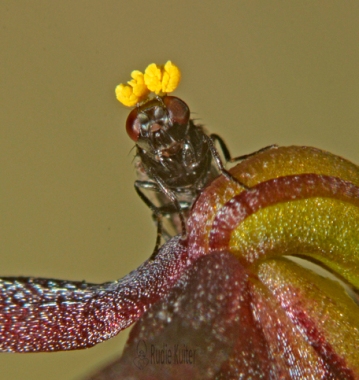
Amongst flowering plants, orchids have evolved in their own special reproductive ways. Their pollen is massed as waxy packages, pollinia, unlike like (sic) other flowers that produce masses of fine pollen grains that mostly go astray. The pollinia are relatively heavy and the usually small creatures need to be strong fliers for cross pollination (see image below). Orchids evolved with amazing strategies to attract specific carriers in order to transfer pollen between flowers of their species only, and in this way eliminating the need to produce great quantities. Various insects, many moths, bees and even birds have been documented as pollinators of orchids around the world (v.d. Cingel, 2001). A number of uniquely different examples of orchids attracting insects for their pollination evolved in Australia, especially in the more temperate southern zones originating from Gondwana times. With very few exceptions the Victorian orchids are terrestrial, ground-dwellers, that rely on small insects such as fungus-gnats, native bees, wasps, ants and many attract only the males by sexual deception. In the case no pollinators visits, many species may self-pollinate as a back up.
When taking an interest in orchids it seems difficult enough to identify some species. Usually one looks and admires the amazing flowers that may resemble an insect and can be difficult to recognise as a flower at first. An insect on a flower may be thought of something that spoils a picture – until taking an interest in the visitor!
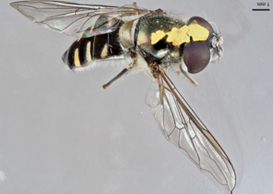
Hoverfly on Caladenia rigida (syn Arachnorchis rigida)
I first learned about the orchid pollinators in Orchids of South Australia by Bates & Weber, 1990, an excellent book by today’s standard, but few were seen over the years by just being there at the right time when photographing orchids. During preparation of the book on Caladenia spider-orchids, certain issues developed from questionable statements made in scientific papers about wasp-pollinators. Of particular concern was about the one-to-one relationship – how only one wasp-species would be involved with only one spider-orchid species – and suggesting populations that were thought to represent the same species comprised different taxa if not pollinated by the same wasp-species. A very different story emerged when monitoring the local spider-orchid populations to find the answers and it became clear that there was much more to it. A site in Wonthaggi with a very large colony of Caladenia dilatata proved to be perfect for this study and also to photograph pollinators as it produces flowers for about four months. It was found that a local wasp-pollinator species typically flies for a little over one month, thus this need to be investigated further. Scientific publications on wasp-pollinators were generally based on short-term experiments, and usually employing baiting methods – moving flowers and often taking them to different sites. Responses included unnatural behaviour or attracting sibling wasps at a non-local site. It is certainly true that a particular flower may attract only one species of wasp a t a locality and a certain time in the season, but this reflects a very small part of the picture. It can be different in the long-term, at certain localities or with a season.
The main study site was in coastal dunes, where in a very large population of Caladenia dilatata produced flowers for over four months from September, and under favourable Summer-conditions into January. At least three congeneric (belonging to the same genus) thynniid wasps species were involved in this population. The flying times were up to about 6 weeks for each wasp species, that were separated or slightly overlapping. The flowering times in other populations of C. dilatata in Wonthaggi and Wilsons Promontory were usually about one month in each, and at the corresponding times to the study site the wasps visiting were the same species. A close sibling C. parva in the Wonthaggi heathland habitats and early flowering C. dilatata were pollinated by the same species, but the later flowering C. tentaculata by a thynniid wasp of the different genus.
Hoverfly with pollinia
Whilst a flower may attract only one wasp species, the kairomones (chemical omitted by the orchid to attract a pollinator) of a species may vary between flowers within in a population or when allopatric (growing in different geographical regions), just like colour or morphology. Variations maybe in relation to locality, weather conditions, or ground chemistry and available pollinator. Pollinators may evolve over time, but adaptions usually require many seasons and this would vary with location. The observations made over several seasons suggest that more than one congeneric insect is involved in pollination depending on local or seasonal conditions, especially after a long drought. Chiloglottis gunnii populations in Langwarrin were checked for pollinators since a decade-long drought and no action was seen for many seasons. When wasps finally made an appearance they comprised different taxa of Neozeleboria the first season, but only one became the common and principal pollinator the following seasons. Thynniid wasps are very localised as females lack wings and rely on the males to carry them around during copulation and to provide food. It limits their travelling and their homing range may comprise just a few hundred metres. Thynniid wasp are very vulnerable in small reserves isolated by land-clearing, and certain species have gone locally extinct due to conducting burns. Insects form a crucial and fundamental part of an ecosystem, but their importance is never considered in the planned burning, showing a complete lack of understanding by people in charge. So little is known of ecosystem’s foundations, but controlled burning continues – ruining precious habitats. Orchid species failing to produce seed pods is an indication that pollinators were absent, probably gone locally extinct. Orchid species that have a sexual association with thynniid wasp pollinators are localised and usually have geographically variable flowers. The situation is different with Cryptostylis spp. And their pollinating male wasp Lissopimpla excelsa, as females are a strong flyers. The flowers of Cryptostylis are geographically uniform in each species and the wasp is widespread. Both sexes are very distinctive in colour that show no variation. They are active over Spring and Summer and are great travellers.
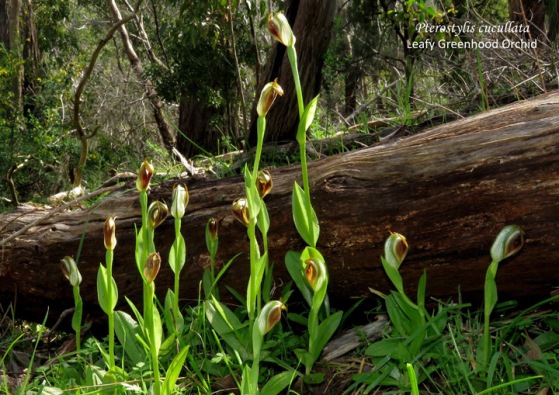
Spring is here and it was reflected in the variety and large number of entries. Lorraine Badger and Ros Miller entered Western Australian species – Caladenia x ericksoniae (Prisoner Orchid) and Paracaelana nigrita (Flying Duck Orchid) respectively. The other six entries were all from South Australia, Diplodium robustum (Common Green Shell Orchid), Caleana major (Flying Duck Orchid) both from Jane Higgs, Greg Sara’s Oligochaetochilus sp (Rufoushood), Judy Sara’s Arachnorchis leptochila (Queen Spider Orchid), Claire Chesson’s Diuris behrii (Cowslip Orchid or Golden Moths) and the outstanding winning picture Pterostylis cucullata by Bevin Scholz.
In many ways, Bevin’s picture of P. cucullata (Leafy Greenhood) is a special picture because it represents some of the conservation work with which NOSSA is involved. For many years NOSSA has worked with the Threatened Plant Action Group (TPAG) to weed the areas in Belair where this species is located and to see such a good show of plants is encouraging. It is a tribute to all who have contributed with their time and labour.
P. cucullata is rated Vulnerable both in South Australia and Victoria, and Endangered in Tasmania. It is also rated Vulnerable under the EPBC Act (Federal). Nationally it is known from about 110 sites with most of these sites being in Victoria and only a few sites in South Australia with Belair National Park having the largest and most important population for the state.
Historically this species covered an area of 2107 km2 in the Lofty Block region but that has now contracted by 82% to only 366 km2 with few locations. With such a reduced range, recovery plans were developed, both at state and federal level. The plans examined the risks and threats to the survival of the different populations.
One of the threats to this orchid is fire, including proscribed burns. Unlike some species such as Pyrorchis nigricans, Leptoceras menziesii or Prasophyllum elatum which flower well after fire, P. cucullata is fire sensitive; populations decline substantially. There does not seem to be a safe time to burn for this species. Should a population survive a burn, it would take it many years to recover.
Fire also leaves the population vulnerable to another threat, that of weed invasion. Unfortunately, it is weedy where this species survives but over the years, a consistent, targeted weeding program has resulted in a declining weed population. NOSSA and TPAG have appreciated the work and effort of volunteers and gladly welcome anyone else who would like to join. And one of the rewards? A beautiful, sunlit display of flowers as seen in Bevin’s picture.
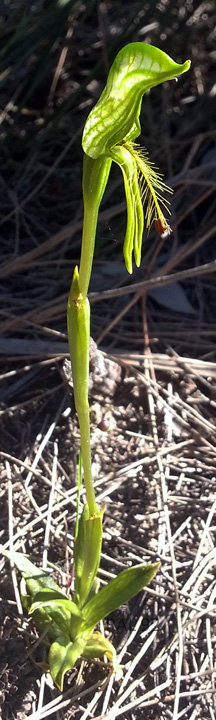
If you are out and about this week, keep an eye out for this attractive and unusual greenhood with its bottle brush labellum and rosette of “pineapple” like leaves.
Commonly known as Woodland Plumed or Bearded Greenhood, or Plumatochilos sp. Woodland Bearded Greenhood. The reason for the phrase name is because many consider that it is a separate species, in this instance, from Plumatochilos plumosum (syn Pterostylis plumosa). Originally all of the Bearded Greenhood were considered as one species – Pterostylis barbata but then Leo Cady named Pterostylis plumosa as a separate species. David Jones in his 2006 tome listed four species, P. barbatum, P plumosum, P. tasmanicum and P. turfosum.
Here in South Australia, Bates lists P. tasmanicum and two with phrase names suggesting that they are distinct from P. plumosum.
Peter Fehre recently posted on the Tasmanian Native Orchids Facebook page some helpful hints differentiating between P. tasmanicum and P. plumosum. Very similar information is found in Bates South Australia’s Native Orchids. These differences are:
P. tasmanicum – a short plant: short flower stem (not more than 14 cms), short labellum (to 15mm) , short ovary; short blunted galea (hood) to 25mm. It prefers damp, sandy areas and swamp margins.
P. plumosum – has length; long flower stem (10 – 30 cm), galea to 40mm with a long tip, long labellum (to 25mm). It is a plant of the woodlands and forests growing on well drained soil.
The differences between the two phrase named species are more subtle
References:
R J Bates, 2011, South Australia’s Native Orchids DVD, NOSSA
D L Jones , 2006, A Complete Guide to Native Orchids of Australia
The Native Orchid Society of South Australia (NOSSA) is affiliated with the national body of native orchid society, Australian Native Orchid Society (ANOS). NOSSA regularly sends reports of its to ANOS. This year’s report covered four years of the society’s activities and is reproduced here to give readers an idea of the many things that we do. This report was produced by Robert Lawrence (currently Vice President).
NOSSA REPORT 2012 to 2016
I believe that the last annual report from the Native Orchid Society of South Australia was in 2011 when we were just commencing a three-year plan with the establishment of a series of subcommittees. All of the committees have since ceased to exist, but not without significant accomplishments.
The Website Subcommittee had established a website, but a Webmaster has since been appointed. The website now uses WordPress and is maintained so that its management could easily be transferred to another person. The website provides a weekly educational post about Australian orchids. It has also provided a point of contact from those outside of the Society. It is linked to a Facebook page that increases the profile of NOSSA among those interested in orchids throughout Australia and beyond.
The Education Subcommittee had established a picture competition at the monthly general meetings. There is still only a small number of contributors, but many excellent pictures are shared. The winning picture from each meeting is used as a basis of one of the weekly posts on the website.
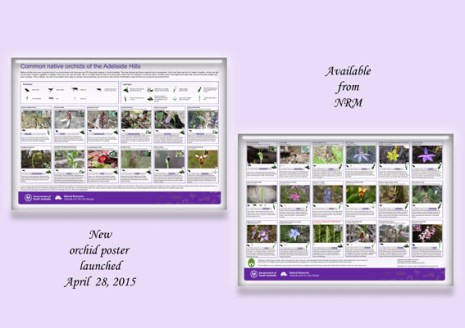
The Education Subcommittee had a vision to produce a brochure of 20 common orchids of the Adelaide region for free distribution to the general public. The NRM (Natural Resources Management) Education ran with the idea and produced a poster of Common native orchids of the Adelaide Hills. This provided brief, but comprehensive, profiles of 29 native orchids and the weedy species. This has been printed as a double-sided poster and is available from the website of Natural Resources Adelaide and Mt Lofty Ranges. NOSSA members worked with NRM staff on the details of the poster and NOSSA members contributed many of the photographs. This poster was completed and launched in April 2015.
NOSSA also provided monetary assistance as a loan with the publication of the field guide entitled, Start with the leaves. A field guide to common orchids and lilies of the Adelaide Hills. This guide covered 50 orchid species as well as native lilies and some weeds in the Iridaceae family that are sometimes mistaken as orchids. The contribution of $8,000 was recovered only 8 months after publication.
The Disc Publication Sub-editing Subcommittee saw the publication of South Australia’s Native Orchids on DVD discs in time for the Spring Show in September 2011. Both the DVD and the book were published in time for the Spring Show in September 2011. Both continue to sell.
A new subcommittee has been established in February 2016 to oversee the publication of a field guide, expected to be called Wild Orchids of South Australia. It is proving to be a challenge to be brief enough to reduce the information to a size suitable for a field guide. (Editor’s note: it has since been decided to defer this until after the development of the interactive website, see below.)
NOSSA members have being working since 2014 to establish an interactive website and database modelled on the Go Botany website run by the New England Wild Flower Society in the USA. This was supported by a grant from the Australian Orchid Foundation. The project is called Wild Orchid Watch. It is hoped to produce an interactive, web-based orchid identification tool. Recording sightings through such means as apps on mobile telephones are also being investigated.
In 2014 NOSSA made a donation to help establish the Orchid Conservation Program. This was led by Dr Noushka Reiter. Once established, staff in the Department for Environment, Water and Natural Resources began to organise a trial with four threatened orchid species from South Australia. Noushka visited South Australia during 2015 and collected samples from each of these species and isolated fungi from these. Seed was also collected and work on propagation commenced in 2015. During 2016 NOSSA sponsored the propagation of one of the four species through the Adelaide Botanic Gardens. Caladenia gladiolata, an endemic species, was selected.
Paul Beltrame, a secondary teacher at Kildare College, contacted and joined NOSSA during 2014 with the interest in getting girls at this school involved in the propagation of native orchids. A program was organised modelled in the Orchids in Schools program run by the Orchid Club of South Australia with Les Nesbitt’s involvement.
A delegation from Kildare College, ably assisted by their enthusiastic laboratory assistant Nenah McKenzie, visited Noushka in Melbourne and learnt the technique for separating and growing fungi. They have since separated fungi from two of our more common greenhood species and supplied this for seed kits that were made available to members as a trial at the start of the 2016 growing season.
The trial of seed kits was done for Pterostylis nana and Pterostylis sanguinea. A trial was conducted in this growing season of seed kits for members. Kits included a pot, growing media, seed, fungus, mulch and instructions. There seems to be limited success with the current round, but improvements are planned from the lessons learnt. One particular growing mix proved successful with a small number of seedlings appearing. The contribution of the Orchids in Schools program at Kildare College has been necessary for the isolation and production of fungi for the kits.
In October 2012 Cathy Houston and Robert Lawrence collected seed of Pterostylis arenicola from the only population on the Adelaide plains after monitoring in September indicated a good year for seed production. The seed was germinated in 2013 and was deflasked at a working bee at the Adelaide Botanic Gardens in early August 2016. The students from the Orchids in Schools program at Kildare College participated. Latest reports are that 40 plants look like surviving. These will be used for seed production and for reintroduction.
Typical of the rufus hood this Oligochaetochilus arenicola shows the sencesing leaves, pendent petals and hairs on the labellum. Photographer: H Lawrence
In 2012 NOSSA was asked to care for and propagate rescued Diuris behrii plants from Hillgrove Resources Mining Lease near Kanmantoo in the Mt. Lofty Ranges. The plan was to maintain the rescued orchid clones in cultivation for several years and to produce additional plants for reintroduction within the mining lease area each Autumn. A comprehensive recording and auditing system has been put in place to track each clone and any seed/daughter tubers/plants. By August 2015 there were 609 plants with 75 original mother plants. There were 95 daughter plants returned to the site for revegetation in each of the years 2014, 2015 and 2016, a total of 285 plants.
Funding from Hillgrove Resources has assisted NOSSA financially and has made it possible to consider funding conservation work. NOSSA is planning to apply for charity status so that donations can be used for tax deductions. Donations will then be feasible through our website. We are also starting an orchid seed bank. Seed will be available only to members and it is hoped that this will increase our membership. There is a demand for Australian orchids overseas and it is hoped that this will become a means for raising funds for conservation. Other means of fund-raising such as sausage sizzles and selling kits for craftwork are also being considered.
NOSSA members still continue to be involved in surveys and monitoring threatened orchids. Members have been involved in the planning of monitoring.
Weeding and Monitoring, two of NOSSA’s conservation activities
The management committee of NOSSA is currently working on a revision to the Rules of Association. In the current version there is a two-year limit on the term of the President of two years. In the first 16 years from 1977 there were there were eight different presidents before one had a second term. Bill Dear was president in alternate terms until he retired and moved to Western Australia in 2012. Robert Lawrence was elected president in March 2014, but for the first time in 2016 there were no nominations for president and he was nominated to the role of vice president with no other nominations. The management committee has appointed a subcommittee to review the Rules in relation to the terms of the president. Another change planned is change from having monthly general meetings to having less formal monthly meetings at which no decisions are made or minutes kept. All resolutions will require calling a formal special meeting. This idea is adapted from the approach used by ANOS Victoria.
Over the last two years NOSSA has asked new and renewing members to complete a survey of their interests. This has proved to be an effective way of getting information on the interests of our members with 79 responses, this being about half of the number of memberships. This is an overall summary of the results ranked according to number of responses:
Area of interest
Responses
Percentage
General Orchid Knowledge
53
67%
Field Trips
48
61%
Photography
47
59%
Conservation
46
58%
Growing Terrestrials
35
44%
Surveys
30
38%
Growing Epiphytes
28
35%
Citizen Science
20
26%
At its establishment NOSSA was primarily a Society of orchid growers. These figures reflect a decline in interest in growing orchids. The figures are somewhat surprising in that the numbers interested in growing orchids are much larger than the number of growers. Presumably some of these are interested in learning with a view to getting involved with growing later. At least we hope this is the case.
We are certainly noticing a decline both in our numbers of growers and in members involved in surveys due to age and health.
The greatest number expressed an interest in general knowledge and we are relying on the Journal and the Website help to keep people interested and informed. Next was field trips, but we haven’t had that many that have attended field trips in in the last few years. Only 11 of those who expressed an interested in field trips are not interested in photography, the next item of interest, and only 10 people interested in photography were not interested in field trips. Not many of these share their photographs at monthly meetings. We are hoping to get members to make their photographs available for the identification guides.
Bearded Orchid Photo: Helen Lawrence
It is pleasing that 58% are interested in conservation, thus supporting the efforts of our Conservation Officer.
Growing terrestrial orchids was next on the list; we hope that the tuber bank and the NOSSA Seed Kits are meeting the demand from members. Twenty-two of the 41 interested in growing orchids are interested in growing both terrestrial and epiphytic orchids. Only 8 of the respondents are bringing plants to meetings and a couple of others have not completed the survey. Of those interested in growing terrestrial orchids, one is a former grower and another is interested in growing them in situ at revegetation sites.
Thirty members expressed an interest in doing orchid surveys and three of these are interested in participating in the future, presumably when more time is available.
Citizen science is a new concept to many and came last in our list of interests. One who did not indicate an interest said he was monitoring orchids at a particular site; this has been taken as an interest. Surveys are certainly one form of citizen science and only 2 of those who indicated an interest in citizen science did not indicate an interest in being involved in surveys now or in the future. Thirteen of the 30 interested in surveys did not express an interest in citizen science. If these were included, interest in citizen science would be 43%.
Only seven members indicated an interest in all of the categories and one of these wants to keep in touch with the club and with old friends.
The Annual Spring Show in September 2015 was a particular success, largely due to the efforts of one our new members in promoting the show through local media and by other means. We also benefited from the donation of collections of growers who had decided not to continue with their collections.
Annual NOSSA Spring Show
NOSSA has continued to maintain a tuber bank that is available for members. A small number of our members are also members of ANOS Victoria, and have obtained tubers from their collection. This is hopefully contributing to the variety of terrestrial orchids grown by our members.
Working bees continued to be conducted in association with the Threatened Plant Action Group at Belair National Park for improving habitat for the nationally endangered Pterostylis cucullata (Leafy Greenhood), at Grange Golf Club to protect and monitor Pterostylis arenicola (Sandhill Greenhood) this being nationally vulnerable and locally endangered and on York Peninsula in conjunction with a local Friends group for the nationally endangered Caladenia intuta.
NOSSA has for many years used Australian Orchid Club (AOC) judges and knowledgeable members, who have all studied the ANOS judging rules, to judge orchids at NOSSA monthly meetings and shows. As the number of judges has fallen in recent years, judging training sessions have had to been discontinued. We wait in anticipation for a proposed ANOS judges correspondence course, as we have for more than 10 years. There are at least three AOC judges interested in the ANOS judging correspondence course. It is disappointing that ANOS Awards are still limited to Queensland, New South Wates and Victoria.
In summary, NOSSA continues to be active in many ways and these activities are working together to support each other.
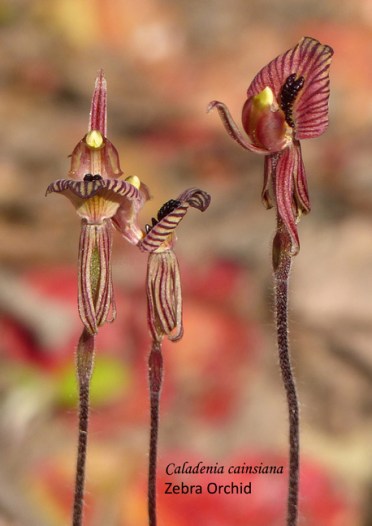
It is always good to see other members submitting images for the competition. This month Rob Soergel entered Urochilus sanguineus growing with Bunochilus viriosus and Ros Miller a Caladenia cairnsiana. Others were Rob and Jenny Pauley’s mass flowering of short Urochilus sanguineus, Pauline Meyers’ Arachnorchis cardiochila hybrid (possibly with A. strigosa) and Lorraine Badger’s Diuris corymbosa.
The winning picture taken by Ros Miller C. cairnsiana (Zebra Orchid) is one of Western Australia’s unique and interesting orchids. It was first collected by Baron Von Mueller (Victorian Government Botanist 1857–1873) from the Stirling Ranges and subsequently named in 1869 after the Rev Adam Cairns a Melbourne Presbyterian minister who promoted “various philanthropic studies”. In the 2000’s various synonyms were applied to the name, most notably Jonesiopsis cairnsiana (2003).
Many of the distinctive features of this species are readily seen in Ros’ picture – the non-clubbed, equidimensional short lateral sepals and petals which are hard pressed up against the ovary; the smooth, upswept labellum. What is not seen is the leaf which is erect large pale green with the bottom third usually irregularly blotched with red-purple.
Flowering from August to November, occasionally in clumps, these orchids are distributed over an extensive geographic area from Lancelin approximately 130 km north east of Perth, to Israelite Bay near Esperance some 775 km south east. They grow in a range of habitats from forests, woodlands, to mallee heathlands.
Interestingly for such a widespread and colourful flower, they are often missed being seen as they are ‘small and hard to see’.
References
Brown, A., et al,(2013) Field Guide to the Orchids of Western Australia. Perth, WA: Simon Neville Publications
The second fact sheet in Terrestrial Culture notes is about Slow Multiplying Terrestrials.
FLAGBEARER SPECIES: Thelymitra nuda
Diuris, Pterostylis and Thelymitra. They are more expensive because they have to be raised from seed in flasks. SMs are not so easy because there is less room for error. A few have a near zero increase rate and will fade away unless additional plants can be produced to make up for occasional losses from predators and disease.
GROWTH HABIT: Australian ground orchids follow an annual growth cycle comprising 6 – 8 months as growing plants under cool (5 – 20°C max, 0 – 14°C min) moist conditions and 4 – 6 months as dormant tubers in hot dry (18 – 42°C max, 12 – 30°C min) conditions. The new tuber is produced in winter – spring. Each tuber sends up a shoot to the surface in Autumn and leaves grow rapidly in late Autumn/early Winter as temperatures fall and the rains set in. Pterostylis leaves are usually the first to appear in March/April followed by Diuris and Thelymitra in April/May. Sometime in October/November the leaves go yellow and then brown and dry as the days get longer, hotter and drier in late Spring.
LIGHT/SHADE:Australian terrestrial orchids are easy to grow. In Adelaide they thrive in a shadehouse of 50% shadecloth. Some species prefer heavy shade, others full sunlight, but most will adapt to a wide range of light intensity. Sun loving species (Diuris, Thelymitra & Rufa group Pterostylis) prefer a brighter location for good growth.
If the leaves and stems are weak and limp or if the leaf rosettes are drawn up to the light then the shading is too dense and the amount of light should be increased. The spring flowering species like higher light intensities at flowering time and flowers may have pale colours if placed in heavy shade, even temporarily, when flowers are just starting to open.
In very cold areas an unheated glasshouse may be required for frost protection although light frosts do not worry the majority of species.
AIR MOVEMENT/HUMIDITY:All species like good air movement and will not thrive in a stuffy humid atmosphere especially if temperatures are high.
WATERING:The soil should be kept moist at all times during active growth by watering gently if there is no rain. Hand watering is especially necessary in spring as soil in pots dries out more rapidly than in the garden. Watering must be done slowly so that the mat of needles on the surface of the pot is not disturbed. Slugs and snails love these plants and must be kept under control. Raising the pots off the ground on galvanised steel benching is very effective in controlling these pests.
After the leaves have turned yellow, let the pot dry out completely to dry up the old roots and tubers otherwise they may turn into a soggy mouldy mess and rot may destroy the adjacent new tubers.
POLLINATION/SEEDCOLLECTING:Flowering plants are hand pollinated and the seed collected just before the pods split open and the dust-like seed blows away. The seed is sprinkled on pots of mother plants at Easter or flasked.
REPOTTING:Repot every second year in half new mix. Repotting is normally done between November and January. The best results are obtained if the tubers are repotted in half fresh soil mix each second year. A suitable soil mix is 40% loam, 50% sand and 10% organic matter with a little blood and bone fertiliser added. A 5 mm sieve is a useful tool for separating tubers from soil. Replant the dormant tubers with the tops 20 mm deep. Cover the soil surface with a mulch of sheoak needles, chopped to 20 – 50 mm lengths, to prevent soil erosion & aerate under the leaves.
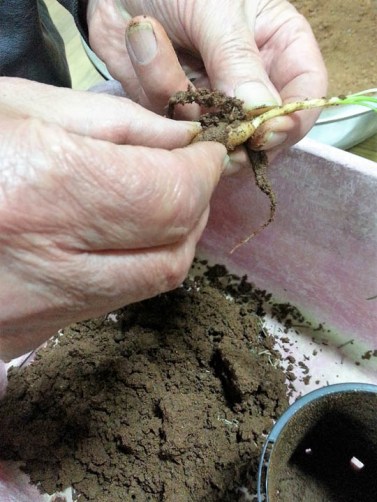
INCREASING PLANT NUMBERS:The pull-off-the-tuber method can be used with some diuris and Pterostylis species to double plant numbers annually. The pots can be knocked out and the tubers examined in Summer without harm.
SUMMER CARE: Keep the pots shaded and allow the pots to dry out between light waterings until mid-February when they should be set out in their growing positions and watered a little more often. The tubers of some species will rot if kept wet during the dormant period, others will produce plants prematurely which are then attacked by pests such as thrip and red spider and fungal diseases in the warm weather.
FERTILIZING:SMs will benefit from weak applications of folia feed in the early growth stages.
Leo Davis is an orchid hunter. He is meticulous in his observations and notes details that many of us may miss. In this article he muses upon the variations that he sees in the field.
You, as I do, must occasionally come upon an orchid or an orchid event that is a little outside normal experience. When I do, I wonder whether this is a purely chance event or is it caused by recent local environmental factors, or is it due to the genes of the plants. Or a combination of these?
I’ve been watching a couple of patches of fire orchids (Pyrorchis nigricans) that many of you will be familiar with, one at Knott Hill N.F.R., the other at Monarto C.P., where a few plants flower every year, without the normally required stimulation by fire. I need to check whether it is the same plants that flower each year.
Pyrorchis nigricans (Fire or Undertaker Orchid) Photo: Leo Davis
~~~~~~~~~~~~~~~~~~~~~~~~~~~~~~~~~~~~
The tall leek orchid (Prasophyllum elatum) puts up leaves at Scott Creek C.P. every year but does not flower. A fire swept through in early 2014 and most plants flowered in October. They’ve not flowered since. But over at Ramsay Way, west of Pt. Vincent, a few plants flower each year without fire. I assume genes are involved.
Prasophyllum elatum (Tall Leek Orchid) Photo: Leo Davis
~~~~~~~~~~~~~~~~~~~~~~~~~~~~~~~~~~~~
In April 2014 I chanced upon a patch of Adelaide Hills parson’s bands (Eriochilus collinus), along Moore’s Road, at Morialta C.P., in which the majority of plants had three flowers per stem. Was this because of favourable conditions or genes? Over the next two seasons I saw only the occasional double header and mainly single flowered plants. I will continue observations and records.
~~~~~~~~~~~~~~~~~~~~~~~~~~~~~~~~~~~~
In July 2015 I found a dense patch, about 3 m2 in area, of hundreds the common mallee shell orchid (Diplodium dolichochilum), in Ferries-McDonald C.P. As usual less than ten plants were in flower, but two of them were double headers. I’ll be checking this season and expect this not to be a chance event but one due to genes.
Diplodium dolichochilum syn. Pterostylis dolichochila (Slim Tongued Shell or Common Mallee Shell Orchid) Photo: Leo Davis
~~~~~~~~~~~~~~~~~~~~~~~~~~~~~~~~~~~~
On May 27, 2012, Bob Bates led a NOSSA outing to Scott Creek C.P. and as ever, when he leads, we saw and learned a lot. He showed us a patch of fringed hare-orchids (Leporella fimbriata) that he assured us should not be growing there on that steep rocky site and that the plants would not flower most years. Unfortunately he was right, as usual. I could not find plants in 2013 and 2014 and it took three searches in 2015 to find a very few leaves. On May 10 this year, over an area of less than 10 m2, I found perhaps 50 leaves and just seven plants in flower. Three of these had three flowers and a tiny unopened bud (check the photo) and the others were doubles. I’ve never seen a triple flowered plant in hundreds I’ve seen at Knott Hill N.F.R. Are genes in an isolated population at play here? Given the paucity of flowering at this site, it may take me years to sort this one out.
Leporella fimbriata (Fringed Hare or Ballerina Orchid) Photo: Leo Davis








 NOSSA
NOSSA 