August 2016 Winning Picture

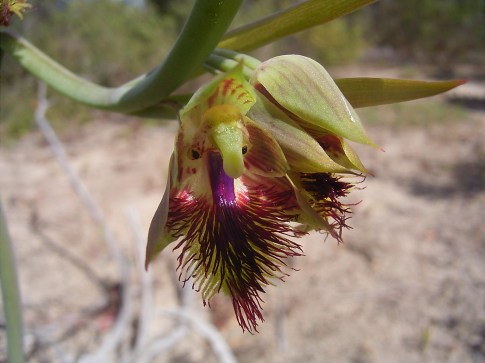
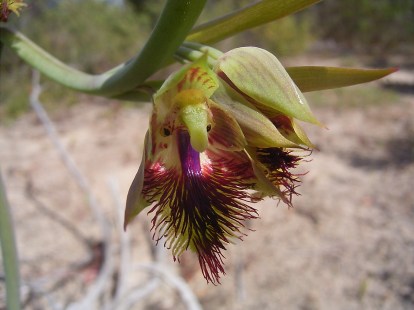
1608 sm CC Pheladenia deformis.jpg

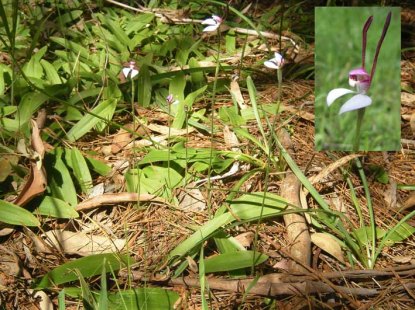
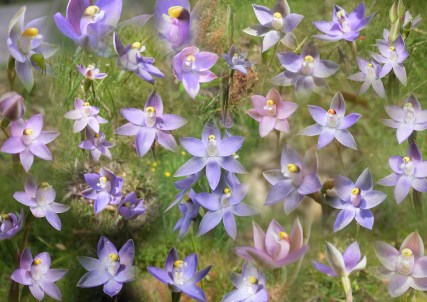
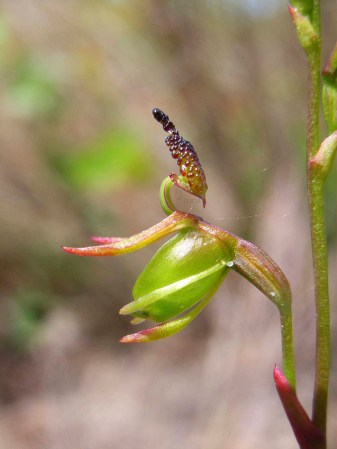
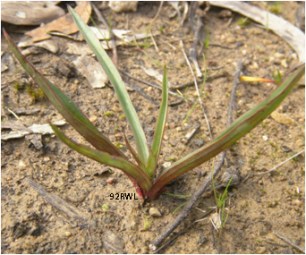
This month’s entries are an interesting collection as it is probably the first time that all entries are currently in flower.  Rosalie Lawrence entered a Pterostylis pedunculata, Ricky Egel (second) Corysanthes despectans, Robert Lawrence (third) Pyrorchis nigricans whilst both Rob Soergel and Claire Chesson (winner) entered Pheladenia deformis. All four are colony forming species.

Both parts of the scientific name for the winning orchid refer to the labellum. Pheladenia meaning false glands which is referring to the calli and deformis meaning departing from the correct shape or mis-shapen.

The labellum plays an important role in pollination; it is the landing platform for the insect. Depending on the process by which the flower is pollinated – or at least attracting the pollinator – this can attempt to mate with the labellum which it has confused for a female of its species (pseudocopulation), or can then feed on the nectar produce. Like many orchids Pheladenia does not produce nectar so the actual attractant for the insect is hard to determine.

The labellum is a distinctive feature of orchids.  A modified petal, they are so amazingly varied and complex that botanists often provided detailed descriptions of the features which are present in various combinations, as a means of describing the species. Terms such as lobes, margins, gland/calli, hairs/vestiture/setae, longitudinal ridges, plates, auricles, spurs, papillae etc are used to describe the various features of the labellum.

Some of the features of the labellum of P. deformis are:

  • It is stiffly attached to the column, unlike Arachnorchis tentaculata which is hinged and freely moving
  • It is tri-lobed meaning that the labellum shape is divided into three distinct sections.
    • Unlike Diuris pardina where this feature is easily seen, it is obscured as the outer two lobes are erect and curved in so that it forms a trumpet like appearance with the column.
  • The margins or edges of the labellum have fine teeth which are slightly curved inward. The margins of Arachnorchis cardiochila are smooth-edged and curve outward from the ‘throat’ of the labellum
  • It has two types of calli, fleshy, non-secreting glands.
    • The ones at the base are not as easily seen but they are described as being papillae, e., small, irregular, pimple-like projections or bumps.
    • The more obvious ones that give the flower its bearded appearance are elongate and without a swollen head, like the bristles on a brush.
    • In contrast, Thelymitra does not have any type of calli, although it should be noted that calli do play an important role in orchid pollination.
  • The apex, tip of the labellum, is curved under (recurved to reflexed)

To see some of the variety of labella, Orchids of South Australia (Bates and Weber, 1990) have several drawings detailing the differences on pages 35 to 38, 81, 97, 104 to 106, 114, 119 to 124.

So why spend time looking at details of labella?

It is not important for identifying Pheladenia deformis but it can be a distinguishing feature for other species, for example, the lateral lobes of Diuris maculata are much narrower than D. pardina (Jones, in Harden (ed.) 1993); or the shape of the callus cluster on Chiloglottis which alludes to the species.


Reference:

Bates, R.J & Weber, J.Z. (1990) Orchids of South Australia, Government Printer, Adelaide

Brown, A., et al, (2013) Field Guide to the Orchids of Western Australia. Perth, WA: Simon Neville Publications

Jones DL (1993). Diuris in Harden GJ Flora of New South Wales, Volume 4. University of NSW Press, Sydney.

Jones, D L et al, (2006) Australian Orchid Genera, an information and orchid identification system, interactive CD-ROM

Thank you to Greg Steenbeeke for assistance with this article.

Half Hiding, Half Peeping the Orchids Appear, …

Spring has come and the bush is bursting with colour and many people are out enjoying it.  One of the gems that provide some of this colour are the orchids but as is highlighted in the following poem they are often overlooked yet without them and the other delicate herbaceous flowers the bush will look grey and gloomy.  So slow down, take a closer look and enjoy the hidden many coloured jewels of the bush.


Stay on the Path

Do they say that the bush is all greyness and gloom

Why, the rainbow has lent every thread from his loom

To weave into flower and shrub!

Diuris x palachila
Diuris x palachila (Hybrid Doubletails or Broad Lip Orchid)

There are star-flowers blue as the deep winter sky,

Here are “Grandmothers Honeycups”, humble and shy;

And the purple of hovea bloom.

Leptoceras menziesii in patch
Leptoceras menziesii, Hare Orchid or Rabbit Ears

Half hiding, half peeping, the orchids appear,

The friendly and cheerful red runner creeps near –

Say, where are the greyness and glooom.

Which is which
Thelymitra or Sun Orchids

Lilian Wooster Greaves

from West Australian Orchids by Emily H Pelloe, 1930

July 2016 Winning Picture

1607 sm RWL Corysanthes diemenicus.jpg

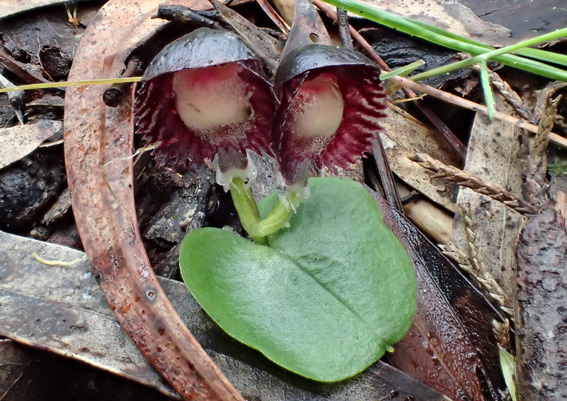
This month there were four very different species.  Two were from Western Australia, Pauline Meyers’ Caladenia longicauda and Lorraine Badger’s Thelymitra pulcherrima, and the other two from South Australia, Rob Soergel’s Bunochilus viriosa and Robert Lawrence’s Corysanthes diemenicus which was the winning picture.

Corysanthes diemenicus is a very common winter orchid but this one is unique as instead of one flower as is normal there are two!  So is it a new species? No, it is a freak; the technical terminology is teratologic.

Of the various plant families, the mint and orchid families (Theissen 2006) are well known for producing teratological plants, that is, plants that are grossly abnormal or deformed.  Bates (2011) divides such abnormalities into five categories – peloric, teratological freaks, monstrosities, colour variants and throwbacks.  All of them are congenital abnormalities which may be a result of unknown genetic malfunction or viral infection in the early developmental stages of the plant.  Based upon this division, Robert’s picture is a monstrosity.  This type of double flower is more likely to be found in self-pollinated plants for example Pterostylis foliata often produces more than one flower.

Most freaks are random, they come and go but peloric freaks are interesting.  An early meaning of peloria was an irregular feature that becomes regular (Walker 1879) but in the orchids the meaning has been narrowed to refer to an “abnormality of the labellum that is of a similar shape and colour of the petals” (Australian Orchid Genera 2006) or more precisely an abnormality of the inner tepal whorl (the petals) wherein the petals can take on the appearance (in part or full) of the labellum, or the labellum takes on the appearance of the petals.  One naturally occurring semi-peloric species is Calochilus imberbis. In recent years, orchid growers have cloned peloric freaks using a technique called mericlone to produce new cultivars eg Rhyncolaelia digbyana var. fimbripetala.

Freaks may be interesting but they are temporary so if you spot something unusual in the field look around at the surrounding orchids.  If there is only the one or two individual or one colony, then it’s likely to be an abnormality rather than a new species.

Thank you to Greg Steenbeeke for checking this article.

Reference:

Bates, R. J., ed. (2011). South Australian Native Orchids. Electronic version, 2011. NOSSA

Jones, D L et al, (2006) Australian Orchid Genera, an information and orchid identification system, interactive CD-ROM

Masters, M T (1879) Vegetable Teratology http://www.gutenberg.org/files/23354/23354-h/23354-h.htm accessed 3rd August 2016

St George, I (2007) Monsters, Freaks, Retrogrades and Primitives http://www.nativeorchids.co.nz/Journals/103/page5.htm accessed 3rd August 2016

Steenbeeke, G, personal communications

Theissen, G (2005) The proper place of hopeful monsters in evolution biology http://carah.sweb.cz/xx12295.pdf accessed 3rd August 2016

Orchids the Flagship Plant Group: How Do We Protect Them?

This week’s post is taken from the IUCN SSC Orchid Specialist Group Facebook post concerning Resolution decided upon at the final session of the International Orchid Conservation Congress Conference, held in May 2016 at the Kadoorie Farm & Botanic Garden, Hong Kong

It was posted by Michael Fay of Royal Botanic Gardens, Kew.  He is also the Chair of the IUCN SSC Orchid Specialist Group.  According to their website, “The Orchid Specialist Group is a global network of experts who volunteer their time and expertise to build a scientific and practical foundation for the conservation of orchids (Orchidaceae).”

(A list of the meanings of acronyms appears at the end of this post.)

Michael’s post follows

Here are the Resolutions from the final session of IOCC VI in Hong Kong:

03 KK sm Sarcochilus falcatus Mt Banda Banda

Orchids are a flagship plant group with a high profile in human culture. They are known from all vegetated continents on earth but their occurrence reflects patterns in the global distribution of biodiversity and their intricate ecological associations, particularly with pollinators and mycorrhizal fungi, reflect sensitive ecosystem processes. Accordingly, orchids are indicators of ecosystem and climate health. Many orchids and their associated biota have been exposed to a variety of threats as a direct consequence of human-driven global change, with almost half of the ca. 27,000 known species now potentially at risk of extinction. Delegates of the IOCC support all efforts to research and mitigate these threats and secure environments on which orchids depend, and are committed to achieving meaningful conservation by recommending that:

  1. The creation of orchid enhanced habitats is a priority for ecological restoration.
  2. Enhanced in situ orchid protection requires the creation of orchid reserves. These will benefit a wide array of other species and biological communities and can be financed through various public and private sources.
  3. The international and domestic wild plant trade is widely recognised by governments and civil society as a major threat to the persistence of many orchid species, and that its curtailment requires concerted government action and enforcement.
  4. The propagation and cultivation of threatened orchids by small and local orchid enterprises should be supported for the sustainable production of orchids used in horticulture, medicine and food.
  5. Orchid cultivation should be licensed and audited by government or other government-approved body through a national (or international) accreditation scheme that specifies adequate safeguards to ensure best practice. Propagated orchids should be traceable and distinguishable from wild orchids so as to minimise the risk of laundering wild plants.
  6. National, regional and international networks should be established and strengthened for promoting in situ and ex situ orchid conservation.
  7. The next generation of orchid taxonomists, ecologists and conservationists is nurtured through improved training, education, publicity and awareness-raising programmes.

    Paracaleana minor 123DM
    Paracaleana minor (Little Duck Orchid) Photo: David Manglesdorf
  8. Members shall strengthen the work of OSG by:
  • Facilitating and conducting national and global Red Listing of orchids, and contributing to the Sampled Red List Index (SRLI);
  • Monitoring and reporting on the illegal trade in orchids to national enforcement agencies and to TRAFFIC;
  • Reviving Orchid Conservation International as a vehicle for web-based education and channelling funding to orchid conservation programmes, along the lines of Birdlife International;
  • Embracing social media and other web-based interactive tools as dynamic and effective means of stimulating communication, raising awareness and building networks;
  • Using citizen science as an effective means of motivating individuals and amateur groups to record orchid occurrence (e.g. OrchidMap, iNaturalist) and help scale-up the collection of verifiable data;
  • Establishing and maintaining a global database of orchid reintroductions (including both successes and failures) and ex situ orchid collections that can be accessed and updated by members and which is linked to the IUCN Reintroduction Specialist Group;
  • Creating new sub-groups focusing on trade and molecular identification, to reflect important cross-cutting themes and challenges.

Thanks to Stephan Gale and Phil Cribb for producing the final version of these.

Bearded Orchid
Calochilus cupreus (Bearded Orchid)  Photo: Helen Lawrence

IOCC VI refers to the International Orchid Conservation Congress Conference was held in May 2016 at the Kadoorie Farm & Botanic Garden, Hong Kong

IUCN: International Union for Conservation of Nature

OSG: Orchid Specialist Groups

SSC: Species Survival Commission

TRAFFIC: Trade Records Analysis of Flora and Fauna in Commerce

Orchid Specialist Group Website: http://www.iucn.org/species/ssc-specialist-groups/about/ssc-specialist-groups-and-red-list-authorities-directory-7

Caladenia procera

Orchid Hunter Visits Kuipto

The following video is by Orchid Hunter, Julian Pitcher.  Julian is concerned about the conservation of orchids and is also keen to teach others about Australia’s unique orchids.  At the time of the visit, Julian was resident in Victoria; now he resides in Queensland.  Enjoy an interstate visitor’s view of our beautiful orchids.

Vale: Enid Robertson 1925 – 2016

Robertson, Enid L.
Enid Robertson (Image from Council of Heads of Australasian Herbaria website)Image from Council of Heads of Australasian Herbaria website

This week saw the passing of Adelaide botanist and conservationist, Enid Robertson.

Over the years Enid was associated with the Native Orchid Society of South Australia (NOSSA) both as a speaker and leader of field trips. A notable contribution to NOSSA was to alert the Society in 1989 about the invasion of the South African weed, Monadenia bracteata (Syn Disa bracteata).  In 1990, she was involved in a Monadenia bracteata eradication campaign.

Reproduced below is an article written by Enid published in the Native Orchid Society of South Australia Journal, Vol 15 No 8 September 1991

Monadenia bracteata
THAT AFRICAN WEED ORCHID AGAIN
Enid Robertson
I heartily endorse “C.H’s” sentiments in the article “If it is meant to be …” in the August issue of NOSSA Journal (Vol. 15, No.7) in which was said, “By removing these weeds from the areas of least infestation when out on our walks and as an ongoing project, we can all help keep our scrub in the beautiful way it is supposed to be.” This encourages me to bring our latest horror species to your attention yet again.

That weed-orchid, Monadenia bracteata, will be emerging from tubers late September and early October. Let’s literally nip it in the bud.  Total eradication (not just control) is required.  It would be a terrific achievement if we could prevent this latest African invader from taking over. Last year 100’s of plants were removed and destroyed before seed set.

Further vigilance and action is required this Spring. More help will be needed to monitor every locality where plants have been previously found and to remove any plants that
sprout from tubers remaining in the soil.

This weed-orchid is yet another exotic plant to invade our diminishing remnant native vegetation. It is occupying space that belongs to Australia’s already threatened little understorey plants. As the weed-orchid produces thousands of tiny wind-borne seeds each season new infestations could occur some distance from known sites. It favours grasslands and woodlands, particularly disturbed areas, not dense sclerophyll bushland. However it has been found infiltrating into sclerophyll scrub from disturbed borders and along firetracks.

Since first recorded in South Australia in 1988 the weed-orchid has been reported from Aldgate, Belair (including Belair National Park), Blackwood, Bridgewater, Chandlers
Hill, Cherry Gardens, Coromandel Valley, Craigburn Farm, Echunga, Eden Hills, Onkaparinga Recreation Park, Panorama, Scott Creek Conservation Park, Shepherds Hill Recreation Park, Sturt Gorge and three localities north of Adelaide: One Tree Hill, Mt Gawler and Mt Crawford Forest.

What is it like? It has a rosette of long narrow green leaves, often with a reddish tinge on the underside, which appear from the underground tuber in Spring (about October).

The flower spike is 15-30 cm tall and is clothed all up its stem with a series of overlapping narrow green leaves. It has up to 50 tiny flowers, brown to maroon in colour.  The flowers are self-pollinating and produce prodigious quantities of dust-like seed.

Seedling Monadenia bracteata plants do not flower in the first year. It probably takes two to three years from seed before a plant produces a flower spike. It is, therefore, very important to search carefully for young plants in areas of known infestation. By mid-October new plants will be showing up and the 1991/92 campaign should begin. The whole plant, tuber and all, must be removed and destroyed.

Please, give your name and contact telephone number to the NOSSA Secretary if you can help. You will be notified of the locality where your help is most need.

Or contact me direct – Enid Robertson (She supplied her phone number at that time).

Disa bracteata - weed
Leaves of Disa bracteata
Disa bracteata RWL
A flowering plant of Disa bracteata

Sadly, eradication is no longer an option, whereas it appeared to be in 1991 when Enid wrote about it.

Culture of Fungi Dependent (FD) Terrestrials

This is the last of the three terrestrial fact sheets in Culture Notes that NOSSA has produced on growing terrestrial orchids.  All three facts sheets can be downloaded – Click on the following for Fungi Dependent, Slow Multipliers and Fast Multipliers.

Orchid 1 Arachnorchis tentaculata
Arachnorchis tentaculata, common name King Spider Orchid or Large Green Comb Spider Orchid

FLAGBEARER SPECIES: Caladenia tentaculata (synonym Arachnorchis tentaculata)

Some 3/4 of Southern Australian terrestrial orchids are fungus dependent throughout their life cycle. Orchids that are fungus dependent have very specific cultural requirements. The fungus must be grown in the pot with the orchid. Sometimes a third entity such as a shrub or tree is involved in the fungal relationship.

A minimum disturbance culture is used.

Limited numbers are available each year. Other fungus dependent species are rarely available. Those in cultivation have mostly come from rescue digs in the past. NOSSA has started a seed kit project to help overcome this vacuum.

GROWTH HABIT: Australian ground orchids follow an annual growth cycle comprising 6 – 8 months as growing plants under cool (5 – 20°C max, 0 – 14°C min) moist conditions and 4 – 6 months as dormant tubers in hot dry (18 – 42°C max, 12 – 30°C min) conditions. The new tuber is produced in winter – spring. Each tuber sends up a shoot to the surface in Autumn and leaves grow rapidly in late Autumn/early Winter as temperatures fall and the rains set in. Sometime in October/November the leaves go yellow and then brown and dry as the days get longer, hotter and drier in late Spring.

LIGHT/SHADE: In Adelaide they thrive in a shadehouse of 50% shadecloth. Some species prefer heavy shade, others full sunlight, but most will adapt to a wide range of light intensity.

If the leaves and stems are weak and limp or if the leaf rosettes are drawn up to the light then the shading is too dense and the amount of light should be increased. FDs are mostly spring flowering and like higher light intensities at flowering time. flowers may have pale colours if placed in heavy shade, even temporarily, when buds are just starting to open.

In very cold areas an unheated glasshouse may be required for frost protection although light frosts do not worry the majority of species.

AIR MOVEMENT/HUMIDITY: All species like good air movement and will not thrive in a stuffy humid atmosphere especially if temperatures are high.

POLLINATION/SEED COLLECTION: FDs seldom multiply so must be propagated from seed.

Flowers on the strongest plants of the same species growing in pots are cross pollenated by hand to set seed pods. The flowers collapse in a day of so and pods ripen in 4-8 weeks. Pods are collected as they change colour from green to brown, which happens quickly on a hot day in October/November. Tea bags can be tied over the pods to catch the dust like seed if frequent visits to site are not possible.

Pods are stored dry in paper envelopes indoors over summer. Seed can be sprinkled on mother pots or scattered on bush sites.

SEEDLING CARE: Seedlings can be raised by sowing seed around potted mother plants.

At Easter time, just before the rainy season begins, the dust-like seed is mixed with fine sand in a pepper shaker (minimizes seed loss) and sprinkled on top of the pots and watered in. Germination occurs in Autumn/Winter as that is when the fungi are most active. Tiny leaves appear from July to October. The seedlings form miniscule tubers on droppers about 1 – 2cm below the surface. Seedlings take up to five years to reach flowering and are best left undisturbed until larger.

WATERING: The soil should be kept moist at all times during active growth by watering gently if there is no rain. Hand watering is especially necessary in spring as soil in pots dries out more rapidly than in the garden. Watering must be done slowly so that the mat of needles on the surface of the pot is not disturbed. Slugs and snails love these plants and must be kept under control. Raising the pots off the ground on galvanised steel benching is very effective in controlling these pests.

After the leaves have turned yellow, let the pot dry out completely to dry up the old roots and tubers otherwise they may turn into a soggy mouldy mess and rot may destroy the adjacent new tubers.

REPOTTING: The plants are not repotted but left in the same pot year after year.

SUMMER CARE: Keep the pots shaded and allow the pots to dry out between light waterings until mid-February when they should be set out in their growing positions and watered a little more often. The tubers of some species will rot if kept wet during the dormant period, others will produce plants prematurely which are then attacked by pests such as thrip and red spider and fungal diseases in the warm weather.

A thin layer of new leaf litter is placed on top of the existing leaf litter each summer to feed the fungus.  Chopped gum leaves or sheoak needles are suitable.

FERTILIZING: NO FERTILISER

OTHER CULTURE NOTES:

CULTURE OF SLOW MULTIPLYING (SM) TERRESTRIALS

Pots of Thelymitra nuda cultivated by Les Nesbitt
Thelymitra nuda

The second fact sheet in Terrestrial Culture notes is about Slow Multiplying Terrestrials.

FLAGBEARER SPECIES: Thelymitra nuda

Diuris, Pterostylis and Thelymitra. They are more expensive because they have to be raised from seed in flasks. SMs are not so easy because there is less room for error. A few have a near zero increase rate and will fade away unless additional plants can be produced to make up for occasional losses from predators and disease.

GROWTH HABIT: Australian ground orchids follow an annual growth cycle comprising 6 – 8 months as growing plants under cool (5 – 20°C max, 0 – 14°C min) moist conditions and 4 – 6 months as dormant tubers in hot dry
(18 – 42°C max, 12 – 30°C min) conditions. The new tuber is produced in winter – spring. Each tuber sends up a shoot to the surface in Autumn and leaves grow rapidly in late Autumn/early Winter as temperatures fall and the rains set in. Pterostylis leaves are usually the first to appear in March/April followed by Diuris and Thelymitra in April/May. Sometime in October/November the leaves go yellow and then brown and dry as the days get longer, hotter and drier in late Spring.

LIGHT/SHADE: Australian terrestrial orchids are easy to grow. In Adelaide they thrive in a shadehouse of 50% shadecloth. Some species prefer heavy shade, others full sunlight, but most will adapt to a wide range of light intensity. Sun loving species (Diuris, Thelymitra & Rufa group Pterostylis) prefer a brighter location for good growth.

If the leaves and stems are weak and limp or if the leaf rosettes are drawn up to the light then the shading is too dense and the amount of light should be increased. The spring flowering species like higher light intensities at flowering time and flowers may have pale colours if placed in heavy shade, even temporarily, when flowers are just starting to open.

In very cold areas an unheated glasshouse may be required for frost protection although light frosts do not worry the majority of species.

AIR MOVEMENT/HUMIDITY: All species like good air movement and will not thrive in a stuffy humid atmosphere especially if temperatures are high.

WATERING: The soil should be kept moist at all times during active growth by watering gently if there is no rain. Hand watering is especially necessary in spring as soil in pots dries out more rapidly than in the garden. Watering must be done slowly so that the mat of needles on the surface of the pot is not disturbed. Slugs and snails love these plants and must be kept under control. Raising the pots off the ground on galvanised steel benching is very effective in controlling these pests.

After the leaves have turned yellow, let the pot dry out completely to dry up the old roots and tubers otherwise they may turn into a soggy mouldy mess and rot may destroy the adjacent new tubers.

POLLINATION/SEEDCOLLECTING: Flowering plants are hand pollinated and the seed collected just before the pods split open and the dust-like seed blows away. The seed is sprinkled on pots of mother plants at Easter or flasked.

REPOTTING: Repot every second year in half new mix. Repotting is normally done between November and January. The best results are obtained if the tubers are repotted in half fresh soil mix each second year. A suitable soil mix is 40% loam, 50% sand and 10% organic matter with a little blood and bone fertiliser added. A 5 mm sieve is a useful tool for separating tubers from soil. Replant the dormant tubers with the tops 20 mm deep. Cover the soil surface with a mulch of sheoak needles, chopped to 20 – 50 mm lengths, to prevent soil erosion & aerate under the leaves.

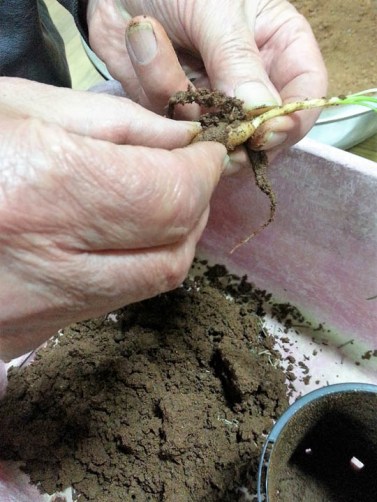
INCREASING PLANT NUMBERS: The pull-off-the-tuber method can be used with some diuris and Pterostylis species to double plant numbers annually. The pots can be knocked out and the tubers examined in Summer without harm.

SUMMER CARE: Keep the pots shaded and allow the pots to dry out between light waterings until mid-February when they should be set out in their growing positions and watered a little more often. The tubers of some species will rot if kept wet during the dormant period, others will produce plants prematurely which are then attacked by pests such as thrip and red spider and fungal diseases in the warm weather.

FERTILIZING: SMs will benefit from weak applications of folia feed in the early growth stages.

OTHER CULTURE NOTES:


NB: IT IS ILLEGAL TO TAKE PLANTS (WHOLE PLANT, FLOWERS, SEEDS AND TUBERS) FROM THE WILD

CULTURE OF FAST MULTIPLYING (FM) TERRESTRIAL ORCHIDS

Recently, NOSSA updated the Terrestrial Culture Fact Sheet.  Instead of one sheet, it was decided to split it into three – Culture of Fast Multiplying Terrestrials, Culture of Slow Multiplying Terrestrials and Culture of Fungi Dependent Terrestrials.  Though much of the growing information is similar, there are some significant differences of which growers need to be aware.  The first of the fact sheets is Culture of Fast Multiplying Terrestrials.

FLAGBEARER SPECIES: Pterostylis curta

Pterostylis curta Labellum and column 92RL
Pterostylis curta (Blunt Greenhood) is rated rare in South Australia.  Ex situ conservation is another dimension to conservation.

Others include Chilogolottis, Corybas, Cyrtostylis, Diplodium, Microtis most Pterostylis and some Diuris. Most FMs are Autumn or Winter flowering. The exceptions are Diuris and Microtis. FM are the most common terrestrial orchids to be seen at meetings and shows. Once seedlings are established they are no longer fungi dependent.

GROWTH HABIT: FMs are the easiest terrestrial’s orchids to grow. They multiply by forming 2 – 5 tubers per plant each year. The annual growth cycle comprises 6 – 8 months as growing plants under cool (5 – 20⁰ C max, 0 – 14⁰ C min) moist conditions and 4 – 6 months as dormant tubers in hot (18 – 42⁰ C max, 12 – 30⁰ C min) dry conditions.  New tubers are produced in winter/spring. FMs are colony types, ie they multiply annually and will spread out over time if planted in the ground. Each tuber sends up a shoot to the surface in autumn and leaves grow rapidly in late autumn/early winter as temperatures fall and the rains set in. FMs mainly flower in Autumn and Winter. Diplodium & Pterostylis leaves are usually the first to appear in March followed by Diuris and Microtis in April, and Corybas in June to July. In October/November the leaves go yellow, then brown and dry as the days get longer, hotter and drier in late spring.

LIGHT/SHADE: In Adelaide, they thrive in a shadehouse of 50% shadecloth. Some species prefer heavy shade, others full sunlight but most will adapt to a wide range of light intensity. Sun loving species (Diuris & Microtis) prefer a brighter location for good growth. Corybas like the shadiest corner.  If the leaves and stems are weak and limp or if the leaf rosettes are drawn up to the light, then the shading is too dense and amount of light should be increased.

In very cold areas an unheated glasshouse may be required for frost protection although light frosts do not worry the majority of species.

AIR MOVEMENT/HUMIDITY: All species like good air movement and will not thrive in a stuffy humid atmosphere especially if temperatures are high.

WATERING: The soil should be kept moist at all times during active growth by watering gently if there is no rain.  Hand watering is especially necessary in spring as soil in pots dries out more rapidly than in the garden. Watering must be done slowly so that the matt of needles on the surface of the pot is not disturbed. Slugs and snails love these plants and must be kept under control. Raising the pots off the ground on galvanised steel benching is very effective in controlling these pests.

After the leaves have turned yellow, let the pot dry out completely to dry up the old roots and tubers otherwise they may turn into a soggy mouldy mess and rot may destroy the adjacent new tubers.

REPOTTING: They grow better if repotted annually otherwise the plants crowd together around the rim of the pot.  Repotting is normally done between November and January. The pots can be knocked out and the tubers examined without harm.  For best results repot the tubers in half fresh soil mix. A suitable soil mix is 40% loam, 50% sand and 10% organic matter with a little blood and bone fertilizer added. (They will also grow in native potting mix.) A 5 mm sieve is a useful tool for separating tubers from soil. Replant the dormant tubers with the tops 20 mm deep. Cover the soil surface with a mulch of chopped sheoak needles (20 – 50 mm lengths). This prevents soil erosion and assists with aeration under the leaves.

SUMMER CARE: Keep the pots shaded and allow the pots to dry out between light waterings until mid-February when they should be set out in their growing positions and watered a little more often. The tubers of some species will rot if kept wet during the dormant period, others will produce plants prematurely which are then attacked by pests such as thrip and red spider mite and fungal diseases in the warm weather.

FERTILIZING: FMs are very hardy and will benefit from weak applications of folia feed in the early growth stages.

OTHER CULTURE NOTES:

NB: IT IS ILLEGAL TO TAKE PLANTS (WHOLE PLANT, FLOWERS, SEEDS AND TUBERS) FROM THE WILD


Genes, seasonal conditions or pure chance?

Leo Davis is an orchid hunter.  He is meticulous in his observations and notes details that many of us may miss.  In this article he muses upon the variations that he sees in the field.

You, as I do, must occasionally come upon an orchid or an orchid event that is a little outside normal experience.  When I do, I wonder whether this is a purely chance event or is it caused by recent local environmental factors, or is it due to the genes of the plants.  Or a combination of these?

I’ve been watching a couple of patches of fire orchids (Pyrorchis nigricans) that many of you will be familiar with, one at Knott Hill N.F.R., the other at Monarto C.P., where a few plants flower every year, without the normally required stimulation by fire.  I need to check whether it is the same plants that flower each year.

Pyrorchis nigricans.jpg
Pyrorchis nigricans (Fire or Undertaker Orchid) Photo: Leo Davis

~~~~~~~~~~~~~~~~~~~~~~~~~~~~~~~~~~~~

The tall leek orchid (Prasophyllum elatum) puts up leaves at Scott Creek C.P. every year but does not flower. A fire swept through in early 2014 and most plants flowered in October.  They’ve not flowered since.  But over at Ramsay Way, west of Pt. Vincent, a few plants flower each year without fire.  I assume genes are involved.

Prasophyllum elatum
Prasophyllum elatum (Tall Leek Orchid) Photo: Leo Davis

 ~~~~~~~~~~~~~~~~~~~~~~~~~~~~~~~~~~~~

In April 2014 I chanced upon a patch of Adelaide Hills parson’s bands (Eriochilus collinus), along Moore’s Road, at Morialta C.P., in which the majority of plants had three flowers per stem. Was this because of favourable conditions or genes? Over the next two seasons I saw only the occasional double header and mainly single flowered plants. I will continue observations and records.   

 Eriochilus collinus

~~~~~~~~~~~~~~~~~~~~~~~~~~~~~~~~~~~~

In July 2015 I found a dense patch, about 3 m2 in area, of hundreds the common mallee shell orchid (Diplodium dolichochilum), in Ferries-McDonald C.P. As usual less than ten plants were in flower, but two of them were double headers.  I’ll be checking this season and expect this not to be a chance event but one due to genes.

Diplodium dolichochilum
Diplodium dolichochilum syn. Pterostylis dolichochila (Slim Tongued Shell or Common Mallee Shell Orchid) Photo: Leo Davis

 ~~~~~~~~~~~~~~~~~~~~~~~~~~~~~~~~~~~~

On May 27, 2012, Bob Bates led a NOSSA outing to Scott Creek C.P. and as ever, when he leads, we saw and learned a lot.  He showed us a patch of fringed hare-orchids (Leporella fimbriata) that he assured us should not be growing there on that steep rocky site and that the plants would not flower most years.  Unfortunately he was right, as usual.   I could not find plants in 2013 and 2014 and it took three searches in 2015 to find a very few leaves. On May 10 this year, over an area of less than 10 m2, I found perhaps 50 leaves and just seven plants in flower.  Three of these had three flowers and a tiny unopened bud (check the photo) and the others were doubles.  I’ve never seen a triple flowered plant in hundreds I’ve seen at Knott Hill N.F.R.  Are genes in an isolated population at play here?  Given the paucity of flowering at this site, it may take me years to sort this one out.

Leporella fimbriata
Leporella fimbriata (Fringed Hare  or Ballerina Orchid) Photo: Leo Davis

Leo Davis.