In 1983, Ron Robjohns, NOSSA’s first treasurer, wrote a comprehensive series of articles about growing epiphytes in South Australia. Thirty years on Ron’s information for growing is still helpful and applicable for today. Any updates or extra information are in black text.
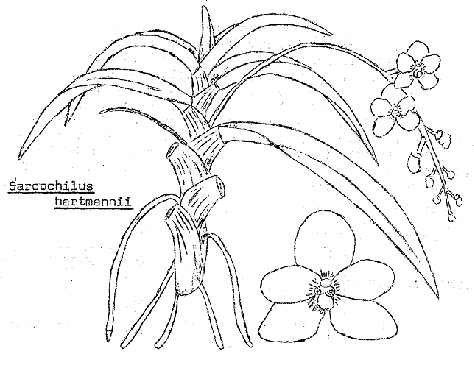
NATIVE ORCHID SOCIETY OF SOUTH AUSTRALIA JOURNAL Volume 7, No. 10, November, 1983 GROWING EPIPHYTIC ORCHIDS IN SOUTH AUSTRALIA – R.T. Robjohns Sarcochilus hartmanii (Hartman’s Sarcochilus) This has a range from the Hastings River in north-eastern New South Wales to the McPherson Ranges in southern Queensland, although some authorities extend this to the Atherton Tablelands in northern Queensland. S. hartmanii is lithophytic and is normally found growing on rocks, sometimes forming large masses but usually in small clumps, however, it occasionally grows on trees. It varies in its habitat from bright sunny positions on cliff faces, above 600 metres, to shady seepages. It must be remembered, however, that this is an area of high summer rainfall and in late summer and autumn has considerable cloud cover with accompanying high humidity.
The leaves, 4 to 9 per stem, from 10 to 20cm long, 1 to 2cm across, are thick, fleshy, deeply channelled and slightly twisted at the base.
Racemes are 6 to 25cm long with 5 to 25 flowers usually sparse at first then crowded towards the apex. The flowers are 2 to 3cm in diameter and have petals and sepals of glistening pure white with deep maroon or crimson spots near the base, though sometimes all white.
The flowering period is September to November.
In 1979 a clone of Sarcochilus hartmanii “Kerrie” was awarded AM/AOC. It was a large plant with 16 spikes and approximately 320 flowers measuring 31mm across the petals.
It adapts well to cultivation and is not difficult to grow, doing well in a shadehouse with 60-70% shade and a good air circulation. I have it growing and flowering in a plastic pot in a bark, charcoal* and polystyrene foam mix and would suggest underpotting rather than overpotting. Good drainage is essential. Other growers recommend shallow baskets or rafts about 8 mm of stag-horn fern fibre as this allows the plant to spread more naturally. It likes to be kept moist (not wet), prefers a humid atmosphere and does not object to regular year-round (½ strength) doses of foliar fertiliser.
November’s theme was hybrids. Orchids, more than any other plant family, are likely to produce natural hybrids. Even though the overall occurrence of natural hybridisation in orchids is low, it occurs often enough to make some species identification challenging.
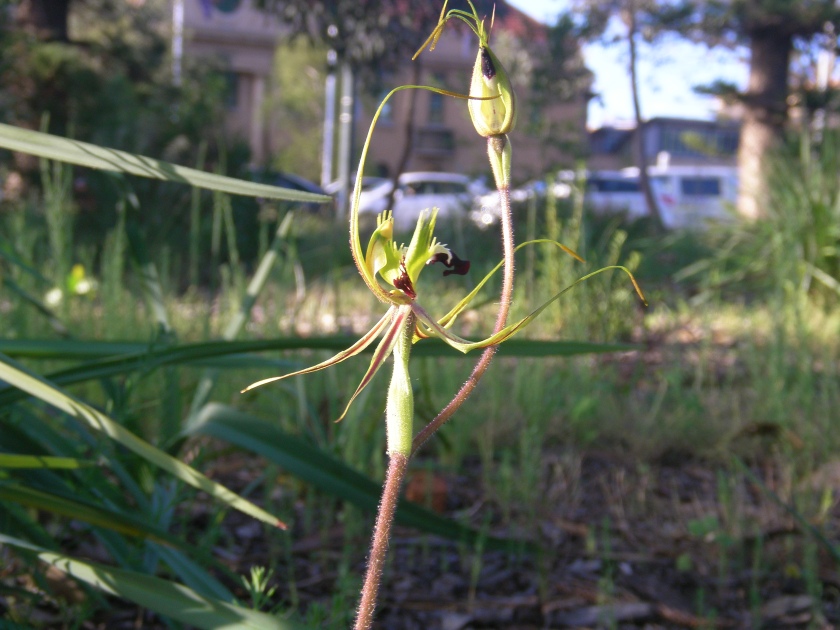
Hybrids mainly occur between species of the same genera such as Jenny Pauley’s Arachnorchis brumalis x A. conferta
Arachnorchis brumalis x A. conferta
but, less commonly, it can occur between genera as seen with Pauline Meyer’s Caladenia latifolia x A. brumalis
Caladenia latifolia x Arachnorchis brumalis
and her Western Australian photograph of Caladenia x enigma; a hybrid between C. falcata and Drakonorchis barbarossa.
Caladenia x enigma
Jones (2006) states that “Natural hybrids are more common in some genera, such as Arachnorchis, Caladenia and Diuris, than in others.” To this list could be added Thelymitra as seen with both of the winning pictures T. x truncata and T. x irregularis. Interestingly with these two hybrids, the parents are not always the same; the parents for T. irregularis could be T. ixiodies or T. juncifolia with either T. carnea or T. rubra.
Thelymitra x irregularis
A similar situation occurs with T. truncata with the parents consisting of T. juncifolia and any member of the T. pauciflora (including T. albiflora, T. arenaria, T. bracteata, T. brevifolia, T. cyanapicata, T. pauciflora) or of the T. nuda complex.
Thelymitra x truncata
The conditions necessary for hybridisation are that the parents must grow in the same area, have overlapping flowering time and share the pollinator. Brown et al (2103) make the additional observation – Hybrids are more common between wasp and bee-pollinated species than between two wasp-pollinated species or two bee-pollinated species. … However, rare hybrids between species using the same pollination strategies, do occasionally occur …
Obviously hybridisation is more likely to occur when there is an abundance of the parent species. This situation can occur when there is mass flowering following fires or good seasonal rains. Site disturbances either through natural causes or clearing can result in increased incidence of hybridisation.
Hybrids are often infertile and will only last for the life of the individual plant but some have the ability to reproduce vegetatively and, provided the conditions remain favourable, may persist for several years.
One situation that can occur is hybrid swarm. When these occur they can make orchid identification challenging. Hybrids share the characteristic of both parents and by careful observation this can be deduced but swarms introduce an added complexity because the hybrid can backcross with either of the parents or cross fertilise with themselves. The result is a wide range of variation which makes orchid identification difficult.
Finally, some orchids will not hybridise even though the conditions are right. This could be due to specific pollinator or possibly chemical or genetic barriers.
References:
Brown et al (2013) Field Guide to the Orchids of Western Australia, Floreat, WA, Simon Nevill Publications
Jeans, Jeffrey & Backhouse, Gary (2006) Wild Orchids of Victoria, Seaford Vic, Aquatic Photographics
Jones, David (1988) Native Orchids of Australia, Frenchs Forest, NSW, Reed Books
Jones, David (2006) A Complete Guide to Native Orchids of Australia including the Islands and Territories, Frenchs Forest, NSW, Reed New Holland
In the disc South Australia’s Native Orchids, 2011, no orchid has the common name of Christmas Orchid but there are several listed that could be a possible candidate. The ones that springs to mind are from the genus Dipodium. In South Australia, there are four species flowering at this time:
Dipodium pardalinum – Note the yellow staining on the bud and no stripes on the labellum
All four are in flower now – D. campanulatum and D. punctatum in the South East and D. roseum and D. pardalinum in the Southern Lofty Ranges.
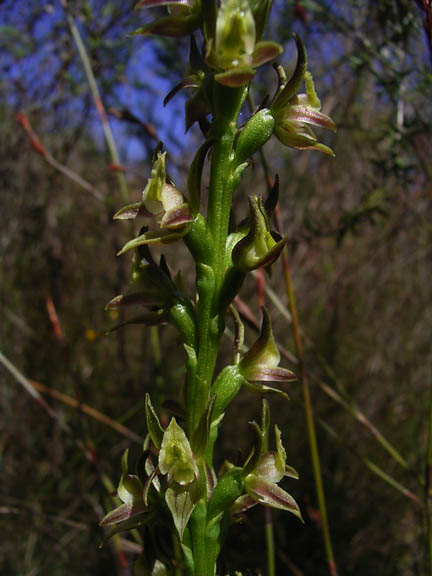
There have been other orchids which would have flowered over the Christmas period but in recent days we are have been having an increasing number of dry year, especially this year (2015) which has resulted in the orchids flowering earlier. For example, Prasophyllum murfetii
Prasophyllum murfettii (Denzel’s Leek Orchid)
finished flowering in November instead of December and Thelymitra circumsepta
Thelymitra circumsepta (Naked Sun Orchid). This photograph was taken on the 28th December 2010
finished flowering in early December but has been seen in flower soon after Christmas Day.
So does South Australia have a Christmas Orchid? Until 1991, D. roseum was included under D. punctatum and the common name according to Bates and Weber 1990 was Christmas Orchid. It seems a pity that when the split was made that neither species retained the common name but nevertheless as they both flower at Christmas, we do have a Christmas Orchid or two!
Reference:
Bates R J, Ed, 2011 South Australia’s Native Orchids, NOSSA
Bates R J & Weber J Z, 1990 Orchids of South Australia
This week there was a workshop South Lofty Block Orchid Recovery Project with representatives from Adelaide and Mt Lofty Ranges Natural Resource Management, SA Water, Forestry SA, Park Rangers, Threatened Plant Action Group and NOSSA. Many issues were discussed. One issue briefly discussed was the development of unofficial bike and walking tracks in parks and the negative impact that this would have on rare and endangered orchids.
This issue is not unique to Australia, the American Orchid Society whose mantra is Education, Conservation and Research published in their journal Orchid February 2008 a summary article titled Watch Your Step: Possible Consequences of Walking off the Trail. The authors are Maryilyn H.S. Light and Michael Mcconaill and the original paper can be found in the Lankesteriana 7:294 – 298 Click on the titles to read the articles.
The researchers studied the effects of visiting a site once a day and standing in the same spot for 10 minutes ie the effects of trampling. Their research suggested that there are possible longer term consequences as they found that the effects of compaction was still observable 18 months later. This does not seem like much but it was sufficient for them to offer some advice such as
stay on the tracks,
don’t walk on the side as even walking on the side of the track can result in unintended damage as the track is widened,
when one person walks off the track others are likely to follow
think carefully of the consequences before walking off the track
where possible step on rocks, not soil
The research was carried out in Canada and though there are differences between the two countries, there are so many similarities it is worth our while to take note of their advice.
Possibly there is scope for research here in South Australia but in the meantime their summary sentence says it all – Until we know what is happening beneath our feet, we should really watch our step
Fortunately our orchids like the edges of paths and so the are easy to spot. But at the same time, trampling on the edge of the paths means that the orchids can be destroyed and so be lost forever.
The following article written by Robert and Rosalie Lawrence is from the Volume 37 No 9 October 2013 Journal of the Native Orchid Society of South Australia
Orchids and the concrete jungle that makes up a city don’t seem together, particularly the terrestrial orchids. Yet in the heart of one of the world’s most well known capital cities such an orchid was found. On the 19th July 2013, the Telegraph reported that botanists from the Natural History Museum had found in the middle of London a white helleborine orchid (Cephalanthera damasonium) which had not been seen in that region since 1900. It was found in the Queen’s backyard, Buckingham Palace. Despite the building, demolishing, rebuilding, bombing and rebuilding that has been going on for the last 400 years, here is an orchid which has survived to surprise the botanist. (For details see Long Lost orchid found in Buckingham Palace Garden)
It is always heartening to hear good news about orchids but here in Adelaide we have our own encouraging story. Settlement in Adelaide is not as long as in London by a long shot but in our own short time we have managed to clear and cover some very good land with concrete and bitumen. The result has been that much of our native flora has been lost with many of our orchid species being the first to disappear.
In recent years effort has been made to bring back the bush with revegetation projects. This work has not tended to involve the orchids, the work of Heather Whiting and her team of volunteers at Vale Park being an exception. Consequently, any orchids found on such sites tend to be the more robust species principally Pterostylis pedunculata, Microtis sp. and in some cases Linguella sp.
Finding anything else will always be special; but that is what has happened at site where a Shell petrol station stood for decades on the corner of Portrush and Greenhill Roads. After the demolition of the service station the site was an area of bare clay for about a decade. Then in 2003, work began on restoring native vegetation incorporating a mini wetland in an area of 2,000 square metres that was given the name Linden “Bush Garden”. Indigenous flora was sourced from the local region and the site has been kept meticulously weed-free by dedicated workers.
Originally 60 local species were planted with several other species arriving by themselves. Among the latter group are five species of orchids. These include a Microtis species and Pterostylis pedunculata, but the other three are more surprizing – Arachnorchis tentaculata, a small blue-flowered Thelymitra species and a Caladenia (syn Petalochilus) species. How they came to be there is a mystery. The long term viability of them will depend upon the continued maintenance of this unique site.
The City of Burnside should be congratulated both for its foresight and initiative as well as its ongoing support of this project.
Natural regeneration at Linden Gardens includes three plants of Arachnorchis tentaculata (King spider Orchid) that are understood to have flowered for the first time this year (2013). The buildings of the council chambers can be seen in the background.
In 1983, Ron Robjohns, NOSSA’s first treasurer, wrote a comprehensive series of articles about growing epiphytes in South Australia. Thirty years on Ron’s information for growing is still helpful and applicable for today. Any updates or extra information are in black text.
NATIVE ORCHID SOCIETY OF SOUTH AUSTRALIA JOURNAL
Volume 7, No. 9, October, 1983
GROWING EPIPHYTIC ORCHIDS IN SOUTH AUSTRALIA – R.T. Robjohns
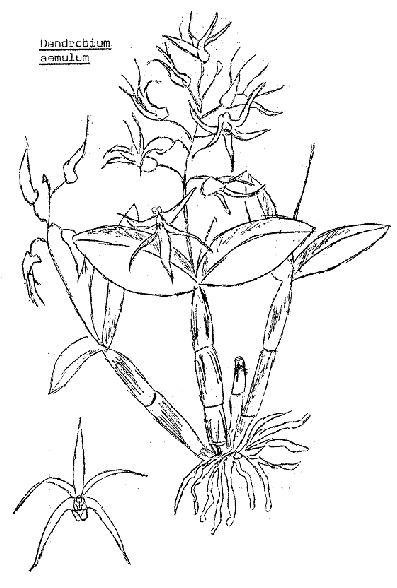
Dendrobium aemulum (Iron Bark Orchid)
There are several growth forms of this orchid due probably to the wide variety of habitats, the flowers of all forms being similar. It has a range from the Clyde River in south eastern New South Wales to the Atherton Tablelands in Queensland
Those growing in the rainforests of New South Wales and Queensland have straight stems up to 20 cm long with 2-4 shining dark green leaves. On the edge of the rainforests in northern New South Wales and southern Queensland in the dense brush forest, the principal hosts are the trunks of “Brush Box” trees where it has stems up to 30 cm long which tend to radiate from a central point. It also has 2-4 dark green leaves. In the open forest areas its hosts are the “Iron Bark” eucalyptus trees, it has shorter (up to 7 cm), stouter (up to) 1 cm), and more crowded stems, sometimes growing into large mats and having 2-4 yellowish green leaves. On the Atherton Tablelands at an altitude of around 750 metres and with callitris trees as its favoured host, it has very slender stems of about 0.3 cm with usually only two dark green leaves.
The flowering period is August/September. One to three slender racemes (5-10 cm long) occur terminally from between the leaves or at nodes along the stem, each raceme bearing 3-20 cm diameter. The flowers are usually pure white (sometimes pale cream) with purple markings on the labellum, the whole raceme turning deep pink before withering.
This is another of our natives which to date does not appear to have attracted much attention from the hybridisers. “Emmy” aemulum x kingianum seems to be the only registered cross.
I find D. aemulum is an easily cultivated and highly rewarding plant that flowers freely with masses of feathery flowers. It grows well mounted on hardwood slabs, cork or on a paperbark branch under 50% shadecloth. Mine get about 65% shade in mid-summer and receive an occasional spray of weak foliar fertiliser during the growing period.
Again this month was a varied selection of species with Pauline Myers’ Caladenia chapmanii (WA), Claire Chesson’s Thelymitra rubra, Jenny Pauley’s hybrid of Arachnorchis brumalis x conferta, David Hirst’s Caladenia discoidea and the winning entry, Rosalie Lawrence’s Diuris brevifolia.
This strikingly yellow flowered donkey orchid endemic to South Australia is listed as Endangered. Its range was once quite widespread in the southern Adelaide Mt Lofty Range region but now it is now restricted to pockets on the Fleurieu Peninsula and western Kangaroo Island in Heathy Woodland, Wetland and Riparian habitats.
There is interest today in cultivating orchids for conservation or ex situ conservation. With the reduced range of this species, can it be cultivated and thus continue to ensure its survival as a species? Some sources seem to suggest that it is an easy plant to cultivate, and some Diuris are easier than others, but Les Nesbitt points out that he has some plants from a rescue dig several years ago and that they have not multiplied very much in that time. This suggests that they may be dependent on a specific fungi. Though it has not been hugely successful in cultivation, it is worth noting that it has been used to produce hybrids with several other Diuris.
Reference
Bates, R. J. (2011) South Australia’s Native Orchids NOSSA DVD, Adelaide
Nesbitt, L personal communications
Adelaide and Mount Lofty Ranges South Australia Threatened Species Profile Fact Sheet – Diuris brevifolia
Sometimes a particular species of orchid is said to be rare or endangered, for instance Thelymitra circumsepta* is listed as endangered in South Australia but has no listing federally whilst the endemic Prasophyllym murfetii* is listed as Critically Endangered federally but only Endangered in South Australia.
Prasophyllum murfettii (Denzel’s Leek Orchid)
What do these listings mean and why are they different for the same species?
What are the Conservation Categories?
Conservation listing by governments gives species a legal status, which can then be used to determine the type of consideration to be given to individual species in decision-making processes for species conservation.
In South Australia, the two main legislations affecting native orchids are the state National Parks and Wildlife Act 1972 (NPW) and the national Environmental Protection and Biodiversity Conservation Act 1999 (EPB). There is also the International Union for Conservation of Nature (IUCN) Red List which is used for international treaties. Each has their own set of categories resulting in terms with slightly different meanings.
The IUCN classification is quite detailed but in summary the conservation status used are
Extinct – not seen for fifty years or despite intensive searching not seen at a previously known site
Extinct in the Wild – no natural populations exist; only surviving in cultivation
Critically Endangered – known only from a single non-viable population
Endangered – in danger of extinction unless the factors causing decline are arrested
Vulnerable – likely to become endangered if the only large populations is wiped out for whatever reason
Near Threatened – close to qualifying or likely to qualify for a threatened category in the near future
Least Concern
Data Deficient
Not Evaluated
The Australian Federal government, under Section 179 of the EPBC Act, has six categories
Extinct – no reasonable doubt that the species has died out
Extinct in the Wild – no natural population existing, surviving in cultivation
Critically Endangered – faces an extremely high risk of extinction in the wild in the immediate future
Endangered – faces a very high risk of extinction in the wild in the near future
Vulnerable – faces a high risk of extinction in the wild in the medium term future
Conservation Dependent – if the cessation of a specific conservation program ceased the species could become vulnerable, endangered or critically endangered
South Australia uses three categories based on the categories from the IUCN Red List Categories and Criteria.
Endangered (Schedule 7) – includes Critically Endangered Extinct in the Wild and Extinct
Vulnerable (Schedule 8)
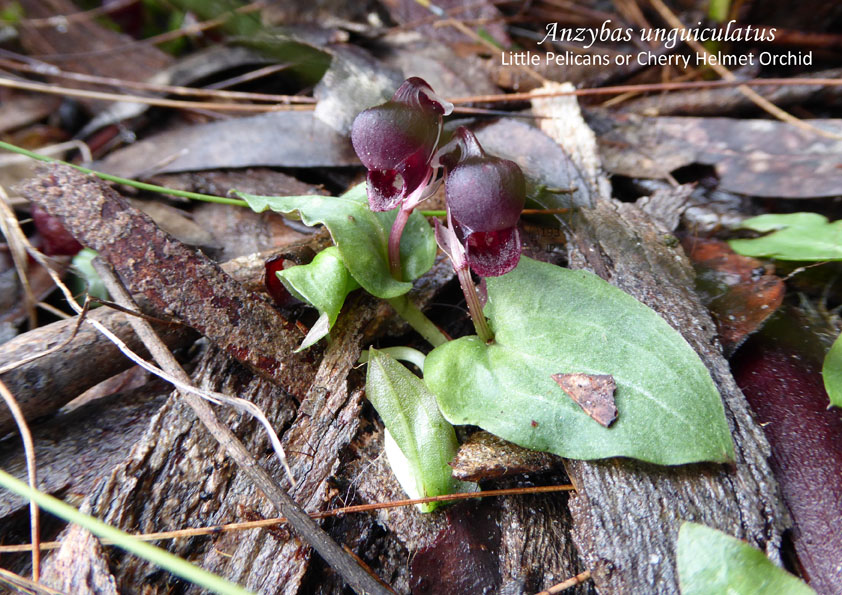
Rare (Schedule 9) – this is a South Australian term not recognised elsewhere but the criteria are consistent with the IUCN Near Threatened category and refers to uncommon species that are naturally limited in location or are in decline. Hence it is possible for a species to be common interstate but threatened in South Australia, for example Anzybas unguiculatus* is rated rare.
Anzybas unguiculatus (Little Pelican or Cherry Helmet Orchids)
Another term that is frequently used is Threatened. For the IUCN Threatened encompasses the three categories of Critically Endangered, Endangered and Vulnerable. It means that a species rated as threatened with extinction under these three categories may have different degrees of threat – note the adjectives in the IUCN definitions above. This serves as a guideline for its usage in South Australia. It should also be noted that Threatened and Rare are not interchangeable but a species rated Rare may be threatened by outside influences.
There is another level of conservation which is the regional status. This level does not have any legal standing but it is helpful in managing the species. The IUCN Red List Categories and Criteria are used to assign a regional conservation status. This is helpful in managing species at this level.
Why does a species have different Conservation Categories?
Looking through Part Two of South Australia’s Native Orchids 2011, it is not uncommon to find a species with two different conservation statuses. It is not surprising when they have the same status eg Arachnorchis behrii* is rated Endangered both state and nationally but why are the others different? Some of this is due to the different number of categories – six federally but only three at the state level so Diplodium bryophilum* is nationally Critically Endangered but only Endangered in South Australia as there is no critically Endangered category. Others have a state status but no national status, for example the endemic Diuris brevifolia* is rated Endangered. Curiously there are no endemic species with the combination of a national status but no state status, although there are five non-endemic species found in South Australia that do have this combination.
Diuris brevifolia (Late Donkey Orchid)
This comes about because there are two different bodies determining the statuses through two very different processes.
Nationally under the EPBC Act any individual can nominate a species which is assessed by the Threatened Species Scientific Committee, put out for public comment, changes adjusted as necessary and then the recommendations are passed onto the Minister who approves or rejects the nomination.
In South Australia, DEWNR (Department Environment Water and Natural Resources) initiates the process by asking the experts, compiling data, holding workshops with the experts. A report is written for the National Parks and Wildlife Council outlining the changes under the NPW Threatened Species Schedules. Once the changes are approved, it is sent to the Minister for approval before being released for public comment. After any necessary adjustments the report is then sent to the South Australian Parliamentary Cabinet for final approval.
Both processes check the species under consideration against the IUCN criteria.
How many South Australian orchids are under threat?
On 22nd July 2014, Doug Bickerton presented a talk at the Native Orchid Society on the conservation status of South Australian orchids. The comparison between the State and Federal listings was as follows:
Number of Orchids with a Conservation Status under the NPW Act (State)
77 species Endangered
33 species Vulnerable
32 species Rare
A total of 142 species or 49% of all South Australian orchids are recognised to be under threat.
Number of Orchids with a Conservation Status under the EPBC Act (Federal)
4 Critically Endangered
22 Endangered
19 Vulnerable
A total of 45 species for the State have a Federal government legal conservation status.
The fact that one authority recognises a species and the other authority does not doesn’t mitigate against the seriousness of the threat to that species. The fact that a species does not have a conservation status from either authority does not mean that it is not under threat. It could still be in danger of extinction.
Cryptostylis subulata (Moose Orchid) State Conservation Status: Vulnerable National Conservation Status: not listed
Currently in South Australian there is a State-wide assessment underway and the results will be published in 2016.
This article was inspired and is based upon notes taken from a talk given by Doug Bickerton in 2014 at the Native Orchid Society of South Australia. I would like to thank Thelma Bridle, Conservation Officer, Native Orchid Society of South Australia, for her help.
*Based on information found in South Australia’s Native Orchids 2011
IUCN RED LIST CATEGORIES AND CRITERIA Version 3.1 Second edition Prepared by the IUCN Species Survival Commission As approved by the 51st meeting of the IUCN Council Gland, Switzerland 9 February 2000
In 1983, Ron Robjohns, NOSSA’s first treasurer, wrote a comprehensive series of articles about growing epiphytes in South Australia. Thirty years on Ron’s information for growing is still helpful and applicable for today. Any updates or extra information are in black text.
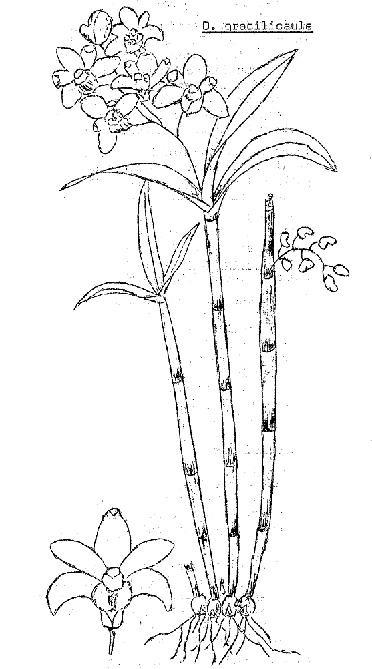
NATIVE ORCHID SOCIETY OF SOUTH AUSTRALIA JOURNAL Volume 7, No. 8, September, 1983 GROWING EPIPHYTIC ORCHIDS IN SOUTH AUSTRALIA – R.T. Robjohns Dendrobium gracilicaule D. gracilicaule is found from Kiama in eastern New South Wales to the Bloomfield River in the south east of Cape York Peninsula in Queensland. It has one of the widest ranges of habitat of any of our epiphytic orchids, growing in the light coastal scrubs, the dense rainforests and, in the tropical areas, on the tablelands. With such a variation in altitude (from near sea-level to about 1200 metres) it follows that there is a wide variety of hosts, even occasionally growing as a lithophyte on rocks. The stems are long, thin and cylindrical, ½ to 1 cm thick, and from 20 to 60 cm in length with 3 to 6 ovate to lanceolate, terminal leaves, 5 to 13 cm long and of rather thin, leathery texture. The racemes are short (5 to 12 cm) and bear 5 to 14 small, cup-shaped flowers of a dull or light yellow colour having the outer sepals lightly to heavily blotched or spotted with a brown or red-brown. Occasionally they are found a brighter yellow and without blotching. The flowering season is from July to September. D. gracilicaule must surely be one of the hardiest and easily cultivated of our Australian epiphytic orchid species as it is adaptable to almost any conditions. I have it growing and flowering on hardwood slabs, paperbark limbs and in a pot, but I think it is better if mounted. It receives 50% – 60% shade and occasional foliar fertiliser. I protect it from frost but the cold does not affect it. It does not flower from first year stems but will flower from mature stems for several years, even after they are leafless. Although most racemes are terminal or near, I have had racemes occurring from nodes halfway along a leafless canes. There are two natural hybrids, i.e. D. x suffusum and D. x gracillimum. D. x gracillimum is a natural hybrid between D. gracilicaule and D. speciosum in which the features of D. gracilicaule are dominant in the flower while in D. x suffusum, the natural hybrid between D. gracilicaule and D. kingianum, D. kingianum is the dominant parent. D. gracilicaule has not attracted professional hybridists, probably because the flowers are not as outstanding as many of our other epiphytes, only two crosses appear to be registered: D. Susan (D. gracilicaule x D. falcorostrum) and D. Shan Leaney (D. gracilicaule x D. gracillimum).
With the development of cities here in Australia, many of our orchids were lost as habitat was cleared and the newly arrived settlers built houses and reconstructed the gardens they knew from the Old World; but the odd pocket of native bushland has survived. Cemeteries and golf courses have often been the only refuge for remnant bushland. One such refuge has been The Pinery, Grange Golf Club, the only known location of Oligochaetochilus arenicola (syn. Pterostylis arenicola) on the Adelaide Plains. In the National Parks and Wildlife Act, this orchid is scheduled as vulnerable. The Golf Club left this site intact and has been supportive of the conservation efforts of the Threatened Plant Action Group who in turn have received assistance from the Native Orchid Society of SA and the Natural Resources Adelaide and Mt Lofty Ranges.
Typical of the rufushoods, this Oligochaetochilus arenicola shows the sencesing leaves, pendent petals and hairs on the labellum. Photographer: H Lawrence
Below is a media release from the Natural Resources, Adelaide and Mt Lofty Ranges
Orchids come in ‘under par’ at Grange Golf course
News release
30 September 2015
A tiny remnant population of rare orchids which survives in a patch of bush on Grange Golf Course has increased 50% since last year, according to a new survey.
The survey conducted this month found 1200 individuals of the Sandhill Greenhood Orchid (Pterostyllis arenicola), a nationally threatened species which is considered critically endangered in the Adelaide and Mt Lofty Ranges region.
When surveys began 20 years ago, only about 100 plants survived at this site. But the latest survey has revealed the population is steadily increasing
The orchid comeback is thanks to decades of care by four groups involved with the annual survey: the Threatened Plant Action Group, the Native Orchid Society of SA, Natural Resources Adelaide and Mt Lofty Ranges, and with support from the Grange Golf Club.
The tiny fragment of native pine bushland in the middle of Grange Golf Course is one of the only known locations of this species within the entire Adelaide and Mt Lofty Ranges region, with other small populations known from near Wellington and Tailem Bend.
The orchid grows 10cm-25 cm high and produces hood-shaped flowers that are green and brown or red-brown with white markings. Most species of orchid flower for only a short period and for the Sandhill Greenhood, it will flower only for the next few weeks.
Grange Golf Course just happens to provide ideal conditions for the plant: red sandy soils and an over-story of native cypress pine trees.
Dedicated project partners have tackled the main threat to orchids – suffocation by Perennial Veldt Grass and Soursob weeds – through years of patient hand weeding.
The orchid comeback is a great success story of collaboration across the community to save one of our state’s tiny floral gems.
As a demonstration of nature’s interdependence, conserving the Sandhill Greenhood also means conserving a particular mycorrhizal fungus that must be in the soil for Sandhill Greenhood seeds to germinate. In addition, the flowers must be pollinated by a particular type of insect, the fungus gnat. The gnat is attracted by the orchid’s pheromones and tries to mate with the flower, only to find itself loaded up with a packet of pollen which it then transfers to the next flower as it continues its romantic adventures.
While the survey results are good news, the Sandhill Greenhood population is still precariously small, and it is hoped that as the population grows, so do the options to secure the species into the future.
South Australia has over 260 species of orchids, including 50 species of greenhood.






 NOSSA
NOSSA 