Leo Davis is an orchid enthusiast with an eye for detail. Everyone seems to be aware of and gets excited over the flower of the large flying duck orchid but in the article below, Leo takes a look at a more significant event – the rare fruiting of the duck in South Australia.
TAKING A DIFFERENT PERSPECTIVE 1(The Large Flying Duck Orchid)
Leo Davis
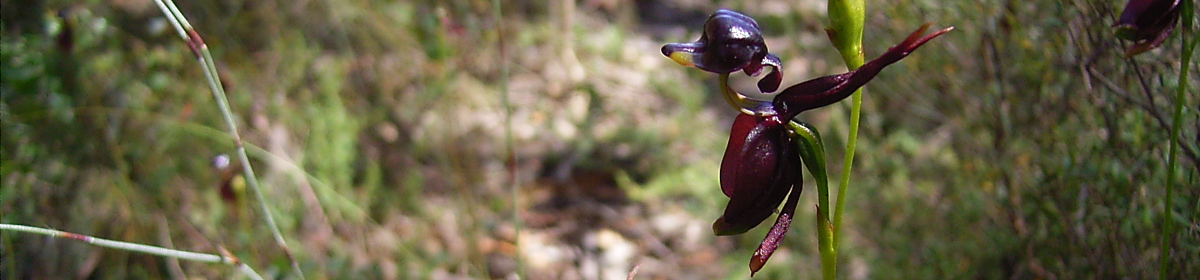
When approaching an iconic orchid like a flying duck orchid the obvious imperative is to emphasise the flying duck image. But as much fun as that can be, we can find and record some other significant aspects of this species. Do remember to look at all orchid flowers, with or without your camera, from different directions. And don’t forget the leaves.
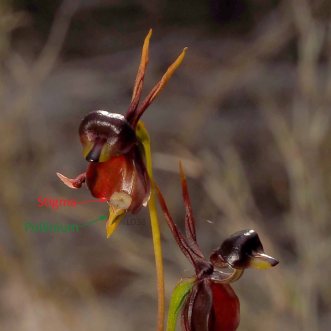
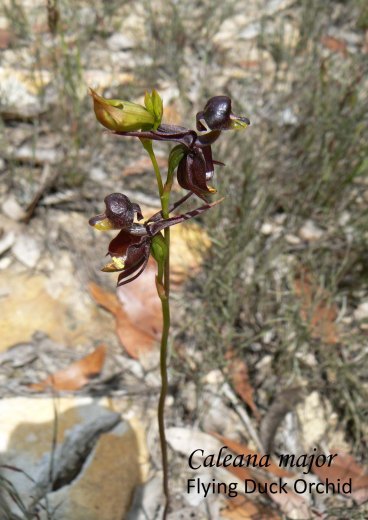
In the last flowering season at Knott Hill NFR (Oct-Dec 2015) I photographed a double flowered large flying duck (Caleana major) on November 14. At the bottom of the upper left hand side flower you can see a white stigma (♀ part), sitting at the base of the bowl shaped column. The sticky surface of the stigma is ready to trap a pollinium (a sack of pollen grains), if the correct pollinator arrives, with a pollinium attached. Immediately below is a three lobed the triangular yellow pollinium packet (♂ part), as yet not taken by a pollinator. The highly sensitive mobile duck shaped labellum, a modified petal, looms above, waiting to slam a visiting insect down onto the pollinium, so attaching it to the back of the insect.
Caleana major (Flying Duck Orchid) – note the location of the stigma and pollinium
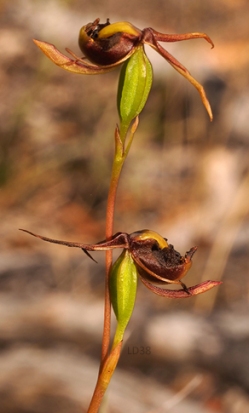
On December 10 I found the same plant, and one adjacent, in FRUIT. This is not often observed in South Australia and it has been suggested that the specific pollinator may be thin on the ground. I photographed both plants but that of the more advanced plant (shown), with fully withered flowers and plump developing ovaries, interested me more, because it suggested progress towards production of viable seed.
Success – Caleana major Fruiting Bodies
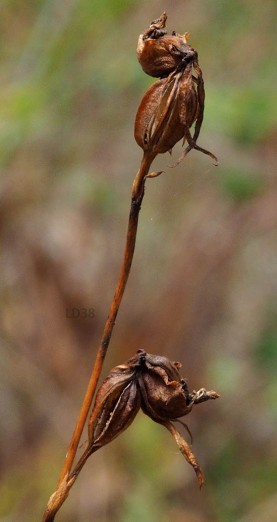
I went back on March 9, this year, and was delighted to find and photograph the fruit that had ripened, dried and split, so releasing the dust like seed. I was prepared for disappointment because the fate of seed pods of many orchid species is to be eaten. For example for the hyacinth orchid (Dipodiun roseum), across both the 2014-15 and 2015-16 flowering seasons, at Knott Hill, all plants that I found had their seed pods consumed. Kangaroos?
Dehiscent (splitting of the seed pod to allow dispersal of the seed) Caleana major
Robert Brown established the genus Caleana based upon his description of a specimen of Caleana major (1810). The type specimen was collected in 1803, at Bennilong Point, the site of the Opera House, so the species is extinct at that site now, of course.
For our first competition of the year we had five photographs – three of flowers and two of participants on a field trip. The species represented were David Mangelsdorf’s Calochilus robertsonii (Southern Bearded Orchid); Robert Lawrence’s Pheladenia deformis (Blue Bearded Orchid) and Pauline Meyer’s Caleana major (Flying Duck Orchid) which was the winning photograph.
There is no doubt that the Duck Orchids are very photogenic and that people want to see and photograph them. When seen the for the first time their small size surprises most. The flower is no bigger than a thumbnail, perched atop a spindly stalk that may only reach 50cms (20 inches).
Although the rusty red colour of the flower is quite exquisite, this means that it blends in with the surrounding leaf litter and scrub and is not easily spotted.
As species of Heathy Woodlands, in South Australia, it is often found growing in sparse colonies near the base of trees. Other plants associated with them are banksias, eg Banksia ornata, Eucalyptus baxteri and bracken. The soil is sandy, often from leached acidic dunes, or gravelly.
Reference:
2008 Department for Environment and Heritage Electronic Flora of South Australia species Fact Sheet: Caleana major R.Br. Available from pa-fact-pafactcaleanamajor.pdf
Bates, R. J., ed. (2011). South Australian Native Orchids. Electronic version, 2011. NOSSA
The best size pots to use for terrestrial orchids should be between a minimum of 125mm (5 inches) to a maximum of 175 mm (7 inches). Black plastic pots are better than terracotta as they last longer and are easy to sterilize.
If the pots are too small, they dry out too quickly in Autumn and Spring.
If they are too large, it gets too wet for the tubers. If using a larger pot, then the drainage needs adjusting by adding coarser sand to the mix. Specimen pots for show purposes utilize pot sizes up to 300mm holding 30-50 plants. Clay pans are sometimes used for show work.
The pots should not be shallow. 125mm depth is the minimum recommended for reliable results. For instance, the Arachnorchis like deeper pots as the tubers tend to go down deep. Droppers have been known to come out of the bottom drainage holes. When this happens to stop the tubers shrivelling up in summer, it will be necessary to stand the pot on the sandy soil of another pot.
Used pots can be cleaned by blasting off loose grime with a high pressure jet of water and then soaking in a bucket of water & White King (bleach).
Caladenia latifolia – show specimen in larger size pot
Orchids are attractive and abound in variety. It is the variety that often provides the challenge of identification. As a novice it can be a bit overwhelming. In the eye of the beginner, the experienced orchid hunters appear to have no difficulty with identification. Over the years they have accumulated various clues that guide them toward accurate identification.
This series aims to document the clues that orchid hunters use.
Prasophyllum and Microtis Leaves
The first in the series relates to distinguishing between Microtis and Prasophyllum leaves. When in flower it is easy to see which is which but not so when only in leaf; and as they do not always produce flowers it is helpful to be able to separate them out at leaf stage.
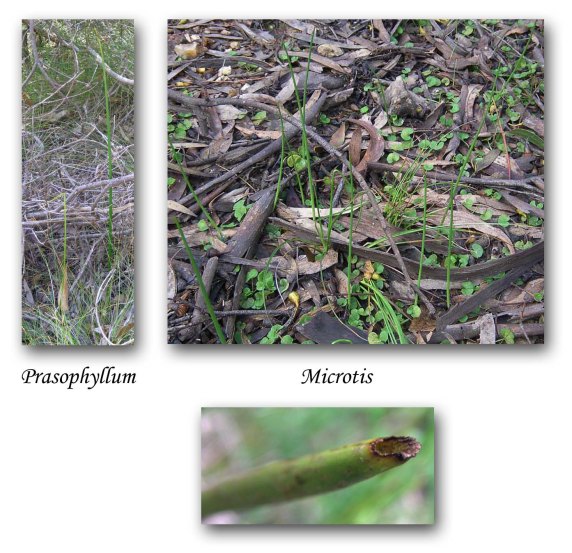
Both leaves are green. Both are cylindrical. Both are hollow. Both resemble onion leaves.
Both types of leaves are long, thin and green. The damaged Microtis leaf (below) shows the hollow.
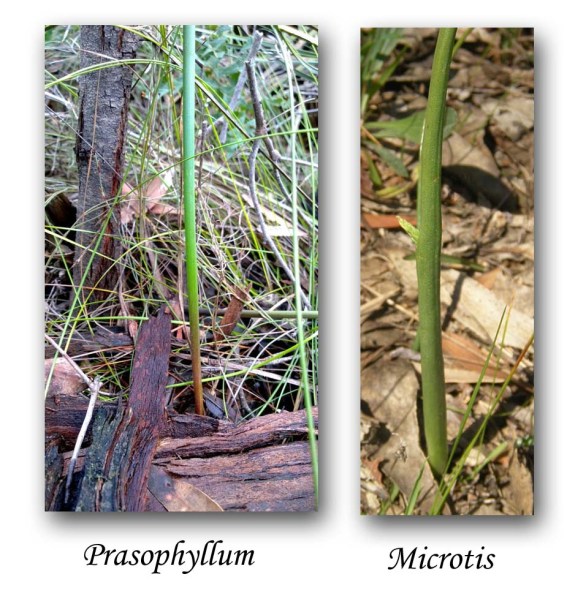
The differences can be found in one or two areas. Microtis leaves are always green at the base whereas Prasophyllum leaves usually but not always will have a red or purplish coloured base. To help in identification, it is necessary to examine the base by moving the leaf litter aside to see where the plant emerges from the soil.
The bases reveal the difference between the two genera.
Prasophyllum species that could have a green base are P. laxum, P. occulatans, P. sp Jip Jip, P. elatum, P. sp Sandplain, P. pallidum (although this is short and usually in bud when noticed), P. spicatum, P validum. So further observations are necessary.
Another other area of difference is that the broken leaf of a Microtis yields a mucilaginous (thick sticky) sap; the Prasophyllum leaf does not.
Within the segregate genera used by many NOSSA members, there are two other genera with similar leaves. They are Microtidium and Hydrorchis. Again they are green, cylindrical, hollow but only hollow in the lower half. The top half is solid.
It should also be noted that Microtis can form dense colonies but Prasophyllum will never form more than loose colonies.
Finally, if upon gently feeling the base of these leaves it feels solid, that will indicate that there is a bud and it will most likely flower this season.
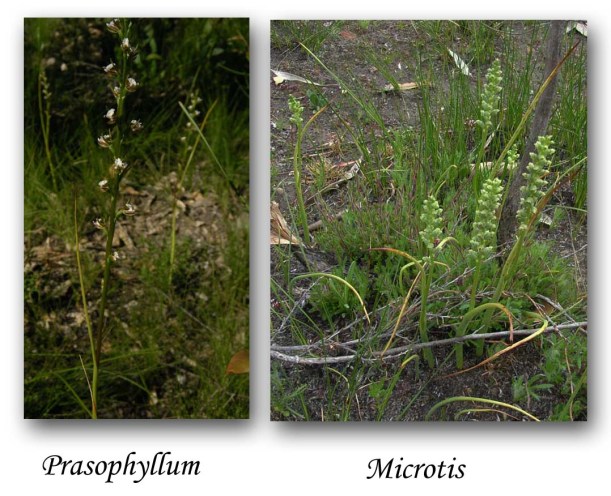
Once in flower, the differences between the two genera is obvious.
Leo Davis is an enthusiast about the natural world and shares his knowledge through different journals. He is a keen observer and meticulous in his record keeping. He is also very knowledgeable about orchids. The following is one such article of Leo’s.
GOOD NEWS FROM FERRIES-McDONALD CONSERVATION PARK Leo Davis
I was aware of the Star Spider Orchid from Bates who lists the species as ‘3E, critically endangered in South Australia, nationally rare’ (pp. 242–243). I knew that in the past it had been found at Monarto and Hartley and discussions with members of the Native Orchid Society of SA (NOSSA) suggested that it had been seen at Ferries-McDonald Conservation Park, but was now possibly extinct there. My searches over five years had all failed. On August 2, 2014, I ran into, then strangers, Len Stephens and his grandson Rickey Egel, in Monarto C.P. They had just come from Ferries-McDonald C.P., about 8 km further south. Rickey, who has a very good eye for spotting orchids, showed me an image, in his camera, of ‘the common spider orchid’. From my hurried glimpse I knew immediately it was far from ‘common’ and told him so. I headed straight for Ferries-McDonald C.P. for the first of many fruitless searches. On August 14, 2015 Rickey and Len showed me a few Star Spider Orchids in flower at Ferries-McDonald C.P. Because I was to lead the Botany Group of the FNSSA on an outing to Ferries-McDonald C.P. on September 5, I had been visiting the park almost weekly and so was able to spend many hours looking for the orchid. It is difficult to spot, being quite small. This year’s plants, perhaps not typical given the very dry June, are between 8 and 20 cm high with flowers only about 35 x 30 mm. Plants were only found in Broombush (Melaleuca uncinata) associations. As soon as Eucalyptus species were present the orchid was no longer found. Any survey, especially by a single person, will produce a lower count than the actual population. Leaves of non-flowering or beheaded (the fate of so many spider orchid flowers) plants will not be recognised, some flowers will not be spotted and some plants will flower before or after surveys, with some areas surveyed on different days. Between August 14 and September 5, 2015 just 18 flowering plants (Fig. 1) were positively identified (about the same number of likely leaves and buds, adjacent to these, were noted) over a narrow area of approximately 3,000 m2. The area searched was very much greater than this. Small as this tally is, it establishes a significant population other than the only other South Australian one that I know. That is on the private property of farmer […], at Hartley. With his kind permission I have counted over 100 flowering plants there during five visits from July 28 (buds only) to August 30 (Fig. 2). The actual population will be larger because I did not cover all of that location. My observations suggest the populations I know to be around 150 to 200 plants with other occurrences probably existing around Monarto and Hartley. Why have I avoided the scientific name? Many of you will follow the Electronic Flora of South Australia which lists the Star Spider Orchid as Caladenia stellata, as does Backhouse (pp. 456–457). I prefer to follow Jones (p. 76) (who does not recognise the species occurring in SA) and Bates (p. 242) (who says it does occur in SA), both of whom call it Arachnorchis stellata. Backhouse points out that the nearest other occurrence, the major one, is in central southern New South Wales, south of Rankin Springs, several hundred kilometres away, and that the plants there differ from our populations in having smaller flowers. He suggests that we are looking at a separate undescribed species, Caladenia sp. ‘Murray mallee’ (p. 484), but that it might indeed be co-specific with the Rock Star Orchid (sic), Caladenia saxatilis, which is similar and occurs further north, in the northern Mt Lofty and the southern Flinders Ranges. Bates told me in conversation, that he disagrees with Backhouse and believes the local plants are the same as those in NSW and distinct from A. saxatilis, which grows in soils of different pH (acidity).
Fig 1: Arachnorchis stellata, Ferries-McDonald CP, August 22, 2015. Photo: Leo Davis
Fig 2: Arachnorchis stellata Hartly, South Australia, August 5, 2015. Photo: Leo Davis
BIBLIOGRAPHY:
Backhouse, G. (2011). Spider-orchids – the genus Caladenia and its relatives in Australia. DVD/pdf, Backhouse, Melbourne. Bates, R.J. (2011). South Australia’s Native Orchids, DVD, NOSSA, Adelaide. eFlora SA. Electronic Flora of South Australia; last updated August 22, 2015. Jones, D.L. (2006). A complete guide to native orchids of Australia including the island territories. Reed New Holland, Sydney.
Used by permission, extract from The South Australian Naturalist Vol. 89 No 2 July-December 2015.
Think of deserts and the image is that of a bleak barren landscape with little to see but this is not so. The conditions are harsh but there is a myriad, though not an abundance, of hardy fauna and flora if one but looks closely.
But concerning orchids – No orchids have been found in true deserts….. They also appear to be absent from the arid mountains of the far north-west, or at least no-one has ever found orchids there.
Orchids need moisture and so they do not grow on unstable soils such as dry sand-hills, gibber plains or the many saline areas of the far north but on the desert fringes there are micro-climates where the moisture, humidity and soil structure is just right (to quote Goldilocks) for orchids. This micro-climate is created by [s]hrubland [which] is … [an] … important dryland orchid habitat. Besides providing shade and shelter for the orchids, shrubs like the many species of wattles, Acacia and hop-bush Dodonea drop fine leaves which help to hold the soil together and slowly break down into humus rich with nutrient and water storing capability. These shrublands usually form in soils too dry or shallow for trees. Orchids of course have no need for deep soils as they are shallow rooted.
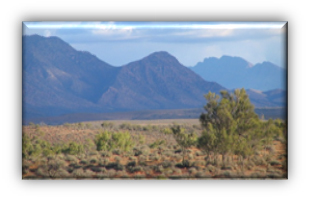
Semi-arid Shrublands, Flinders Ranges
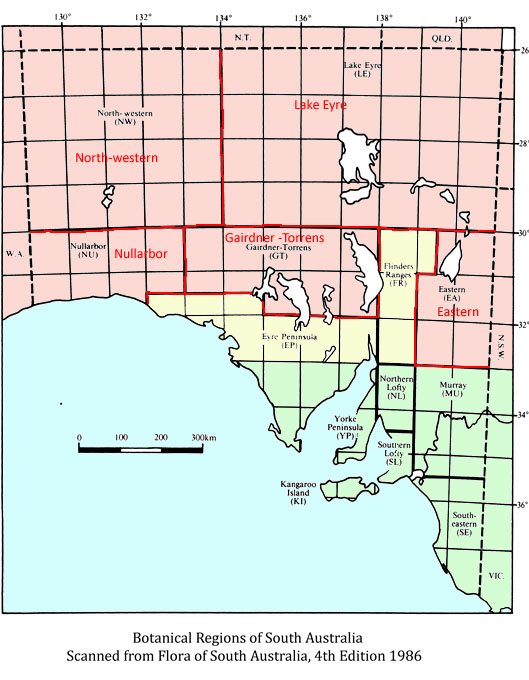
Of the five desert botanical regions, the Eastern region contains the most number of species with over a dozen species.
Colour added to indicate the desert regions (in red)
Orchids of the Eastern Region – this region is from the east of the Flinders Ranges to the New South Wales border and includes the Olary Spur and Lake Frome.
Arachnorchis toxochila – Dry Land Spider Orchid or Bow Lip Spider Orchid.
Corunastylis tepperi – Mallee Midge Orchid
Diplodium robustum – Common green shell-orchid.
Hymenochilus pagophilus – Mountain Shell-orchid
Microtis eremaea – Desert onion orchid
Microtis frutetorum – Common woodland onion orchid.
Oligochaetochilus bisetus species complex, Rusty rufous-hoods
Oligochaetochilus sp. Blue-bush Plain – Blue Bush rufous-hood (O. bisetus complex)
The Gairdner-Torrens region includes, besides the salt lakes it is named after, the Gawler Ranges and the southern part of the Great Victoria Desert. Though not as many species as the Eastern region, it contains some different species including a Sun Orchid.
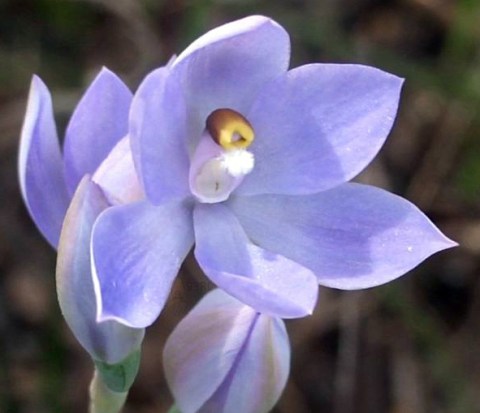
Thelymitra megcalyptra – Scented or Dryland Sun Orchid
Third of this group is the Nullabor region. Consisting of flat treeless limestone plains, this area, surprisingly, has two species both of which have been found close to the coast.
The final two regions Lake Eyre and North-Western contain the vast expanses of desert of the far north of South Australia. Definitely not a place to find orchids yet one specimen has been collected from each of these two regions.
Oligochaetochilus sp. Everard Range (L. Scott 173), Mimili Orchid (possibly O. woollsii complex) from North-Western Region.
Oligochaetochilus sp. Gammon Range (O excelusus complex) from the Lake Eyre region.
It is unusual to find orchids in the desert because they only grow when there have been good winter rains which isn’t very often. But nevertheless, here in South Australia we have over 20 possible species – an astonishingly high number for such a harsh area!
Reference:
Bates R J ed, South Australia’s Native Orchids, 2011 Native Orchid Society of South Australia
Map adapted from Flora of South Australia, Fourth Edition, 1986
Recently, 10th February 2016, Anita Marquart, PhD student, Adelaide University spoke at the Field Naturalists Society of South Australia. She is a recipient of the Society’s Lirabenda Endowment Fund Research Grant. At the meeting she gave a summary of her research – Orchids, Insects and Fire: Investigating the impacts of prescribe burning on orchid pollinators in Southern Australia. Though she has not finished collating the data she has kindly supplied a summary of her talk with her preliminary findings.
It is always encouraging to see research on our native orchids. They are the Barometer of the Bush, so the more we can discover about them, hopefully the more we will better understand how to manage our native bushland.
Orchids, Insects and Fire: Investigating the impacts of prescribed burning on orchid pollinators in Southern Australia
Anita Marquart, Renate Faast, José M. Facelli, Andrew Austin
School of Earth and Environmental Sciences,
The University of Adelaide, Adelaide 5005 Australia
PhD Project
Summary
Fire is an important ecological factor in Australian ecosystems. Orchids that depend on specific pollinators may be more susceptible to disturbance than more generalist species. Therefore, declines or changes in pollinator communities due to prescribed burns and wild fires could lead to reduced pollination success and consequently declines in orchid populations. The project combines traditional plant and insect ecology with advanced molecular techniques to identify orchid pollinators and assess their response to prescribed burns and wild fires. Insect relevant habitat characteristics (such as floral abundance, vegetation height, presence of logs, litter and standing litter) were assessed and trapping surveys of potential orchid pollinators were conducted in spring, before and after prescribed burns. The effect of both spring burns and autumn burns is being investigated.
Study sites are located in the Adelaide hills with always one burn and one adjacent control site respectively in Kersbrook Native Forest, Millbrook Reservoir, Para Wirra Recreation Park and South Para Reservoir. Some parts of the study sites in Kersbrook and Millbrook were affected by the Sampson Flat Bushfire. Affected sites are used to compare the effects on orchid pollinators after prescribed burns in contrast to wild fires.
Potential orchid pollinators are being identified using DNA barcoding with the mitochondrial cytochrome oxidase I (COI) gene. Sequencing results will be compared with existing databanks and confirmed using morphological identification. As the data accumulates it will build up a reference library of COI barcodes for the species found in the surveys.
The outcome of this research project might help to advise the optimal management of orchid species under fire-managed regimes in the Mount Lofty region of South Australia, as well as more generally in south eastern Australia.
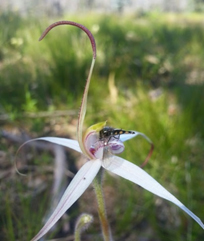
A hoverfly, Melangyna collatus on Arachnorchis rigida syn Caldenia rigida (Rigid White Spider Orchid)
Orchids and their pollinators
Native bees, thyninne wasps and Syrphid flies are known orchid pollinators of South Australian orchid species. Orchids of main interest for this study were Caladenia rigida, Caladenia behrii, Caladenia tentaculata and Glossodia major. Caladenia tentaculata and C. behrii are sexually deceptive orchids and are known to be pollinated by thynnine wasps (Bates 2011). In contrast, C. rigida is food advertising and uses a broad range of bee and fly species, such as native bees and hoverflies (Faast et al. 2009). Glossodia major is a generalist in its pollination strategy and is using small native bees of several genera (Bates 2011, personal observations).
Preliminary findings
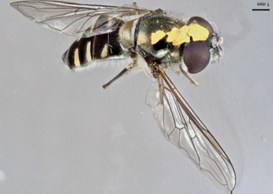
Syrphid flies were successfully separated into different species using DNA barcoding methods. Results show that we have two dominating species on our field sites in the Adelaide hills. Both species, Melangyna collatus and Symosyrphus grandicornis are common native Australian species. Both species were caught with orchid pollinia attached and were observed on Caladenia rigida flowers.
First findings suggest that hoverflies don’t seem to be much affected by prescribed burns or bushfires. Syrphid fly numbers vary greatly between the years of sampling, but we did not find a significant impact of prescribed burning or the Samson Flat bushfire.
Statistical analyses for the data on syrphids, native bees and thynnine wasps are currently underway.
Preliminary findings suggest that a range of pollinators are still present on field sites after prescribed burns and even after bushfires. Nevertheless, some specific species might be more sensitive to fires and might have disappeared from the study sites. For example, orchids relying on one species of wasp could be more affected by changes in the abundance of their pollinator after fire, than orchids that are pollinated by a number of different insects.
We will have to analyse our results in more detail to look into the specific species composition for the insect families, especially for native bees and thynnines, rather than looking at overall abundance.
Hoverfly, Melangyna collatus with orchid pollinia attached
References:
Faast R, Farrington L, Facelli JM, Austin AD (2009). Bees and white spiders: unravelling the pollination syndrome of Caladenia rigida (Orchidaceae). Australian Journal of Botany57, 315–325.
Bates, R. J. (2011). South Australia’s Native Orchids. Native Orchid Society of South Australia.
Orchids are found in a wide range of habitats. One such habitat is the littoral zone or more simply the seaside. The following information is taken from the NOSSA’s CD/DVD South Australia’s Native Orchids 2011.
The Littoral Zone
Many orchid species have a linear distribution following the coastline. Here on the leeward side of sandhills the air is usually moist and mild, few frosts occur so close to the sea and sea-fogs in winter will cause water to drip into the sand which easily soaks up both the moisture and the extra nutrients provided by sea-spray. Some of the best known coastal orchids include the gnats Cyrtostylis robusta, pink fairies Caladenia latifolia, coast onion-orchids, Microtis arenaria and coastal helmet orchids Corysanthes expansa as well as C. despectans. All of these are colony forming species, mostly because the windblown sand would soon cover ‘single plant’ species which start to appear after the second line of dunes.
Coastal species can be a few kilometres from the sea but there are several that grow either at the high tide mark, within sight or sound of the sea or in coastal dunes. Apart from the ones already mentioned above, the following are some others that can potentially be found within sight and sound of the sea.
In 1983, Ron Robjohns, NOSSA’s first treasurer, wrote a comprehensive series of articles about growing epiphytes in South Australia. Thirty years on Ron’s information for growing is still helpful and applicable for today. Any updates or extra information are in black text.
NATIVE ORCHID SOCIETY OF SOUTH AUSTRALIA JOURNAL Volume 7, No. 11, December, 1983
GROWING EPIPHYTIC ORCHIDS IN SOUTH AUSTRALIA – R.T. Robjohns
Cymbidium canaliculatum
A most interesting orchid, also one of the few epiphytes to grow in Western Australia. It is credited with a southern limit of near Forbes in New South Wales, extending northwards to Cape Yorke Peninsula in northern Queensland and westwards across the Northern Territory to the northern areas of Western Australia. Although sometimes found in the near coastal areas of the eastern states it is primarily a plant of the open forests of the drier inland areas. In some of its habitats there is less than a 55 cm rainfall, summer temperatures of over 38⁰ C with a very low humidity and winter temperatures dropping to below freezing. While not exclusively, it is usually found growing in hollow branches or trunks of trees where its roots penetrate the decomposed wood and often grow to considerable length. No doubt the fact that the roots are protected from the heat enables it to survive and even thrive under such harsh conditions.
It frequently grows to form large clumps of crowded pseudobulbs having two to six leaves which are thick, rigid and channelled and are from 10 to 50 cm long and 2 to 4 cm wide. The racemes are up to 50 cm long and can be erect or pendulous with up to 60 extremely variable flowers about 2-3 cm across.
The colours range from green, brown, purple, dull red or a combination of those colours and may be either with or without spotting, the labellum, however, is usually white with red markings.
I find that C. canaliculatum responds reasonably well to cultivation and have grown and flowered it in plastic planters filled with a mix of charcoal, pine bark and rotted hardwood, also in hollow logs filled with the same mixture. Propagation from backbulbs has been with limited success and it looks like about a six year project from planting to flowering.
An established plant can take full sun and will withstand our winter frosts without detriment. Fertilising has been with the occasional dose of liquid fertiliser. When purchasing from a nursery I would suggest medium to small plants as although large clumps may look attractive they usually have had the root system almost completely removed – an operation to which they do not take kindly.
Les adds that Cym. canaliculatum should be kept dry from Anzac Day (25th April) to September when the flower spikes appear.
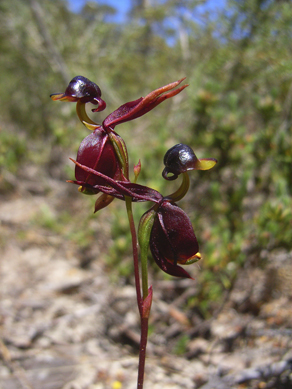
Each year the Australian Orchid Foundation has an orchid essay competition. The topic for 2014 Essay Competition was Our Favourite Orchid. The orchid featured, unsuprisingly, was the Flying Duck Orchid, Caleana major. The authors were K Yin and Sau-wan Chan. It is an interesting story and well worth the read of their discovering the delights of this unique Australian orchid.
It all started with the arrival of an email from Sau-wan’s sister who lives in Hong Kong with an article about the Flying Duck Orchid. The article contained lovely pictures of this orchid taken from different angles. It stated that this orchid from Down Under was as unique to the Australian flora as the kangaroo and platypus were to the Australian fauna. The orchid even had a stamp from Australian Post released in its honour! The email ended with the question asking us if we had seen the orchid. This really presented a serious challenge to us and we were both embarrassed and curious by this – embarrassed because of the fact that we had neither seen nor even heard of this orchid after having lived in Australia for nearly 40 years. We love the Australian bush and regard ourselves as having at least above average knowledge of Australian flora and fauna amongst our friends. … Read More






 NOSSA
NOSSA 