Gleanings from the Journals #2 – Harold Goldsack (27/6/1908 – 25/4/1989)


[Primary source material is the NOSSA Journals. Direct quotes from the Journal in blue and additional information in black.]

Sometimes gleanings take much time and effort to locate but other times there is an abundance of information just waiting to be picked up. This was the case when searching the Journal for information on Harold Goldsack.

Upon the death of Dr R S Rogers, Harold Goldsack became the leading authority of South Australian orchids. To quote Peter Hornsby (1977), NOSSA’s first editor, “Harold is undoubtedly the most experienced of our native orchid botanists and knows more of the history of our orchids than anyone alive.”

Though not a foundational member, Harold was one of NOSSA’s early members, joining at the end of 1977. He was both a grower of epiphytes – winning the Champion epiphyte for 1982 (Dendrobium x gracillimum) and terrestrials – producing the first greenhood hybrid, Pterostylis Cutie (baptistii x cucullata) which was registered on 5th March, 1982. At the meetings he gave talks, plant commentaries and judged the orchids. Outside of the meetings he was active in advancing the cause of Australian orchids. His enthusiasm influenced many people, one person being a young Mark Clements, current Research Scientist, Centre for Australian National Biodiversity Research, CSIRO, Canberra.

It is not surprising than that in 1984 he was made NOSSA’s second life member.


Bob Bates wrote an informative biography in Harold’s obituary.

Journal 1989 Volume 13 No 4 May

Vale Harold Goldsack.

It is with sadness that we announce the passing of life member Harold Goldsack on April 25th. Our sympathies to his family.

Harold was born in East Bengal, India on 27th June 1908. He once told how he could remember epiphytic orchids blooming outside the bedroom window of his childhood home.

His family moved to Adelaide in 1916 and he attended Princes College as a boarding student.

He was introduced to South Australian orchids in bushland adjacent his family’s orchard at Coromandel Valley using Rogers “Introduction to the Study of South Australian Orchids” to identify these. Harold in 1924 introduced himself to Dr Rogers and they became good friends. Harold soon began to find orchids that were new to Dr Rogers and this fired his enthusiasm so that he began a serious study of our orchid flora.

One day in 1928 on a visit to Dr Rogers, Harold was shown the very first collection of the underground orchid Rhizanthella gardeneri. This was to be the subject of the last article Harold wrote over 50 years later.

With the passing of Dr Rogers in 1942 Harold became the foremost authority on South Australian orchids corresponding regularly with H M R Rupp, W H Nicholls and A W Dockrill. His extensive collection of pressed orchids was donated to the State Herbarium in 1978.

Harold wrote many articles on orchids his best known being “Common Orchids of South Australia” which appeared in the S Aust Naturalist in June 1944 and was used in “National Parks and Wild Life Reserves” book from 1965-1970. Harold also revised the orchid section of Black’s “Flora S Australia” in 1943.

Besides drawing and photographing the S Aust orchids Harold developed a large personal Orchid Library and cultivated many Australian orchids which he displayed at shows including our NOSSA shows. The first registered Pterostylis hybrid Ptst. Cutie was made by Harold and the name given to the original clone now grown by hundreds of orchid lovers is “Harolds Pride!”

His main interest was to enthuse others to see the beauty and value of our native orchids through his articles and the many illustrated talks he gave to natural history groups.

Harold was a member of the Royal Society of S Australia.

He was a Foundation Member of the Australian Native Orchid Society. (ANOS)

Ever ready for a challenge Harold at age 64 began studying for his Engineering and Surveying Certificate gaining distinctions in Maths, then working on the surveying of the S E Freeway.

Harold Goldsack’s name is commemorated in the South Australian endemic orchid Prasophyllum goldsackii, a fitting tribute to a true orchid lover.

R Bates
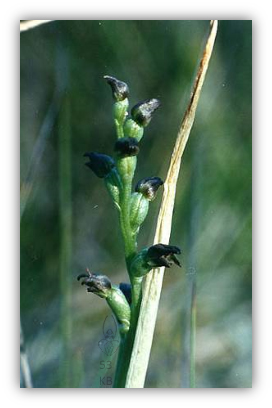
53KB Prasaphyllum goldsackii
Prasophyllum goldsackii – Photographer Ken Bayley

Bibliography of Papers by Harold Goldsack

Orchids of Coromandel Valley – SA Naturalist XIV, Nov 1932 PP 12 – 15

Notes on Caladenia Catifolia – R Br SA Naturalist XV, March 1934, pp 59 – 63

National Park of South Australia – Field Naturalists Sect. of Royal Soc of SA 1936, Being Vol XVII, Nos 1 to 4 of SA Naturalist pp 52 – 54 Orchids

Common Orchids of South Australia – SA Naturalist XXII June 1944 PP 1 – 12 with line drawings of 52 species

New Orchid Records for South Australia – SA Naturalist XXII June 1944, p 13

National Park and Reserves – Commissioners of the National Park, Sept 1956 pp 59 – 79 with line drawings of 52 species of Orchids, p 195 Distribution and flowering times of orchids in the National Park and Reserves

SA National Parks and Wild Life Reserves – Commissioners of the National Park and Wild Life Reserves, March 1964, pp 46 – 64 Orchids with line drawings of 52 species, pp 189 – 199. Distribution and Flowering times of Orchids in the National Park and Reserves

Orchids of the National Park and Wild Life Reserves – Reprinted 1965 by Field Naturalists Society, if (sic) SA from “SA National Parks and Wild Life Reserves” with permission of the Commissioners of the National Park and Wild Life Reserves

Blacks’ Flora of South Australia – Revised edition of p1, 1946 Assisted Rev H M R Rupp and W H Nicholls with the revision of the Orchidacea

Pollination of Caladenia deformis R Br – R S Rogers transactions of Royal Society of SA Volume LV Oct 1931 The pollination of Caladenia deformis as observed by H G was written up by Dr R S Rogers in an article for the Royal Society of SA

Rhizanthella gardnerii R S Rogers – The Orchadian p 113 Sept 1979 A note about the discovery of this orchid

Following is the article by Harold Goldsack referred to by Bob Bates in Harold’s obituary. Though he wrote for other publications, this was appears to be the only one in the NOSSA Journals.

Journal 1979 Volume 3 No 8 August

RHIZANTHELLA GARDNERI Rogers                              Harold Goldsack

Corrigin, Shackleton, Goomalling, Munglingup. Western Australia.

A new locality where the subterranean orchid Rhizanthelle gardneri Rogers has been found, as noted by Don Voigt in his letter to Roy Hargreaves to brings with it hope that after 50 years the secret life of the remarkable orchid may be unveiled. It also brings back memories of my first encounter with this plant.

As a young orchid enthusiast I had been collecting for, and writing to, Dr R.S. Rogers of Adelaide, who, at that time, was an extremely busy public personality. To my surprise, one day in 1928 I received a note from Dr Rogers inviting me to call at his house in Hutt Street after surgery hours as he had something to show me which he was sure would be of interest.

Naturally, I took the first opportunity to visit the Doctor, whereon he brought into the room a large jar with some white vegetable pickled in it. With a smile he said “Have you ever seen anything like this before?”

Well, there it was – this unique subterranean orchid from Corrigin, Western Australia, sent over by Mr C A Gardiner, the Government Botanist of Perth, who had realised the importance of this discovery.

The first plants were found in an area of virgin lane that had been rolled, burnt and then ploughed, which operation uncovered the white underground rhizomes. Mr John Trott, the discoverer, was puzzled by this strange plant growing around the stumps of Melaleuca uncinata R Br, common in the area, and sent it to Mr C A Gardiner. He, realizing the orchidaceous nature of the plant, visited the area, made personal observations and then sent a specimen to Dr Rogers for study, which led to the description of a now sub-tribe, genus and species of orchid – Rhizanthella gardneri Rogers.

Soon after this the Field Naturalists Society were to hold their Wild Flower Show in the Adelaide Town hall and attempted to have this unique specimen displayed there. However, the plant was too valuable to risk and an artist – Mr Lyall Lush – made a black and white drawings which was exhibited instead.

Within three years, on the east coast of Australia at Bulahdelah, another subterranean orchid Cryptanthemis slateri Rupp was unearthed. Unearthed is the word, for this one was unearthed by Mr Slater who was digging up rhizomes of Dipodium punctatum, the “Wild Hyacinth”, to attempt to grow them. All plants of the new orchid were found growing in association Dipodium. The importance of this find was such that Rev H I R Rupp was given a grant to travel to Bulahdelah to make further studies. This second find aroused worldwide interest and a German botanist suggested that the flowers of Cryptanthemis slateri were underground spikes of Dipodium. The morphology of the flowers soon disproved that theory.

Regarding this orchid, which Rupp named in 1932, Dr Rogers commented to me that he was sure that Rev Rupp’s parishioners must have had a very brief sermon the week Rupp received the first specimen of Cryptanthemis!

Dr Rogers then lamented that the orchid hunter has to add a plough and a pick to his orchid collecting equipment!!
 

Gleanings From The Journals: Who Was Our First Conservation Officer?

As the following article indicates there is much to be learnt from the old journals so much so that from time to time there will be a series of posts titled Gleanings from the Journals.

This first of the series was taken from Volume 36 No 10, November 2012 Journal of the Native Orchid of South Australia.

WHO WAS OUR FIRST CONSERVATION OFFICER?

Recently I’ve been looking over the old NOSSA Journals. I like (my husband says addictive!) reading history and even more reading original source material, so it’s not surprising that I’ve enjoyed this activity. There are some lovely gems in them. I like to read about the people, which brings me to the title of this article – Who was our first Conservation Officer?

Well if you ask Thelma Bridle, she’ll say that it was Karen Possingham but when I read in the April 1984 edition, I see that Margaret Fuller is said to be “the initiator of the Conservation Group” back in 1982. Margaret had a long involvement with the Bird Care and Conservation Group. She headed the NOSSA group who collaborated with the Education Department to produce Pic-a-Pac, an orchid teaching package for the schools.

Yet was Margaret the first? For I then read of two foundational members. Roy Hargreaves who is described as a “keen conservationist, ambassador and liaison person with numerous groups including SGAP, OCSA, Parks and Wildlife, the Adelaide Botanic Gardens, Black Hill Flora Research Centre, … an initiator of the R. S. Rogers Orchid House.” The other is Ron Robjohns who “drafted the Society’s Constitution and By-laws and formulated the Society’s Conservation Policy.” But ….. there is a third contender amongst the founding members – Peter Hornsby, the Society’s first editor and an organiser of field trips. Peter was always putting articles in the Journals relating to conservation. A keen conservationist and current member, he resigned his role as editor in 1981 to “concentrate on his study of the behaviour of the Yellow-footed Rock Wallaby in the North Flinders Ranges.” And yet we could continue for there were other foundational members who took a keen interest in conservation.

So who was our first Conservation Officer? Well, Thelma is right. It was Karen Possingham. She was the first one to have the title Conservation Officer when she was appointed to the role in March 1992 – fifteen years after the founding of the Society, and remained in that role until May 1997 when she became a councillor with the Burnside City Council. Karen formalised many activities, organizing bi-monthly meetings, Conservation Booths at the various NOSSA shows, lobbying, weeding, etc

Below is her report of their first meeting.

CONSERVATION GROUP PRIORITIES SET                                       K. Possingham

The first meeting of the 1992 NOSSA Orchid Conservation Sub-Committee was held on Wednesday 15th April. The following priorities were set at the meeting:

1) Lobby politicians; resolution to write letters to the Minister of the Environment, to National Parks and Wildlife, Department of Environmental Planning, Woods and Forests and Leaders of the Opposition Parties, and request a meeting in July to discuss Orchid Conservation strategy.

Liaise with other Conservation groups such as the Conservation Council; join at first as an Association Member and find out about South Australia’s conservation concerns and needs.

3) Monitor Hills Zone development; – liaise with Mt. Lofty Ranges Conservation Association.

4) Prioritise high risk sites that are not managed properly and in danger of clearance, habitat degradation etc.

5) In short term adopt a Reserve such as Belair National Park in order to monitor known Orchid populations, raise Society profile and provide assistance in weeding and other such requirements. This will provide conservation experience for members. There is easy access to Belair from Adelaide and the park and conservation activities should appeal to younger members as well as older members: we’ll be doing something concrete!

6) Possibility to apply for funding from Endangered Species Program, World Wildlife Fund and Save the Bush, to work on endangered orchids.

7) Education: area at Warrawong to be fenced off from animals for native orchids to be established and protected.

Meetings are to be held bi-monthly: Next meeting will be held on Wednesday, 10th June at 8

P.M. Anyone is welcome. Enquiries Karen Possingham, Conservation Officer, ph 364 0671.

Karen remained involved with the Conservation Group until the family moved to Queensland in 2000 where her husband Hugh took a chair in the departments of Mathematics and Biological Sciences at the University of Queensland. Prior to leaving Adelaide, Hugh had been President of the Nature Conservation Council, Professor of Environmental Science and Management at Adelaide University and instrumental in initiating biodiversity planning in South Australia. Hugh has made various trips back to Adelaide will be back here on 27th November to talk about Citizen Science prior to the Uni SA and ABC 891 Great Koala Count the next day.

I have wandered a bit from Karen as NOSSA’s first Conservation Officer but from what I can see in reading the Journals Hugh and Karen worked together in conservation and though no longer in South Australia are still actively involved in conservation. The objectives of that first meeting Karen left with NOSSA and continues to this day, albeit with changes to adapt to current issues and thinking.

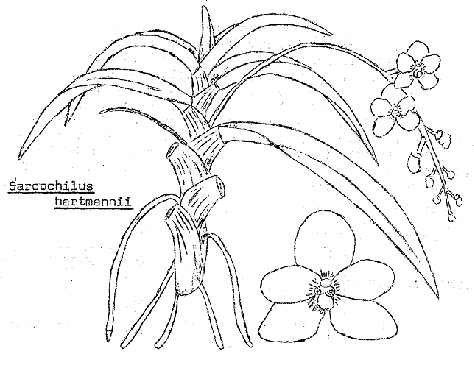
Growing Sarchochilus hartmanii in Adelaide 1983 and Now

In 1983, Ron Robjohns, NOSSA’s first treasurer, wrote a comprehensive series of articles about growing epiphytes in South Australia. Thirty years on Ron’s information for growing is still helpful and applicable for today. Any updates or extra information are in black text.

NATIVE ORCHID SOCIETY OF SOUTH AUSTRALIA JOURNAL
Volume 7, No. 10, November, 1983
GROWING EPIPHYTIC ORCHIDS IN SOUTH AUSTRALIA – R.T. Robjohns
Sarcochilus hartmanii (Hartman’s Sarcochilus)
This has a range from the Hastings River in north-eastern New South Wales to the McPherson Ranges in southern Queensland, although some authorities extend this to the Atherton Tablelands in northern Queensland.
S. hartmanii is lithophytic and is normally found growing on rocks, sometimes forming large masses but usually in small clumps, however, it occasionally grows on trees. It varies in its habitat from bright sunny positions on cliff faces, above 600 metres, to shady seepages. It must be remembered, however, that this is an area of high summer rainfall and in late summer and autumn has considerable cloud cover with accompanying high humidity.

The leaves, 4 to 9 per stem, from 10 to 20cm long, 1 to 2cm across, are thick, fleshy, deeply channelled and slightly twisted at the base.

Racemes are 6 to 25cm long with 5 to 25 flowers usually sparse at first then crowded towards the apex. The flowers are 2 to 3cm in diameter and have petals and sepals of glistening pure white with deep maroon or crimson spots near the base, though sometimes all white.

The flowering period is September to November.

In 1979 a clone of Sarcochilus hartmanii “Kerrie” was awarded AM/AOC. It was a large plant with 16 spikes and approximately 320 flowers measuring 31mm across the petals.

It adapts well to cultivation and is not difficult to grow, doing well in a shadehouse with 60-70% shade and a good air circulation. I have it growing and flowering in a plastic pot in a bark, charcoal* and polystyrene foam mix and would suggest underpotting rather than overpotting. Good drainage is essential. Other growers recommend shallow baskets or rafts about 8 mm of stag-horn fern fibre as this allows the plant to spread more naturally. It likes to be kept moist (not wet), prefers a humid atmosphere and does not object to regular year-round (½ strength) doses of foliar fertiliser.

*Charcoal is not used today.
Sarchochilus hartmanii

November 2015 Winning Photograph

November’s theme was hybrids. Orchids, more than any other plant family, are likely to produce natural hybrids. Even though the overall occurrence of natural hybridisation in orchids is low, it occurs often enough to make some species identification challenging.

Hybrids mainly occur between species of the same genera such as Jenny Pauley’s Arachnorchis brumalis x A. conferta

11sm JP Arachnorchis brumalis x conferta
Arachnorchis brumalis x A. conferta

but, less commonly, it can occur between genera as seen with Pauline Meyer’s Caladenia latifolia x A. brumalis

11 sm PM C latifolia X A brumalis
Caladenia latifolia x Arachnorchis brumalis

and her Western Australian photograph of Caladenia x enigma; a hybrid between C. falcata and Drakonorchis barbarossa.

11sm PM Caladenia x enigma
Caladenia x enigma


Jones (2006) states that “Natural hybrids are more common in some genera, such as Arachnorchis, Caladenia and Diuris, than in others.” To this list could be added Thelymitra as seen with both of the winning pictures T. x truncata and T. x irregularis. Interestingly with these two hybrids, the parents are not always the same; the parents for T. irregularis could be T. ixiodies or T. juncifolia with either T. carnea or T. rubra.

11 sm RAL Thelymitra x irregularis.jpg
Thelymitra
x irregularis

A similar situation occurs with T. truncata with the parents consisting of T. juncifolia and any member of the T. pauciflora (including T. albiflora, T. arenaria, T. bracteata, T. brevifolia, T. cyanapicata, T. pauciflora) or of the T. nuda complex.

11 sm RWL Thelymitra x truncata
Thelymitra
x truncata

The conditions necessary for hybridisation are that the parents must grow in the same area, have overlapping flowering time and share the pollinator. Brown et al (2103) make the additional observation – Hybrids are more common between wasp and bee-pollinated species than between two wasp-pollinated species or two bee-pollinated species.   … However, rare hybrids between species using the same pollination strategies, do occasionally occur …

Obviously hybridisation is more likely to occur when there is an abundance of the parent species. This situation can occur when there is mass flowering following fires or good seasonal rains. Site disturbances either through natural causes or clearing can result in increased incidence of hybridisation.

Hybrids are often infertile and will only last for the life of the individual plant but some have the ability to reproduce vegetatively and, provided the conditions remain favourable, may persist for several years.

One situation that can occur is hybrid swarm. When these occur they can make orchid identification challenging. Hybrids share the characteristic of both parents and by careful observation this can be deduced but swarms introduce an added complexity because the hybrid can backcross with either of the parents or cross fertilise with themselves. The result is a wide range of variation which makes orchid identification difficult.

Finally, some orchids will not hybridise even though the conditions are right. This could be due to specific pollinator or possibly chemical or genetic barriers.

References:

Brown et al (2013) Field Guide to the Orchids of Western Australia, Floreat, WA, Simon Nevill Publications

Jeans, Jeffrey & Backhouse, Gary (2006) Wild Orchids of Victoria, Seaford Vic, Aquatic Photographics

Jones, David (1988) Native Orchids of Australia, Frenchs Forest, NSW, Reed Books

Jones, David (2006) A Complete Guide to Native Orchids of Australia including the Islands and Territories, Frenchs Forest, NSW, Reed New Holland

Introduction to Australian Orchidaceae CD-ROM

https://www.anbg.gov.au/cpbr/cd-keys/orchidkey/html/intro-c_hybrid.html   accessed 7th December 2015

Bates, Robert (2011) South Australia’s Native Orchids NOSSA DVD Adelaide

Spotted Pink Sun Orchid – Beautiful, but Only a Hybrid

https://nossa.org.au/2014/09/26/thelymitra-x-irregularis-beautiful-but-only-a-hybrid/ accessed 7th December 2015


Does South Australia Have a Christmas Orchid?

Western Australia has the Christmas Spider Orchid (Caladenia serotina) and the Christmas Leek Orchid (Prasophyllum brownie) whilst in the rainforest of the eastern seaboard is the Christmas Orchid (Calanthe triplicata).

In the disc South Australia’s Native Orchids, 2011, no orchid has the common name of Christmas Orchid but there are several listed that could be a possible candidate.  The ones that springs to mind are from the genus Dipodium.  In South Australia, there are four species flowering at this time:

  • D. campanulatum (Bell Hyacinth Orchid)
  • D. punctatum (Dark Spotted Hyacinth Orchid),
  •  D. roseum (Common Hyacinth Orchid)

    Dipodium roseum
    Dipodium roseum
  • D. pardalinum (Small Spotted Hyacinth Orchid)

    D pardalium Flower and Bud
    Dipodium pardalinum – Note the yellow staining on the bud and no stripes on the labellum

All four are in flower now – D. campanulatum and D. punctatum in the South East and D. roseum and D. pardalinum in the Southern Lofty Ranges.

There have been other orchids which would have flowered over the Christmas period but in recent days we are have been having an increasing number of dry year, especially this year (2015) which has resulted in the orchids flowering earlier.  For example, Prasophyllum murfetii

Prasophyllum murfettii sm
Prasophyllum murfettii (Denzel’s Leek Orchid)

finished flowering in November instead of December and Thelymitra circumsepta

Thelymitra circumsepta
Thelymitra circumsepta (Naked Sun Orchid). This photograph was taken on the 28th December 2010

finished flowering in early December but has been seen in flower soon after Christmas Day.

So does South Australia have a Christmas Orchid?  Until 1991, D. roseum was included under D. punctatum and the common name according to Bates and Weber 1990 was Christmas Orchid.  It seems a pity that when the split was made that neither species retained the common name but nevertheless as they both flower at Christmas, we do have a Christmas Orchid or two!

Reference:

Bates R J, Ed, 2011 South Australia’s Native Orchids, NOSSA

Bates R J & Weber J Z, 1990 Orchids of South Australia

A Timely Reminder

This article is reprinted from  Volume 39 No 11 December 2015 Native Orchid Society of South Australia Inc. Journal

Tuber Repotting Time is here

Les Nesbitt

Now that Australian terrestrial orchids have gone into dormancy it is time to think about repotting and preparing for the next growing season.

The best months for this activity are December and January.

I will limit this discussion to the easily grown colony forming terrestrial orchids as these are more likely to be available – for easily grown terrestrials, click here.

IMPORTANCE AND NECESSITY OF GROWING SOUTH AUSTRALIAN ORCHIDS

We need more terrestrial growers in NOSSA to feed the tuber bank and to supply spare pots for sale to the public at the Spring Show. I found it embarrassing to see so few terrestrials for sale at the 2015 Spring Show compared to the numbers available in years gone by.

Growing terrestrials is a rewarding hobby that does not take up much time or space and will pay for itself. Plus you are doing something effective orchids and the environment even if only the most common terrestrials are grown (eg the greenhoods and onion orchids). Consider easily grown, fast multiplying, Pterostylis curta (listed as rare in the SA Act) has been widely grown in NOSSA collections since the days Roy Hargreave’s wash trough when NOSSA was formed.

Once the basic principles are understood it to move onto the rarer species as artificially propagated plants become available in future as they surely will. Members can draw on the tuber bank in December to get started seriously about it as a group of volunteers will be needed within a year or two to help look after the output of a number of projects already underway or about to start.

Year 8 girls at Kildare College have been repotting the school’s terrestrial collection and this is how they did it.

EQUIPMENT

Prepare all the materials needed including:

  • Pots
  • crocking material,
  • sand
  • organic matter
    • blood & bone, native compost, chopped up sheoak needles
  • 4B pencil and labels.

PREPARATION

  • Water the pots lightly a day or two before repotting. The mix should be damp enough to not be dusty, yet dry enough to not stick to everything.
  • Remove the label, wash it in a container of water and stand it aside to dry.
  • Check on the label back to see how many tubers were planted last year.

REPOTTING

Scrape off and dump the top layer of soil as this can be contaminated with moss, slimy bacteria and liverworts.

  • Tap out the plug of soil into a sieve sitting on a bowl. Pick out any tubers that are visible on the outside of the plug.
  • Gently break the soil apart and search for tubers while squashing the lumps of mix through the sieve.
    • Very small tubers may go through especially with Corybas. If you have not got a sieve do this operation on a sheet of newspaper.

Place the tubers in a dish so they do not roll away.

  • Count the new tubers to see whether they increased by 2, 3 or 4 times.
  • Discard anything left in the sieve (old tubers, roots etc.).
  • Work out how many new pots are needed to plant all the new tubers.

Add to the old mix in the bowl

  • a pinch of blood & bone,
  • a handful of sand and a handful of native potting mix.
    • Also add enough of these ingredients for each additional pot and mix the contents of the bowl together.

Select new or sterilised 125 mm standard pots

  • and place a square of shadecloth in the bottom to keep the sand in and critters out.
  • Pour in mix to within 30 mm of the top and ram down with your fist.
  • Place up to 10 tubers on top of the mix.
    • Lay tubers horizontally if unsure which is the top.

Labelling and finishing the task

  • Write out the orchid name on extra labels and fill in the numbers of tubers on the back for each pot.
  • Almost fill the pot with mix and tamp down.
  • Insert the label. Place a layer of cut sheoak needles on top of the mix.
  • Water the pots and the job is done.

For show pots use 175 mm or larger pots and plant 20 to 50 of the largest tubers available.

If the tubers have decreased or look unhealthy, throw out all the old mix and replant in new mix.

20150922_210750
Repotting a Diuris

Related Articles:

Growing Terrestrial Orchids Part One of Four

Growing Terrestrial Orchids Part Two of Four

Growing Terrestrial Orchids Part Three of Four


Protect Our Orchids – Stay on the Path

This week there was a workshop South Lofty Block Orchid Recovery Project with representatives from Adelaide and Mt Lofty Ranges Natural Resource Management, SA Water, Forestry SA, Park Rangers, Threatened Plant Action Group and NOSSA. Many issues were discussed. One issue briefly discussed was the development of unofficial bike and walking tracks in parks and the negative impact that this would have on rare and endangered orchids.

This issue is not unique to Australia, the American Orchid Society whose mantra is Education, Conservation and Research published in their journal Orchid February 2008 a summary article titled Watch Your Step: Possible Consequences of Walking off the Trail.  The authors are Maryilyn H.S. Light and Michael Mcconaill and the original paper can be found in the Lankesteriana 7:294 – 298  Click on the titles to read the articles.

The researchers studied the effects of visiting a site once a day and standing in the same spot for 10 minutes ie the effects of trampling. Their research suggested that there are possible longer term consequences as they found that the effects of compaction was still observable 18 months later. This does not seem like much but it was sufficient for them to offer some advice such as

  • stay on the tracks,
  • don’t walk on the side as even walking on the side of the track can result in unintended damage as the track is widened,
  • when one person walks off the track others are likely to follow
  • think carefully of the consequences before walking off the track
  • where possible step on rocks, not soil

The research was carried out in Canada and though there are differences between the two countries, there are so many similarities it is worth our while to take note of their advice.

Possibly there is scope for research here in South Australia but in the meantime their summary sentence says it all – Until we know what is happening beneath our feet, we should really watch our step

Stay on the Path
Fortunately our orchids like the edges of paths and so the are easy to spot.  But at the same time, trampling on the edge of the paths means that the orchids can be destroyed and so be lost forever.

Related Article

Orchid Etiquette – Tread Carefully

From the Journals: A Tale of Two Cities – London & Burnside

The following article written by Robert and Rosalie Lawrence is from the Volume 37 No 9 October 2013 Journal of the Native Orchid Society of South Australia

Orchids and the concrete jungle that makes up a city don’t seem together, particularly the terrestrial orchids. Yet in the heart of one of the world’s most well known capital cities such an orchid was found. On the 19th July 2013, the Telegraph reported that botanists from the Natural History Museum had found in the middle of London a white helleborine orchid (Cephalanthera damasonium) which had not been seen in that region since 1900. It was found in the Queen’s backyard, Buckingham Palace. Despite the building, demolishing, rebuilding, bombing and rebuilding that has been going on for the last 400 years, here is an orchid which has survived to surprise the botanist. (For details see Long Lost orchid found in Buckingham Palace Garden)

It is always heartening to hear good news about orchids but here in Adelaide we have our own encouraging story. Settlement in Adelaide is not as long as in London by a long shot but in our own short time we have managed to clear and cover some very good land with concrete and bitumen. The result has been that much of our native flora has been lost with many of our orchid species being the first to disappear.

In recent years effort has been made to bring back the bush with revegetation projects. This work has not tended to involve the orchids, the work of Heather Whiting and her team of volunteers at Vale Park being an exception. Consequently, any orchids found on such sites tend to be the more robust species principally Pterostylis pedunculata, Microtis sp. and in some cases Linguella sp.

Finding anything else will always be special; but that is what has happened at site where a Shell petrol station stood for decades on the corner of Portrush and Greenhill Roads. After the demolition of the service station the site was an area of bare clay for about a decade. Then in 2003, work began on restoring native vegetation incorporating a mini wetland in an area of 2,000 square metres that was given the name Linden “Bush Garden”. Indigenous flora was sourced from the local region and the site has been kept meticulously weed-free by dedicated workers.

Originally 60 local species were planted with several other species arriving by themselves. Among the latter group are five species of orchids. These include a Microtis species and Pterostylis pedunculata, but the other three are more surprizing – Arachnorchis tentaculata, a small blue-flowered Thelymitra species and a Caladenia (syn Petalochilus) species. How they came to be there is a mystery. The long term viability of them will depend upon the continued maintenance of this unique site.

The City of Burnside should be congratulated both for its foresight and initiative as well as its ongoing support of this project.

Orchid 1 Arachnorchis tentaculata
Natural regeneration at Linden Gardens includes three plants of Arachnorchis tentaculata (King spider Orchid) that are understood to have flowered for the first time this year (2013). The buildings of the council chambers can be seen in the background.


Growing Dendrobium aemulum in Adelaide 1983 and Now

In 1983, Ron Robjohns, NOSSA’s first treasurer, wrote a comprehensive series of articles about growing epiphytes in South Australia. Thirty years on Ron’s information for growing is still helpful and applicable for today. Any updates or extra information are in black text.

NATIVE ORCHID SOCIETY OF SOUTH AUSTRALIA JOURNAL

Volume 7, No. 9, October, 1983

GROWING EPIPHYTIC ORCHIDS IN SOUTH AUSTRALIA – R.T. Robjohns

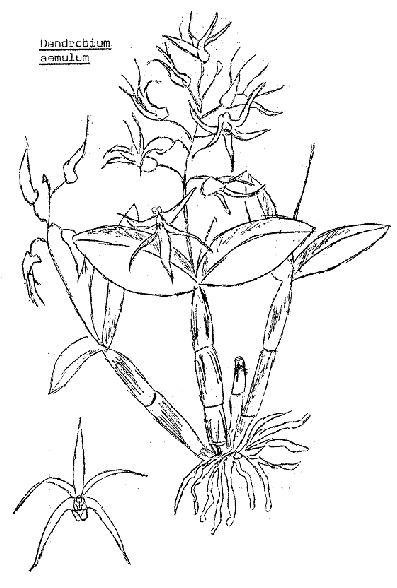
Dendrobium aemulum (Iron Bark Orchid)

There are several growth forms of this orchid due probably to the wide variety of habitats, the flowers of all forms being similar. It has a range from the Clyde River in south eastern New South Wales to the Atherton Tablelands in Queensland

Those growing in the rainforests of New South Wales and Queensland have straight stems up to 20 cm long with 2-4 shining dark green leaves. On the edge of the rainforests in northern New South Wales and southern Queensland in the dense brush forest, the principal hosts are the trunks of “Brush Box” trees where it has stems up to 30 cm long which tend to radiate from a central point. It also has 2-4 dark green leaves. In the open forest areas its hosts are the “Iron Bark” eucalyptus trees, it has shorter (up to 7 cm), stouter (up to) 1 cm), and more crowded stems, sometimes growing into large mats and having 2-4 yellowish green leaves. On the Atherton Tablelands at an altitude of around 750 metres and with callitris trees as its favoured host, it has very slender stems of about 0.3 cm with usually only two dark green leaves.

The flowering period is August/September. One to three slender racemes (5-10 cm long) occur terminally from between the leaves or at nodes along the stem, each raceme bearing 3-20 cm diameter. The flowers are usually pure white (sometimes pale cream) with purple markings on the labellum, the whole raceme turning deep pink before withering.

This is another of our natives which to date does not appear to have attracted much attention from the hybridisers. “Emmy” aemulum x kingianum seems to be the only registered cross.

I find D. aemulum is an easily cultivated and highly rewarding plant that flowers freely with masses of feathery flowers. It grows well mounted on hardwood slabs, cork or on a paperbark branch under 50% shadecloth. Mine get about 65% shade in mid-summer and receive an occasional spray of weak foliar fertiliser during the growing period.

Reference: Dockerill “Australian Indigenous Orchids”.

Dendrobium aemulum
Dendrobium aemulum

2015 October Winning Photo

Diuris brevifolia (Late Donkey Orchid)
Diuris brevifolia  (Late Donkey Orchid)

Again this month was a varied selection of species with Pauline Myers’ Caladenia chapmanii (WA), Claire Chesson’s Thelymitra rubra, Jenny Pauley’s hybrid of Arachnorchis brumalis x conferta, David Hirst’s Caladenia discoidea and the winning entry, Rosalie Lawrence’s Diuris brevifolia.

This strikingly yellow flowered donkey orchid endemic to South Australia is listed as Endangered. Its range was once quite widespread in the southern Adelaide Mt Lofty Range region but now it is now restricted to pockets on the Fleurieu Peninsula and western Kangaroo Island in Heathy Woodland, Wetland and Riparian habitats.

There is interest today in cultivating orchids for conservation or ex situ conservation. With the reduced range of this species, can it be cultivated and thus continue to ensure its survival as a species? Some sources seem to suggest that it is an easy plant to cultivate, and some Diuris are easier than others, but Les Nesbitt points out that he has some plants from a rescue dig several years ago and that they have not multiplied very much in that time. This suggests that they may be dependent on a specific fungi. Though it has not been hugely successful in cultivation, it is worth noting that it has been used to produce hybrids with several other Diuris.

Reference

Bates, R. J. (2011) South Australia’s Native Orchids NOSSA DVD, Adelaide

Nesbitt, L personal communications

Adelaide and Mount Lofty Ranges South Australia Threatened Species Profile Fact Sheet – Diuris brevifolia