One of the orchids currently flowering is Nemacianthus caudatus (syn Acianthus caudatus). The common name is Mayfly orchid. Robert Lawrence’s post in OrchidNotes gives an interesting background to the resemblance of the flower both to the Mayfly’s three tails and its mass swarming.
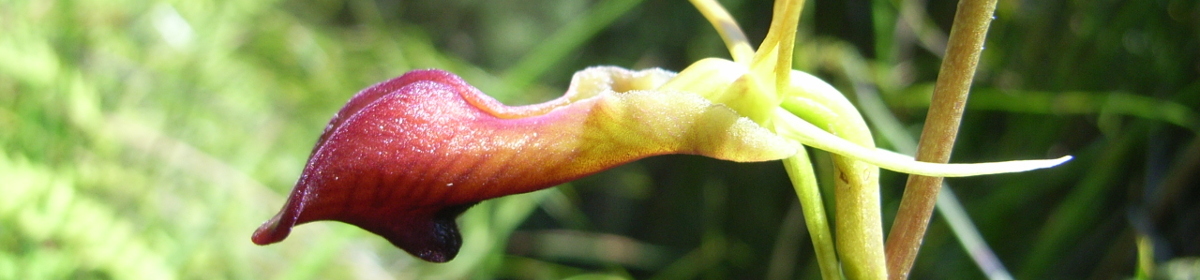
The Mayfly Orchid is a small orchid with very dark reddish brown flowers with long, hair-like sepals. It flowers from late July to August. One might question what sort of insect was behind the naming of this orchid, which does not even flower in May. Mayflies are an insect with which many of us are not acquainted.
Close view of a typical flowering Mayfly Orchid
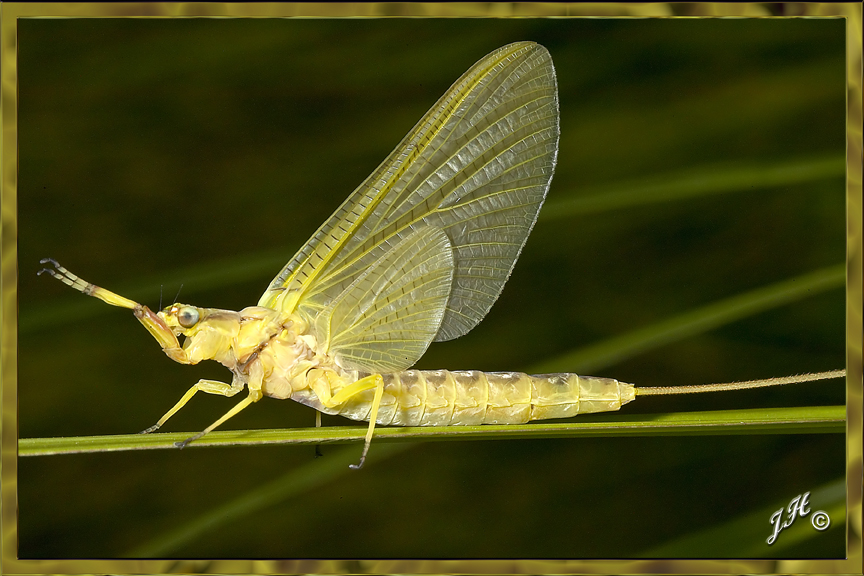
One source attributed the naming or the orchid being similar to the long legs of a Mayfly. However, a quick search in the Internet revealed that Mayflies have fairly short legs, as in the image below:
It turns out that it is the appendages on the end of the abdomen that the sepals of the Mayfly Orchid resemble. Mayflies usually have three tails (two cerci, one middle filament), although the middle tail is rarely reduced or absent. …
In 1983, Ron Robjohns, NOSSA’s first treasurer, wrote a comprehensive series of articles about growing epiphytes in South Australia. Thirty years on Ron’s information for growing is still helpful and applicable for today. Any updates or extra information are in black text.
NATIVE ORCHID SOCIETY OF SOUTH AUSTRALIA JOURNAL
Volume 7, No. 6, July, 1983
GROWING EPIPHYTIC ORCHIDS IN SOUTH AUSTRALIA – R.T. Robjohns
Dendrobium tetragonum (Tree Spider Orchid)
A variable epiphytic species growing mainly in rainforest areas from Illawarra in New South Wales to the Endeavour River in Queensland. A favourite haunt is on trees overhanging water, often in deep shade. It has a variety of hosts (including Myrtles, Eugenias, Water Gums and occasionally Melaleuca) on which it grows into small clumps. Altitude is of little concern as it is found from near sea level to approximately 1000 metres.
The stems, which are semi-pendulous and from 6 to 45 cm long, arise from a prostrate and branching rhizome They are round, thin and wiry at the base but thickening to become rectangular (hence the name tetragonum – derived from the Greek “tetra” meaning “four-sided”), then tapering slightly before the leaves. There are from 2 to 5 leaves up to 8 cm long at the end of the stems. They are deep green in colour and often with crinkled or wavy margins.
The racemes appear from between the leaves but are short and have from 1 to 5 flowers which are widely spreading and spidery in appearance. The colour is greenish/yellow with irregular and variable brown, red and purple markings. In size the flowers are from 4 to 9 cm from the top of the dorsal sepal to the tip of the lateral sepal and they have quite a pronounced fragrance.
The var giganteum is the tropical species and ranges from the Fitzroy to the Endeavour Rivers. The flowers are usually larger, but not always, and have a slightly different colour pattern.
The plant does not lend itself readily to pot culture and should be mounted. I have it growing on Melaleuca and cork slabs, but best results have been with one mounted on a hardwood slab.
I find that it needs little more than 50% shade plus humidity and, of course, plenty of air movement. Protect from frosts. Fertilise in the growing period with foliar fertiliser at half recommended strength. A number of interesting hybrids have been produced using D. tetragonum as one of the parents. They mostly flower well and have reasonably large flowers.
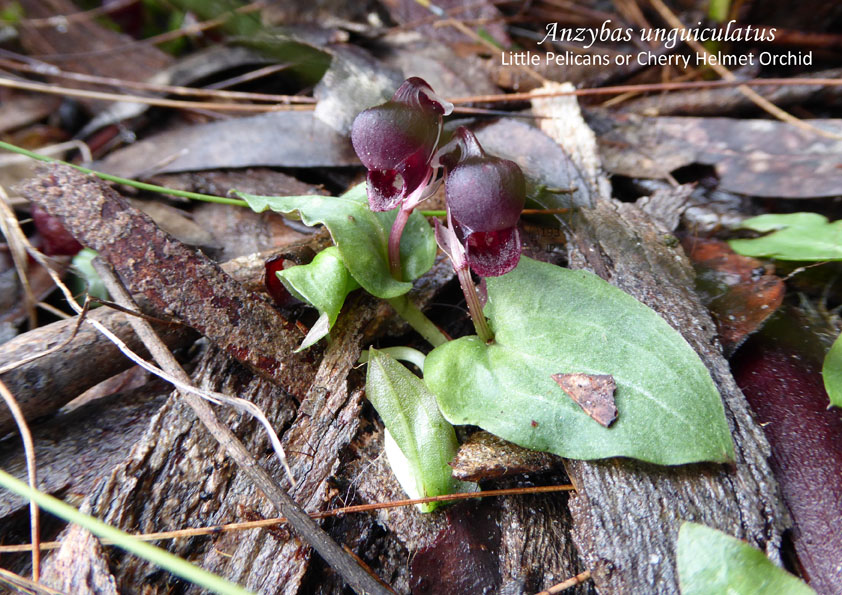
Anzybas unguiculatas (common name Little Pelican or Cherry Helmet Orchid) was the main focus for this month’s competition with three photographs of this diminutive flower.
The other photographs were Ed Lowrey’s close-up of a triggered Urochilus sanguineus labellum, John Badger’s first Diuris palustris sighting for this year and Pauline Meyer’s mass flowering of Leptoceras menziesii post fire. Of the Anzybas, Jenny Pauley entered two and Lorraine Badger one. Jenny Pauley’s photograph of two flowers was the outstanding winner.
Originally named Corysanthes unguiculata (1810), then Corybas unguiculatus (1871), the genus name was changed in 2002 to Anzybas in recognition of its distribution both in Australia in New Zealand. Since 1945 it had been recognised that the New Zealand species Corybas cheesemanii was a synonym for Corybas unguiculatas although the juvenile plant can have two leaves unlike the Australian species which is single leafed.
An interesting feature of this flower is the prominent white ears at the rear of the helmet (not clearly seen in this photograph) which are part of the labellum.
These plants are small. The gum leaves and twigs give an idea of size but the engagement ring shows it very clearly. Note also the prominent ‘white ears’ of the labellum.
An unusual aspect of this photograph is that the colour of the underside of one of the leaves. It lacks the characteristic distinguishing feature of the purple underside of the leaves. According to orchid growers, the light affects the leaf colour. Heavy shade produces green leaves. It is possible that the heavy leaf litter where this plant was growing provided enough deep shade to cause the colour loss.
Bates (1990) states that it (has) not proved amenable to cultivation, but it has, on rare occasions, been benched at NOSSA meetings with the most recent occurrence was in July 2010 but it remains a very difficult plant to cultivate. The electronic version Vol 34 No 7 has a photograph of the plant just visible within the moss.
It is not always easy to photograph this species as not only is it rare with limited numbers but there are very few sites where it can be found. Added to that is that the window of opportunity is short in South Australia with a flowering time from June to August compared with those interstate which can range from May to October.
There has always been an interest in Australian orchids. Over the years there have been many photographs of orchids. This stereographic postcard from 1928 is a study in beauty –
This postcard is held by the State Library of Victoria.
Although the distribution covers the Southern Lofty, Kangaroo Island and the South East regions of South Australia, it has become increasingly rare due to loss of habitat which consists of leaf litter on damp soils. As a result, there are very limited localities where they can now be found.
It is one of our earliest helmets to flower which is from June to July.
Rupp, HMR and Hatch, ED (1945) Relation of the Orchid Flora of Australia to that of New Zealand in Proceeding of the Linnean Society of New South Wales Vol 70 1945, pages 53 – 61
Part One – Attracting Pollinators looked at pollination strategy, but the fourth aim of the paper was to establish that Corunastylis littoralis reproduced by xenogamy or geitonogamy and that the species was not autogamous or apomictic, that is, pollinated, self pollinating or non pollinating plants.
Xenogamy or geitonogamy that is vector mediated pollination or out-crossing is when fertilization occurs by the transfer of pollen from one flower to another flower usually by the means of insect.
Autogamy or self-pollinating is when the flower is pollinated by its own pollen.
Apoximis is when reproduction occurs without pollination, that is, vegetative reproduction.
As explained in the paper, there are visual clues for determining which process is used by the plant.
Xenogmay
Autogamy
Apoximis
Pollinia removal and pollen deposition
Pollinia not removed
Lacks pollen or it is tightly bound
Pollinia weakly attached to the viscidium
If pollinia present, then unable to be removed
Not all the ovaries are fertilized
All the ovaries are fertilized and have viable seeds
Swelling of the ovaries can occur whilst in bud
Perfumed
Likely to have no perfume
Attracts insects
Flowers short lived
More detailed information was gained by dissecting the flower.
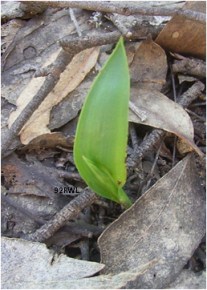
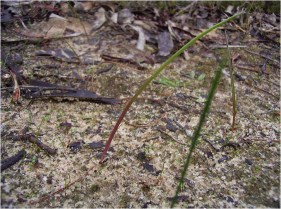
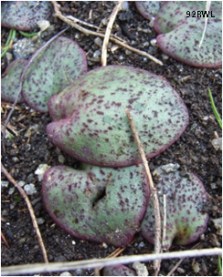
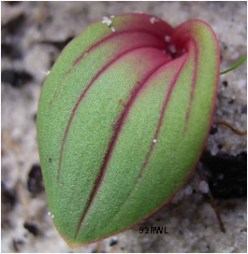
In 2006 the electronic version of the Journal of the Native Orchid Society of South Australia Volume 30 No 2 March contained a quiz – Do you Know Your Leaves? It featured photographs of the leaves of 15 different orchid. In 2011 Robert Lawrence produced a book titled Start With the Leaves which was based upon the premise that the flower is not always present but identification is still possible.
Many but not all can be identified to species level by the leaf alone.
So here is the web version of the original quiz – how well do you know your leaves?
Hint – 20 of them are South Australian, more specifically, the Mount Lofty Ranges region. One is a weed.
Did you get them? Click on the image to go to the name and pictures of the flower. As a couple of the links are not working and until I have time to rectify them, click here to find the all answers in the Journal.
It will be on the last page.
In 1983, Ron Robjohns, NOSSA’s first treasurer, wrote a comprehensive series of articles about growing epiphytes in South Australia. Thirty years on Ron’s information for growing is still helpful and applicable for today. Any updates or extra information are in black text.
NATIVE ORCHID SOCIETY OF SOUTH AUSTRALIA JOURNAL
Volume 7, No. 5, June, 1983
GROWING EPIPHYTIC ORCHIDS IN SOUTH AUSTRALIA – R.T. Robjohns
Dendrobium falcorostrum (Beech Orchid)
This is one of the most attractive of the New South Wales epiphytic orchids, the common name being derived from the fact that it is only found in the forests of the Antarctic Beech, which occur in the highlands, extending from the Barrington Tops in New South Wales northwards to the McPherson Ranges in southern Queensland. However, within those forests it does occasionally grow on other than beech trees.
Due to the clearing of those forests it is fast becoming an “endangered species”.
It is a plant of the highlands and is rarely found below 900 metres, consequently it will tolerate cold conditions, however, it requires protection from frosts and needs to be grown where there is plenty of air movement.
There are from two to six light green lanceolate leaves at the top of the stem which is from 12 to 50 cm high and the mature stems are ribbed. The flowers number from four to 20 in the raceme and are intensely fragrant during the warmer part of the day. They are from 3 to 5 cm in diameter.
Flower spikes are terminal and some stems will flower for two or three years.
They are a glistening pure white to cream with the exception of the labellum which is streaked with purple. The common name is derived from the labellum, which is short and broad, bearing a fanciful resemblance to a falcon’s beak. The flowering season is from August to October.
It can be grown using either slab or pot culture using a mixture of aged pine bark, scoria* and charcoal* in a plastic pot and grown under 50% shadecloth.
Fertilise lightly during the growing season using foliar fertilisers at half the recommended strength.
Propagation is usually by division.
*NB Charcoal is no longer used and scoria can get cold and wet in winter.
Because of their details, research papers can contain some very interesting facts of interest to a wide range of readers. This paper was no different. The aim of the paper was to identify the pollinator(s), how the attractant worked, confirm that C. littoralis was not autogamous (self-fertilizing) or apomictic (reproduction without pollination) and to assess the requirements & long-term viability of the pollinator.
The following summary notes have been drawn from both the research paper and the consultancy report. Note that Corunastylis littoralis is a synonym of Genoplesium littorale.
One of the interesting issues discussed was the different types of pollination strategies employed by orchids. It is commonly accepted that about one third of orchids use deceptive practices to attract a pollinator whereby they promise but don’t deliver. Some of these strategies are quite unusual. It would appear that there are at least four strategies now known. In order of frequency they are
Food mimicry
Sexual mimicry
Brood-site mimicry
Prey/carrion mimicry
The first two are well known to many orchid lovers. The orchid promises food such as nectar but does not produce any nectar or it has the appearance and even odour of the female insect pollinator so that it fools the male. The lesser known deception is brood-site mimicry where the female insect pollinator is tricked into laying the eggs on the flower but there is no chance for survival of the off-spring. Finally the most uncommon and unusual deception of prey or carrion mimicry, known as kleptomyiophily.
This method was discussed in detail in the report and made for fascinating reading although it was helpful to have a dictionary on hand.
Some insects are kleptoparasitic that is they feed on the haemolymph (roughly similar to blood) but from freshly killed insects. The researchers established that the pollinator for C. littoralis was not Drosophilidae (vinegar fly) but were instead from the families Chloropidae and Milichiidae known kleptoparasitic flies.
It has been observed that the pollinators swarm around the Corunastylis. This is a known behavioural pattern of kleptoparasitic flies that are attracted to the prey of other predators such as spiders, robber flies and other predatory insects.
It was noted that the pollinators were dominated by females. This precludes sexual deception and suggests that the females may require the haemolymph, which is protein rich, for egg maturation. It was also noted that C littoralis is a nectar producing orchid. It was considered that the nectar contained properties that mimic haemolymph.
Based upon these observations it was hypothesized that prey mimicry pollination syndrome was the best fit for the Corunastylis. Though this syndrome has been observed in orchids in the northern hemisphere, this would be the first time that this has been demonstrated as a possibility for Australian orchids.
Photo: Colin Bower
Part two will consider the fourth aim of the paper which was to determine the method of reproduction.
Thank you to Colin Bower for checking this post and for allowing the use of his photographs.
Of the five entries this month, four featured winter orchids. Lorraine Badger entered a Diplodium robustum, whilst Claire Chesson, Robert and Rosalie Lawrence all entered Urochilus sangineus. Though not the winning photographs it was interesting to see the differences between the U. sangineus with one being no taller than the small Acianthus pusillus next to it and another being taller than the rapier sedge.
But the winning photograph was the spring flowering Arachnorchis argocalla (White Beauty Spider Orchid) by Pauline Meyers. This is amongst our most threatened orchids and is dealt with in depth in the Recovery Plan For Twelve Threatened Orchids in the Lofty Block Region of South Australia 2010. This fungi dependent endemic orchid is rated Endangered both at State and National level.
Found in the Southern and Northern Lofty regions, it range has been severely reduced by possibly 80%. Since 1918 no plant has been found south of Adelaide.
Flowering from September to October, it is often found in grassy woodlands often growing on gentle southerly-facing hill slopes. The soil is a clay loam with a high humus content.
This beautiful orchid has one to two non-perfumed white flowers with thickened but not clubbed drooping lateral sepals and petals. The strongly recurved broad labellum is usually white, sometimes crimson, fringed with short teeth.
This is one of our larger spider orchids reaching a height of 60cms. The size of the plant flower and leaf help to distinguish it from other similar appearing orchids such as A. brumalis and albino flowers of A. behrii.
Like many of the spider orchids it takes 2 – 5 years to reach maturity and then has a potential reproductive life of 10 years. With an average pollination rate of less than 10%, the potential to increase the population is low and any threat to survival of the individual plants needs to taken seriously.
Some threats are obvious such as weed invasion including the garden escapees such as Topped lavender (Lavandula stoechas spp. stoechas) and action is being taken to curb the spread of weeds through targeted weeding programs.
Another threat is habitat loss. This has been the result of land clearing but sites are being protected either through conservation legislation or Heritage Agreements. Habitat loss can also occur indirectly and that is through Phytophthora being introduced into the sites. Although the direct effect of Phytophtora on the orchid is unknown, it is known that it can affect the plants that grow in association with this orchid. This threat can be reduced by all of us implementing good hygiene practices.
These were some of the threats noted in the Recovery Plan. This plan was not just defensive, ie attempt to halt and minimalize the damage; but it was also proactive with measures outlined to increase the population. These included seed and fungi collection eventually resulting in germination and cultivation with a view to re-introduction.
It is good to see that there is a plan and active steps are being taken to bring this orchid back from threat of extinction.
Photographers from L to R: Claire Chesson, Rosalie Lawrence, Lorraine Badger, Robert Lawrence
In 1983, Ron Robjohns, NOSSA’s first treasurer, wrote a comprehensive series of articles about growing epiphytes in South Australia. Thirty years on Ron’s information for growing is still helpful and applicable for today. Any updates or extra information are in black text.
NATIVE ORCHID SOCIETY OF SOUTH AUSTRALIA JOURNAL
Volume 7, No. 4, May, 1983
GROWING EPIPHYTES IN SOUTH AUSTRALIA – R.T. Robjohns
Dendrobium linguiforme (Tongue Orchid)
The plant is epiphytic or lithophytic, forming large masses on trees or rocks. Its range is from the extreme south-east of New South Wales to at least the Burdekin River in Queensland. It grows from sea-level to altitudes of around 1000 metres, but is confined mainly to the coastal areas, although it has been found up to 250 kilometres inland. The inland plants have smaller, tougher leaves than those of the coastal areas, due no doubt to the harsher conditions under which they exist. It is not confined to a specific host but is found on quite a large variety of trees.
The rhizomes are prostrate and branching with thick, tough ovate leaves, 3 to 4 cm long having distinctive longitudinal furrows on top.
The racemes, up to 15 cm long, grow from just below the base of the leaf and bears from six to 20 flowers. The flowers are usually white or cream with a number of faint purple markings on the labellum.
The flowering time is usually August-September here but earlier in the tropical areas.
It does not lend itself to pot culture but is very hardy and with a little care will grow freely on cork or hardwood slabs. I have had good success using pieces of Melaleuca on which it readily establishes itself. It receives approximately 75% shade. It should be protected from our frosts and can be fertilised using foliar fertilisers at half the recommended strength.
This is the variety of the species on which the genus Dendrobium was founded. It was first described by O. Swartz.
There are three varieties of this species, the best known of which is var. nugentii, which is a tropical form from about the Burdekin River north to Bloomfield River in the south-east of Cape York Peninsula.
This form has broader, thicker leaves which are more rounded at the apex and in addition to the longitudinal furrows it often has transverse furrows. The flowers of this form are slightly smaller and age quicker.
The following article titled Moving Lablellums written by Helen Lawrence is reproduced from the NOSSA Journal Volume 36 (1) February 2012
Labellums are fascinating. Well I think they are fascinating, especially the ones that move.
Bunochilus viriosus with the labellum down
Why do these labellum move? You may have observed that the orchids which have labellums often have “hoods” and inside these “hoods” are the pollen. It is quite simple, the pollinator lands on the labellum, triggers it and is held captive by the labellum. As it struggles to free itself it pollinates the orchid. Clever, isn’t it?
Bunochilus viriosus with the labellum up
So that these labellums can capture the insect they need to be sensitive. Consequently they can easily be “set off.” This can happen with of a gust of wind, or if the plant is in a pot, the labellum may trigger if the plant is moved/knocked.
It is easy to see these labellums as they move up into their “triggered position.” They move reasonably quickly, so the insect does not have time to respond.
However, how does the labellum return to its “normal” position? Does it slowly return to the position, or does it happen in a sudden movement in the same manner as when it is triggered?
One day when I was travelling in the car with a Pterostylis curta (Blunt Greenhood), I observed something very interesting. When I looked at the flower, the labellum was up, but then when I looked at it a minute or two later, the labellum was down. The labellum had to move quickly. However was it the bumps in the road which caused it to move? I had to find out.
I devised an experiment to satisfy my curiosity, and find out what these fascinating labellums actually do.
First I had to find an orchid with a labellum that could be triggered. I ended up using an Oligochaetochhilus bisetus (Two-bristle Greenhood).
Oligochaetochilus arenicola
Second I had found a good camera that could take high definition video. I placed it on a “tripod” (a pile of books).
So I had set up my apparatus, set the camera rolling, triggered the labellum, and left the room.
So what happened?
For the first six minutes after I had triggered the flowers nothing happened. There was no movement that I could see.
In the next five minutes, the labellums of the two flowers slowly moved downwards until they were half way down.
After twelve minutes of the flower being triggered, the labellum returned rapidly to its original position. This final stage of the labellum moving lasted for less than five seconds, and appeared to move at the same speed as when it was triggered.
So it looks like the labellum returns to it normal position first moving slowly and then in a rapid final movement which returns the labellum to its original position.
Urochilus sanguineus
If I thought it would be that simple, I was mistaken.
As I briefly looked through the fifty minute video I took, I came upon something that made no sense to me.
A minute after the labellum had returned to its resting position, one of the labellums suddenly returned to its “triggered” position. What’s more, there was nothing in the room to trigger the labellum: no wind, no insects, and no people. So what triggered the flower?
I do not know. Six minutes after the labellum was triggered it returned to its original position, and then two minutes later the other flower’s labellum moved into the triggered position. The first flower was triggered again for no apparent reason at all, four minutes after the second flower was triggered and still remained up.
Once the labellums returned to their original position, there was no more movement.
Maybe triggering the labellum causes a chain reaction. Maybe the labellums periodically “trigger themselves.” Well, I can’t give you any answers, all I can tell you is that it looks like this is an example of how we barely know anything about these wild gems. They are beautiful but bizarre and of course fascinating!
After 7 minutes, just before the labellum movedAfter 12 minutes, labellum about to fallAfter 13 minutes, labellum in original position
As a 50 minute video is a bit long to watch, Helen has produced a four minute video, so watch and enjoy the music!


 Close view of a typical flowering Mayfly Orchid
  Mayflies have relatively short legs … Source: http://www.empirepestcontrol.co.uk/wp-content/uploads/ephemerella_subvaria.jpg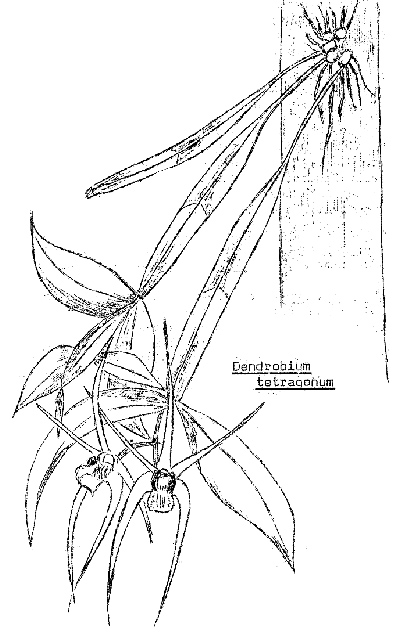








 NOSSA
NOSSA 