March 2015 Winning Photograph

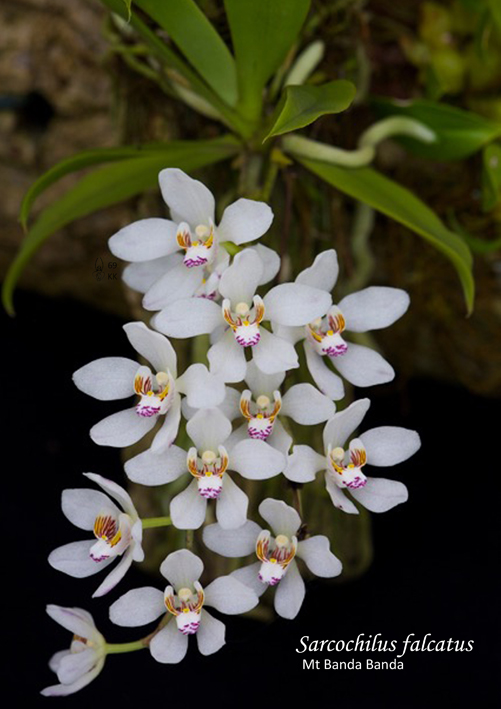
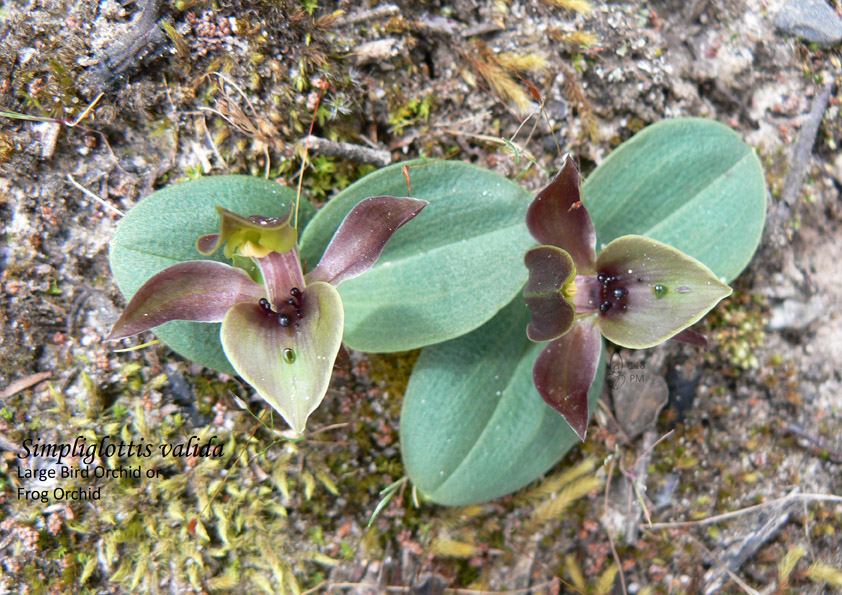
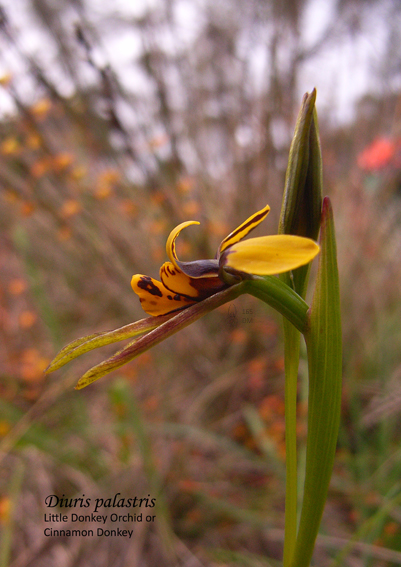
Three winners; three very different orchids but that is typical of Australian Orchids, there is no one species that you can point to and say that is a typical orchid as illustrated by the the winners which were Sarchochilus falcatus (Kris Kopicki), Diuris palustris (David Mangelsdorf) and Simpliglottis valida synonym Chiloglottis valida (Pauline Meyers).

Sarchochilus falcatus (common name Orange Blossom Orchid) is an epiphyte.  03 KK sm Sarcochilus falcatus Mt Banda BandaThe cultivated plant in this photo originated from the Blue Mountains just north of Macquarie.  Epiphytic/lithophytic orchids are found across northern Western Australia through the Top End and from a narrow band down the east coast to Tasmania; that is in all States except South Australia.  About a quarter of Australian orchids are epiphytes and despite the widespread distribution, 90% of epiphytic orchids are found primarily in the rainforests of northeastern Queensland.
S. valida (common name Large Bird Orchid or Frog Orchid) 03 sm PM Chiloglottis validaand D. palustris (common name Little Donkey Orchid or Cinnamon Donkey Orchid) are terrestrial, the larger of the two orchid groups.03 sm DM Diuris palustris  Terrestrials are mainly found across the southern part of the continent with some occurring in the north and tropics.  Their optimal habitat is the various types of sclerophyll forests found in Australia.
There is some distribution overlap but the two groups mainly occupy different habitats.

Concerning the habitat of the two terrestrials, S. valida ranges from tall moist closed forest to shaded places of drier open forests to sphagnum bogs and in the mature pine plantations of the South East.  Whereas D. palustris occurs in wet and swampy habitats in the Eastern states (hence it is named from the Latin palustre meaning swampy), in South Australia it is not so. Instead it is found in open terrain of grassland, grassy woodland, mallee and shrubland.

Some Odd Facts:

S. valida is a small ground hugging plant the scape (flowering stalk) of which elongates to 10cm or more after pollination.  Click on this video link to see these plants ‘talking’.  In New Zealand it is described as a vagrant having been introduced from Australia.

Sarchochilus falcatus is the most common and widely distributed species of this genus in Australia.  Occassionally it is lithophytic (grows on rocks). Though it had been rated Endangered and downgraded to Vulnerable in 2005, it is still under major threat from illegal collecting, trampling, water pollution, weeds and fire. New Zealand has epiphytes and the common name for them is Perching Orchids.

D. palustris is uncommon in South Australia and Tasmania; and rare in Victoria.  D. palustris was one of the subjects painted by Adelaide colonial artist and cartoonist Margaret Cochrane Scott in 1890s who had an affinity for native orchids.


References:

All internet references accessed on 31st March 2015

https://www.anbg.gov.au/cpbr/cd-keys/orchidkey/html/intro-c_habitat.html

http://anpsa.org.au/APOL19/sep00-1.html

http://www.nativeorchids.co.nz/Species/Simpliglottis_valida.html

http://data.rbg.vic.gov.au/vicflora/flora/taxon/4cebc1f9-38da-4c61-9c3c-37c2efc6da32

Mark Clements The Allure of Orchids 2014

http://www.iucnredlist.org/details/44392876/0

Bates 2011 South Australia’s Native Orchids DVD
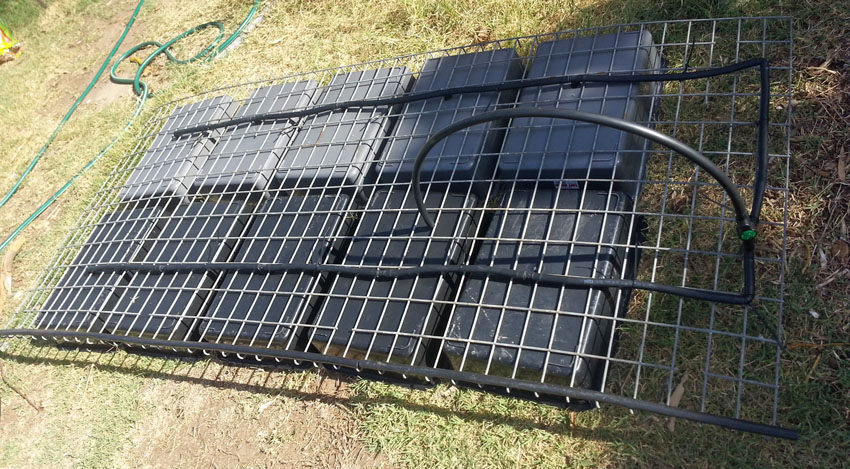
Creating a Mosquito-free Micro Climate for Epiphytes

Adelaide in summer is very dry and hot with very little humidity or rain.  Since January 2015 there has been over 60 days without any significant rainfall.  This presents a problem for growing Australian epiphytes which come mainly from the eastern seaboard with its increased humidity and summer rain.  Therefore to grow ephiphytes in Adelaide, it becomes necessary to attempt to replicate these conditions through creating a micro climate with increased humidity.  To achieve this many growers will stand the pots on gravel in water-filled trays but this presents a problem.  Mosquitoes love it and rapidly breed up to the annoyance of us all.

The following system stops mosquitoes from breeding plus prevents pots getting water logged in Adelaide’s winter, particularly when the pots are not under a solid roof but shadecloth (in this instance, 50% shadecloth).

  • Equipment
    • 10 Black trays – these were inexpensive trays from Cheap as Chips
    • Black irrigation tubing
    • 10 Grommets
    • 11 ‘T’ junctions and 2 angle junctions
    • Tap
    • Sealant
    • Gravel
    • Builders Landscape Fabric
  • Preparing the trays
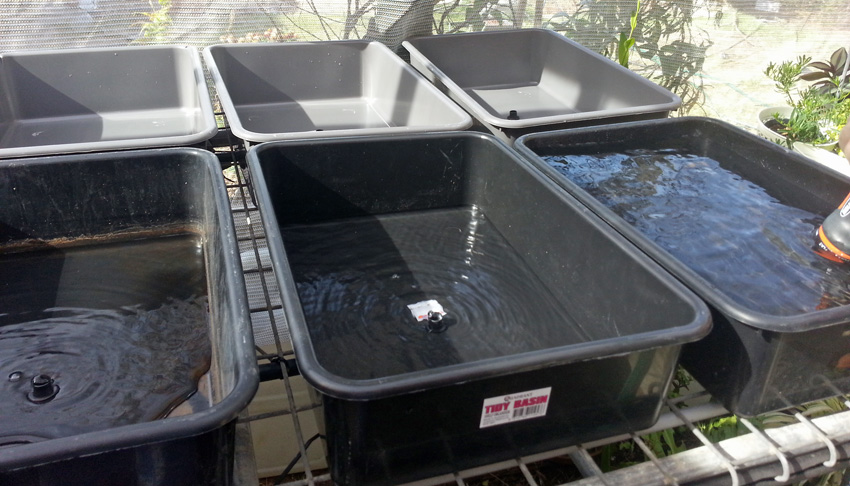
    • One hole was drilled in each of the trays.  A grommet was placed in each hole and using ‘T’ and corner junctions the trays were joined with poly tubing including a tap.

      The trays connected.  To give stability the trays and hose were connected to the table top.
      The trays connected. To give stability the trays and hose were connected to the table top with the hose running under the table top. This allows free drainage as it stops the hose from being squashed.
  • Checking the system for leaks
    • The next step was to check that the water flowed into all the trays and that there were no leaks.

      Filling all the trays from one tray.
      Filling all the trays from one tray.
    • There were leaks and these were sealed with an aquarium sealant.
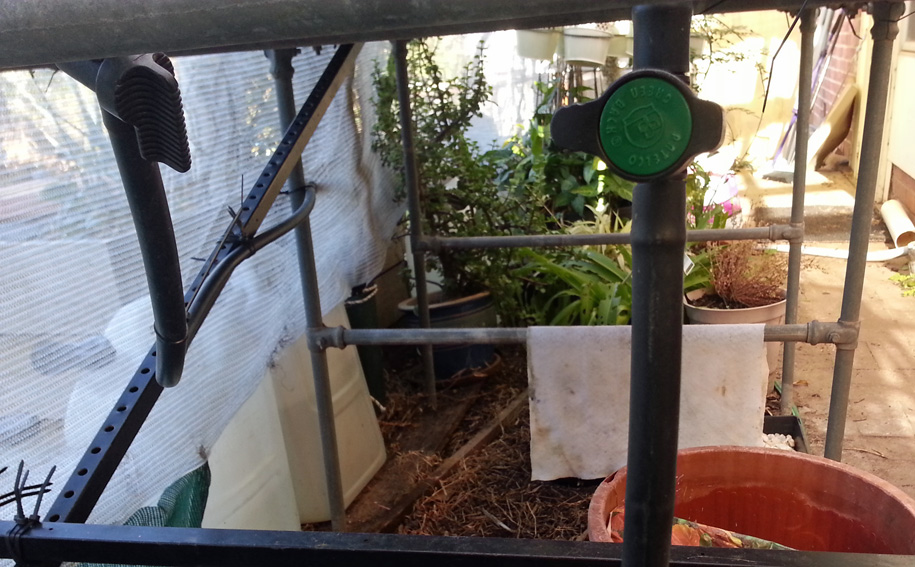
    • A hose with a tap was directed toward a raised garden bed on the other side of the shadecloth.

      Checking for leaks & the drainage system
      Tubing leading to the raised garden bed
  • Preparing the inner tray
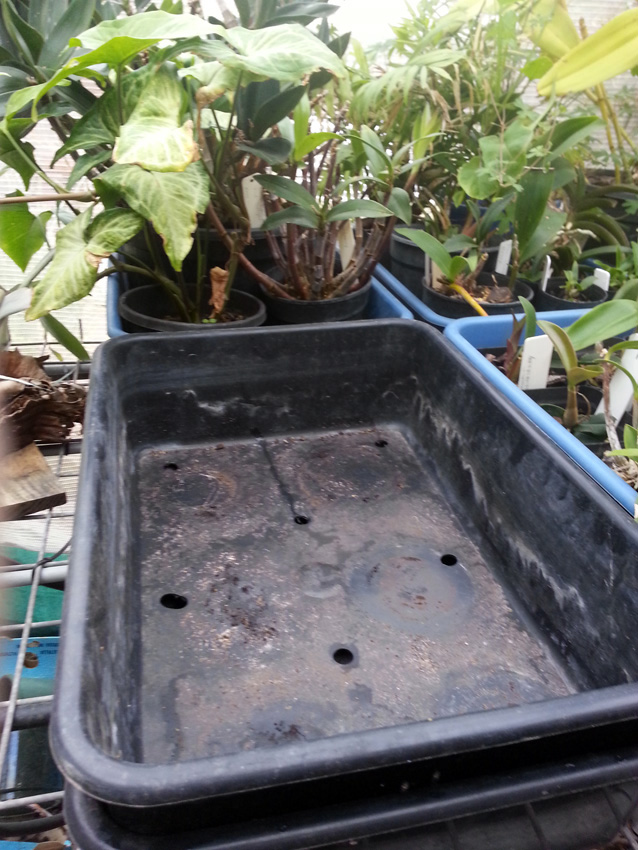
    • The system requires a second tray.  Drainage holes were drilled in the trays.

      Inner (upper) trays with holes to allow the water to come up into the pots.
      Inner trays with holes to allow the water to come up into the pots.
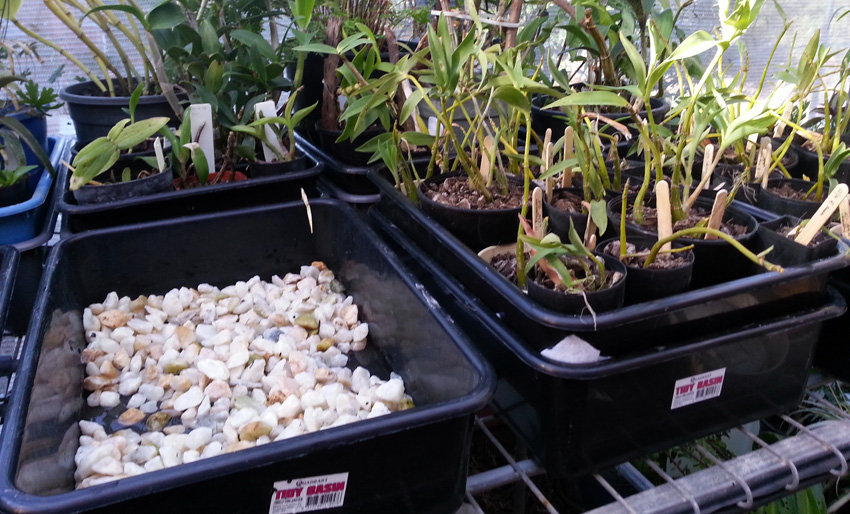
    • Gravel was placed in the outer (lower) tray.

      Gravel to support the inner trays
      Gravel to support the inner trays
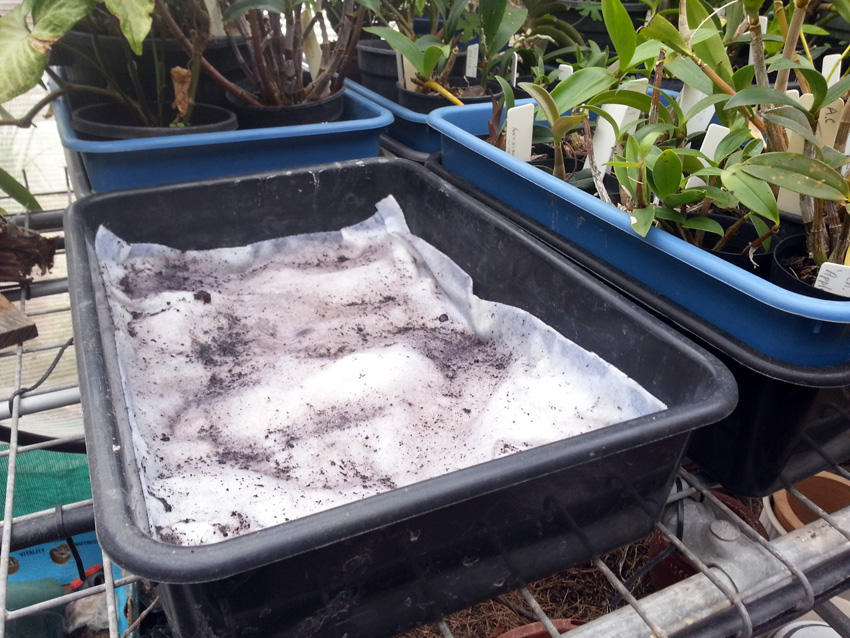
    • The reason was two-fold.  One was to make it easier to remove the inner tray with the pots insitu and the other was to hold the builder’s landscape fabric nearer the inner tray.  The purpose of the fabric is to keep the tubing clear of debris.

      Layer of cloth to stop debris entering the drainage pipes
      Layer of cloth to stop debris entering the drainage pipes
  • The finished system
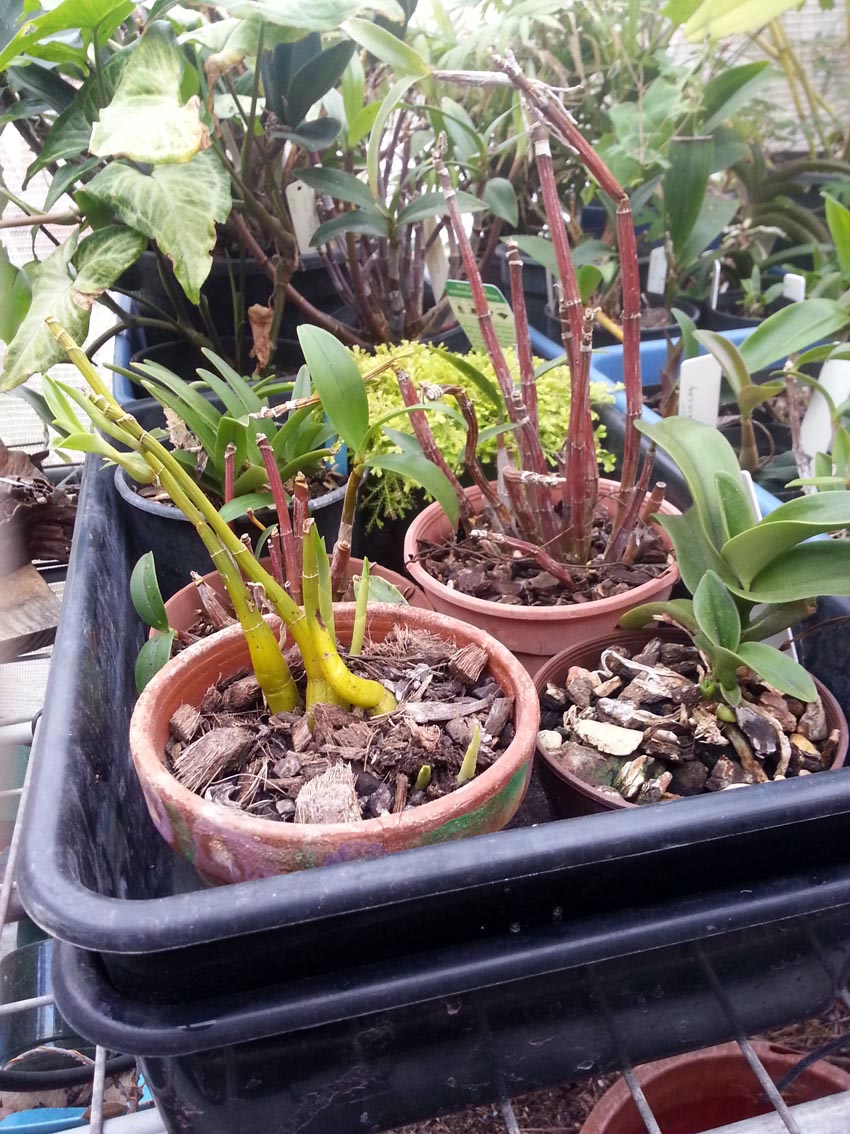
    • Pots in place and ready to enjoy the new growth of those numerous plants that were divided previously – see the post Breaking up is ….. easy to do.

      The front pot originally consisted of just the pseudobulbs without leaves of Dendrobium kingianum.  After a few weeks in this system, new growth.
      The front pot originally consisted of just the pseudobulbs of Dendrobium kingianum. There were no leaves. After a few weeks in this system, new growth has appeared.
  • Using the system
    • Depending upon the conditions, the mosquito breeding cycle can be as short as four days from egg-laying to the larva emerging as a adult.  As a result, the water is fully drained every four days or less.  This regular drainage of water means that there is no stagnant water left lying around for any prolonged length of time.
    • The trays are allowed dry for a couple of days (less in a heat wave) before refilling again and the pots sit in a small amount of water.
    • By following this watering cycle there are no mosquitoes.
    • The shallow layer of water around the pots provides the necessary humidity.
    • In winter the taps are left open the whole time to prevent the plants from becoming water-logged.

NB This system is not suitable for the terrestrial orchids.


Greenhood Pollination Strategy

Since orchids, and Australian orchids in particular, first came to the attention of the western world in the 1800s researchers have been fascinated by the so many different aspects of the orchid’s morphology and life cycle. One area of interest has been that of how orchids are pollinated. The mechanism of pollination has not always been clear as the orchids seem to use different and complex methods.  From time to time various papers have been published of observations by researchers.

One such paper was published in the Annals of Botany 113: 629 – 641, 2014 titled ‘Caught in the act: pollination of sexually deceptive trap-flowers by fungus gnats in Pterostylis (Orchidaceae)’ by R D Phillips, D Scaccabarozzi, B A Retter, C Hayes, G Brown, K W Dixon and R Peakall.

The ‘question and answer’ style of the paper helps with ease of reading and is worthwhile perusing, even for the lay person. The accompanying VIDEO is also of interest.

The essence of the paper was to establish whether sexual deception was used to facilitate pollination.  The species researched was Pterostylis sanguinea (syn. Urochilus sanguineus) and the researchers confirmed that this did happen.  Their research showed that the attraction for the insect came only from the labellum which exuded an alluring chemical.  P. sanguinea has a mobile hinged labellum which is a feature of other sexually deceptive orchids such Paracaleana, Caleana, Arachnorchis.

Urochilus sanguineus RWL
Pterostylis sanguinea syn. Urochilus sanguineus with the untriggered labellum
Urochilus sanguineus RWL(1)
Pterostylis sanginea syn. Urochilus sangineus with a side view of the labellum


Australian Orchids & the Doctors they Commemorate Part 18 of 20

Colin Ledward (1903 – 1963)

A general medical practitioner of Cloncurry and Canungra (Queensland); the orchid that bears his name was collected from a single colony discovered in 1934 and is now almost certainly extinct.

Orchid

Acianthus fornicatus (= Acianthus ledwardii)

2015 February Winning Photograph

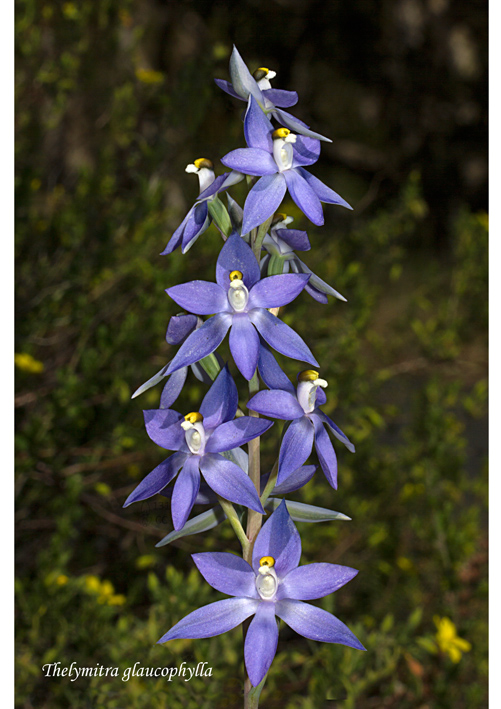
02 CC Thelymitra glaucophylla sm

The number of photographs may have been few but the quality was present. The clear winner was Claire Chesson’s Thelymitra glaucophylla (Glaucous Leaf Sun Orchid). Flowering from October to December, this endemic grassy woodland species of the ranges was only published in 2013 by Jeff Jeanes in the Mulleria 31:3 – 30 (2013) but it had been recognized much earlier by Bob Bates and has appeared with this name in his electronic Orchids of South Australia since 2005. It belongs to the T. nuda complex, of which there are 15 species, six of them having only been published in 2013. This complex is characterised by having large scented blue multiple flowers that open freely.

Not seen in this picture is the leaf and though the leaf is highly variable – 10-50cm long, 8-20mm wide, erect and short, long and flaccid, Jeanes mentions that T. glaucophylla “can be identified with a high degree of confidence from the mature leaves alone” (Page 4 Vol 31, 2013 Mulleria). The main features of the leaf are grey-green glaucous ie white bloom and is often senescent (withered) at anthesis (full flowered). Of the T. nuda complex, T. megcalyptra is the most similar but its leaf is never glaucous and has a red base, as well as an earlier flowering time and habitat of plains and rock outcrops.

For more details on the other orchids in the T. nuda group see the post titled Those Blue Orchids Again … posted 30th January 2015 with the link to Jeanes article in the Muelleria

Advice from the past – Start Watering

In 1984, G.J.Nieuwenhoven was the editor of the NOSSA Journal.  In February of that year he wrote the following:

Welcome back to NOSSA.

 After the holiday break we are all looking forward to the next meeting to talk about our favourite plants and renew friendships.

Several members have reported an early start to the terrestrial season with Pterostylis species, a couple of Diuris species popping up already.  For some of the eastern states Pterostylis of the cauline group this is normal, especially if you keep the pots cool during the summer (a cellar is ideal but underneath a shaded bench in the shadehouse will do nicely). Very light watering should take place when the first shoots appear but do not overdo the watering or place pots in the sun for we are sure to get some more hot weather yet and this could cook your plants before you know it.

The Diuris are really out of season but it was probably the rain in late December and early January that started them off, anyway, these too should be kept slightly damp if they are up.

If you have not finished repotting by now it would be best to leave it until next year as the new shoots which are already beginning to grow from the tubers are very easily broken off while sifting them from the soil.

Apart from that all you can do is wait for the rains to come in March and then start searching for plants to appear – and keep those fingers out of the pots or you may damage one of your best plants looking for the new growths.

This is also the time to start taking notes when plants first appear, etc.:

  • when they flower and how many flowers from a given number of tubers;
  • what kind of soil; what conditions (i.e. shaded or not, damp or dry).
  • Anything that may assist in years to come to help you understand and grow our orchids better and, more importantly, multiply them.
  • A card index system would be a good way to store information, otherwise an exercise book will do.

                                                            Editor

The timing of the article tallies with the advice that was recently given at the end of February – start watering the terrestrials now if you haven’t already begun.  Hopefully by the flowering time you will have a lovely display of terrestrials such as the Thelymitra, Arachnorchis and Caladenia featured below.


Pot of Thelymitra Kay Nesbitt Cultivar copyPot of Arachnorchis argocallaPot of Caladenia latifolia cultivated by Les Nesbitt

Australian Orchids & the Doctors they Commemorate Part 19 of 20

Arthur George Harrold (1918 – 2012)

A navy surgeon who later worked as general medical practitioner, ecologist and conservationist in Noosa (Queensland), and graduate of the University of Cambridge; he formed the Noosa Parks Association in 1962 and helped establish the Cooloola National Park.

Orchid

Habenaria harroldii

Named in recent years, so there is only general information on the genus, Habenaria

Three Key Starting Points for Successfully Growing Australian Orchids

There is a lot of information on growing orchids so much so that it can become overwhelming.  As a novice, I’ve put together my observations which can be summed up in three key points.

One – Find a Mentor

The best and first thing to do is to join a local orchid club, such as the Native Orchid Society of South Australia (NOSSA), and find a mentor within the group.  There are many books but nothing substitutes for that personal interaction with an experienced grower who will know both the plant and the adaptions needed for the local conditions.  At the monthly meetings, NOSSA has a Grower’s forum where various aspects of growing orchids are discussed and questions answered.  It is well worth attending.

Two – Have an Equipment Kit

There are some things that are essential and it is good to have a basic kit to get started.  Later, more equipment can be added as one’s skill develops in growing orchids.  The necessary items would include:

  • Secateurs
  • Labels – these can be proper plant labels from a garden store or wooden lollipop sticks, so long as they are waterproof.
  • Pen – indelible ink pen or pencil (there are pencils that can write on plastic) as it is pointless having a labelled plant with the details washed off.
    • it may be necessary to use both current name and synonyms on the label eg Corybas/Corysanthes
  • Wettable Sulphur – necessary for guarding against diseases and is available from garden centres but Tomato Dust can be a good substitute although it is half the strength.
  • Sterilizing equipment
    • Good nursery hygiene techniques are important
    • Dilute bleach, tri-sodium phosphate (and possibly a small blow torch for metal tools)
    • newspaper
      • a different sheet for each orchid when dividing will help prevent transference of any disease, etc (don’t forget handwashing)
  • For Epiphytes
    • Ties and Stakes
  • For Terrestrials
    • Sieve for recovering tubers
    • Sheoak or pine needles for putting on top of the pots to stop soil and fungi splashing up on the undersize of the leaves
  • Pots – do not need to be fancy but the pot size will depend upon the species
    • Diuris prefer deeper pots; Corysanthes prefer wider, shallower pots whilst Pterostylis doesn’t seem to mind either

Three – Work within the Plant’s Growing Condition

This will require time, research, experiment and going back to the experienced growers.  Each one of us eventually needs to find what is the best setup for our individual location but some general guidelines would be:

  • Start with plants that are suitable for your current climatic conditions.  Obviously putting a tropical Dendrobium bigibbum under the patio in temperate Adelaide is not going to be successful.  For the terrestrials it is better to start with Pterostylis curta or a Microtis than a fungi dependent Arachnorchis tentaculata.
  • Research the plant you want to grow and then create the micro-climate necessary for the flourishing of the plant.  This will entail separating the orchids, don’t put shade lovers such as Corysanthes with those requiring brighter light eg the Thelymitra genus.
Dendrobium speciosum
Potted Epiphyte – Dendrobium speciosum
Thelymitra plants in pots
Potted Terrestrials – Thelymitra (Sun Orchids)

2014 November Photograph Competition Part 2

Part Two of the November competition consisted of photographs of insects on orchids. There was quite a range of insects but the winner was a draw between Cyrtostylis robusta (Winter Gnat Orchid) with an ant and Pterostylis curta (Blunt Greenhood) with a midge fly; both taken by Doug Castle.

With today’s technology it is not only easier to take crisp images but fine details can be seen particularly when enlarging the image. Hence when the pictures are enlarged it is possible to see hairs on the ant and feathered antennae on the midge fly.

With identifying orchids, it is often the detail that is important. Both of these orchids are distinctive and can be readily identified but it is good to examine why this is the case.

Pterostylis curta (Blunt Greenhood)

With the greenhood, there is enough detail to see that the dorsal sepal and lateral petals have united to form a galea, ie hood, and that the lateral sepals are semi-fused and erect resulting in lateral orifices (side gap) between the two structures. These are some of the features that separate Pterostylis* from the other greenhoods such as Diplodium, Speculantha and Taurantha. This becomes apparent when browsing through the greenhood photographs, pages 286 to 339, in Jones “A Complete Guide to Native Orchids of Australia”. Having established that the plant is a Pterostylis, the twisted labellum is diagnostic of a P. curta as it is the only one that is described with a twisted labellum. Although not all the identifying features are present, enough information is available in this picture for identification.

In contrast the photograph of the Cyrtostylis robusta only has sufficient data to confidently identify it as a Cyrtostylis species, having a distinctive labellum that is larger than the lateral sepals and petals. In South Australia there are only two species and according to Bates (2011), the distinguishing features between the two

Cyrtostylis robusta (Winter Gnat Orchid)

appear to be the leaf, the bud and the labellum. In this picture, the angle of the image does not give a clear view of the labellum (it could possibly be damaged) and of course there is no bud or leaf. It is possible that the pale edges of the dorsal sepal may give a clue to species identification as C. reniformis has mainly darker buds than C. robusta. Obviously Doug was able to identify it from his observations of the other features not present in this photograph.

In summary, one image is not always sufficient for identification. As was discussed on the night, to confirm identification, orchids should always be photographed from more than one angle, including pictures of other parts of the plant.

*In South Australia, Pterostylis foliata is a possible exception as it has no obvious lateral orifice.

References

Jones, D.L., T. Hopley, S.M. Duffy, K.J. Richards, M.A. Clements & X. Zhang (2006) Australian orchid genera. An information and identification system. CSIRO Publishing: Collingwood, Vic.

Bates, R.J. (2011) South Australia’s Native Orchids. DVD-ROM. Native Orchid Society of South Australia Inc.: Adelaide.

Jones, D.L. (2006) A complete guide to native orchids of Australia, including the island territories. New Holland Publishers: Sydney.

Australian Orchids & the Doctors they Commemorate Part 17 of 20

Hugo Flecker (1884 – 1957)

A pioneer Australian radiotherapist, radiologist, general medical practitioner and toxicologist of Cairns (Queensland) who dug his own radioactive ore at Radium Hill (South Australia), a medical graduate from the University of Sydney, and a natural historian; his life and works are commemorated by the Flecker Botanic Gardens in Cairns.

Orchids

Cestichis fleckeri (= Liparis fleckeri) Slender Sphinx Orchid

Thelychiton fleckeri (= Dendrobium fleckeri) Apricot Cane Orchid