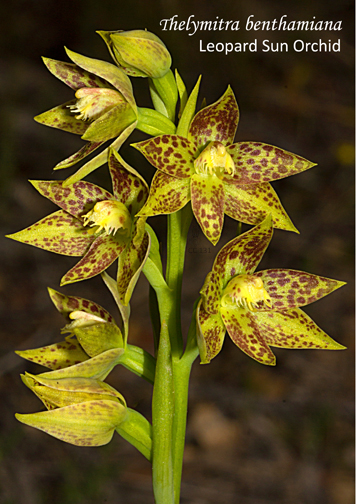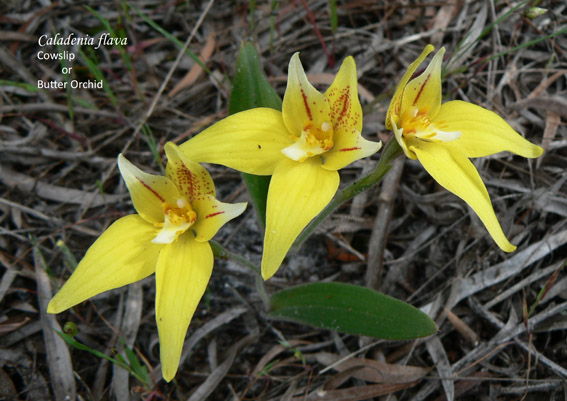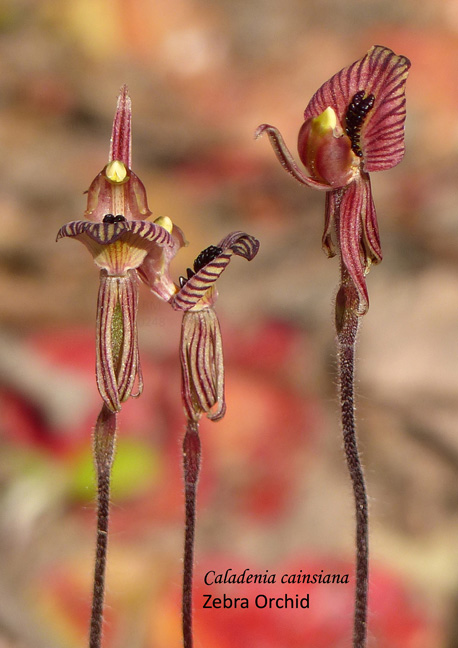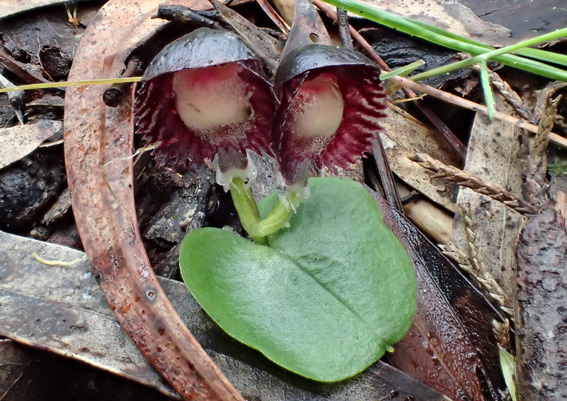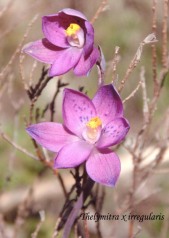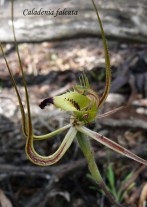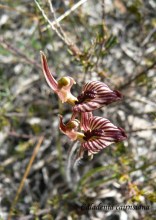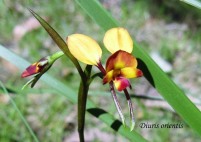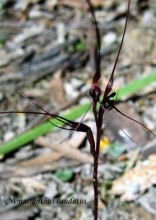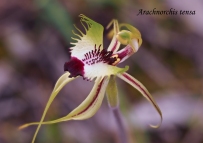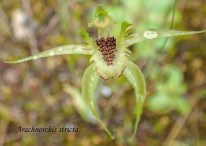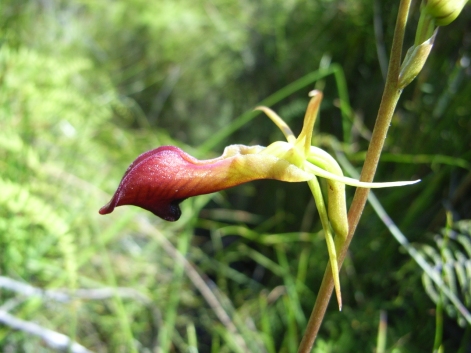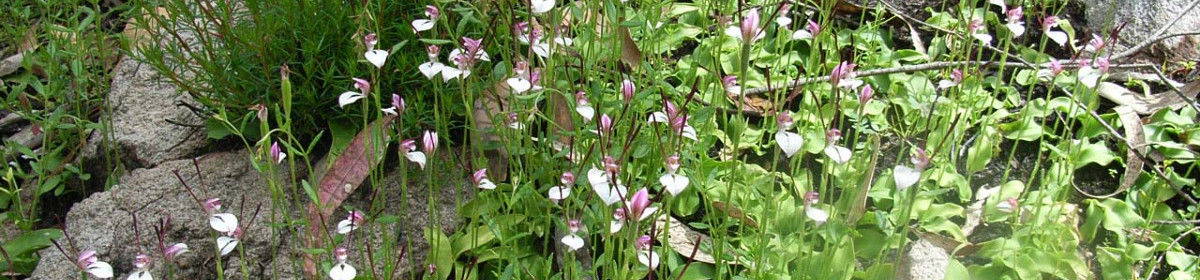
For the final meeting of the year we chose the best of the 2016 monthly winners of the picture competition.
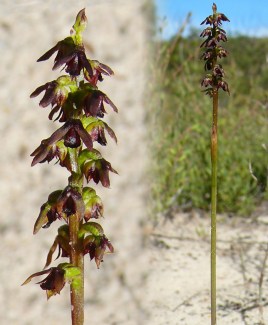
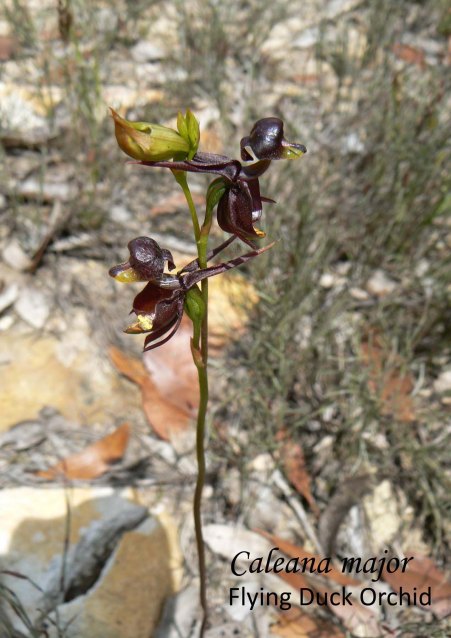
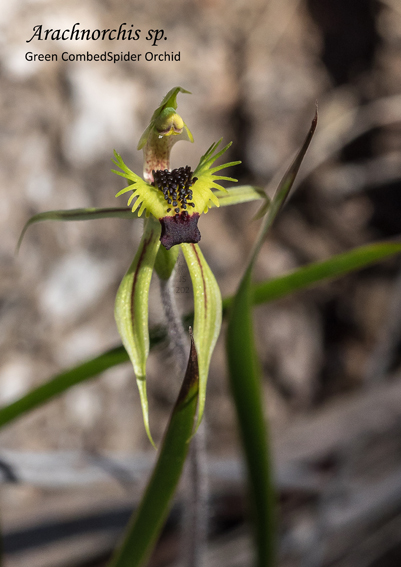
Here in Australia we are fortunate to have such a variety of orchids. They may not be as big and showy as some of the overseas orchids but the diversity of shapes fires the imagination as reflected in this year’s monthly winners, when put together. The common names of the winners – spider, leopard, flying duck, cowslip, zebra, helmet, bluebeard and greenhood – reinforce this theme of diversity.
Patterns and colours contribute to the variety of our orchids. Australian orchid colours run the gamut of the rainbow and more, with Australia being home to most of the naturally occurring blue orchids in the world. This colour fascinates and allures people around the world so much so that nurseries will dye a white orchid blue because it will sell. There is even a website devoted to the colour called, not surprisingly, Blue Orchid and the popular band master Glenn Miller wrote a song titled Blue Orchids (1944).
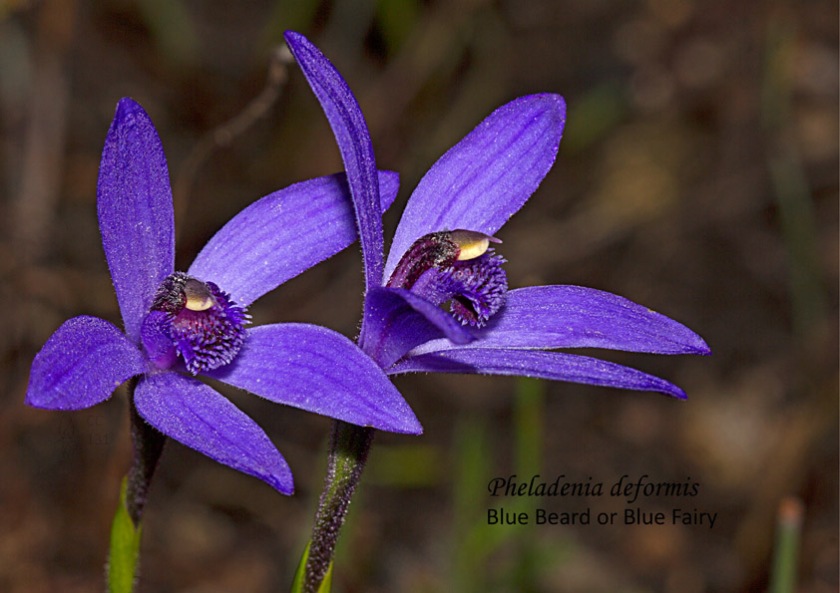
Could this be why the very clear winner for the year was Claire Chesson’s Pheladenia deformis common name Bluebeard or Blue Fairy?
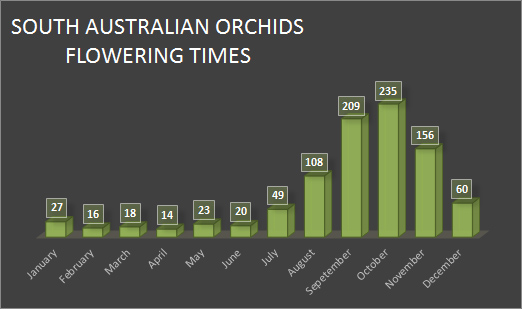
The short answer is that in South Australia there will be potentially an orchid flowering somewhere in any month of the year but the caveat is that in certain months specifically December, January, February, and March it is very difficult to find any as there are only a few flowering species and most of them are restricted to localised/sensitive sites. The flowering times for the highest number of species occur in winter and spring with October being the most prolific month for flowering.
To see how this varies across the state for the individual regions see the charts below.
Another is question “Will I find orchids when I visit a particular park on a particular day?” is not such an easy question to answer because it DEPENDS on so many different factors.
The timing of the rains affects the flowering time, for instance, Autumn orchids appear about 6 – 8 weeks after the first autumn rains. Normally the South East is the best place but this year the lower South East did not have a good flowering due to the storms and associated cold with the wet conditions.
Pollination affects the likelihood of finding flowers. Flowers remain open until pollination occurs. If the pollination is delayed the flower will be on display for a longer time until it runs out of energy and naturally shrivels up. To illustrate this NOSSA visited Scott Creek Conservation Park one day and there was a beautiful display of sun orchids along with several spider orchids but on a visit to the same site one week later, there were hardly any flowers left. Many had been pollinated as was evidenced by the swollen capsules.
So as a rough guide click here for the species flowering times of South Australian Orchids and herefor month by month information. This data is based upon information found in the 2011 South Australia’s Native Orchids disk.
For detailed information, it is necessary to consult with someone who knows the orchids in the area but it may not always be easy to find such a person. In which case, contact NOSSA and we may be able to, through our network, find someone to help.
This week’s blog is an extract from Volume 30 No 10 November 2006. In this article of Len Field he gives not only cultural notes but also some interesting background including an orchid link with the infamous Captain Bligh.
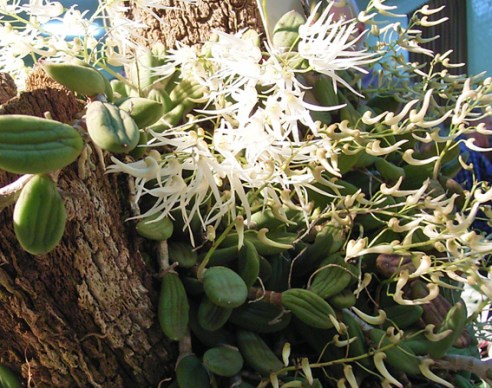
Dockrillia linguiformis (Sw) 1800 Brieger
Dockrilla linguiformis
Len Field Common names Thumbnail orchid, Tongue orchid, and in North Queensland the Tick
orchid.
The name linguiforme is from the Latin lingu(a) as in linguiforme (a tongue). It was also claimed for many years that this was the orchid that Olaf Peter Swartz the German botanist founded the genus Dendrobiumin 1800, but this was wrong, although this was the first orchid seen by white man when they landed at the rocks area in Sydney cove, Port Jackson. It was introduced into England by Rear Admiral Bligh of Bounty fame.
Other names it has been called are Dendrobium linguiforme var. linguiforme Swartze 1800 Callista linguiforme (Swartze) Rev. Kuntze 1891 Dendrobium linguiforme (Swartze) var. huntianum Rupp 1942
There was another variety named from this species called var. huntianum by Rupp in 1942, which was named after T.E. Hunt and is a June or July flower and found near Ipswitch (sic) in Queensland, but as it reverts to type form it never reached true variety status and was considered just a variation of the type form.
This orchid has a huge range of habitat which stretches from almost the Victorian border up to North Queensland and West to the Great Dividing Range. It is very common throughout this area and equally happy as an epiphyte or a lithophyte but where as a epiphyte it likes swamp oaks (Casuarina glauca), river oaks (Casuarina cunninghamiana), in fact it will grow on most trees that will hold there bark including the tea trees (Leptospermum species). I have seen this orchid hundreds of kilometres inland from the coast still forming large mats on the rock faces, while in its more prolific growing areas these mats will cover huge areas of the rocks where it can survive and grow in extreme exposed conditions that would kill other orchids. In the dry times the leaves which are very thick, tough and numerous will shrivel and can last up to six months without water. This is a feature of a lot of Australian Dendrobium and Dockrillia Flowering is from August to October with blooms that are long lasting, up to two weeks with one raceme per leaf. Culture. If grown on slabs which is the usual way it should be hung up high and if grown in pots a very coarse open mix. In nature it likes plenty of sunlight although at times it will grow in shade. Whichever way it is grown it should have good light, humidity and air movement.
There are many different activities involved with orchid conservation. In situ conservation consists of looking after the orchids where they are growing; maintaining and protection of habitats and ecological systems. On the other hand ex situ conservation is caring for the orchids in cultivation in a similar way that zoos maintain an animals species that is extinct in the wild.
For the orchids one form of ex situ conservation is via seed collection and the propagation of new plants. With many of our terrestrial orchids this is not an easy task but here in South Australia an attempt is being made with four of our endangered orchids.
Unlike some of our terrestrial orchids these are ones which we have not been able to grow. There is a collaborative effort co-ordinated through the South Australian Seed Conservation Centre (Seedbank) to change this. Amongst the people helping the Seedbank are members of the Native Orchid Society of South Australia, students from Kildare College and Dr Noushka Reiter of the Royal Botanic Gardens Melbourne.
On July 30 2016, Dan Duval of the Seedbank was interviewed by Jon Lamb on Ashley Walsh’s ABC 891 Adelaide Talkback Gardening program. It is an informative interview and well worth the listen.
For more information on the work of the Seedbank, visit their website
Video as heard on Talkback Gardening with Jon Lamb and Ashley Walsh – Saturdays from 8.30 on 891 ABC Adelaide.
Pauline Myer’s Caladenia falcata and Caladenia carinsiana;
Margaret Lee’s Diuris orientis and Nemacianthus caudatus;
Judy Sara’s Arachnorchis tensa;
Greg Sara’s Arachnorchis stricta which had an unusual green coloured flower;
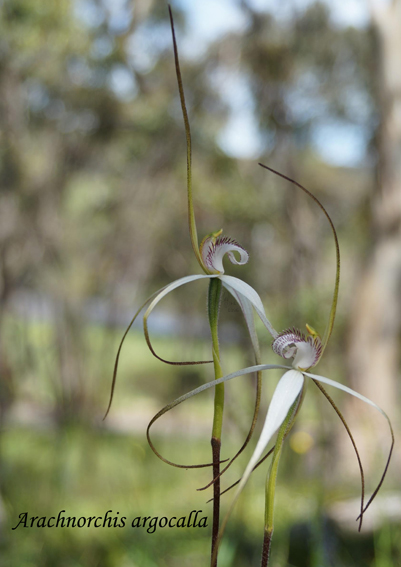
and Helen Lawrence’s Arachnorchis argocalla.
Helen’s picture of the nationally endangered A. argocalla was the outstanding winner. Now known as the White Beauty Spider Orchid^, it was featured last year as a winner with Pauline Meyer’s June 2015 entry*.
This is one of our largest spider orchids. For size, beauty and delicacy it rivals the Western Australian Caladenia longicauda ssp. eminens (White Stark Spider Orchid) and A. venusta, syn. Caladenia venusta (Graceful Spider Orchid) from Victoria and the South East.
It shares many similarities with these two species in that they are reasonably good size white flowers with a stiffly hinged labellum that has long, thin teeth and the segments have threadlike tips without clubs. It is separated both geographically and in the type of habitat from these two species. A. argocalla is a plant of the inland hills and valleys.
Though primarily a white flower and part of the A. patersonii complex, A. argocalla has red colouring in the labellum which according to Backhouse may possibly indicate genetic introgression (that is long term mixing of the gene pool) with either the A. reticulata or A. leptochila complexes. Certainly, the colour of the labellum was quite variable ranging from white through to a deep red.
^Previously known as Common White Spider Orchid because of its abundance but now only known to a limited number of locations.
*NOSSA Journal, July 2015
Reference:
Department of the Environment (2016). Caladenia argocalla in Species Profile and Threats Database, Department of the Environment, Canberra. Available from: http://www.environment.gov.au/sprat. Accessed Thu, 3 Nov 2016 16:31:39 +1100
Mad dogs and Englishmen are not the only ones to go out in the midday sun. For orchidologists to see Sun Orchids flowering, then it is out into the midday sun on a hot day because that is when they open. There is no point going much before 11am and by 2pm most are closing and no point going out on a cool or windy day.
But for those who don’t want to go out (or cannot get out) into the midday sun, here is a video to be viewed in the cool of the shade.
This video features the Leopard Sun Orchid (Thelymitra benthamiana) an uncommon Sun Orchid in South Australia. Unlike many sun orchids which requires a view of the flower to confirm identification, this one can be identified by the leaf alone. At the beginning of the video take note of its distinctive leaf.
Continuing last week’s blog, here is the completion of Rudie Kuiter’s Introducion, Orchid Pollinators of Victoria. In this section he discusses some factors of hybridisation and the value of regular observation by local people interested in orchids.
Lissopimpla excelsa is the pollinator of all members of Cryptostylis, but hybrids are not known, even when sympatric, thus a molecular mechanism is in place that prevents cross-fertilisation. Hybrids in other orchid genera do occur and these usually are amongst closely related species. Several congeneric orchids attract the same male pollinator species, thus would be emitting the same kairomones, the scent that is a mimic of the female’s sex-pheromones, but normally these orchids are allopatric or have different habitat preferences. The land clearing, frequent fires, changes of watercourses, gold-diggings are amongst many unnatural human habitat interference of recent times. Historically in undisturbed natural habitats sibling orchid species that attracted the same male insect were not sympatric, not flowering at the same time or were in close vicinity to each other. In disturbed sites the situation has changed, as closely related species may have become sympatric and hybridisation take place. Spider-orchids that attract thyniid wasps with kairomones normally target a certain local species, but many allopatric species are know to share the same pollinator and readily hybridise where they became sympatric. In Pterostylis greenhoods the known hybrids are also caused when different species attract the same pollinators.
Cryptostylis subulata (Moose Orchid)
We still have much to learn to fully understand how adaptable the orchids are, the role insects play and how to interpret what we see. Orchids are finely tuned to their world and can change and adapt in ways that most people seem to underestimate. I requires observations of the same plants over many seasons to get a good understanding of their variability and adaptability. Unusual forms often show after a drought or fire may look like a new species, but soon change back to typical or normal within a few good seasons or after regeneration. It is usually the local people taking an interest that see the changes in the same plants over time that dispute what the ‘on-the-fly’ taxonomist come up with.
Creatures evolved as part of an endless combination of life-forms, ranging from microscopic to the tallest tree, that together form an ecosystem in which all organisms depend on each other. The climate, weather and other factors changes the environment constantly that influence the members differently, dome doing better than others, but it collectively maintains a balance. Natural events such as a major fire or flood may benefit environments in areas as part of seemingly long cycles, but they are very short in evolutionary terms. Unnatural man-made fires are very destructive as these are conducted much too frequently, wrong time of the year, and in the wrong place. Not obvious, but also very detrimental is the use of insecticides that seems to effect the Diptera members the most. Many of the important pollinators such as the fungus-gnats have gone locally extinct and most of the Pterostylis depend on them. To work with the pollinators it is essential to have a good understand of the life-cycles of the insects involved and watch the flowers in the wild. After witnessing Pollinator behaviours of the fungus-gnat on Pterostylis nutans countless times, the principal pollinator is easily recognised with other species. Unfortunately few good areas to find orchids and learn about their pollinators are left. Many are now rare and measures taken to protect them usually focuses on just a species. To be effective their habitat area and surrounding needs to be cared for, letting the natives grow and have the natural canopy reform. At least, habitats should be protected from further disturbances, especially by badly informed governmental environment departments with their fires.
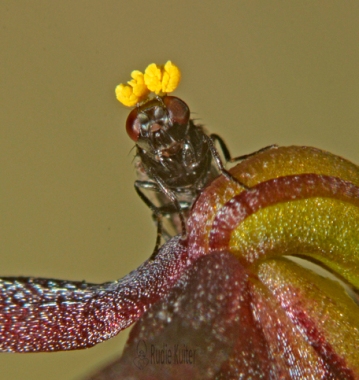
Pollinator with pollinia
Note This book is solely based on first-hand observations on the orchid-pollinators in the wild. Descriptions and comments are from many hours of watching each species over multiple seasons.
Apart from Orchid Pollinators of Victoria, Rudie Kuiter has produced several Victorian orchid books. If you are interested in purchasing any please contact us.
This week’s blog, Part One of Two Parts, is quoted directly from the introductory chapter (Pages 2&3) Orchid Pollinators of Victoria 4th Edition, 2016, Rudie Kuiter. Over the years of photographing orchids and their pollinators, Rudie and his team have been discovering much of the hidden world of orchid pollinators. In this first section he highlights the fallacy of the “one orchid-one pollinator” as well as touching briefly on the vast difference between the insects and their role in the ecosystem.
Amongst flowering plants, orchids have evolved in their own special reproductive ways. Their pollen is massed as waxy packages, pollinia, unlike like (sic) other flowers that produce masses of fine pollen grains that mostly go astray. The pollinia are relatively heavy and the usually small creatures need to be strong fliers for cross pollination (see image below). Orchids evolved with amazing strategies to attract specific carriers in order to transfer pollen between flowers of their species only, and in this way eliminating the need to produce great quantities. Various insects, many moths, bees and even birds have been documented as pollinators of orchids around the world (v.d. Cingel, 2001). A number of uniquely different examples of orchids attracting insects for their pollination evolved in Australia, especially in the more temperate southern zones originating from Gondwana times. With very few exceptions the Victorian orchids are terrestrial, ground-dwellers, that rely on small insects such as fungus-gnats, native bees, wasps, ants and many attract only the males by sexual deception. In the case no pollinators visits, many species may self-pollinate as a back up.
When taking an interest in orchids it seems difficult enough to identify some species. Usually one looks and admires the amazing flowers that may resemble an insect and can be difficult to recognise as a flower at first. An insect on a flower may be thought of something that spoils a picture – until taking an interest in the visitor!
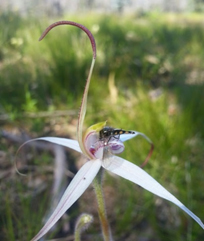
Hoverfly on Caladenia rigida (syn Arachnorchis rigida)
I first learned about the orchid pollinators in Orchids of South Australia by Bates & Weber, 1990, an excellent book by today’s standard, but few were seen over the years by just being there at the right time when photographing orchids. During preparation of the book on Caladenia spider-orchids, certain issues developed from questionable statements made in scientific papers about wasp-pollinators. Of particular concern was about the one-to-one relationship – how only one wasp-species would be involved with only one spider-orchid species – and suggesting populations that were thought to represent the same species comprised different taxa if not pollinated by the same wasp-species. A very different story emerged when monitoring the local spider-orchid populations to find the answers and it became clear that there was much more to it. A site in Wonthaggi with a very large colony of Caladenia dilatata proved to be perfect for this study and also to photograph pollinators as it produces flowers for about four months. It was found that a local wasp-pollinator species typically flies for a little over one month, thus this need to be investigated further. Scientific publications on wasp-pollinators were generally based on short-term experiments, and usually employing baiting methods – moving flowers and often taking them to different sites. Responses included unnatural behaviour or attracting sibling wasps at a non-local site. It is certainly true that a particular flower may attract only one species of wasp a t a locality and a certain time in the season, but this reflects a very small part of the picture. It can be different in the long-term, at certain localities or with a season.
The main study site was in coastal dunes, where in a very large population of Caladenia dilatata produced flowers for over four months from September, and under favourable Summer-conditions into January. At least three congeneric (belonging to the same genus) thynniid wasps species were involved in this population. The flying times were up to about 6 weeks for each wasp species, that were separated or slightly overlapping. The flowering times in other populations of C. dilatata in Wonthaggi and Wilsons Promontory were usually about one month in each, and at the corresponding times to the study site the wasps visiting were the same species. A close sibling C. parva in the Wonthaggi heathland habitats and early flowering C. dilatata were pollinated by the same species, but the later flowering C. tentaculata by a thynniid wasp of the different genus.
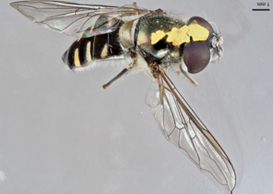
Hoverfly with pollinia
Whilst a flower may attract only one wasp species, the kairomones (chemical omitted by the orchid to attract a pollinator) of a species may vary between flowers within in a population or when allopatric (growing in different geographical regions), just like colour or morphology. Variations maybe in relation to locality, weather conditions, or ground chemistry and available pollinator. Pollinators may evolve over time, but adaptions usually require many seasons and this would vary with location. The observations made over several seasons suggest that more than one congeneric insect is involved in pollination depending on local or seasonal conditions, especially after a long drought. Chiloglottis gunnii populations in Langwarrin were checked for pollinators since a decade-long drought and no action was seen for many seasons. When wasps finally made an appearance they comprised different taxa of Neozeleboria the first season, but only one became the common and principal pollinator the following seasons. Thynniid wasps are very localised as females lack wings and rely on the males to carry them around during copulation and to provide food. It limits their travelling and their homing range may comprise just a few hundred metres. Thynniid wasp are very vulnerable in small reserves isolated by land-clearing, and certain species have gone locally extinct due to conducting burns. Insects form a crucial and fundamental part of an ecosystem, but their importance is never considered in the planned burning, showing a complete lack of understanding by people in charge. So little is known of ecosystem’s foundations, but controlled burning continues – ruining precious habitats. Orchid species failing to produce seed pods is an indication that pollinators were absent, probably gone locally extinct. Orchid species that have a sexual association with thynniid wasp pollinators are localised and usually have geographically variable flowers. The situation is different with Cryptostylis spp. And their pollinating male wasp Lissopimpla excelsa, as females are a strong flyers. The flowers of Cryptostylis are geographically uniform in each species and the wasp is widespread. Both sexes are very distinctive in colour that show no variation. They are active over Spring and Summer and are great travellers.
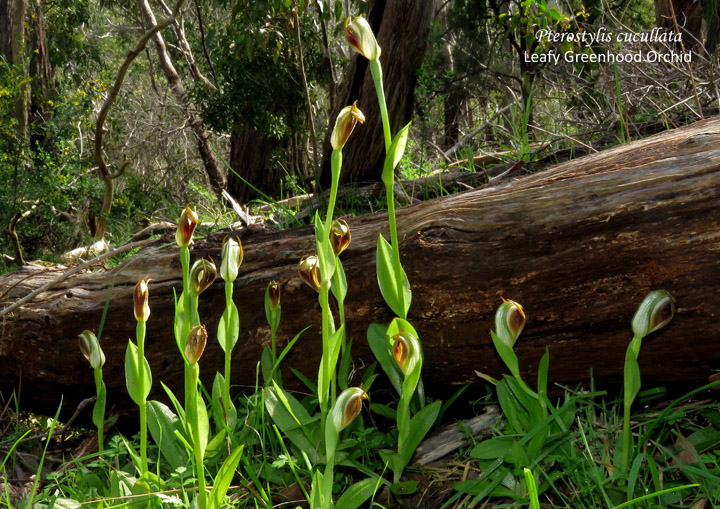
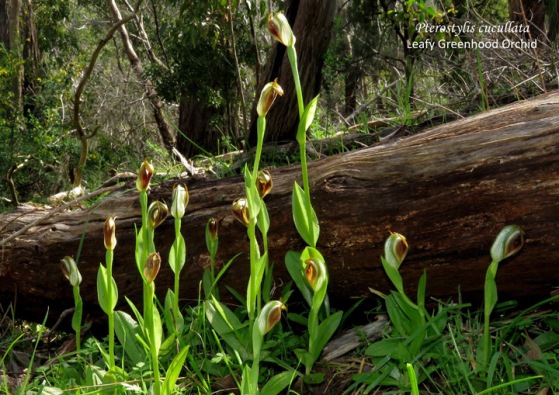
Spring is here and it was reflected in the variety and large number of entries. Lorraine Badger and Ros Miller entered Western Australian species – Caladenia x ericksoniae (Prisoner Orchid) and Paracaelana nigrita (Flying Duck Orchid) respectively. The other six entries were all from South Australia, Diplodium robustum (Common Green Shell Orchid), Caleana major (Flying Duck Orchid) both from Jane Higgs, Greg Sara’s Oligochaetochilus sp (Rufoushood), Judy Sara’s Arachnorchis leptochila (Queen Spider Orchid), Claire Chesson’s Diuris behrii (Cowslip Orchid or Golden Moths) and the outstanding winning picture Pterostylis cucullata by Bevin Scholz.
In many ways, Bevin’s picture of P. cucullata (Leafy Greenhood) is a special picture because it represents some of the conservation work with which NOSSA is involved. For many years NOSSA has worked with the Threatened Plant Action Group (TPAG) to weed the areas in Belair where this species is located and to see such a good show of plants is encouraging. It is a tribute to all who have contributed with their time and labour.
P. cucullata is rated Vulnerable both in South Australia and Victoria, and Endangered in Tasmania. It is also rated Vulnerable under the EPBC Act (Federal). Nationally it is known from about 110 sites with most of these sites being in Victoria and only a few sites in South Australia with Belair National Park having the largest and most important population for the state.
Historically this species covered an area of 2107 km2 in the Lofty Block region but that has now contracted by 82% to only 366 km2 with few locations. With such a reduced range, recovery plans were developed, both at state and federal level. The plans examined the risks and threats to the survival of the different populations.
One of the threats to this orchid is fire, including proscribed burns. Unlike some species such as Pyrorchis nigricans, Leptoceras menziesii or Prasophyllum elatum which flower well after fire, P. cucullata is fire sensitive; populations decline substantially. There does not seem to be a safe time to burn for this species. Should a population survive a burn, it would take it many years to recover.
Fire also leaves the population vulnerable to another threat, that of weed invasion. Unfortunately, it is weedy where this species survives but over the years, a consistent, targeted weeding program has resulted in a declining weed population. NOSSA and TPAG have appreciated the work and effort of volunteers and gladly welcome anyone else who would like to join. And one of the rewards? A beautiful, sunlit display of flowers as seen in Bevin’s picture.
Epiphytic orchids grow on trees or rocks (lithophytic), where they are dependent on their host for support but not for food.
CULTIVATION
The majority of Australian epiphytic orchids can be easily grown in cultivation. Most can be grown in Adelaide if the correct cultural requirements are provided. These include controlled glasshouse conditions, shadehouse conditions and, in some instances, in the garden. Only a few species are able to tolerate the cold winter months in Adelaide without extra protection, and all need protection from frost.
CONTAINERS AND MOUNTS
Plants can be grown in pots or mounted on an appropriate substrate. Pots may be either plastic or terracotta. Terracotta pots are porous and dry out more quickly than plastic. If terracotta pots are used, their drainage holes may need to be enlarged to give very good drainage. Plants should be potted into the smallest pot, which comfortably accommodates the base of the plant.
Plants may be mounted on materials such as compressed or natural cork slabs, branches of rough barked trees, black weathered tree fern slabs and pieces of weathered hardwood. Brown tree fern slabs contain substances, which are toxic to orchid roots and are not suitable. Those species that have a pendulous habit e.g. Dendrobium teretifolium should only be mounted.
POTTING MIX
Most potted orchids require a mixture made up of bark chips (fir or pine), to which may be added charcoal, gravel or polystyrene chips, in which to grow. Bark used should be aged and preferably purchased as graded hammer-milled bark, not shredded bark. Fresh pine bark contains compounds, which are toxic to orchids. Before use fresh pine bark should be soaked in water changed regularly, to remove toxins. This may take 3 weeks. If in doubt as to the freshness of the bark, treat as above to be sure.
Depending on the size of your plant, bark may vary from 5-7mm up to 20mm in diameter, and sieved if necessary to remove fine particles and dust. Other substances such as scoria, leaf mould and coarse grit may also be added according to the requirements of the particular species involved. Whatever the substrate, be it a slab or potting mix, the essential thing with all epiphytic orchids is to always provide good drainage for the plant’s root system. This ensures no, or minimal, root rot of plants.
Repotting is necessary when the potting mix breaks down resulting in poor drainage, the medium goes stale or when the plant over grows its container. The best time to repot is during the spring, after flowering, when the plant starts to actively grow again. Try to repot every 2-3 years.
Potting on: If the plant has overgrown its container and the mix has not deteriorated, it can be potted on into the next sized pot with minimal disturbance to the root system.
GROWING ENVIRONS, HOUSING
Garden Culture
Several species may be grown outside in Adelaide, provided they are given a position sheltered from frosts and hot drying winds. They should receive daily supplementary watering during the summer. They may be tied on to trees with rough non-deciduous bark or grown on rocks. Microclimates can be created in areas of the garden using screens for protection and other plants to help maintain a humid atmosphere.
Bush house, Shadehouse
These structures are built to give protection from frosts, strong winds and sun and to provide extra humidity for plants. They may be covered with shadecloth or tea-tree and should have a solid south wall. They provide protection, but still allow for good air circulation around the plants. A water impervious roof, e.g. fibreglass or polycarbonate sheets, will protect plants and flowers from excess water in the winter.
Unheated glasshouse
An unheated glasshouse gives more protection to the plants, achieving higher temperatures during winter days, and better humidity. It may be made from glass or other materials such as fibreglass or polycarbonate sheets. Additional shading with shadecloth or paint is necessary from October to March-April. Adequate ventilation must be provided, by using ventilators under the benches to let in fresh air, and roof ventilators to let out hot air. Alternatively, air circulation can be achieved using fans. All orchids love fresh air.
WATERING
All plants need to be watered frequently from October to April, during the growing period. Most species require watering once a day or twice a day if the weather is particularly hot or drying. Ensure that plants dry out between waterings. During winter, watering once a week should be sufficient for plants in a glass house environment, although plants which are mounted may be misted (a very fine spray) more frequently. Water early in the morning of winter days to ensure that the leaves of the plants have dried off by night. Water lodging in leaf axils in cold, comparatively still conditions, renders that area liable to fungal attack. Humidity may be maintained by watering the floor and under the benches, particularly in summer.
Rainwater, if available, is preferable to mains water, which can. In some cases, increase in salinity to a level, which is harmful to good plant growth.
FERTILISING
To promote healthy growth of all epiphytic orchids, a supplement of half strength liquid fertiliser every two weeks may be used during the growing season of the plant, i.e. November to April. Mature potted plants can be sparingly fertilised with slow release pellets. Too much fertiliser will lead to a salt build up (especially in charcoal), which will harm the plants.
PESTS
Pests will become a problem in any shadehouse or glasshouse if the grower does not keep a watchful eye out for them. The shadehouse or glasshouse should be kept free from weeds, decaying organic matter and rubbish, as these are the places where pests feed and accumulate. Overcrowding of plants will also encourage pests to thrive.
Pests can be easily removed by squashing if they are in small enough numbers. A pest strip hung in the glasshouse successfully controls many pests. Unfortunately the environment of a glasshouse, which suits orchid culture, also provides a suitable environment for the spread of pests. Poisonous chemical sprays should only be used after non-toxic preparations have been unsuccessfully used. These chemicals also destroy the natural predators of insect pests, upsetting the natural balance.
Caution should be used when handling chemical sprays as many are very toxic to the user as well as the pests. The manufacturer’s directions and warning labels should be read carefully and recommended strength adhered to strictly.
DISEASES
Australian epiphytic orchids are generally disease free. Fungal infections may occur, susceptible areas being new growths, especially in young plants. These can be kept to a minimum by maintaining good air movement and avoiding water remaining in leaf axils for too long. Broad spectrum fungicides are suitable to control severe infections.
PLANT CARE
Removal of any dead leaves, pseudobulbs, etc, not only enhances the aesthetics of the plants, but also lessens the chance of further deterioration. These areas are also the places where pests may accumulate or diseases harbour.