Gleanings from the Journals #2 – Harold Goldsack (27/6/1908 – 25/4/1989)


[Primary source material is the NOSSA Journals. Direct quotes from the Journal in blue and additional information in black.]

Sometimes gleanings take much time and effort to locate but other times there is an abundance of information just waiting to be picked up. This was the case when searching the Journal for information on Harold Goldsack.

Upon the death of Dr R S Rogers, Harold Goldsack became the leading authority of South Australian orchids. To quote Peter Hornsby (1977), NOSSA’s first editor, “Harold is undoubtedly the most experienced of our native orchid botanists and knows more of the history of our orchids than anyone alive.”

Though not a foundational member, Harold was one of NOSSA’s early members, joining at the end of 1977. He was both a grower of epiphytes – winning the Champion epiphyte for 1982 (Dendrobium x gracillimum) and terrestrials – producing the first greenhood hybrid, Pterostylis Cutie (baptistii x cucullata) which was registered on 5th March, 1982. At the meetings he gave talks, plant commentaries and judged the orchids. Outside of the meetings he was active in advancing the cause of Australian orchids. His enthusiasm influenced many people, one person being a young Mark Clements, current Research Scientist, Centre for Australian National Biodiversity Research, CSIRO, Canberra.

It is not surprising than that in 1984 he was made NOSSA’s second life member.


Bob Bates wrote an informative biography in Harold’s obituary.

Journal 1989 Volume 13 No 4 May

Vale Harold Goldsack.

It is with sadness that we announce the passing of life member Harold Goldsack on April 25th. Our sympathies to his family.

Harold was born in East Bengal, India on 27th June 1908. He once told how he could remember epiphytic orchids blooming outside the bedroom window of his childhood home.

His family moved to Adelaide in 1916 and he attended Princes College as a boarding student.

He was introduced to South Australian orchids in bushland adjacent his family’s orchard at Coromandel Valley using Rogers “Introduction to the Study of South Australian Orchids” to identify these. Harold in 1924 introduced himself to Dr Rogers and they became good friends. Harold soon began to find orchids that were new to Dr Rogers and this fired his enthusiasm so that he began a serious study of our orchid flora.

One day in 1928 on a visit to Dr Rogers, Harold was shown the very first collection of the underground orchid Rhizanthella gardeneri. This was to be the subject of the last article Harold wrote over 50 years later.

With the passing of Dr Rogers in 1942 Harold became the foremost authority on South Australian orchids corresponding regularly with H M R Rupp, W H Nicholls and A W Dockrill. His extensive collection of pressed orchids was donated to the State Herbarium in 1978.

Harold wrote many articles on orchids his best known being “Common Orchids of South Australia” which appeared in the S Aust Naturalist in June 1944 and was used in “National Parks and Wild Life Reserves” book from 1965-1970. Harold also revised the orchid section of Black’s “Flora S Australia” in 1943.

Besides drawing and photographing the S Aust orchids Harold developed a large personal Orchid Library and cultivated many Australian orchids which he displayed at shows including our NOSSA shows. The first registered Pterostylis hybrid Ptst. Cutie was made by Harold and the name given to the original clone now grown by hundreds of orchid lovers is “Harolds Pride!”

His main interest was to enthuse others to see the beauty and value of our native orchids through his articles and the many illustrated talks he gave to natural history groups.

Harold was a member of the Royal Society of S Australia.

He was a Foundation Member of the Australian Native Orchid Society. (ANOS)

Ever ready for a challenge Harold at age 64 began studying for his Engineering and Surveying Certificate gaining distinctions in Maths, then working on the surveying of the S E Freeway.

Harold Goldsack’s name is commemorated in the South Australian endemic orchid Prasophyllum goldsackii, a fitting tribute to a true orchid lover.

R Bates
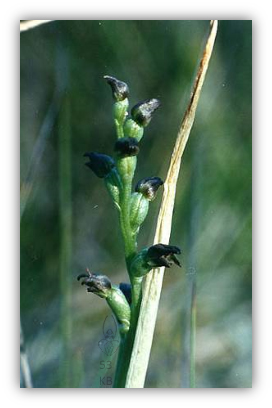
53KB Prasaphyllum goldsackii
Prasophyllum goldsackii – Photographer Ken Bayley

Bibliography of Papers by Harold Goldsack

Orchids of Coromandel Valley – SA Naturalist XIV, Nov 1932 PP 12 – 15

Notes on Caladenia Catifolia – R Br SA Naturalist XV, March 1934, pp 59 – 63

National Park of South Australia – Field Naturalists Sect. of Royal Soc of SA 1936, Being Vol XVII, Nos 1 to 4 of SA Naturalist pp 52 – 54 Orchids

Common Orchids of South Australia – SA Naturalist XXII June 1944 PP 1 – 12 with line drawings of 52 species

New Orchid Records for South Australia – SA Naturalist XXII June 1944, p 13

National Park and Reserves – Commissioners of the National Park, Sept 1956 pp 59 – 79 with line drawings of 52 species of Orchids, p 195 Distribution and flowering times of orchids in the National Park and Reserves

SA National Parks and Wild Life Reserves – Commissioners of the National Park and Wild Life Reserves, March 1964, pp 46 – 64 Orchids with line drawings of 52 species, pp 189 – 199. Distribution and Flowering times of Orchids in the National Park and Reserves

Orchids of the National Park and Wild Life Reserves – Reprinted 1965 by Field Naturalists Society, if (sic) SA from “SA National Parks and Wild Life Reserves” with permission of the Commissioners of the National Park and Wild Life Reserves

Blacks’ Flora of South Australia – Revised edition of p1, 1946 Assisted Rev H M R Rupp and W H Nicholls with the revision of the Orchidacea

Pollination of Caladenia deformis R Br – R S Rogers transactions of Royal Society of SA Volume LV Oct 1931 The pollination of Caladenia deformis as observed by H G was written up by Dr R S Rogers in an article for the Royal Society of SA

Rhizanthella gardnerii R S Rogers – The Orchadian p 113 Sept 1979 A note about the discovery of this orchid

Following is the article by Harold Goldsack referred to by Bob Bates in Harold’s obituary. Though he wrote for other publications, this was appears to be the only one in the NOSSA Journals.

Journal 1979 Volume 3 No 8 August

RHIZANTHELLA GARDNERI Rogers                              Harold Goldsack

Corrigin, Shackleton, Goomalling, Munglingup. Western Australia.

A new locality where the subterranean orchid Rhizanthelle gardneri Rogers has been found, as noted by Don Voigt in his letter to Roy Hargreaves to brings with it hope that after 50 years the secret life of the remarkable orchid may be unveiled. It also brings back memories of my first encounter with this plant.

As a young orchid enthusiast I had been collecting for, and writing to, Dr R.S. Rogers of Adelaide, who, at that time, was an extremely busy public personality. To my surprise, one day in 1928 I received a note from Dr Rogers inviting me to call at his house in Hutt Street after surgery hours as he had something to show me which he was sure would be of interest.

Naturally, I took the first opportunity to visit the Doctor, whereon he brought into the room a large jar with some white vegetable pickled in it. With a smile he said “Have you ever seen anything like this before?”

Well, there it was – this unique subterranean orchid from Corrigin, Western Australia, sent over by Mr C A Gardiner, the Government Botanist of Perth, who had realised the importance of this discovery.

The first plants were found in an area of virgin lane that had been rolled, burnt and then ploughed, which operation uncovered the white underground rhizomes. Mr John Trott, the discoverer, was puzzled by this strange plant growing around the stumps of Melaleuca uncinata R Br, common in the area, and sent it to Mr C A Gardiner. He, realizing the orchidaceous nature of the plant, visited the area, made personal observations and then sent a specimen to Dr Rogers for study, which led to the description of a now sub-tribe, genus and species of orchid – Rhizanthella gardneri Rogers.

Soon after this the Field Naturalists Society were to hold their Wild Flower Show in the Adelaide Town hall and attempted to have this unique specimen displayed there. However, the plant was too valuable to risk and an artist – Mr Lyall Lush – made a black and white drawings which was exhibited instead.

Within three years, on the east coast of Australia at Bulahdelah, another subterranean orchid Cryptanthemis slateri Rupp was unearthed. Unearthed is the word, for this one was unearthed by Mr Slater who was digging up rhizomes of Dipodium punctatum, the “Wild Hyacinth”, to attempt to grow them. All plants of the new orchid were found growing in association Dipodium. The importance of this find was such that Rev H I R Rupp was given a grant to travel to Bulahdelah to make further studies. This second find aroused worldwide interest and a German botanist suggested that the flowers of Cryptanthemis slateri were underground spikes of Dipodium. The morphology of the flowers soon disproved that theory.

Regarding this orchid, which Rupp named in 1932, Dr Rogers commented to me that he was sure that Rev Rupp’s parishioners must have had a very brief sermon the week Rupp received the first specimen of Cryptanthemis!

Dr Rogers then lamented that the orchid hunter has to add a plough and a pick to his orchid collecting equipment!!
 

From the Journals: A Tale of Two Cities – London & Burnside

The following article written by Robert and Rosalie Lawrence is from the Volume 37 No 9 October 2013 Journal of the Native Orchid Society of South Australia

Orchids and the concrete jungle that makes up a city don’t seem together, particularly the terrestrial orchids. Yet in the heart of one of the world’s most well known capital cities such an orchid was found. On the 19th July 2013, the Telegraph reported that botanists from the Natural History Museum had found in the middle of London a white helleborine orchid (Cephalanthera damasonium) which had not been seen in that region since 1900. It was found in the Queen’s backyard, Buckingham Palace. Despite the building, demolishing, rebuilding, bombing and rebuilding that has been going on for the last 400 years, here is an orchid which has survived to surprise the botanist. (For details see Long Lost orchid found in Buckingham Palace Garden)

It is always heartening to hear good news about orchids but here in Adelaide we have our own encouraging story. Settlement in Adelaide is not as long as in London by a long shot but in our own short time we have managed to clear and cover some very good land with concrete and bitumen. The result has been that much of our native flora has been lost with many of our orchid species being the first to disappear.

In recent years effort has been made to bring back the bush with revegetation projects. This work has not tended to involve the orchids, the work of Heather Whiting and her team of volunteers at Vale Park being an exception. Consequently, any orchids found on such sites tend to be the more robust species principally Pterostylis pedunculata, Microtis sp. and in some cases Linguella sp.

Finding anything else will always be special; but that is what has happened at site where a Shell petrol station stood for decades on the corner of Portrush and Greenhill Roads. After the demolition of the service station the site was an area of bare clay for about a decade. Then in 2003, work began on restoring native vegetation incorporating a mini wetland in an area of 2,000 square metres that was given the name Linden “Bush Garden”. Indigenous flora was sourced from the local region and the site has been kept meticulously weed-free by dedicated workers.

Originally 60 local species were planted with several other species arriving by themselves. Among the latter group are five species of orchids. These include a Microtis species and Pterostylis pedunculata, but the other three are more surprizing – Arachnorchis tentaculata, a small blue-flowered Thelymitra species and a Caladenia (syn Petalochilus) species. How they came to be there is a mystery. The long term viability of them will depend upon the continued maintenance of this unique site.

The City of Burnside should be congratulated both for its foresight and initiative as well as its ongoing support of this project.

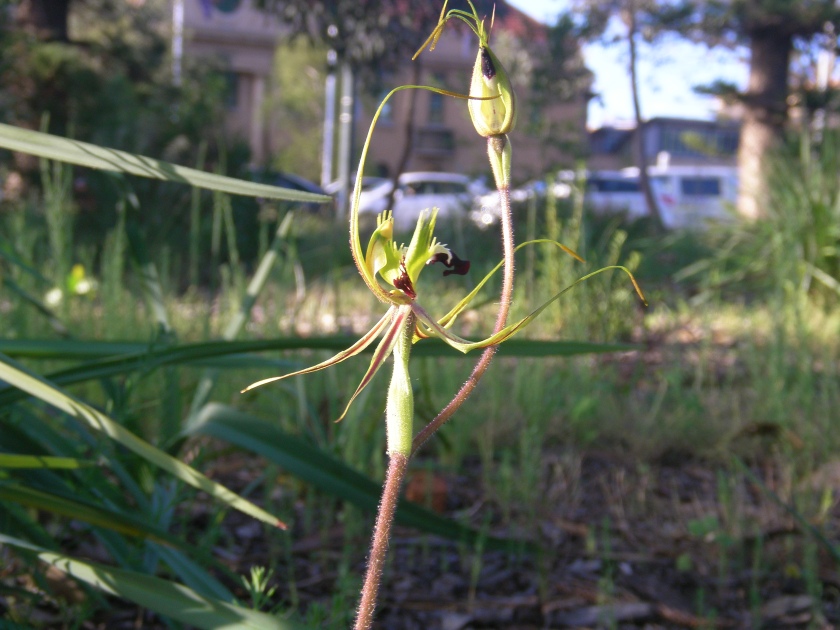
Orchid 1 Arachnorchis tentaculata
Natural regeneration at Linden Gardens includes three plants of Arachnorchis tentaculata (King spider Orchid) that are understood to have flowered for the first time this year (2013). The buildings of the council chambers can be seen in the background.


2015 April Winning Photograph: Calochilus cupreus

04 sm HL Calochilus cupreusDespite having five very different but high quality photographs, Helen Lawrence’s photograph of Calochilus cupreus (Aldinga Bearded Orchid) was the clear winner with the vast majority of votes.

In South Australia it is considered endemic and endangered. Researching it was interesting. For instance, there is no mention of it in Jones extensive book (2006) yet it was named by R S Rogers in 1918 with a description appearing in Black’s Flora of South Australia (1922 edition), including a drawing by Rosa Fiveash. Between then and now there was a shift. In the Third edition of Black’s (1978) C. cupreus is absent but C. campestris present. In Bates and Weber 1990 the authors describe C. campetris (C. cupreus). Currently, the eflora of South Australia (the electronic version of 1986 Flora of South Australia) considers it a synonym of C. campestris. This is reflected in the Census.

It would appear that as C. campestris was studied and its variations documented (e.g. article by Jones 1976 Orchadian 5:83) the distinction with C. cupreus was lost. Clements and Jones (2006) state “Calochilus cupreus R.S.Rogers = Calochilus campestris” which means that they are not using C. cupreus. But in Jones’ book an anomaly occurs – he does not include South Australia in the distribution of C. campestris and as result Bates, from 2008, states that it is not recognized as occurring in South Australia.

Though C. cupreus disappeared from the literature the name still continued to be discussed amongst orchid enthusiasts. So when in 1995 NOSSA members found a distinctively different colony at Aldinga they identified it as Rogers’ C. cupreus.

Below is a chart, based upon Dr Rogers’ description, of some of the differences that made him consider C. cupreus a separate species:

C. cupreus C. campestris C. robertsonii
Shorter leaf

Rather rigid or fleshy erect triangular section

Longer leaf

Crescentic section

Longer leaf

Crescentic section

Base of labellum oblong glabrous (without hairs) with several raised longitudinal line Base of labellum round thickened, smooth no raised longitudinal lines Whole of labellum hirsute (hairy)
8 – 15 flowers About 8 flowers maximum About 8 flowers maximum

It will be interesting to watch what happens.

References

Bates personal communications

Bates & Weber (1990) Orchids of South Australia

Bates (2011) NOSSA South Australia’s Native Orchids

Bates (2005 to present) Orchids of South Australia CDs various editions

Clements and Jones An Australian Orchid Name Index (27/4/2006)

https://www.anbg.gov.au/cpbr/cd-keys/orchidkey/html/AustralianOrchidNameIndex.pdf

Jones (2006) A Complete Guide to Native Orchids of Australia

NOSSA Journal Vol 25 No 10 November 2001

Rogers R S Transactions of the Royal Society of South Australia V42 (1918) Pages 24, 25

http://www.biodiversitylibrary.org/item/113409#page/40/mode/1up

Australian Orchids & the Doctors they Commemorate Part 20 of 20

 This series ends with Dr John Pearn’s summary below.

Enduring memorials

Scientific names of living things will be used as long as scientists find it useful to do so. Names change as taxonomists revise plant groupings and there is a proposal to dispense with scientific names, in favour of an alternative system called the PhyloCode.

In the past, the doctrine of signatures linked the forms of plants with their supposed therapeutic uses. But the world of binomial nomenclature (which Linnaeus introduced in 1753), allows for the most fitting memorials in medicine and botany. In the scientific names of Australian orchids, the lives of many doctors and botanists endure.

Though this series has been divided into 20 parts, it does not cover the whole of his original article which can be viewed here and downloaded as a pdf.

Remembering Bill Murdoch

On the eve of the  100th anniversary of ANZAC Day, this week’s post is taken from the NOSSA Journal April 2015 Vol. 39 No. 3.   The article is by Lorraine Badger.

William Hugh Murdoch, Anzac Veteran
17 September, 1885 – 24 July 1989

William Hugh Murdoch, known as Bill, was born at Poowong in Victoria’s Gippsland*.  Later in life he became an orchid grower, eventually becoming co-founder of the Australian Native Orchid Society (ANOS), after sending out letters in 1962, suggesting the formation of a Society, to fellow Native Orchid Growers.  

However, it is not for that reason alone, that we remember him in this journal.  This month  is the hundred year anniversary of the first battle of our new country, at Gallipoli.  Following several weeks training in Egypt, William landed at ANZAC Cove with the 17th battalion on 16  August**, just four months after the initial landing.   The battalion was mainly responsible for the defence of Quinn’s Post***. 

Conditions on the  Dardanelles peninsular ‘defy description.’  Water was scarce.  Food rations were limited to mainly bully beef and hard tack biscuits.  ‘The terrain and close fighting did not allow for the dead to be buried.  Flies and other vermin flourished in the heat, which caused epidemic sickness’****.  Under these conditions William, amongst dozens of men, contracted Enteric Fever, better known as Typhoid Fever, just three months after his arrival.  He was sent by hospital ship, SS Nevasa (sic), to Alexandria back in Egypt before being sent to the  Australian hospital in Helios on the outskirts of Cairo and then the Enteric Convalescent Camp in Port Said.

On 21 January 1916 he was declared fit to travel and was repatriated to Australia for three months of rehabilitation, leaving Pt Said on the Suez, via the  MAT Commonwealth.  Almost nine months later he returned to join his battalion, first disembarking in England.  Four days before Christmas Day in 1916, he left the UK to join his battalion which had returned to Etaples, France following a spell in a quieter sector of the front in Belgium following the battalion’s first major battle at Pozières between 25 July and 5 August.  In their new location they manned the front through a very bleak winter and William was again needed hospitalisation on several occasions for frostbite, diarrhoea, being wounded in action and finally Trench Fever a few weeks prior to armistice in 1918. He embarked for Australia in March 1916 reaching Australia in May where he was discharged.

Again when WWII commenced William re-joined the Army and was involved in training and later as ‘Voyage Only Officer’.

Bill Murdoch Trophy
Bill is also remembered by ANOS through the Australia wide, Bill Murdoch Trophy for Champion Australian Native Orchid Species of the Year.  It is not often that a South Australian wins this prestigious award but Kris Kopicki has become the latest recipient for his winning entry, Caladenia discoidea, in the NOSSA 2014 Spring Show.

This picture was taken in 2013, in 2014 it was the winner of the Bill Murdoch Trophy
Caladenia discoidea (Bee Orchid or Dancing Orchid).  This picture was taken of the 2014 winning plant in 2013.  Congratulations Kris for growing a winner!

References

*Birthdate gleaned from: http://www.irabutlertrophy.org/WRMurdoch.htm  However, on his enlistment papers of 2 February 1915 it states that he was  aged  19  years  and  4  months  –  which  would  suggest  he was born about October 1895.

**Taken from his  Army records  in the Australian Archives and
online at http://recordsearch.naa.gov.au/

***The 17th Battalion https://www.awm.gov.au/unit/U51457/

****Gallipoli http://www.1914-1918.net/Gallipoli.htm

Australian Orchids & the Doctors they Commemorate Part 18 of 20

Colin Ledward (1903 – 1963)

A general medical practitioner of Cloncurry and Canungra (Queensland); the orchid that bears his name was collected from a single colony discovered in 1934 and is now almost certainly extinct.

Orchid

Acianthus fornicatus (= Acianthus ledwardii)

Australian Orchids & the Doctors they Commemorate Part 19 of 20

Arthur George Harrold (1918 – 2012)

A navy surgeon who later worked as general medical practitioner, ecologist and conservationist in Noosa (Queensland), and graduate of the University of Cambridge; he formed the Noosa Parks Association in 1962 and helped establish the Cooloola National Park.

Orchid

Habenaria harroldii

Named in recent years, so there is only general information on the genus, Habenaria

Australian Orchids & the Doctors they Commemorate Part 17 of 20

Hugo Flecker (1884 – 1957)

A pioneer Australian radiotherapist, radiologist, general medical practitioner and toxicologist of Cairns (Queensland) who dug his own radioactive ore at Radium Hill (South Australia), a medical graduate from the University of Sydney, and a natural historian; his life and works are commemorated by the Flecker Botanic Gardens in Cairns.

Orchids

Cestichis fleckeri (= Liparis fleckeri) Slender Sphinx Orchid

Thelychiton fleckeri (= Dendrobium fleckeri) Apricot Cane Orchid

Australian Orchids & the Doctors They Commemorate Part 16 of 20

Hereward Leighton Kesteven (1881 – 1964)

A general medical practitioner, medical scientist, zoologist, pioneer of industrial medicine in Australia, and national medical director of the Allied Works Council during World War II.

Orchids

Dendrobium kestevenii  is the name applied to the hybrid between D. speciosum subsp. speciosum and D. kingianum

Australian Orchids & the Doctors they Commemorate Part 15 of 20

Charles Stanford Sutton (1895 – 1950)

A Melbourne general medical practitioner and expert on subalpine flora.

Orchids

Pterostylis suttonii  Name not found in the Australian Plant Name Index or International Plant Index
Prasophyllum suttonii or Mauve Leek Orchid