2016 Orchid Picture of the Year

For the final meeting of the year we chose the best of the 2016 monthly winners of the picture competition.

Here in Australia we are fortunate to have such a variety of orchids. They may not be as big and showy as some of the overseas orchids but the diversity of shapes fires the imagination as reflected in this year’s monthly winners, when put together. The common names of the winners – spider, leopard, flying duck, cowslip, zebra, helmet, bluebeard and greenhood – reinforce this theme of diversity.

Patterns and colours contribute to the variety of our orchids. Australian orchid colours run the gamut of the rainbow and more, with Australia being home to most of the naturally occurring blue orchids in the world. This colour fascinates and allures people around the world so much so that nurseries will dye a white orchid blue because it will sell. There is even a website devoted to the colour called, not surprisingly, Blue Orchid  and the popular band master Glenn Miller wrote a song titled Blue Orchids (1944).

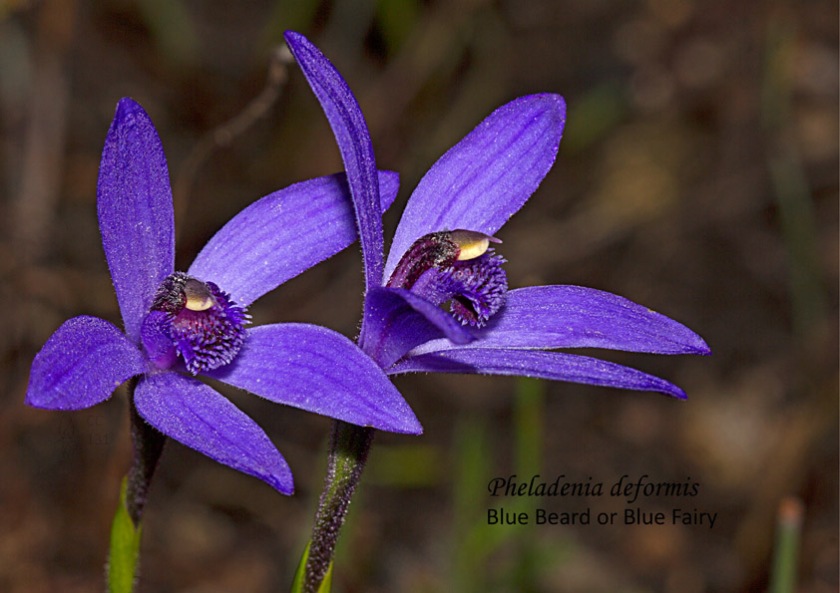
Could this be why the very clear winner for the year was Claire Chesson’s Pheladenia deformis common name Bluebeard or Blue Fairy?

  congratulations-clipart-k15686507

  Claire Chesson on your most beautiful picture.

1608-sm-cc-pheladenia-deformis
Pheladenia deformis

Claire won the August competition.

As a reminder, below are the other winners for the year.  Click on the image to see the related articles.

February 2016 Photographer: Pauline Meyers

1602 sm PM Caleana major
Caleana major

March 2016 Photographer: Judy Sara

1603 sm JS Arachnorchis sp
Arachnorchis sp. (Green Combed Spider Orchid

April 2016 Photographer: Claire Chesson

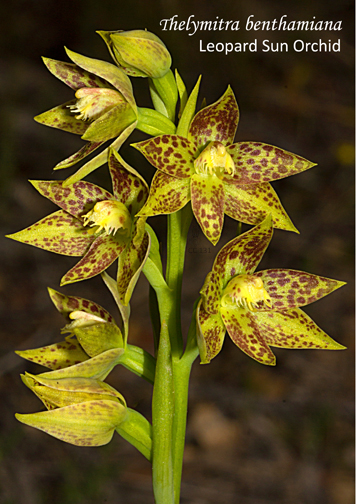
1604 sm CC T benthamaniana
Thelymitra benthamiana

May 2016 Photographer: Pauline Meyers

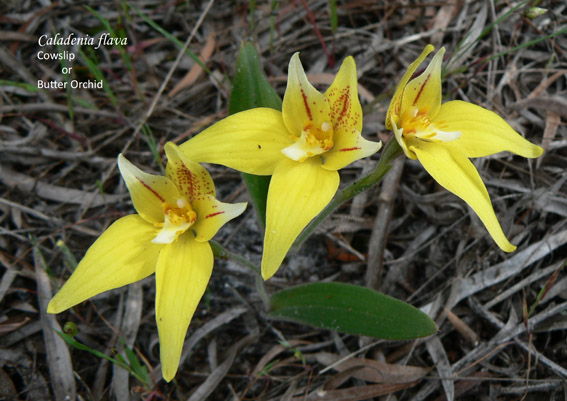
1605 sm PM Caladenia flava
Caladenia flava

2016 June Photographer: Ros Miller

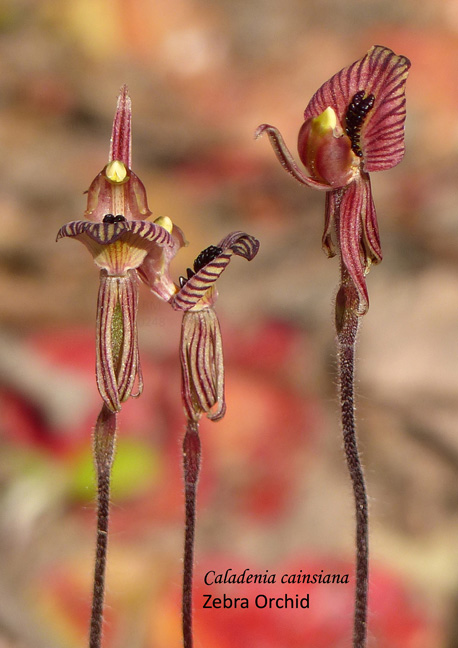
1606 sm RM Caladenia cairnsiana
Caladenia cairnsiana

2016 July Photographer: Robert Lawrence

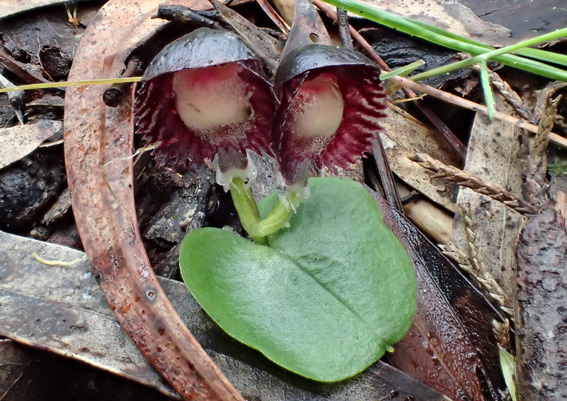
1607 sm RWL Corysanthes diemenicus
Corysanthes diemenica (mutation)

2016 September Photographer: Bevin Scholz

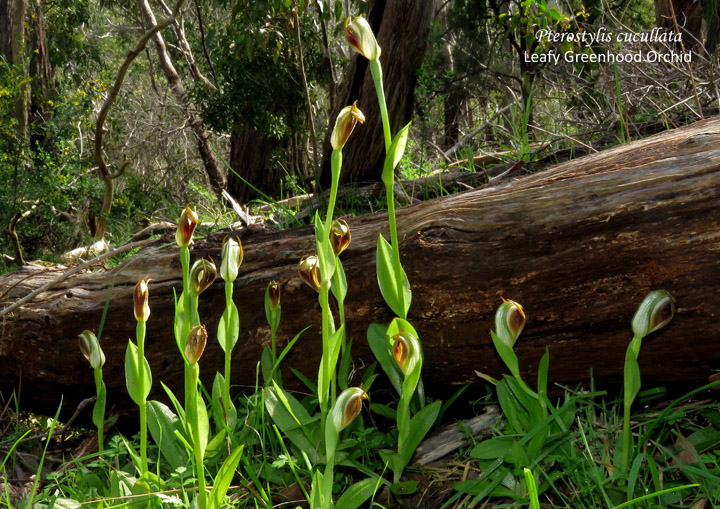
1609-sm-bs-pterostylis-cucullata
Pterostylis cucullata

2016 October Photographer: Helen Lawrence

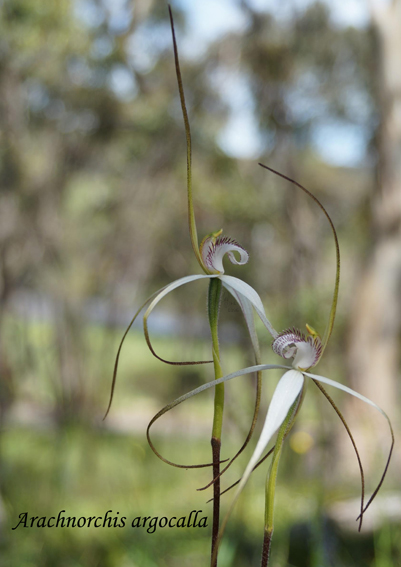
1610-hl-sm-arachnorchis-argocalla


2016 October Winning Picture


Quite a few pictures were entered this month.

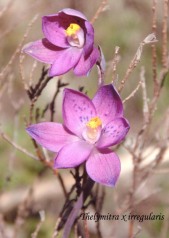
Ricky Egel’s Thelymitra x irregularis, 1610-re-sm-thelymitra-x-irregularis

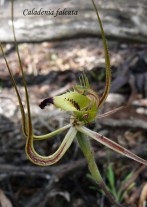
Pauline Myer’s Caladenia falcata and Caladenia carinsiana; 1610-pm-sm-caladenia-falcata

1610-pm-sm-caladenia-cairnsiana

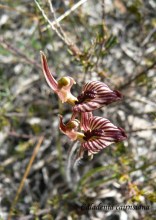
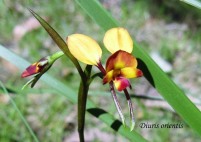
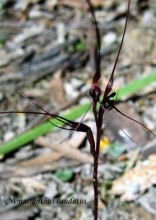
Margaret Lee’s Diuris orientis and Nemacianthus caudatus;

1610-ml-sm-diuris-orientis

1610-ml-sm-nemacianthus-caudatus

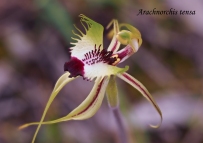
Judy Sara’s Arachnorchis tensa;

1610 JS A4 Arachnorchis tensa.jpg

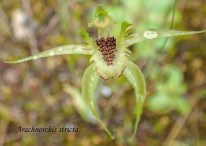
Greg Sara’s Arachnorchis stricta which had an unusual green coloured flower;

1610-gs-sm-arachnorchis-stricta

and Helen Lawrence’s Arachnorchis argocalla.

1610-hl-sm-arachnorchis-argocalla

Helen’s picture of the nationally endangered A. argocalla was the outstanding winner.  Now known as the White Beauty Spider Orchid^, it was featured last year as a winner with Pauline Meyer’s June 2015 entry*.

This is one of our largest spider orchids. For size, beauty and delicacy it rivals the Western Australian Caladenia longicauda ssp. eminens (White Stark Spider Orchid) and A. venusta, syn. Caladenia venusta (Graceful Spider Orchid) from Victoria and the South East.

It shares many similarities with these two species in that they are reasonably good size white flowers with a stiffly hinged labellum that has long, thin teeth and the segments have threadlike tips without clubs.  It is separated both geographically and in the type of habitat from these two species. A. argocalla is a plant of the inland hills and valleys.

Though primarily a white flower and part of the A. patersonii complex, A. argocalla has red colouring in the labellum which according to Backhouse may possibly indicate genetic introgression (that is long term mixing of the gene pool) with either the A. reticulata or A. leptochila complexes. Certainly, the colour of the labellum was quite variable ranging from white through to a deep red.

^Previously known as Common White Spider Orchid because of its abundance but now only known to a limited number of locations.

*NOSSA Journal, July 2015

Reference:

Department of the Environment (2016). Caladenia argocalla in Species Profile and Threats Database, Department of the Environment, Canberra. Available from: http://www.environment.gov.au/sprat. Accessed Thu, 3 Nov 2016 16:31:39 +1100

Introgression https://en.wikipedia.org/wiki/Introgression Accessed 4 November 2016

Bates, R. J., ed. (2011). South Australian Native Orchids. Electronic version, 2011. NOSSA

Jones, David L (2006) A complete Guide to Native Orchids of Australia, Frenchs Forest, NSW: Reed New Holland

Backhouse, G (2011) Spider-orchids the Genus Caladenia and its Relatives in Australia


NB: November Competition will be judging the monthly winners from this year.

September 2016 Winning Picture

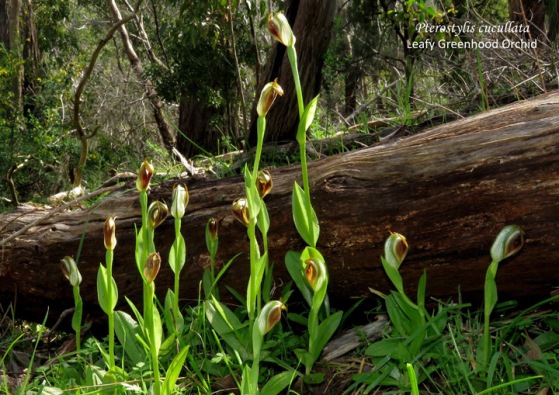
Spring is here and it was reflected in the variety and large number of entries.  Lorraine Badger and Ros Miller entered Western Australian species – Caladenia x ericksoniae (Prisoner Orchid) and Paracaelana nigrita (Flying Duck Orchid) respectively.  The other six entries were all from South Australia, Diplodium robustum (Common Green Shell Orchid), Caleana major (Flying Duck Orchid) both from Jane Higgs, Greg Sara’s Oligochaetochilus sp (Rufoushood), Judy Sara’s Arachnorchis leptochila (Queen Spider Orchid), Claire Chesson’s Diuris behrii (Cowslip Orchid or Golden Moths) and the outstanding winning picture Pterostylis cucullata by Bevin Scholz.

 1609-sm-bs-pterostylis-cucullata

In many ways, Bevin’s picture of P. cucullata (Leafy Greenhood) is a special picture because it represents some of the conservation work with which NOSSA is involved. For many years NOSSA has worked with the Threatened Plant Action Group (TPAG) to weed the areas in Belair where this species is located and to see such a good show of plants is encouraging.  It is a tribute to all who have contributed with their time and labour.

P. cucullata is rated Vulnerable both in South Australia and Victoria, and Endangered in Tasmania. It is also rated Vulnerable under the EPBC Act (Federal). Nationally it is known from about 110 sites with most of these sites being in Victoria and only a few sites in South Australia with Belair National Park having the largest and most important population for the state.

Historically this species covered an area of 2107 km2 in the Lofty Block region but that has now contracted by 82% to only 366 km2 with few locations. With such a reduced range, recovery plans were developed, both at state and federal level.  The plans examined the risks and threats to the survival of the different populations.

One of the threats to this orchid is fire, including proscribed burns.  Unlike some species such as Pyrorchis nigricans, Leptoceras menziesii or Prasophyllum elatum which flower well after fire, P. cucullata is fire sensitive; populations decline substantially.  There does not seem to be a safe time to burn for this species.  Should a population survive a burn, it would take it many years to recover.

Fire also leaves the population vulnerable to another threat, that of weed invasion.  Unfortunately, it is weedy where this species survives but over the years, a consistent, targeted weeding program has resulted in a declining weed population.  NOSSA and TPAG have appreciated the work and effort of volunteers and gladly welcome anyone else who would like to join. And one of the rewards? A beautiful, sunlit display of flowers as seen in Bevin’s picture.

Reference:

Duncan, M. (2010). National Recovery Plan for the Leafy Greenhood Pterostylis cucullata. Department of Sustainability and Environment, Victoria https://www.environment.gov.au/system/files/resources/14e1ae30-5cf7-4be6-8a35-2c752886c14f/files/pterostylis-cucullata.pdf

Nature Conservation Society of South Australia (2009) DRAFT RESPONSE ON THE BELAIR NATIONAL PARK TRAILS MASTERPLAN: PRELIMINARY ISSUE January 2009  http://www.ncssa.asn.au/images/stories/ncssasubmission_belairnptrails_masterplan_jan09_final.pdf

Quarmby, J.P. (2010) Recovery Plan for Twelve Threatened Orchids in the Lofty Block Region of South Australia 2010. Department of Environment and Natural Resources, South Australia https://www.environment.gov.au/system/files/resources/e362cfd2-a37b-443a-b007-db3a2b7b64dd/files/lofty-block-orchids-recovery-plan.pdf

August 2016 Winning Picture

1608 sm CC Pheladenia deformis.jpg

This month’s entries are an interesting collection as it is probably the first time that all entries are currently in flower.  Rosalie Lawrence entered a Pterostylis pedunculata, Ricky Egel (second) Corysanthes despectans, Robert Lawrence (third) Pyrorchis nigricans whilst both Rob Soergel and Claire Chesson (winner) entered Pheladenia deformis. All four are colony forming species.

Both parts of the scientific name for the winning orchid refer to the labellum. Pheladenia meaning false glands which is referring to the calli and deformis meaning departing from the correct shape or mis-shapen.

The labellum plays an important role in pollination; it is the landing platform for the insect. Depending on the process by which the flower is pollinated – or at least attracting the pollinator – this can attempt to mate with the labellum which it has confused for a female of its species (pseudocopulation), or can then feed on the nectar produce. Like many orchids Pheladenia does not produce nectar so the actual attractant for the insect is hard to determine.

The labellum is a distinctive feature of orchids.  A modified petal, they are so amazingly varied and complex that botanists often provided detailed descriptions of the features which are present in various combinations, as a means of describing the species. Terms such as lobes, margins, gland/calli, hairs/vestiture/setae, longitudinal ridges, plates, auricles, spurs, papillae etc are used to describe the various features of the labellum.

Some of the features of the labellum of P. deformis are:

  • It is stiffly attached to the column, unlike Arachnorchis tentaculata which is hinged and freely moving
  • It is tri-lobed meaning that the labellum shape is divided into three distinct sections.
    • Unlike Diuris pardina where this feature is easily seen, it is obscured as the outer two lobes are erect and curved in so that it forms a trumpet like appearance with the column.
  • The margins or edges of the labellum have fine teeth which are slightly curved inward. The margins of Arachnorchis cardiochila are smooth-edged and curve outward from the ‘throat’ of the labellum
  • It has two types of calli, fleshy, non-secreting glands.
    • The ones at the base are not as easily seen but they are described as being papillae, e., small, irregular, pimple-like projections or bumps.
    • The more obvious ones that give the flower its bearded appearance are elongate and without a swollen head, like the bristles on a brush.
    • In contrast, Thelymitra does not have any type of calli, although it should be noted that calli do play an important role in orchid pollination.
  • The apex, tip of the labellum, is curved under (recurved to reflexed)

To see some of the variety of labella, Orchids of South Australia (Bates and Weber, 1990) have several drawings detailing the differences on pages 35 to 38, 81, 97, 104 to 106, 114, 119 to 124.

So why spend time looking at details of labella?

It is not important for identifying Pheladenia deformis but it can be a distinguishing feature for other species, for example, the lateral lobes of Diuris maculata are much narrower than D. pardina (Jones, in Harden (ed.) 1993); or the shape of the callus cluster on Chiloglottis which alludes to the species.


Reference:

Bates, R.J & Weber, J.Z. (1990) Orchids of South Australia, Government Printer, Adelaide

Brown, A., et al, (2013) Field Guide to the Orchids of Western Australia. Perth, WA: Simon Neville Publications

Jones DL (1993). Diuris in Harden GJ Flora of New South Wales, Volume 4. University of NSW Press, Sydney.

Jones, D L et al, (2006) Australian Orchid Genera, an information and orchid identification system, interactive CD-ROM

Thank you to Greg Steenbeeke for assistance with this article.

July 2016 Winning Picture

1607 sm RWL Corysanthes diemenicus.jpg

This month there were four very different species.  Two were from Western Australia, Pauline Meyers’ Caladenia longicauda and Lorraine Badger’s Thelymitra pulcherrima, and the other two from South Australia, Rob Soergel’s Bunochilus viriosa and Robert Lawrence’s Corysanthes diemenicus which was the winning picture.

Corysanthes diemenicus is a very common winter orchid but this one is unique as instead of one flower as is normal there are two!  So is it a new species? No, it is a freak; the technical terminology is teratologic.

Of the various plant families, the mint and orchid families (Theissen 2006) are well known for producing teratological plants, that is, plants that are grossly abnormal or deformed.  Bates (2011) divides such abnormalities into five categories – peloric, teratological freaks, monstrosities, colour variants and throwbacks.  All of them are congenital abnormalities which may be a result of unknown genetic malfunction or viral infection in the early developmental stages of the plant.  Based upon this division, Robert’s picture is a monstrosity.  This type of double flower is more likely to be found in self-pollinated plants for example Pterostylis foliata often produces more than one flower.

Most freaks are random, they come and go but peloric freaks are interesting.  An early meaning of peloria was an irregular feature that becomes regular (Walker 1879) but in the orchids the meaning has been narrowed to refer to an “abnormality of the labellum that is of a similar shape and colour of the petals” (Australian Orchid Genera 2006) or more precisely an abnormality of the inner tepal whorl (the petals) wherein the petals can take on the appearance (in part or full) of the labellum, or the labellum takes on the appearance of the petals.  One naturally occurring semi-peloric species is Calochilus imberbis. In recent years, orchid growers have cloned peloric freaks using a technique called mericlone to produce new cultivars eg Rhyncolaelia digbyana var. fimbripetala.

Freaks may be interesting but they are temporary so if you spot something unusual in the field look around at the surrounding orchids.  If there is only the one or two individual or one colony, then it’s likely to be an abnormality rather than a new species.

Thank you to Greg Steenbeeke for checking this article.

Reference:

Bates, R. J., ed. (2011). South Australian Native Orchids. Electronic version, 2011. NOSSA

Jones, D L et al, (2006) Australian Orchid Genera, an information and orchid identification system, interactive CD-ROM

Masters, M T (1879) Vegetable Teratology http://www.gutenberg.org/files/23354/23354-h/23354-h.htm accessed 3rd August 2016

St George, I (2007) Monsters, Freaks, Retrogrades and Primitives http://www.nativeorchids.co.nz/Journals/103/page5.htm accessed 3rd August 2016

Steenbeeke, G, personal communications

Theissen, G (2005) The proper place of hopeful monsters in evolution biology http://carah.sweb.cz/xx12295.pdf accessed 3rd August 2016

June 2016 Winning Picture

1606 sm RM Caladenia cairnsiana

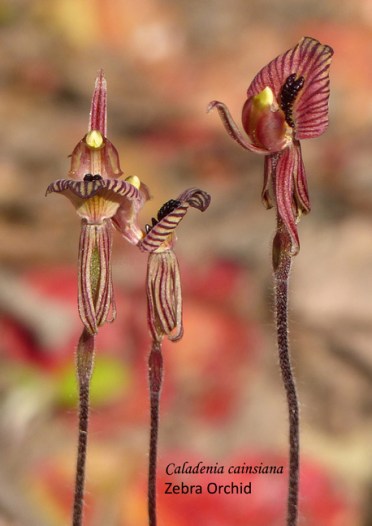
It is always good to see other members submitting images for the competition. This month Rob Soergel entered Urochilus sanguineus growing with Bunochilus viriosus and Ros Miller a Caladenia cairnsiana. Others were Rob and Jenny Pauley’s mass flowering of short Urochilus sanguineus, Pauline Meyers’ Arachnorchis cardiochila hybrid (possibly with A. strigosa) and Lorraine Badger’s Diuris corymbosa.

The winning picture taken by Ros Miller C. cairnsiana (Zebra Orchid) is one of Western Australia’s unique and interesting orchids. It was first collected by Baron Von Mueller (Victorian Government Botanist 1857–1873) from the Stirling Ranges and subsequently named in 1869 after the Rev Adam Cairns a Melbourne Presbyterian minister who promoted “various philanthropic studies”. In the 2000’s various synonyms were applied to the name, most notably Jonesiopsis cairnsiana (2003).

Many of the distinctive features of this species are readily seen in Ros’ picture – the non-clubbed, equidimensional short lateral sepals and petals which are hard pressed up against the ovary; the smooth, upswept labellum. What is not seen is the leaf which is erect large pale green with the bottom third usually irregularly blotched with red-purple.

Flowering from August to November, occasionally in clumps, these orchids are distributed over an extensive geographic area from Lancelin approximately 130 km north east of Perth, to Israelite Bay near Esperance some 775 km south east. They grow in a range of habitats from forests, woodlands, to mallee heathlands.

Interestingly for such a widespread and colourful flower, they are often missed being seen as they are ‘small and hard to see’.

References

Brown, A., et al,(2013) Field Guide to the Orchids of Western Australia. Perth, WA: Simon Neville Publications

Hanson, Kim (2016) WANOSCG Facebook conversation July 2016 https://www.facebook.com/groups/377740182396565/

http://www.orchidspecies.com/caladcairnsiana.htm accessed July 6 2016

http://members.iinet.net.au/~emntee/HISTORY_OF_ORCHID_COLLECTING.htm accessed July 6 2016

Archer, W http://esperancewildflowers.blogspot.com.au/2009/09/zebra-orchid-caladenia-cairnsiana.htm acc 12 July 2016

May 2016 Winning Picture

1605 sm PM Caladenia flava

There were four entries this month with two from Western Australia Pauline Meyers’s Caladenia flava and Ros Miller’s Caladenia longicauda sbsp. eminens; one local Greg Sara’s Pheladenia deformis; and one from the Australian Capital Territory, Lorraine Badger’s Cyanicula caerulea.  The winner was the Caladenia flava.

If I was to think of an orchid that represents Western Australia it would be hard to choose between the Queen of Sheba and this one.

With its long flowering season (July to December) it is Western Australia’s most common and widespread species; being found in the south west triangle of the state from Kalbarii to Israelite Bay; in habitat as variable as the coastal heathlands through to inland rocky outcrops; from forests to swamp margins.  Being so prevalent, it is not surprising that it was amongst one of the first Western Australian orchids collected in September to October, 1791 by the ship-surgeon and naturalist, Archibald Menzies. It was subsequently named in 1810 by Scottish botanist Robert Brown.

C. flava is one of the five species belonging to the subgenus Elevatae. The other four being C. marginata, C. nana, C. reptans (all WA endemics) and C. latifolia which is widespread across southern Australia. All five species have the same characteristic feature of the calli joined together on a raised plate near the base of the labellum. C. flava is distinctively and predominately yellow whereas the others are pink or white.

C. flava has two pollinators, native bees which are lured deceitfully to the non-existent nectar and scarab beetles (Neophyllotocus sp.). As they share the same pollinators, C. flava often hybridizes with C. reptans and C. latifolia, producing very colourful offspring.

Observations have led orchidologists to divide C. flava into 3 subspecies. These differences are based upon floral morphology. but curiously they each have their own separate distribution.

References:

Brown A, et al, 2013 Field Guide to the Orchids of Western Australia

Hopper, SD & Brown, AP 2001b Contributions to Western Australian Orchidology: 2, New taxa and circumscriptions in Caladenia (Spider, Fairy and Dragon Orchids of Western Australia), Nuytsia 14:27–314.

April 2016 Winning Picture Competition

1604 sm CC T benthamaniana
Thelymitra benthamiana; Photographer: Claire Chesson

Five entries were received, again spanning the country from east to west. John Badger entered a Chiloglottis reflexa recently photographed in Tasmania, Pauline Meyers an unidentified Western Australian Spider orchid, Judy Sara had two entries from the latest field trip, Eriochilus collinus (previously phrase name Adelaide Hills) and Leporella fimbriata and Claire Chesson’s Thelymitra benthamiana.

T. benthamiana, the winning picture, is a beautiful sun orchid that is found across the southern Australia from Western Australia through South Australia to Victoria and Flinders Island. More common in west than elsewhere it is the only one of the seven species in the T. fuscolutea complex to be found in the east.

It would appear that this complex has been a problematic as indicated by Jeanes (2006) in his article Resolution of the Thelymitra fuscolutea (Orchidaceae) complex of southern Australia published Muelleria; the Royal Botanic Gardens of Victoria research journal.

Since the early days confusion, which persisted into this millennium, has occurred. In 1871 Reichenbach recognised 3 species one of which was T benthamiana but Bentham after whom the orchid was named disagreed and consider it but a synonym of T. fuscolutea. There were many twists and turns in the names but in effect, for over a hundred years, most authors followed Bentham’s taxonomy rather than Reichenbach’s until 1989 when Mark Clements after studying the drawings, literature and orchid type material came to the same conclusion as Reichenbach that T. benthamiana was a distinct species from T. fuscolutea. Since then, authors have followed Reichenbach/Clements taxonomy.

Over the decades, the number of species in this complex varied considerably. By 1938 three separate species were recognised, but between then and 1989 it fluctuated between recognizing one, three and four species and in 1998 the orchidologist were considering a possible seven species.  These were all confirmed and named in Jeans’ 2006 paper. Today, according to Orchids of Western Australia there is potentially an eighth member in this group.

Jeanes highlights some of the issues involved in determining which species is which. Some of the issues are lack of accurate/detailed information such as location, type of terrain, habitat, surrounding plants, date of collection, etc. Dried specimens by themselves are inadequate as important features may be lost in the drying process.

This complex is but an example of a widespread problem across many of our Australian orchids indicating not only the need for careful observations in the field but meticulous record keeping that others can access.

References

Jeans J A, Resolution of the Thelymitra fuscolutea R. Br. (Orchidaceae) complex of southern Australia. Muelleria 24: 3-24 (2006)

Brown A, et al, Field Guide to the Orchids of Western Australia, 2013

Thank you to Juergen Kellermann, (senior botanist for the State Herbarium) for critiquing this article.

March 2016 Winning Photograph

1603 sm JS Arachnorchis sp

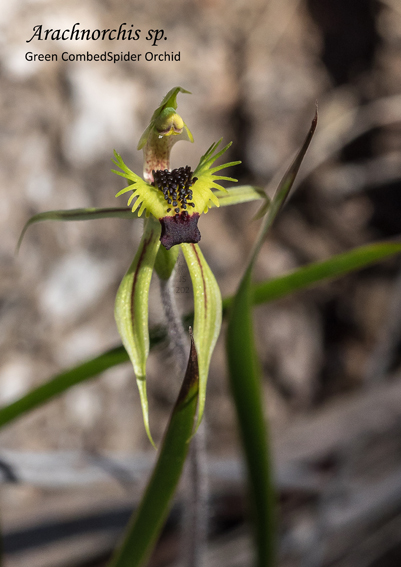
We frequently receive entries from Western Australia but this month our entries were from both the west and the east. Allen Jennings entered a Calanthe triplicata (Christmas Orchid) from New South Wales. Pauline Meyer’s was from the west, (Western) Flying Duck Orchid, Paracaleana nigrita. The other entries were South Australian, Jenny Pauley’s recently photographed Leporella fimbriata (Fringed Hare Orchid), Greg Sara’s Thelymitra rubra (Common Pink Sun Orchid) and Judy Sara’s Plumatochilos sp. (Bearded Orchid) and Arachnorchis sp. (Spider Orchid).

The winning photograph was Judy’s Spider Orchid. Obviously it was one of the Green Comb Spider Orchids – A. dilatata complex. Of this group there are about a dozen possibilities. Knowing the location, Mt Boothby, helped to narrow the options with the most likely candidate being Arachnorchis stricta but it wasn’t convincing. It would appear that the tips of the sepals may have been chewed off when in bud.

A distinguishing feature of this species is that there are no clubs or osmophores on the sepals. Other species of this complex have clubs. Another feature is that the dorsal sepal is bent over the column unlike many other green combs which have an erect dorsal sepal. The features that caused doubt were lateral sepals looking droopy instead of being characteristically stiffly held out but dry conditions could cause this. The other was that the labellum did not strictly fit the description of A. stricta but then again it is a variable species.

The conclusion was a possible hybrid but there is no information on the likely parents or that is an atypical A. stricta that may have been damaged in bud.

This is an example of the difficulties that can occur when attempting to identify a plant from one photograph.

Reference:

Personal communications Thelma Bridle (NOSSA Conservation Officer)

Personal communications Bob Bates

Bates, R. J., ed. (2011). South Australian Native Orchids. Electronic version, 2011. NOSSA

Rules of entry:

The subject matter must have something to do with Australian orchids.  Any format is acceptable including Photo shopped images, artwork, etc

How to enter:

Email nossa.enquiries@gmail.com – jpg as large as you are able to send it, preferably A4 ratio for printing

Post: PO Box 565, Unley, 5061

Bring in to the meeting

February 2016 Winning Photograph

1602 sm PM Caleana major

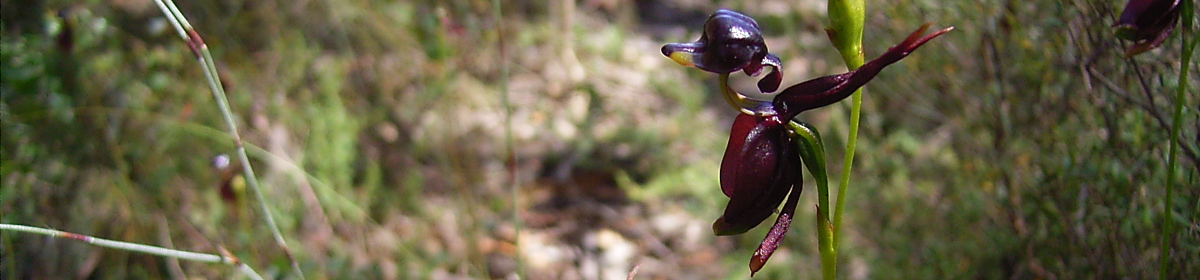
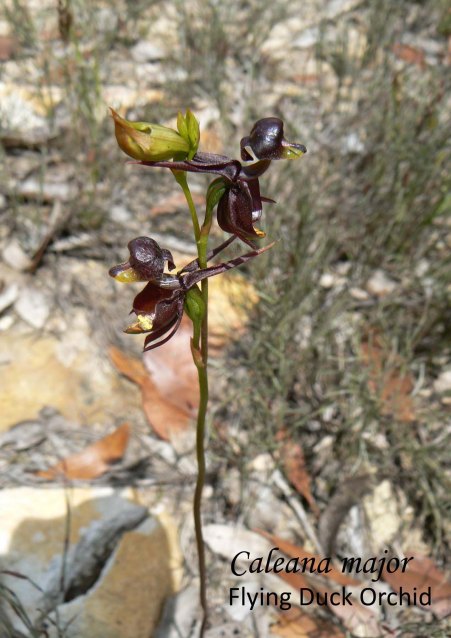
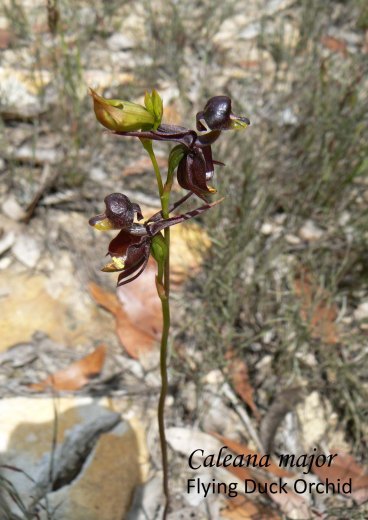
For our first competition of the year we had five photographs – three of flowers and two of participants on a field trip.  The species represented were David Mangelsdorf’s Calochilus robertsonii (Southern Bearded Orchid); Robert Lawrence’s Pheladenia deformis (Blue Bearded Orchid) and Pauline Meyer’s Caleana major (Flying Duck Orchid) which was the winning photograph.

There is no doubt that the Duck Orchids are very photogenic and that people want to see and photograph them.  When seen the for the first time their small size surprises most.  The flower is no bigger than a thumbnail, perched atop a spindly stalk that may only reach 50cms (20 inches).

Although the rusty red colour of the flower is quite exquisite, this means that it blends in with the surrounding leaf litter and scrub and is not easily spotted.

As species of Heathy Woodlands, in South Australia, it is often found growing in sparse colonies near the base of trees.  Other plants associated with them are banksias, eg Banksia ornata, Eucalyptus baxteri and bracken.  The soil is sandy, often from leached acidic dunes, or gravelly.

Reference:

2008 Department for Environment and Heritage Electronic Flora of South Australia species Fact Sheet: Caleana major R.Br. Available from pa-fact-pafactcaleanamajor.pdf

Bates, R. J., ed. (2011). South Australian Native Orchids. Electronic version, 2011. NOSSA