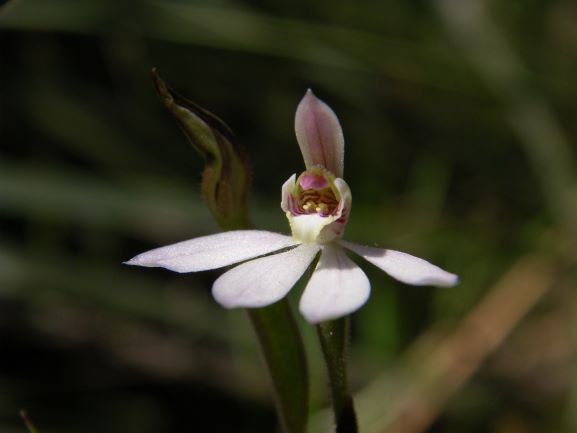
Caladenia haemantha is no more ….

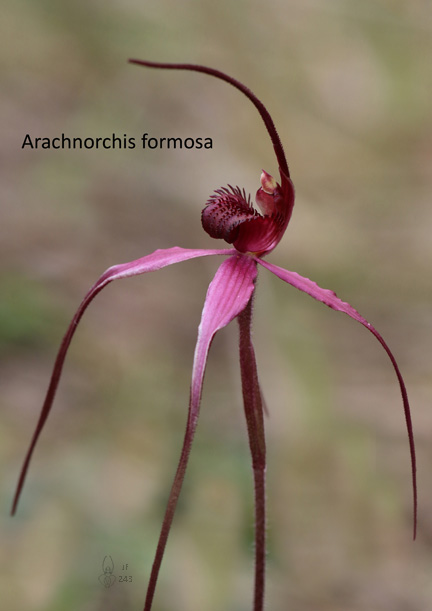
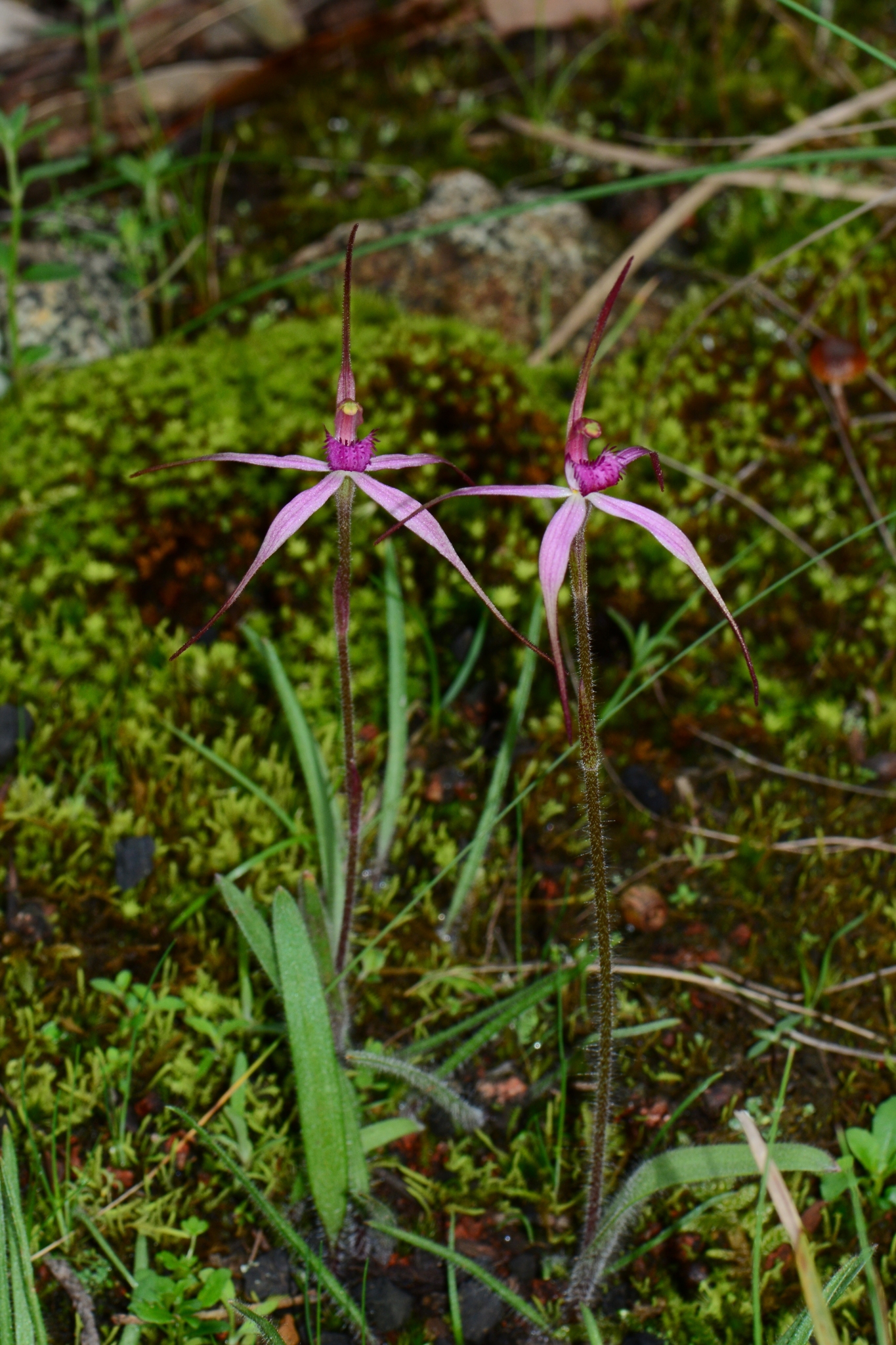
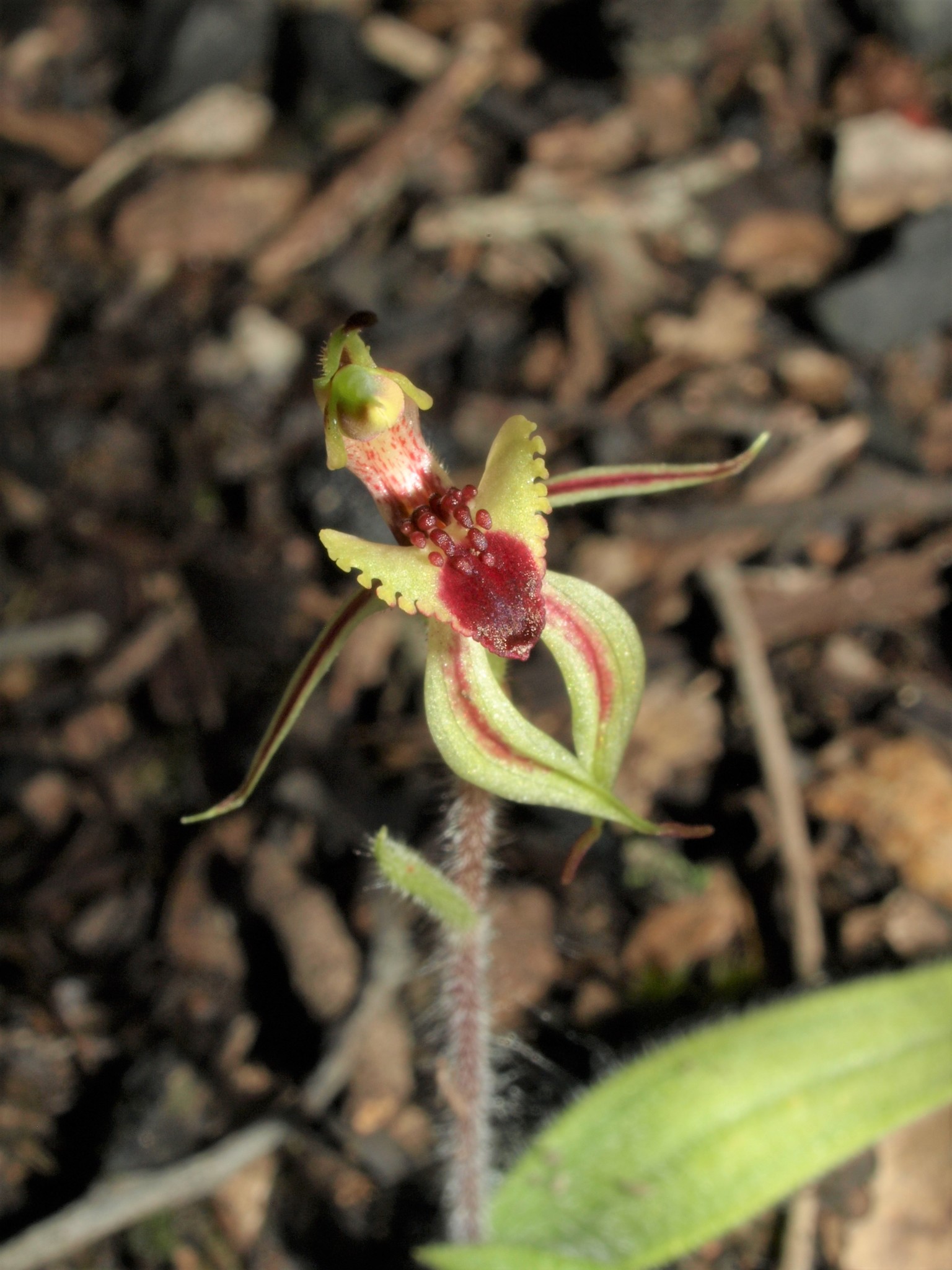
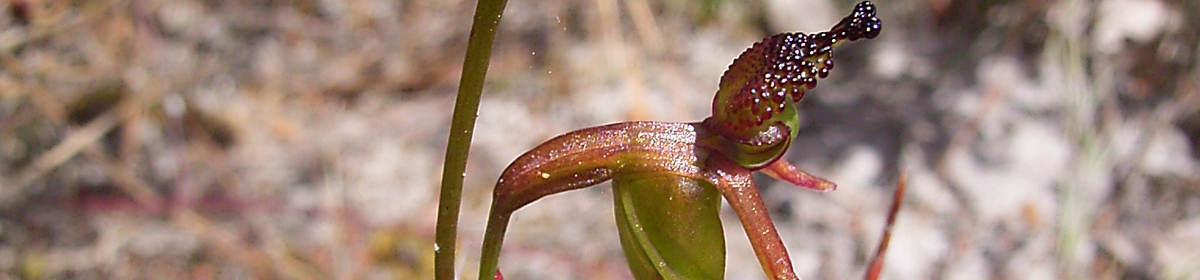
Orchid taxonomy can take some interesting turns. This has just happened to Caladenia haemantha. Based upon the examination of the type specimens collected for C haemantha and C formosa, authors Andrew McDougall & Timothy Hammer have just published an article reinstating C haemantha as C formosa.

Soon after C formosa was described and named in 1991 by GW Carr, David L Jones came along and described and named C haemantha; but in 1993, Mark Clements took a look and listed it as a synonymy of C formosa, where is stayed for many years until 2021 when Jones reinstated it as C haemantha.

But, through the beauty of science, along comes Andrew and Tim to have a closer look at the two type specimens. Meticulously they counted the details and duly documented their findings. Their conclusion – C haemantha is a synonym of C formosa.

To read more of the detail in Swainsona, click on the image below –

KUDOS TO NILLUMBIK SHIRE – SAFEGUARDING SPIDER ORCHIDS

It is well known that many of our Australian orchids are facing extinction. But across the nation, there are many groups actively seeking to save them. One such group being the Nillumbik Shire near Melbourne with their Nillumbik Threatened Orchid Recovery Team. Effort has been preventing extinction of very threatened orchids – Charming Spider-orchid (Caladenia amoena) and Rosella Spider-orchid (Caladenia rosella). Both these species have highly restricted populations with less than 150 wild plants each. The shire has teamed up with the Royal Botanic Gardens Victoria’s Orchid Conservation Program to propagate and return to the wild plants of these beautiful orchids.

For details see these two articles – https://www.nillumbik.vic.gov.au/Council/News-and-publications/Latest-news/Safeguarding-Nillumbik%E2%80%99s-Charming-Spider-orchid-from-extinction

and

https://www.nillumbik.vic.gov.au/Explore/Environment/Natural-environment/Animals/Native-animals/Rosella-Spider-Orchid

Rosella Spider-orchid (Caladenia rosella)
Photographer: Micheal Keogh – https://www.inaturalist.org/observations/91826364

Charming Spider-orchid (Caladenia amoena)
Photographer: Michael Keogh https://www.inaturalist.org/observations/51880159

Protected: Photograph Competition – November 2021

This content is password-protected. To view it, please enter the password below.

Petalochilus – when use of a segregate or common name is helpful

The following article is from the Native Orchid Society of South Australia Journal Volume 44 No 7, author Rosalie Lawrence.

Over the years there have been many orchid name changes (particularly at genus level), some quite drastic, some multiple times and for many there can be a reversion back. Yes, this creates confusion but there are times when some of these name changes, known as segregates (both at species and genus level) can be useful.

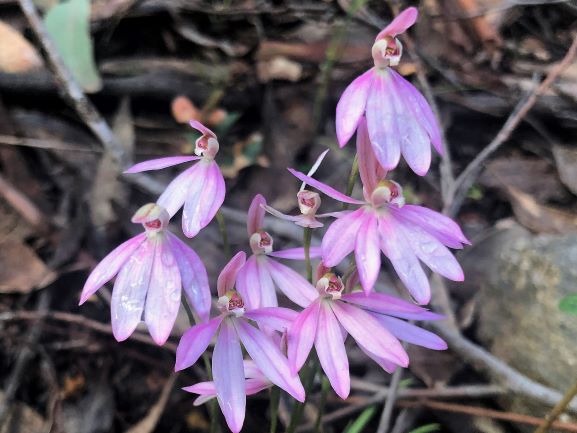
Caladenia carnea (synonym Petalochilus carneus) Photographer Lindsay Ames

A case in point, is Lindsay Ames’ winning photograph (June) – Caladenia carnea synonym Petalochilus carneus. Petalochilus was proposed as a genus in 2001 by DL Jones, MA Clements, et al. It was one of many proposed genera changes. Many discussion papers followed but in 2015 after further taxonomic and DNA work, Mark Clements et al published a paper that “points to Lindley’s 1840 interpretation of Caladenia (…..) as being the most accurate reflection of the group.” Hence the discontinued use of Petalochilus and the other segregate genera.

So, it currently belongs with Caladenia, a large genus with over 350 species (mainly in Australia). It is a genus with great morphological (visual) diversity – compare Caladenia tentaculata with C. cucullata or C. flava. But Caladenia
subgenera Caladenia (synonym Petalochilus*), as a much smaller segregate genus allows us to visualize a specific group within the Caladenia genus.

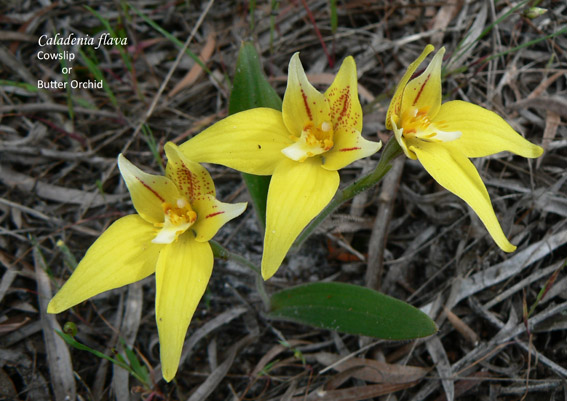
Caladenia flava Photographer Pauline Meyer

Caladenia sens. lat. are characterised by single hairy leaf, lacking lobes or serrations; hairy stem; showy flowers with similar sepals & petals. The labellum is highly modified consisting of three lobes with calli on the middle lobe.

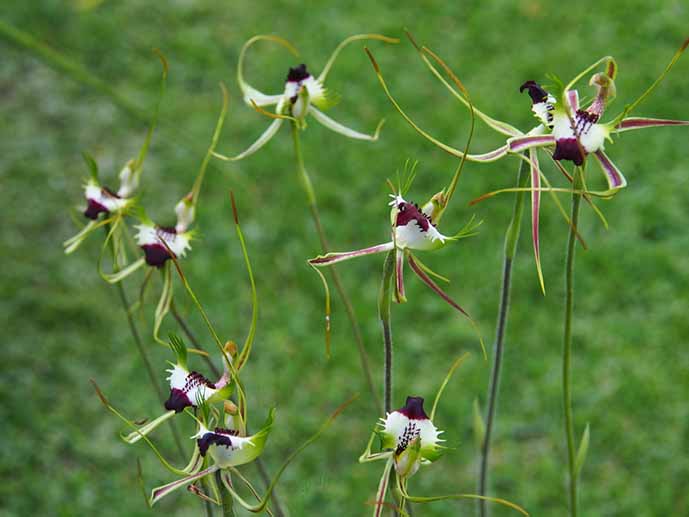
Caladenia tentaculata (synonym Arachnorchis tentaculata) Photographer Jane Higgs

Petalochilus is further characterised by small (1 – 5 cm) pink to white flowers,
short broad forward projecting tepals; erect to slightly incurved dorsal sepal,
distinct trilobe labellum, hinged, with calli and red transverse bars, column
green to pink with red to purple bars.

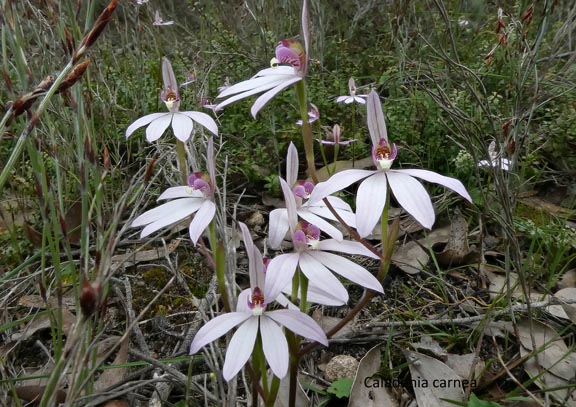
Caladenia carnea (synonym Petalochilus carneus) Photographer: Rob Pauley

Yet within Petalochilus itself there can be further groupings of which P carneus is most likely the main one. This consists of at least 8 species – P carneus (C carnea), P catenatus (C catenata), P coactilis (C coactilis), P fuscatus (C fuscata), P ornatus (C ornata), P prolatus (C prolata) , P. vulgaris (C vulgaris) and P xantholeucus (C xantholeuca). When a specimen cannot be identified to species level, it may be helpful to refer to it as a complex.

This is where comes the fun of trying to identify the specific species in the field (or for that matter from a photograph). To help myself understand, I often produce comparison charts based on descriptions found in the literature. The chart comparing the eight species is available as a pdf.

Caladenia prolata (Petalochilus prolatus) Photographer: Helen Lawrence

*Throughout the article the synonym Petalochilus is used for Caladenia subgenera Caladenia to make a clear distinction from Caladenia sens lat. It needs
to be noted C carnea is considered the type specimen for Caladenia so with any splits, it will remain in Caladenia.

References

Backhouse G et al,Bush Gems: a guide to the Wild Orchids of Victoria 2016
Bates R B South Australia’s Native Orchids 2011
Clements MA, et al, Caladenia Revisited: Results of Molecular Phylogenetic Analyses of Caladeniinae Plastid and Nuclear Loci 2015
Jones DJ, A Complete Guide to Australian Orchids including it Territories and Islands 2006
https://en.wikipedia.org/wiki/Caladenia Accessed 3 August 2020
https://www.pacificbulbsociety.org/pbswiki/index.php/Petalochilus Accessed 3 August 2020

Thank you to Andrew Brown for reviewing this article.

Caladenia plicata – April Winning Photograph

Shane Grave’s winning photograph for April was the spring flowering Caladenia plicata which is endemic to the South West of Western Australia.

Caladenia is a very large genus with over 330 species, 39 of these currently unnamed. In addition, there are 58 named subspecies and varieties. Caladenia plicata would belong under the subgenus Calonema or the segregate genus Arachnorchis which, although not generally recognised by State herbaria is commonly accepted by many amateur enthusiasts. Yet even this subdivision is still large with 192 species. As a result, some authors have created further groups/complexes, for example C. dilatata complex, C. longicauda complex, etc. However, according to Andrew Brown, C. plicata doesn’t seem to fit neatly into any of these categories, although David Jones does include it within the clubbed spider orchids.

Various authors consistently refer to the labellum as being unusual. In Fitzgerald’s formal description (1882) he states that the labellum tip is “recurved so as to become plicate and touch the under surface of the disc”. Plicate means to fold. The labellum tip of many other Arachnorchis species are known to curl under but none fold under in the way that this species does. The sharp fold with the spreading horizontal fringed margins (edges) combined with a central band of tall dense calli (wart-like structures) gives a distinctive shape reminiscence of a crab, hence the common name Crab Lipped Spider Orchid. The effect of this is best seen from a front, rather than a side, view.

The very mobile labellum is sufficient to identify this species, but it is also possible to identify when in bud “due to the prominent short osmophores (clubs) on the sepals”. The sepals narrow halfway along to form thick brown clubs and when the flower is open both the lateral sepals and petals are downswept. This is clearly seen in Shane’s photograph.

Finally, for those interested in pollination, it is pollinated by an undescribed male thynnine wasp of the genus Zeleboria. This has been captured on video https://ars.els-cdn.com/content/image/1-s2.0-S0960982217306310-mmc6.mp4


Thank you to Andrew Brown for assisting me with this article.

References:

Brown A, et al, Field Guide to the Orchids of Western Australia 2013

Brown A, personal communication

Caladenia accessed 24 May 2019

https://en.wikipedia.org/wiki/Caladenia

Caladenia plicata Wikipedia accessed 24 May 2019

https://en.wikipedia.org/wiki/Caladenia_plicata

Haiyang Xu et al Complex Sexual Deception in an Orchid Is Achieved by Co-opting Two Independent Biosynthetic Pathways for Pollinator Attraction 2017

https://www.sciencedirect.com/science/article/pii/S0960982217306310

Jones DL, A Complete Guide to Native Orchids of Australia including the Island Territories 2006

Jones DL, et al, Australian Orchid Genera CD-ROM 2008 CSIRO accessed 24 May 2019

https://www.anbg.gov.au/cpbr/cd-keys/orchidkey/html/genera/Arachnorchis.htm

Pelloe, EH, West Australian Orchids 1930

http://gutenberg.net.au/ebooks04/0400681h.html#page50

Orchids of South-West Australia website

http://chookman.id.au/wp_orchids/?page_id=2424


May 2018 Winning Photograph

One never knows what species will be entered each month – this month’s entries included Andrew Primer’s Eriochilus collinus, John Fennell’s Prasophyllum elatum, Marg Paech’s Pterostylis nutans and the winning picture, Pauline Meyer’s Arachnorchis sp. (which has subsequently been identified as Arachnorchis sp.)
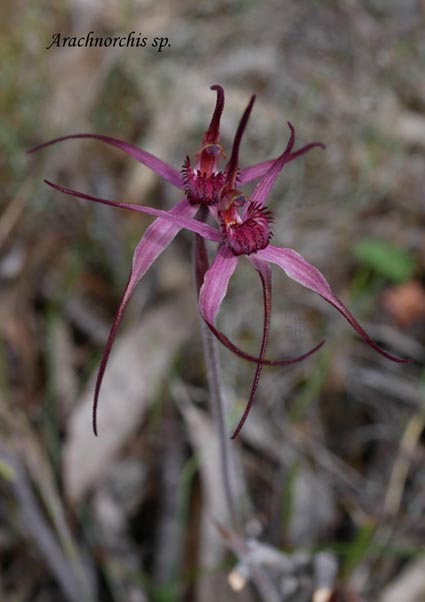
 

1805 sm PM Arachnorchis sp

In the last six years there have been over a dozen photo competition articles (the most recent April 2018) written on some aspects related to Spider Orchids. So, with another Spider Orchid winning the competition it is about time to answer the question – What Is A Spider Orchid?


Around the world, the common name Spider Orchid has been bestowed upon a number of orchids in different genera. In Australia, they have principally been applied to a large group within the genus Caladenia, a highly diverse cumbersome genus.

Caladenia in the broad sense is distinguished by erect flower stem and single linear, ovate to lanceolate leaf, (both hairy), labellum distinctly different from the other segments, generally fringed, curved and decorative calli. But within this genus it has been recognised for a long time that there are several distinct but varied groups, which has been reflected in the common names – Dragon, Pink Fingers, Hare, Spider, Wispy Spider, etc.

Consequently in 2001, several segregate genera were published including Arachnorchis for the common named Spider Orchids. This was not widely accepted, as reflected by the Herbaria of Australia. Indeed the original authors are no longer using the segregate names.

Yet despite all that, the segregate names have proved to be very practical for fieldwork. By using the segregate name when species is unknown, extra information is communicated. This was the case with Pauline’s picture. Yes she photographed a Caladenia but which one? It was an Arachnorchis species.

With that in mind, it is time to consider the features that make up a Spider Orchid or Arachnorchis.

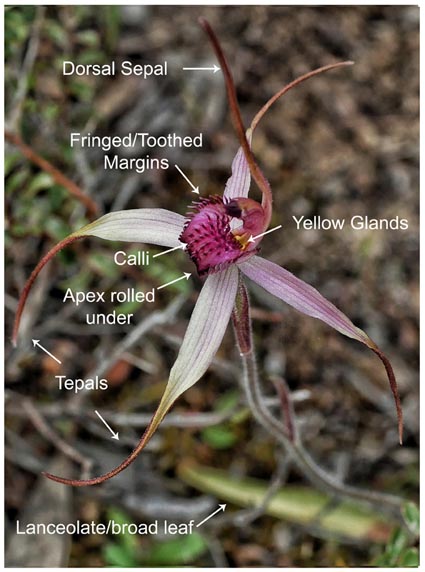
In following through a dichotomous key Arachnorchis is immediately separated out from the rest of the Caladenia by the presence of two yellow waxy glands at the base of the column. As this is not the immediate feature seen, the following chart comparing it with the very similar looking Joneseopsis should assist with recognising some of the main distinguishing features.

  SPIDER ORCHIDS
(ARACHNORCHIS)
WISPY SPIDER OR DADDY LONG LEGS
(JONESIOPSIS)
Leaf Sparse to densely hairy
Narrow to broad lanceolate
Red base
Sparsely hairy
Slender
Red base
Stem Wiry densely hairy Hairy wiry
Flower    
Dorsal sepal Erect Erect
Tepals

(Petals & Sepals)

Long & slender with long slender glandular tails or thickened short to long clubs*

Petals and sepals similar size

Narrow, end in very long thin threadlike glandular tails*
Labellum Trilobed
obliquely erect lateral lobes
Midlobe often differently coloured to the base
Small indistinctly lobed

Narrow

  Hinged Hinged
Apex Rolled under at the apex Rolls under*
Margins Fringed with short to long teeth* Short, blunt teeth to smooth
Calli Vary from short rounded crowded to long curved and widely spaced Short blunt congested lamina calli*
  2 or more rows 2 rows*
Basal Gland 2 yellow at  base of the column None
Growth Habit Loose groups* Clumping


*Exceptions in all these descriptions

1805 PM Arachnorchis sp Labelled wm

Labelled Features of a Spider Orchid

Reference

Backhouse, G, (2018) Spider Orchids: The Genus Caladenia and Its Relatives in Australia ISBN: 978-0-9946489 Electronic version

Bates, R. J., ed. (2011). South Australian Native Orchids. Electronic version, 2011. NOSSA

Jones, D. L., A Complete Guide to Native Orchids of Australia Including the Island Territories. Reed New Holland

Jones, D. L.; Hopely, T; Duffy, S. M.; Richards, K. J.; Clements, M. A and Zhang X, Australian Orchid Genera an information and identification system. Electronic version, 2006, CSIRO

 

March 2018 Winning Photograph

1803 A4 sm JF Arachnorchis formosa

Four very different species were entered this month. Ricky Egel’s autumn flowering Coryunastylis fuscoviridis (see February Journal for name usage), Rosalie Lawrence’s winter flowering Diplodium bryophilum and John Fennell’s spring flowering Stegostyla cucullata and Arachnorchis formosa.

It was no surprise that John’s A. formosa (syn. Caladenia formosa) was the winning photograph. Words such as stunning, spectacular, wonderful and attractive are used in the description of this rare orchid and is reflected in its common names – Scarlet Spider Orchid, Elegant Red Spider Orchid, Elegant Spider Orchid and Blood-red Spider Orchid. It is truly a stunning red flower with its drooping petals and sepals (tepals).

A. formosa is part of the large patersonii alliance which is characterised by white to reddish flowers with (mainly) drooping tepals ending in long, slender (sometimes thickened) sparsely to densely glandular (hairy) tails, labellum with short to long marginal teeth. The features that separate A. formosa from others in the complex are the large (~60 mm across) deep red flowers with long (~80mm) tapering, drooping tepals. Similar species to A. formosa is the smaller once common but now extremely rare Caladenia ‘Fleurieu Peninsula’ In Victoria there are some other similar species.

A. formosa is confined mainly to the South East and into south western Victoria.

References:

Backhouse, G., (2011). Spider-orchids – the Genus Caladenia and its Relatives in Australia, Melbourne, Electronic version.

Backhouse, G., et al, (2016). Bush Gems: A Guide to the Wild Orchids of Victoria, Australia, Electronic version.

Bates, R. J., ed. (2011). South Australian Native Orchids. Electronic version. NOSSA

2018 February Winning Photograph

1802 sm RP Caladenia carnea

A small but varied number of entries for our first competition of the year. Andrew Primer entered a lovely picture Thelymitra azurea from Eyre Peninsula; Thelma Bridle entered Calochilus cupreus one of South Australia’s endangered orchids; John Fennell’s close up of Caladenia prolata and Rob Pauley’s mass flowering of Caladenia carnea.

The winner was Rob Pauley’s C. carnea a wide spread orchid which ranges from across the Eyre Peninsula through to the South East as well as occurring in the Eastern States and Tasmania. Although considered common both nationally and at a state level, there are regions within its range where it is considered to be Near Threatened, Rare and even Vulnerable. Also, despite being common, the Seedbank notes that there are areas of probable decline: Fleurieu (KAN02), Mt Lofty Ranges (FLB01), Eyre Mallee (EYB05), Wimmera (MDD05) and Southern Yorke (EYB01). It is a reminder that not only the rarest species but also that common species can be in decline.

The situation is complicated by taxonomic issues; C. carnea is not only a highly variable species but also a complex of several similar species plus many undescribed species which continues to challenge botanists.

References:

http://saseedbank.com.au/species_information.php?rid=815 accessed 8 March 2018

Backhouse, G., et al, (2016) Bush Gems: A Guide to the Wild Orchids of Victoria, Australia, Electronic version.

Bates, R. J., ed. (2011). South Australian Native Orchids. Electronic version. NOSSA

Orchid Basics – Labellums and Columns

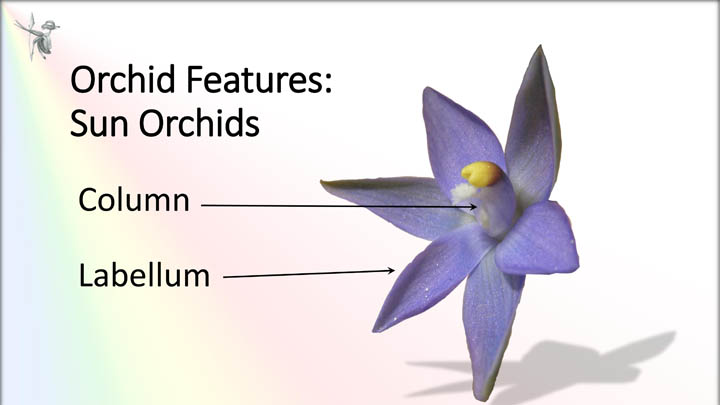
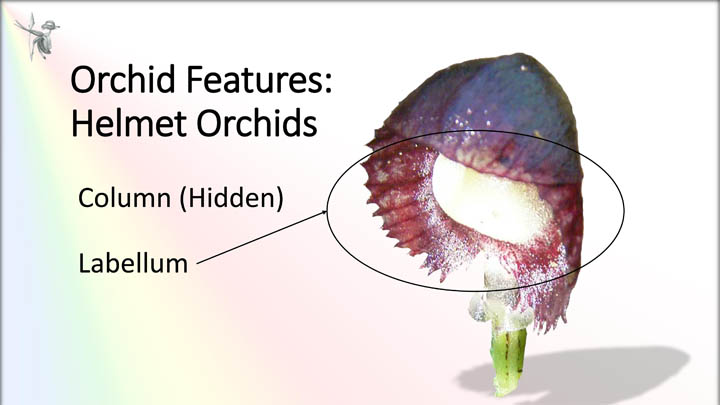
Orchids are unique in the floral world. Two distinctive characteristics that set orchids apart from other plants are the labellum and the column.

The labellum is a modified petal.  It is extremely varied in appearance; “often lobed, spurred, adorned with glands, appendages of calli (callus, a hardened swelling or thickening of the skin), sometimes mobile and highly irritable and often brightly coloured”. * The labellum is important for pollination.

The column (as described by Bates and Weber) “is a distinctive feature of all orchids and a unique structure in the plant kingdom. It is formed by fusion of the male parts ‘stamens’ and female organ ‘pistil’.”*

Below are examples of the various types of labellums and columns in some South Australian terrestrial orchids. Each genus has its own characteristic labellum and column.

Sun Orchid
Thelymitra – though the labellum is almost indistinguishable from the other petals and sepals, the column is quite complex.

Hyacinth Orchid
Dipodium or Hyacinth Orchid

Greenhood
Pterostylis or Greenhoods – generally a simple labellum with the column hidden well back into the hood.

Spider Orchid
Arachnorchis (syn Caladenia) can have quite varied and complex, mobile labellums

Helmet Orchid
Corybas or Helmet Orchid – the labellum dominates and the column is hidden deep inside the flower.

Donkey Orchid
Diuris or Donkey Orchid – the labellum is divided giving the appearance of more than one structure.

*Bates and Weber Orchids of South Australia 1990


2017 May Winning Picture

Corunastylis morrisii @ Simpson 25/2/2017

May’s theme was miniscule, or less than 10mm. Of the eight entries five were Corunastylis, two Spider orchids from Western Australia and one an epiphyte. The flowers of the two spiders, Caladenia pachychila (photographer Rob & Jenny Pauley) and Caladenia bryceana subsp. bryceana (Pauline Myers) were the largest of the group being about 10mm across whilst the Bulbophylum globuliforme (Ros Miller) and C. despectans (Rosalie Lawrence) were the smallest being only 2mm across.

Of the remaining Corunastyllis entries the flower size ranged from 3mm for C. pumila (Rob & Jenny Pauley), 4mm for C. tepperi (Ricky Egel), 7mm for C. ciliata (Rosalie Lawrence) and 8mm for C. morrisii (Rob & Jenny Pauley).

The winning picture C. morrisii (Bearded or Hairy Midge Orchid) is one of the larger midge orchids. Other synonyms are Prasophyllum morrisii and Genoplesium morrisii. This common species is mainly found in Victoria but it does extend into southern New South Wales in the east and in the west just spills 50 km over the border into South Australia where it is rated endangered. It also occurs in the south east of Tasmania.

Flowering Times: Nov – May

 
 State N D J F M A M
Tas        
NSW      
Vic
SA          √

With such a wide distribution range, it is not surprising to see quite a variation in flowering time from late spring through to autumn depending upon location.

Reference

http://plantnet.rbgsyd.nsw.gov.au/cgi-bin/NSWfl.pl?page=nswfl&lvl=sp&name=Genoplesium~morrisii

https://en.wikipedia.org/wiki/Caladenia_pachychila

https://en.wikipedia.org/wiki/Caladenia_bryceana_subsp._cracens

http://plantnet.rbgsyd.nsw.gov.au/cgi-bin/NSWfl.pl?page=nswfl&lvl=sp&name=Genoplesium~pumilum

Bates, R. J., ed. (2011). South Australian Native Orchids. Electronic version, 2011. NOSSA

Wapstra, M., Roberts, N., Wapstra, H. & Wapstra, A. (2012). Flowering Times of Tasmanian Orchids: A Practical Guide for Field Botanists. Self-published by the authors (May 2012
version).

Backhouse, G., Kosky, B., Rouse, D. & Turner, J. (2016). Bush Gems: A Guide to the Wild Orchids of Victoria. Self-published by the authors