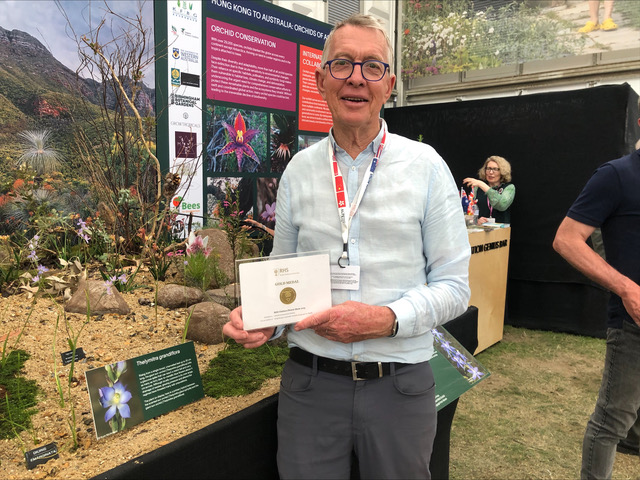
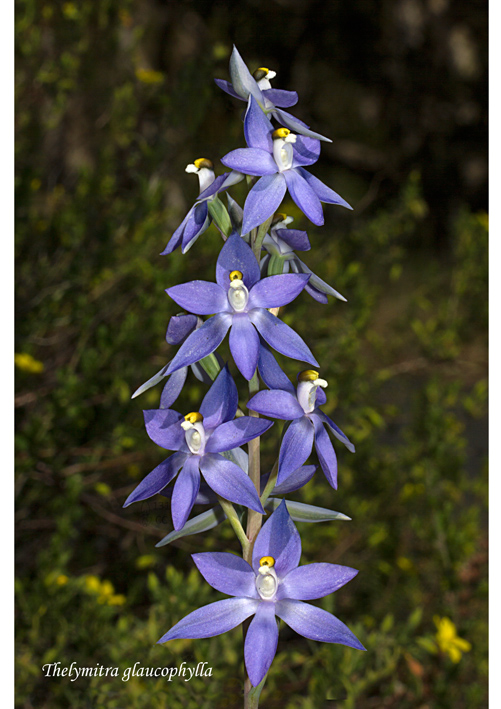
So the news is out – Aussie orchid (as part of a display with South east Asia and the Pacific) wins Gold Medal for conservation at the 2025 Chelsea Flower Show and according to Professor Kingsley Dixon this is the equivalent to winning Gold at the Olympics. One orchid was a hybrid, Thelymitra glaucaphylla x grandiflora.
Professor Kingsley Dixon (Image from Australian Orchid Foundation)
The Chelsea Flower Show is a prestigious event managed by the Royal Horticulture Society (RHS) who’s beginnings start with the presentation of a potato at a 1805 meeting. Over time, various exhibitions were developed with the Flower Show Fete first held at Cheswick in 1827 and moving to Chelsea Hospital in 1913 where it became known as the Chelsea Flower Show. The show was popular with exhibitors but only half of the applicants were accepted that first year. But in that group, McBean Orchids (Britain’s oldest orchid nursery) was one of the fortunate exhibitors and so orchids have always been present at the Show, though they were generally not terrestrial orchids.
Image from Australian Orchid Foundation
To win such an award, the team needed to put together a meticulously curated display to meet the RHS stringent standards; even a wrong font can result in disqualification. But there were other barriers to be overcome. Australian terrestrial orchids are not easy to grow. They require skill and attention to detail. Not many people are able to grow this exquisite orchid. In fact less than 10% of our orchid species are in cultivation. So this was quite an achievement in itself.
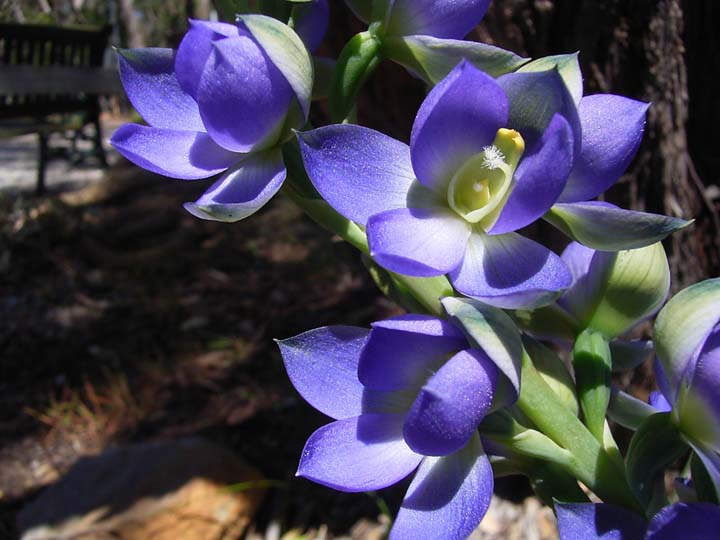
Thelymitra grandiflora (Photographer Robert Lawrence)
Over 90% of Australian orchids are unique to Australia with about half considered threatened; and so though T glaucophylla does not have a rating, it is still under threat being uncommon. T grandiflora is rated rare. Both are endemic to similar limited areas in South Australia. That is the Southern Mt Lofty Ranges and the Southern Flinders Ranges. Both are under threat from habitat loss, weed invasion, grazing, trampling, etc. So in-situ conservation is important if these, as well as other orchids, are to survive.
Working toward conservation of Australian orchids is a major pillar of NOSSA and it was encouraging that two of South Australian endemics played a part in this display. Congratulations for the immense effort that Kinsley Dixon and his collaborators have put into bringing orchid conservation awareness to the Chelsea Flower Show and to the world.
It is well known that many of our Australian orchids are facing extinction. But across the nation, there are many groups actively seeking to save them. One such group being the Nillumbik Shire near Melbourne with their Nillumbik Threatened Orchid Recovery Team. Effort has been preventing extinction of very threatened orchids – Charming Spider-orchid (Caladenia amoena) and Rosella Spider-orchid (Caladenia rosella). Both these species have highly restricted populations with less than 150 wild plants each. The shire has teamed up with the Royal Botanic Gardens Victoria’s Orchid Conservation Program to propagate and return to the wild plants of these beautiful orchids.
2020 started like most other years but that didn’t last for long. March is the anniversary of when the world went into lockdown. All due to Covid 19!
So like most other organisations here in Adelaide, NOSSA was immediately and suddenly impacted. All plans went out the window. Face to face activities ceased and it was some months before even a semblance of meetings resumed.
Yet despite all the difficulties and challenges, when the committee looked back over the year we were amazed at what we did achieve and so here is our list of 2020 – Covid19 could not keep us down!
NOSSA 2020 highlights instigated – Lindy McCallum, adapted from the February 2021 Journal
AGM
Delayed but not out. Held in September (instead of March) via Zoom and face-to-face meeting.
Committee Meetings
Following a brief hiatus, the committee made use of email communications and then Zoom meetings. From June the committee used a mix of face-to-face and Zoom meetings.
Finally the opportunity to have members present when unable to attend!
Monthly meetings
Combination Face to Face and Zoom meetings from July Results
Speaker Zoomed from Sydney
Country, interstate and overseas members are now able to join the meeting from afar
So many of us are interested in preserving our native flora and fauna, and for NOSSA it is the native orchids. But many of us may not be aware of how we can play a significant role in minimising our impact upon the environment so that they are still around for our children and grandchildren
The following video is a brief overview of two documents that NOSSA has produced. They are guidelines to help individuals know how they can minimalize their impact on the environment and so assist in the conservation of our beautiful and unique native orchids.
Below are the links to the documents referred to in the video:
Sadly many of our orchids are under threat of extinction.
Fortunately, conservationists and researchers are putting in a lot of effort in an attempt to save them. Part of this work consists of caging and tagging individual plants.
Most people do the right thing and do not disturb the cages/tags. Unfortunately some, hopefully mainly through lack of knowledge, do move them. Sadly, too many of them are being moved. Sometimes they are re-positioned but not always.
There are a good reasons for the individual plants to be tagged/caged. And there are good reasons for not moving either the tags or the cages.
Tags
Tags are usually numbered. These numbered tags are reference locations from which the distance and bearing of plants are measured. If the pin is moved the record for that individual plant is invalidated. Position of pins are used to determine if plants reappear in succeeding years.
Replacing the pins can also result in inadvertently spearing, and thus destroying, the tubers.
Cages
Cages are used to protect individual plants from grazing. Moving cages, even if returned, can result in damage to the plant, as well as damage to any emerging juvenile plants.
NOSSA & Conservation
One of the main activities of NOSSA is conservation. Many of our members assist in the work of monitoring, caging and tagging of plants. They know of the time and effort required for this work. They know why it is important not to move tags or cages, not even for taking photographs.
But we are aware that there are those who do not know and so would ask that others pass this message onto friends who may be unaware of the significance of cages/tags.
So simply put, “Cages & tags are not to be moved under any circumstances”.
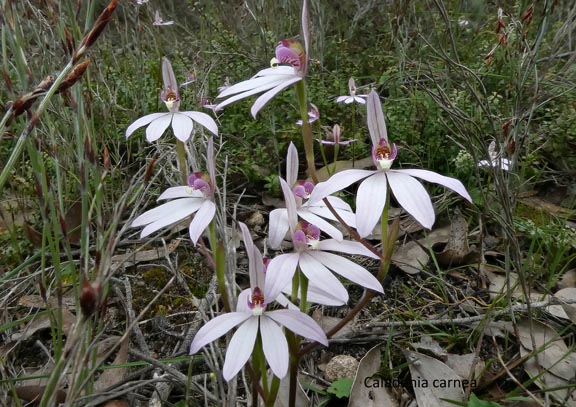
A small but varied number of entries for our first competition of the year. Andrew Primer entered a lovely picture Thelymitra azurea from Eyre Peninsula; Thelma Bridle entered Calochilus cupreus one of South Australia’s endangered orchids; John Fennell’s close up of Caladenia prolata and Rob Pauley’s mass flowering of Caladenia carnea.
The winner was Rob Pauley’s C. carnea a wide spread orchid which ranges from across the Eyre Peninsula through to the South East as well as occurring in the Eastern States and Tasmania. Although considered common both nationally and at a state level, there are regions within its range where it is considered to be Near Threatened, Rare and even Vulnerable. Also, despite being common, the Seedbank notes that there are areas of probable decline: Fleurieu (KAN02), Mt Lofty Ranges (FLB01), Eyre Mallee (EYB05), Wimmera (MDD05) and Southern Yorke (EYB01). It is a reminder that not only the rarest species but also that common species can be in decline.
The situation is complicated by taxonomic issues; C. carnea is not only a highly variable species but also a complex of several similar species plus many undescribed species which continues to challenge botanists.
The Native Orchid Society of SA has been involved with the Threatened Orchid Project which is attempting to propagate some of our most threatened orchids. There has been some success such as Thelymitra epicaptoides (Metallic Sun Orchids) but others are proving elusive. Marc Freestone, from the Orchid Conservation Project, Royal Botanic Gardens Victoria, is a PhD student who is researching one such difficult to grow orchid genus, the Prasophyllum.
Prasophyllum murfettii (Denzel’s Leek Orchid)
To assist with his research Marc has the sent the following request.
CAN ANYONE GROW LEEK ORCHIDS?
South Australia has about 40 species and Victoria about 74 species of the native Leek Orchids, Prasophyllum. Some are on the brink of extinction.
A major problem hampering efforts to prevent our Leek Orchids from going extinct is that they have proven next to impossible to grow in cultivation. They have proved extremely difficult, usually not germinating at all, or germinating but then dying soon after. Occasionally some success has been had (particularly with symbiotic germination) but successful germination trials to our knowledge have so far proved un-repeatable. Working out how to grow Prasophyllum is critical for the survival of many species at risk of extinction across southern Australia.
To try and change this, I will be studying Prasophyllum and their relationships with symbiotic mycorrhizal fungi.
But I need your help!
I am wanting to hear from as many people as possible who
have tried (either successfully or unsuccessfully) to grow Leek Orchids or the closely related Midge Orchids (Corunastylis).
have observed Leek Orchids (or Midge Orchids) recruiting from seed in the wild.
If you can help, or know of anyone who might be worth talking to, please contact me at: marc.freestone@rbg.vic.gov.au or 0428 304 299.
(Funding and support for this project: Australian National University, Federal Government National Environmental Science Programme, Royal Botanic Gardens Victoria, University of Tasmania).
I would encourage people to contact Marc with whatever information that you have, no matter how insignificant you may think it is. Every little bit helps including unsuccessful attempts.
His eventual aim is to be able to work out how to grow them reliably from seed in cultivation.
There are many different activities involved with orchid conservation. In situ conservation consists of looking after the orchids where they are growing; maintaining and protection of habitats and ecological systems. On the other hand ex situ conservation is caring for the orchids in cultivation in a similar way that zoos maintain an animals species that is extinct in the wild.
For the orchids one form of ex situ conservation is via seed collection and the propagation of new plants. With many of our terrestrial orchids this is not an easy task but here in South Australia an attempt is being made with four of our endangered orchids.
Unlike some of our terrestrial orchids these are ones which we have not been able to grow. There is a collaborative effort co-ordinated through the South Australian Seed Conservation Centre (Seedbank) to change this. Amongst the people helping the Seedbank are members of the Native Orchid Society of South Australia, students from Kildare College and Dr Noushka Reiter of the Royal Botanic Gardens Melbourne.
On July 30 2016, Dan Duval of the Seedbank was interviewed by Jon Lamb on Ashley Walsh’s ABC 891 Adelaide Talkback Gardening program. It is an informative interview and well worth the listen.
For more information on the work of the Seedbank, visit their website
Video as heard on Talkback Gardening with Jon Lamb and Ashley Walsh – Saturdays from 8.30 on 891 ABC Adelaide.
Spring is here and it was reflected in the variety and large number of entries. Lorraine Badger and Ros Miller entered Western Australian species – Caladenia x ericksoniae (Prisoner Orchid) and Paracaelana nigrita (Flying Duck Orchid) respectively. The other six entries were all from South Australia, Diplodium robustum (Common Green Shell Orchid), Caleana major (Flying Duck Orchid) both from Jane Higgs, Greg Sara’s Oligochaetochilus sp (Rufoushood), Judy Sara’s Arachnorchis leptochila (Queen Spider Orchid), Claire Chesson’s Diuris behrii (Cowslip Orchid or Golden Moths) and the outstanding winning picture Pterostylis cucullata by Bevin Scholz.
In many ways, Bevin’s picture of P. cucullata (Leafy Greenhood) is a special picture because it represents some of the conservation work with which NOSSA is involved. For many years NOSSA has worked with the Threatened Plant Action Group (TPAG) to weed the areas in Belair where this species is located and to see such a good show of plants is encouraging. It is a tribute to all who have contributed with their time and labour.
P. cucullata is rated Vulnerable both in South Australia and Victoria, and Endangered in Tasmania. It is also rated Vulnerable under the EPBC Act (Federal). Nationally it is known from about 110 sites with most of these sites being in Victoria and only a few sites in South Australia with Belair National Park having the largest and most important population for the state.
Historically this species covered an area of 2107 km2 in the Lofty Block region but that has now contracted by 82% to only 366 km2 with few locations. With such a reduced range, recovery plans were developed, both at state and federal level. The plans examined the risks and threats to the survival of the different populations.
One of the threats to this orchid is fire, including proscribed burns. Unlike some species such as Pyrorchis nigricans, Leptoceras menziesii or Prasophyllum elatum which flower well after fire, P. cucullata is fire sensitive; populations decline substantially. There does not seem to be a safe time to burn for this species. Should a population survive a burn, it would take it many years to recover.
Fire also leaves the population vulnerable to another threat, that of weed invasion. Unfortunately, it is weedy where this species survives but over the years, a consistent, targeted weeding program has resulted in a declining weed population. NOSSA and TPAG have appreciated the work and effort of volunteers and gladly welcome anyone else who would like to join. And one of the rewards? A beautiful, sunlit display of flowers as seen in Bevin’s picture.
The Native Orchid Society of South Australia (NOSSA) is affiliated with the national body of native orchid society, Australian Native Orchid Society (ANOS). NOSSA regularly sends reports of its to ANOS. This year’s report covered four years of the society’s activities and is reproduced here to give readers an idea of the many things that we do. This report was produced by Robert Lawrence (currently Vice President).
NOSSA REPORT 2012 to 2016
I believe that the last annual report from the Native Orchid Society of South Australia was in 2011 when we were just commencing a three-year plan with the establishment of a series of subcommittees. All of the committees have since ceased to exist, but not without significant accomplishments.
The Website Subcommittee had established a website, but a Webmaster has since been appointed. The website now uses WordPress and is maintained so that its management could easily be transferred to another person. The website provides a weekly educational post about Australian orchids. It has also provided a point of contact from those outside of the Society. It is linked to a Facebook page that increases the profile of NOSSA among those interested in orchids throughout Australia and beyond.
The Education Subcommittee had established a picture competition at the monthly general meetings. There is still only a small number of contributors, but many excellent pictures are shared. The winning picture from each meeting is used as a basis of one of the weekly posts on the website.
The Education Subcommittee had a vision to produce a brochure of 20 common orchids of the Adelaide region for free distribution to the general public. The NRM (Natural Resources Management) Education ran with the idea and produced a poster of Common native orchids of the Adelaide Hills. This provided brief, but comprehensive, profiles of 29 native orchids and the weedy species. This has been printed as a double-sided poster and is available from the website of Natural Resources Adelaide and Mt Lofty Ranges. NOSSA members worked with NRM staff on the details of the poster and NOSSA members contributed many of the photographs. This poster was completed and launched in April 2015.
NOSSA also provided monetary assistance as a loan with the publication of the field guide entitled, Start with the leaves. A field guide to common orchids and lilies of the Adelaide Hills. This guide covered 50 orchid species as well as native lilies and some weeds in the Iridaceae family that are sometimes mistaken as orchids. The contribution of $8,000 was recovered only 8 months after publication.
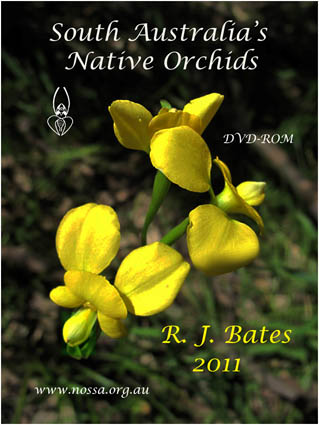
The Disc Publication Sub-editing Subcommittee saw the publication of South Australia’s Native Orchids on DVD discs in time for the Spring Show in September 2011. Both the DVD and the book were published in time for the Spring Show in September 2011. Both continue to sell.
A new subcommittee has been established in February 2016 to oversee the publication of a field guide, expected to be called Wild Orchids of South Australia. It is proving to be a challenge to be brief enough to reduce the information to a size suitable for a field guide. (Editor’s note: it has since been decided to defer this until after the development of the interactive website, see below.)
NOSSA members have being working since 2014 to establish an interactive website and database modelled on the Go Botany website run by the New England Wild Flower Society in the USA. This was supported by a grant from the Australian Orchid Foundation. The project is called Wild Orchid Watch. It is hoped to produce an interactive, web-based orchid identification tool. Recording sightings through such means as apps on mobile telephones are also being investigated.
In 2014 NOSSA made a donation to help establish the Orchid Conservation Program. This was led by Dr Noushka Reiter. Once established, staff in the Department for Environment, Water and Natural Resources began to organise a trial with four threatened orchid species from South Australia. Noushka visited South Australia during 2015 and collected samples from each of these species and isolated fungi from these. Seed was also collected and work on propagation commenced in 2015. During 2016 NOSSA sponsored the propagation of one of the four species through the Adelaide Botanic Gardens. Caladenia gladiolata, an endemic species, was selected.
Paul Beltrame, a secondary teacher at Kildare College, contacted and joined NOSSA during 2014 with the interest in getting girls at this school involved in the propagation of native orchids. A program was organised modelled in the Orchids in Schools program run by the Orchid Club of South Australia with Les Nesbitt’s involvement.
A delegation from Kildare College, ably assisted by their enthusiastic laboratory assistant Nenah McKenzie, visited Noushka in Melbourne and learnt the technique for separating and growing fungi. They have since separated fungi from two of our more common greenhood species and supplied this for seed kits that were made available to members as a trial at the start of the 2016 growing season.
The trial of seed kits was done for Pterostylis nana and Pterostylis sanguinea. A trial was conducted in this growing season of seed kits for members. Kits included a pot, growing media, seed, fungus, mulch and instructions. There seems to be limited success with the current round, but improvements are planned from the lessons learnt. One particular growing mix proved successful with a small number of seedlings appearing. The contribution of the Orchids in Schools program at Kildare College has been necessary for the isolation and production of fungi for the kits.
In October 2012 Cathy Houston and Robert Lawrence collected seed of Pterostylis arenicola from the only population on the Adelaide plains after monitoring in September indicated a good year for seed production. The seed was germinated in 2013 and was deflasked at a working bee at the Adelaide Botanic Gardens in early August 2016. The students from the Orchids in Schools program at Kildare College participated. Latest reports are that 40 plants look like surviving. These will be used for seed production and for reintroduction.
Typical of the rufus hood this Oligochaetochilus arenicola shows the sencesing leaves, pendent petals and hairs on the labellum. Photographer: H Lawrence
In 2012 NOSSA was asked to care for and propagate rescued Diuris behrii plants from Hillgrove Resources Mining Lease near Kanmantoo in the Mt. Lofty Ranges. The plan was to maintain the rescued orchid clones in cultivation for several years and to produce additional plants for reintroduction within the mining lease area each Autumn. A comprehensive recording and auditing system has been put in place to track each clone and any seed/daughter tubers/plants. By August 2015 there were 609 plants with 75 original mother plants. There were 95 daughter plants returned to the site for revegetation in each of the years 2014, 2015 and 2016, a total of 285 plants.
Funding from Hillgrove Resources has assisted NOSSA financially and has made it possible to consider funding conservation work. NOSSA is planning to apply for charity status so that donations can be used for tax deductions. Donations will then be feasible through our website. We are also starting an orchid seed bank. Seed will be available only to members and it is hoped that this will increase our membership. There is a demand for Australian orchids overseas and it is hoped that this will become a means for raising funds for conservation. Other means of fund-raising such as sausage sizzles and selling kits for craftwork are also being considered.
NOSSA members still continue to be involved in surveys and monitoring threatened orchids. Members have been involved in the planning of monitoring.
Weeding and Monitoring, two of NOSSA’s conservation activities
The management committee of NOSSA is currently working on a revision to the Rules of Association. In the current version there is a two-year limit on the term of the President of two years. In the first 16 years from 1977 there were there were eight different presidents before one had a second term. Bill Dear was president in alternate terms until he retired and moved to Western Australia in 2012. Robert Lawrence was elected president in March 2014, but for the first time in 2016 there were no nominations for president and he was nominated to the role of vice president with no other nominations. The management committee has appointed a subcommittee to review the Rules in relation to the terms of the president. Another change planned is change from having monthly general meetings to having less formal monthly meetings at which no decisions are made or minutes kept. All resolutions will require calling a formal special meeting. This idea is adapted from the approach used by ANOS Victoria.
Over the last two years NOSSA has asked new and renewing members to complete a survey of their interests. This has proved to be an effective way of getting information on the interests of our members with 79 responses, this being about half of the number of memberships. This is an overall summary of the results ranked according to number of responses:
Area of interest
Responses
Percentage
General Orchid Knowledge
53
67%
Field Trips
48
61%
Photography
47
59%
Conservation
46
58%
Growing Terrestrials
35
44%
Surveys
30
38%
Growing Epiphytes
28
35%
Citizen Science
20
26%
At its establishment NOSSA was primarily a Society of orchid growers. These figures reflect a decline in interest in growing orchids. The figures are somewhat surprising in that the numbers interested in growing orchids are much larger than the number of growers. Presumably some of these are interested in learning with a view to getting involved with growing later. At least we hope this is the case.
We are certainly noticing a decline both in our numbers of growers and in members involved in surveys due to age and health.
The greatest number expressed an interest in general knowledge and we are relying on the Journal and the Website help to keep people interested and informed. Next was field trips, but we haven’t had that many that have attended field trips in in the last few years. Only 11 of those who expressed an interested in field trips are not interested in photography, the next item of interest, and only 10 people interested in photography were not interested in field trips. Not many of these share their photographs at monthly meetings. We are hoping to get members to make their photographs available for the identification guides.
Bearded Orchid Photo: Helen Lawrence
It is pleasing that 58% are interested in conservation, thus supporting the efforts of our Conservation Officer.
Growing terrestrial orchids was next on the list; we hope that the tuber bank and the NOSSA Seed Kits are meeting the demand from members. Twenty-two of the 41 interested in growing orchids are interested in growing both terrestrial and epiphytic orchids. Only 8 of the respondents are bringing plants to meetings and a couple of others have not completed the survey. Of those interested in growing terrestrial orchids, one is a former grower and another is interested in growing them in situ at revegetation sites.
Thirty members expressed an interest in doing orchid surveys and three of these are interested in participating in the future, presumably when more time is available.
Citizen science is a new concept to many and came last in our list of interests. One who did not indicate an interest said he was monitoring orchids at a particular site; this has been taken as an interest. Surveys are certainly one form of citizen science and only 2 of those who indicated an interest in citizen science did not indicate an interest in being involved in surveys now or in the future. Thirteen of the 30 interested in surveys did not express an interest in citizen science. If these were included, interest in citizen science would be 43%.
Only seven members indicated an interest in all of the categories and one of these wants to keep in touch with the club and with old friends.
The Annual Spring Show in September 2015 was a particular success, largely due to the efforts of one our new members in promoting the show through local media and by other means. We also benefited from the donation of collections of growers who had decided not to continue with their collections.
Annual NOSSA Spring Show
NOSSA has continued to maintain a tuber bank that is available for members. A small number of our members are also members of ANOS Victoria, and have obtained tubers from their collection. This is hopefully contributing to the variety of terrestrial orchids grown by our members.
Working bees continued to be conducted in association with the Threatened Plant Action Group at Belair National Park for improving habitat for the nationally endangered Pterostylis cucullata (Leafy Greenhood), at Grange Golf Club to protect and monitor Pterostylis arenicola (Sandhill Greenhood) this being nationally vulnerable and locally endangered and on York Peninsula in conjunction with a local Friends group for the nationally endangered Caladenia intuta.
NOSSA has for many years used Australian Orchid Club (AOC) judges and knowledgeable members, who have all studied the ANOS judging rules, to judge orchids at NOSSA monthly meetings and shows. As the number of judges has fallen in recent years, judging training sessions have had to been discontinued. We wait in anticipation for a proposed ANOS judges correspondence course, as we have for more than 10 years. There are at least three AOC judges interested in the ANOS judging correspondence course. It is disappointing that ANOS Awards are still limited to Queensland, New South Wates and Victoria.
In summary, NOSSA continues to be active in many ways and these activities are working together to support each other.








 NOSSA
NOSSA 