Eyre Peninsula – Finding the Records for South Australia’s First Collected Orchid

Recently, Jodie Hamilton (ABC reporter) wrote a good orchid article highlighting the importance of and threats to orchids. Click on the link to read her article – Orchid enthusiasts call for greater protection for native species facing habitat threats When she emailed me with some orchid questions (28 November 2025), I gave a comprehensive answer from which she was able to take what she needed for her article.

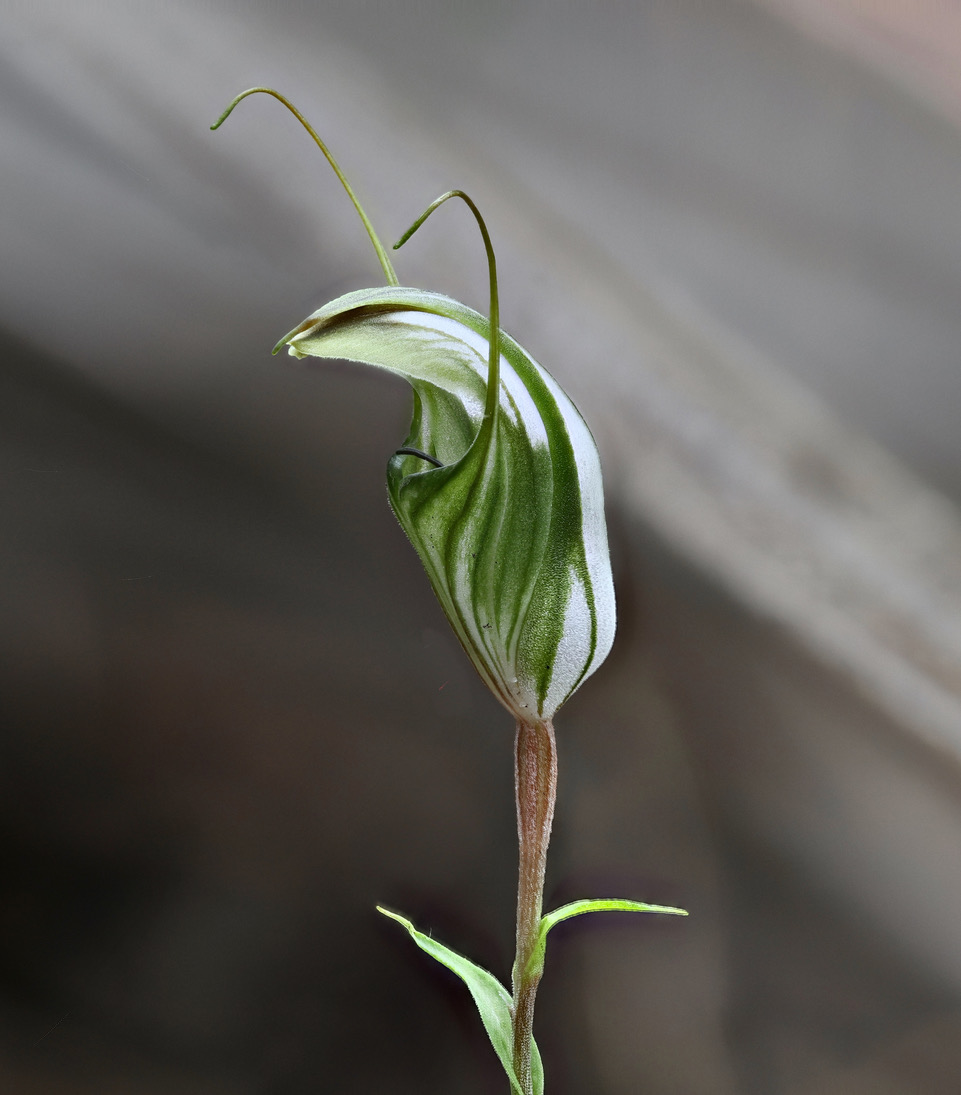
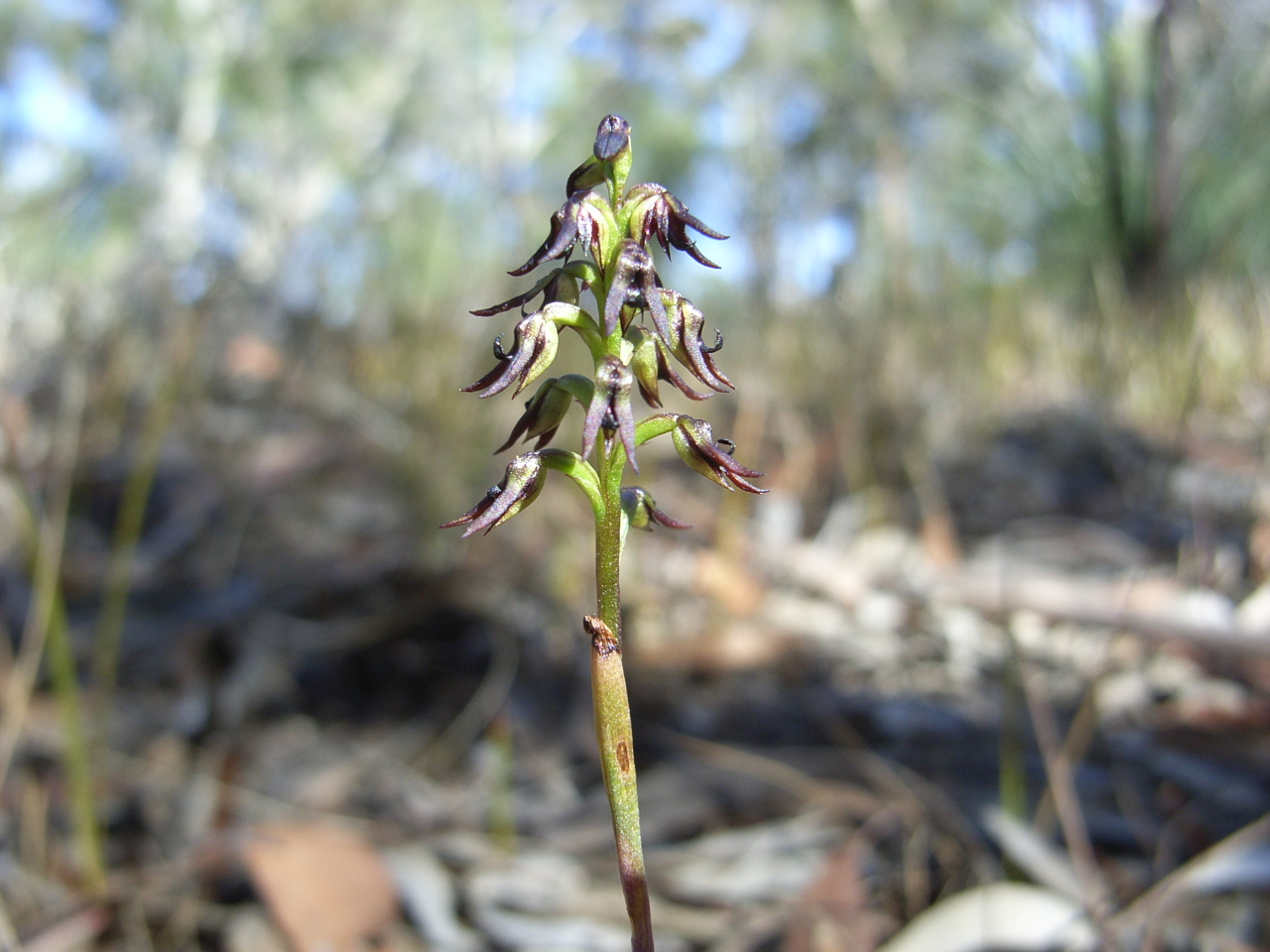
Possibly Genoplesium nigricans (Photo June Niejalke)

As there is additional information in my answer, I thought others might be interested in my reply. Here it is –

“Hi Jodie,

As to numbers, the answer to some of your questions depends upon who you ask. So the figures will vary. Orchid taxonomy is being reviewed with several researchers looking into South Australian orchids and in coming years we will see the numbers change. But regardless of the detail, it can be confidently said that over half of South Australian orchids are threatened.  Threats are clearance & development, weeds, herbicide, overgrazing, isolated “island” population (orchids need room to spread).

So having said that, looking at the Atlas of Australia (ALA), there are 4,470 observations of 141 species of orchids in EP collected between 1850 and 2025. Since 2015, iNaturalist, a citizen science project, 117 observers have collected over 1,200 of those ALA observations.  iNaturalist is significant because in recent years individuals are adding observations exponentially to the database, a thing we have not been able to do in the past. The more people that get involved with iNaturalist, the more data we will have and be able to have a better understanding of not only orchids, but all our other species.

My numbers are more aligned to the herbarium numbers. Approximately 12 species are endemic to EP (~162 species for the whole of SA).*

As to why orchids are important, the following information is taken from a talk I gave earlier this year – Orchids are bio-indicators of the health of the bushland. Because they have great visual appeal, we notice them and when aware of them we are able to use their presence to determine what is happening.

  • They have a low tolerance for change/disruption whereas other plants will show stress signs later, making them an early indicator of what’s happening.
  • Pollinated orchids indicate pollinator presence i.e. insects as many orchids do not provide food for the pollinators.
  • They have a strong reliance upon mycorrhizal fungi from germination and with some species through the whole of their life cycle.
    • The significance of the fungi is that they contribute to the soil health, are involved in nutrient recycling and contribute to plant growth. 

This makes orchids a potential flagship for conservation work. I’ve attached a pdf of the talk.

Fun Fact you might like.

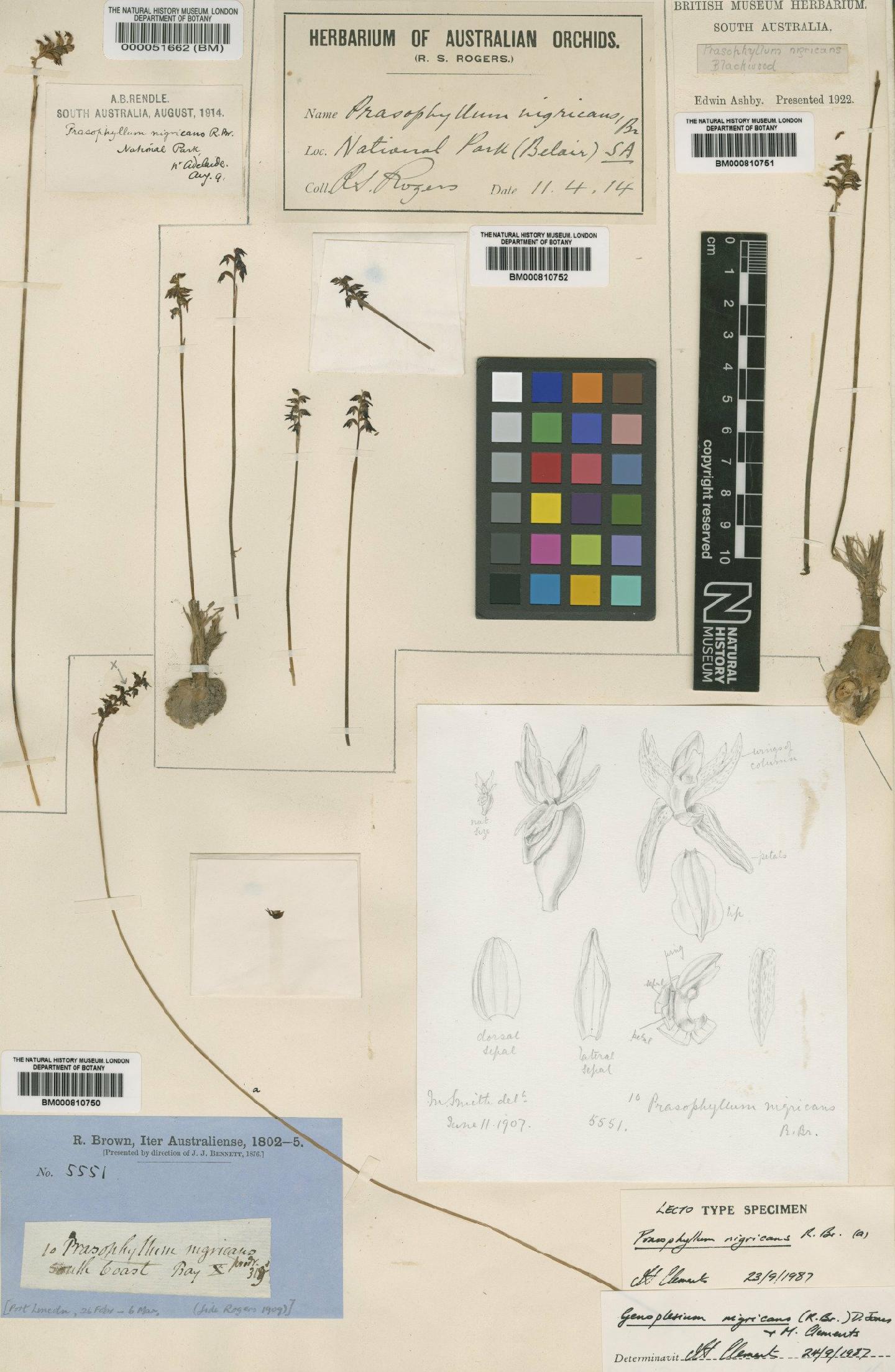
The first orchid found in South Australia was March 3,1802 by Robert Brown, botanist on the Investigator with Matthew Flinders. This was at Port Lincoln. Initially it was called  Prasophyllum nigricans but today is known as Genoplesium nigricans. I find it amazing that he managed to find such a small sticklike orchid which often gets overlooked in our modern species lists.

June Nieljalke would also be able to help you.”

Close up (Photo June Nieljalke)

In giving Jodie the fun fact about the first orchid found (or rather I should say first documented), I went down a bit of a rabbit warren on the ‘net as I couldn’t find my original research material for a 2019 talk and wanted to double check the accuracy of my information.

So, I typed into Google “when was the first orchid found in south australia” only for it to give a wrong answer. I do appreciate that the Google AI gives references (other ChatBots such as Co-Pilot do not). This is important as it pointed me to an article I’d written about Caladenia cardiochila which was a few decades after settlement and therefore unlikely to be correct as other orchids would have been found before that.

Screenshot of Google’s AI reply

As a tool, AI does not do research, let alone original research. It does not understand concepts but recognises individual words and word patterns. The words it picked was “first”, “orchids” “found” and “south australia”. All four words were in the article but the concept was about when Caladenia cardiochila was first described but it was not the first orchid found in South Australia which is what the question was about.
 

As AI did not have a summary, it meant I needed to do some research, potentially looking for original material. This took me to the Internet Archive, the Biodiversity Heritage Library (a very useful source as it contains a lot of original source material), Digital Herbariums, etc from which I was able through deduction to come to the answer of “when was the first orchid found in south australia”

Now when you type in the same question, Google hopefully will give the correct answer.

Lectotype for Prasophyllum nigricans – note Brown’s handwriting is on the blue slip

References

Lectotype
Natural History Museum (2014). Specimens (from Collection specimens) [Data set resource]. Natural History Museum. https://data.nhm.ac.uk/dataset/collection-specimens/resource/05ff2255-c38a-40c9-b657-4ccb55ab2feb

https://data.environment.sa.gov.au/Content/publications/JABG21P004_Barker.pdf
 Appendix 2 page 34/35 Plant Collections by the British from South Australian waters in 1802. This reference gave the dates and locations of where the Investigator was as well as the specimens collected

https://archive.org/details/mobot31753003393979/page/318/mode/2up  page 319 Latin description of Prasophyllum nigricans

Disentangling the history of the Robert Brown specimens at RBGE – Botanics Stories some background history on Robert Brown and his collection

Personal correspondence Jurgen Kellermann, South Australian Herbarium

*My figures for the endemic species numbers came from a spreadsheet, I’d initially complied years ago based upon 2011 Native Orchids of South Australia and updated.

MOVING ORCHIDS IN OR OUT OF AUSTRALIA

From time to time, NOSSA receives overseas requests from individuals wanting to purchase some of our beautiful orchids. Unfortunately, NOSSA does not sell overseas due to the various legal and administrative issues involved. For internationals wanting to buy Australian orchids, go to OrchidWire which is a directory ‘connecting a world of orchids’. On their site is a list of orchid vendors.

Below is the information from the Australian government website laying out the requirements – https://www.dcceew.gov.au/environment/wildlife-trade/publications/orchids-into-or-out-of-Australia.

Department Environment & Energy

Live orchid plants coming into or leaving Australia must be accompanied by an Australian wildlife trade permit.

Permit rules apply, unless the live orchid plants meet permit exemption criteria listed on the back of this card.

This means you need to get a wildlife trade permit before you move your orchids—whether you intend to carry the orchids with you or you plan to send them by post or freight.

Without a permit, you may be breaking the law. You could be liable for significant penalties including seizure of the orchids and fines.

Apply for a wildlife trade permit from the Department of the Environment and Energy at: International wildlife trade

All permit applications are processed as quickly as possible. The timeframe for assessing permit applications varies based on the volume of applications received. Please allow up to 40 business days for your permit application to be processed.

10 Diuris behrii
10 Diuris behrii

Permit exemption criteria

Under Australian law, Australian wildlife trade permits are not required for the following:

  • Orchid seeds, spores and pollen
  • Orchid seedling or tissue cultures/flasks
  • Cut flowers of artificially-propagated orchids
  • Artificially-propagated hybrids of CymbidiumDendrobiumPhalaenopsis and Vanda species
    if they meet all of the following criteria:

All specimens must:

  • be recognisable as artificially propagated
  • be healthy with no signs of damage
  • look uniform in size and shape.

When shipped in a flowering state:

  • each plant must have at least one fully open flower
  • plants must be professionally processed for retail sale—i.e. labelled with printed labels or packaging indicating the name of the hybrid and the country of final processing.

When shipped in a non-flowering state:

  • each container* must have 20 or more plants of the same hybrid type (e.g. V. Kru Chon ‘Dark Knight’)
  • each shipment must include an invoice or other document that clearly states the number of plants of each hybrid in the shipment.

* ‘Container’ includes cartons, boxes, crates or individual shelves of CC-Containers (Container Centralen or Danish Trolley).

KUDOS TO NILLUMBIK SHIRE – SAFEGUARDING SPIDER ORCHIDS

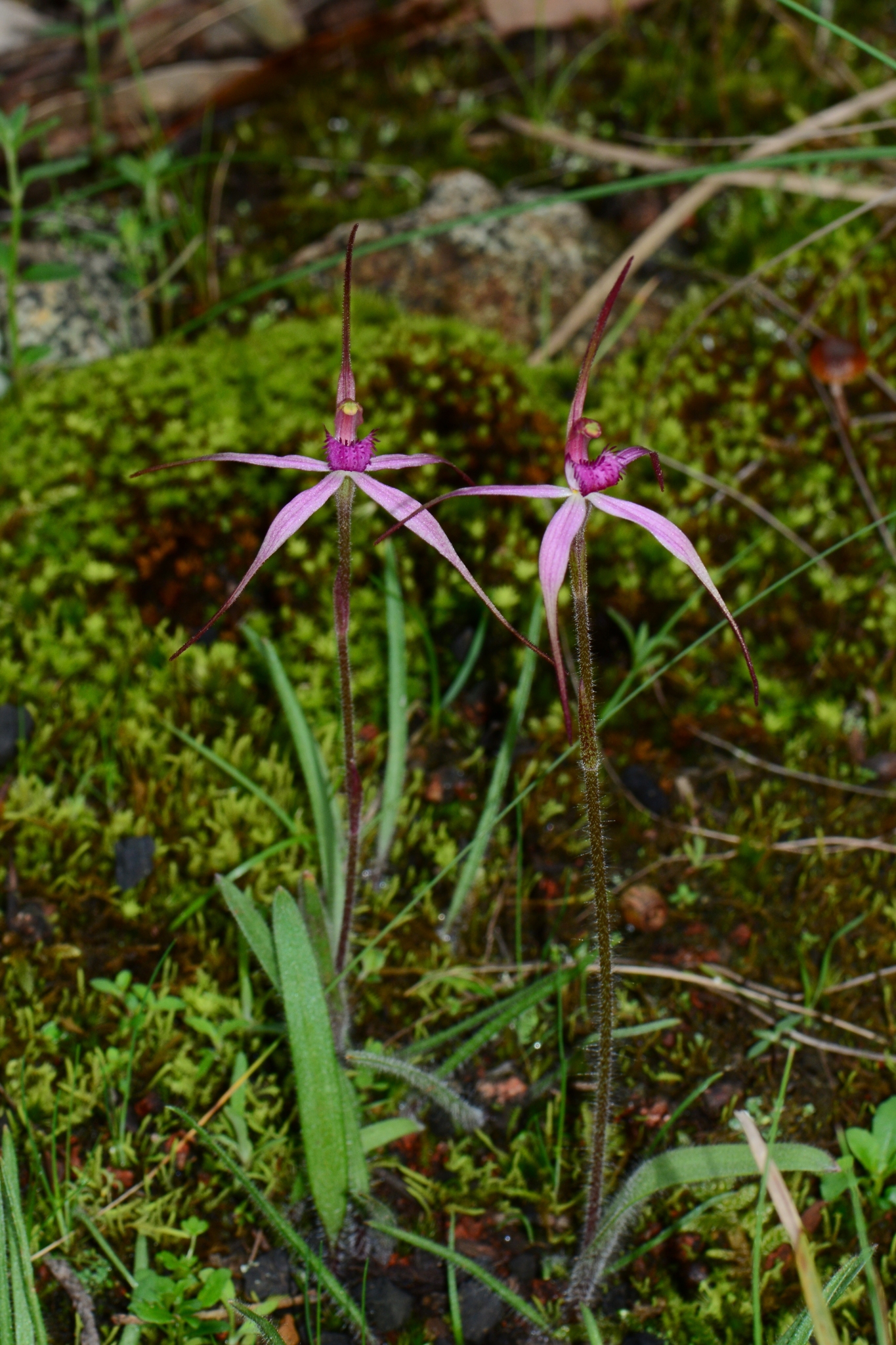
It is well known that many of our Australian orchids are facing extinction. But across the nation, there are many groups actively seeking to save them. One such group being the Nillumbik Shire near Melbourne with their Nillumbik Threatened Orchid Recovery Team. Effort has been preventing extinction of very threatened orchids – Charming Spider-orchid (Caladenia amoena) and Rosella Spider-orchid (Caladenia rosella). Both these species have highly restricted populations with less than 150 wild plants each. The shire has teamed up with the Royal Botanic Gardens Victoria’s Orchid Conservation Program to propagate and return to the wild plants of these beautiful orchids.

For details see these two articles – https://www.nillumbik.vic.gov.au/Council/News-and-publications/Latest-news/Safeguarding-Nillumbik%E2%80%99s-Charming-Spider-orchid-from-extinction

and

https://www.nillumbik.vic.gov.au/Explore/Environment/Natural-environment/Animals/Native-animals/Rosella-Spider-Orchid

Rosella Spider-orchid (Caladenia rosella)
Photographer: Micheal Keogh – https://www.inaturalist.org/observations/91826364

Charming Spider-orchid (Caladenia amoena)
Photographer: Michael Keogh https://www.inaturalist.org/observations/51880159

Australian Orchids: The How, Where, When & Why

It’s been a little while in coming, but here is the second of a three part educational video about Australian Orchids.

Orchids are special.

They are unique but even more they are important. Orchids are the barometer to the health of the ecosystem.

So, watch and enjoy the video …

To watch the first video click here.

Genus Plumatichilos

This week’s blog is from the Journal of the Native Orchid Society of South Australia, Volume 42 No 8. Leo Davis has been doing a series of articles aimed at helping members learn how to identify the orchids.

This article is about Plumatichilos, one of the segregate genera of Pterostylis. It has an unique labellum which sets it apart from the other Greenhoods. Leo wrote this article soon after David Jones named them in the Australian Orchid Review.  Will these names be accepted or not is a matter of waiting and seeing but it should be noted that they have been in manuscript form for many years. At the time of writing, they are not in the South Australian eflora.

Both the species discussed in Leo’s articles are from the Plumatiochilos plumosum complex or group.

Plumatichilos sp. Mallee Bearded Greenhood =Plumatichilos multisignatus

Plumatichilos sp. Woodland Bearded Greenhood = P. foliaceus

Unless otherwise noted, all images are Leo Davis.

Genus Plumatichilos.

Back in 1990 Bates & Weber placed all greenhood orchids in genus Pterostylis(1. pp118-143) where some of you and all Australian State Herbaria and certainly Janes & Duretto (3. pp260-269) would have them still be.  In 2001 Szlachetko erected the genus Plumatichilos.  In his Guide(4. pp286-339), Jones divided the greenhoods into 16 separate genera, these in two groups, each of eight genera.  One group all have the lateral sepals directed downwards (including Bunochilus and Urochilus) and the other eight all have them directed upwards (deflexed, as in Diplodium and Pterostylis).  Even those of you who reject the splitting and creation of the extra genera will concede that those placed in Plumatichilos, which have downward directed and partly fused lateral sepals (forming a synsepalum), are strikingly different in appearance to any other Pterostylis species.  The most obvious distinguishing features are the unique labellum and the two openings to the galea.

I had known just two species of Plumatichilos, both of which were undescribed.  I could recognise and distinguish them essentially because they grew in very different habitats and locations.  I used Bates’ tag names, Mallee Bearded Greenhood (Plumatichilos sp. Mallee Bearded Greenhood) (3. pp913-4) and Woodland Plumed or Bearded Greenhood (Plumatichilos sp. Woodland Bearded Greenhood)(1. pp915-916).   In recent weeks both (along with two other South Australian species) have been formally described.  They are now, respectively, Plumatichilos multisignatus(5. pp33-35) (Fig. 1) and P. foliaceus(5. pp30-32) (Fig. 2).  But, to a large extent, I still identify them more by the locations in which I find them than, to my eye, clearly discernable physical features.

Fig 1 P multisignatus Fig 2 P foliaceus
Fig. 1. Plumatichilos multisignatus. Monarto. Sept 10, 2012. Fig 2. Plumatichilos foliaceus. Para Wirra. Sept 11, 2013.

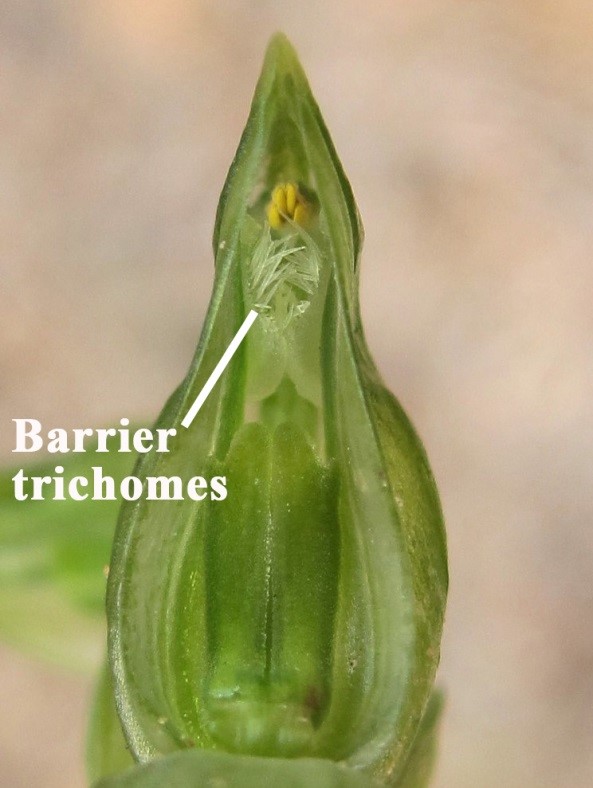
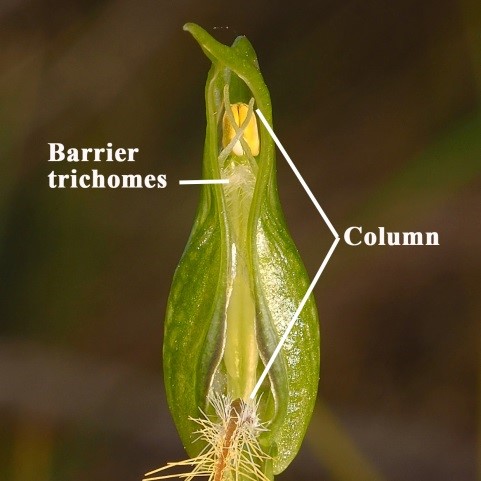
I had no idea what ‘barrier trichomes’ were but I saw that Jones listed them as the last of 13 dot pointed characters of genus Plumatichilos(5. p26).  Trichome simply means a hair growing from a plant epidermis.  They can be unicellar or multicellular and branched or unbranched.  The ‘barrier’ refers to its capacity to block and direct a pollinating insect to an exit path that puts it in the right posture to transfer a pollinium to the stigma (sticky receptive female part of flower).

Fig 3 Bunochilus prasinus June Niejalke Janes & Duretto, who reject the splitting of genus Pterostylis, divide it into two subgenera using the absence (subgenus Pterostylis) or the presence (subgenus Oligochaetochilus) of barrier trichomes on the column wings(3. pp262).  They place what I call Plumatichilos in the section V, Catochilus, of subgenus 2 Oligochaetochilus(3. pp266), and, yes, I see your eyes glaze over.  To them the Adelaide Hills ‘plum’ would be Pterostylis, subg. 2 Oligochaetochilus, Sec. V. Catochilus, species foliaceus.  Learning what ‘barrier trichomes’ are had me go back searching my photo library and I found images of the barrier trichomes in Bunochilus flowers that I had not previously spotted.  I have used and annotated a detail sent to me by June Niejalke. (see Fig. 3).

Fig. 3. Bunochilus prasinus. Sherlock (Type location for the species). Photo by June Niejalke.

As with all ‘true’ Pterostylis, the dorsal sepal and the two lateral petals, of the upside down flowers, are formed into a galea or cap (Fig. 1).  They are fused so closely that it can be hard to discern the join between the sepal and the comparatively small petals, especially in some less clearly striped flowers. (Figs. 1 & 2).

The typical Pterostylis galea has a single opening but in Plumatichilos there are two, a lower one, from which the uniquely formed labellum protrudes (and through which the pollinating male gnats enter) and an upper one (through which the pollinators exit) (4. p335), guided by the barrier trichomes (Fig. 4).  Through this upper opening you can observe the top of the column, including parts of it, the pollinia, the barrier trichomes, column arms and sometimes the stigma.  Two crossed filaments, in front to the pollinia, are column arms.

Fig. 4. Plumatichilos foliaceus. Scott Creek C.P. Sept 2015.

Fig 4 P foliaceus


Fig 5 P foliaceus.jpg The labellum (the modified third petal) (Figs 1, 2 & 5) is unlike that of any other Pterostylis sp.  It has a slightly flattened filament having a reddish-brown apical knob and two or three types of hairs along its length.  Jones describes the labellum of P. foliaceus as having three types of hairs(5. p30).  You may be able to see the short white ones (1 mm) at the base of the labellum in Fig. 5.  The longer (5-7 mm) yellow ones along the most of the length of the labellum are easy to see.  I am not sure that I can distinguish the shorter proximal (near point of attachment) yellow ones (1.5 mm).  In P. multisignatus Jones describes just two types of labellum hairs(5. p33) with the white basal ones absent, and two sorts yellow hairs, proximal ones to 1.2 mm and longer ones 5-8 mm.  To my eye, this character, two or three types of labellum hairs, is the only objective, rather than subjective , distinguishing feature between the two species that I regularly observe.

Fig. 5. Plumatichilos foliaceus. Scott Creek C.P. Sept 26, 2015.

In Fig. 5, I think that you can see that the hairs arise, in two parallel rows, not paired, from the sides of the flattened shaft of the labellum filament.

Fig 6 P foliaceus Fig. 6. Plumatichilos foliaceus in early bud. Scott Creek C.P. August 29, 2018.

Another generic character is ‘leaves sessile (no stems), ascending to erect, often with whitish or yellowish interveinal areas.’ (5. p26)  You may need to look very closely, in Fig. 6, to see these ‘windows’, mainly at the bases of the stemless leaves. 


References:

  1. Bates, R.J (2011). South Australian Native Orchids, DVD Issued by the Subediting Committee (NOSSA) on behalf of the
    Native Orchid Society of South Australia Incorporated.
    2. Bates, R.J. & Weber. J.Z (1990). Orchids of South Australia, A. B. Caudell, Government Printer, South Australia.
  2. Janes, J.K. & Duretto, M.F. (2010), A new classification for subtribe Pterostylidinae (Orchidaceae), reaffirming
    Pterostylis in the broad sense. Australian Systematic Botany, 23, 260–269.
  3. Jones, D.L. (2006), A Complete Guide to the Native Orchids of Australia, Reed New Holland, Australia.
    5. Jones, D.L. (2018), Six new species of Plumatichilos (Orchidaceae: Pterostylidinae) fromSouth-eastern Australia and a
    new species from New Zealand, Australian Orchid Review 83(4): 26-44.

Other articles about Plumatochilos can be found here and here.

2018 July Winning Photograph

1807 sm JF thelymitra azurea
Thelymitra azurea (common name Azure Sun Orchid)

With two sun orchids entered this month it is not surprising that one of them should be the winner which was John Fennell’s Thelymitra azurea a lovely blue flower with hints of pink. The other sun orchid taken by Pauline Meyers was one of the lovely pinks, T. rubra. She also entered a picture of Pyrorchis nigricans with a spider quietly waiting for its next meal! The final entry from Trevor Williams was that of a double headed Diplodium robustum which he found at Spring Gully Conservation Park.


June 2018 Winning Photograph

1806 sm JB T epipactoides1


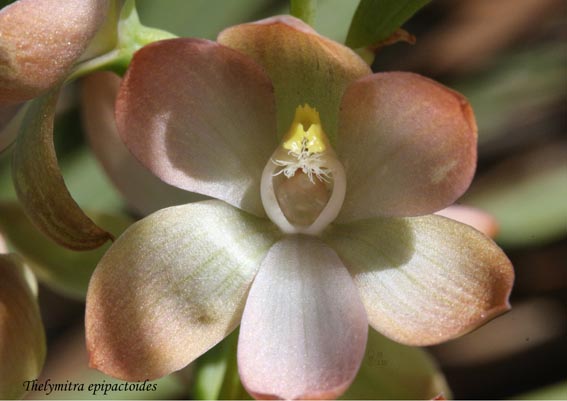
An advantage of entering a photograph is that it does not need to be in season. This month John Fennell entered an autumn flowering Corunastylis fuscoviride and a late spring/early summer flowering Diuris sulpherea, Robert and Rosalie Lawrence both entered the winter flowering Diplodium robustum and the winning picture, John Badger’s Thelymitra epipactoides is an early spring flowering orchid.

Sun Orchids are another popular winner of the competitions and as there was a comprehensive article written on Thelymitra epipactiodes and as some have asked “what, actually, is a sun orchid?”, it is time to answer the general question about Sun Orchids.

Of all the Australian terrestrial orchids Thelymitra or Sun Orchid is the one that looks the least like an orchid as all the segments – the sepals and petals including the labellum – are very similar in appearance. They mimic the flowers of the Lilliaceae and Goodeniaceae families.

Nevertheless, it is an orchid as evidenced by the column. Columns are a unique feature of orchids. They are the combination of the reproductive organs into one structure. Between the different Thelymitra species, it is the column that is often the main distinguishing feature used in identification. Because, the column is quite detailed and so important in identification, we plan to feature this in future Journals.

Other general features of Thelymitra are single, non-hairy, mainly linear leaf (of course, there are always exceptions) with a single flower stem. Flowers range from being singular to having multiple flowers which come in a range of colours from yellow to pinks to blues. Despite the lack of nectar, most Thelymitra are bee pollinated but there are some that are self-pollinated. The pollinia instead of being yellow are white and it is not unusual to see the white pollen on the self-pollinating flowers.

Reference

Bates, R. J., ed. (2011). South Australian Native Orchids. Electronic version, 2011. NOSSA

Jones, D. L., A Complete Guide to Native Orchids of Australia Including the Island Territories. Reed New Holland

Jones, D. L.; Hopely, T; Duffy, S. M.; Richards, K. J.; Clements, M. A and Zhang X, Australian Orchid Genera an information and identification system. Electronic version, 2006, CSIRO

Thelymitra https://en.wikipedia.org/wiki/Thelymitra Accessed 4 July 2018

March 2018 Winning Photograph

1803 A4 sm JF Arachnorchis formosa

Four very different species were entered this month. Ricky Egel’s autumn flowering Coryunastylis fuscoviridis (see February Journal for name usage), Rosalie Lawrence’s winter flowering Diplodium bryophilum and John Fennell’s spring flowering Stegostyla cucullata and Arachnorchis formosa.

It was no surprise that John’s A. formosa (syn. Caladenia formosa) was the winning photograph. Words such as stunning, spectacular, wonderful and attractive are used in the description of this rare orchid and is reflected in its common names – Scarlet Spider Orchid, Elegant Red Spider Orchid, Elegant Spider Orchid and Blood-red Spider Orchid. It is truly a stunning red flower with its drooping petals and sepals (tepals).

A. formosa is part of the large patersonii alliance which is characterised by white to reddish flowers with (mainly) drooping tepals ending in long, slender (sometimes thickened) sparsely to densely glandular (hairy) tails, labellum with short to long marginal teeth. The features that separate A. formosa from others in the complex are the large (~60 mm across) deep red flowers with long (~80mm) tapering, drooping tepals. Similar species to A. formosa is the smaller once common but now extremely rare Caladenia ‘Fleurieu Peninsula’ In Victoria there are some other similar species.

A. formosa is confined mainly to the South East and into south western Victoria.

References:

Backhouse, G., (2011). Spider-orchids – the Genus Caladenia and its Relatives in Australia, Melbourne, Electronic version.

Backhouse, G., et al, (2016). Bush Gems: A Guide to the Wild Orchids of Victoria, Australia, Electronic version.

Bates, R. J., ed. (2011). South Australian Native Orchids. Electronic version. NOSSA

Blue – it just ain’t natural

2017 June Winning Picture: Blue & White Orchids

1706 sm RWL Thelymitra grandiflora 10

This month’s theme for the photo competition was blue and white. White flowers can occur as a result of lack of colour such as Rosalie Lawrence’s Caladenia latifolia (Pink Fairies) which is normally pink. White orchids can also occur naturally such as the Arachnorchis argocalla (White Beauty Spider Orchid) and Arachnorchis intuta (Ghost Spider Orchid) both photographed by John Fennel, or as a dominant colour such as Lorraine Badger’s Eriochilus collinius (syn Eriochilus sp Hills Woodland).

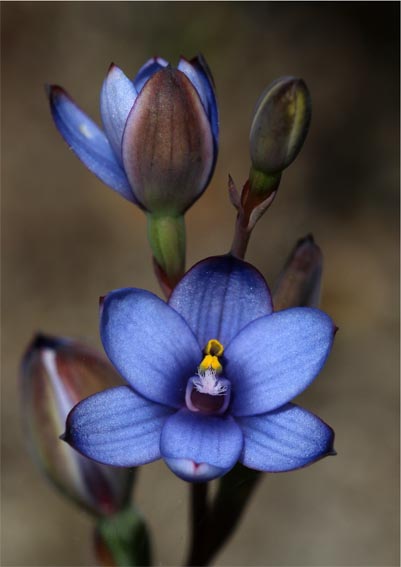
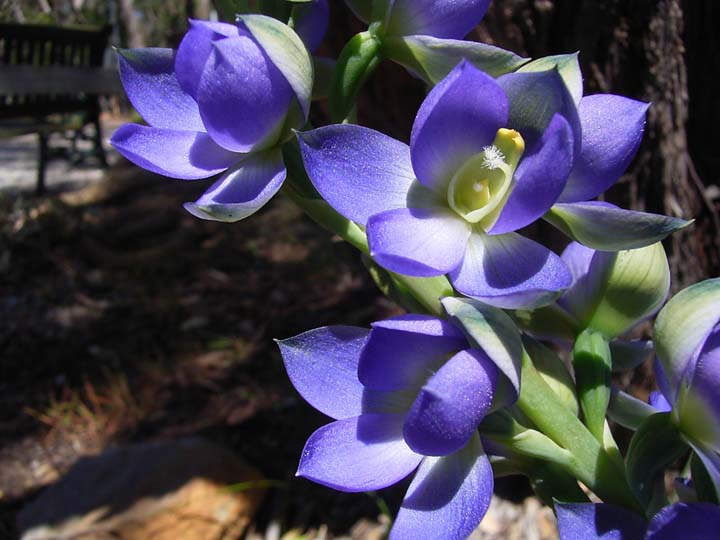
Of the blue orchids, both Ricky Egel and John Badger entered pictures of Thelymitra x truncata (Blue Spotted Hybrid Sun Orchid) whilst Robert Lawrence entered a Thelymitra grandiflora (Giant Sun Orchid) which was the outstanding winning picture.

Blue in the floral world is unusual colour in the floral world for it is not a naturally occurring colour. In fact, “[t}he key ingredient for making blue flowers are the red anthocyanin pigments. Less than 10 percent of the 280,000 species of flowering plants produce blue flowers.” (Lee, 2010 as cited in Oder 2014).

Whilst blue orchids occur outside of Australia, their “colour cannot rival” … “the intensely blue flowers” … “especially [are] unique in the orchid world” … “of their Australian counterparts. The sun orchids (Thelymitra) in particular are famous for their sky blue flowers.” (Ronse 2008: 103)

Based upon Jones 2006 tome, the following genera have true blue orchid species – Cyanicula (9 species), Pheladenia (1 species), Epiblema (1 species) and the largest group Thelymitra (about 65 out of potentially 118 species) plus one hybrid, XGlossodenia tutelata. Of the epiphytes, blue is almost non-existent except for three which Jones lists that rarely might be bluish and they are Vappodes bigibba, V. lithocola and V. phalaenopsis*.

With such rarity, is it any wonder then that the Chinese attached special significance to it as a plant that could cure lung disease and the Aztecs saw it as a symbol of strength.

*Names used as they appear in Jones 2006 tome

Reference

Jones, D. L., A Complete Guide to Native Orchids of Australia Including the Island Territories. Reed New Holland

Lee, David (2010), Nature’s Palette: The Science of Plant Color< Chicago, University of Chicago Press

Oder, T, The Science of Blue Flowers https://www.mnn.com/your-home/organic-farming-gardening/stories/the-science-of-blue-flowers accessed 6 July 2017

Pretty Zesty All About Blue Orchids http://www.prettyzesty.com/2012/11/all-about-blue-orchids.html accessed 6 July 2017

Pterostylis Pollinators

Rudie Kuiter et al have been observing orchid pollinators over many seasons spending hours watching and becoming familiar with pollinator interaction with the orchid, learning when to anticipate pollination activity.

Their observations of various Pterostylis species has been documented in Overview of Pterostylis Pollination (Orchidaceae) in Victoria. In all, they observed 53 Pterostylis species and 40 species of pollinators from several different genera. They noted that some pollinators species were active most of the day but others were only active in the late afternoon whilst others were “only seen on dusk and possibly are nocturnal as well”.