March 2016 Winning Photograph

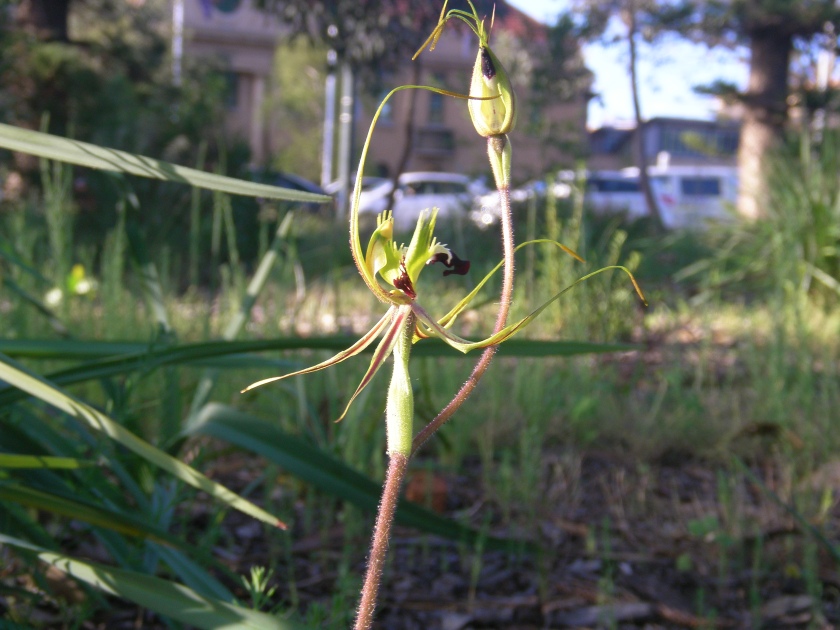
1603 sm JS Arachnorchis sp

We frequently receive entries from Western Australia but this month our entries were from both the west and the east. Allen Jennings entered a Calanthe triplicata (Christmas Orchid) from New South Wales. Pauline Meyer’s was from the west, (Western) Flying Duck Orchid, Paracaleana nigrita. The other entries were South Australian, Jenny Pauley’s recently photographed Leporella fimbriata (Fringed Hare Orchid), Greg Sara’s Thelymitra rubra (Common Pink Sun Orchid) and Judy Sara’s Plumatochilos sp. (Bearded Orchid) and Arachnorchis sp. (Spider Orchid).

The winning photograph was Judy’s Spider Orchid. Obviously it was one of the Green Comb Spider Orchids – A. dilatata complex. Of this group there are about a dozen possibilities. Knowing the location, Mt Boothby, helped to narrow the options with the most likely candidate being Arachnorchis stricta but it wasn’t convincing. It would appear that the tips of the sepals may have been chewed off when in bud.

A distinguishing feature of this species is that there are no clubs or osmophores on the sepals. Other species of this complex have clubs. Another feature is that the dorsal sepal is bent over the column unlike many other green combs which have an erect dorsal sepal. The features that caused doubt were lateral sepals looking droopy instead of being characteristically stiffly held out but dry conditions could cause this. The other was that the labellum did not strictly fit the description of A. stricta but then again it is a variable species.

The conclusion was a possible hybrid but there is no information on the likely parents or that is an atypical A. stricta that may have been damaged in bud.

This is an example of the difficulties that can occur when attempting to identify a plant from one photograph.

Reference:

Personal communications Thelma Bridle (NOSSA Conservation Officer)

Personal communications Bob Bates

Bates, R. J., ed. (2011). South Australian Native Orchids. Electronic version, 2011. NOSSA

Rules of entry:

The subject matter must have something to do with Australian orchids.  Any format is acceptable including Photo shopped images, artwork, etc

How to enter:

Email nossa.enquiries@gmail.com – jpg as large as you are able to send it, preferably A4 ratio for printing

Post: PO Box 565, Unley, 5061

Bring in to the meeting

February 2016 Winning Photograph

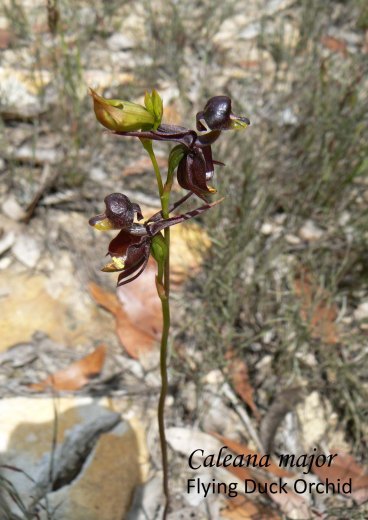
1602 sm PM Caleana major

For our first competition of the year we had five photographs – three of flowers and two of participants on a field trip.  The species represented were David Mangelsdorf’s Calochilus robertsonii (Southern Bearded Orchid); Robert Lawrence’s Pheladenia deformis (Blue Bearded Orchid) and Pauline Meyer’s Caleana major (Flying Duck Orchid) which was the winning photograph.

There is no doubt that the Duck Orchids are very photogenic and that people want to see and photograph them.  When seen the for the first time their small size surprises most.  The flower is no bigger than a thumbnail, perched atop a spindly stalk that may only reach 50cms (20 inches).

Although the rusty red colour of the flower is quite exquisite, this means that it blends in with the surrounding leaf litter and scrub and is not easily spotted.

As species of Heathy Woodlands, in South Australia, it is often found growing in sparse colonies near the base of trees.  Other plants associated with them are banksias, eg Banksia ornata, Eucalyptus baxteri and bracken.  The soil is sandy, often from leached acidic dunes, or gravelly.

Reference:

2008 Department for Environment and Heritage Electronic Flora of South Australia species Fact Sheet: Caleana major R.Br. Available from pa-fact-pafactcaleanamajor.pdf

Bates, R. J., ed. (2011). South Australian Native Orchids. Electronic version, 2011. NOSSA

Growing Cymbidium canaliculatum in Adelaide 1983 and Now

In 1983, Ron Robjohns, NOSSA’s first treasurer, wrote a comprehensive series of articles about growing epiphytes in South Australia. Thirty years on Ron’s information for growing is still helpful and applicable for today. Any updates or extra information are in black text.

NATIVE ORCHID SOCIETY OF SOUTH AUSTRALIA JOURNAL Volume 7, No. 11, December, 1983

GROWING EPIPHYTIC ORCHIDS IN SOUTH AUSTRALIA – R.T. Robjohns

Cymbidium canaliculatum

A most interesting orchid, also one of the few epiphytes to grow in Western Australia. It is credited with a southern limit of near Forbes in New South Wales, extending northwards to Cape Yorke Peninsula in northern Queensland and westwards across the Northern Territory to the northern areas of Western Australia. Although sometimes found in the near coastal areas of the eastern states it is primarily a plant of the open forests of the drier inland areas. In some of its habitats there is less than a 55 cm rainfall, summer temperatures of over 38⁰ C with a very low humidity and winter temperatures dropping to below freezing. While not exclusively, it is usually found growing in hollow branches or trunks of trees where its roots penetrate the decomposed wood and often grow to considerable length. No doubt the fact that the roots are protected from the heat enables it to survive and even thrive under such harsh conditions.

It frequently grows to form large clumps of crowded pseudobulbs having two to six leaves which are thick, rigid and channelled and are from 10 to 50 cm long and 2 to 4 cm wide. The racemes are up to 50 cm long and can be erect or pendulous with up to 60 extremely variable flowers about 2-3 cm across.

The colours range from green, brown, purple, dull red or a combination of those colours and may be either with or without spotting, the labellum, however, is usually white with red markings.

I find that C. canaliculatum responds reasonably well to cultivation and have grown and flowered it in plastic planters filled with a mix of charcoal, pine bark and rotted hardwood, also in hollow logs filled with the same mixture. Propagation from backbulbs has been with limited success and it looks like about a six year project from planting to flowering.

An established plant can take full sun and will withstand our winter frosts without detriment. Fertilising has been with the occasional dose of liquid fertiliser. When purchasing from a nursery I would suggest medium to small plants as although large clumps may look attractive they usually have had the root system almost completely removed – an operation to which they do not take kindly.

Cym caniculatum drawing

Les adds that Cym. canaliculatum should be kept dry from Anzac Day (25th April) to September when the flower spikes appear.

Growing Sarchochilus hartmanii in Adelaide 1983 and Now

In 1983, Ron Robjohns, NOSSA’s first treasurer, wrote a comprehensive series of articles about growing epiphytes in South Australia. Thirty years on Ron’s information for growing is still helpful and applicable for today. Any updates or extra information are in black text.

NATIVE ORCHID SOCIETY OF SOUTH AUSTRALIA JOURNAL
Volume 7, No. 10, November, 1983
GROWING EPIPHYTIC ORCHIDS IN SOUTH AUSTRALIA – R.T. Robjohns
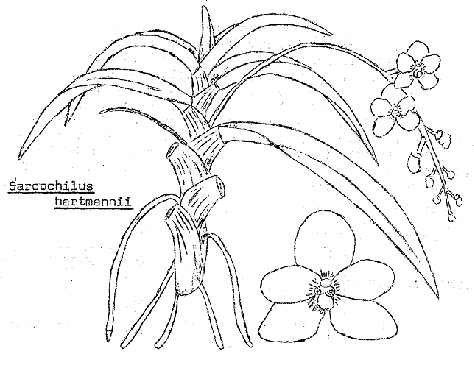
Sarcochilus hartmanii (Hartman’s Sarcochilus)
This has a range from the Hastings River in north-eastern New South Wales to the McPherson Ranges in southern Queensland, although some authorities extend this to the Atherton Tablelands in northern Queensland.
S. hartmanii is lithophytic and is normally found growing on rocks, sometimes forming large masses but usually in small clumps, however, it occasionally grows on trees. It varies in its habitat from bright sunny positions on cliff faces, above 600 metres, to shady seepages. It must be remembered, however, that this is an area of high summer rainfall and in late summer and autumn has considerable cloud cover with accompanying high humidity.

The leaves, 4 to 9 per stem, from 10 to 20cm long, 1 to 2cm across, are thick, fleshy, deeply channelled and slightly twisted at the base.

Racemes are 6 to 25cm long with 5 to 25 flowers usually sparse at first then crowded towards the apex. The flowers are 2 to 3cm in diameter and have petals and sepals of glistening pure white with deep maroon or crimson spots near the base, though sometimes all white.

The flowering period is September to November.

In 1979 a clone of Sarcochilus hartmanii “Kerrie” was awarded AM/AOC. It was a large plant with 16 spikes and approximately 320 flowers measuring 31mm across the petals.

It adapts well to cultivation and is not difficult to grow, doing well in a shadehouse with 60-70% shade and a good air circulation. I have it growing and flowering in a plastic pot in a bark, charcoal* and polystyrene foam mix and would suggest underpotting rather than overpotting. Good drainage is essential. Other growers recommend shallow baskets or rafts about 8 mm of stag-horn fern fibre as this allows the plant to spread more naturally. It likes to be kept moist (not wet), prefers a humid atmosphere and does not object to regular year-round (½ strength) doses of foliar fertiliser.

*Charcoal is not used today.
Sarchochilus hartmanii

Protect Our Orchids – Stay on the Path

This week there was a workshop South Lofty Block Orchid Recovery Project with representatives from Adelaide and Mt Lofty Ranges Natural Resource Management, SA Water, Forestry SA, Park Rangers, Threatened Plant Action Group and NOSSA. Many issues were discussed. One issue briefly discussed was the development of unofficial bike and walking tracks in parks and the negative impact that this would have on rare and endangered orchids.

This issue is not unique to Australia, the American Orchid Society whose mantra is Education, Conservation and Research published in their journal Orchid February 2008 a summary article titled Watch Your Step: Possible Consequences of Walking off the Trail.  The authors are Maryilyn H.S. Light and Michael Mcconaill and the original paper can be found in the Lankesteriana 7:294 – 298  Click on the titles to read the articles.

The researchers studied the effects of visiting a site once a day and standing in the same spot for 10 minutes ie the effects of trampling. Their research suggested that there are possible longer term consequences as they found that the effects of compaction was still observable 18 months later. This does not seem like much but it was sufficient for them to offer some advice such as

  • stay on the tracks,
  • don’t walk on the side as even walking on the side of the track can result in unintended damage as the track is widened,
  • when one person walks off the track others are likely to follow
  • think carefully of the consequences before walking off the track
  • where possible step on rocks, not soil

The research was carried out in Canada and though there are differences between the two countries, there are so many similarities it is worth our while to take note of their advice.

Possibly there is scope for research here in South Australia but in the meantime their summary sentence says it all – Until we know what is happening beneath our feet, we should really watch our step

Stay on the Path
Fortunately our orchids like the edges of paths and so the are easy to spot.  But at the same time, trampling on the edge of the paths means that the orchids can be destroyed and so be lost forever.

Related Article

Orchid Etiquette – Tread Carefully

From the Journals: A Tale of Two Cities – London & Burnside

The following article written by Robert and Rosalie Lawrence is from the Volume 37 No 9 October 2013 Journal of the Native Orchid Society of South Australia

Orchids and the concrete jungle that makes up a city don’t seem together, particularly the terrestrial orchids. Yet in the heart of one of the world’s most well known capital cities such an orchid was found. On the 19th July 2013, the Telegraph reported that botanists from the Natural History Museum had found in the middle of London a white helleborine orchid (Cephalanthera damasonium) which had not been seen in that region since 1900. It was found in the Queen’s backyard, Buckingham Palace. Despite the building, demolishing, rebuilding, bombing and rebuilding that has been going on for the last 400 years, here is an orchid which has survived to surprise the botanist. (For details see Long Lost orchid found in Buckingham Palace Garden)

It is always heartening to hear good news about orchids but here in Adelaide we have our own encouraging story. Settlement in Adelaide is not as long as in London by a long shot but in our own short time we have managed to clear and cover some very good land with concrete and bitumen. The result has been that much of our native flora has been lost with many of our orchid species being the first to disappear.

In recent years effort has been made to bring back the bush with revegetation projects. This work has not tended to involve the orchids, the work of Heather Whiting and her team of volunteers at Vale Park being an exception. Consequently, any orchids found on such sites tend to be the more robust species principally Pterostylis pedunculata, Microtis sp. and in some cases Linguella sp.

Finding anything else will always be special; but that is what has happened at site where a Shell petrol station stood for decades on the corner of Portrush and Greenhill Roads. After the demolition of the service station the site was an area of bare clay for about a decade. Then in 2003, work began on restoring native vegetation incorporating a mini wetland in an area of 2,000 square metres that was given the name Linden “Bush Garden”. Indigenous flora was sourced from the local region and the site has been kept meticulously weed-free by dedicated workers.

Originally 60 local species were planted with several other species arriving by themselves. Among the latter group are five species of orchids. These include a Microtis species and Pterostylis pedunculata, but the other three are more surprizing – Arachnorchis tentaculata, a small blue-flowered Thelymitra species and a Caladenia (syn Petalochilus) species. How they came to be there is a mystery. The long term viability of them will depend upon the continued maintenance of this unique site.

The City of Burnside should be congratulated both for its foresight and initiative as well as its ongoing support of this project.

Orchid 1 Arachnorchis tentaculata
Natural regeneration at Linden Gardens includes three plants of Arachnorchis tentaculata (King spider Orchid) that are understood to have flowered for the first time this year (2013). The buildings of the council chambers can be seen in the background.


Growing Dendrobium aemulum in Adelaide 1983 and Now

In 1983, Ron Robjohns, NOSSA’s first treasurer, wrote a comprehensive series of articles about growing epiphytes in South Australia. Thirty years on Ron’s information for growing is still helpful and applicable for today. Any updates or extra information are in black text.

NATIVE ORCHID SOCIETY OF SOUTH AUSTRALIA JOURNAL

Volume 7, No. 9, October, 1983

GROWING EPIPHYTIC ORCHIDS IN SOUTH AUSTRALIA – R.T. Robjohns

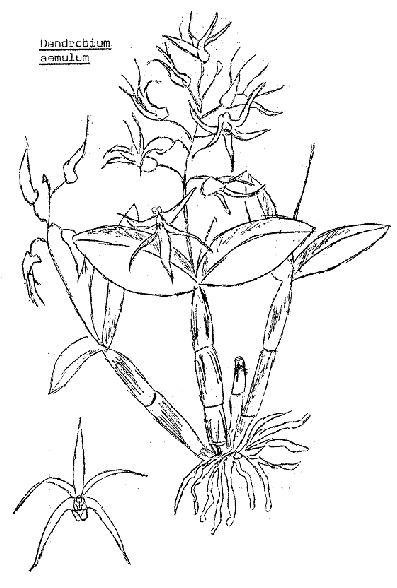
Dendrobium aemulum (Iron Bark Orchid)

There are several growth forms of this orchid due probably to the wide variety of habitats, the flowers of all forms being similar. It has a range from the Clyde River in south eastern New South Wales to the Atherton Tablelands in Queensland

Those growing in the rainforests of New South Wales and Queensland have straight stems up to 20 cm long with 2-4 shining dark green leaves. On the edge of the rainforests in northern New South Wales and southern Queensland in the dense brush forest, the principal hosts are the trunks of “Brush Box” trees where it has stems up to 30 cm long which tend to radiate from a central point. It also has 2-4 dark green leaves. In the open forest areas its hosts are the “Iron Bark” eucalyptus trees, it has shorter (up to 7 cm), stouter (up to) 1 cm), and more crowded stems, sometimes growing into large mats and having 2-4 yellowish green leaves. On the Atherton Tablelands at an altitude of around 750 metres and with callitris trees as its favoured host, it has very slender stems of about 0.3 cm with usually only two dark green leaves.

The flowering period is August/September. One to three slender racemes (5-10 cm long) occur terminally from between the leaves or at nodes along the stem, each raceme bearing 3-20 cm diameter. The flowers are usually pure white (sometimes pale cream) with purple markings on the labellum, the whole raceme turning deep pink before withering.

This is another of our natives which to date does not appear to have attracted much attention from the hybridisers. “Emmy” aemulum x kingianum seems to be the only registered cross.

I find D. aemulum is an easily cultivated and highly rewarding plant that flowers freely with masses of feathery flowers. It grows well mounted on hardwood slabs, cork or on a paperbark branch under 50% shadecloth. Mine get about 65% shade in mid-summer and receive an occasional spray of weak foliar fertiliser during the growing period.

Reference: Dockerill “Australian Indigenous Orchids”.

Dendrobium aemulum
Dendrobium aemulum

Growing Dendrobium gracilicaule in Adelaide 1983 and Now

In 1983, Ron Robjohns, NOSSA’s first treasurer, wrote a comprehensive series of articles about growing epiphytes in South Australia. Thirty years on Ron’s information for growing is still helpful and applicable for today. Any updates or extra information are in black text.

NATIVE ORCHID SOCIETY OF SOUTH AUSTRALIA JOURNAL
Volume 7, No. 8, September, 1983
GROWING EPIPHYTIC ORCHIDS IN SOUTH AUSTRALIA – R.T. Robjohns
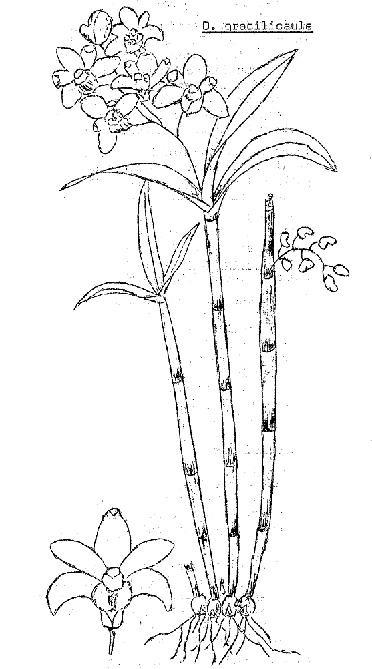
Dendrobium gracilicaule
D. gracilicaule is found from Kiama in eastern New South Wales to the Bloomfield River in the south east of Cape York Peninsula in Queensland. It has one of the widest ranges of habitat of any of our epiphytic orchids, growing in the light coastal scrubs, the dense rainforests and, in the tropical areas, on the tablelands. With such a variation in altitude (from near sea-level to about 1200 metres) it follows that there is a wide variety of hosts, even occasionally growing as a lithophyte on rocks.
The stems are long, thin and cylindrical, ½ to 1 cm thick, and from 20 to 60 cm in length with 3 to 6 ovate to lanceolate, terminal leaves, 5 to 13 cm long and of rather thin, leathery texture.
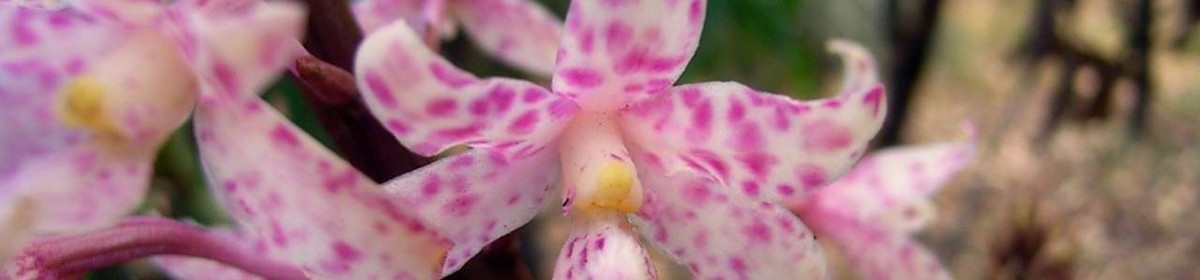
The racemes are short (5 to 12 cm) and bear 5 to 14 small, cup-shaped flowers of a dull or light yellow colour having the outer sepals lightly to heavily blotched or spotted with a brown or red-brown. Occasionally they are found a brighter yellow and without blotching. The flowering season is from July to September.
D. gracilicaule must surely be one of the hardiest and easily cultivated of our Australian epiphytic orchid species as it is adaptable to almost any conditions. I have it growing and flowering on hardwood slabs, paperbark limbs and in a pot, but I think it is better if mounted. It receives 50% – 60% shade and occasional foliar fertiliser. I protect it from frost but the cold does not affect it.
It does not flower from first year stems but will flower from mature stems for several years, even after they are leafless. Although most racemes are terminal or near, I have had racemes occurring from nodes halfway along a leafless canes.
There are two natural hybrids, i.e. D. x suffusum and D. x gracillimum. D. x gracillimum is a natural hybrid between D. gracilicaule and D. speciosum in which the features of D. gracilicaule are dominant in the flower while in D. x suffusum, the natural hybrid between D. gracilicaule and D. kingianum, D. kingianum is the dominant parent. D. gracilicaule has not attracted professional hybridists, probably because the flowers are not as outstanding as many of our other epiphytes, only two crosses appear to be registered: D. Susan (D. gracilicaule x D. falcorostrum) and D. Shan Leaney (D. gracilicaule x D. gracillimum).

Dendrobium gracilicaule

Orchids come in ‘under par’ at Grange Golf course

With the development of cities here in Australia, many of our orchids were lost as habitat was cleared and the newly arrived settlers built houses and reconstructed the gardens they knew from the Old World; but the odd pocket of native bushland has survived.  Cemeteries and golf courses have often been the only refuge for remnant bushland.  One such refuge has been The Pinery, Grange Golf Club, the only known location of Oligochaetochilus arenicola (syn. Pterostylis arenicola) on the Adelaide Plains.  In the National Parks and Wildlife Act, this orchid is scheduled as vulnerable. The Golf Club left this site intact and has been supportive of the conservation efforts of the Threatened Plant Action Group who in turn have received assistance from the Native Orchid Society of SA and the Natural Resources Adelaide and Mt Lofty Ranges.

Typical of the rufus hood this Oligochaetochilus arenicola shows the sencesing leaves, pendent petals and hairs on the labellum. Photographer: H Lawrence
Typical of the rufushoods, this Oligochaetochilus arenicola shows the sencesing leaves, pendent petals and hairs on the labellum.
Photographer: H Lawrence

Below is a media release from the Natural Resources, Adelaide and Mt Lofty Ranges

Orchids come in ‘under par’ at Grange Golf course

News release
30 September 2015

A tiny remnant population of rare orchids which survives in a patch of bush on Grange Golf Course has increased 50% since last year, according to a new survey.

The survey conducted this month found 1200 individuals of the Sandhill Greenhood Orchid (Pterostyllis arenicola), a nationally threatened species which is considered critically endangered in the Adelaide and Mt Lofty Ranges region.

When surveys began 20 years ago, only about 100 plants survived at this site. But the latest survey has revealed the population is steadily increasing

The orchid comeback is thanks to decades of care by four groups involved with the annual survey: the Threatened Plant Action Group, the Native Orchid Society of SA, Natural Resources Adelaide and Mt Lofty Ranges, and with support from the Grange Golf Club.

The tiny fragment of native pine bushland in the middle of Grange Golf Course is one of the only known locations of this species within the entire Adelaide and Mt Lofty Ranges region, with other small populations known from near Wellington and Tailem Bend.

The orchid grows 10cm-25 cm high and produces hood-shaped flowers that are green and brown or red-brown with white markings. Most species of orchid flower for only a short period and for the Sandhill Greenhood, it will flower only for the next few weeks.

Grange Golf Course just happens to provide ideal conditions for the plant: red sandy soils and an over-story of native cypress pine trees.

Dedicated project partners have tackled the main threat to orchids – suffocation by Perennial Veldt Grass and Soursob weeds – through years of patient hand weeding.

The orchid comeback is a great success story of collaboration across the community to save one of our state’s tiny floral gems.

As a demonstration of nature’s interdependence, conserving the Sandhill Greenhood also means conserving a particular mycorrhizal fungus that must be in the soil for Sandhill Greenhood seeds to germinate. In addition, the flowers must be pollinated by a particular type of insect, the fungus gnat. The gnat is attracted by the orchid’s pheromones and tries to mate with the flower, only to find itself loaded up with a packet of pollen which it then transfers to the next flower as it continues its romantic adventures.

While the survey results are good news, the Sandhill Greenhood population is still precariously small, and it is hoped that as the population grows, so do the options to secure the species into the future.

South Australia has over 260 species of orchids, including 50 species of greenhood.

For a free colourful field guide to local orchids, go to http://www.naturalresources.sa.gov.au/adelaidemtloftyranges/home and search for ‘orchid’.

When do I stop watering my Greenhoods?

This was the question posed to Les Nesbitt at the September monthly meeting.  Later there was some further discussion, of which see below:

When do I stop watering my Greenhoods?

The short answer is when the leaves go yellow and start to die off, usually in October- November. Allow the pot to dry out completely to dry up the roots and old tubers so that they do not go mouldy and rot the new tubers.

Australian terrestrial orchids form tubers underground. The mature plant dies back at the end of the growing season and enters a period of dormancy which for South Australian terrestrials is over summer.

A general principle of watering is to match the watering to the rainfall pattern. Whilst there is minimal rain over summer, when dormant tubers are in pots it is important to not let them stay dry for months and become desiccated. A light sprinkling every week or two is sufficient.

Unicode
Pterostylis ‘Nodding Grace’ This is an hybrid between P. nutans and P. curta. Obviously it is not time to stop watering.

When do I start watering again? 

For the cauline group (Diplodiums) from South-eastern Australia start watering at the end of January as the tubers are starting to shoot by then. For other greenhoods start light watering in late February and gradually increase the water until shoots appear usually in March-April. Do not let the pots dry out once leaves are visible.

Diplodium robustum - one of the cauline greenhoods
Diplodium robustum – one of the cauline greenhoods. Note difference the between the leaves of the non-flowering rosettes and the flowering plants.

Other cultivated Australian terrestrial orchids require a similar watering regime although leaves of some appear later in May or June.