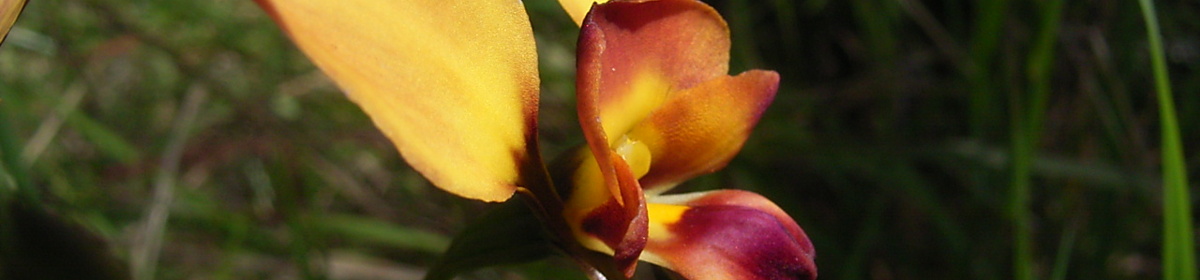
100 years ago on 15 July 1915, the state government declared Morialta a National Pleasure Resort. The Friends of Black Hill and Morialta have been holding a series of public events to celebrate the Centenary of Morialta. As part of the celebrations, the Native Orchid Society of South Australia has conducted some orchid walks in the park.
In 2004, an interim Flora Species List was produced by the then Department for Environment and Heritage and 39 orchid species were listed. It is an interim list and considering that the park is 5.33 square kilometres with a range of different habitats, it is possible that there are more species than originally listed.
One native species not included on the list is Caladenia latifolia but its presence is well known to members of the Native Orchid Society. Unfortunately the South African weed orchid Disa bracteata (Monadenia bracteata) hasalso been found in the park.
In this video most of the shots have not been taken at Morialta but it does showcase some of the orchids that can be found in the park.
In 1983, Ron Robjohns, NOSSA’s first treasurer, wrote a comprehensive series of articles about growing epiphytes in South Australia. Thirty years on Ron’s information for growing is still helpful and applicable for today. Any updates or extra information are in black text.
NATIVE ORCHID SOCIETY OF SOUTH AUSTRALIA JOURNAL
Volume 7, No. 7, August, 1983
GROWING EPIPHYTIC ORCHIDS IN SOUTH AUSTRALIA – R.T. Robjohns
Dendrobium pugioniforme (Dagger Orchid)
This is an epiphyte frequently growing into large pendulous masses on the branches or trunks of trees, mainly in the rain forest areas from Mt. Dromedary on the south coast of New South Wales northwards to the Bunyah Mountains in south eastern Queensland. The stems are slender, wiry and branching, often quite long and usually tangled. Thin creeping roots develop freely from nodes at the branches.
The distinguishing feature of the numerous shiny, thick flat, ovate to lanceolate leaves is the sharply pointed tip.
The flowers are usually single but sometimes 2 or 3 per inflorescence and are 2 to 2½ cm in diameter. The petals and sepals are light green, the labellum pale with bright red or purple markings. The flowering season is September to November.
It is a reasonably hardy plant which will respond to cultivation on quite a variety of hosts. I have had success using Melaleuca, and find that it responds to a position having plenty of shade and moisture, particularly during our summer. Although in the wild it will tolerate cold conditions, (being found from near sea level to around 1300 metres), it will require shelter from our winter frosts
Most authorities designate it an epiphyte, however, in “The Orchadian” Vol. 4, No. 2, p. 24 (1972) D.L. Jones reports having found a bleached and tough looking plant growing on Alum Mountain with its roots amongst leaf litter in a crevice. Again in “The Orchadian” Vol. 7, No. 7, p. 164 (1983) G. Walsh describes ‘inter alia‘ lithophytic forms of D. pugioniforme growing in the Illawarra District of New South Wales.
In view of this it could possibly be grown in a pot, but as it grows quite readily on a slab I have felt it pointless to possibly waste a plant just to grow it in a pot. Fertilise in the growing season with foliar fertiliser at half the recommended strength.
Two naturally occurring hybrids of D. pugioniforme have been recorded – D. pugioniforme x D. tenuissimum and D. pugioniforme x D. beckleri but they are relatively rare (Ford, “The Orchadian”, Vol, 3, No. 7, p.88: Dockerill, Aust. Indig. Orch. Vol. 1, pp 370-371) and as yet it has not yet attracted the hybridists as there does not appear to be any registered crossings.
Of the five entries this month, three were spider orchids and the winner was from this group. It was Rob Pauley’s Arachnorchis cardiochila (syn Caladenia cardiochila), Heart Lip Spider Orchid which can be found across South Australia and into western Victoria. At one time a specimen was found on Flinders Island, Tasmania but as it was collected in 1947 it is considered extinct in that region.
This lovely flower is quite variable in colour and form.
The heart shape labellum is a distinctive feature of this spider orchid, so it is not surprising that this is reflected in the name. Cardio means heart and chila lip.
What probably is surprising is that the traditional heart shape symbol has come full circle. It had a botanical origin. According to cardiologist Professor Armin Dietz the symbol was originally a stylized vine/ivy leaf as evidenced from paintings on goblets from the 3rd millennium. In the Middle Ages, doctors and anatomists used the shape to represent the heart. As at that time Latin and Greek were both the international languages of scholars, including doctors, the word associated with the symbol was the Greek word kardia (ie cardio) meaning heart. Consequently, by the time Ralph Tate names this species in 1887, the shape has become intrinsically linked with the heart and so it must have appeared to him as an obvious descriptive name.
There are several field guides which give a detailed description of the species including South Australia’s Native Orchids DVD-ROM which is available for sale from NOSSA.
The texts published on this website are taken from his book “Ewige Herzen – Kleine Kulturgeschichte der Herzbestattungen” (“Eternal Hearts – a short cultural history of heart burials”), published 1998 in MMV Medien und Medizin Verlag, Munich. (English translation by Pauline Liesenfeld.)
In 1983, Ron Robjohns, NOSSA’s first treasurer, wrote a comprehensive series of articles about growing epiphytes in South Australia. Thirty years on Ron’s information for growing is still helpful and applicable for today. Any updates or extra information are in black text.
NATIVE ORCHID SOCIETY OF SOUTH AUSTRALIA JOURNAL
Volume 7, No. 6, July, 1983
GROWING EPIPHYTIC ORCHIDS IN SOUTH AUSTRALIA – R.T. Robjohns
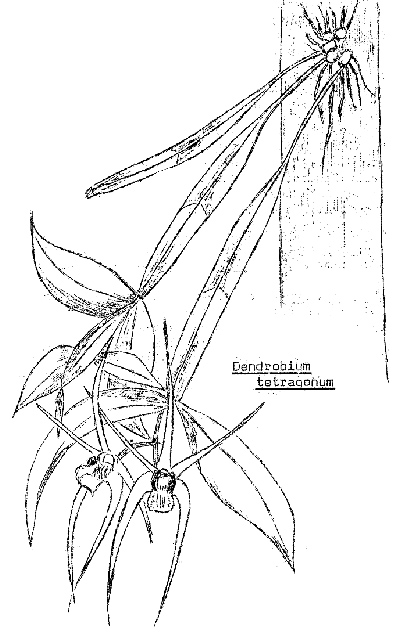
Dendrobium tetragonum (Tree Spider Orchid)
A variable epiphytic species growing mainly in rainforest areas from Illawarra in New South Wales to the Endeavour River in Queensland. A favourite haunt is on trees overhanging water, often in deep shade. It has a variety of hosts (including Myrtles, Eugenias, Water Gums and occasionally Melaleuca) on which it grows into small clumps. Altitude is of little concern as it is found from near sea level to approximately 1000 metres.
The stems, which are semi-pendulous and from 6 to 45 cm long, arise from a prostrate and branching rhizome They are round, thin and wiry at the base but thickening to become rectangular (hence the name tetragonum – derived from the Greek “tetra” meaning “four-sided”), then tapering slightly before the leaves. There are from 2 to 5 leaves up to 8 cm long at the end of the stems. They are deep green in colour and often with crinkled or wavy margins.
The racemes appear from between the leaves but are short and have from 1 to 5 flowers which are widely spreading and spidery in appearance. The colour is greenish/yellow with irregular and variable brown, red and purple markings. In size the flowers are from 4 to 9 cm from the top of the dorsal sepal to the tip of the lateral sepal and they have quite a pronounced fragrance.
The var giganteum is the tropical species and ranges from the Fitzroy to the Endeavour Rivers. The flowers are usually larger, but not always, and have a slightly different colour pattern.
The plant does not lend itself readily to pot culture and should be mounted. I have it growing on Melaleuca and cork slabs, but best results have been with one mounted on a hardwood slab.
I find that it needs little more than 50% shade plus humidity and, of course, plenty of air movement. Protect from frosts. Fertilise in the growing period with foliar fertiliser at half recommended strength. A number of interesting hybrids have been produced using D. tetragonum as one of the parents. They mostly flower well and have reasonably large flowers.
Part One – Attracting Pollinators looked at pollination strategy, but the fourth aim of the paper was to establish that Corunastylis littoralis reproduced by xenogamy or geitonogamy and that the species was not autogamous or apomictic, that is, pollinated, self pollinating or non pollinating plants.
Xenogamy or geitonogamy that is vector mediated pollination or out-crossing is when fertilization occurs by the transfer of pollen from one flower to another flower usually by the means of insect.
Autogamy or self-pollinating is when the flower is pollinated by its own pollen.
Apoximis is when reproduction occurs without pollination, that is, vegetative reproduction.
As explained in the paper, there are visual clues for determining which process is used by the plant.
Xenogmay
Autogamy
Apoximis
Pollinia removal and pollen deposition
Pollinia not removed
Lacks pollen or it is tightly bound
Pollinia weakly attached to the viscidium
If pollinia present, then unable to be removed
Not all the ovaries are fertilized
All the ovaries are fertilized and have viable seeds
Swelling of the ovaries can occur whilst in bud
Perfumed
Likely to have no perfume
Attracts insects
Flowers short lived
More detailed information was gained by dissecting the flower.
Of the five entries this month, four featured winter orchids. Lorraine Badger entered a Diplodium robustum, whilst Claire Chesson, Robert and Rosalie Lawrence all entered Urochilus sangineus. Though not the winning photographs it was interesting to see the differences between the U. sangineus with one being no taller than the small Acianthus pusillus next to it and another being taller than the rapier sedge.
But the winning photograph was the spring flowering Arachnorchis argocalla (White Beauty Spider Orchid) by Pauline Meyers. This is amongst our most threatened orchids and is dealt with in depth in the Recovery Plan For Twelve Threatened Orchids in the Lofty Block Region of South Australia 2010. This fungi dependent endemic orchid is rated Endangered both at State and National level.
Found in the Southern and Northern Lofty regions, it range has been severely reduced by possibly 80%. Since 1918 no plant has been found south of Adelaide.
Flowering from September to October, it is often found in grassy woodlands often growing on gentle southerly-facing hill slopes. The soil is a clay loam with a high humus content.
This beautiful orchid has one to two non-perfumed white flowers with thickened but not clubbed drooping lateral sepals and petals. The strongly recurved broad labellum is usually white, sometimes crimson, fringed with short teeth.
This is one of our larger spider orchids reaching a height of 60cms. The size of the plant flower and leaf help to distinguish it from other similar appearing orchids such as A. brumalis and albino flowers of A. behrii.
Like many of the spider orchids it takes 2 – 5 years to reach maturity and then has a potential reproductive life of 10 years. With an average pollination rate of less than 10%, the potential to increase the population is low and any threat to survival of the individual plants needs to taken seriously.
Some threats are obvious such as weed invasion including the garden escapees such as Topped lavender (Lavandula stoechas spp. stoechas) and action is being taken to curb the spread of weeds through targeted weeding programs.
Another threat is habitat loss. This has been the result of land clearing but sites are being protected either through conservation legislation or Heritage Agreements. Habitat loss can also occur indirectly and that is through Phytophthora being introduced into the sites. Although the direct effect of Phytophtora on the orchid is unknown, it is known that it can affect the plants that grow in association with this orchid. This threat can be reduced by all of us implementing good hygiene practices.
These were some of the threats noted in the Recovery Plan. This plan was not just defensive, ie attempt to halt and minimalize the damage; but it was also proactive with measures outlined to increase the population. These included seed and fungi collection eventually resulting in germination and cultivation with a view to re-introduction.
It is good to see that there is a plan and active steps are being taken to bring this orchid back from threat of extinction.
Photographers from L to R: Claire Chesson, Rosalie Lawrence, Lorraine Badger, Robert Lawrence
In 1983, Ron Robjohns, NOSSA’s first treasurer, wrote a comprehensive series of articles about growing epiphytes in South Australia. Thirty years on Ron’s information for growing is still helpful and applicable for today. Any updates or extra information are in black text.
NATIVE ORCHID SOCIETY OF SOUTH AUSTRALIA JOURNAL
Volume 7, No. 4, May, 1983
GROWING EPIPHYTES IN SOUTH AUSTRALIA – R.T. Robjohns
Dendrobium linguiforme (Tongue Orchid)
The plant is epiphytic or lithophytic, forming large masses on trees or rocks. Its range is from the extreme south-east of New South Wales to at least the Burdekin River in Queensland. It grows from sea-level to altitudes of around 1000 metres, but is confined mainly to the coastal areas, although it has been found up to 250 kilometres inland. The inland plants have smaller, tougher leaves than those of the coastal areas, due no doubt to the harsher conditions under which they exist. It is not confined to a specific host but is found on quite a large variety of trees.
The rhizomes are prostrate and branching with thick, tough ovate leaves, 3 to 4 cm long having distinctive longitudinal furrows on top.
The racemes, up to 15 cm long, grow from just below the base of the leaf and bears from six to 20 flowers. The flowers are usually white or cream with a number of faint purple markings on the labellum.
The flowering time is usually August-September here but earlier in the tropical areas.
It does not lend itself to pot culture but is very hardy and with a little care will grow freely on cork or hardwood slabs. I have had good success using pieces of Melaleuca on which it readily establishes itself. It receives approximately 75% shade. It should be protected from our frosts and can be fertilised using foliar fertilisers at half the recommended strength.
This is the variety of the species on which the genus Dendrobium was founded. It was first described by O. Swartz.
There are three varieties of this species, the best known of which is var. nugentii, which is a tropical form from about the Burdekin River north to Bloomfield River in the south-east of Cape York Peninsula.
This form has broader, thicker leaves which are more rounded at the apex and in addition to the longitudinal furrows it often has transverse furrows. The flowers of this form are slightly smaller and age quicker.
This week’s post is taking a brief look at a paper by Noushka Reiter, Mark Clements and Kate Vlcek which appeared in Muelleria, Volume 31: 69 – 76, 2013.
Titled “An examination of Pterostylis xerophila (Orchidaceae) and the confirmation of P. lingua as a new species in Victoria” this paper seeks to ascertain whether the records collected are correctly identified, that there are differences between them both in morphology and associated vegetation.
Both P. xerophila and P. lingua are found in South Australia where they are known, respectively, by the synonyms Oligochaetochilus xerophilus and O. linguus. In fact the type specimen for O. xerophilus is from South Australia.
In the introduction, the authors give a detailed description of Oligochaetochilus otherwise known as the ‘rufa group’ which differs from Pterostylis, in the strict sense, in several features. Some of the main features of this group are:
Basal rosette of overlapping stemless leaves
Leaves senesced, withered and died, by flowering
Erect multi-flowered
Flowers
Lateral sepals
hang down
basal half joined
tips become long and threadlike
Labellum
is very mobile
has obvious long white hairs and often short hairs as well
Typical of the rufus hood, this Oligochaetochilus arenicola shows the sencesing leaves, pendent petals and hairs on the labellum. Photographer: H Lawrence
Later in the articles, the differences between the two species are discussed. There is much of interest concerning the two species but one outcome of the research was to establish that P. lingua (O. linguus) had been incorrectly identified in the records and by correcting the names of the specimens the authors were able to confirm that it did occur in Victoria.
To find the answer to the authors other questions, read the paper
And for those that need a glossary of the terminology used, click here
For images of P. xerophila (O. xerophilus) click here
Despite having five very different but high quality photographs, Helen Lawrence’s photograph of Calochilus cupreus (Aldinga Bearded Orchid) was the clear winner with the vast majority of votes.
In South Australia it is considered endemic and endangered. Researching it was interesting. For instance, there is no mention of it in Jones extensive book (2006) yet it was named by R S Rogers in 1918 with a description appearing in Black’s Flora of South Australia (1922 edition), including a drawing by Rosa Fiveash. Between then and now there was a shift. In the Third edition of Black’s (1978) C. cupreus is absent but C. campestris present. In Bates and Weber 1990 the authors describe C. campetris (C. cupreus). Currently, the eflora of South Australia (the electronic version of 1986 Flora of South Australia) considers it a synonym of C. campestris. This is reflected in the Census.
It would appear that as C. campestris was studied and its variations documented (e.g. article by Jones 1976 Orchadian 5:83) the distinction with C. cupreus was lost. Clements and Jones (2006) state “Calochilus cupreus R.S.Rogers = Calochilus campestris” which means that they are not using C. cupreus. But in Jones’ book an anomaly occurs – he does not include South Australia in the distribution of C. campestris and as result Bates, from 2008, states that it is not recognized as occurring in South Australia.
Though C. cupreus disappeared from the literature the name still continued to be discussed amongst orchid enthusiasts. So when in 1995 NOSSA members found a distinctively different colony at Aldinga they identified it as Rogers’ C. cupreus.
Below is a chart, based upon Dr Rogers’ description, of some of the differences that made him consider C. cupreus a separate species:
C. cupreus
C. campestris
C. robertsonii
Shorter leaf
Rather rigid or fleshy erect triangular section
Longer leaf
Crescentic section
Longer leaf
Crescentic section
Base of labellum oblong glabrous (without hairs) with several raised longitudinal line
Base of labellum round thickened, smooth no raised longitudinal lines
In 1983, Ron Robjohns, NOSSA’s first treasurer, wrote a comprehensive series of articles about growing epiphytes in South Australia. Thirty years on Ron’s information for growing is still helpful and applicable for today. Any updates or extra information are in black text.
NATIVE ORCHID SOCIETY OF SOUTH AUSTRALIA JOURNAL
Volume 7, No. 3, April, 1983
GROWING EPIPHYTIC ORCHIDS IN SOUTH AUSTRALIA – R.T. Robjohns
Epiphytes usually grow where there is plenty of air movement, ample light but also shade and to achieve this they are frequently found well above the ground storey in the forest from where, should they be dislodged from their host and fall to the forest floor they wither and die. With most plants the roots grow downwards, however, with epiphytes in their natural habitat, the roots may grow up, down or around their host, that is, in any direction in search of suitable conditions.
As a novice grower I urge you to learn all you can about the natural habitat of the plant and its principal host, bearing in mind that in accounts of plants that grow on rock faces, often they are growing with their roots in crevices into which any moisture drains and maybe in an accumulation of leaf litter. Frequently the rocks on which the lithophytic orchids grow are sandstone – a rock which can absorb moisture and consequently keeps cool longer than most other rocks. “In an exposed situation” should not be construed as being in full sun all of the time: usually they receive some shade.
With the possible exception of Cymbidium canaliculatum few epiphytes grow at their best in full sun in nature. Full sun in the hot dry South Australian summer will usually burn off the plants or at the best cause severe yellowing and loss of leaves. It is to be noted that this State has no native epiphytic orchids.
Most Australian epiphytic orchids grow in the coastal belt of northern New South Wales and Queensland where the average rainfall in their DRY season is much the same as the Adelaide winter or WET season with which it coincides, consequently advice that plants require to dry out during the winter should not be taken to the extreme and the plants left without water.
The three principal requirements of epiphytes are a free air circulation, a semi-shaded position and free drainage.
In South Australia epiphytes are grown in two ways, the most popular being pot culture and the other slab culture.
For pot culture the medium must be a free draining one and a mixture of “aged” pinebark, scoria and charcoal is quite effective.
Note 2015 – Today the potting media used is composted pine bark. Charcoal is not used and scoria can get cold and wet in winter.
In choosing material for slab culture consider the conditions under which you intend to grow the plants. For humid conditions cork is ideal while tree fern, which holds moisture longer, is good for dry conditions, although any of our native trees with papery or corky bark is suitable. Perhaps you would wish to attach the plants directly to trees in your garden, for this purpose try Jacaranda, Melaleuca or trees with a similar bark.
Watering is important, slab culture requires more watering than pot culture and in summer water orchids on slabs at least every second day and every-day during a hot spell. Water according to the weather and watch for signs of stress – in wintertime the rain is usually sufficient.
Fertilising is best done using half of the recommended strength of commercial proprietary fertilisers.
As a last general recommendation – beware of frosts. Last year (1982) the frosts in some areas of Adelaide caused severe losses amongst plants of epiphytic native orchids. Large tubs of D*. speciosum, whose thick leathery leaves I mistakenly thought frost resistant, were reduced to a mass of leafless canes; even baskets of D. kingianum hanging three feet below the 50% shadecloth had all of the leaves burnt off. These were but two of the varieties which suffered, so be warned and ensure that your plants are protected from frosts.