A common question asked is when to water terrestrials. The short answer is to keep them dry over summer but there are variations such as was previously posted about the watering regime for Chiloglottis. In the March 2017 NOSSA Journal, Les Nesbitt’s article highlights another watering variation.
Blue Tags
Les Nesbitt
Jane Higgs’ lovely pot of the red form of Pterostylis coccina in flower had a blue tag. Jane explained that a blue tag meant that watering had to commence in January for that pot and not at the end of February as is normal for most terrestrials. Start watering later and there will be no flowers. Her pots are under a solid roof. She explained that in the ANOS Vic cultural booklet (Cultivation of Australian Native Orchids) there is a list of cauline type greenhoods which she tags with blue, and includes Pterostylis decurva, aestiva, laxa, coccina, revoluta, reflexa, truncata, robusta, alata, and fischii. To this list can be added abrupta and also the rosette types ophioglossa and baptistii which shoot early.
I have trouble growing and flowering this group of Autumn flowering greenhoods. I went home and dragged out my ANOS Vic booklet and brushed up on the notes. I found several old blue labels in the shed and cut them into strips. I now have blue labels in my pots and the pots are grouped together in the shadehouse where they get afternoon shade. They were given a thorough watering but it will be too late to expect flowers this year. I find large tubers of this group rot easily in Spring and the plants go dormant earlier than other greenhoods. I will try to remember to move the pots under cover in September to let them dry off.
Diplodium robustum – one of the cauline greenhoods
Having a visual reminder would certainly make it easier to know when and which pots to water. Obviously other coloured tags can be used instead of blue, so long as they stand out from the label.
Orchid names are contentious. The reasons appear to be complex but whatever the reasons the situation exists whereby some orchidologists are naming species that may or may not be accepted by others. The result is that there are publications using different names for the same species. And of course, in the midst of it all, are those names that have been accepted for previous species with phrase names or manuscript names.
Whatever the name, it is helpful then to be able to match them up. Last week’s blog covered South Australian names but in the same week Andrew Brown published on the Western Australian Native Orchid Conservation Study Group Facebook an updated list of WA orchids whereby he has linked them with significant WA Orchid field guide books.
Andrew has kindly given permission for this list to be published. Other lists are also included and these are available on the NOSSA’s Orchid eBook page.
It is worth reading Andrew’s introduction in ALIGNMENT of WESTERN AUSTRALIAN DIURIS AND PTEROSTYLIS NAMES.
The object of this exercise is to align the phrase names in these three publications with names published in recent taxonomic papers. Please note that most, but not all, currently recognized (described and undescribed) Western Australian Diuris and Pterostylis are included. There are other taxa that may be considered worthy of recognition but have not been included at this time as we feel further research is required.
In the case of phrase names, these are added and removed for taxa as new information comes to hand and should not be thought of as the final view. Rather, these should be thought of as current thinking that may change in the future. Taxa are only formally recognized as being distinct once their scientific names are published. Even then, later thinking may result in further changes.
Given that phrase names are a work in progress, some may think that we should not be promoting their use and that they should not be included in popular books. However, I think it is worthwhile putting them out to the wider audience so that their distinctiveness can be debated. Having a large group of people looking for (and at) these taxa provides us with a great deal of information and opinion based on firsthand experience in the field, that we may not otherwise have obtained. Then, if and when the taxon is formally described, it will be done on a much more informed basis.
As I am sure you are aware, the naming plants is an evolving process and there will be further changes as new information comes to light.
Continuing last week’s blog, here is the completion of Rudie Kuiter’s Introducion, Orchid Pollinators of Victoria. In this section he discusses some factors of hybridisation and the value of regular observation by local people interested in orchids.
Lissopimpla excelsa is the pollinator of all members of Cryptostylis, but hybrids are not known, even when sympatric, thus a molecular mechanism is in place that prevents cross-fertilisation. Hybrids in other orchid genera do occur and these usually are amongst closely related species. Several congeneric orchids attract the same male pollinator species, thus would be emitting the same kairomones, the scent that is a mimic of the female’s sex-pheromones, but normally these orchids are allopatric or have different habitat preferences. The land clearing, frequent fires, changes of watercourses, gold-diggings are amongst many unnatural human habitat interference of recent times. Historically in undisturbed natural habitats sibling orchid species that attracted the same male insect were not sympatric, not flowering at the same time or were in close vicinity to each other. In disturbed sites the situation has changed, as closely related species may have become sympatric and hybridisation take place. Spider-orchids that attract thyniid wasps with kairomones normally target a certain local species, but many allopatric species are know to share the same pollinator and readily hybridise where they became sympatric. In Pterostylis greenhoods the known hybrids are also caused when different species attract the same pollinators.
Cryptostylis subulata (Moose Orchid)
We still have much to learn to fully understand how adaptable the orchids are, the role insects play and how to interpret what we see. Orchids are finely tuned to their world and can change and adapt in ways that most people seem to underestimate. I requires observations of the same plants over many seasons to get a good understanding of their variability and adaptability. Unusual forms often show after a drought or fire may look like a new species, but soon change back to typical or normal within a few good seasons or after regeneration. It is usually the local people taking an interest that see the changes in the same plants over time that dispute what the ‘on-the-fly’ taxonomist come up with.
Creatures evolved as part of an endless combination of life-forms, ranging from microscopic to the tallest tree, that together form an ecosystem in which all organisms depend on each other. The climate, weather and other factors changes the environment constantly that influence the members differently, dome doing better than others, but it collectively maintains a balance. Natural events such as a major fire or flood may benefit environments in areas as part of seemingly long cycles, but they are very short in evolutionary terms. Unnatural man-made fires are very destructive as these are conducted much too frequently, wrong time of the year, and in the wrong place. Not obvious, but also very detrimental is the use of insecticides that seems to effect the Diptera members the most. Many of the important pollinators such as the fungus-gnats have gone locally extinct and most of the Pterostylis depend on them. To work with the pollinators it is essential to have a good understand of the life-cycles of the insects involved and watch the flowers in the wild. After witnessing Pollinator behaviours of the fungus-gnat on Pterostylis nutans countless times, the principal pollinator is easily recognised with other species. Unfortunately few good areas to find orchids and learn about their pollinators are left. Many are now rare and measures taken to protect them usually focuses on just a species. To be effective their habitat area and surrounding needs to be cared for, letting the natives grow and have the natural canopy reform. At least, habitats should be protected from further disturbances, especially by badly informed governmental environment departments with their fires.
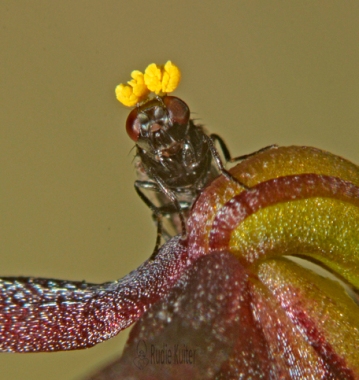
Pollinator with pollinia
Note This book is solely based on first-hand observations on the orchid-pollinators in the wild. Descriptions and comments are from many hours of watching each species over multiple seasons.
Apart from Orchid Pollinators of Victoria, Rudie Kuiter has produced several Victorian orchid books. If you are interested in purchasing any please contact us.
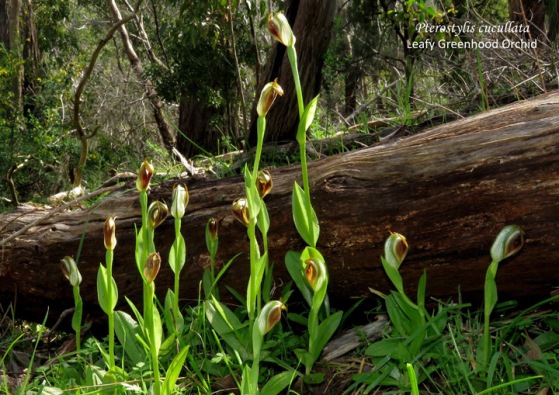
Spring is here and it was reflected in the variety and large number of entries. Lorraine Badger and Ros Miller entered Western Australian species – Caladenia x ericksoniae (Prisoner Orchid) and Paracaelana nigrita (Flying Duck Orchid) respectively. The other six entries were all from South Australia, Diplodium robustum (Common Green Shell Orchid), Caleana major (Flying Duck Orchid) both from Jane Higgs, Greg Sara’s Oligochaetochilus sp (Rufoushood), Judy Sara’s Arachnorchis leptochila (Queen Spider Orchid), Claire Chesson’s Diuris behrii (Cowslip Orchid or Golden Moths) and the outstanding winning picture Pterostylis cucullata by Bevin Scholz.
In many ways, Bevin’s picture of P. cucullata (Leafy Greenhood) is a special picture because it represents some of the conservation work with which NOSSA is involved. For many years NOSSA has worked with the Threatened Plant Action Group (TPAG) to weed the areas in Belair where this species is located and to see such a good show of plants is encouraging. It is a tribute to all who have contributed with their time and labour.
P. cucullata is rated Vulnerable both in South Australia and Victoria, and Endangered in Tasmania. It is also rated Vulnerable under the EPBC Act (Federal). Nationally it is known from about 110 sites with most of these sites being in Victoria and only a few sites in South Australia with Belair National Park having the largest and most important population for the state.
Historically this species covered an area of 2107 km2 in the Lofty Block region but that has now contracted by 82% to only 366 km2 with few locations. With such a reduced range, recovery plans were developed, both at state and federal level. The plans examined the risks and threats to the survival of the different populations.
One of the threats to this orchid is fire, including proscribed burns. Unlike some species such as Pyrorchis nigricans, Leptoceras menziesii or Prasophyllum elatum which flower well after fire, P. cucullata is fire sensitive; populations decline substantially. There does not seem to be a safe time to burn for this species. Should a population survive a burn, it would take it many years to recover.
Fire also leaves the population vulnerable to another threat, that of weed invasion. Unfortunately, it is weedy where this species survives but over the years, a consistent, targeted weeding program has resulted in a declining weed population. NOSSA and TPAG have appreciated the work and effort of volunteers and gladly welcome anyone else who would like to join. And one of the rewards? A beautiful, sunlit display of flowers as seen in Bevin’s picture.
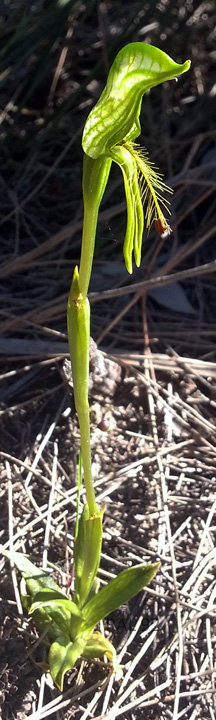
If you are out and about this week, keep an eye out for this attractive and unusual greenhood with its bottle brush labellum and rosette of “pineapple” like leaves.
Commonly known as Woodland Plumed or Bearded Greenhood, or Plumatochilos sp. Woodland Bearded Greenhood. The reason for the phrase name is because many consider that it is a separate species, in this instance, from Plumatochilos plumosum (syn Pterostylis plumosa). Originally all of the Bearded Greenhood were considered as one species – Pterostylis barbata but then Leo Cady named Pterostylis plumosa as a separate species. David Jones in his 2006 tome listed four species, P. barbatum, P plumosum, P. tasmanicum and P. turfosum.
Here in South Australia, Bates lists P. tasmanicum and two with phrase names suggesting that they are distinct from P. plumosum.
Peter Fehre recently posted on the Tasmanian Native Orchids Facebook page some helpful hints differentiating between P. tasmanicum and P. plumosum. Very similar information is found in Bates South Australia’s Native Orchids. These differences are:
P. tasmanicum – a short plant: short flower stem (not more than 14 cms), short labellum (to 15mm) , short ovary; short blunted galea (hood) to 25mm. It prefers damp, sandy areas and swamp margins.
P. plumosum – has length; long flower stem (10 – 30 cm), galea to 40mm with a long tip, long labellum (to 25mm). It is a plant of the woodlands and forests growing on well drained soil.
The differences between the two phrase named species are more subtle
References:
R J Bates, 2011, South Australia’s Native Orchids DVD, NOSSA
D L Jones , 2006, A Complete Guide to Native Orchids of Australia
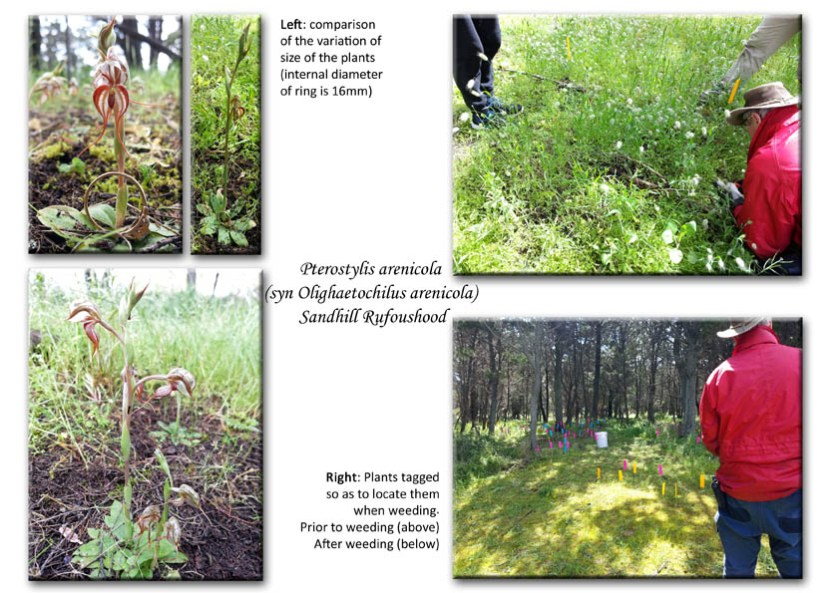
Conservation of orchids takes many forms, one of which is weeding. NOSSA members often assist the Threaten Plant Action Group in this area. There are several sites where significant orchids are under threat from invasive weeds; and over the years, through consistent weeding, the weed front has been pushed back allowing the orchids an opportunity to recover and even increase in numbers. It is an ongoing task but seeing the orchids recover makes it an encouraging task BUT …
This activity is heavily reliant upon volunteers. And those who regularly volunteer deserve a big thank you from the community. BUT ….
More helpers are always needed. If you are interested in seeing the orchids, consider joining one of the weeding activities that are held throughout the year (these are advertised on this website). Often the weeding activities target a specific weed, so it is great for a beginner who does not have an in-depth knowledge of plants.
The orchids are first marked with tags as they can be difficult to see whilst weeding but afterwards they can be clearly seen.
The second fact sheet in Terrestrial Culture notes is about Slow Multiplying Terrestrials.
FLAGBEARER SPECIES: Thelymitra nuda
Diuris, Pterostylis and Thelymitra. They are more expensive because they have to be raised from seed in flasks. SMs are not so easy because there is less room for error. A few have a near zero increase rate and will fade away unless additional plants can be produced to make up for occasional losses from predators and disease.
GROWTH HABIT: Australian ground orchids follow an annual growth cycle comprising 6 – 8 months as growing plants under cool (5 – 20°C max, 0 – 14°C min) moist conditions and 4 – 6 months as dormant tubers in hot dry (18 – 42°C max, 12 – 30°C min) conditions. The new tuber is produced in winter – spring. Each tuber sends up a shoot to the surface in Autumn and leaves grow rapidly in late Autumn/early Winter as temperatures fall and the rains set in. Pterostylis leaves are usually the first to appear in March/April followed by Diuris and Thelymitra in April/May. Sometime in October/November the leaves go yellow and then brown and dry as the days get longer, hotter and drier in late Spring.
LIGHT/SHADE:Australian terrestrial orchids are easy to grow. In Adelaide they thrive in a shadehouse of 50% shadecloth. Some species prefer heavy shade, others full sunlight, but most will adapt to a wide range of light intensity. Sun loving species (Diuris, Thelymitra & Rufa group Pterostylis) prefer a brighter location for good growth.
If the leaves and stems are weak and limp or if the leaf rosettes are drawn up to the light then the shading is too dense and the amount of light should be increased. The spring flowering species like higher light intensities at flowering time and flowers may have pale colours if placed in heavy shade, even temporarily, when flowers are just starting to open.
In very cold areas an unheated glasshouse may be required for frost protection although light frosts do not worry the majority of species.
AIR MOVEMENT/HUMIDITY:All species like good air movement and will not thrive in a stuffy humid atmosphere especially if temperatures are high.
WATERING:The soil should be kept moist at all times during active growth by watering gently if there is no rain. Hand watering is especially necessary in spring as soil in pots dries out more rapidly than in the garden. Watering must be done slowly so that the mat of needles on the surface of the pot is not disturbed. Slugs and snails love these plants and must be kept under control. Raising the pots off the ground on galvanised steel benching is very effective in controlling these pests.
After the leaves have turned yellow, let the pot dry out completely to dry up the old roots and tubers otherwise they may turn into a soggy mouldy mess and rot may destroy the adjacent new tubers.
POLLINATION/SEEDCOLLECTING:Flowering plants are hand pollinated and the seed collected just before the pods split open and the dust-like seed blows away. The seed is sprinkled on pots of mother plants at Easter or flasked.
REPOTTING:Repot every second year in half new mix. Repotting is normally done between November and January. The best results are obtained if the tubers are repotted in half fresh soil mix each second year. A suitable soil mix is 40% loam, 50% sand and 10% organic matter with a little blood and bone fertiliser added. A 5 mm sieve is a useful tool for separating tubers from soil. Replant the dormant tubers with the tops 20 mm deep. Cover the soil surface with a mulch of sheoak needles, chopped to 20 – 50 mm lengths, to prevent soil erosion & aerate under the leaves.
INCREASING PLANT NUMBERS:The pull-off-the-tuber method can be used with some diuris and Pterostylis species to double plant numbers annually. The pots can be knocked out and the tubers examined in Summer without harm.
SUMMER CARE: Keep the pots shaded and allow the pots to dry out between light waterings until mid-February when they should be set out in their growing positions and watered a little more often. The tubers of some species will rot if kept wet during the dormant period, others will produce plants prematurely which are then attacked by pests such as thrip and red spider and fungal diseases in the warm weather.
FERTILIZING:SMs will benefit from weak applications of folia feed in the early growth stages.
Recently, NOSSA updated the Terrestrial Culture Fact Sheet. Instead of one sheet, it was decided to split it into three – Culture of Fast Multiplying Terrestrials, Culture of Slow Multiplying Terrestrials and Culture of Fungi Dependent Terrestrials. Though much of the growing information is similar, there are some significant differences of which growers need to be aware. The first of the fact sheets is Culture of Fast Multiplying Terrestrials.
FLAGBEARER SPECIES: Pterostylis curta
Pterostylis curta (Blunt Greenhood) is rated rare in South Australia. Ex situ conservation is another dimension to conservation.
Others include Chilogolottis, Corybas, Cyrtostylis, Diplodium, Microtis most Pterostylis and some Diuris. Most FMs are Autumn or Winter flowering. The exceptions are Diuris and Microtis. FM are the most common terrestrial orchids to be seen at meetings and shows. Once seedlings are established they are no longer fungi dependent.
GROWTH HABIT:FMs are the easiest terrestrial’s orchids to grow. They multiply by forming 2 – 5 tubers per plant each year. The annual growth cycle comprises 6 – 8 months as growing plants under cool (5 – 20⁰ C max, 0 – 14⁰ C min) moist conditions and 4 – 6 months as dormant tubers in hot (18 – 42⁰ C max, 12 – 30⁰ C min) dry conditions. New tubers are produced in winter/spring. FMs are colony types, ie they multiply annually and will spread out over time if planted in the ground. Each tuber sends up a shoot to the surface in autumn and leaves grow rapidly in late autumn/early winter as temperatures fall and the rains set in. FMs mainly flower in Autumn and Winter. Diplodium & Pterostylis leaves are usually the first to appear in March followed by Diuris and Microtis in April, and Corybas in June to July. In October/November the leaves go yellow, then brown and dry as the days get longer, hotter and drier in late spring.
LIGHT/SHADE: In Adelaide, they thrive in a shadehouse of 50% shadecloth. Some species prefer heavy shade, others full sunlight but most will adapt to a wide range of light intensity. Sun loving species (Diuris & Microtis) prefer a brighter location for good growth. Corybas like the shadiest corner. If the leaves and stems are weak and limp or if the leaf rosettes are drawn up to the light, then the shading is too dense and amount of light should be increased.
In very cold areas an unheated glasshouse may be required for frost protection although light frosts do not worry the majority of species.
AIR MOVEMENT/HUMIDITY: All species like good air movement and will not thrive in a stuffy humid atmosphere especially if temperatures are high.
WATERING: The soil should be kept moist at all times during active growth by watering gently if there is no rain. Hand watering is especially necessary in spring as soil in pots dries out more rapidly than in the garden. Watering must be done slowly so that the matt of needles on the surface of the pot is not disturbed. Slugs and snails love these plants and must be kept under control. Raising the pots off the ground on galvanised steel benching is very effective in controlling these pests.
After the leaves have turned yellow, let the pot dry out completely to dry up the old roots and tubers otherwise they may turn into a soggy mouldy mess and rot may destroy the adjacent new tubers.
REPOTTING: They grow better if repotted annually otherwise the plants crowd together around the rim of the pot. Repotting is normally done between November and January. The pots can be knocked out and the tubers examined without harm. For best results repot the tubers in half fresh soil mix. A suitable soil mix is 40% loam, 50% sand and 10% organic matter with a little blood and bone fertilizer added. (They will also grow in native potting mix.) A 5 mm sieve is a useful tool for separating tubers from soil. Replant the dormant tubers with the tops 20 mm deep. Cover the soil surface with a mulch of chopped sheoak needles (20 – 50 mm lengths). This prevents soil erosion and assists with aeration under the leaves.
SUMMER CARE: Keep the pots shaded and allow the pots to dry out between light waterings until mid-February when they should be set out in their growing positions and watered a little more often. The tubers of some species will rot if kept wet during the dormant period, others will produce plants prematurely which are then attacked by pests such as thrip and red spider mite and fungal diseases in the warm weather.
FERTILIZING: FMs are very hardy and will benefit from weak applications of folia feed in the early growth stages.
Leo Davis is an orchid hunter. He is meticulous in his observations and notes details that many of us may miss. In this article he muses upon the variations that he sees in the field.
You, as I do, must occasionally come upon an orchid or an orchid event that is a little outside normal experience. When I do, I wonder whether this is a purely chance event or is it caused by recent local environmental factors, or is it due to the genes of the plants. Or a combination of these?
I’ve been watching a couple of patches of fire orchids (Pyrorchis nigricans) that many of you will be familiar with, one at Knott Hill N.F.R., the other at Monarto C.P., where a few plants flower every year, without the normally required stimulation by fire. I need to check whether it is the same plants that flower each year.
Pyrorchis nigricans (Fire or Undertaker Orchid) Photo: Leo Davis
~~~~~~~~~~~~~~~~~~~~~~~~~~~~~~~~~~~~
The tall leek orchid (Prasophyllum elatum) puts up leaves at Scott Creek C.P. every year but does not flower. A fire swept through in early 2014 and most plants flowered in October. They’ve not flowered since. But over at Ramsay Way, west of Pt. Vincent, a few plants flower each year without fire. I assume genes are involved.
Prasophyllum elatum (Tall Leek Orchid) Photo: Leo Davis
~~~~~~~~~~~~~~~~~~~~~~~~~~~~~~~~~~~~
In April 2014 I chanced upon a patch of Adelaide Hills parson’s bands (Eriochilus collinus), along Moore’s Road, at Morialta C.P., in which the majority of plants had three flowers per stem. Was this because of favourable conditions or genes? Over the next two seasons I saw only the occasional double header and mainly single flowered plants. I will continue observations and records.
~~~~~~~~~~~~~~~~~~~~~~~~~~~~~~~~~~~~
In July 2015 I found a dense patch, about 3 m2 in area, of hundreds the common mallee shell orchid (Diplodium dolichochilum), in Ferries-McDonald C.P. As usual less than ten plants were in flower, but two of them were double headers. I’ll be checking this season and expect this not to be a chance event but one due to genes.
Diplodium dolichochilum syn. Pterostylis dolichochila (Slim Tongued Shell or Common Mallee Shell Orchid) Photo: Leo Davis
~~~~~~~~~~~~~~~~~~~~~~~~~~~~~~~~~~~~
On May 27, 2012, Bob Bates led a NOSSA outing to Scott Creek C.P. and as ever, when he leads, we saw and learned a lot. He showed us a patch of fringed hare-orchids (Leporella fimbriata) that he assured us should not be growing there on that steep rocky site and that the plants would not flower most years. Unfortunately he was right, as usual. I could not find plants in 2013 and 2014 and it took three searches in 2015 to find a very few leaves. On May 10 this year, over an area of less than 10 m2, I found perhaps 50 leaves and just seven plants in flower. Three of these had three flowers and a tiny unopened bud (check the photo) and the others were doubles. I’ve never seen a triple flowered plant in hundreds I’ve seen at Knott Hill N.F.R. Are genes in an isolated population at play here? Given the paucity of flowering at this site, it may take me years to sort this one out.
Leporella fimbriata (Fringed Hare or Ballerina Orchid) Photo: Leo Davis
[Primary source material is the NOSSA Journals. Direct quotes from the Journal in blue and additional information in black.]
Sometimes gleanings take much time and effort to locate but other times there is an abundance of information just waiting to be picked up. This was the case when searching the Journal for information on Harold Goldsack.
Upon the death of Dr R S Rogers, Harold Goldsack became the leading authority of South Australian orchids. To quote Peter Hornsby (1977), NOSSA’s first editor, “Harold is undoubtedly the most experienced of our native orchid botanists and knows more of the history of our orchids than anyone alive.”
Though not a foundational member, Harold was one of NOSSA’s early members, joining at the end of 1977. He was both a grower of epiphytes – winning the Champion epiphyte for 1982 (Dendrobium x gracillimum) and terrestrials – producing the first greenhood hybrid, Pterostylis Cutie (baptistii x cucullata) which was registered on 5th March, 1982. At the meetings he gave talks, plant commentaries and judged the orchids. Outside of the meetings he was active in advancing the cause of Australian orchids. His enthusiasm influenced many people, one person being a young Mark Clements, current Research Scientist, Centre for Australian National Biodiversity Research, CSIRO, Canberra.
It is not surprising than that in 1984 he was made NOSSA’s second life member.
Bob Bates wrote an informative biography in Harold’s obituary.
Journal 1989 Volume 13 No 4 May
Vale Harold Goldsack.
It is with sadness that we announce the passing of life member Harold Goldsack on April 25th. Our sympathies to his family.
Harold was born in East Bengal, India on 27th June 1908. He once told how he could remember epiphytic orchids blooming outside the bedroom window of his childhood home.
His family moved to Adelaide in 1916 and he attended Princes College as a boarding student.
He was introduced to South Australian orchids in bushland adjacent his family’s orchard at Coromandel Valley using Rogers “Introduction to the Study of South Australian Orchids” to identify these. Harold in 1924 introduced himself to Dr Rogers and they became good friends. Harold soon began to find orchids that were new to Dr Rogers and this fired his enthusiasm so that he began a serious study of our orchid flora.
One day in 1928 on a visit to Dr Rogers, Harold was shown the very first collection of the underground orchid Rhizanthella gardeneri. This was to be the subject of the last article Harold wrote over 50 years later.
With the passing of Dr Rogers in 1942 Harold became the foremost authority on South Australian orchids corresponding regularly with H M R Rupp, W H Nicholls and A W Dockrill. His extensive collection of pressed orchids was donated to the State Herbarium in 1978.
Harold wrote many articles on orchids his best known being “Common Orchids of South Australia” which appeared in the S Aust Naturalist in June 1944 and was used in “National Parks and Wild Life Reserves” book from 1965-1970. Harold also revised the orchid section of Black’s “Flora S Australia” in 1943.
Besides drawing and photographing the S Aust orchids Harold developed a large personal Orchid Library and cultivated many Australian orchids which he displayed at shows including our NOSSA shows. The first registered Pterostylis hybrid Ptst. Cutie was made by Harold and the name given to the original clone now grown by hundreds of orchid lovers is “Harolds Pride!”
His main interest was to enthuse others to see the beauty and value of our native orchids through his articles and the many illustrated talks he gave to natural history groups.
Harold was a member of the Royal Society of S Australia.
He was a Foundation Member of the Australian Native Orchid Society. (ANOS)
Ever ready for a challenge Harold at age 64 began studying for his Engineering and Surveying Certificate gaining distinctions in Maths, then working on the surveying of the S E Freeway.
Harold Goldsack’s name is commemorated in the South Australian endemic orchid Prasophyllum goldsackii, a fitting tribute to a true orchid lover.
R Bates
Prasophyllum goldsackii – Photographer Ken Bayley
Bibliography of Papers by Harold Goldsack
Orchids of Coromandel Valley – SA Naturalist XIV, Nov 1932 PP 12 – 15
Notes on Caladenia Catifolia – R Br SA Naturalist XV, March 1934, pp 59 – 63
National Park of South Australia – Field Naturalists Sect. of Royal Soc of SA 1936, Being Vol XVII, Nos 1 to 4 of SA Naturalist pp 52 – 54 Orchids
Common Orchids of South Australia – SA Naturalist XXII June 1944 PP 1 – 12 with line drawings of 52 species
New Orchid Records for South Australia – SA Naturalist XXII June 1944, p 13
National Park and Reserves – Commissioners of the National Park, Sept 1956 pp 59 – 79 with line drawings of 52 species of Orchids, p 195 Distribution and flowering times of orchids in the National Park and Reserves
SA National Parks and Wild Life Reserves – Commissioners of the National Park and Wild Life Reserves, March 1964, pp 46 – 64 Orchids with line drawings of 52 species, pp 189 – 199. Distribution and Flowering times of Orchids in the National Park and Reserves
Orchids of the National Park and Wild Life Reserves – Reprinted 1965 by Field Naturalists Society, if (sic) SA from “SA National Parks and Wild Life Reserves” with permission of the Commissioners of the National Park and Wild Life Reserves
Blacks’ Flora of South Australia – Revised edition of p1, 1946 Assisted Rev H M R Rupp and W H Nicholls with the revision of the Orchidacea
Pollination of Caladenia deformis R Br – R S Rogers transactions of Royal Society of SA Volume LV Oct 1931 The pollination of Caladenia deformis as observed by H G was written up by Dr R S Rogers in an article for the Royal Society of SA
Rhizanthella gardnerii R S Rogers – The Orchadian p 113 Sept 1979 A note about the discovery of this orchid
Following is the article by Harold Goldsack referred to by Bob Bates in Harold’s obituary. Though he wrote for other publications, this was appears to be the only one in the NOSSA Journals.
Journal 1979 Volume 3 No 8 August
RHIZANTHELLA GARDNERI Rogers Harold Goldsack
Corrigin, Shackleton, Goomalling, Munglingup. Western Australia.
A new locality where the subterranean orchid Rhizanthelle gardneri Rogers has been found, as noted by Don Voigt in his letter to Roy Hargreaves to brings with it hope that after 50 years the secret life of the remarkable orchid may be unveiled. It also brings back memories of my first encounter with this plant.
As a young orchid enthusiast I had been collecting for, and writing to, Dr R.S. Rogers of Adelaide, who, at that time, was an extremely busy public personality. To my surprise, one day in 1928 I received a note from Dr Rogers inviting me to call at his house in Hutt Street after surgery hours as he had something to show me which he was sure would be of interest.
Naturally, I took the first opportunity to visit the Doctor, whereon he brought into the room a large jar with some white vegetable pickled in it. With a smile he said “Have you ever seen anything like this before?”
Well, there it was – this unique subterranean orchid from Corrigin, Western Australia, sent over by Mr C A Gardiner, the Government Botanist of Perth, who had realised the importance of this discovery.
The first plants were found in an area of virgin lane that had been rolled, burnt and then ploughed, which operation uncovered the white underground rhizomes. Mr John Trott, the discoverer, was puzzled by this strange plant growing around the stumps of Melaleucauncinata R Br, common in the area, and sent it to Mr C A Gardiner. He, realizing the orchidaceous nature of the plant, visited the area, made personal observations and then sent a specimen to Dr Rogers for study, which led to the description of a now sub-tribe, genus and species of orchid – Rhizanthella gardneri Rogers.
Soon after this the Field Naturalists Society were to hold their Wild Flower Show in the Adelaide Town hall and attempted to have this unique specimen displayed there. However, the plant was too valuable to risk and an artist – Mr Lyall Lush – made a black and white drawings which was exhibited instead.
Within three years, on the east coast of Australia at Bulahdelah, another subterranean orchid Cryptanthemis slateri Rupp was unearthed. Unearthed is the word, for this one was unearthed by Mr Slater who was digging up rhizomes of Dipodium punctatum, the “Wild Hyacinth”, to attempt to grow them. All plants of the new orchid were found growing in association Dipodium. The importance of this find was such that Rev H I R Rupp was given a grant to travel to Bulahdelah to make further studies. This second find aroused worldwide interest and a German botanist suggested that the flowers of Cryptanthemis slateri were underground spikes of Dipodium. The morphology of the flowers soon disproved that theory.
Regarding this orchid, which Rupp named in 1932, Dr Rogers commented to me that he was sure that Rev Rupp’s parishioners must have had a very brief sermon the week Rupp received the first specimen of Cryptanthemis!
Dr Rogers then lamented that the orchid hunter has to add a plough and a pick to his orchid collecting equipment!!




 NOSSA
NOSSA 