CULTURE OF SLOW MULTIPLYING (SM) TERRESTRIALS

Pots of Thelymitra nuda cultivated by Les Nesbitt
Thelymitra nuda

The second fact sheet in Terrestrial Culture notes is about Slow Multiplying Terrestrials.

FLAGBEARER SPECIES: Thelymitra nuda

Diuris, Pterostylis and Thelymitra. They are more expensive because they have to be raised from seed in flasks. SMs are not so easy because there is less room for error. A few have a near zero increase rate and will fade away unless additional plants can be produced to make up for occasional losses from predators and disease.

GROWTH HABIT: Australian ground orchids follow an annual growth cycle comprising 6 – 8 months as growing plants under cool (5 – 20°C max, 0 – 14°C min) moist conditions and 4 – 6 months as dormant tubers in hot dry
(18 – 42°C max, 12 – 30°C min) conditions. The new tuber is produced in winter – spring. Each tuber sends up a shoot to the surface in Autumn and leaves grow rapidly in late Autumn/early Winter as temperatures fall and the rains set in. Pterostylis leaves are usually the first to appear in March/April followed by Diuris and Thelymitra in April/May. Sometime in October/November the leaves go yellow and then brown and dry as the days get longer, hotter and drier in late Spring.

LIGHT/SHADE: Australian terrestrial orchids are easy to grow. In Adelaide they thrive in a shadehouse of 50% shadecloth. Some species prefer heavy shade, others full sunlight, but most will adapt to a wide range of light intensity. Sun loving species (Diuris, Thelymitra & Rufa group Pterostylis) prefer a brighter location for good growth.

If the leaves and stems are weak and limp or if the leaf rosettes are drawn up to the light then the shading is too dense and the amount of light should be increased. The spring flowering species like higher light intensities at flowering time and flowers may have pale colours if placed in heavy shade, even temporarily, when flowers are just starting to open.

In very cold areas an unheated glasshouse may be required for frost protection although light frosts do not worry the majority of species.

AIR MOVEMENT/HUMIDITY: All species like good air movement and will not thrive in a stuffy humid atmosphere especially if temperatures are high.

WATERING: The soil should be kept moist at all times during active growth by watering gently if there is no rain. Hand watering is especially necessary in spring as soil in pots dries out more rapidly than in the garden. Watering must be done slowly so that the mat of needles on the surface of the pot is not disturbed. Slugs and snails love these plants and must be kept under control. Raising the pots off the ground on galvanised steel benching is very effective in controlling these pests.

After the leaves have turned yellow, let the pot dry out completely to dry up the old roots and tubers otherwise they may turn into a soggy mouldy mess and rot may destroy the adjacent new tubers.

POLLINATION/SEEDCOLLECTING: Flowering plants are hand pollinated and the seed collected just before the pods split open and the dust-like seed blows away. The seed is sprinkled on pots of mother plants at Easter or flasked.

REPOTTING: Repot every second year in half new mix. Repotting is normally done between November and January. The best results are obtained if the tubers are repotted in half fresh soil mix each second year. A suitable soil mix is 40% loam, 50% sand and 10% organic matter with a little blood and bone fertiliser added. A 5 mm sieve is a useful tool for separating tubers from soil. Replant the dormant tubers with the tops 20 mm deep. Cover the soil surface with a mulch of sheoak needles, chopped to 20 – 50 mm lengths, to prevent soil erosion & aerate under the leaves.

INCREASING PLANT NUMBERS: The pull-off-the-tuber method can be used with some diuris and Pterostylis species to double plant numbers annually. The pots can be knocked out and the tubers examined in Summer without harm.

SUMMER CARE: Keep the pots shaded and allow the pots to dry out between light waterings until mid-February when they should be set out in their growing positions and watered a little more often. The tubers of some species will rot if kept wet during the dormant period, others will produce plants prematurely which are then attacked by pests such as thrip and red spider and fungal diseases in the warm weather.

FERTILIZING: SMs will benefit from weak applications of folia feed in the early growth stages.

OTHER CULTURE NOTES:


NB: IT IS ILLEGAL TO TAKE PLANTS (WHOLE PLANT, FLOWERS, SEEDS AND TUBERS) FROM THE WILD

Genes, seasonal conditions or pure chance?

Leo Davis is an orchid hunter.  He is meticulous in his observations and notes details that many of us may miss.  In this article he muses upon the variations that he sees in the field.

You, as I do, must occasionally come upon an orchid or an orchid event that is a little outside normal experience.  When I do, I wonder whether this is a purely chance event or is it caused by recent local environmental factors, or is it due to the genes of the plants.  Or a combination of these?

I’ve been watching a couple of patches of fire orchids (Pyrorchis nigricans) that many of you will be familiar with, one at Knott Hill N.F.R., the other at Monarto C.P., where a few plants flower every year, without the normally required stimulation by fire.  I need to check whether it is the same plants that flower each year.

Pyrorchis nigricans.jpg
Pyrorchis nigricans (Fire or Undertaker Orchid) Photo: Leo Davis

~~~~~~~~~~~~~~~~~~~~~~~~~~~~~~~~~~~~

The tall leek orchid (Prasophyllum elatum) puts up leaves at Scott Creek C.P. every year but does not flower. A fire swept through in early 2014 and most plants flowered in October.  They’ve not flowered since.  But over at Ramsay Way, west of Pt. Vincent, a few plants flower each year without fire.  I assume genes are involved.

Prasophyllum elatum
Prasophyllum elatum (Tall Leek Orchid) Photo: Leo Davis

 ~~~~~~~~~~~~~~~~~~~~~~~~~~~~~~~~~~~~

In April 2014 I chanced upon a patch of Adelaide Hills parson’s bands (Eriochilus collinus), along Moore’s Road, at Morialta C.P., in which the majority of plants had three flowers per stem. Was this because of favourable conditions or genes? Over the next two seasons I saw only the occasional double header and mainly single flowered plants. I will continue observations and records.   

 Eriochilus collinus

~~~~~~~~~~~~~~~~~~~~~~~~~~~~~~~~~~~~

In July 2015 I found a dense patch, about 3 m2 in area, of hundreds the common mallee shell orchid (Diplodium dolichochilum), in Ferries-McDonald C.P. As usual less than ten plants were in flower, but two of them were double headers.  I’ll be checking this season and expect this not to be a chance event but one due to genes.

Diplodium dolichochilum
Diplodium dolichochilum syn. Pterostylis dolichochila (Slim Tongued Shell or Common Mallee Shell Orchid) Photo: Leo Davis

 ~~~~~~~~~~~~~~~~~~~~~~~~~~~~~~~~~~~~

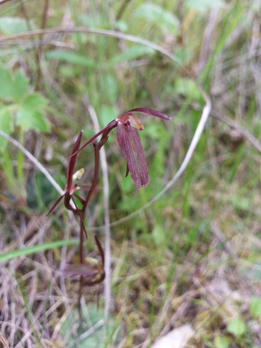
On May 27, 2012, Bob Bates led a NOSSA outing to Scott Creek C.P. and as ever, when he leads, we saw and learned a lot.  He showed us a patch of fringed hare-orchids (Leporella fimbriata) that he assured us should not be growing there on that steep rocky site and that the plants would not flower most years.  Unfortunately he was right, as usual.   I could not find plants in 2013 and 2014 and it took three searches in 2015 to find a very few leaves. On May 10 this year, over an area of less than 10 m2, I found perhaps 50 leaves and just seven plants in flower.  Three of these had three flowers and a tiny unopened bud (check the photo) and the others were doubles.  I’ve never seen a triple flowered plant in hundreds I’ve seen at Knott Hill N.F.R.  Are genes in an isolated population at play here?  Given the paucity of flowering at this site, it may take me years to sort this one out.

Leporella fimbriata
Leporella fimbriata (Fringed Hare  or Ballerina Orchid) Photo: Leo Davis

Leo Davis.


April 2016 Winning Picture Competition

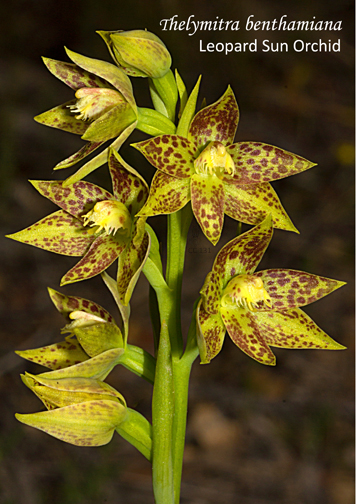
1604 sm CC T benthamaniana
Thelymitra benthamiana; Photographer: Claire Chesson

Five entries were received, again spanning the country from east to west. John Badger entered a Chiloglottis reflexa recently photographed in Tasmania, Pauline Meyers an unidentified Western Australian Spider orchid, Judy Sara had two entries from the latest field trip, Eriochilus collinus (previously phrase name Adelaide Hills) and Leporella fimbriata and Claire Chesson’s Thelymitra benthamiana.

T. benthamiana, the winning picture, is a beautiful sun orchid that is found across the southern Australia from Western Australia through South Australia to Victoria and Flinders Island. More common in west than elsewhere it is the only one of the seven species in the T. fuscolutea complex to be found in the east.

It would appear that this complex has been a problematic as indicated by Jeanes (2006) in his article Resolution of the Thelymitra fuscolutea (Orchidaceae) complex of southern Australia published Muelleria; the Royal Botanic Gardens of Victoria research journal.

Since the early days confusion, which persisted into this millennium, has occurred. In 1871 Reichenbach recognised 3 species one of which was T benthamiana but Bentham after whom the orchid was named disagreed and consider it but a synonym of T. fuscolutea. There were many twists and turns in the names but in effect, for over a hundred years, most authors followed Bentham’s taxonomy rather than Reichenbach’s until 1989 when Mark Clements after studying the drawings, literature and orchid type material came to the same conclusion as Reichenbach that T. benthamiana was a distinct species from T. fuscolutea. Since then, authors have followed Reichenbach/Clements taxonomy.

Over the decades, the number of species in this complex varied considerably. By 1938 three separate species were recognised, but between then and 1989 it fluctuated between recognizing one, three and four species and in 1998 the orchidologist were considering a possible seven species.  These were all confirmed and named in Jeans’ 2006 paper. Today, according to Orchids of Western Australia there is potentially an eighth member in this group.

Jeanes highlights some of the issues involved in determining which species is which. Some of the issues are lack of accurate/detailed information such as location, type of terrain, habitat, surrounding plants, date of collection, etc. Dried specimens by themselves are inadequate as important features may be lost in the drying process.

This complex is but an example of a widespread problem across many of our Australian orchids indicating not only the need for careful observations in the field but meticulous record keeping that others can access.

References

Jeans J A, Resolution of the Thelymitra fuscolutea R. Br. (Orchidaceae) complex of southern Australia. Muelleria 24: 3-24 (2006)

Brown A, et al, Field Guide to the Orchids of Western Australia, 2013

Thank you to Juergen Kellermann, (senior botanist for the State Herbarium) for critiquing this article.

Leptoceras and Leporella – Why are they in different genera?

QUESTION: Are there more than one species called Hare Orchid? This one [Leporella fimbriata] looks different from Leptoceras…?  Why are they in different genera?


ANSWER:

Originally they were described the genus Caladenia but as the knowledge information increased other genera were created.  Thus Leporella fimbriata was put into Eriochilus, as Eriochilus fimbriatus (1882), then Leptoceras fimbriata and finally into its own genus Leporella (A S George 1971).  Caladenia menziesii became Leptoceras menziesii.

This does not answer the why of the question which is about classification but Jones (2006) is helpful when he says:

“Plant classification systems rely on interpreting and measuring the features in one group of plants and comparing these with another group, either seeking difference or similarities.  Studies in orchids are usually biased heavily towards features of floral morphology but recent studies have revealed the importance of vegetative features in the roots, stems and leaves.  The most successful classification system is one that is balanced and based on a wide range of vegetative and floral features.”  To add to this list is the molecular studies being done on orchids.

This means the authors advocating change need to clearly show why a name change and/or a new species is warranted.

For instance, Fitzgerald gives the following reason for not including Leporella fimbriata in the Caladenia genus

“Leaves much more frequently observed than flowers.  It is with great reluctance I depart from the naming in ‘Flora Australiensis’ [author Bentham, 1863 – 1878], but I cannot concur with the inclusion of this with Caladenia, and have place it in Lindleys’ Leptoceras for the following reasons: Leaf or leaves not those of Caladenia.  In Caladenia I have never seen more than one leaf, always thin and usually hairy; in this plant leaf thick, hard and shining, occasionally two.  In Caladenia tubers are generally numerous, in L. fimbriata I have only observed one.  The labellum, is without the characteristic glans and is not of the form obtaining in Caladenia, the stigma is very different in form being triangular and deep sunk, the upper parts overhanging, not oval and shallow; and the flowers have the peculiarity of drying and continuing in a state hardly to be distinguished from the fresh flowers long after the seed has been shed.  It approaches C. menziesii only (so far as I can see) in having erect linear-clavate petals, in which C. menziesii is itself peculiar, L. firmbriata seems to come near to Eriochilus than to Caladenia but differs from it again” Quoted from Emily Pelloe Western Australian Orchids 1930

Concerning Leptoceras menziesii, Bates & Weber have made the following statement:

“True Caladenias have hairy scapes and hairy leaves.  (C. menziesii now believed to belong to a separate genus is glabrous)”.

Even though they are not Caladenia, why not have them in the same genus for both have glabous (without hairs) leaves, more leaves than flowers, erect spathulate (spoon shaped) glandular petals, colony forming, similar distribution.

Leporella fimbriata  in patch
Leporella fimbriata – note the absence of leaves and the dry sandy conditions [Photo: R Lawrence]
Leptoceras menziesii in patch
Leptoceras menziesii – note the abundance of leaves [Photo: R Lawrence]
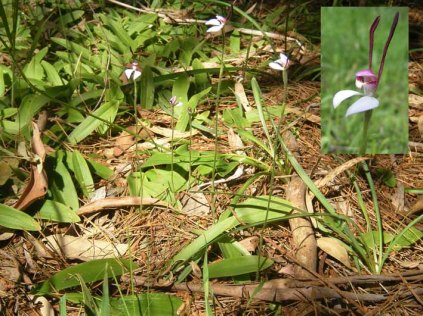
There are similarities.  In fact, Bates (2011) calls them sister genera but despite the similarities there are enough differences to recognise them at genus level at present including “different flowering times, different mycorrhizal fungi associations and different pollination” some of which are detailed in the chart below.


Feature Leptoceras Leporella
Pollination Strategy Strategy unknown

Native Bee

Strategy pseudocopulation

Winged male ants (Myrmecia urens)

Myrmecophyte – lives in mutualistic association with colony of ants
Labellum Curved white with red stripes

Has calli

Wider than longer, purple and green

Has no calli

Flowering Time Spring (September to November) Autumn (March to May)
Habitat Shaded sites – moist gullies; scrub, heath, woodland and foret Open sites – acid sands, light scrub, stringybark
Leaf Emergence Leaves emerge before flowering Leaves emerge after flowering


Leptoceras menziesii (Rabbit Ears Orchid)
Leptoceras menziesii (Hare Orchid or Rabbit Ears Orchid) after a fire, [Photo: R Lawrence]

REFERENCES:

https://en.wikipedia.org/wiki/Myrmecophyte accessed May 13 2016

http://www.flora.sa.gov.au/cgi-bin/speciesfacts_display.cgi?form=speciesfacts&name=Leporella_fimbriata accessed May 13 2016

http://www.flora.sa.gov.au/cgi-bin/speciesfacts_display.cgi?form=speciesfacts&name=Caladenia_menziesii accessed May 13 2016

Pelloe E, Western Australian Orchids 1930

Bates R & Weber J, Orchids of South Australia, 1990

Bates R Editor, South Australia’s Native Orchids 2011

Martin A, The Vocabulary of Orchids: an Amateur Perspective 2005

Rogers R, South Australian Orchids 2nd Ed 1911

Jones D, A Complete Guide to Native Orchids of Australia including the Island Territories 2006

WHAT ORCHID IS THIS? HOW PHOTOS CAN HELP! – Part Two of Two Parts

Part One covered hints for photographing orchids so as to be able to identify the plant.  Part Two gives an example with Cyrtostylis robusta (Winter Gnat Orchid) and C. reniformis (Small Gnat Orchid).

Although the flowering times are different – C reniformis is spring flowering and C. robusta is winter flowering – there is a slight overlap in August when it is possible for both to be flowering at the same time and in the same place.

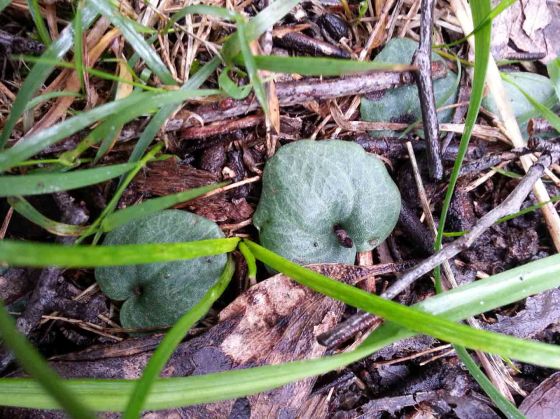
The flowers are very similar but major difference between the two species is the leaf.  Both leaves are roughly kidney shape but C. robusta is pale green with pale , almost undistinguished veins, silvery underneath whilst  C. reniformis is heavily veined, blue-green above and green below.

Cyrtostylis reniformis (4)
C. reniformis, easily identified by the leaf, even when in bud.

The other differences are more subtle.

  • C. reniformis has dark buds and the apex of the labellum tends to be rounded rather than pointed
  • C. robusta has pale reddish buds and larger flowers, labellum crenulated (slightly wavy) and a fine point at the apex.
Cyrtostylis reniformis
C. reniformis – This is not a good identification picture because though the leaf is present, it is too blurry for identifying the species and the angle of the flower obscures the labellum  details

Consequently, it is important that photographs of the flowers clearly show the labellum – pointed labellum apex for C. robusta compared with the rounded labellum tip of C. reniformis.


Cyrtostylis robusta
In this photograph it is possible to identify the plants as C. robusta because of the leaves even though there are no clear views of the labellum.

March 2016 Winning Photograph

1603 sm JS Arachnorchis sp

We frequently receive entries from Western Australia but this month our entries were from both the west and the east. Allen Jennings entered a Calanthe triplicata (Christmas Orchid) from New South Wales. Pauline Meyer’s was from the west, (Western) Flying Duck Orchid, Paracaleana nigrita. The other entries were South Australian, Jenny Pauley’s recently photographed Leporella fimbriata (Fringed Hare Orchid), Greg Sara’s Thelymitra rubra (Common Pink Sun Orchid) and Judy Sara’s Plumatochilos sp. (Bearded Orchid) and Arachnorchis sp. (Spider Orchid).

The winning photograph was Judy’s Spider Orchid. Obviously it was one of the Green Comb Spider Orchids – A. dilatata complex. Of this group there are about a dozen possibilities. Knowing the location, Mt Boothby, helped to narrow the options with the most likely candidate being Arachnorchis stricta but it wasn’t convincing. It would appear that the tips of the sepals may have been chewed off when in bud.

A distinguishing feature of this species is that there are no clubs or osmophores on the sepals. Other species of this complex have clubs. Another feature is that the dorsal sepal is bent over the column unlike many other green combs which have an erect dorsal sepal. The features that caused doubt were lateral sepals looking droopy instead of being characteristically stiffly held out but dry conditions could cause this. The other was that the labellum did not strictly fit the description of A. stricta but then again it is a variable species.

The conclusion was a possible hybrid but there is no information on the likely parents or that is an atypical A. stricta that may have been damaged in bud.

This is an example of the difficulties that can occur when attempting to identify a plant from one photograph.

Reference:

Personal communications Thelma Bridle (NOSSA Conservation Officer)

Personal communications Bob Bates

Bates, R. J., ed. (2011). South Australian Native Orchids. Electronic version, 2011. NOSSA

Rules of entry:

The subject matter must have something to do with Australian orchids.  Any format is acceptable including Photo shopped images, artwork, etc

How to enter:

Email nossa.enquiries@gmail.com – jpg as large as you are able to send it, preferably A4 ratio for printing

Post: PO Box 565, Unley, 5061

Bring in to the meeting

THE DUCKS – TAKING A DIFFERENT PERSPECTIVE PART TWO of TWO

In Part One, Leo Davis’ first article centred on the Large Flying Duck, this second part is about the lesser known Little Duck.

TAKING A DIFFERENT PERSPECTIVE 2 (The Small Flying Duck Orchid)

There are at least three speceis of flying duck orchids in SA, one in genus Caleana and two others having been moved from there to genus Paracaleana.

My favourite, of the two duck orchids that most of us see, is the small duck orchid (Paracaleana minor).  It is actually rarer than the more popular species, can bear six or more flowers on a spike, and has a more delicate and quirky charm, to my eye. 

As with the large flying duck the usual angle of photographing the smaller species is to emphasise the ‘flying’ nature.  But again there is other detail to see and to be illustrated from other view-points.

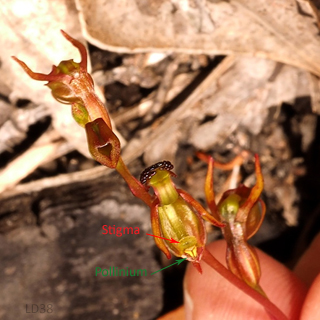
The accompanying image of the little duck flower, viewed from the front, shows variations on the same structures shown previously in the large duck orchid.  Down at the bottom of the flower is the sticky stigma (♀ part), not white this time, and immediately below is the triangular yellow pollinium packet (♂ part).  Again both structures sit in the bowl shaped column.

Paracalean minor arrows copy
Paracalean minor (Little Flying Duck Orchid)

Note the three part symmetry of the pollinium, with a distinctive Mercedes Benz logo (or Mitsubishi if your budget only stretches that far) to tease us.

The location of the female (♀) and male (♂) organs, adjacent to each other, fused to form a column, is one of the main distinguishing characteristic features of the orchid family.

As an afterword let me remind you that the little duck (like the larger, collected in Sydney in 1803) started out as Caleana minor but was moved to a new genus, leaving the large duck as the only member of its genus.  Rules of nomenclature mean that the small duck had to keep its specific name (minor), hence we now have Paracaleana minor but there is no, and never will be, Paracaleana major.  But Caleana minor still appears in publications and some folks may still use that name.

Some of you choose to use different scientific names to some that others use. Recently some of us bought a propagation pack that Les Nesbitt produced, to grow the maroon banded greenhood (Pterostylis sanguinea.) In the unlikely event that my pack produces seedlings I will label them Urochilus sanguineus.  And we can both justify our choice.  And then, of course, some taxonomist could move the little duck back to its original genus one day. 

Then, of course, there is the added complication that David Jones (Native Orchids of Australia Including the Island Territories. 2006, p148) calls the species Sullivania minor!

Leo Davis

February 2016 Winning Photograph

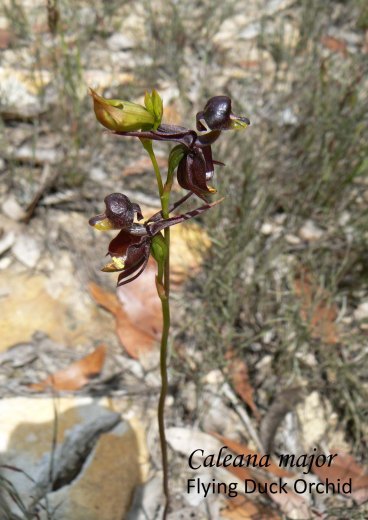
1602 sm PM Caleana major

For our first competition of the year we had five photographs – three of flowers and two of participants on a field trip.  The species represented were David Mangelsdorf’s Calochilus robertsonii (Southern Bearded Orchid); Robert Lawrence’s Pheladenia deformis (Blue Bearded Orchid) and Pauline Meyer’s Caleana major (Flying Duck Orchid) which was the winning photograph.

There is no doubt that the Duck Orchids are very photogenic and that people want to see and photograph them.  When seen the for the first time their small size surprises most.  The flower is no bigger than a thumbnail, perched atop a spindly stalk that may only reach 50cms (20 inches).

Although the rusty red colour of the flower is quite exquisite, this means that it blends in with the surrounding leaf litter and scrub and is not easily spotted.

As species of Heathy Woodlands, in South Australia, it is often found growing in sparse colonies near the base of trees.  Other plants associated with them are banksias, eg Banksia ornata, Eucalyptus baxteri and bracken.  The soil is sandy, often from leached acidic dunes, or gravelly.

Reference:

2008 Department for Environment and Heritage Electronic Flora of South Australia species Fact Sheet: Caleana major R.Br. Available from pa-fact-pafactcaleanamajor.pdf

Bates, R. J., ed. (2011). South Australian Native Orchids. Electronic version, 2011. NOSSA

It’s Not Extinct at Ferris-McDonald After All

Leo Davis is an enthusiast about the natural world and shares his knowledge through different journals.  He is a keen observer and meticulous in his record keeping.  He is also very knowledgeable about orchids.  The following is one such article of Leo’s.

GOOD NEWS FROM FERRIES-McDONALD CONSERVATION PARK
Leo Davis

I was aware of the Star Spider Orchid from Bates who lists the species as ‘3E, critically endangered in South Australia, nationally rare’ (pp. 242–243). I knew that in the past it had been found at Monarto and Hartley and discussions with members of the Native Orchid Society of SA (NOSSA) suggested that it had been seen at Ferries-McDonald Conservation Park, but was now possibly extinct there. My searches over five years had all failed.
On August 2, 2014, I ran into, then strangers, Len Stephens and his grandson Rickey Egel, in Monarto C.P. They had just come from Ferries-McDonald C.P., about 8 km further south. Rickey, who has a very good eye for spotting orchids, showed me an image, in his camera, of ‘the common spider orchid’. From my hurried glimpse I knew immediately it was far from ‘common’ and told him so. I headed straight for Ferries-McDonald C.P. for the first of many fruitless searches.  On August 14, 2015 Rickey and Len showed me a few Star Spider Orchids in flower at Ferries-McDonald C.P. Because I was to lead the Botany Group of the FNSSA on an outing to Ferries-McDonald C.P. on September 5, I had been visiting the park almost weekly and so was able to spend many hours looking for the orchid. It is difficult to spot, being quite small. This year’s plants, perhaps not typical given the very dry June, are between 8 and 20 cm high with flowers only about 35 x 30 mm.
Plants were only found in Broombush (Melaleuca uncinata) associations. As soon as Eucalyptus species were present the orchid was no longer found.
Any survey, especially by a single person, will produce a lower count than the actual population. Leaves of non-flowering or beheaded (the fate of so many spider orchid flowers) plants will not be recognised, some flowers will not be spotted and some plants will flower before or after surveys, with some areas surveyed on different days. Between August 14 and September 5, 2015 just 18 flowering plants (Fig. 1) were positively identified (about the same number of likely leaves and buds, adjacent to these, were noted) over a narrow area of approximately 3,000 m2. The area searched was very much greater than this. Small as this tally is, it establishes a significant population other than the only other South Australian one that I know.  That is on the private property of farmer […], at Hartley. With his kind permission I have counted over 100 flowering plants there during five visits from July 28 (buds only) to August 30 (Fig. 2). The actual population will be larger because I did not cover all of that location. My observations suggest the populations I know to be around 150 to 200 plants with other occurrences probably existing around Monarto and Hartley.
Why have I avoided the scientific name? Many of you will follow the Electronic Flora of South Australia which lists the Star Spider Orchid as Caladenia stellata, as does Backhouse (pp. 456–457). I prefer to follow Jones (p. 76) (who does not recognise the species occurring in SA) and Bates (p. 242) (who says it does occur in SA), both of whom call it Arachnorchis stellata. Backhouse points out that the nearest other occurrence, the major one, is in central southern New South Wales, south of Rankin Springs, several hundred kilometres away, and that the plants there differ from our populations in having smaller flowers. He suggests that we are looking at a separate undescribed species, Caladenia sp. ‘Murray mallee’ (p. 484), but that it might indeed be co-specific with the Rock Star Orchid (sic), Caladenia saxatilis, which is similar and occurs further north, in the northern Mt Lofty and the southern Flinders Ranges. Bates told me in conversation, that he disagrees with Backhouse and believes the local plants are the same as those in NSW and distinct from A. saxatilis, which grows in soils of different pH (acidity).


Good News from Ferries-McDonald-1 38LD
Fig 1: Arachnorchis stellata, Ferries-McDonald CP,  August 22, 2015.  Photo: Leo Davis

Good News from Ferries-McDonald-2 38LD
Fig 2: Arachnorchis stellata Hartly, South Australia, August 5, 2015.  Photo: Leo Davis

BIBLIOGRAPHY:

Backhouse, G. (2011). Spider-orchids – the genus Caladenia and its relatives in Australia. DVD/pdf, Backhouse, Melbourne.
Bates, R.J. (2011). South Australia’s Native Orchids, DVD, NOSSA, Adelaide.
eFlora SA. Electronic Flora of South Australia; last updated August 22, 2015.
Jones, D.L. (2006). A complete guide to native orchids of Australia including the island territories. Reed New Holland, Sydney.


Used by permission, extract from The South Australian Naturalist Vol. 89 No 2 July-December 2015.

Are there any orchids growing in the desert?

Think of deserts and the image is that of a bleak barren landscape with little to see but this is not so.  The conditions are harsh but there is a myriad, though not an abundance, of hardy fauna and flora if one but looks closely.

But concerning orchids – No orchids have been found in true deserts…..  They also appear to be absent from the arid mountains of the far north-west, or at least no-one has ever found orchids there.

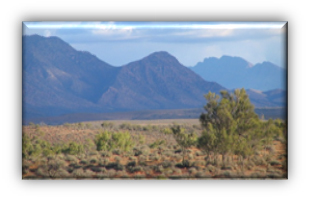
Orchids need moisture and so they do not grow on unstable soils such as dry sand-hills, gibber plains or the many saline areas of the far north but on the desert fringes there are micro-climates where the moisture, humidity and soil structure is  just right (to quote Goldilocks) for orchids.  This micro-climate is created by [s]hrubland  [which] is … [an] … important dryland orchid habitat. Besides providing shade and shelter for the orchids, shrubs like the many species of wattles, Acacia and hop-bush Dodonea drop fine leaves which help to hold the soil together and slowly break down into humus rich with nutrient and water storing capability. These shrublands usually form in soils too dry or shallow for trees. Orchids of course have no need for deep soils as they are shallow rooted. 

Robert Bates Semi-arid Shrubland.jpg
Semi-arid Shrublands, Flinders Ranges

Of the five desert botanical regions, the Eastern region contains the most number of species with over a dozen species.

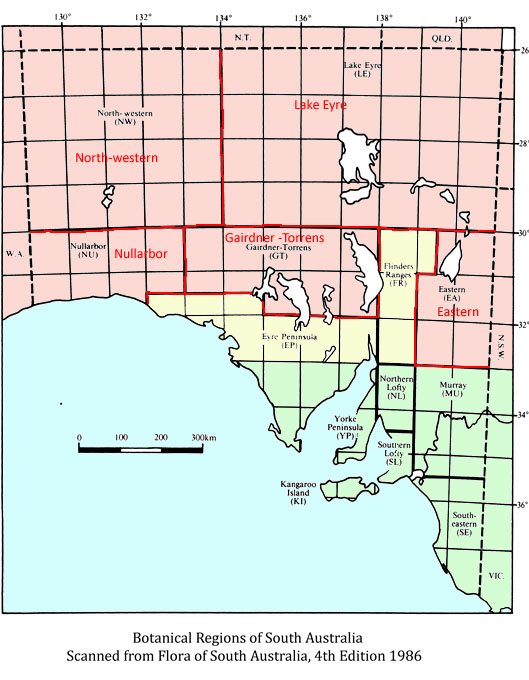
Botanical Regions Map
Colour added to indicate the desert regions (in red)

Orchids of the Eastern Region – this region is from the east of the Flinders Ranges to the New South Wales border and includes the Olary Spur and Lake Frome.

Arachnorchis toxochila – Dry Land Spider Orchid or Bow Lip Spider Orchid.
Corunastylis tepperi – Mallee Midge Orchid
Diplodium robustum – Common green shell-orchid.
Hymenochilus pagophilus – Mountain Shell-orchid
Microtis eremaea – Desert onion orchid
Microtis frutetorum – Common woodland onion orchid.
Oligochaetochilus bisetus species complex, Rusty rufous-hoods

Oligochaetochilus sp. Blue-bush Plain – Blue Bush rufous-hood (O. bisetus complex)

Oligochaetochilus sp. Outback – Outback rufous-hood (O. bisetus complex)

Oligochaetochilus cobarensis – Little desert rufous-hood
Oligochaetochilus sp. Crossed Sepals Bibliando rufous-hood. (O. hamatus complex)
Oligochaetochilus sp. Bimbowrie Bimbowrie Rufoushood (O boormanii complex)
Oligochaetochilus linguus – Swept-back Rufoushood

Oligochaetochilus sp. Old Boolcoomatta Large-lip rufous-hood (O. linguus complex)

Oligochaetochilus sp. Quartz – Quartz hill rufous-hood (O. linguus complex)

Oligochaetochilus sp. Slender desert – Slender Desert rufous-hood (O excelusus complex)
Undescribed not within any other Oligochaetochilus complex

Oligochaetochilus sp. Canegrass – Desert Sand-hill Orchid.

Oligochaetochilus sp. Oratan Rock – Diminutive rufous-hood

Oligochaetochilus sp. ‘Mt Victoria Uranium Mine’ – Uranium rufous-hood

Prasophyllum odoratum – Scented Leek-orchid

Prasophyllum sp. Desert Desert Leek-orchid (P. odoratum complex)

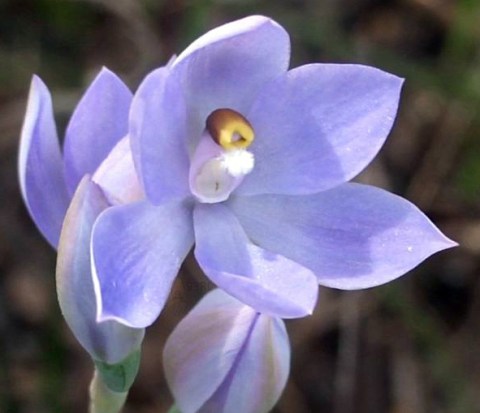
The Gairdner-Torrens region includes, besides the salt lakes it is named after, the Gawler Ranges and the southern part of the Great Victoria Desert.  Though not as many species as the Eastern region, it contains some different species including a Sun Orchid.

Thelymitra megcalyptra
Arachnorchis interanea – Inland Green-comb Spider Orchid
Arachnorchis toxochila – Dry Land Spider Orchid or Bow Lip Spider Orchid.
Hymenochilus pagophilus – Mountain Shell-orchid
Hymenochilus pisinnus – Tiny Shell-orchid
Jonesiopsis capillata – Pale Wispy Spider Orchid
Linguella sp. Hills nana – White haired little-greenhood.
Microtis eremaea – Desert onion orchid
Oligochaetochilus ovatus – Ovate Lip Rufoushood
Oligochaetochilus xerophilus – Desert rufous-hood
Prasophyllum sp. Desert Desert Leek-orchid (P. odoratum complex)
Thelymitra megcalyptra – Scented or Dryland Sun Orchid

Third of this group is the Nullabor region.  Consisting of flat treeless limestone plains, this area, surprisingly, has two species both of which have been found close to the coast.

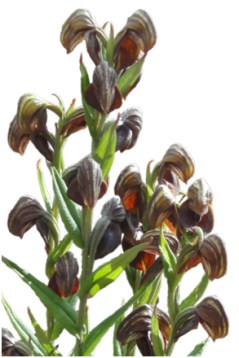
Urochilus sanguineus – Maroon banded greenhood
Corunastylis sp. Intermediate – Halbury Midge Orchid (C. rufa complex)
Urochilus sanguineus

The final two regions Lake Eyre and North-Western contain the vast expanses of desert of the far north of South Australia.  Definitely not a place to find orchids yet one specimen has been collected from each of these two regions.

Oligochaetochilus sp. Everard Range (L. Scott 173), Mimili Orchid (possibly O. woollsii complex) from North-Western Region.

Oligochaetochilus sp. Gammon Range (O excelusus complex) from the Lake Eyre region.

It is unusual to find orchids in the desert because they only grow when there have been good winter rains which isn’t very often.  But nevertheless, here in South Australia we have over 20 possible species – an astonishingly high number for such a harsh area!

Reference:

Bates R J ed, South Australia’s Native Orchids, 2011 Native Orchid Society of South Australia

Map adapted from Flora of South Australia, Fourth Edition, 1986