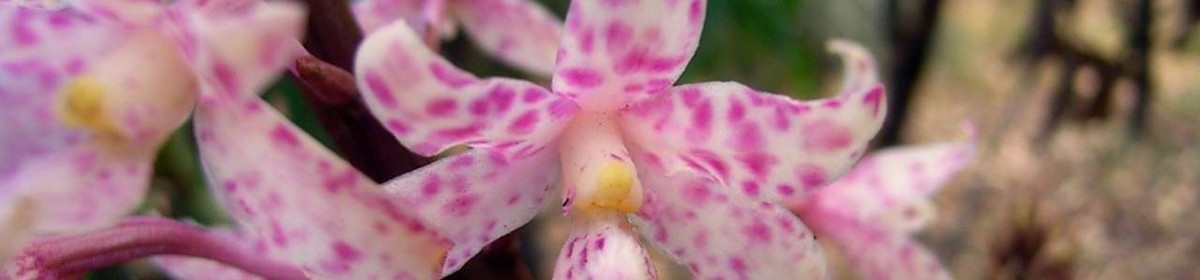
Sun Orchid Observations – Extract from Start With The Leaves

In the past week there has been some Facebook conversation on the identification of some Thelymitra (Sun Orchids) here in South Australia.  Sun Orchids can be problematic particularly when there is only one photograph.  If the photograph has a clear view of a diagnostic feature, then identification becomes simpler but there are many species for which careful observations are necessary to determine the correct one.  This is important when considering some of the complexes, eg T. nuda and T. pauciflora which have several similar species.  Colour is not always helpful as there can be either variation in colour or no colour at all.  Further complicating identification is that Sun Orchids readily hybridise, far too easily sometimes!

When Robert Lawrence wrote his book, Start With the Leaves, he realised the difficulty in identifying some orchids, so he included a checklist of observations.  The checklist is extensive but was developed to be used with the electronic version of South Australia’s Native Orchids by RJ Bates which covered all the known South Australian orchids in 2011.

 To assist in orchid identification, take as many photographs as possible, showing different parts of the plant and habitat from as many different angles.  But remember, photograph the typical plants.

Which is which
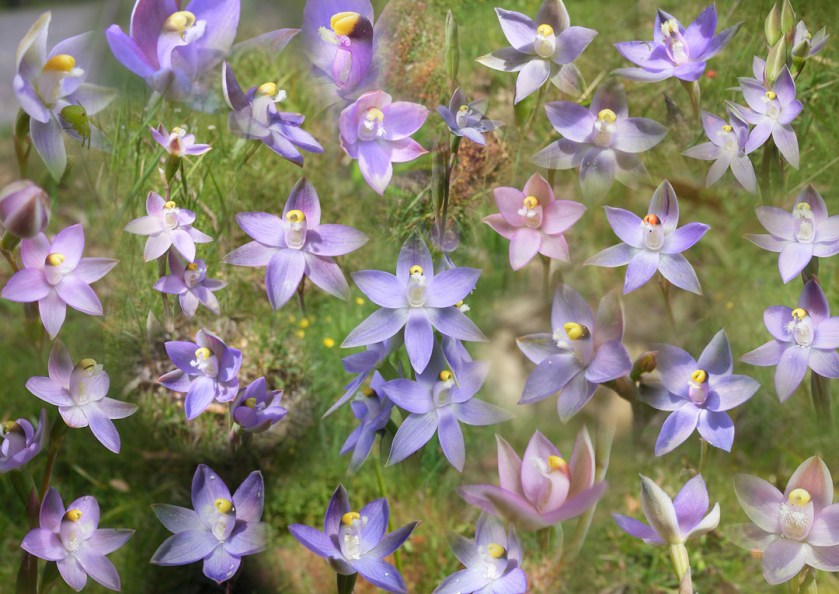
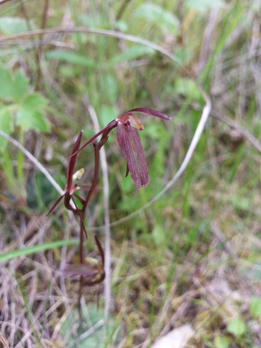
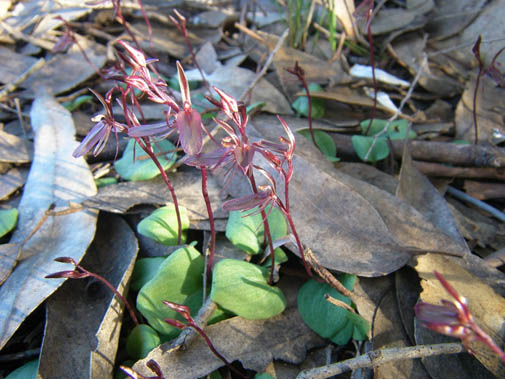
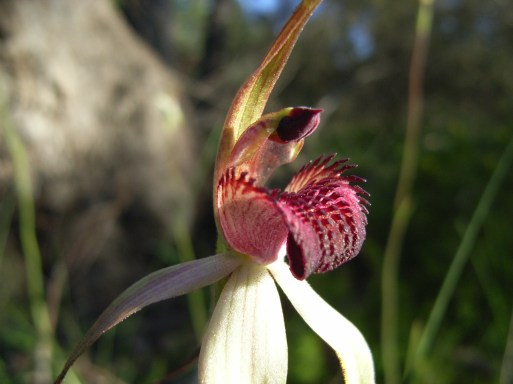
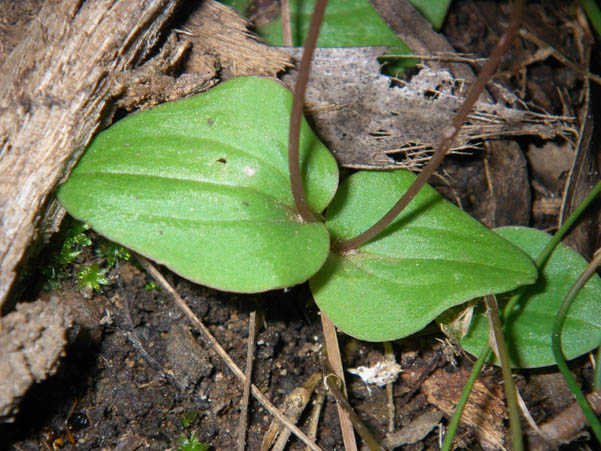
In this collage there are several species but which is which?

At the bottom of the post is a picture showing the parts of the flower.

The following extract is from pages 185 – 187

Thelymitra species (Sun Orchids)

Habitat features

Describe the habitat where the plants are found

Is the species confined to swamps or very moist sites?

Was the site burnt in the last year or two?  (Find out when if possible)

Are the plants restricted to a particular habitat or is there a range of situations where it grows?

Has it multiplied following disturbance?

Does it prefer wet or dry sites?

What other plants are growing with the orchids, including the trees forming the canopy?

Number of plants

Estimate the number of plants or describe the distribution of the plants at the site

Do plants occur in small clumps?

Do plants occur in colonies and if so how large are they?

Size of the plant

What is the height of the flower stem and width of the flower stem?

Leaf features

What are the length, width and shape of the leaf?

Is the leaf flat, channelled (u-shaped) or tubular in section?

Does the leaf change shape along its length?

Does the leaf have parallel ridges?

Is the leaf thick and fleshy or thin and papery?

What colour is the leaf?

Does the leaf have a reddish base and is the red colouration in parallel lines?

Are there any hairs on the leaf and are they confined to the margins?

Is the leaf rigid and upright or is it weak at the tip and falling under its own weight?

What is the tip of the leaf like and does it have a pointed apex?

Are the leaves shiny or to they have a powdery covering?

Stem features

What is the diameter of the stem?

What is the colour of the stem?

How high is the fistula, the point the point where the stem separates from the leaf?

Sterile bracts

(Bracts are leaf-like structures along the flowering stem)

How many bracts are there on the stem (ie those that are not immediately below a flower)?

How long is each of these bracts?

What colour are the bracts?

Are the bracts tightly or loosely wrap around the stem?

Fertile bracts

(Fertile bracts are leaf-like structures at the base of each flower)

How long are the bracts?

What colour are the bracts?

Ovary features

(The ovary is the structure immediately below the petals and sepals that becomes the seed capsule after the flowers are pollinated)

What colour are the ovaries?

How long are the ovaries?

How wide are the ovaries?

Flower features

What time of the year are the flowers open

What is the length and width of each flower?

Do the petals and sepals open widely, or does the flower remain almost closed?

What colour are the petals and sepals?

Do the petals have spots or darker coloured veins?

Is the labellum larger or smaller than the other segments (petals and sepals)?

Are segments rounded, pointed or cup shaped?

What colour is the outside of the buds?

What conditions are required for the flowers to open?  Are they only open in hot, humid conditions?

 Column features

What colour is the main part of the column?

Describe the post-anther/mid-column lobe

Is there a tubular structure on the top of the column?  What colour is this and does it have a collar of a different colour?

Does the lobe have a cleft in the apex and how deep is this?

Does the column have lateral lobes (arms) reaching in front of the column?

Are there trichomes (hair-like structures) in a mop or toothbrush arrangement?

Is there a sharp bend in the column arms?

If there is not a tubular lobe, are there three levels of structures on the column?

Are there papillae (rows of narrow bumps)?  How many and what colour are they?

What colour is the crest, if present?

Fragrance

Describe the fragrance of the flower or whether there is none

Thelymitra Flower Details

Related Articles

Thelymitra (Sun Orchid) Columns

What Orchid is This? How Photos can Help! Part One of Two Parts

What Orchid is This? How Photos can Help! Part Two of Two Parts – Comparing Crytostylis reniformis and C. robusta

Spotted Pink Sun Orchid – Beautiful but Only A Hybrid  T. x irregularis

November 2015 Winning Picture includes T. x truncata and T. x irregularis

Those Blue Orchids Again – An Overview of the Thelymitra nuda complex


April 2016 Winning Picture Competition

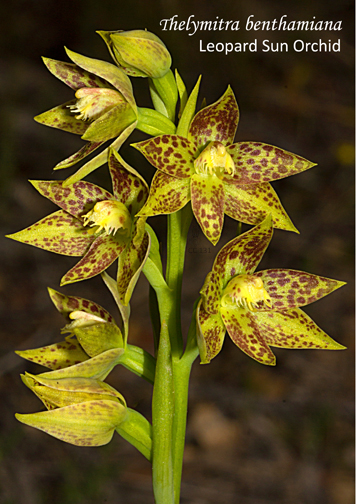
1604 sm CC T benthamaniana
Thelymitra benthamiana; Photographer: Claire Chesson

Five entries were received, again spanning the country from east to west. John Badger entered a Chiloglottis reflexa recently photographed in Tasmania, Pauline Meyers an unidentified Western Australian Spider orchid, Judy Sara had two entries from the latest field trip, Eriochilus collinus (previously phrase name Adelaide Hills) and Leporella fimbriata and Claire Chesson’s Thelymitra benthamiana.

T. benthamiana, the winning picture, is a beautiful sun orchid that is found across the southern Australia from Western Australia through South Australia to Victoria and Flinders Island. More common in west than elsewhere it is the only one of the seven species in the T. fuscolutea complex to be found in the east.

It would appear that this complex has been a problematic as indicated by Jeanes (2006) in his article Resolution of the Thelymitra fuscolutea (Orchidaceae) complex of southern Australia published Muelleria; the Royal Botanic Gardens of Victoria research journal.

Since the early days confusion, which persisted into this millennium, has occurred. In 1871 Reichenbach recognised 3 species one of which was T benthamiana but Bentham after whom the orchid was named disagreed and consider it but a synonym of T. fuscolutea. There were many twists and turns in the names but in effect, for over a hundred years, most authors followed Bentham’s taxonomy rather than Reichenbach’s until 1989 when Mark Clements after studying the drawings, literature and orchid type material came to the same conclusion as Reichenbach that T. benthamiana was a distinct species from T. fuscolutea. Since then, authors have followed Reichenbach/Clements taxonomy.

Over the decades, the number of species in this complex varied considerably. By 1938 three separate species were recognised, but between then and 1989 it fluctuated between recognizing one, three and four species and in 1998 the orchidologist were considering a possible seven species.  These were all confirmed and named in Jeans’ 2006 paper. Today, according to Orchids of Western Australia there is potentially an eighth member in this group.

Jeanes highlights some of the issues involved in determining which species is which. Some of the issues are lack of accurate/detailed information such as location, type of terrain, habitat, surrounding plants, date of collection, etc. Dried specimens by themselves are inadequate as important features may be lost in the drying process.

This complex is but an example of a widespread problem across many of our Australian orchids indicating not only the need for careful observations in the field but meticulous record keeping that others can access.

References

Jeans J A, Resolution of the Thelymitra fuscolutea R. Br. (Orchidaceae) complex of southern Australia. Muelleria 24: 3-24 (2006)

Brown A, et al, Field Guide to the Orchids of Western Australia, 2013

Thank you to Juergen Kellermann, (senior botanist for the State Herbarium) for critiquing this article.

Leptoceras and Leporella – Why are they in different genera?

QUESTION: Are there more than one species called Hare Orchid? This one [Leporella fimbriata] looks different from Leptoceras…?  Why are they in different genera?


ANSWER:

Originally they were described the genus Caladenia but as the knowledge information increased other genera were created.  Thus Leporella fimbriata was put into Eriochilus, as Eriochilus fimbriatus (1882), then Leptoceras fimbriata and finally into its own genus Leporella (A S George 1971).  Caladenia menziesii became Leptoceras menziesii.

This does not answer the why of the question which is about classification but Jones (2006) is helpful when he says:

“Plant classification systems rely on interpreting and measuring the features in one group of plants and comparing these with another group, either seeking difference or similarities.  Studies in orchids are usually biased heavily towards features of floral morphology but recent studies have revealed the importance of vegetative features in the roots, stems and leaves.  The most successful classification system is one that is balanced and based on a wide range of vegetative and floral features.”  To add to this list is the molecular studies being done on orchids.

This means the authors advocating change need to clearly show why a name change and/or a new species is warranted.

For instance, Fitzgerald gives the following reason for not including Leporella fimbriata in the Caladenia genus

“Leaves much more frequently observed than flowers.  It is with great reluctance I depart from the naming in ‘Flora Australiensis’ [author Bentham, 1863 – 1878], but I cannot concur with the inclusion of this with Caladenia, and have place it in Lindleys’ Leptoceras for the following reasons: Leaf or leaves not those of Caladenia.  In Caladenia I have never seen more than one leaf, always thin and usually hairy; in this plant leaf thick, hard and shining, occasionally two.  In Caladenia tubers are generally numerous, in L. fimbriata I have only observed one.  The labellum, is without the characteristic glans and is not of the form obtaining in Caladenia, the stigma is very different in form being triangular and deep sunk, the upper parts overhanging, not oval and shallow; and the flowers have the peculiarity of drying and continuing in a state hardly to be distinguished from the fresh flowers long after the seed has been shed.  It approaches C. menziesii only (so far as I can see) in having erect linear-clavate petals, in which C. menziesii is itself peculiar, L. firmbriata seems to come near to Eriochilus than to Caladenia but differs from it again” Quoted from Emily Pelloe Western Australian Orchids 1930

Concerning Leptoceras menziesii, Bates & Weber have made the following statement:

“True Caladenias have hairy scapes and hairy leaves.  (C. menziesii now believed to belong to a separate genus is glabrous)”.

Even though they are not Caladenia, why not have them in the same genus for both have glabous (without hairs) leaves, more leaves than flowers, erect spathulate (spoon shaped) glandular petals, colony forming, similar distribution.

Leporella fimbriata  in patch
Leporella fimbriata – note the absence of leaves and the dry sandy conditions [Photo: R Lawrence]
Leptoceras menziesii in patch
Leptoceras menziesii – note the abundance of leaves [Photo: R Lawrence]
There are similarities.  In fact, Bates (2011) calls them sister genera but despite the similarities there are enough differences to recognise them at genus level at present including “different flowering times, different mycorrhizal fungi associations and different pollination” some of which are detailed in the chart below.


Feature Leptoceras Leporella
Pollination Strategy Strategy unknown

Native Bee

Strategy pseudocopulation

Winged male ants (Myrmecia urens)

Myrmecophyte – lives in mutualistic association with colony of ants
Labellum Curved white with red stripes

Has calli

Wider than longer, purple and green

Has no calli

Flowering Time Spring (September to November) Autumn (March to May)
Habitat Shaded sites – moist gullies; scrub, heath, woodland and foret Open sites – acid sands, light scrub, stringybark
Leaf Emergence Leaves emerge before flowering Leaves emerge after flowering


Leptoceras menziesii (Rabbit Ears Orchid)
Leptoceras menziesii (Hare Orchid or Rabbit Ears Orchid) after a fire, [Photo: R Lawrence]

REFERENCES:

https://en.wikipedia.org/wiki/Myrmecophyte accessed May 13 2016

http://www.flora.sa.gov.au/cgi-bin/speciesfacts_display.cgi?form=speciesfacts&name=Leporella_fimbriata accessed May 13 2016

http://www.flora.sa.gov.au/cgi-bin/speciesfacts_display.cgi?form=speciesfacts&name=Caladenia_menziesii accessed May 13 2016

Pelloe E, Western Australian Orchids 1930

Bates R & Weber J, Orchids of South Australia, 1990

Bates R Editor, South Australia’s Native Orchids 2011

Martin A, The Vocabulary of Orchids: an Amateur Perspective 2005

Rogers R, South Australian Orchids 2nd Ed 1911

Jones D, A Complete Guide to Native Orchids of Australia including the Island Territories 2006

WHAT ORCHID IS THIS? HOW PHOTOS CAN HELP! – Part Two of Two Parts

Part One covered hints for photographing orchids so as to be able to identify the plant.  Part Two gives an example with Cyrtostylis robusta (Winter Gnat Orchid) and C. reniformis (Small Gnat Orchid).

Although the flowering times are different – C reniformis is spring flowering and C. robusta is winter flowering – there is a slight overlap in August when it is possible for both to be flowering at the same time and in the same place.

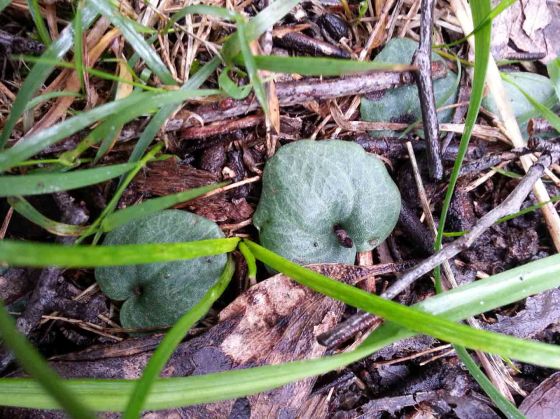
The flowers are very similar but major difference between the two species is the leaf.  Both leaves are roughly kidney shape but C. robusta is pale green with pale , almost undistinguished veins, silvery underneath whilst  C. reniformis is heavily veined, blue-green above and green below.

Cyrtostylis reniformis (4)
C. reniformis, easily identified by the leaf, even when in bud.

The other differences are more subtle.

  • C. reniformis has dark buds and the apex of the labellum tends to be rounded rather than pointed
  • C. robusta has pale reddish buds and larger flowers, labellum crenulated (slightly wavy) and a fine point at the apex.
Cyrtostylis reniformis
C. reniformis – This is not a good identification picture because though the leaf is present, it is too blurry for identifying the species and the angle of the flower obscures the labellum  details

Consequently, it is important that photographs of the flowers clearly show the labellum – pointed labellum apex for C. robusta compared with the rounded labellum tip of C. reniformis.


Cyrtostylis robusta
In this photograph it is possible to identify the plants as C. robusta because of the leaves even though there are no clear views of the labellum.

March 2016 Winning Photograph

1603 sm JS Arachnorchis sp

We frequently receive entries from Western Australia but this month our entries were from both the west and the east. Allen Jennings entered a Calanthe triplicata (Christmas Orchid) from New South Wales. Pauline Meyer’s was from the west, (Western) Flying Duck Orchid, Paracaleana nigrita. The other entries were South Australian, Jenny Pauley’s recently photographed Leporella fimbriata (Fringed Hare Orchid), Greg Sara’s Thelymitra rubra (Common Pink Sun Orchid) and Judy Sara’s Plumatochilos sp. (Bearded Orchid) and Arachnorchis sp. (Spider Orchid).

The winning photograph was Judy’s Spider Orchid. Obviously it was one of the Green Comb Spider Orchids – A. dilatata complex. Of this group there are about a dozen possibilities. Knowing the location, Mt Boothby, helped to narrow the options with the most likely candidate being Arachnorchis stricta but it wasn’t convincing. It would appear that the tips of the sepals may have been chewed off when in bud.

A distinguishing feature of this species is that there are no clubs or osmophores on the sepals. Other species of this complex have clubs. Another feature is that the dorsal sepal is bent over the column unlike many other green combs which have an erect dorsal sepal. The features that caused doubt were lateral sepals looking droopy instead of being characteristically stiffly held out but dry conditions could cause this. The other was that the labellum did not strictly fit the description of A. stricta but then again it is a variable species.

The conclusion was a possible hybrid but there is no information on the likely parents or that is an atypical A. stricta that may have been damaged in bud.

This is an example of the difficulties that can occur when attempting to identify a plant from one photograph.

Reference:

Personal communications Thelma Bridle (NOSSA Conservation Officer)

Personal communications Bob Bates

Bates, R. J., ed. (2011). South Australian Native Orchids. Electronic version, 2011. NOSSA

Rules of entry:

The subject matter must have something to do with Australian orchids.  Any format is acceptable including Photo shopped images, artwork, etc

How to enter:

Email nossa.enquiries@gmail.com – jpg as large as you are able to send it, preferably A4 ratio for printing

Post: PO Box 565, Unley, 5061

Bring in to the meeting

WHAT ORCHID IS THIS? HOW PHOTOS CAN HELP! – Part One of Two Parts

The following article is from the April 2016 Journal of the Native Orchid Society of South Australia.  The article is complete in itself but Part Two of this post will illustrate how images can help with images of Crytostylis robusta and C. reniformis.

Orchids are beautiful plants and many of us like to capture that beauty on photographs. And there are many beautiful pictures around.

Many times NOSSA, the Herbarium and other specialist groups receive images requesting identification but the vital information is missing.

When photographing for identification, it is necessary to take more than one image, particularly if you are unable to easily return to the site for more images. When in doubt, take several shots from many different angles highlighting different features of the plant and its habitat.

Another very important point to remember is, when there are several of the same plant, to photograph the orchid that is most representative of the group, not the atypical or unusual plant.

General Guide

As a general guide, it is helpful to take a picture of each of the following

  • whole plant
  • individual flower – both from the front and the side, occasionally the back.
  • flower head
  • leaf or leaves
  • habitat

Other helpful things to consider photographing are:

  • capsules of the finished flower – sometimes it can yield useful information.
  • for some genera, the stem can also be a helpful feature as between some species there can be a difference in the hairiness of the stem.
  • It is also worth including in a photograph an indication of whether the plants are growing in colonies with others or as scattered individual plants.

Importance of Size

It is also good to give an idea of size, this can be as simple as using a thumb or hand, a coin (show the reverse not the head) or any item that had an easily recognized size. It is important to have the object next to the feature being photographed. For example, a coin on the ground next to a leaf or a hand immediately behind the flower gives a clear indication of size. Remember to take another photo without the hand or coin.

Some Specific Identifying Features

Some species are distinctive and easily recognised, eg the Flying Duck Orchid, but others are not and it is helpful to know what part of the plant to photograph as different genera will have different identifying features.

  • Spider orchids – the tips of the segments (petals and sepals) and details of the labellum are important
  • Sun orchids – the column in the middle, the ovary at the base of the flower, and the number of bracts (leaf-like growth) on the stems
  • Pink fingers – the length of the leaf in comparison with the length of the flower stalk; also the back of the flower is helpful
  • Gnat orchid – the leaf is the best identifying feature, but also the bud can be helpful
  • Hyacinth orchid (of the Adelaide Hills) – labellum
  • Mosquito, Mayfly and Helmet orchids when not in flower – both sides of the leaf
  • Gastrodia – the flower spike
  • Rufoushoods – side view of the flower and close up of the labellum as the hairs on or surrounding the labellum are important features.
  • Leek Orchids – the labellum is very important, as well as part if not all of the flower spike as the distance between the individual flowers aids identification
  • Greenhoods – if present, the non-flowering rosette of leaves

The Australian Virtual Herbarium has some good tips for photographing flower. Click here to visit the site


Spider Orchid
Spider Orchid Photo: Robert Lawrence

This image lacks the ends of the segments to determine the identification.  The presence or absence of  clubs on the ends of the segments (petals and sepals) can often be the distinguishing feature with many of the Arachnorchis (Spider Orchids).

Atypical Cyrtostylis leaves

These leaves are an unusual shape and by themselves are not suitable for identification

THE DUCKS – TAKING A DIFFERENT PERSPECTIVE PART TWO of TWO

In Part One, Leo Davis’ first article centred on the Large Flying Duck, this second part is about the lesser known Little Duck.

TAKING A DIFFERENT PERSPECTIVE 2 (The Small Flying Duck Orchid)

There are at least three speceis of flying duck orchids in SA, one in genus Caleana and two others having been moved from there to genus Paracaleana.

My favourite, of the two duck orchids that most of us see, is the small duck orchid (Paracaleana minor).  It is actually rarer than the more popular species, can bear six or more flowers on a spike, and has a more delicate and quirky charm, to my eye. 

As with the large flying duck the usual angle of photographing the smaller species is to emphasise the ‘flying’ nature.  But again there is other detail to see and to be illustrated from other view-points.

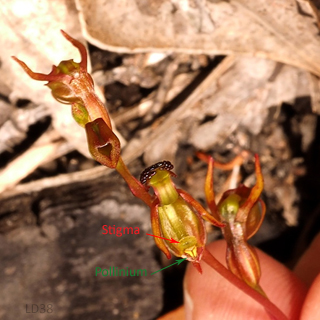
The accompanying image of the little duck flower, viewed from the front, shows variations on the same structures shown previously in the large duck orchid.  Down at the bottom of the flower is the sticky stigma (♀ part), not white this time, and immediately below is the triangular yellow pollinium packet (♂ part).  Again both structures sit in the bowl shaped column.

Paracalean minor arrows copy
Paracalean minor (Little Flying Duck Orchid)

Note the three part symmetry of the pollinium, with a distinctive Mercedes Benz logo (or Mitsubishi if your budget only stretches that far) to tease us.

The location of the female (♀) and male (♂) organs, adjacent to each other, fused to form a column, is one of the main distinguishing characteristic features of the orchid family.

As an afterword let me remind you that the little duck (like the larger, collected in Sydney in 1803) started out as Caleana minor but was moved to a new genus, leaving the large duck as the only member of its genus.  Rules of nomenclature mean that the small duck had to keep its specific name (minor), hence we now have Paracaleana minor but there is no, and never will be, Paracaleana major.  But Caleana minor still appears in publications and some folks may still use that name.

Some of you choose to use different scientific names to some that others use. Recently some of us bought a propagation pack that Les Nesbitt produced, to grow the maroon banded greenhood (Pterostylis sanguinea.) In the unlikely event that my pack produces seedlings I will label them Urochilus sanguineus.  And we can both justify our choice.  And then, of course, some taxonomist could move the little duck back to its original genus one day. 

Then, of course, there is the added complication that David Jones (Native Orchids of Australia Including the Island Territories. 2006, p148) calls the species Sullivania minor!

Leo Davis

The Ducks – Taking A Different Perspective Part One of Two

Leo Davis is an orchid enthusiast with an eye for detail.  Everyone seems to be aware of and gets excited over the flower of the large flying duck orchid but in the article below, Leo takes a look at a more significant event – the rare fruiting of the duck in South Australia.

TAKING A DIFFERENT PERSPECTIVE 1(The Large Flying Duck Orchid)
Leo Davis

When approaching an iconic orchid like a flying duck orchid the obvious imperative is to emphasise the flying duck image. But as much fun as that can be, we can find and record some other significant aspects of this species.  Do remember to look at all orchid flowers, with or without your camera, from different directions. And don’t forget the leaves.

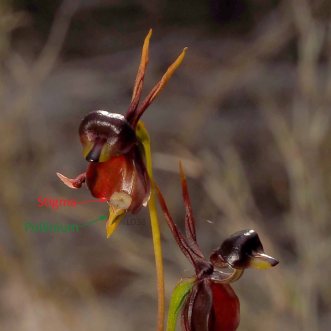
In the last flowering season at Knott Hill NFR (Oct-Dec 2015) I photographed a double flowered large flying duck (Caleana major) on November 14.  At the bottom of the upper left hand side flower you can see a white stigma (♀ part), sitting at the base of the bowl shaped column. The sticky surface of the stigma is ready to trap a pollinium (a sack of pollen grains), if the correct pollinator arrives, with a pollinium attached. Immediately below is a three lobed the triangular yellow pollinium packet (♂ part), as yet not taken by a pollinator.  The highly sensitive mobile duck shaped labellum, a modified petal, looms above, waiting to slam a visiting insect down onto the pollinium, so attaching it to the back of the insect.

OLYMPUS DIGITAL CAMERA
Caleana major (Flying Duck Orchid) – note the location of the stigma and pollinium

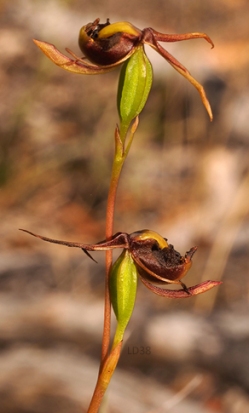
On December 10 I found the same plant, and one adjacent, in FRUIT. This is not often observed in South Australia and it has been suggested that the specific pollinator may be thin on the ground.  I photographed both plants but that of the more advanced plant (shown), with fully withered flowers and plump developing ovaries, interested me more, because it suggested progress towards production of viable seed.

Caleana major fruiting body
Success – Caleana major Fruiting Bodies

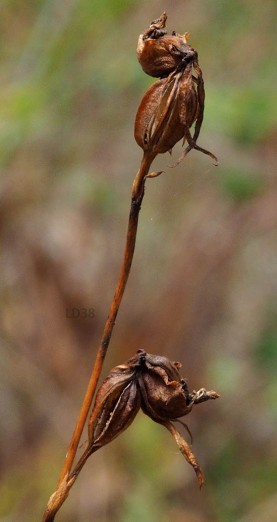
I went back on March 9, this year, and was delighted to find and photograph the fruit that had ripened, dried and split, so releasing the dust like seed.  I was prepared for disappointment because the fate of seed pods of many orchid species is to be eaten.  For example for the hyacinth orchid (Dipodiun roseum), across both the 2014-15 and 2015-16 flowering seasons, at Knott Hill, all plants that I found had their seed pods consumed. Kangaroos?

OLYMPUS DIGITAL CAMERA
Dehiscent (splitting of the seed pod to allow dispersal of the seed) Caleana major

Robert Brown established the genus Caleana based upon his description of a specimen of Caleana major (1810).  The type specimen was collected in 1803, at Bennilong Point, the site of the Opera House, so the species is extinct at that site now, of course.


February 2016 Winning Photograph

1602 sm PM Caleana major

For our first competition of the year we had five photographs – three of flowers and two of participants on a field trip.  The species represented were David Mangelsdorf’s Calochilus robertsonii (Southern Bearded Orchid); Robert Lawrence’s Pheladenia deformis (Blue Bearded Orchid) and Pauline Meyer’s Caleana major (Flying Duck Orchid) which was the winning photograph.

There is no doubt that the Duck Orchids are very photogenic and that people want to see and photograph them.  When seen the for the first time their small size surprises most.  The flower is no bigger than a thumbnail, perched atop a spindly stalk that may only reach 50cms (20 inches).

Although the rusty red colour of the flower is quite exquisite, this means that it blends in with the surrounding leaf litter and scrub and is not easily spotted.

As species of Heathy Woodlands, in South Australia, it is often found growing in sparse colonies near the base of trees.  Other plants associated with them are banksias, eg Banksia ornata, Eucalyptus baxteri and bracken.  The soil is sandy, often from leached acidic dunes, or gravelly.

Reference:

2008 Department for Environment and Heritage Electronic Flora of South Australia species Fact Sheet: Caleana major R.Br. Available from pa-fact-pafactcaleanamajor.pdf

Bates, R. J., ed. (2011). South Australian Native Orchids. Electronic version, 2011. NOSSA

What Pots Should I Use For My Terrestrial Orchids?

The best size pots to use for terrestrial orchids should be between a minimum of 125mm (5 inches) to a maximum of 175 mm (7 inches).  Black plastic pots are better than terracotta as they last longer and are easy to sterilize.

If the pots are too small, they dry out too quickly in Autumn and Spring.

If they are too large, it gets too wet for the tubers.  If using a larger pot, then the drainage needs adjusting by adding coarser sand to the mix.  Specimen pots for show purposes utilize pot sizes up to 300mm holding 30-50 plants.  Clay pans are sometimes used for show work.

The pots should not be shallow. 125mm depth is the minimum recommended for reliable results.  For instance, the Arachnorchis like deeper pots as the tubers tend to go down deep.  Droppers have been known to come out of the bottom drainage holes.  When this happens to stop the tubers shrivelling up in summer, it will be necessary to stand the pot on the sandy soil of another pot.

Used pots can be cleaned by blasting off loose grime with a high pressure jet of water and then soaking in a bucket of water & White King (bleach).

Pot of Caladenia latifolia cultivated by Les Nesbitt
Caladenia latifolia – show specimen in larger size pot