2015 February Winning Photograph

02 CC Thelymitra glaucophylla sm

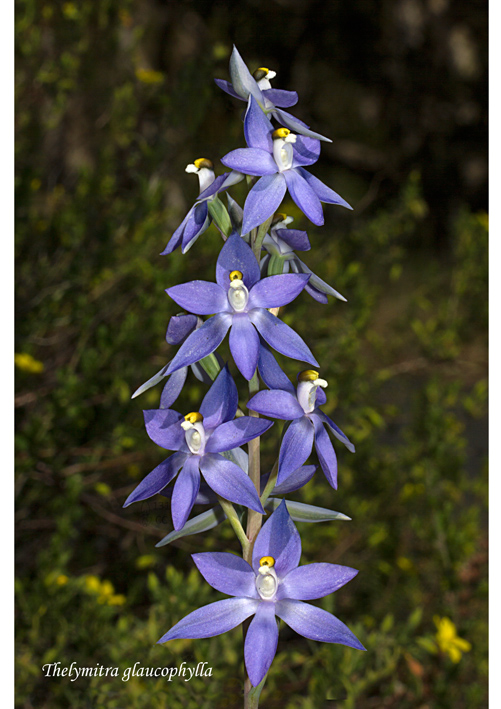
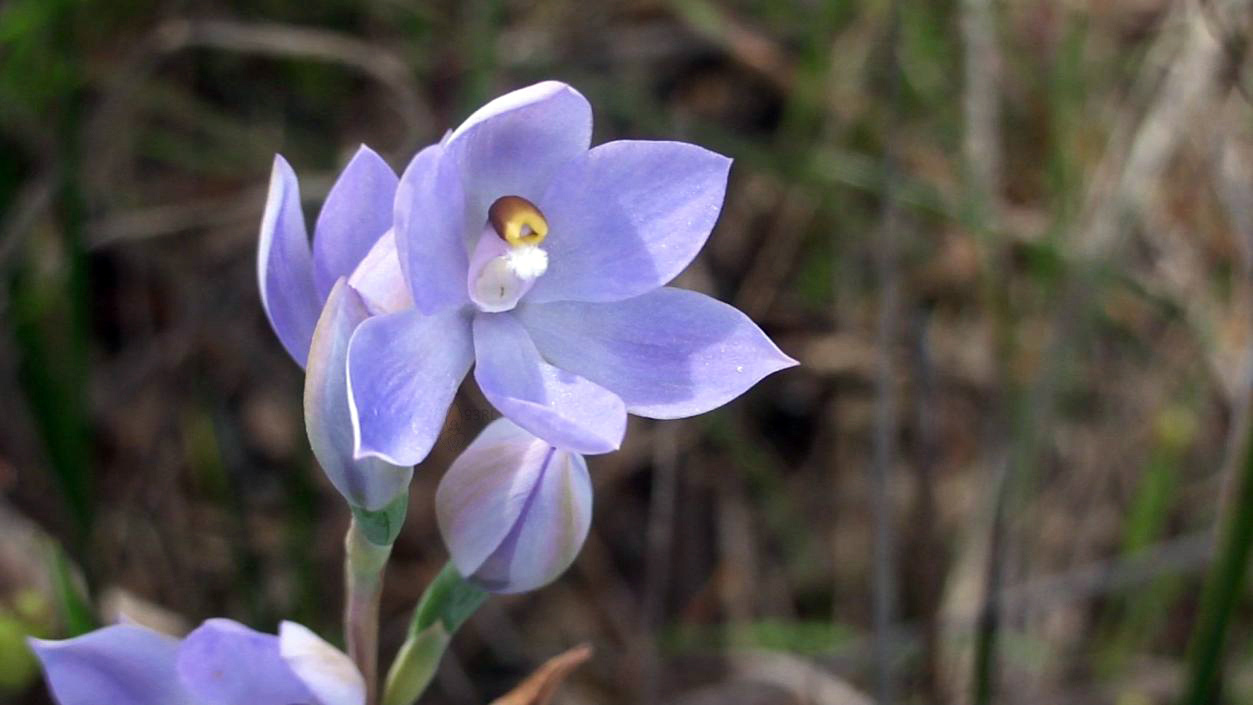
The number of photographs may have been few but the quality was present. The clear winner was Claire Chesson’s Thelymitra glaucophylla (Glaucous Leaf Sun Orchid). Flowering from October to December, this endemic grassy woodland species of the ranges was only published in 2013 by Jeff Jeanes in the Mulleria 31:3 – 30 (2013) but it had been recognized much earlier by Bob Bates and has appeared with this name in his electronic Orchids of South Australia since 2005. It belongs to the T. nuda complex, of which there are 15 species, six of them having only been published in 2013. This complex is characterised by having large scented blue multiple flowers that open freely.

Not seen in this picture is the leaf and though the leaf is highly variable – 10-50cm long, 8-20mm wide, erect and short, long and flaccid, Jeanes mentions that T. glaucophylla “can be identified with a high degree of confidence from the mature leaves alone” (Page 4 Vol 31, 2013 Mulleria). The main features of the leaf are grey-green glaucous ie white bloom and is often senescent (withered) at anthesis (full flowered). Of the T. nuda complex, T. megcalyptra is the most similar but its leaf is never glaucous and has a red base, as well as an earlier flowering time and habitat of plains and rock outcrops.

For more details on the other orchids in the T. nuda group see the post titled Those Blue Orchids Again … posted 30th January 2015 with the link to Jeanes article in the Muelleria

Advice from the past – Start Watering

In 1984, G.J.Nieuwenhoven was the editor of the NOSSA Journal.  In February of that year he wrote the following:

Welcome back to NOSSA.

 After the holiday break we are all looking forward to the next meeting to talk about our favourite plants and renew friendships.

Several members have reported an early start to the terrestrial season with Pterostylis species, a couple of Diuris species popping up already.  For some of the eastern states Pterostylis of the cauline group this is normal, especially if you keep the pots cool during the summer (a cellar is ideal but underneath a shaded bench in the shadehouse will do nicely). Very light watering should take place when the first shoots appear but do not overdo the watering or place pots in the sun for we are sure to get some more hot weather yet and this could cook your plants before you know it.

The Diuris are really out of season but it was probably the rain in late December and early January that started them off, anyway, these too should be kept slightly damp if they are up.

If you have not finished repotting by now it would be best to leave it until next year as the new shoots which are already beginning to grow from the tubers are very easily broken off while sifting them from the soil.

Apart from that all you can do is wait for the rains to come in March and then start searching for plants to appear – and keep those fingers out of the pots or you may damage one of your best plants looking for the new growths.

This is also the time to start taking notes when plants first appear, etc.:

  • when they flower and how many flowers from a given number of tubers;
  • what kind of soil; what conditions (i.e. shaded or not, damp or dry).
  • Anything that may assist in years to come to help you understand and grow our orchids better and, more importantly, multiply them.
  • A card index system would be a good way to store information, otherwise an exercise book will do.

                                                            Editor

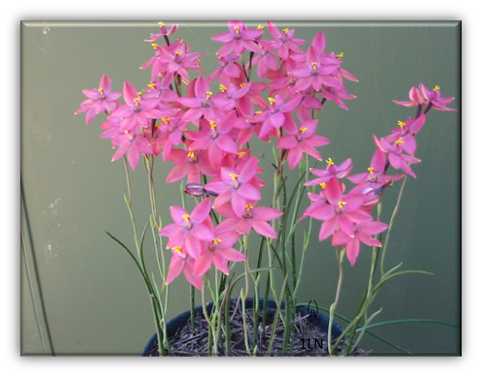
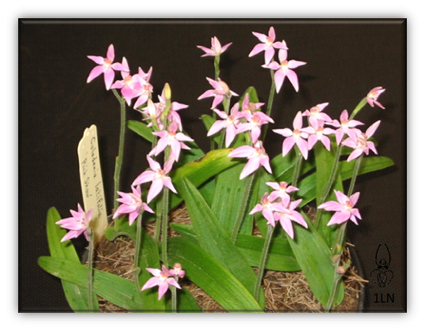
The timing of the article tallies with the advice that was recently given at the end of February – start watering the terrestrials now if you haven’t already begun.  Hopefully by the flowering time you will have a lovely display of terrestrials such as the Thelymitra, Arachnorchis and Caladenia featured below.


Pot of Thelymitra Kay Nesbitt Cultivar copyPot of Arachnorchis argocallaPot of Caladenia latifolia cultivated by Les Nesbitt

2014 November Photograph Competition Part 2

Part Two of the November competition consisted of photographs of insects on orchids. There was quite a range of insects but the winner was a draw between Cyrtostylis robusta (Winter Gnat Orchid) with an ant and Pterostylis curta (Blunt Greenhood) with a midge fly; both taken by Doug Castle.

With today’s technology it is not only easier to take crisp images but fine details can be seen particularly when enlarging the image. Hence when the pictures are enlarged it is possible to see hairs on the ant and feathered antennae on the midge fly.

With identifying orchids, it is often the detail that is important. Both of these orchids are distinctive and can be readily identified but it is good to examine why this is the case.

Pterostylis curta (Blunt Greenhood)

With the greenhood, there is enough detail to see that the dorsal sepal and lateral petals have united to form a galea, ie hood, and that the lateral sepals are semi-fused and erect resulting in lateral orifices (side gap) between the two structures. These are some of the features that separate Pterostylis* from the other greenhoods such as Diplodium, Speculantha and Taurantha. This becomes apparent when browsing through the greenhood photographs, pages 286 to 339, in Jones “A Complete Guide to Native Orchids of Australia”. Having established that the plant is a Pterostylis, the twisted labellum is diagnostic of a P. curta as it is the only one that is described with a twisted labellum. Although not all the identifying features are present, enough information is available in this picture for identification.

In contrast the photograph of the Cyrtostylis robusta only has sufficient data to confidently identify it as a Cyrtostylis species, having a distinctive labellum that is larger than the lateral sepals and petals. In South Australia there are only two species and according to Bates (2011), the distinguishing features between the two

Cyrtostylis robusta (Winter Gnat Orchid)

appear to be the leaf, the bud and the labellum. In this picture, the angle of the image does not give a clear view of the labellum (it could possibly be damaged) and of course there is no bud or leaf. It is possible that the pale edges of the dorsal sepal may give a clue to species identification as C. reniformis has mainly darker buds than C. robusta. Obviously Doug was able to identify it from his observations of the other features not present in this photograph.

In summary, one image is not always sufficient for identification. As was discussed on the night, to confirm identification, orchids should always be photographed from more than one angle, including pictures of other parts of the plant.

*In South Australia, Pterostylis foliata is a possible exception as it has no obvious lateral orifice.

References

Jones, D.L., T. Hopley, S.M. Duffy, K.J. Richards, M.A. Clements & X. Zhang (2006) Australian orchid genera. An information and identification system. CSIRO Publishing: Collingwood, Vic.

Bates, R.J. (2011) South Australia’s Native Orchids. DVD-ROM. Native Orchid Society of South Australia Inc.: Adelaide.

Jones, D.L. (2006) A complete guide to native orchids of Australia, including the island territories. New Holland Publishers: Sydney.

Those Blue Orchids Again …

Volume 31, 2013 of the Muelleria contains an orchid article by Jeffery A Jeanes. The title may be long – An overview of the Thelymitra nuda (Orchidaceae) complex in Australia including the description of six new species – but the subject is of interest to all of us who want to know our sun orchids, many of which are not always easy to identify.

By way of introduction, Muelleria is the Royal Botanic Gardens of Melbourne official research journal and has been published since 1955.

Though a technical article there is much to be gleaned for the ordinary reader, for instance the article contains a good description of the commonly used terms for describing the column for example stigma, trichomes, anther, post anther lobe, etc. This is helpful to know as the column structure is often the main feature of the plant used to identify the individual species. Naturally the key features of the T. nuda complex are covered comprehensively, as well as a brief discussion of the taxonomic history.

Another helpful section is the dichotomous key for all fifteen species described in the article. Of the fifteen species four are found in South Australia and are pictured below.  But to discover more read the article ……

Thelymitra nuda
Thelymitra nuda
T megcalyptra130927
Thelymitra megcalyptra
Thelymitra glaucophylla photographed by Robert Bates
Thelymitra alcockiae

Another Summer Orchid

Just on Christmas, NOSSA received an enquiry from Tim in the South East about an orchid he had photographed.  He knew about Dipodium roseum but in 20 years he had not seen one like this one.

From the photograph that he’d sent, it was obvious that it was a Gastrodia.  In South Australia there are three species ranging in size from the smaller G. vescula (Limp Potato Orchid) through to G. sesamoides (Cinnamon Bells or Common Potato Orchid) to the larger G. procera (Tall Potato Orchid).  Whilst G. vescula and G. procera are limited in South Australia to the South East, G. sesamoides is also found in the Southern Lofty and Kangaroo Island regions.

Tim’s orchid was G. procera.  The features that set it apart from the other two were the time of year – late December whereas both G. sesamoides and G. procera would have finished flowering (and for 2014 most orchids finished flowering earlier than usual); the spike was crowded and the plant was upright but G. sesamoides has a bent or droopy spike when in bud and G. vescula is small with very few flowers.

Though Tim considered the photographs to not be very good, he’d photographed the necessary features to help with identification. Another feature seen in his picture is the warty appearance of the plant compared with the photograph of the G. sesamoides.

Gastrodia procera or Tall Potato Orchid
Gastrodia procera (Tall Potato Orchid) Note the upright spike and the ‘wartiness’
Gastrodia sesamoides (Cinnamon Bells or Common Potato Orchid)


Although it is has no conservation rating federally and may even be considered secure in the Eastern States, in South Australia it is rated endangered, so well done to Tim for spotting it!

 It was possible to identify this orchid from the information found in South Australia’s Native Orchids, an electronic book produced and sold by the Native Orchid Society of South Australia.  Identification was confirmed by one of our most knowledgeable members.

‘Tis the Season … for Dipodium

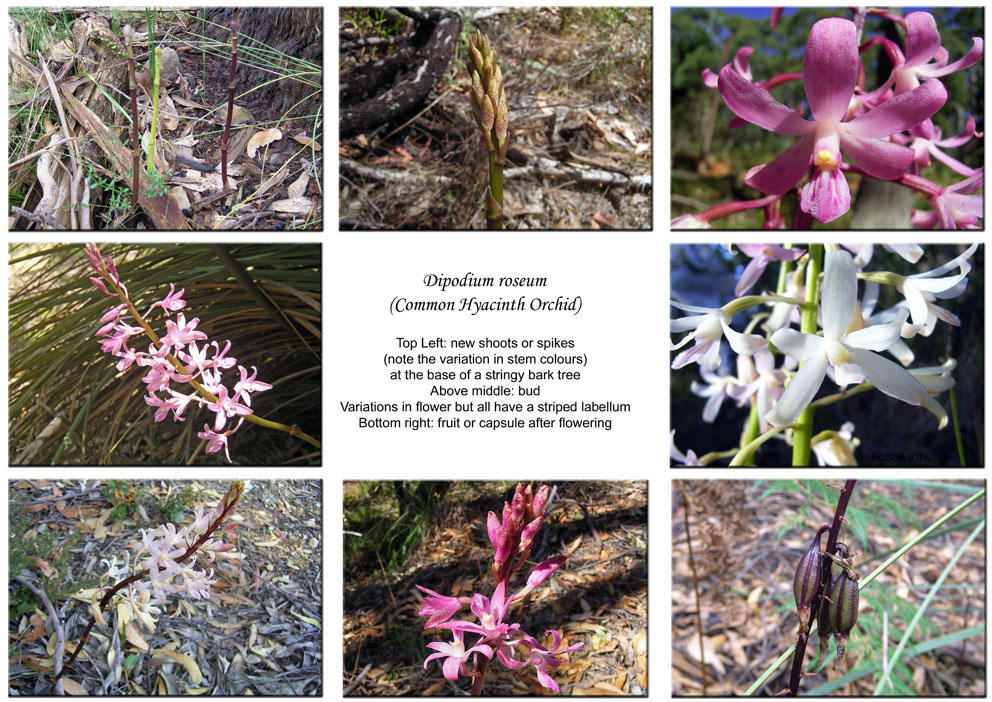
For many with Christmas and New Year holidays it is a busy time but not so with the orchids here in the Adelaide region.  The vast majority of orchids have finished flowering for the year except for a few including one of our most showy orchids, the Hyacinth Orchids (Dipodium species).  Of the four species found in South Australia, two are found in Adelaide Hills –  D. roseum or Common Hyacinth Orchid and D. pardalinum or Small-spotted Hyacinth Orchid and these will be flowering across the whole of the summer period.

Both of these Dipodium species are leafless plants that are dependent upon mycorrhizal fungi associated with stringy bark trees, either Eucalyptus obliqua or E. baxteri.  This growth requirement makes it impossible to grow in cultivation.  (Stringy bark trees can’t be grown in pots!)  The emerging stem and buds resemble an asparagus shoot.  The stems can range from a light green through to a deep dark red.  At this stage it is difficult to tell the two species apart although if there are yellowing tips on white buds it may be a clue that the plant could be D. pardalinum.

Once in flower D. roseum has a surprising range of variation  from carmine (a lightly purplish deep red) through to pink to white, with suffused rather than clearly defined spots.  On paler or white flowers these blotches may appear pale mauve-pink rather than candy-pink.   It always has a distinctive striped labellum.

Dipodium roseum composite

This feature sets it apart from D. pardalinum which has a clearly spotted labellum and in contrast to D. roseum, the flowers lack variation of colour but are consistently white with small well-defined candy spots.  (There are other Dipodium species with larger spots.)

Note the yellow staining on the bud and no stripes on the labellum

And the final word, D. roseum is common but D. pardalinum is rated vulnerable in South Australia.


Reference: South Australia’s Native Orchids Bates 2011

2014 November Photograph Competition Part 1

11 sm CD Arachnorchis sp with hover fly

With a theme of Orchids and Insects for the November meeting it was hoped that there would be some entries with pollinators and therefore there would be two categories Insect Visitors and Pollinators. This month’s article will feature the Pollinator section and Insect Visitors in the next month.

In all there were four potential pollinator photographs. The insects were either scrounging around at the base of the column or else they had the pollinia attached to them. Unfortunately only one was a true pollinator so the category became Insects with Pollinia. The winning photograph of Arachnorchis brumalis with an unidentified hoverfly was taken by Chris Davey. Interestingly the other two pictures also featured Arachnorchis species with the hover fly Simosyrphus grandicornis. Resembling a wasp but minus the sting, this species is one of the common hover flies native to Australia.

Called Hover Flies owing to their ability to hover motionless in one spot, they are also known as Flower Flies because they are often found hovering around as well as pollinating flowers. It is not surprising, therefore, to find them around orchids. Yet instead of being called pollinators they are non-pollinators (Bates & Weber 1990). They visit the orchids, forage inside the flower and may even manage to collect some pollinia but that is all. They may not necessarily visit another flower of the same species but if they do, they will fail to deliver the pollinia to the stigma2.

Rudie Kuiter agrees with Bates that hover flies are not orchid pollinators but just when we think we have worked it out he adds “but we have at least one orchid in Victoria that is pollinated by hoverflies and witnessed now several times and this is Caladenia catenata” (synonym Petalochilus catenatus). Notwithstanding the case for this species, it would appear that in most cases hoverflies remove pollinia so that it is not available to a more specific pollinator.

Why then are the hover flies attracted to the orchids? Is it for food? An internet image search revealed that hover flies visit the flowers of many different genera including Thelymitra and Diuris. This is interesting because flowers are the food source for hover flies but though many orchids promise food, many species do not produce the nectar and pollen (as a food source) that they desire. Diuris and Thelymitra belong to this group of non-nectar producing flower. Other orchids that don’t produce nectar include Gastrodia, Dipodium and the Duck orchids. Again, there are orchids such as Crytostylis which produce minimal nectar and with Prasophyllum the nectar is hidden in cells that require puncturing – not a good food source!

Having discussed hover flies as non-pollinators, in this month’s competition, which photograph had a pollinator? – It came last and was Robert Lawrence’s photograph of a native bee on a Dipodium pardalinum, another non-nectar producing orchid. The story of this photograph was featured in Photographing Orchid Pollinators, April 2014 Journal as well as in a previous blog on Photographing Pollinators.

References:

Smith James, Information Centre, South Australian Museum, personal communications

Kuiter Rudie personal communications

Bates and Weber, Orchids of South Australia, 1990

Australian Museum, http://australianmuseum.net.au/Hover-flies Accessed 4th December 2014

Brown, et al, Field Guide to the Orchids of Western Australia, 2013

Jones, Native Orchids of Australia Including the Island Territories, 2006

Bates, South Australia’s Native Orchids 2011 DVD-ROM

Martin, The Vocabulary of Orchids: An Amateur’s Perspective, 2005

1Pollinia is basically a coherent compact mass of pollen that allows the pollen to be transported as a single unit

2The stigma is a sticky depression (or swelling) at the front of the column, the receiving surface for the pollinia that is necessary for germination.

NOSSA and the Lofty Block Threatened Orchid Recovery Project

In the NOSSA Constitution (2007) the aims of NOSSA “are to promote and engage in activities for the promotion and furtherance of :
  1. the culture, propagation, conservation, knowledge and scientific study of the native orchids of southern Australia and the Australasian region;
  2. the preservation of orchids as a species and their preservation within their native habitat.”

The article following is about one of the ongoing conservation activities with which NOSSA members were and are currently involved.  Quoted verbatim from SA Veg on the Edge, Vol 7, No. 1, 2007

Recovery Plan for 12 Threatened Orchids in the Lofty Block Region released
Since 1998, the Lofty Block Threatened Orchid Recovery Project (LBTORP) has been implementing recovery actions for threatened orchids in the Lofty Block region of SA. In late 2006, a draft recovery plan was completed for the following twelve species:
  • Caladenia argocalla (White Beauty Spider-orchid) – ENDANGERED (EPBC Act)
  • C. behrii (Pink-lipped Spider-orchid) – ENDANGERED (EPBC Act)
  • C. gladiolata (Bayonet Spider-orchid) – ENDANGERED (EPBC Act)
  • C. sp. ‘Brentwood’ (Ghost Spider-orchid) – Nominated as CRITICALLY ENDANGERED (EPBC Act)
  • C. macroclavia (Large-club Spider-orchid) – ENDANGERED (EPBC Act)
  • C. rigida (White Spider-orchid) – EPBC Act – ENDANGERED (EPBC Act)
  • C. woolcockiorum (Woolcock’s Spider-orchid) – VULNERABLE (EPBC Act)
  • C. xantholeuca (Flinders Ranges Spider-orchid) – ENDANGERED (EPBC Act)
  • Pterostylis bryophila (Hindmarsh Valley Greenhood) – CRITICALLY ENDANGERED (EPBC Act)
  • P. cucullata (Leafy Greenhood) – VULNERABLE (EPBC Act)
  • P. despectans (Lowly Greenhood) – ENDANGERED  (EPBC Act)
  • P. sp. ‘Halbury’ (Halbury Greenhood) – ENDANGERED (EPBC Act)
The recovery plan describes each of these twelve species in detail including their morphology, distribution, population size, habitat, and ecology.  Importantly, it also outlines the threats to each species and prescribes recovery objectives, targets, and actions for the next five years.
  • Determine population size and trends
  • Determine current extent of occurrence and number of sub-populations
  • Mitigate threats to sub-populations.
Recovery actions will be implemented for each of the twelve species in accordance with the recovery plan over the next five years by the LBTORP.  Community involvement is recognised as a key factor in the successful delivery of on-ground recovery actions.
Fact sheets and a webpage that provide up to date information on the program were recently completed … Joe Quarmby, Lofty Block Threatened Orchid Recovery Project Officer , SA DEH
(NB Joe Quramby now is the Threatened Flora Ecologist Natural Resources, Adelaide & Mount Lofty Ranges Partnerships and Stewardship and DEH is now Department of Environment, Water and Natural Resources, 2014)

The article may be seven years old but it is a good overview of some of the conservation work that NOSSA members have done with Joe Quarmby.

The full 176 page report can be found here.


Arachnorchis behrii (Pink Lipped Spider Orchid)


Orchid Season

South Australia has some very interesting and unique orchids but it is not always possible see them  either because one cannot get out to see them or the season has been poor with inadequate rain at the right time.  So, one of NOSSA’s member has produced a video.  It starts in autumn and goes through to summer.

So sit back and enjoy ……

2014 September Winning Photograph

The winning picture was a single flower of Thelymitra epipactoides (Metallic Sun Orchid) taken by Rosalie Lawrence. This picture was cropped from a photograph taken on a mobile phone. Phones have come a long way since the days of Alexander Graham Bell!

Thelymitral epipactoides or Metallic Sun Orchid

T. epipactoides is a special orchid both in its beautiful colourings and that it is one of our rarest orchids. This endangered species has been well studied in an effort to prevent its demise with the result that there is an abundance of information about it. Recently, with the knowledge gained, Dr Nouska Reiter of the Australian Network for Plant Conservation (ANPC) and her team have managed to cultivate 3,000 plants with the plan to re-introduce them back into the bush in the Wimmera area.

Following are some interesting points from two good sources, which are the

  1. Biodiversity Information Resources Data page  (quotes in blue)
  2. Species Profile and Threats Database page  (quotes in brown)


Life Cycle

  • (2)……can remain dormant as a tuber in the soil for up to nine years ……….

(But once a plant has flowered)

  • (2)…….Plants can produce flowers from their second year of growth onwards for up to four consecutive years, but no more. Individual plants can remain dormant for up to two years then grow to produce flowers, but if dormant for four years or more, plants generally do not reappear. …..
  • (2)…… Detailed monitoring suggests that mature plants only live for about 10 years before dying (Cropper 1993). ……..
  • (2)……..flowers open when the relative humidity is lower than 52%, air temperature is above 15 °C, and there are clear skies ………….
  • (2)……..Flowers remain for up to four weeks but wither a week after pollination ……
  • (2)……. fungus is required to initiate successful seed germination (Calder et al. 1989) and seeds cannot survive more than two weeks without associating with the fungus ………

Plant Information

  • (1)…….Flower colour is highly variable, brown, copper, blue and green being the main colour groups which are determined by the proportion of red, blue and green epidermal cells, some of which are reflective giving a metallic appearance. …….
  • (2)….The leaf is loosely sheathing ………
  • (2)…Mature non-flowering plants have slightly narrower leaves to 51 cm long and not sheathing …
  • (1)………Flower colour is highly variable, brown, copper, blue and green being the main colour groups which are determined by the proportion of red, blue and green epidermal cells, some of which are reflective giving a metallic appearance. ………

Topography:

  • (2)…. is undulating plains, crests of hills, gentle slopes of low broad ridges and at the bottom of broad, shallow swales (Obst 2005). It grows in sandy soils over a clay subsoil, with these soils having a tendency to become waterlogged in winter and spring, and drying out in summer and autumn ……
  • (2)…..This species is a post-disturbance coloniser, utilising early successional stages after disturbance events such as human activities, fire, animal activities such as scratching of the soil, or associated vegetation disturbance. ……
  • (2)……..requires open sites for flowering and seedling recruitment (Calder et al. 1989). ………

Population Size

  • (1)……Population estimates vary from about 1050 plants in Australia (DEH 2006), to less than 3,000 plants (Coats et al 2002). More recent assessments suggest the population could be less than 1500 plants in the wild …….
  • (2)……In the Murray Darling Basin and South East Regions of South Australia there were ten populations of the Metallic Sun-orchid recorded in 2004 by Obst ……..


Reminder – November theme is Orchids and Insects (Spiders and other such critters are honorary insects)