Orchids can be incredibly easy to identify or frustratingly difficult. For instance, the Flying Duck orchid is easily recognizable. The name says it all. But for many other orchids, particularly the ubiquitous blue sun orchids, it is necessary to make careful observations.
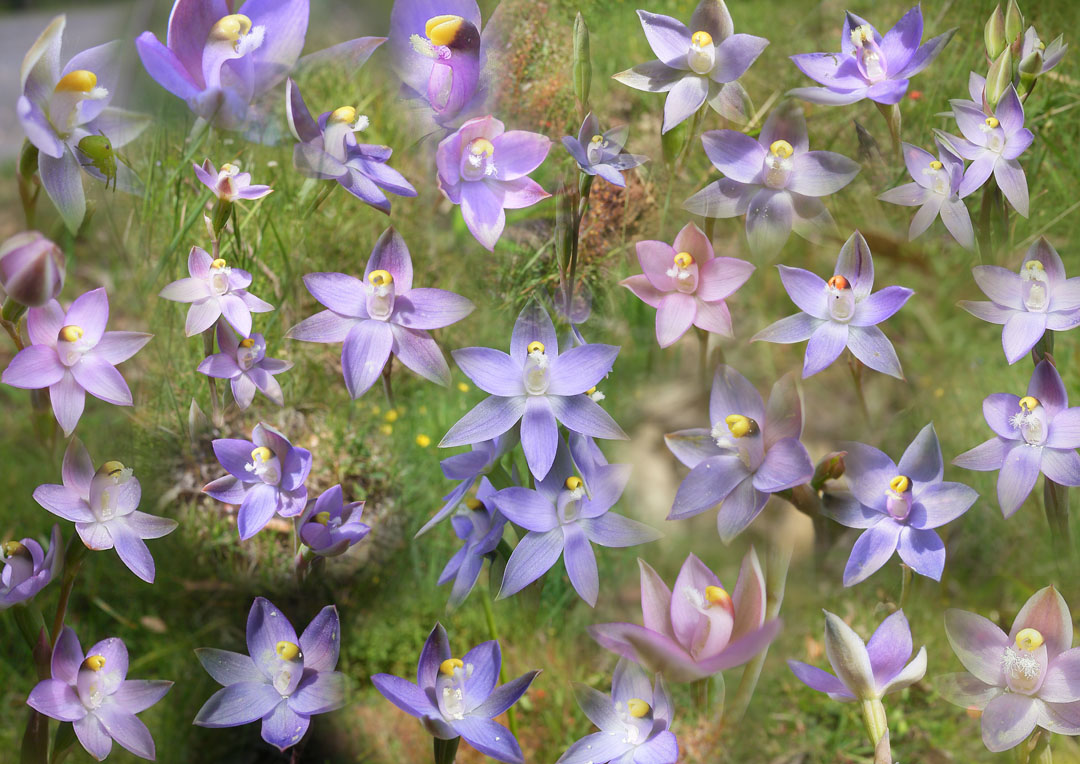
In this collage there are several species, but which is which?
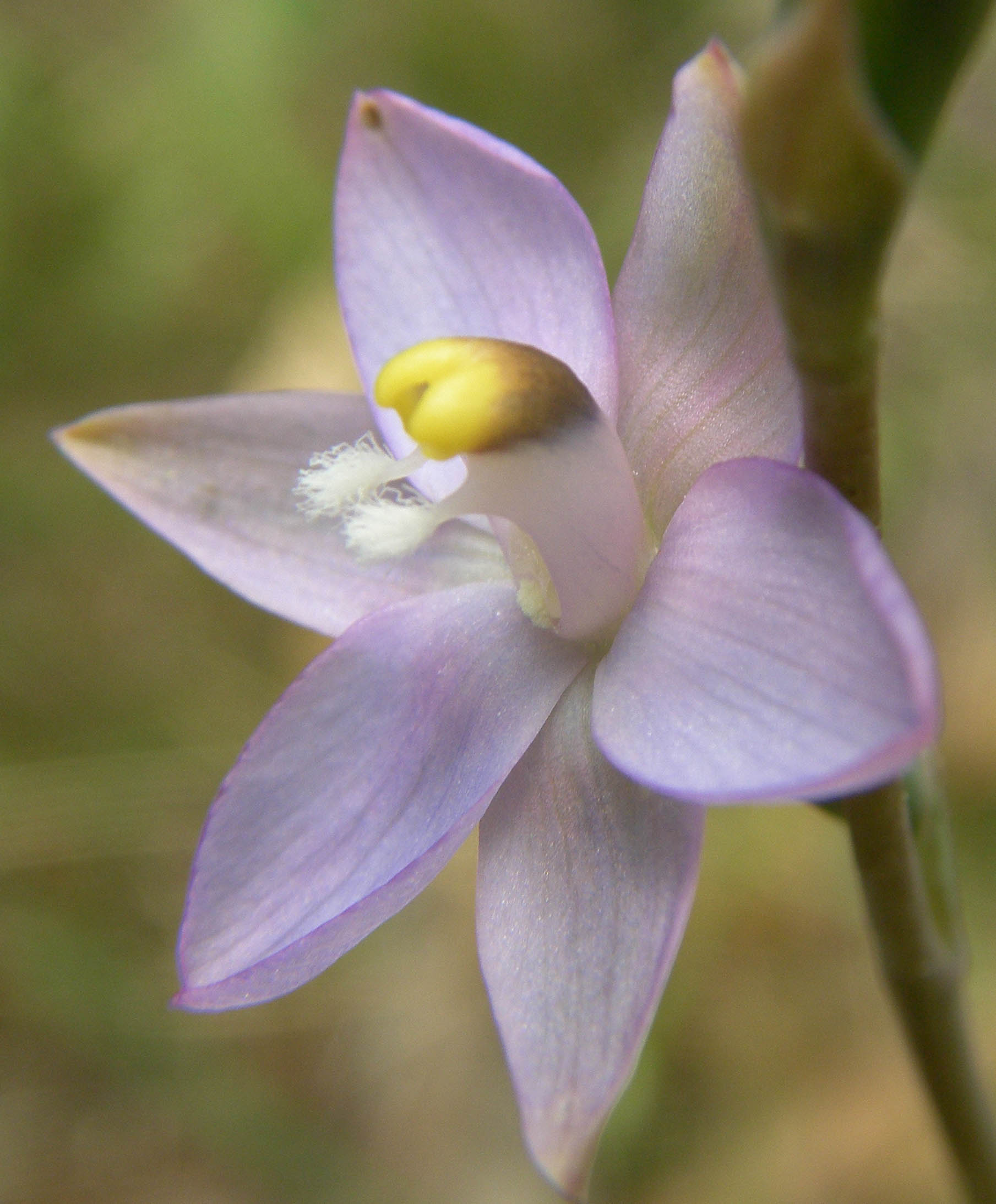
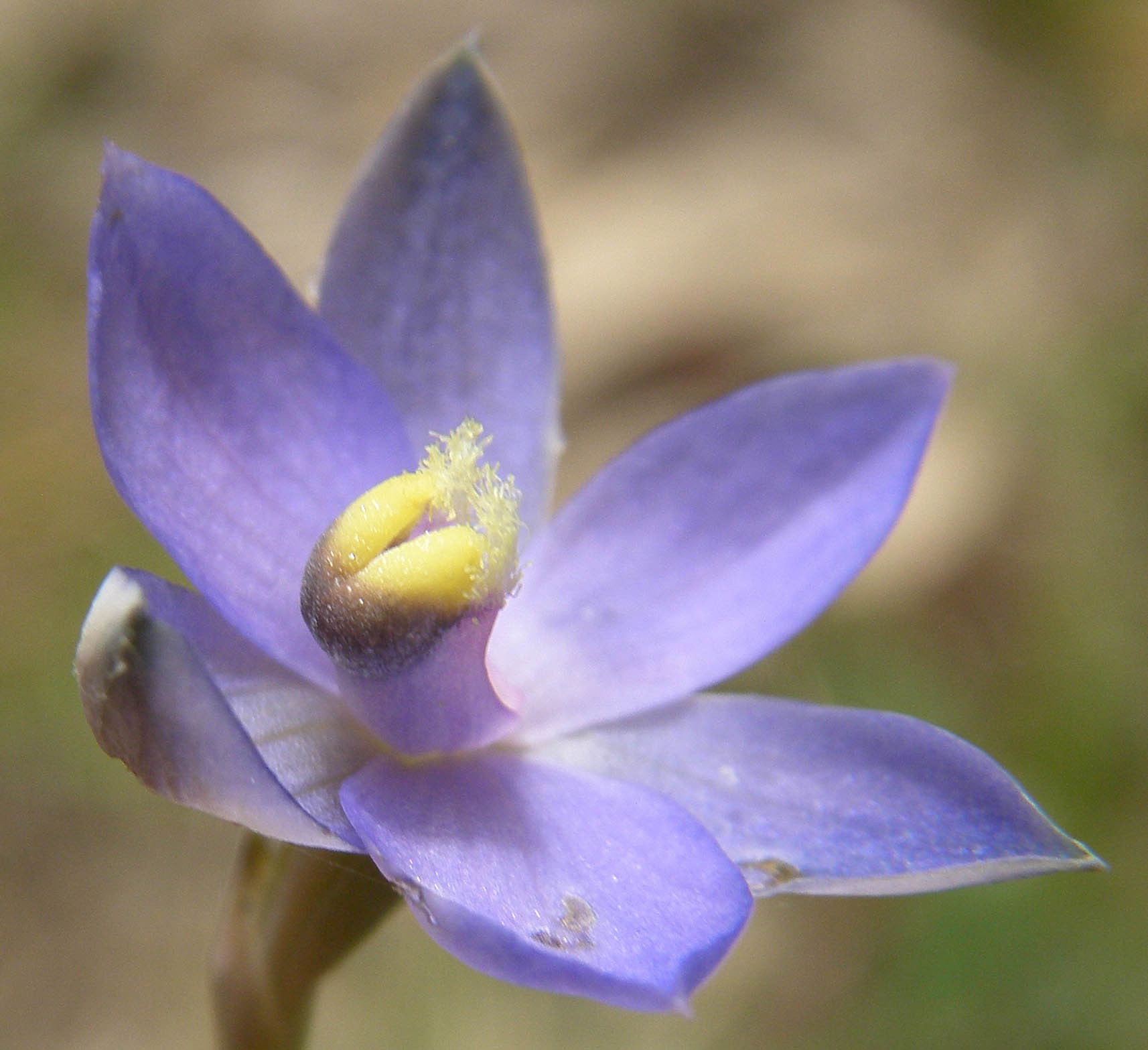
For sun orchids the most important distinguishing feature will often be the column, details of which are described or illustrated in orchid keys. For example Bates and Weber, Orchids of South Australia (1990) has an illustrated dichotomous keys showing the different types of columns.
Images from Bates & Weber, Orchids of South Australia, pages 147 to 150; courtesy of the Board of the Botanic Gardens and State Herbarium.
With today’s cameras, it is possible to photograph the column, preferably from front, side and above. This helps greatly with identification.
The following photographs illustrate the variety of columns.
Thelymitra megcalyptraThelymitra X truncata – a natural hybrid
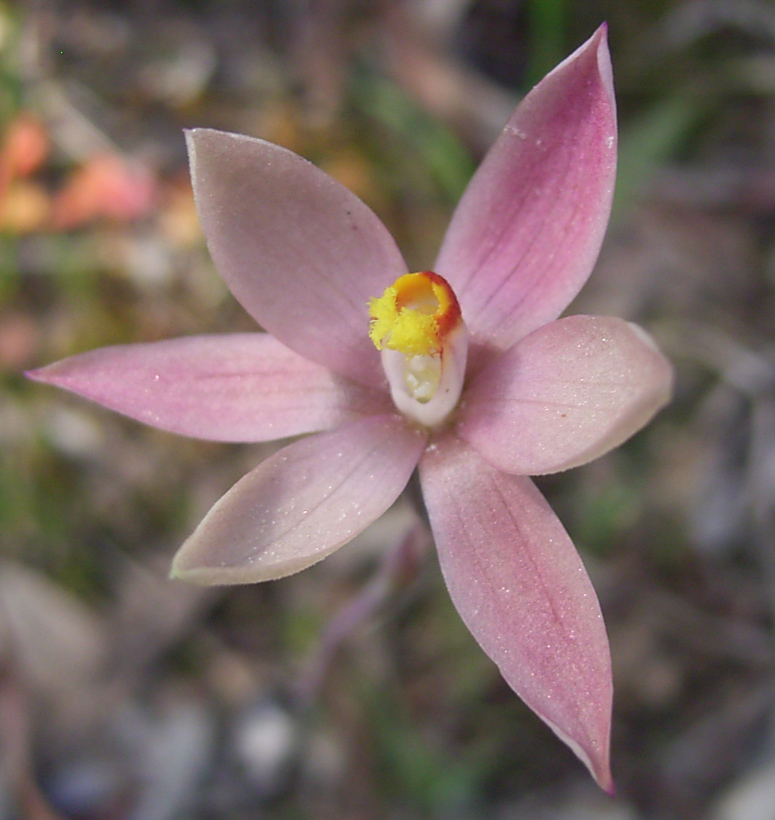
And it is not only the blue orchids that can be a problem, in South Australia; there are three pink orchids which are different in size and flowering time, features that are not obvious in a photograph, so the column is a helpful identification tool.
Thelymitra luteocilium – has tufted hairy column armsThelymitra rubra – has finger-like column arms and no tuftThelymitra carnea – has smooth column arms
And just what is the column? It is the reproductive organ of the orchid flower and is unique amongst plants because it is the fusion of the male (stamens) and female (pistil) parts. It is usually found in the centre of the flower and both releases and receives the pollen sac.
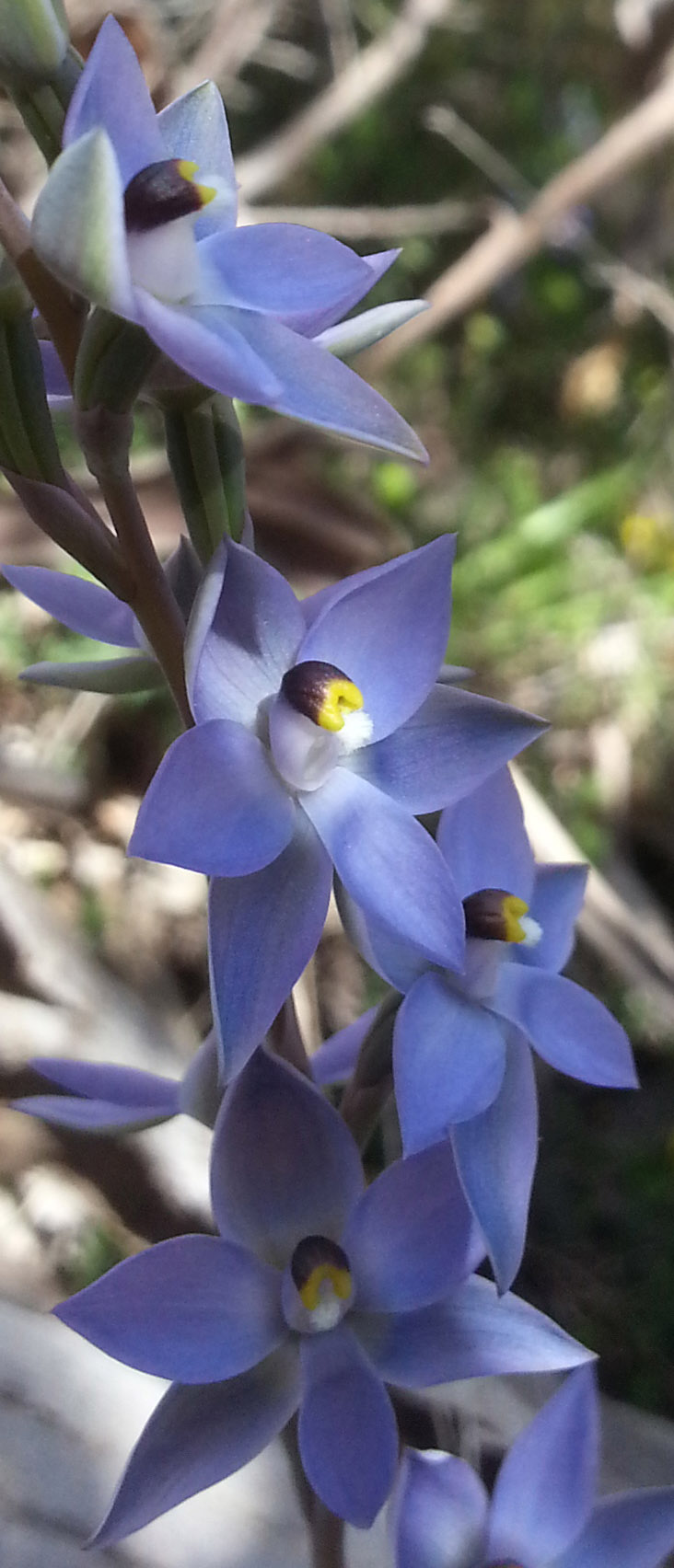
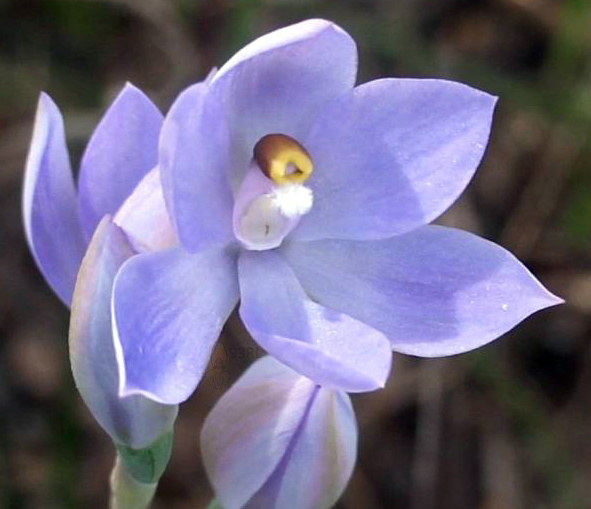
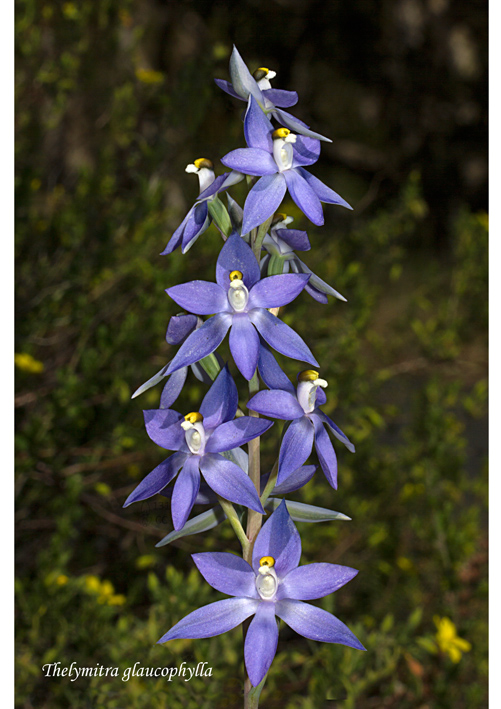
The number of photographs may have been few but the quality was present. The clear winner was Claire Chesson’s Thelymitra glaucophylla (Glaucous Leaf Sun Orchid). Flowering from October to December, this endemic grassy woodland species of the ranges was only published in 2013 by Jeff Jeanes in the Mulleria 31:3 – 30 (2013) but it had been recognized much earlier by Bob Bates and has appeared with this name in his electronic Orchids of South Australia since 2005. It belongs to the T. nuda complex, of which there are 15 species, six of them having only been published in 2013. This complex is characterised by having large scented blue multiple flowers that open freely.
Not seen in this picture is the leaf and though the leaf is highly variable – 10-50cm long, 8-20mm wide, erect and short, long and flaccid, Jeanes mentions that T. glaucophylla “can be identified with a high degree of confidence from the mature leaves alone” (Page 4 Vol 31, 2013 Mulleria). The main features of the leaf are grey-green glaucous ie white bloom and is often senescent (withered) at anthesis (full flowered). Of the T. nuda complex, T. megcalyptra is the most similar but its leaf is never glaucous and has a red base, as well as an earlier flowering time and habitat of plains and rock outcrops.
For more details on the other orchids in the T. nuda group see the post titled Those Blue Orchids Again …posted 30th January 2015 with the link to Jeanes article in the Muelleria
There is a lot of information on growing orchids so much so that it can become overwhelming. As a novice, I’ve put together my observations which can be summed up in three key points.
One – Find a Mentor
The best and first thing to do is to join a local orchid club, such as the Native Orchid Society of South Australia (NOSSA), and find a mentor within the group. There are many books but nothing substitutes for that personal interaction with an experienced grower who will know both the plant and the adaptions needed for the local conditions. At the monthly meetings, NOSSA has a Grower’s forum where various aspects of growing orchids are discussed and questions answered. It is well worth attending.
Two – Have an Equipment Kit
There are some things that are essential and it is good to have a basic kit to get started. Later, more equipment can be added as one’s skill develops in growing orchids. The necessary items would include:
Secateurs
Labels – these can be proper plant labels from a garden store or wooden lollipop sticks, so long as they are waterproof.
Pen – indelible ink pen or pencil (there are pencils that can write on plastic) as it is pointless having a labelled plant with the details washed off.
it may be necessary to use both current name and synonyms on the label eg Corybas/Corysanthes
Wettable Sulphur – necessary for guarding against diseases and is available from garden centres but Tomato Dust can be a good substitute although it is half the strength.
Sterilizing equipment
Good nursery hygiene techniques are important
Dilute bleach, tri-sodium phosphate (and possibly a small blow torch for metal tools)
newspaper
a different sheet for each orchid when dividing will help prevent transference of any disease, etc (don’t forget handwashing)
For Epiphytes
Ties and Stakes
For Terrestrials
Sieve for recovering tubers
Sheoak or pine needles for putting on top of the pots to stop soil and fungi splashing up on the undersize of the leaves
Pots – do not need to be fancy but the pot size will depend upon the species
Diuris prefer deeper pots; Corysanthes prefer wider, shallower pots whilst Pterostylis doesn’t seem to mind either
Three – Work within the Plant’s Growing Condition
This will require time, research, experiment and going back to the experienced growers. Each one of us eventually needs to find what is the best setup for our individual location but some general guidelines would be:
Start with plants that are suitable for your current climatic conditions. Obviously putting a tropical Dendrobium bigibbum under the patio in temperate Adelaide is not going to be successful. For the terrestrials it is better to start with Pterostylis curta or a Microtis than a fungi dependent Arachnorchis tentaculata.
Research the plant you want to grow and then create the micro-climate necessary for the flourishing of the plant. This will entail separating the orchids, don’t put shade lovers such as Corysanthes with those requiring brighter light eg the Thelymitra genus.
The winning picture was a single flower of Thelymitra epipactoides (Metallic Sun Orchid) taken by Rosalie Lawrence. This picture was cropped from a photograph taken on a mobile phone. Phones have come a long way since the days of Alexander Graham Bell!
T. epipactoides is a special orchid both in its beautiful colourings and that it is one of our rarest orchids. This endangered species has been well studied in an effort to prevent its demise with the result that there is an abundance of information about it. Recently, with the knowledge gained, Dr Nouska Reiter of the Australian Network for Plant Conservation (ANPC) and her team have managed to cultivate 3,000 plants with the plan to re-introduce them back into the bush in the Wimmera area.
Following are some interesting points from two good sources, which are the
(2)……can remain dormant as a tuber in the soil for up to nine years ……….
(But once a plant has flowered)
(2)…….Plants can produce flowers from their second year of growth onwards for up to four consecutive years, but no more. Individual plants can remain dormant for up to two years then grow to produce flowers, but if dormant for four years or more, plants generally do not reappear. …..
(2)…… Detailed monitoring suggests that mature plants only live for about 10 years before dying (Cropper 1993). ……..
(2)……..flowers open when the relative humidity is lower than 52%, air temperature is above 15 °C, and there are clear skies ………….
(2)……..Flowers remain for up to four weeks but wither a week after pollination ……
(2)……. fungus is required to initiate successful seed germination (Calder et al. 1989) and seeds cannot survive more than two weeks without associating with the fungus ………
Plant Information
(1)…….Flower colour is highly variable, brown, copper, blue and green being the main colour groups which are determined by the proportion of red, blue and green epidermal cells, some of which are reflective giving a metallic appearance. …….
(2)….The leaf is loosely sheathing ………
(2)…Mature non-flowering plants have slightly narrower leaves to 51 cm long and not sheathing …
(1)………Flower colour is highly variable, brown, copper, blue and green being the main colour groups which are determined by the proportion of red, blue and green epidermal cells, some of which are reflective giving a metallic appearance. ………
Topography:
(2)…. is undulating plains, crests of hills, gentle slopes of low broad ridges and at the bottom of broad, shallow swales (Obst 2005). It grows in sandy soils over a clay subsoil, with these soils having a tendency to become waterlogged in winter and spring, and drying out in summer and autumn ……
(2)…..This species is a post-disturbance coloniser, utilising early successional stages after disturbance events such as human activities, fire, animal activities such as scratching of the soil, or associated vegetation disturbance. ……
(2)……..requires open sites for flowering and seedling recruitment (Calder et al. 1989). ………
Population Size
(1)……Population estimates vary from about 1050 plants in Australia (DEH 2006), to less than 3,000 plants (Coats et al 2002). More recent assessments suggest the population could be less than 1500 plants in the wild …….
(2)……In the Murray Darling Basin and South East Regions of South Australia there were ten populations of the Metallic Sun-orchid recorded in 2004 by Obst ……..
Reminder – November theme is Orchids and Insects (Spiders and other such critters are honorary insects)
When noticed, Australian orchids capture people’s imagination and many want to be able to grow them. As a result we often receive request for where to purchase them, particularly from overseas. For people overseas we are unable to help them. Recently I came across some comments from Philip Shin and he has kindly written about his experience with trying to purchase orchids from Australia. I trust that his experience will help our overseas people understand some of the issues involved.
So let’s hear what he has to say …..
It has been brought to my attention that there have been many requests from international buyers who wish to purchase Native Australian Terrestrial Orchids from Australia. To give you all a basic idea of who I am and why I’m writing this brief article, I will tell you a few things about me.
Firstly, I am an orchid hobbyist just like you all. I live in the United States of America. My love for orchids stemmed from repeated failures of growing bromeliads, (which I eventually learned how to grow), after which my parents had suggested I try growing orchids instead, as they might be easier to cultivate. I took them up on it and for the most part, when it came to many of the more commonly available orchid hybrids, they were right. After a few tries, I managed to not only grow some orchids, but I also was able to bloom them as well! From here, my appreciation for the hobby grew to include species orchids. Then I learned about terrestrial orchids and how people were attempting to cultivate them in their gardens/greenhouses, and that lead to me wanting to grow them too.
Some of the terrestrial orchids that caught my eyes were those pretty little blue flowered orchids in the genus Thelymitra. I was always told that there were “no such things as orchids that were true blue”, but seeing photos of them contradicted that notion, and thus I was intrigued. Then, I started hearing about how some people were attempting to grow them. I thought to myself, “I must have some!” And that was when reality hit hard.
You see, I eventually learned that acquiring Thelymitras through legal channels was quite an endeavour here in America. I had to acquire a permit through our APHIS/USDA (Animal and Plant Health Inspection Service/ United States Department of Agriculture) to import plants from other countries, (specifically, Australia and Europe in the case of Thelymitras and a few other Native Australian Terrestrial Orchids). Of course, there was also paying for the CITES (Convention on International Trade in Endangered Species) permit and phytosanitary certificate in order to have them make it through our US Customs. The difficult part wasn’t necessarily with the USDA permit, but rather paying for the CITES permit and phytosanitary certificate. When Australia was open for export, the fees for CITES permits and phytosanitary certificates were rather high in price, running at about $250 USD per shipment. But shortly after making two orders to be shipped out from Australia, the exportation laws had changed radically! During this time, CITES and phytosanitary paperwork now cost somewhere in the order of $1,000 USD. It was now clear that Australia was no longer in the business of exporting goods from small companies. Which then brings us to the next option, Europe…
Europe had somehow also managed to get a hold of Native Australian Terrestrial Orchids much earlier than America did, but they were still not very prevalent in the hobby.
It then bears the question, “if Native Australian Terrestrial Orchids are already on the market, why aren’t they more prevalent or more popular?” The answer to this question would be, although people have attempted to grow these orchids, they are not necessarily the easiest orchids to grow long term. Some may be easier than others, but they are still a novelty in the hobby, partially because of this. The difficulty lies in that they are plants that have a tight symbiotic relationship with fungi. I’m not sure whether or not the orchids started to develop smaller and smaller root systems because of the symbiosis, but these orchids do tend to have rather negligible amount of roots. This often makes it difficult to cultivate these orchids, because once the roots get damaged for any reason, they pretty much die. Hence, why these orchids are not more prevalent in numbers despite the demand.
In short, this article is an explanation of the difficulties of obtaining Native Australian Terrestrial Orchids. And this is also some insight on how it is trying to obtain these plants here in America. For anyone coming across this article, I appreciate the time and effort it took for you to read through an American hobbyist’s perspective on Native Australian Terrestrial Orchids. Thank you.
Philip Shin
Pots of Thelymitra nuda cultivated by Les Nesbitt in South Australia
Just as a postscript, Philip mentioned that he could grow Diuris or Donkey Orchid “but that it takes quite a bit of trial and error before you can see anything that resembles success.”
This week, a local radio station introduced a segment with the phrase “our rarest sun orchid” and that it was called Thelymitra irregularis or Spotted Pink Sun Orchid. However it certainly is not our rarest sun orchid.
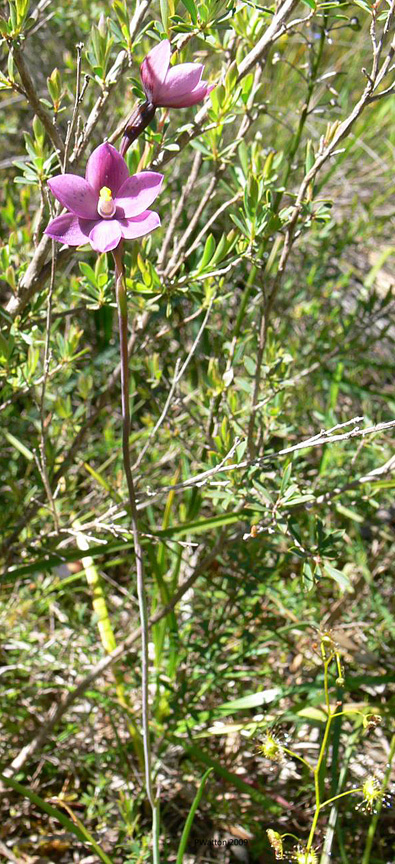
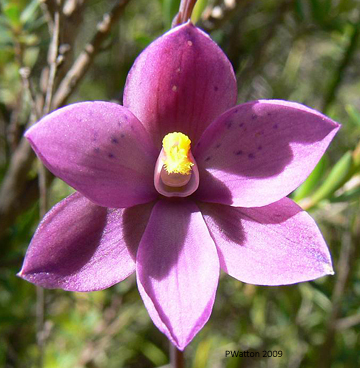
Thelymitra x irregularis, Peter Watton, 2009
True, it is not common, but that is partly because it is a hybrid and, correctly speaking, the name should be written as Thelymitra x irregularis (the “x” indicates that it is a hybrid).
For a hybrid to occur, the two parent species need to grow in close proximity, the flowers need to open at the same time that the pollinator is visiting flowers, either to collect or to deposit the pollen and, in the case of self pollinating species, before the individual flower has pollinated itself.
The majority of hybrids are sterile, but occasionally some are fertile. When hybrids occur the majority will only last a few years before disappearing although sometimes colonies are formed which may last for decades. Hence, it is not usual to name hybrids, but the more common and recurring ones have been named formally. T. x irregularis is one of them.
Several species of Thelymitra have been proposed as parent species of Thelymitra x irregularis. Jeanes & Backhouse (2006) give T. ixioides and T. carnea as parents; Weber & Entwisle (1996) and Jones (2006) suggest T. ixioides and T. carnea and/or T. rubra; Bates & Weber (1990) state that in South Australia the parents are T. ixioides and T. rubra, but T. ixioides and T. carnea in the Eastern states; in contrast, Bates (2011) states that in South Australia it is a hybrid between T. juncifolia and T. rubra. However, without detailed genetic studies or breeding experiments these all remain suggestions.
Due to the transient nature of hybrids and the conditions needed to produce them, the named hybrids are not common, but since the 1890s specimens of Thelymitra x irregularis have been collected in every decade, which suggest that this hybrid readily occurs. The 71 specimens held in the Australian herbaria have been collected from four states – which gives a good indication of the distribution but not necessarily the frequency of occurrence. See Australia’s Virtual Herbarium (AVH) for details. The AVH lists 12 herbarium records for South Australia with specimens collected from the Adelaide Hills, the Barossa Valley, Kangaroo Island and near Naracoorte.
This Thelymitra x irregularis or Pink Spotted Sun Orchid was photographed by Peter Watton in 2009 near Macclesfield, South Australia
The botanical name “irregularis” refers to the description of the column. With many sun orchids, it is often necessary to observe the column to distinguish one species from another. In this instance the top of the column is irregularly toothed. Retired Aussie has some very good photographs with one in particular showing the column detail.
Thanks to Juergan Kellermann, State Herbarium of South Australia for his help with this post.
References
Bates (2011). South Australia’s Native Orchids. DVD-ROM
Bates & Weber (1990). Orchids of South Australia.
Jeanes & Backhouse. Wild Orchids of Victoria, Australia
Jones (2006), Native Orchids of Australia, 2nd edn.
A photograph of a yellow sun orchid is July’s winning photograph and was taken by John Badger.
It is not difficult to identify a yellow sun orchid because amongst all of the Australian Thelymitras there are only two true yellow sun orchids. These are Thelymitra antennifera and the less common and very different, smaller T. flexuosa.
T. antennifera has a distinctive column with two reddish brown appendages resembling rabbit’s ears henc the connom name of Rabbit Ears Sun Orchid. Another common name Lemon Sun Orchid refers to the faint but recognisable lemon scent produced by the flower but as to why it should ever have been singled out from the other sun orchids to be called Women’s Caps1, I cannot tell.
Prior to flowering, the leaf distinguishes this sun orchid from others. Though having a red base like some of the other sun orchid, it is thin and rounded ie filiform and terete. Further, the closed buds are dark pink with lemon yellow margins of the sepals.
It should be noted that both T. carnea and T. rubra can on rare occasions produce a pale yellow variety but they will have all the features of their respective species. Also a T antennifera hybrid, T. x macmillanii, can on occasions produce yellow flowers.
References
R. Bates (2011) South Australia’s Native Orchids DVD
David L. Jones (2006) A Complete Guide to Native Orchids of Australia
The first orchids scientifically named in the Pacific were species in the genus Thelymitra J.R.Forst. & G.Forst., a taxon raised and coined by the Forsters — the irascible Johann Reinhold Forster (1729–1798), and his son Georg Forster (1754–1794), who was 18 years old when they left on Cook’s second voyage of 1772 to 1775. The Forsters collected Thelymitra longifolia in the South Island of New Zealand in 1772 and published the name of the species in 1776. The Forsters described and named nine new species in what they termed the “Class of Orches” in the South Pacific. Georg Forster graduated in medicine in Vilna (now Vilnius, Lithuania) in 1784. Species of Thelymitra, which are known as the Sun Orchids, are found mainly in the south-west of Western Australia.
It should be noted that Thelymitra are found both in the east, central and the west of southern Australia.
Pauline Meyer’s winning photograph is a whole plant picture of Western Australia’s flamboyant Queen of Sheba Orchid. It was taken at Eneabba, north of Perth and identified by a local as Thelymitra variegata but in consulting the books it would appear that it is the Northern Queen of Sheba, T. pulcherrima. There are three species known as Queen of Sheba orchids in Western Australia – T. varigata, T. pulcherrima and T. speciosa.
T. variegata was originally named in 1839 by John Lindley but under the genus Macdonaldia. In 1865 Ferdinand Mueller moved it to Thelymitra, later people began to separate it out to three different species* but it wasn’t until 2009 that Jeff Jeanes describeds T. pulcherrima and T. speciosa as distinct species from T. variegata.
All three species have a single thin spiral leaf and showy multi-coloured flowers.
T. pulcherrima and T. speciosa differ from T. variegata in the following points.
T. speciosa, begins flowering earlier, is a slightly shorter plant with fewer flowers (one, more rarely two) and although the flowers are a similar size to T. variegata they are even more colourful and the petals and sepals are distinctly different colours.
T pucherrima is similar in height to T. variegata but has smaller flowers with yellow, red, purple mauve sepals and pink purple mauve petals. It too begins flowering earlier than T. variegata.
They all have distinct separate locations as reflected in the common names – Southern Queen of Sheba (T. variegata), Eastern Queen of Sheba (T. speciosa) and Northern Queen of Sheba (T. pulcherrima). For some good images go to Retired Aussies or the Chookman
Finally there is one other species that is similar to these three and it is called Cleopatra’s Needle, T. apiculata.
Thelymitra pulcherrima
Theylmitra speciosa
Thelymitra variegata
Northern Queen of Sheba
Eastern Queen of Sheba
Southern Queen of Sheba
Distribution
North of Perth between Lancelin and Dongara
Between the Stirling Range and Condingup
Between Perth & Albany with disjunct populations near Hyden
Flowering
late June – early September
late June – September
August to September
Flower numbers
1 to 5
1 to 2
1 to 5
Flower height
150 – 350
100 – 200 mm
100 – 350 mm
Flower size
25 – – 35mm
30 – 50 mm
30 – 50 mm
Sepals
Yellow, red, purple and mauve
Yellow, red, purple and mauve
Deep pink purple blotched
Petals
Pink or purple and mauve
Pink or purple and mauve
Deep pink or purple and darker purple blotched
References:
Field Guide to the Orchids of Western Australia 2013, pages 425 & 427
I would like to thank Andrew Brown, co-author, for his help with this article.
* The name T. puchemirra is mentioned in the Western Australian Native Orchid Study and Conservation Group 2008 field trip report
In continuing this series of Professor John Pearn, links have been provided for the genera or species mentioned. In this group most of them are from limited locations in Queensland.
Orchids named after medical professionals
Sixteen doctors who practised medicine and/or botany in Australia have their names recorded in the scientific names of 24 indigenous orchids of Australia. In addition, one separate species (Thelymitra flexuosa, also known as Thelymitra smithiana) and five genera of indigenous Australian orchids record the names of European doctors, pharmacologist–pharmacists or herbalists. The five genera are Burnettia Lindl. (described by John Lindley in 1840), a monospecific genus; Cadetia Gaud. (described by Charles Gaudichaud-Beaupré in 1829); Goodyera R.Br. (described by Robert Brown in 1813); Robiquetia Gaud. (described by Charles Gaudichaud-Beaupré in 1829); and Vrydagzynea Blume (described by Carl Ludwig Blume in 1858).
The Lizard Orchid, Burnettia cuneata, blooms in eastern Australia and Tasmania; it commemorates Gilbert Thomas Burnett (1800–1835), surgeon and foundation professor of botany at King’s College London.
In the genus Cadetia(delicate white orchids), four species are named after the apothecary of the French imperial court, Charles-Louis Cadet de Gassicourt (1769–1821) — C. collinsii, C. maideniana, C. taylori and C. wariana. They commemorate his life and works as an apothecary, soldier, scholar, writer, scientist and researcher.
The genus Goodyerais named after the 17th century herbalist John Goodyer (1592–1664).
Robiquetiacommemorates Pierre Jean Robiquet (1780–1840), a French pharmacist, organic chemist, professor and foundation member of the Académie royale de Médecine (1820). He was the first to describe an amino acid (asparagine) (1806), and he characterised caffeine (1821) and discovered codeine (1832).
One species out of the 40 species of the Tonsil Orchids, Vrydagzynea grayi, grows in Australia. A rare orchid of the Daintree rainforest in north Queensland, it commemorates Theodore Daniel Vrydag Zynen (fl. 1850), a Dutch pharmacologist and contemporary of one of the most famous doctor–orchidologists, Karl Ludwig Blume (1796–1862). The Twisted Sun Orchid, Thelymitra flexuosa, commemorates the Norwich physician and friend of Joseph Banks, Sir James Edward Smith (1759–1828). When he was 25 years old, Smith took the decisive action to buy the great Linnean collection of plants, which were in danger of being lost to science following the death of Linnaeus’s son in 1783. Smith bought them when they were offered for sale in 1784. In conjunction with the bishop of Carlisle, he founded the Linnaean Society of London and was its first president. In 1798, he raised the new genus, Diuris, which is one of the first taxa of Pacific orchids to be described. The Lilly Pilly, Syzygium smithii, is another of his six botanical memorials.













 NOSSA
NOSSA 